J. L. BELL is a Massachusetts writer who specializes in (among other things) the start of the American Revolution in and around Boston. He is particularly interested in the experiences of children in 1765-75. He has published scholarly papers and popular articles for both children and adults. He was consultant for an episode of History Detectives, and contributed to a display at Minute Man National Historic Park.

Subscribe thru Follow.it


•••••••••••••••••


Showing posts with label Marblehead. Show all posts

Sunday, April 26, 2026

“John Hill be sent under a proper Guard to Boston Goal”

As recounted yesterday, on 25 Apr 1776 the Massachusetts General Court issued a resolve to catch John Hill, an Irish-born Loyalist accused of helping to loot Boston as the British evacuated.

I haven’t found any newspaper advertisements for Hill, suggesting that local authorities located him within just a few days.

The Marblehead committee of correspondence sent the man back to Watertown, and on 1 May the legislature passed a new act: 
Whereas John Hill a Prisoner now before this Court is justly suspected to have been assisting Crean Brush in Robbing the Inhabitants of the Town of Boston of their Goods & Merchandize

It is therefore
Resolved that the said John Hill be sent under a proper Guard to Boston Goal, there to be confined as a prisoner until he shall be Examined by the Seven Justices of the Peace of the County of Suffolk or the major part of them who are appointed to try associators and abetters of the Ministerial Army, which Justices are impowered to Examine the said Hill and deal with him in the same manner as if he had remained in Boston after the said Fleet & Army had gone away
Magistrates in Boston were questioning a long list of people who had stayed in town through the siege about their political loyalties.

Boston’s “goal” or jail appears on the detail from the 1769 town map above, but barely. At the bottom of that image are two large buildings: the Town House, now the Old State House (lowercase a), and the First or Old Brick Meeting-House (big A). Above the meeting-house is the label “Church Square.” And above that, mostly worn off because of a fold, is the label “Prison.” That building faced onto Queen Street, now Court Street—named for the courthouse, which was conveniently near the prison.

Hill remained in that Boston jail for several months. The United States declared independence. The British military returned to New York in force.

On 18 October, the Connecticut Gazette of New London reported:
Last Saturday [12 October], the Wife and Daughter of one John Hill, a Prisoner in Boston Goal, for being concerned with Crean Brush and others, in Robbing the Inhabitants of Boston, when that Place was evacuated; came to this Town from Providence by Water, and was endeavouring to get a Passage to the West End of Long-Island, but were stopped by the Committee of this Town, and on Examination were found upon them, sundry Papers, containing Matters of Intelligence respecting the People, and State of the Country, sent from said Hill and others in Boston, to be communicated to General [William] Howe;…
TOMORROW: Mystery women.

Monday, April 20, 2026

“Such Cost and Charge as hath arisen by their being brought before the General Court”

On 13 Apr 1776, the Massachusetts General Court decided that “Caleb Wheaton and others [well, other men], who were taken aboard the brig,” should be brought to its meeting-place in Watertown ”for Examination.”

Four days later, as quoted yesterday, the Marblehead committee of correspondence wrote to say they now thought two of Wheaton’s sons—Joseph and Caleb, Jr.—had stolen a local man’s boat about six weeks before. That apparently focused the legislators’ attention on the family.

On 19 April the Council and the House named members to a joint committee to question the Wheatons.

Four days later, those members determined that Caleb Wheaton, Sr., had been “an Associator”—a member of the Loyalist militia—inside besieged Boston. Furthermore, he had been “in other Instances unfriendly to American Liberty,” perhaps a reference to his work as a Customs officer in Maine, or his statements supporting Parliament back in early 1775.

But the two legislative houses disagreed about what to do with the Wheatons. The published record of the Massachusetts House, readable here, says simply that the Council approved the first recommendation from the committee and the assembly didn’t concur.

Peter Force’s American Archives, evidently based on more complete manuscript records from the Council, revealed more details. The committee recommended
that the said Caleb Wheaton give bond to the Treasurer of this Colony for the sum of three hundred Pounds, with sufficient surety for his future good behaviour, or be confined in some Jail within this Colony until he shall find such surety; or if the said Wheaton shall think proper, and shall procure his passage for himself and family to Nova-Scotia, he may have liberty to remove there on his own expense, provided he will give his promise in writing, not to bear arms against the United Colonies.

And that the said Caleb Wheaton, Jun., and Joseph Wheaton, upon their giving their written paroles not to bear arms against the United Colonies, nor any way to aid or assist the enemies of said Colonies, and they paying the expense of being brought before this Court, may be discharged.
After the lower house said that wasn’t good enough, two more legislators were added to the joint committee, and they went back to rethink their recommendation.

The next day the Council approved a revised proposal:
  • All three Wheatons would be responsible for a £500 bond.
  • They not only had to promise not to fight the colonies, but also “not correspond with any of the Enemies of America.”
  • They had to “pay such Cost and Charge as hath arisen by their being brought before the General Court.” 
  • If any of those conditions weren’t met, they would be “committed to close confinement.”
There was no more mention of letting the Wheaton family resume their trip to Nova Scotia.

On 25 April the House considered those strictures and agreed. (Its journal says “close Imprisonment” instead of “close confinement,” if that matters.)

The committee report on that measure, signed off by Caleb Cushing of Salisbury for the Council, Perez Morton as Council secretary, and James Warren as speaker of the house, went up for auction last year.

Caleb Wheaton came back on 4 May with a petition to the House
setting forth that he has been apprehended as inimical to his Country, that he is released by giving Bonds, and is now in low Circumstance; and praying therefore that he may be enabled to recover his Household Furniture, Provisions, &c. on board the Brig Elizabeth, at Portsmouth; whereby he may support himself and Family.
The assembly gave Wheaton “Leave to withdraw his Petition.” In other words, it said no.

The Massachusetts legislature, especially the lower house, was in no mood to do any favors to Loyalists. In fact, the Wheatons even had to pay the costs of being transported to the General Court. And it appears Caleb, Sr., later told the British government that he was locked up for three months. The Wheatons’ case reflects a popular mood in the spring of 1776 that affected other Loyalists as well.

TOMORROW: William Jackson returns to Boston.

Sunday, April 19, 2026

The Case of the Stolen Fishing Boat

Ashley Bowen was a sailrigger in Marblehead who kept a diary for many years, published in print and online by the Colonial Society of Massachusetts.

On 29 February 1776, Bowen recorded a waterfront crime:
This night some seamen took Eleazer Ingalls’s boat and went to the Nautilus.
H.M.S. Nautilus was a Royal Navy sloop, rated for sixteen guns, under the command of Cdr. John Collins. It patrolled outside Marblehead harbor, hunting for the Continental schooners and trading ships. Or, as Bowen wrote on 1 March:
The Nautilus layeth a mile below our Fort. Much ice about her. Ingalls’s boat astern.
The next day the warship sailed out of sight “and carried Ingalls’s boat with her.”

A month later, Bowen started to record details about the Loyalists captured on the Elizabeth:
5 [April:] … Admiral John Manley arrived at Beverly [other sources say Gloucester] with 13 of the King’s troops on board, prisoners whom he had taken out of a brig he took bound from Boston for Halifax and carried in to Portsmouth, laden mostly with English dry goods, one [William] Jackson merchant. . . .

9 [April:] … I find Captain Samuel Tucker hath brought the inhabitants that was taken by Manley from Cape Ann and landed them here, and they are housed at Mr. William Rogers’s house at Nick Cove. . . .

10 [April:] Sam Tucker went out and returned to Beverly as his cruise is up. Passed a ship for Boston. The 3 men are taken up that stole Eleazer Ingalls’s boat and carried her to the ship.
The authorities had cracked the case of the missing boat! On 17 April Joseph Orne reported to the Massachusetts Council on behalf of the Marblehead committee of safety:
The Committe of Correspondence upon a ReExamination of the Prisoners, (taken by Capn Manly on board the Brig Sally [sic] bound to Hallifax) have made a Discovery of Joseph Wheaton & his Brother Caleb Wheatons Stealing & Carrg away a Fishing Boat in the night of the 28th Feby last, from Eleazer Ingalls of this Town, & then made their Escape to one of the Men of Warr Station’d here—

An Acct of the Boats amount with stores &c, Will be forwarded by the Owner who also Attends to Wait your Honours Determination respecting what Steps He shall pursue in the Recovery of his Intrest Again—

We are with the Greatest Respect
In behalf of the Committee
Joshua Orne Chairm.

P S Phineas Jones one of the Prisoners & who was also concerned in the above Theft Eloped the 10th Inst—notwithstandg he was under the Care of the Guards
Before reading these sources, I pictured Caleb Wheaton, Sr., going into Boston just before the war began or shortly afterward, and his wife and family joining him there (perhaps reluctantly for some) in the spring or summer of 1775.

The way Orne wrote about this theft suggests a different scenario: Phineas Jones, Joseph Wheaton, and Caleb Wheaton, Jr., stole Ingalls’s boat in order to get to H.M.S. Nautilus and thus into Boston. If so, those Wheaton brothers were inside the besieged town for only a couple of weeks before it was time to leave.

TOMORROW: A summons to Watertown.

Sunday, April 12, 2026

“What I am to dow whith the Prisoners for I have Thirtey hear now upon Expences”

A lot of the correspondence that followed the Continental capture of the Elizabeth in April 1776 involved money.

First, there was the cost of housing the prisoners taken on that brig.

Eleven men were sent to Gloucester, including four British soldiers and Caleb Wheaton, the Customs officer from Maine. Their families came along.

Winthrop Sargent, Sr. (1727–1793), the Continental Army’s agent at that port, wrote to Gen. George Washington on 7 April:
The Bayer [bearer] of this has under his Gard a Number of Prisoners & Toreys tachen by Comodor [John] Manley & Capt. [Daniel] Warters the Prise is sent to Portsmouth I mack Know doubt you have had Acount of before this Reaches your Excellence thar nams you have below

thare is two Women & Sum Children Left hear which is not Abel to Travel Should be glad your Excellence would Send me Answor to what I Roat you Last about Capt. Watt:s Goods and what I am to dow whith the Prisoners for I have Thirtey hear now upon Expences.

I Rem[ai]n You[r] Hume Sarv.
Winthrop Sargent, Agent

P.S. Sence I rote the above Capt. [Samuel] Tucker here Carres the Prisners to Marvelhead ware thay well be sent to head Quartr will not Carrey the women & Children for fear of the Small Pox so I am fors to porvide for them hear Should be glad of your Order in Regard to the afore
Capt. Tucker on the armed schooner Franklin carried twenty-two people, including the Wheatons, to Marblehead on 9 April. That town’s committee of correspondence sent Azor Orne to ask the Massachusetts Council what to do with them.

On 13 April, the legislature “Resolved that the Soldiers belonging to the British Army, with their Wives and Children, be sent to General [Artemas] Ward.” Apparently they would be treated like other prisoners of war.

The Marblehead committee would be responsible for maintaining all the civilian women and children, tracking the expenses so the town could “endeavour to have the same discharged out of the Monies arising on the Sales of the Cargo and effects found on Board the said Vessel.”

And that was where the big money was. John Rowe heard that the Elizabeth had “Twenty five Thousand pound Sterling On board—in English Goods & Other Merchandise.” The Boston Gazette reported, “she is estimated to be worth about 35,000l. sterling.”

Cdre. Manley had sent the brig into Portsmouth, New Hampshire, where Continental agent Joshua Wentworth would go through the legal process of ”condemning” the ship and its contents and putting them up for auction. Manley, his captains, and his crews were no doubt anticipating a good payday.

TOMORROW: What to do with the Wheatons.

Friday, February 20, 2026

The J.A.R.’s Books of the Year

The Journal of the American Revolution has announced its 2025 Book of the Year Award.

The winner is The American Revolution and the Fate of the World by Richard Bell (no relation, for the record).

The citation says:
The American Revolution undoubtedly changed world history. Many nations seeking their own independence tried to emulate the ideals of the Declaration of Independence, a document whose words still influence national and world events. What many people do not realize was that, at the time, the Revolution directly affected places all over the world. It was truly a global happening, reaching not only Europe, but also Latin America, India, China, and even Australia.
This is a book of synthesis, bringing together recent scholarship by many people to provide a global look at.

One of the runners-up took the opposite approach, looking at one community within one Massachusetts port: Enemies to Their Country: The Marblehead Addressers and Consensus in the American Revolution by Nicholas W. Gentile.
Gentile demonstrates how, even before a single shot was fired, the Revolution lived in the minds of this town’s residents as they harshly reacted to thirty-three signers of a letter of support to the departing governor Thomas Hutchinson. What follows is an interesting look at dynamics in this town—heavily influenced by Puritan theology—and the ways in which residents exerted social pressure to essentially coerce the signers back to the Patriot cause, placing ultimate importance on maintaining unity. Signers (“Addressers,” as they were called) ended up recanting through written and published statements, showcasing the growing importance of print culture during this period and the role that it played in creating a uniform identity going into the conflict. Gentile traces the fate of each of the thirty-three as they recanted and either rejoined the Patriot cause or, in the case of several, led lives in exile.
The other runner-up, The Course of Human Events by Steven Sarson, is a study of the intellectual roots and immediate impetuses behind the Declararion of Independence.

Sunday, December 21, 2025

The Burdicks after the Boston Massacre

In the year after the Boston Massacre, Benjamin Burdick became the proprietor of the Freemason’s Arms tavern—better known as the Green Dragon Tavern, owned by the St. Andrew’s lodge.

I imagine his wife Jane did a lot of the hosting since Benjamin remained Constable of the Town House Watch through 1774.

As the London government cracked down and war approached, the Burdicks moved out to Marblehead. Benjamin opened a “large, genteel, and commodious” inn opposite Jeremiah Lee’s mansion. Soon he was watching over auctions of captured goods and vessels. Later the inn hosted auctions of estates confiscated from absent Loyalists.

By 1786 Burdick had relocated to Danvers, at the Sign of the Flag, but that property was sold the next year. Jane was back in Boston when she died in 1791. I haven’t found a record of Benjamin’s death. (It doesn’t help that genealogists have intertwined him with a man of the same name from Westerly, Rhode Island.)

In 1778, the Boston merchant Samuel Phillips funded the opening of a new academy in Andover with Eliphalet Pearson as preceptor. The inaugural class of that school included Malcolm McNeil Burdick, born in Boston 1764—the Burdicks’ oldest son. (His first and middle name appeared with different spellings.) Malcolm was in his teens but for some reason listed as age ten in school records.

Later Malcolm M. Burdick went to sea, appearing in advertisements as master of the Minerva sailing from Baltimore to Liverpool in 1801 and of the John out of New York in 1807. By 1812 he had settled in Windham, Maine, where he advertised that someone else’s livestock had gotten onto his land.

Another of Benjamin and Jane Burdick’s sons, William, born in 1774, went into printing. In July 1795 he and Benjamin Sweetser cofounded a newspaper in Boston called the Courier. Soon that became The Courier, Boston Evening Gazette and Universal Advertiser. Burdick signed over his portion of the business to Sweetser in December, and it ceased publishing in March 1796 after a fire.

[ADDENDUM: From 1798 to 1800 William Burdick was the junior partner in publishing the Oriental Trumpet newspaper in Portland, Maine. He then returned to Boston.]

In 1809 William Burdick married Lucretia Sprague (1788–1849), daughter of Continental artillery veteran Samuel Sprague (1753–1844). According to her brother, the banker and poet Charles Sprague (1791–1895), their father was also part of the Boston Tea Party.

William Burdick reused the Boston Evening Gazette name for a new periodical in 1813. His printing office at Congress and State Streets was next to the Exchange Coffee House, and he bought stock in that jittery enterprise. The printer’s older brother Malcolm sold subscriptions up in Maine.

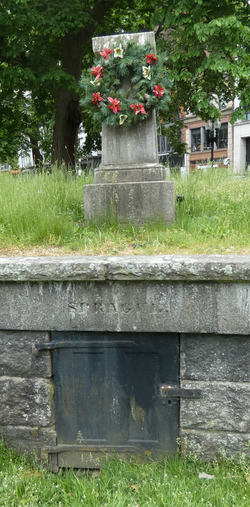
That Boston Evening Gazette evolved into the the Boston Intelligencer in August 1816. Burdick sold the business the following January and died on 30 May 1817, under Dr. John Collins Warren’s care. He was intestate but solvent, so his widow Lucretia could settle the estate and live for three more decades. She was interred in the Sprague family tomb in Boston’s Central Burying-Ground, shown above.

Wednesday, October 29, 2025

“Fully compensate for all the Insults and Indignities”?

Enemies to Their Country: The Marblehead Addressers and Consensus in the American Revolution is Nicholas W. Gentile’s first book, just published by the University of Massachusetts Press.

Timothy Symington’s review for the Journal of the American Revolution says:
Marblehead was an important fishing community, with an aristocracy created by the cod fishing industry. . . . the town’s harmony was threatened by the signatures of thirty-three residents to a letter published in the Essex Gazette in May 1774. The letter was a “send-off” to departing governor Thomas Hutchinson. . . . The thirty-three residents who added their names to the letter were hoping that Hutchinson would return to London and try to use his influence to calm the situation.

The letter thanked Hutchinson for his involvement on behalf of the fishing industry, and then ended on a conciliatory note: “‘We heartily wish you, Sir, a safe and prosperous Passage to Great-Britain, and when you arrive there may you find such a Reception, as shall fully compensate for all the Insults and Indignities which have been offered you.’”

The idea of apologizing to a man like Hutchinson was anathema to many who subscribed to the Patriot cause (which, at this point, meant a return to no taxation and stopping the abridgement of British liberties). Most of the Marblehead residents considered themselves Whigs and were incensed at the letter. Gentile describes the importance of everyone in the community at that time in history being on the same page. Giving up one’s individual needs for the common good helped to create social harmony. . . .

Most Addressers ended up offering recantations, and some then took active roles in fighting on the Patriot side after war broke out. Some Addressers were truly contrite and regretted signing the letter, claiming that they did not truly understand Hutchinson’s character. Other Addressers took a longer time to recant, which some did more than once since their first attempts were not accepted by the community. All Addressers did recant at some point, but some of them could not reconcile their politics for the good of the community.
The Marblehead Addresser I’ve written about most was John Pedrick, who after another century was turned into a Patriot hero through the stories of his daughter and granddaughter.

Gentile will speak about his book at the Marblehead Museum on Thursday, 6 November, at 7 P.M. For tickets to attend that event in person, go to this page. To watch online, go here. Tickets are $15, or $10 for museum members.

Monday, October 27, 2025

“Great Trade to Bilbao” Symposium in Salem, 8 Nov.

On Saturday, 8 November, Salem State University will host a symposium titled “’To Drive a Great Trade to Bilbao’: Rediscovering New England’s Iberian Ties, 1640s–c.1830.”

This scholarly event coincides with the Marblehead Museum’s ongoing exhibition “Bilbao Bound,” created with the Itsasmuseum Bilbao (Bilbao Maritime Museum).

The symposium brings together an international group of historians and curators to examine a largely forgotten aspect of early New England history: the trading connections between Boston’s North Shore and the Spanish Basque port of Bilbao. Those commercial ties played a part in securing Spanish Crown support for the American Revolution.

10 to 11:30 A.M.
“Bilbao Bound” exhibit tour
Donald C. Carleton, Jr., guest curator
Marblehead Museum

All the symposium presentations will take place in the Petrowski Room of Marsh Hall at Salem State University.

1:30 to 1:45 P.M.
Greetings and Welcome
Brad Austin, Chairman, History Department, Salem State University
Rafael Orbegozo Guzmán, Advisor to the Chairman, Iberdrola

1:45 to 2:05 P.M.
“James G. Lydon and the Rediscovery of New England’s Iberian Trade(s)”
Donald C. Carleton, Jr., exhibit curator

2:15 to 3:45 P.M.
New England and Iberia: Peoples, Ports, Perspectives
  • “Dowries of Cod and Prayers against Shipwreck: Women and Their Atlantic World in the Early Modern Basque Country” by Amanda L. Scott, Associate Professor of History and Women’s, Gender, and Sexuality Studies, The Pennsylvania State University
  • “El papel de cádiz en las primeras redes comerciales atlántico-mediterráneas de nueva inglaterra (1770–1820)” [“The Role of Cádiz in the early Atlantic-Mediterranean Commercial Networks of New England (1770–1820)”] by Guadalupe Carrasco-Gonzalez, Profesora Titular, Universidad de Cádiz via Zoom
  • “Fish for Faience: Archaeological Evidence of Early New England’s Trade with Portugal” by Emerson Baker, Professor of History, Salem State University
Moderator: Donald C. Carleton, Jr.

4:00 to 5:15 P.M.
Yankees, Cod, Spain, and Revolution
  • “Spain and the American Revolution: The View from Madrid” by Larrie D. Ferreiro, George Mason University
  • “Fish to Firearms: How Lee, Gerry, and Gardoqui Helped Arm a Revolution” by José Manuel Guerrero Acosta, Project Director and Curator, Spain and the Support for the American Revolution, a Project by Iberdrola
Moderator: Dane Morrison, Professor Emeritus of Early American History, Salem State University

5:15 to 5:30 P.M.
Concluding Remarks
Brad Austin

The symposium is free, but attendees must register in advance. For in-person seats, sign up here. To watch the presentations online, use this link.

Wednesday, May 07, 2025

“It was not disturbed, nor was any of their property taken”

I’ve now quoted two nineteenth-century accounts from descendants of Elbridge Gerry, Azor Orne, and Jeremiah Lee (shown here) saying that British soldiers searched the tavern in Menotomy where they were staying on the night of 18–19 Apr 1775.

The three men, all delegates from Marblehead to the Massachusetts Provincial Congress, fled out the back of the tavern and hid outside in the cold.

Less than a month later, Lee died of an illness, which his family attributed to the stress of that night. That obviously made the men’s choices in the early hours of 19 April carry more weight.

There are, however, big problems with the story that part of the British army column searched Ethan Wetherby’s Black Horse tavern that night.

First, Gen. Thomas Gage’s orders for the march said nothing about looking for committee of safety members along the way. His intelligence files have no information on the whereabouts of those committee men. Rather, the general wanted his troops to get to Concord as quickly as possible.

Furthermore, none of the British army officers who wrote reports on that march described searching a tavern in west Cambridge, or anywhere else on their way out.

Finally, no contemporaneous accounts from the provincial side—neither depositions, letters, nor newspaper articles—complained about this search, either. And people made a lot of complaints in the wake of the Battle of Lexington and Concord.

There might be a seed of truth at the start of the story. Both versions say a small number of soldiers approached the tavern after the vanguard passed by. It’s conceivable that some redcoats turned aside to use the tavern’s well or outhouse before catching up with the column. But the lore goes much further than that, saying soldiers spent “more than an hour” searching every room in the building, “even the beds.”

The lore offers no corroborating evidence for that detail, such as the landlord’s testimony. In fact, the nineteenth-century versions specify that the committee men couldn’t point to anything missing as a sign that the soldiers had visited their room:
  • “a valuable watch of Mr. Gerry’s, which was under his pillow, was not disturbed.”
  • “Mr. Gerry’s watch was under his pillow, but it was not disturbed, nor was any of their property taken.”
Ordinarily if everything in a room looks the same as before, we treat that as a sign it wasn’t searched.

By 1916, Thomas Amory Lee might have spotted that weakness in the traditional tale because his article “Colonel Jeremiah Lee: Patriot” for the Essex Institute Historical Collections stated: “Gerry’s silver watch and French great coat disappeared.” That’s a direct contradiction of earlier Gerry family lore, and even that new version said Orne’s watch went untouched.

Given the totality of evidence, I think the Marblehead delegates were more worried about arrest than Gerry’s exchange of notes with John Hancock let on. Seeing hundreds of British soldiers outside their inn, perhaps seeing some of those soldiers coming closer to the building, they bolted for an exit.

There are reports Gerry and perhaps Lee sustained injuries in their flight. Then they stayed outside in the cold until it felt safe to return. Waiting for the whole army column to pass by and go out of sight may have felt like an hour, but it probably took less time than that.

Finally the three men came back inside, grateful to have escaped arrest. Then came news of the shooting at Lexington, the redcoat reinforcement column, the outbreak of war. The delegates fled the tavern again, this time with their possessions. Lee fell ill soon after, and died on 10 May.

Looking back on the episode decades later, Gerry and Orne—and perhaps even more so their and Lee’s descendants—would have resisted the thought that those sacrifices weren’t really necessary. That the three Marblehead men could have stayed in their warm bedroom, watched the glittering troops march by, and never faced arrest. That Lee might have lived longer.

So they convinced themselves that running outside had been necessary. Not just prudent but necessary. Which meant believing that soldiers came into the tavern and searched the bedrooms, leaving no sign of their presence.

Tuesday, March 18, 2025

William Browne, John Glover, and a Farmhouse in Swampscott

Save the Glover is a campaign by several historic organizations in Swampscott and neighboring towns to preserve an eighteenth-century farmhouse.

The house was originally built in the third quarter of the 1700s by William Browne (1737–1802), a wealthy and respected lawyer. It was his country estate since he already owned a mansion in Salem, as well as part of a family seat in what’s now Danvers.

Browne was elected to the Massachusetts General Court in 1762. Though he joined the Customs service in 1762 as collector for the port of Salem, he favored local merchants enough to keep getting reelected—until he voted to rescind the Circular Letter of 1768.

After that, Browne was firmly on the side of the royal government. Gov. Thomas Hutchinson rewarded him with appointments: as colonel of the Essex County militia, as judge in the county court, and eventually as the last royal appointment to the Massachusetts superior court in 1774. That same year, the London government named him to the mandamus Council.

Refusing to resign from the Council made Browne unpopular locally. Dozens of militia officers refused to serve under him. He moved to Boston late in 1774, to Britain in 1776, and to Bermuda as royal governor in 1781. The state of Massachusetts confiscated Browne’s real estate, including that country house and land.

Gen. John Glover (1732–1797) of the Continental Army bought the property and moved in with his second wife in 1782. He lived there for the rest of his life, welcoming fellow veterans and serving in local offices.

In 1793 the Rev. William Bentley recorded how “the general received us with Great Hospitality” when a committee came through to settle the boundaries of Marblehead, Salem, and Lynn. Glover evidently felt he still lived in Marblehead, but surveyors determined that his house stood in a narrow splinter of Salem which later became part of Swampscott.

The property remained a farm through the nineteenth century. The photo above shows how it looked about 1910. In the twentieth century, the original house became the core of a larger inn and then restaurant, both named, in fine Colonial Revival fashion, for Gen. Glover. For the last thirty years or so, however, that complex has been abandoned.

Originally the Save the Glover campaign sought to preserve the house from being taken down for a new residential development (to be called Glover Residences, naturally). However, the developer has scrapped that project. Now weather and decay are the biggest dangers to the Glover house.

Thursday, February 13, 2025

“Leslie’s Retreat” Commemorations in Salem and Marblehead

Essex County is gearing up to commemorate the Sestercentennial of “Leslie’s Retreat,” the frustrated British army expedition on 26 Feb 1775 to seize cannon that Patriot rebels were collecting in north Salem.

Redcoat troops landed in Marblehead and marched through town to Salem. The militia companies of other nearby towns mobilized in response. That confrontation could have led to serious violence in the midst of Massachusetts’s second-largest settlement, but fortunately it was resolved peacefully.

Here are all the commemorations that I’ve learned about through Salem 400, the Marblehead Museum, and partner organizations.

Saturday, 15 February, 10 A.M.
Leslie’s Retreat: Salem on the Brink of Revolution
Salem Armory Visitor Center, 2 New Liberty Street, Salem

The National Park Service opens its exhibit on why Crown soldiers under Lt. Col. Alexander Leslie came to Salem on February 26, 1775, who were the major players in the event, and how this event has been remembered and celebrated in Salem in the last 250 years. This free exhibit wlll be on display through 27 April.

Saturday, 15 February, 11:30 A.M.
250th Anniversary of Leslie’s Retreat Forum and Discussion
Pickering House, 18 Broad Street, Salem

Local historians David Moffatt, Benjamin Shallop, Jeff Swartz, and Vijay Joyce discuss the British army expedition and the local reaction. $25 admission, $20 for Pickering House members. (Currently listed as sold out.)

Sunday, 16 February, noon to 3 P.M.

Tours of the Pickering House
18 Broad Street, Salem

The caretaker of the oldest house in Salem will introduce eleven generations of Salem history, including the Patriot activist Timothy Pickering, later a Continental Army general and U.S. Secretary of War and Secretary of State. The tour will cover the oldest parts of the house and end with tea and coffee. Order tickets here.

Friday, 21 February, 6:30 P.M.
Leslie’s Retreat exhibit opening reception and lecture
Salem Armory Visitor Center, 2 New Liberty Street, Salem

Emily Murphy, Ph.D., curator of this exhibit and for the Salem Maritime National Historic Site and Saugus Iron Works National Historic Site, will speak about the history and its interpretation at this free event.

Saturday, 22 February
Commemorative March and Tours
Salem
  • 9:30 A.M.: Presentation at St. Peter’s San Pedro’s Episcopal Church, 24 St. Peter’s Street, Salem.
  • 11 A.M.: Redcoat March to North Bridge. The public will view the reenactors from the site of the bridge. Spectaors should plan to be at the North Bridge at 11 A.M. sharp.
  • Noon to 4 P.M.: Self-guided tours of St. Peter’s San Pedro Episcopal Church.
  • 12:30 P.M. and 2:30 P.M.: Salem-Marblehead Trolley Tour lead by local architectural historian Judy Anderson. Reservations encouraged. The trolley starts boarding fifteen minutes before the tour, and everyone with a reservation must be aboard by 12:20 or 2:20. Then the remaining seats will be made available on a first-come first-served basis.
  • 2:30 P.M.: Fashion in the Season of Revolution: A Panel Discussion & Revolutionary Reenactor Promenade, Peabody Essex Museum, 161 Essex Street, Salem, free with museum admission.
  • 7:30 P.M.: Revolution Ball, Hamilton Hall, 9 Chestnut Street, Salem. An evening of live music, dancing, food, and drinks, with attendees in colonial dress or black-tie fashion. General admission $150.

Sunday, 23 February
Indoor Commemorations
Salem
  • 10:30 A.M.: “A Revolutionary Reckoning,” a joint religious service led by First Church in Salem, Unitarian Universalist, and Tabernacle Congregational Church. All ages and denominations welcome. Attendees can stay for a special Fellowship Hour of coffee, tea, and refreshments.
  • Noon to 3 P.M.: Tours of the Pickering House, 18 Broad Street, Salem (see above).
  • 12:30 to 1:30 P.M.: Norumbega Harmony concert, First Church, 316 Essex Street, Salem. Norumbega Harmony is a choral ensemble founded in 1976 and dedicated to the preservation, promotion, and performance of New England psalm singing from the colonial and early American periods.
  • 3 to 5 P.M.: “In Open Rebellion,” Old Town Hall, 32 Derby Square, Salem. World premiere of a drama written by Kristina Wacome Stevick, directed by Samantha Searles, and produced by History Alive. In the fall of 1774, Salem’s Patriots, Loyalists, and enslaved Africans debate the meanings of liberty and loyalty. Free, but attendees must reserve tickets.

Thursday, 27 February, 7 P.M.

When Redcoats Marched in Marblehead
Marblehead Museum, 170 Washington Street, Marblehead, and online

I’ll speak about both the history and the mythology of “Leslie’s Retreat,” drawing on eyewitness accounts and primary sources to illuminate a day the Revolutionary War might have begun, but didn’t. This talk will put the event in the context of the maneuvering between Gov. Thomas Gage and the Massachusetts Provincial Congress, and cut away some of the myths that have stuck to it. $15 admission, $10 for museum members.

Saturday, February 01, 2025

Join Us for “The Outbreak of War,” 3–6 Apr.

Last spring I worked with the Pursuit of History, the nonprofit founded by Lee Wright to organize History Camp, to produce a weekend of talks and tours about the New England rebellion of 1774.

This spring we’re offering a new program. On 3–6 April, we’ll gather in Concord and visit nearby towns to explore “The Outbreak of War.”

Once again, there are a limited number of seats available for this event, and I understand most have already been reserved. People are coming from as far away as California, Texas, Arizona, and New Mexico.

The event will start with dinner on Thursday, 3 April, at the eighteenth-century Wayside Inn in Sudbury. Over dessert I’ll review what led up to April 1775 and look ahead to the next three days.

On Friday, 4 April, we’ll meet inside the Wright Tavern in the center of Concord. Massachusetts Provincial Congress delegates met in committee in this building in the spring of 1775, and on April 19 the British commanders used it as their headquarters. We’ll hear presentations from these experts:
  • Jayne Triber, Ph.D., author of A True Republican: The Life of Paul Revere.
  • Don N. Hagist, author of Noble Volunteers: The British Soldiers Who Fought the American Revolution and editor of The Journal of the American Revolution.
  • Alexander Cain, author of We Stood Our Ground: Lexington in the First Year of the American Revolution.
  • Joel Bohy, expert in historic arms who appears regularly on Antiques Roadshow, sharing findings from recent battlefield archeology.
On that day we’ll also visit Concord’s Old Hill Burying Ground and North Bridge.

That evening, we’ll have dinner at the Colonial Inn, which dates to 1716. I’ll speak afterwards about how the royal government and the Massachusetts Patriots competed to control information before and after the battle.

On Saturday, 5 April, we’ll visit Lexington Common, viewing the historic buildings and monuments nearby and watching the rehearsal for the 250th-anniversary reenactment of the first shots of the Revolutionary War. (We have a contingency plan if bad weather postpones that rehearsal.) We’ll also stop at the Hartwell Tavern site, the Parker’s Revenge site, and the Jason Russell House in Arlington.

On Sunday, 6 April, attendees can sign up for an optional tour of colonial Marblehead architecture with Judy Anderson for an additional cost.

Some meals are included, and some will be up to the attendees. Lodging isn’t included in the cost, but there are rooms available for reserving at the Colonial Inn and other hotel possibilities nearby.

The Pursuit of History has a webpage with lots more details about the event. That page also includes a couple of videos of me out in Concord on a winter day, looking ahead to spring.

Tuesday, July 30, 2024

“Not a topsail vessel to be seen”

Dissecting the multiple texts of the Solemn League and Covenant boycott and following the Rev. Ebenezer Parkman’s uncomfortable wriggling around that issue in Westboro pulled me past the debate over that document in Boston.

So I’m going back to mid-June 1774. Many of Boston’s merchants thought the top priority should be finding a way to lift the Port Bill, even if that meant (as George Erving and John Amory proposed) raising money privately to pay the cost of the tea destroyed in December.

The town’s political leaders, on the other hand, felt that standing up to Parliament’s oppressive laws was more important than regaining some expedient advantages in business.

The merchant John Andrews, who normally supported the Whigs (albeit at an ironic distance), joined their opponents on this issue. He saw the town’s economic situation as dire, as he wrote in a 12 June letter to a relative in Philadelphia:
Our wharfs are intirely deserted; not a topsail vessel to be seen either there or in the harbour, save the ships of war and transport, the latter of which land their passengers in this town tomorrow.

Four regiments are already arriv’d, and four more are expected. How they are to be disposed of, can’t say. Its gave out, that if ye. General Court don’t provide barracks for ’em, they are to be quarter’d on ye. inhabitants in ye. fall: if so, am determin’d not to stay in it.
Only five days after Andrews wrote, Gen. Thomas Gage dissolved the Massachusetts General Court, as recounted here. That legislature never had a chance to provide quarters for the troops in Boston—or to refuse to.

Nonetheless, those soldiers were never housed in private homes, nor did Gage invoke the revised Quartering Act to put them into “uninhabited buildings” and taverns. Instead, the royal government built barracks and rented buildings from willing landlords, including warehouses empty because of the lack of trade.

Andrews still thought royal officials were being too strict:
The executors of the [Boston Port] Act seem to strain points beyond what was ever intended, for they make all ye. vessels, both with grain and wood, entirely unload at Marblehead before they’ll permit ’em to come in here, which conduct, in regard to ye. article of wood has already greatly enhanced the price, and the masters say they won’t come at all, if they are to be always put to such trouble, as they are oblig’d to hire another vessel to unload into, and then to return it back again, as they have no wharves to admit of their landing it on.

Nor will they suffer any article of merchandize to be brought or carry’d over Charles river ferry, that we are oblig’d to pay for 28 miles land carriage to get our goods from Marblehead or Salem. Could fill up a number of sheets to enumerate all our difficulties.
Nonetheless, at this time Andrews saved his worst criticism for Boston’s zealous Whigs, “those who have govern’d the town for years past and were in a great measure the authors of all our evils, by their injudicious conduct.” Now those men were supposedly threatening to finish off the town’s trade with the Solemn League and Covenant.

TOMORROW: Back to town meeting.

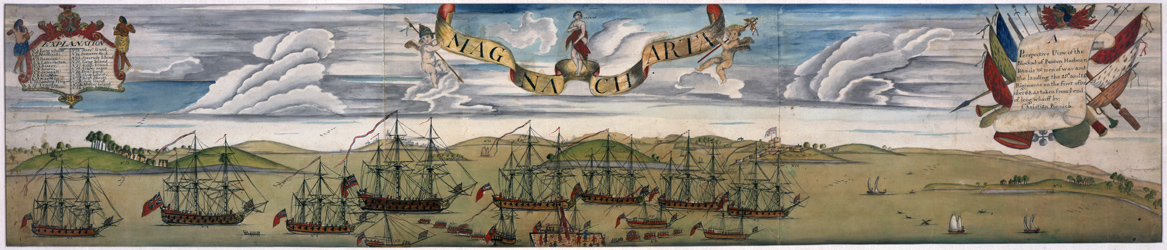
(The picture above, courtesy of the Massachusetts Historical Society, is one version of Christian Remick’s painting of the Crown fleet in Boston harbor as seen from Long Wharf in 1768.)

Saturday, July 13, 2024

“Many among us, who are for compromising matters”

John Andrews was another merchant who left a lively record of the discussions in Boston in spring 1774 as the business community grappled with the impending effects of the Boston Port Bill.

Andrews was more aligned with the Whigs than John Rowe, but still didn’t always see eye-to-eye with the radicals.

Andrews’s account appears in a series of letters to an in-law in Philadelphia, now in the collections of the Massachusetts Historical Society. On 18 May he wrote in the most dire tone:
Imagine to yourself the horror painted in the faces of a string of slaves condemn’d by the Inquisition to perpetual drudgery at the oar! Such is the dejection imprinted on every countenance we meet in this once happy, but now totally ruin’d town.
Andrews urged his correspondent to sign on to “an entire stoppage of trade, both to England and the West Indies, throughout the continent.” Any alternative would be to “acknowledge the right of parliament to d—n us whenever they please.”

Later that day Andrews added the news that “we have had advice from Salem, Newbury, etc’a., that they will haul up all their vessels, and stop every trade, provided it becomes general through the continent.”

If accurate, that news must have after the day’s town meeting session, where a committee reported merely that the selectmen of Marblehead and Salem had sounded sympathetic and promised to call meetings in their towns, too.

Note how the promise from those smaller Massachusetts ports was contingent on all the other ports in North America signing on to a boycott as well. That’s often how collective action has to be organized: promising party A that party B is ready to act if party A will, and promising party B that party A is ready to act if party B will.

Yet Andrews also reported some Boston merchants calling for a different approach:
At the same time, we have many among us, who are for compromising matters, and put forward a subscription to pay for the Tea.

George Erving has declar’d this day. that if it should be promoted, he is ready to put down two thousand pounds sterling towards it, and will take it upon himself to wait on Governor [Thomas] Gage and know what his demands upon us are—which circumstance Jno. Amory mentioned at ye. town meeting this day, which was in general rejected, though he urged the matter much.
George Erving (1738–1806) and John Amory (1728-1803, shown above) were both Loyalists during the war. Amory ultimately returned to Massachusetts, and Erving’s son became a U.S. diplomat.

Though the Boston Tea Party had cost the East India Company over £9,000, five merchants pledging the amount Erving promised would have been enough to cover that sum. But the community “rejected” that idea.

At that point in late May 1774, Boston’s committee of correspondence may well have felt they had solid popular support for promoting a general boycott to protest the Port Bill. But when the committee drafted its “Solemn League and Covenant” and sent it to other towns and provinces, its members may have overplayed their hand.

TOMORROW: Going too far?

Saturday, June 08, 2024

“Bruised and splintered by the bullets of the British soldiers”

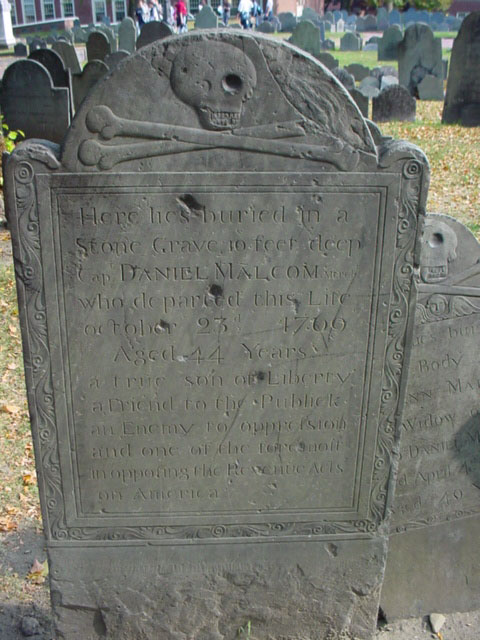
As shown yesterday, Capt. Daniel Malcom’s gravestone still stands in Copp’s Hill Burying Ground.

Indeed, it’s one of the featured attractions there, with signage pointing out how the stone is pitted, reportedly by British soldiers’ musket balls.

The uppermost round mark on the stone was produced by the carver, not by a musket. It’s the eye socket of the skull facing right. A very similar design appears on Ann Malcom’s stone nearby and on the Rev. John Barnard’s gravestone in Marblehead, both from 1770.

But there’s clearly other damage to the Daniel Malcom stone, divots in the middle of the text. I went looking for more information about those marks and was surprised by what I found.

The earliest printed mention was a note in the back of Urania: A Rhymed Lesson, a poem published by Oliver Wendell Holmes, Sr., in 1846, seventy years after the British military evacuated Boston. It quoted Malcom’s marker and added:
The gravestone from which I copied this inscription is bruised and splintered by the bullets of the British soldiers.
I’d be pleased to hear about earlier mentions. Unlike a quotation or phrase that one can search for exactly, this fact could be stated in many ways.

A couple of years after Holmes’s poem, the April 1848 issue of the New England Historical and Genealogical Register stated:
There are marks upon the stone, and tradition says that the British soldiers made use of it as a target during their occupation of Boston, at the commencement of the Revolution.
The 4 Aug 1849 Boston Statesman newspaper quoted this item from the reformist Boston Chronotype:
Mean Revenge.—During a stroll through Copp’s Hill burying ground, a few days ago, a gentleman directed our attention to the following inscription on a grave stone:— . . .

The stone exhibits marks of violence, and our informant—who is an antiquarian, versed in the genealogy of almost every family buried on Copp’s Hill—stated that Capt. Malcolm [sic] had rendered himself extremely obnoxious to the British troops, and that a short time after his death a file of soldiers was drawn up and discharged a volley of musketry at his grave stone. Our informant said that in his younger days he had heard several eye witnesses related the story. The marks of the balls are distinctly visible at the present day. We might search long to find a more despicable species of revenge than this.
That article was reprinted later that year in Scientific American.

Assuming this story was accurate, the next question is when such vandalism took place. Malcom died in 1769, when British regiments were in Boston and his defiance of royal authority was recent. Those soldiers (or officers) might have seen Malcom in action. But if people had seen redcoats shooting at his grave then, there would surely be complaints in the vigorous local press.

Vandalism would more likely have gone unreported during the siege of Boston, with no opposition newspapers in town and bigger stories to print. That would mean the soldiers (or officers supervising them) were angered by the “true Son of Liberty” phrase on the stone rather than direct knowledge of Daniel Malcom.

Yet another possibility is that the damage was produced by something other than British muskets, but saying that made for a better story. The unnamed “antiquarian” in 1849 referred to “several [unnamed] eye witnesses” to the actual shooting, however.

I’d also like to know when the plaque for Malcom, shown here, was put up inside Old North Church. It refers to him being “Safe from British Bullets.” Was that an allusion to the scars on his gravestone nearby?

COMING UP: John Malcom’s welcome to Newport.

Tuesday, April 16, 2024

“The Inhabitants of Boston are on the move”

Among the items in the London newspapers that arrived in Marblehead in the first week of April 1775 was this:
Yesterday a messenger was sent to Falmouth, with dispatches for General [Thomas] Gage at Boston, to be forwarded by a packet boat detained there for that purpose.
It didn’t take long for the Massachusetts Patriots to figure out that if this report had gone into the newspapers, and those newspapers had traveled to New England, then those dispatches could have made it to New England, too. And in that case, the royal governor might already be preparing to act on them.

Decades later, Mercy Warren wrote of the royal authorities in Massachusetts: “from their deportment, there was the highest reason to expect they would extend their researches, and endeavour to seize and secure, as they termed them, the factious leaders of rebellion.”

I can’t actually find those italicized words in the writings of royal officials, and “deportment” is a lousy basis for such a conclusion. But the Patriots may have had a more solid basis for expecting arrests, possibly from sympathetic people in Britain.

On behalf of the imperial government, the Earl of Dartmouth had written to Gage: “the first & essential step to be taken towards re-establishing Government, would be to arrest and imprison the principal actors & abettors in the Provincial Congress.” That letter didn’t arrive in Massachusetts until 14 April, but it looks like Patriots anticipated it after those Marblehead arrivals.

Most of the rest of the letter from James Warren to his wife Mercy that I’ve been discussing is about that worry—that Gage’s government would start arresting resistance leaders. On 6 April, James wrote from Concord:
The Inhabitants of Boston begin to move. The Selectmen and Committee of Correspondence are to be with us, I mean our Committee, this day. The Snow Storm yesterday and Business prevented them then. From this Conference some vigorous resolutions may grow. . . .

I am with regards to all Friends and the greatest Expressions of Love and regard to you, your very affect. Husband, JAS. WARREN

Love to my Boys. I feel disposed to add to this long letter but neither time nor place will permit it.
Then on 7 April James went back to his letter with more information and a warning:
I am up this morning to add. Mr. [Isaac] Lothrop [another Plymouth delegate] is the bearer of this and can give you an Acct. of us.

The Inhabitants of Boston are on the move. [John] H[ancock] and [Samuel] A[dams] go no more into that Garrison, the female Connections of the first [Lydia Hancock and Dorothy Quincy] come out early this morning and measures are taken relative to those of the last [Elizabeth Adams, who didn’t make it out before the siege]. The moving of the Inhabitants of Boston if effected will be one grand Move. I hope one thing will follow another till America shall appear Grand to all the world.

I begin to think of the Trunks which may be ready against I come home, we perhaps may be forced to move: if we are let us strive to submit to the dispensations of Providence with Christian resignation and phylosophick Dignity.

God has given you great abilities; you have improved them in great Acquirements. You are possessd of eminent Virtues and distinguished Piety. For all these I esteem I love you in a degree that I can't express. They are all now to be called into action for the good of Mankind, for the good of your friends, for the promotion of Virtue and Patriotism. Don’t let the fluttering of your Heart interrupt your Health or disturb your repose. Believe me I am continually Anxious about you. Ride when the weather is good and don’t work or read too much at other times. I must bid you adieu. God Almighty bless you. No letter yet. What can it mean? Is she not well? She can't forget me or have any Objections to writing.
James Warren appears to have gone home to Plymouth a few days later and then immediately gone on to Rhode Island to try to convince that elected government to help prepare a New England army. He was in that colony when word came of shooting at Lexington.

Saturday, April 13, 2024

James Warren: “News we have”

On 6 Apr 1775, James Warren was in Concord, representing Plymouth in the Massachusetts Provincial Congress.

He started writing home to his wife, Mercy, that day. That letter contains a passage I’ve quoted many times in my Road to Concord talks, but there’s a lot more going on, too.

So over the next few days I’ll analyze of Warren’s whole letter.
My Dear Mercy,—

Four days ago I had full Confidence that I should have had the pleasure of being with you this day, we were then near closeing the Session. Last Saturday we came near to an Adjournment, were almost equally divided on that question, the principle argument that seemd to preponderate, and turn in favour of sitting into this week was the prospect of News and News we have.

Last week things wore rather a favourable aspect, but alas how uncertain are our prospects. Sunday Evening brought us accounts of a Vessel at Marblehead from Falmouth, and the English Papers etc by her. I have no need to recite perticulars. you will have the whole in the Papers, and wont wonder at my forgoeing the pleasure of being with you. I dare say you would not desire to see me till I could tell you that I had done all in my power to secure and defend us and our Country.

We are no longer at a loss what is Intended us by our dear Mother. We have Ask’d for Bread and she gives us a Stone, and a serpent for a Fish.
That last line is an allusion to Matthew 7:9–11.

The British news that Warren alluded was printed in the Essex Journal of Newburyport before spreading to other papers. “Capts. Barker and Andrews” had sailed from England on 17 February, bringing the latest.

The Essex Journal reprinted a long report on debate in Parliament on 5 April and an even longer one on 12 April. Those two articles don’t agree in all the details, but they’re clear on the basic developments.

For years the Massachusetts Whigs had hoped that their pleas, protests, and persistence would prompt a change in British government policy. Instead, the Lords refused to hear the latest petitions from America.

The Earl of Chatham, formerly William Pitt and still America’s favorite, moved that Parliament repeal the Coercive Acts and remove troops from Boston. Other peers argued for “compelling the Americans to the immediate obedience of the legislature of the mother country.” Ultimately the House of Lords rejected all of Chatham’s proposals by margins like 77 to 18.

Furthermore, on 9 February both houses of Parliament had signed off on an address to the king that declared in part:
…we find that a part of your majesty’s subjects in the province of Massachusetts Bay have proceeded so far to resist the authority of the supreme legislature; that a rebellion at this time actually exists within the said province. . . .

we consider it as our indispensible duty, humbly to beseech your majesty that you will take the most effectual measures to enforce due obedience to the laws and authority of the supreme legislature; and we assure your majesty that it is our fixed resolution, at the hazard of our lives and properties, to stand by your majesty against all rebellious attempts…
The king’s official response was to promise “the most speedy and effectual measure for enforcing due obedience to the laws, and the authority of the supreme legislature.”

And that was just the official record. The London newspapers also threw in comments like “Lord N—h is determined that the Americans shall wear chains.”

TOMORROW: Keeping up spirits, keeping up defenses.

Sunday, March 17, 2024

Anderson on the Glover Houses of Marblehead, 18 Mar.

On Monday, 18 March, Judy Anderson will discuss “Five Glover Houses in Marblehead” at the Abbot Public Library.

Registration to attend this event in person has been closed, but I believe people can still listen in on Zoom.

The event description says:
Dive into Marblehead’s architectural heritage through a talk about five Glover family homes from the mid-1700s, with photos, beginning with General John Glover’s handsome Georgian-style home located on today’s Glover Square, near the public Town Landing on Front Street. Glover’s heroism in the American Revolution is well known. But this talk will feature stories about the homes, lives and families of General Glover and his three brothers.

General Glover’s home is one of Marblehead’s most significant houses, among nearly 300 homes that still survive from the 1700s, before the American Revolution began in 1775. Its elegant front doorway frame also makes it among the most stylish, since only about a half dozen from that time remain that were not updated or remodeled as styles changed. Unlike most homes from the 1700s, the Glover house also retains much of its original interior woodwork craftsmanship. In addition, one of its two front rooms has finely carved woodwork in the “Federal” or neoclassical style, from the decades before the War of 1812.

In 1781, toward the end of General Glover’s retirement from nearly seven years of grueling service in the Revolution, he purchased a farmhouse that is now located on a uniquely shared historic site in Swampscott, Marblehead and Salem. The house is thought to have been built in the 1750s in what was then Salem, though new evidence suggests it may have been built as early as 1732, the year Glover was born.

Over the fifteen years before General Glover’s death in 1797, he would serve in elected offices on the local, regional and state level, including as a Marblehead selectman, a Massachusetts state legislator, and on state committees that ratified the U.S. Constitution and oversaw land distribution in northern New England.
Judy Anderson is a social and cultural historian with a focus on architecture, daily life, and women’s and family history. She was curator of Marblehead’s Jeremiah Lee Mansion for a decade, and can lead expert walking tours of the town.

This talk coincides with a campaign to “Save the General Glover Farmhouse,” the home John Glover bought in 1781. Before the Revolution, that house had belonged to Superior Court justice William Browne.

This event will run from 6:30 to 8:00 P.M. Here is the link to attend by Zoom.

Saturday, February 10, 2024

“Of these injuries he was confined some time”

You may have noticed that the two newspaper articles I’ve quoted about Sylvanus Lowell’s injuries and recovery didn’t state his full name.

The Boston and Newburyport newspaper printers referred to him only as “Captain Lowell” of Newburyport, trusting readers to know who that was if they really deserved to know.

Last fall I decided to fill in that missing name by looking for other sources mentioning such an unusual accident.

Not only did I luck out in finding references to the captain, but his given name turned out to be Sylvanus. There were other Sylvanus Lowells in New England during his lifetime, of course, but the combination was rare enough to track him further.

Among the sources that named Capt. Lowell are:
  • Delmar R. Lowell, The Historic Genealogy of the Lowells in America (1899): “Capt. Sylvanus…On ‘Cat Island,’ in Boston Harbor, he lost his two arms and one eye while firing a cannon.”
  • Biographical Sketches of Representative Citizens of the Commonwealth of Massachusetts (1901): “Captain Sylvanus Lowell, who shortly before his marriage lost both his arms by the accidental discharge of a cannon, the right one being taken off just below the elbow, and the left just above it, and also lost the sight of one eye.”
  • John J. Currier, paper delivered to the Historical Society of Old Newbury (1911): “Sylvanus Lowell…was a sea captain, and while firing a salute on one of the islands in Boston harbor had the misfortune to injure both arms so that amputation was necessary, and at the same time lost the sight of one eye.”
The earliest source to provide a full name, and also more detail about the injury (not necessarily more accurate), was the captain’s obituary in the 7 Aug 1830 Newburyport Herald:
In 1773, he, with many others, were at Cat Island, in Boston harbor [sic], to be inoculated for the Small Pox—the physicians directed that two cannon should be taken to the Island for their amusement and recreation.—

Capt. L. was engaged in loading one of these, and while ramming down the cartridge, the piece went off—his left arm was blown off above the elbow, and his right just above the wrist; the right of one eye was entirely destroyed, and he was otherwise injured.

Of these injuries he was confined some time.
As you can tell from the date of that obituary, Capt. Lowell lived more than fifty-five years after his accident, even though most people felt he would die soon after.

But what sort of life did Lowell have, given his lack of hands and damaged sight? He had been a ship’s captain before, but how did he make his living afterward?

TOMORROW: Plus, a war broke out about a year later.

(Contrary to what those quoted sources say, Cat Island wasn’t in Boston harbor but off the coast of Marblehead. It’s legally part of Salem. In the 1850s the Salem Steamboat Company developed a seaside resort on the island. Because some of the investors were from the city of Lowell, they renamed their property Lowell Island. Thus, for several decades the site of Capt. Lowell’s injury shared his name. The resort didn’t last, though. The place is now home to a day camp and officially called Children’s Island. Presumably there are no working cannon for the children’s “amusement and recreation.”)