J. L. BELL is a Massachusetts writer who specializes in (among other things) the start of the American Revolution in and around Boston. He is particularly interested in the experiences of children in 1765-75. He has published scholarly papers and popular articles for both children and adults. He was consultant for an episode of History Detectives, and contributed to a display at Minute Man National Historic Park.

Subscribe thru Follow.it


•••••••••••••••••


Showing posts with label Ame and Elizabeth Cumings. Show all posts

Friday, January 31, 2020

“Voted to proceed to the Business of the Meeting”

On 23 Jan 1770, as described yesterday, the Bostonians meeting about non-importation in Faneuil Hall received a letter from acting governor Thomas Hutchinson declaring their gathering to be illegal and ordering them to disperse.

In response, those men “unanimously voted to proceed to the Business of the Meeting.” Sheriff Stephen Greenleaf asked moderator William Phillips for a written message to take back to the governor. The meeting came up with this note, addressed to the sheriff:
It is the unanimous Desire of this Body, that you inform his Honor the Lieutenant-Governor, that his Address to this Body has been read and attended to, with all that Deference and Solemnity which the Message and the Times demand; and it is the unanimous Opinion of this Body, after serious Consideration and Debate, that this Meeting is warranted by Law: And they desire you to inform his Honor, that they had determined to keep Consciences void of just Offence towards God and towards Man.
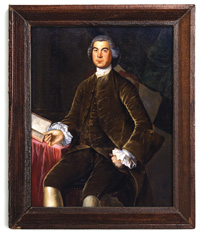
In Smugglers and Patriots, John W. Tyler stated that letter was written in the fine hand of John Hancock (shown above). The previous week, he shied from leading a crowd to the governor’s house. Now Hancock was ready to stand at the front of the movement.

Before leaving, Greenleaf made sure to tell the people he wanted “to be considered in the Light only of the Bearer of his Honor’s Letter.” In other words, Hutchinson stood alone, his show of authority ending in a resounding defeat.

The “Body of the Trade” then proceeded through a series of votes. In response to accusations that someone had tried to burn down the store of importer William Jackson, the meeting offered a £100 reward for the arsonist. A further resolution suggested that an enemy of the community—Harbottle Dorr suggested it was Jackson himself—had planted the evidence of that crime.

Another resolution asked people “totally to abstain from the use of Tea upon any pretence whatever” since tea accounted for “the greatest Part of the Revenue” from the Townshend duties.

But the main business of the meeting was about naming and shaming the shopkeepers who were still defying the non-importation committee.

The first group was the merchants Jackson, Theophilus Lillie, John Taylor, and Nathaniel Rogers. The meeting deemed them “obstinate and inveterate Enemies of their Country, and Subverters of the Rights and Liberties of this Continent.” It declared that people should respond by “withholding not only all commercial Dealing; but every Act and Office of common Civility” from them. The resolution went on for a long time. You can read it here in the Boston Gazette.

Then the meeting turned to a second group of defiant businesspeople:
Most of those people were “strangers in this Country,” the meeting declared. They had “in the most insolent manner too long affronted this people, and endeavoured to undermine the liberties of this country.” Invoking Biblical language (Isaiah 51:1), the gathering declared “that they deserve to be driven into that obscurity, from which they originated, and to the hole of the pit from whence they were digged.”

The next day, Lt. Gov. Hutchinson wrote to Lord Hillsborough, the Secretary of State, about his attempt to stop the meeting. He said he’d spoken with Phillips, his Council, and the town’s justices of the peace about how such meetings would lead to “high treason,” but no one had agreed with him. He acknowledged his letter had failed to disperse the crowd. But Hutchinson insisted that “it made them more anxious to restrain all disorders.”

In the coming weeks, we’ll see how that worked out.

Monday, November 25, 2019

The Devil and George Gailer

Here’s a final note on the riotous events of 28 Oct 1769—the merchants’ confrontation with printer John Mein and the tarring and feathering of sailor George Gailer.

In 2011 Dr. Caitlin G. D. Hopkins shared a passage from a letter by Elizabeth Cumings, a shopkeeper who witnessed both events from inside nearby buildings. Cumings, from a Concord family, hadn’t had much formal education, so her spelling offers a fun challenge.

Here’s what Cumings had to say about the attack on Gailer:
it was Dark our house shut up & we alon trimbling lick Courds [“trembling like curds,” I think], when a larg Mob of ful a thousand Man & boys aranged themselves befor our Dorr & on a Kart a Man was Exibited as we thought in a Gore of Blod; & poor meen [John Mein] we was shure was the sufrer but we was happyly mistaken it was an informer they had caught the moment Meen found Shalter, & instintly posted him on a kart tard him all over the town then fathered him all under our windo thin carid him threu the town obliging him to carry the lantren in his hand & calling to all the inhabitince to put Candles in their Windoes
Elizabeth Cumings and her older sister Ame were becoming unpopular for defying the non-importation movement. Hopkins has also shared her analysis of the Cumings sisters’ situation in “Enemies to Their Country”:
After Mein’s escape, the crowd had caught a suspected customs informer, George Gailer, who was beaten, tossed into a cart, and jostled through the streets. At strategic points along the route, men poured buckets of tar over Gailer’s bare skin, scalding his flesh and filling his wounds with hot, gummy resin. When the torturers “aranged themselves befor [the Cumings’] Dorr,” they applied this treatment once more, this time finishing it off with feathers. As they moved away, down Cornhill, someone thrust a lantern into Gailer’s hand, obliging him to stay conscious, lest he drop the flame and set himself afire.
In his legal filing, Gailer didn’t mention the lantern or any fear of being set on fire. Instead, he emphasized how the crowd beat him. And I’m not convinced that the purpose of the lantern was to threaten Gailer with being burned.

Indeed, the crowd could simply have held a flame to the feathers. The Customs officer Owen Richards later testified that in 1770 a mob “put him into a Cart, Tarr’d and Feathered him, then set the Feathers on Fire on his Back.”

Richards’s account was probably the source for the “Recipe” for tar and feathers in Peter Oliver’s Origin and Progress of the American Rebellion including the lines: “Then hold a lighted Candle to the Feathers, & try to set it all on Fire; if it will burn so much the better. But as the Experiment is often made in cold Weather; it will not then succeed.”

My immediate thought of seeing Cumings’s description of Gailer being made to hold a lantern was the Pope Night wagons. In 1767 Pierre Eugène du Simitière sketched three wagons in Boston. In the back of all three was an oversized effigy of the devil, and all three devils held lanterns out in one hand. Du Simitière’s image of the North End gang’s devil appears above, dangling his lantern off the back of the wagon.

Judge Oliver, Isaiah Thomas, and other witnesses also wrote of those devil figures being covered with tar and feathers. In other words, the 29 October mob turned George Gailer into a living preview of one of the effigies that would roll around town on 6 November, a little over a week away.

[Incidentally, this month I got to see Caitlin Hopkins speak about the extended Vassall family and their slaveholding at Longfellow House–Washington’s Headquarters in Cambridge. She has also turned in a report to the Harvard University administration about the college’s links to slavery, which seems like it should be issued as part of the newly announced initiative.]

Wednesday, October 30, 2019

“If he appeared abroad he should be made a Sacrifice”

As described yesterday, late in the afternoon of 28 Oct 1769, a group of Boston merchants approached the Boston Chronicle printer John Mein on King Street in Boston.

Mein was an increasingly vocal supporter of the royal government, in turn supported by contracts with the Customs service. The merchants were part of the non-importation movement boycotting British goods—except, as Mein’s newspaper revealed, when men who had signed onto that boycott imported goods anyway. One merchant, Samuel Dashwood, had particular reason to be upset with Mein, who had dubbed him “the Grunting Captain.”

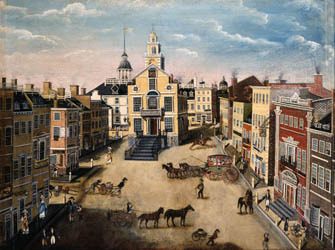
The conversation became a confrontation and quickly turned violent. Mein pulled out a pistol and backed toward the army’s main guard, where he could find redcoat protection. (It was in the building to the left of the Old State House in the Massachusetts Historical Society’s painting above.) As the printer reached the doorstep of that building, a tailor and militia officer named Thomas Marshall swung an iron shovel at his back. That’s when someone fired a shot.

According to Mein, the shot came from a pistol held by his printing partner:
Mr. [John] Fleeming, who was at a little distance, on seeing him [Marshall] coming up, run to us also, but before he came near Marshal had made the blow and was running off; however, Fleeming struck at him with a stick he had in his left hand, which just touched Marshals Back, Fleeming having missed his Blow reeled forwards, and in endeavouring to recover himself, grasping his hand close, a Pistol he had in his right hand accidently went off, but the ball went into ground & did no harm:
However, most people watching from King Street believed the shot came from Mein’s own gun. Even shopkeeper Elizabeth Cumings, who was on the printer’s side politically, wrote that he “fired a pistel he had in his hand, loded only with powder.”

Furthermore, the shot did cause a little damage. Merchant John Rowe wrote that Mein “wounded a Grenadier of the 29th Regiment in the Arm.” A report in the Boston News-Letter said the shot “tore the Sleeve of a Soldier’s Coat; but whether with a Bullet or only a Wad we cannot say.”

For that offense, some of the Boston Whigs rushed to sympathetic magistrate Richard Dana and secured a warrant to arrest Mein “for having put innocent People in Bodily Fear.”

The printer insisted the whole thing had been a set-up, the mob preconcerted:
their plan was to get me into the Custody of the Officer, & it being then dark, to knock on the head; & then their usual sayings might have been repeated again, that it was done by Boys & Negroes, or by Nobody.
Crown informant George Mason also reported hearing talk that once “Mr. Mein…was in Custody of the Civil Officers,…it was intended the Mob should rescue him from their hands, and deal with him as they themselves should think proper.” That was surely wild speculation, but the gunshot gave the Whigs all the legal reason they needed to pursue the man.

Once Justice Dana issued the warrant, Deputy Sheriff Benjamin Cudworth and a constable went into the main guard. Along with them went merchant William Molineux and officeholder Samuel Adams, both top Whig organizers. They spent “above an hour searching” before giving up.

Mein was hiding “above the room in the Garret,” he wrote. “I made my escape in a Soldiers Dress to Col. [William] Dalrymple’s.” From there he slipped “on board of his Majestys Schooner [Hope, commanded by] Lt. [George] Dawson,” later to “the Rose Man of War” under Capt. Benjamin Caldwell. Meanwhile, he wrote, the mob “went to the South End, attacked the House & Printing Office, broke open the great Gate, & our other Doors, and our Ware room:”

Mein had to lie low. Elizabeth Cumings declared, “the people are so exasperated they would sertenly kill him if he appered.” That year’s Pope Night processions on 6 November (because the fifth was a Sunday) featured Mein as the villain hanged in effigy. According to acting governor Thomas Hutchinson, Mein told him
he intended to pursue in the law the persons who had assaulted him; but he was unable to do it, having been threatened that if he appeared abroad he should be made a Sacrifice: And he therefore applied to me for protection and to call in the military power for that purpose.
Hutchinson declined to use military force that way and dissuaded Mein from suing. In a short time witnesses spoke up about the printer defending himself. According to province secretary Andrew Oliver, “Mr. Danas Son it is said was a Witness of the Transaction.” The warrant against Mein was withdrawn.

Nonetheless, the printer didn’t feel safe in Boston. Mein gave Fleeming a power of attorney to continue running the Boston Chronicle and the London Book-Store. He collected letters from Hutchinson to the Secretary of State, Lord Hillsborough; from magistrate James Murray to his sister, Elizabeth (Murray Campbell) Smith; and from secretary Oliver to Gov. Francis Bernard. He sailed out of Boston harbor on H.M.S. Hope on 17 November.

Though Mein still had property and legal entanglements in Boston, and he continued to write about Boston politics, he never returned to the town. The merchants had driven away their sharpest critic.

TOMORROW: More violence that same night.

Tuesday, October 29, 2019

A Sestercentennial Stand-Off on King Street

By publishing Customs house documents that embarrassed the Whig merchants of Boston, John Mein knew that he made himself unpopular.

In fact, a confidential informant, the painter George Mason, told Customs Collector Joseph Harrison on 20 Oct 1769 that Mein was “oblig’d to go Arm’d, and ’tis but a few Nights since that two Persons who resembled him pretty much were attack’d in a narrow Alley with Clubs, and would in all probability have lost their Lives if the Mistakes had not been timely discover’d.”

Mein’s insulting “Characters” of top Whigs, published in his Boston Chronicle newspaper on 26 October and republished in a pamphlet two days later, pushed some of those enemies over the edge. Toward the end of the day on Saturday, 28 October, Mein and his printing partner John Fleeming, were walking along King Street.

Merchant captain Samuel Dashwood (1729?-1792) confronted Mein, angry at being called “the Grunting Captain.” With him were other Whig merchants, such as William Molineux (1713?-1774), Edward Davis (1718-1784), and Duncan Ingraham (1726-1811). Two of those men were in their forties, the other two in their fifties, but they were about to behave like the twenty- and thirtysomething gentlemen who had thrust themselves into the Otis-Robinson fight the month before.

According to Mein, writing on 5 November:
Davis first made a push at me with his Cane which struck me on the left side of the belly, and has left a Bloody Contussion, which now, 8 days after, still remains with great hardness all round; on being struck I immediately took a Pistol out of my Pocket, cocked, and presented it; instantly a large Circle was formed
As one would expect.

Mein, pointing his pistol, backed toward the main guard near the Town House (now the Old State House). “I often told them I would shoot the first Man who touched me,” he declared. Fleeming followed. The crowd, still at a distance, grew larger. Shopkeeper and importer Elizabeth Cumings, visiting a friend on King Street, heard “a violent skreeming Kill him, kill him” outside. Mein said people were throwing things. He spotted selectman Jonathan Mason within the crowd.

The main guard was the building where the army organized its sentries and patrols, where soldiers on duty that night were gathered. As the printer approached, an officer recognized him and “desired the Centries to keep their Posts clear” of people. Those soldiers probably stepped forward and presented their bayonets. Mein began “cooly stepping up the Guardroom steps.”

Thomas Marshall (1719-1800, shown above) didn’t want to see Mein get away. He was a tailor with a shop on King Street, but he was better known in Boston as the colonel in charge of the town’s militia regiment. Mein listed Marshall among the men who had first confronted him, but it seems just as likely that he came out of his store after he heard the commotion.

The colonel grabbed “a large Iron Shovel” from the hardware shop of Daniel and Joseph Waldo, the sign of the Elephant. He slipped around the sentries and came at Mein from the rear, swinging the shovel. Mein stated, “the Blow cut thro’ my Coat & Waistcoat, and made a Wound of about two Inches long in my left Shoulder.”

And then a gun went off.

TOMORROW: Manhunt.

Tuesday, May 14, 2019

Dr. John Cuming, Justice of the Peace

The other Concord magistrate who collected depositions from captured British soldiers on 23 Apr 1775 was John Cuming according to one printed version and John Cummings according to another.

Dr. John Cuming (c. 1728-1788) was from a branch of an aristocratic Scottish family that had settled in Concord. His sisters Ame and Elizabeth Cumings were shopkeepers and “she-merchants” in Boston. They defied the non-importation boycott of 1769-1770, at one point publicly criticized as “enemies of the country.” The Cumings sisters would remain loyal to the Crown.

John Cuming, in contrast, established deep roots in Massachusetts. He became a Concord selectman, chairman of the committee of correspondence, colonel of the local militia, in 1776 a representative to the state legislature, and in 1779 a delegate to the convention to write a new state constitution. He owned slaves and lots of land. He left substantial bequests to Harvard College and the poor of Concord. Even today there’s a building at the local hospital named for him.

After the battle on 19 April, Cuming treated the wounded, including redcoats. According to Concord historian Lemuel Shattuck, based on an interview with Mary Barrett in 1831, “Eight of the wounded [prisoners] received medical attendance from Dr. Cuming, at the house then standing near Captain Stacy’s.” (I don’t know if that’s the same as the Cuming house shown above, but let’s assume.) Reportedly those men included Pvt. John Bateman, one of the redcoats who gave a deposition.

But Bateman doesn’t appear to have been Cuming’s patient yet on 23 April. That deposition was said to have been signed in Lincoln, not Concord. An invoice from Dr. Joseph Fiske that Joel Bohy found in the Massachusetts state archives shows that on 20 April he dressed two prisoners’ wounds in Lincoln, and one of those men was probably Bateman.

After Pvt. Bateman recovered somewhat, the provincial authorities moved him out to Concord to be held with other British men at the county jail. That’s when Dr. Cuming presumably took over caring for him.

TOMORROW: A visit to the jail.

Friday, January 04, 2019

“Mary makes and sells Tea-Kettles and Coffee pots”

As recounted in yesterday’s posting, by the end of 1735 Mary Jackson had reopened her husband James’s braziery shop a few weeks after he died at sea.

Mary Jackson had two sons under age five to provide for, and, according to accounts she later filed to the probate court, a staff of seven dependent on the shop. Plus her husband left well over a thousand pounds in inventory, and well over two thousand pounds in debt. So there were many reasons to make the most of the business.

Given that amount of stock at the Sign of the Brazen Head and the shop’s location near the center of Boston, Jackson immediately became one of the town’s most visible businesswomen.

The best documented “she-merchant” in pre-Revolutionary Boston was Elizabeth Murray, subject of Patricia Cleary’s 2000 biography. Murray opened a millinery shop after arriving from Scotland as a young woman in 1751. She imported the latest dress fashions, cloth, ribbons, and other dry goods, and she gave lessons in genteel embroidery and other skills for girls.

Murray married three times, gaining a great deal of wealth with her second marriage to Isaac Smith, but she was always able to support herself. She used prenuptial agreements to ensure she controlled her own wealth. And she acted as mentor to younger single women in Boston business, such as Janette Day and the Cumings sisters.

Jackson, in contrast, appears to have become a businesswoman by default because of her husband’s death. Furthermore, manufacturing brass hardware was not a traditionally female profession like millinery.

On 11 Oct 1736 Jackson published this advertisement in the Boston Gazette:
MARY JACKSON, at the Brazen-Head, in Cornhill, makes and sells all sorts of Brass and Founders Ware, as Hearths, Fenders, Shovels and Tongs, Hand-Irons, Candlesticks, Brasses for Chaises and Saddles, of the newest Fashion; all sorts of Mill Brasses; Mortars, Cocks, large and small; all sorts of polish’d Brazier’s Ware, at reasonable Rates.

A Quantity of large brown Paper fit for sheathing Ships, to be sold: Likewise buys old Copper, Brass, Pewter, Lead and Iron.
I’ve found a couple of other ads in which Jackson stated in some way that she actually produced the metal goods she sold, such as this line in the 21 June 1750 Boston News-Letter:
Said Mary makes and sells Tea-Kettles and Coffee pots; copper Drinking-pots, brass and copper Sauce-pans, Stew-pans, and Baking-pans; Kettle-pots, and Fish-Kettles.
However, in many more advertisements over the course of twenty years, Mary Jackson emphasized that she sold the hardware and other goods at the Brazen Head. So I’m not sure how hands-on she was in the production of brassware, as opposed to supervising employees’ work, managing imports from Britain, and running the retail shop. Because she was definitely the boss of the enterprise.

TOMORROW: The men who worked for Mary Jackson.

Friday, April 11, 2008

“We was alarmed with a violent Skreeming”

For today’s dose of primary-source material, interesting analysis, and commentary, just hop over to Vast Public Indifference’s discussion of Elizabeth Murray, her school for girls in mid-1700s Boston, and how her business protegĂ©es the Cumings sisters reacted to political violence right outside their shop window. Excellent stuff.

Murray was an expert in needlework, but her school went well beyond that subject. And speaking of needlework, the antiques broker who blogs under the name Maine Cliff Dweller had a lot to say last year about collecting eighteenth-century embroidery, including the shepherdess to the right.

Off with you now. See you tomorrow.

Thursday, March 29, 2007

Pulling Teeth in Colonial Boston

Before John Baker arrived from London and promoted the notion of specialized “surgeon dentists,” it looks like most Bostonians went to their regular doctors for dental care—which usually meant having teeth pulled rather than repaired. Indeed, losing one’s teeth seem to have been an experience that connected people.

John Cary, the biographer of Dr. Joseph Warren, wrote: “During the first years of practice, Warren charged one shilling, four pence for the extraction of teeth, one of his most common medical services.” On 27 Jan 1765, for example, Warren recorded extracting a tooth from Hannah Flucker, who was then fourteen years old. Her father was Thomas Flucker, later the last Secretary of the royal province, and her younger sister Lucy married Henry Knox.

Dr. Elisha Story extracted teeth from town watchman Benjamin Burdick’s wife and children. Indeed, Story’s office records for 12 Oct 1768 seem to be the only documentation for one of those children. Burdick and Knox were both at the Boston Massacre, trying to calm the conflict.

Ame [pronounced, I think, as “Amy”] and Elizabeth Cumings were two sisters who came to Boston from Scotland in the 1760s to set up a shop. Among the many things they sold, according to their ad in the 11 Nov 1765 Boston Gazette, were “Teeth Tincture and Powder.” In 1771 Knox rented space from the Cumingses for his first bookshop.

Merchant John Rowe wrote in his diary on 14 June 1769:

Sent for Dr. [James] Lloyd to have my Tooth drawn & had not Resolution to go thro’ the Operation.
One person who didn’t remove teeth was the painter John Singleton Copley (whose painting of Warren appears above, and who also painted Flucker). But the Rev. Dr. Mather Byles, Sr., who rarely passed by a chance for a pun, reportedly told a man to go to Copley’s house to have a tooth drawn. Drawn—get it? (With jokes like that, it’s no surprise that Dr. Byles’s congregation swiftly voted to remove him from their pulpit after the war began.)

Tuesday, February 20, 2007

February 1770: Boston's Boycott Heats Up

As the year 1769 closed, Boston’s Whigs were eager to strengthen their “nonimportation” movement—a boycott on most goods from Britain. Their goal was to pressure British merchants to use their political leverage to make Parliament repeal the Townshend duties.

A handful of merchants and small shopkeepers, most politically aligned with the royal governor, had never signed onto the nonimportation pledge, or wanted to end their participation. In January 1770, Boston’s town meeting voted to declare those businesspeople “Enemies of their Country.” They listed John Bernard and Nathaniel Rogers, both relatives of royal governors; merchants James and Patrick McMasters, printer John Mein, and shopkeepers Ame (Amy) and Elizabeth Cumings, all recent Scottish immigrants; small merchants Theophilus Lillie and John Taylor; brazier William Jackson; Israel Williams of Hatfield; and Henry Barnes of Marlborough.

In early February, some Whigs decided to take the protests straight to the offenders’ doors. An informant reporting to the Customs office wrote this report dated 8 Feb 1770, which is now at Harvard’s Houghton Library:

about 10 oClock in the forenoon, a board was stuck up, on the Town pump, with a Hand painted on it, pointing to Mr. Jacksons Shop and below, the word Importer, in Large Letters.—

this affair drew the attention of the boys, and Country people, who flock’d about it, in great numbers; the Boys insulting Every body who went in, or out of the Shop, by Hissing and pelting them with Dirt.—
The informant later added, “thursday is the principal market day, and also on that day all the schools are Vacant.” Town schools had only a short morning session on Thursdays, letting out about ten o’clock so the boys could attend a public lecture, a sort of extra sermon for the week; Harry Otis recalled that no boys ever did. Thursdays were also a day when rural farmers brought goods into town and bought their supplies, so it was a good day for a public protest.

Why did the crowd focus first on William Jackson? Why did someone print special handbills about not doing business with him (shown above)? Jackson’s shop was a landmark close to the Town House in the center of town, with the well-known sign of a “brazen head.” I also wonder how popular he had been in Boston since his earlier shop was the source of a fire that burned a big swath of the town in 1760.

The report continued:
Jackson made several attempts to take it Down, but was Repulsed by a Number of Idle people, who were standing by, with Clubs and Sticks in their Hands, however about one oClock it was taken away, by those who put it up, and the Crow’d dispersed first taking care to bespatter, all Jacksons windows over, with mudd and dirt—

During this Exhibition a Number of considerable Merchants Stood at a Little distance, and seemed highly pleased with what was going on, and Mr. M[olineu]x took Care to distinguish himself in a particular manner—
William Molineux was among the most important of Boston’s Whigs at this time, and probably the most paradoxical. He was a merchant deep in business with Crown supporters, a native Englishman, and an Anglican (at least formally—some critics said that he was a deist). Men with those qualities were more likely to side with the Crown than with the Whigs. Yet Molineux not only opposed the royal governor, but he became one of the most radical Whigs, a gentleman leading crowds in the streets or, as in this case, looking on with approval.

It’s unclear who instigated this first protest, but by the following Thursday the boys themselves were taking the initiative. They produced the sort of insulting effigies they were used to carting about on Pope Night. On 15 February, the Crown informant reported:
Between the 8th & this date, most of the Importers had their Windows broke their Signs defaced, and many other marks of Resentment— . . .

The Exhibition the same as last week with addition of the Effegies of some of the Importers, and below was wrote, that the Effegies of four [Customs] Commissioners, five of their understrappers, with some people on the other side the water [i.e., in Britain] where [sic—were] to make their appearance on Liberty Tree the week following—

four soldiers of the 14th. Regt. attempted to take it down, but where bear of [i.e., were borne off] and one of them much Hurt.
This political conflict was turning violent, and the army was unofficially being drawn in.

Thursday, November 23, 2006

The Politics of Thanksgiving

These days we treat Thanksgiving as a family holiday for all Americans, regardless of political or sectarian divisions. But in pre-Revolutionary Boston, Thanksgiving was associated most strongly with the Congregationalist tradition, and thus with the Patriot cause. Royal governors issued Thanksgiving proclamations, but in practice Anglicans and friends of the royal government seem to have paid less respect to the holiday and, in times of political turmoil, even defied it.

In his unpublished manuscript The Bay-Boy, a novel set in the pre-Revolutionary Boston where he had grown up, Royall Tyler composed this conversation between his Congregationalist narrator and an Anglican doctor, quite possibly modeled on Dr. Silvester Gardiner:

Author. “...hoping you will permit me to spend Thanksgiving day with my Grandmother.”

Doctor G. “By all means. That Yankee festival is not in our calendar. Eat your pumpkin pudding wherever you please. I hope, however, you will take your Christmas pie with me.”
Thus, at least in this depiction, Congregationalists celebrated Thanksgiving with food and piety while Anglicans waited to feast on Christmas.

In late 1769, the Whigs were putting pressure on a few merchants and shopkeepers to sign on with the rest and stop selling British goods. This "non-importation" was intended to protest the Townshend duties. Among the remaining importers were Henry Barnes of Marlborough and Elisabeth Cumings of Boston, and their supporters included justice of the peace James Murray.

On 29 Nov 1769, Henry's wife Christian Barnes wrote to her friend Elizabeth Smith (who was also Justice Murray's sister) in London about the untraditional way her circle had observed Thanksgiving:
Last thursday which was thanksgiving Day a Ball was given by Mrs. [Elizabeth] Murray [the justice's wife] at Brush Hill [in Milton] to a number of Gentlemen & Ladys from Boston Miss E Cumings was one of the Party

their Goods and ours are arrived in very good order which has caused a Commity from the Well disposed [i.e., the Whig activists] to wait upon them and write to Mr. Barnes with a desire that the Goods may be stored till further orders and so they are to better purpose I hope then they design’d them for they are well Charg’d and I dare say will have a quick Sail [i.e., sale]
Political tensions were even higher on Thanksgiving Day in 1774. The few Sandemanian shopkeepers in Boston kept their shops open to show loyalty to the Crown and were “taken notice of,” as Samuel Adams wrote the next 31 January. (There was an ethnic component to these divisions as well: Cumings, Murray, Smith, and Sandeman were all Scottish immigrants.)

On the other hand, some Anglican families did adopt the Thanksgiving celebration. On 4 Dec 1770 Charles Pelham, a private schoolmaster in Newton, wrote to his half-brother Henry in Boston:
The bearer brings 1 1/2 busl. Malt for our Mama, and 3 buss. for Bror. [John Singleton] Copley, which being good, will afford you a great deal of wholsome Liquor. . . .

Its now very find wholsome weather and a little Tour into the Country would promote any one’s health, especially the Sedentary Persons; I therefore strenuously recommend your keeping the approaching Thanksgiving with us, but take me right; I do not invite you to a sumptuous feast, but to good wholsome Country Fare with undissembled friendship.
SEE ALSO: The politics of football in colonial Boston.