


J. L. BELL is a Massachusetts writer who specializes in (among other things) the start of the American Revolution in and around Boston. He is particularly interested in the experiences of children in 1765-75. He has published scholarly papers and popular articles for both children and adults. He was consultant for an episode of History Detectives, and contributed to a display at Minute Man National Historic Park.

Subscribe thru Follow.it


•••••••••••••••••


Showing posts with label Christian Remick. Show all posts

Thursday, January 17, 2019

Two Images of the Boston Massacre at Auction

The next Seth Kaller auction of manuscripts and printed Americana includes a print of Paul Revere’s engraving of the Boston Massacre. The auction is scheduled for 24 January, and the price estimate is up to $200,000.

This is a second-state copy, shown by the clock on the Old Brick Meetinghouse tower. Its hands point to 10:20 P.M. while the earlier copies say 8:00. (The shooting probably occurred around 9:30.)

This copy is hand-colored, a luxury touch that customers paid extra for. That coloring offers further support for one of my arguments about this engraving.

Some people complain that Revere either didn’t show Crispus Attucks or portrayed him as white. That’s based on interpreting the figure lying face down in the center foreground as Attucks, and on seeing uncolored images.

I think that central victim is ropemaker Samuel Gray. In the colored prints, that man often has blood coming from wounds on his head, and Gray was indeed shot in the head.

There are multiple victims in the crowd at the left, as shown in the detail above. One face is colored to be darker than the others. That face is even more dark in the Philadelphia library’s copy. In addition, that victim is often painted with two bloody wounds in his chest, which is how Attucks was shot. At least in this colored print, it’s easy to identify Attucks and recognize him as a person of color.

If an original Revere engraving is beyond your price range, Boston 1775 friend Charles Bahne alerted me to a variation on that image being sold closer to home.

CRN Auctions of Cambridge is offering a hand-drawn copy of Revere’s print for sale on 27 January. It came from the Doggett family, who moved from Boston to Maine in the early twentieth century.

Above the drawing is the same title that Revere engraved on his copperplate, minus the word “Bloody.” At bottom is the rhyming verse from the Revere print. That text wasn’t written to match the lettering on the print. Instead, it’s in an eighteenth-century business hand, using the long s.

All in all, I’m baffled at why this picture was made. Was it a drawing and handwriting exercise for a teenager? A patriotic memento? An attempt to replace Grandpapa’s beloved picture after it got damaged (“Quick, Judah, make a copy and he’ll never notice!”)?

The auction house’s description seems to hold out the possibility that this painting was produced by Christian Remick and served as the model for Revere’s print. But we know that Revere copied the image from Henry Pelham, whose perspective and figure drawing was better than both Revere’s and this unknown artist.

In addition, the hand-drawn copy shows the clock at 10:20, meaning it was based on Revere’s second state.

Sunday, September 30, 2018

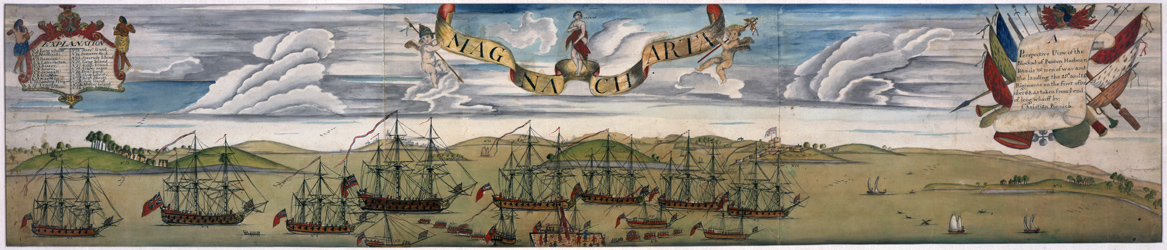
“Boston Surrounded with aboute 14 Ships”

On 30 Sept 1768, Deacon John Tudor wrote in his diary that the Royal Navy’s transport ships were now approaching Boston’s wharves:
At 3 O’Clock P. M. the Lanceston of 40 Guns, the Mermaid of 28, Glasgow of 20, Keven [Beaver, wrote John Rowe] of 14, Senegal 14, Bonnetta 10, several armed schooners, which with the Romney of 50 Guns (which had been hear most of the Summer) & the other Ships of War before in the Harbour, Capt. [James] Smith in the Mermaid Comadore, all came up to town bringing with them the 14th Regiment Col. [William] Dalrymple & 29th Regt. Col. [Maurice] Care.

So that now we See Boston Surrounded with aboute 14 Ships, or Vessells of war. The greatest perade perhaps ever seen in the Harbour of Boston.
Boston’s selectmen had been expecting those troops as far back as 10 September. After that, they met on the 11th, 12th, 13th (twice), 14th (twice), and 15th (twice). Most of those meetings produced no official decisions, the exceptions being typical small tasks such as admitting a person to the poorhouse or setting the price of rye bread.

On the 18th, the selectmen went to the Council Chamber in the Town House and received official word that four regiments were on their way, two from Halifax and two later from Ireland. Those thousands of soldiers would need a place to stay, the Council relayed. Three days later, the selectmen returned to the Council and said the only place for the soldiers was in Castle William.

The selectmen met again on the afternoon of the 21st, the 23rd, 26th, 28th, 29th, and 30th (twice). Again, most of those meetings officially resulted in nothing. The record of the afternoon meeting on the 30th even says: “A number of His Majestys Justices were present, but nothing transacted, matter of minuting.”

(On 26 September a cloth dyer named Thomas Mewse alerted the selectmen that he had come to Boston from Norwich, England, with his son. Mewse would go into “the Weaving Business” with William Molineux, a partnership that broke down in mutual recriminations, lawsuits, and newspaper essays. I wrote a long chapter about how that dispute connects to Molineux’s sudden death in October 1774 for The Road to Concord, and then I cut it for length. But it was nice to see Mewse make his entrance.)

The reason for the selectmen’s frequent meetings, and the magistrates’ presence on the 30th, is that Gov. Francis Bernard was trying to make the Manufactory building near the Common available as barracks. He told Col. Dalrymple that the Manufactory “is a building belonging to the Province and at present not leased or appropriated to any Person or Purpose.”

In fact, there were a few families in that large building weaving cloth or stockings or making buttons on a small scale. Moving them out would require a legal eviction, hence the justices of the peace—but most of those appointees stood with the selectmen in opposing the troops’ presence in town.

As much as Gov. Bernard wanted to turn the Manufactory over to the army, he didn’t want to take all the responsibility for doing so. He had spent almost two weeks trying to get his Council to agree with the idea. Those elected officials refused, also siding with the Boston selectmen.

In his letter to Col. Dalrymple, the governor wrote, “you have requested of me the Use of the building called the manufactory house.” So far as I know, Dalrymple had never been in Boston, but the governor wanted the request to come from the army.

On 30 September, Gov. Bernard finally bit the bullet and acted on his own authority—but he turned all the hard work over to Dalrymple:
as it is my Duty to preserve the Peace of the Town by all means in my Power, for which it is necessary to prevent an intermixture of the Soldiers and the People, as it must certainly give frequent occasions for the breaking the Peace, I do hereby assign & appoint the Manufactory house being a building appropriated to no use, & belonging to the Province; & I do authorise you to take possession of the same as & for a Barrack for the quartering the King’s Troops.
Until that building was available, the governor said, he had no objection to the regiments camping on Boston Common. As for straw for that camp, he would speak with the Council—the same uncooperative Council that didn’t want the troops in Boston in the first place.

TOMORROW: The landing.

(The picture above, courtesy of the Massachusetts Historical Society, is one version of Christian Remick’s painting of the fleet in Boston harbor as seen from Long Wharf.)

Monday, June 18, 2018

The Trials of Thomas Careless

This weekend I made my debut at Small State, Big History, an online journal devoted to the history of Rhode Island.

My article, titled “Thomas Careless of the Royal Navy: Tried for Murder in Newport, Court-Martialed for Tossing a Block Islander,” grew from the series of Boston 1775 postings from May 2017 about how Midshipman Thomas Careless went on trial for killing Newport man Henry Sparker. This month has brought the sestercentennial of that trial.

There are a couple of Boston connections to that Rhode Island story. First, the Boston Chronicle had the most detailed report on what led Careless to stab Sparker. Rhode Island newspapers withheld some information, ostensibly to protect the integrity of the trial but perhaps also to maintain the colony’s respectability.

Second, the Royal Navy vessel on which Careless was serving, H.M.S. Senegal, was one of the warships that brought British troops to Boston in the fall of 1768. In fact, we discovered that the best period pictures of that ship were produced by Christian Remick and Paul Revere (as shown above) while the Senegal and the rest of that fleet lay in Boston harbor.

The Small State, Big History article also contains another story about Thomas Careless that I hadn’t found when I wrote my 2017 postings. He returned to Rhode Island during the war—and got in trouble again!

In connection with this article, I’m scheduled to appear on Bruce Newbury’s “Talk of the Town” show on WADK (1540 AM) in Newport on Monday morning shortly after 10:00 A.M. to talk about Sparker, Careless, and what their fatal encounter says about the American Revolution.

Small State, Big History comes from a team led by Christian M. McBurney, author of Spies in Revolutionary Rhode Island, Kidnapping the Enemy: The Special Operations to Capture Generals Charles Lee and Richard Prescott, and The Rhode Island Campaign: The First French and American Operation of the Revolutionary War, among other history books. Its weekly articles cover the whole range of the colony and state’s history, from founding to recent politics.

[ADDENDUM: Here’s a recording of my conversation with Bruce Newbury of WADK, starting off the hour after news.]

Saturday, December 02, 2017

A Remick on the Wall

Last night I attended a function at the Club of Odd Volumes on Beacon Hill. Between the many bookshelves, the clubhouse has a very impressive collection of eighteenth-century prints on its walls.

I spotted the early view of Boston Common, a portrait of Gov. Francis Bernard, a couple of the political engravings issued in London in the last months before the Revolution, a fine map of the siege, and so on.

On one wall hung what looked from a distance like three copies of Christian Remick’s view of Royal Navy ships in Boston harbor in 1768. If the club has three, I thought, surely it wouldn’t miss just one.

But when I got closer, I realized that the top image wasn’t a print by Remick. It was the copperplate—the actual etched copper—that the club commissioned Sidney L. Smith to make from Remick’s original around 1904. The club printed 51 copies of the image, I read later. Underneath the copperplate was presumably one of those prints, hand-colored.

And the third picture was one of Remick’s original watercolors. I’d misremembered—he didn’t have that image engraved in pre-Revolutionary Boston, as Paul Revere prepared the related picture of royal troops disembarking on Long Wharf. Rather, Remick painted multiple copies of the ships in the harbor for upper-class patrons.

The Massachusetts Historical Society (which owns the copy shown above) explains:
Remick produced six known versions of this work, several dedicated to specific people. Though it bears no dedication, the provenance of this watercolor has been recorded by its previous owners and it is thus known that it was first owned by the royal governor in 1768, Thomas Hutchinson [actually not even acting governor until the following year]. The Massachusetts Historical Society owns a second, smaller version of this, and the Essex Institute [now the Peabody Essex Museum] also owns two versions. Another, dedicated to John Hancock, is owned by the Club of Odd Volumes, and one belongs to the New England Historic Genealogical Society.
And sure enough, the copy on the club’s wall has Hancock’s name incorporated into the label.

Saturday, February 18, 2017

“Exhibition at the Dwelling-House of Mr. PAUL REVERE”

Yesterday I passed on the news of activities next week at the Paul Revere House, which is now a historic museum.

But well before that building became a museum in the early 1900s, Paul Revere himself made it into a spectacle. That was on 5 March 1771, the first anniversary of the Boston Massacre. Less than a year after his family moved into that house, Revere used its windows to help his political movement.

In an unusually typset front page, Edes and Gill’s Boston Gazette described how the town observed that day. The Congregational meetinghouses (but not, by implication, the Anglican churches) tolled their bells for an hour starting at noon. And then:
In the Evening there was a very striking Exhibition at the Dwelling-House of Mr. PAUL REVERE, fronting the Old-North Square.—At one of the Chamber-Windows was the appearance of the Ghost of the unfortunate young [Christopher] Seider, with one of his Fingers in the Wound, endeavouring to stop the Blood issuing therefrom: Near him his Friends weeping: And at a small distance a monumental Obelisk, with his Bust in Front:—On the Front of the Pedestal, were the Names of those killed on the 5th of March: Underneath the following Lines,
Seider’s pale Ghost fresh-bleeding stands,
And Vengeance for his Death demands.
In the next Window were represented the Soldiers drawn up, firing at the People assembled before them—the Dead on the Ground—and the Wounded falling, with the Blood running in Streams from their Wounds: Over which was wrote FOUL PLAY.

In the third Window was the Figure of a Woman, representing AMERICA, sitting on the Stump of a Tree, with a Staff in her Hand, and the Cap of Liberty on the Top thereof,—one Foot on the Head of a Grenadier lying prostrate grasping a Serpent.—Her Finger pointing to the Tragedy.

The whole was so well executed, that the Spectators, which amounted to many Thousands, were struck with solemn Silence, and their Countenances covered with a melancholy Gloom. At Nine o’Clock the Bells tolled a doleful Peal, until Ten; when the Exhibition was withdrawn, and the People retired to their respective Habitations.
I’ve seen no report of a similar exhibition in Boston. It’s notable that it took place at Revere’s house in the North End rather than somewhere close to the center of town.

Perhaps Revere’s sideline of making and selling historical engravings was behind this event. The picture of the Massacre in his window could certainly have been based on the famous design he copied from Henry Pelham, and he could have had prints for sale. I suspect there were likewise models, perhaps British, of the other two scenes the newspaper described. Either that, or artist Christian Remick made them for Revere.

All that news from 1771 is a reminder that we’re coming up on the anniversary of the Massacre again. This year the reenactment will take place on the evening of Saturday, 4 March, outside the Old State House Museum. All that day there will be very striking activities.

Thursday, May 21, 2015

“We Are One” Exhibit Opens in Boston

Earlier this year I recommended the “God Save the People” exhibit at the Massachusetts Historical Society. This month the Norman B. Leventhal Map Center at the Boston Public Library, just a few blocks away on Boyltston Street, opened a new exhibit called “We Are One.” It’s also very good. Both displays are up through the summer, and both are free.

There’s some overlap between the two exhibits. For example, both have copies of the Paul Revere engraving of the Boston Massacre. The B.P.L. also shows the overhead drawing of the killing scene credited to Revere, perhaps used in the legal proceedings that followed. The M.H.S. has two of the musket balls fired that night.

Likewise, both exhibits include a copy of Phillis Wheatley’s 1773 collection of poetry. (Old South Meeting House is also displaying that book now.) The M.H.S. copy of Wheatley’s collection sits alongside what is reportedly her writing desk. The B.P.L. copy contains her signature.

“We Are One” is bigger, with a broader scope. “God Save the People” is focused on greater Boston; it starts with the Stamp Act of 1765 and ends with the Battle of Bunker Hill in 1775. In contrast, the B.P.L. exhibit goes back to trade routes in the mid-eighteenth-century British Empire, the end of the French & Indian War, and the British line of settlement in 1763. It extends through the ratification of the Constitution and the expansion of the U.S. of A. And it covers a lot of ground.

(I’m going to link to a lot of “We Are One” artifacts through the accompanying website. The “God Save the People” exhibit doesn’t have such an elaborate website, but, as this page says, many of its items are visible on the web.)

Because “We Are One” is from a Map Center, it naturally emphasizes cartography. Not just maps, but other ways of visualizing the world. One item I found striking was Georg Balthasar Probst’s view of the London skyline. It’s often said that when Paul Revere and Christian Remick created their view of British troops landing on Boston’s Long Wharf in 1768, they emphasized Boston’s church spires to underscore the town’s religiosity. But Probst’s view of London had even more spires. So was he making the same point, or were church spires the most notable features of any town?

Among my favorite Revolutionary artifacts are the watercolors that Lt. Richard Williams painted on top of Beacon Hill, showing each sector of the view in turn. Back in May 2006 (the month I started this blog), I noted that a set of those had come up for auction. Richard H. Brown has generously loaned them and other items for the “We Are One” exhibit; two originals will be on display in rotation while the whole series is reproduced overhead. Down below you can see me pointing out details of those pictures during a visit earlier this month. (Reproductions of a Williams panorama are also part of the display at the Lexington visitor center of Minute Man National Historical Park.)

Thanks to the B.P.L.’s collections, “We Are One” also goes well beyond cartography. It also includes the gold medal that the Continental Congress commissioned for Gen. George Washington at the end of the siege of Boston. What’s more, beside it is the gorget that Washington wore for his 1772 portrait. That actual gorget. And, back to maps, there’s a 1750 land survey that the teen-aged Washington drew.

Over the next couple of days I’ll discuss a couple of the “We Are One” items in more depth.

Friday, February 28, 2014

The Signature Style of Paul Revere

Yesterday I showed a watercolor painting of a British officer that the Skinner auction house is selling this weekend. And here’s the detail that makes this image so interesting: the words at the bottom of the picture identifying the subject as “Major John Pitcairn” and the artist as “P. Revere.”

I’m skeptical of most things from the Revolution that aren’t clearly contemporaneous, and some that are. I was therefore skeptical about the authenticity of this portrait. As Skinner says, it’s the only known painting credited to Paul Revere. For his engravings he relied on other artists like Christian Remick and Henry Pelham, or he copied prints from Britain. Even that note on the back of this picture’s frame says:
The portrait is a really creditable piece of painting, revealing the facial evidences of individual character, a work that must enhance his artistic reputation, at present resting upon the various engraved Views in which the figures barely escape caricature.
Yet the draftsmanship is neither so competent nor so incompetent as to indicate, at least to these untrained eyes, whether it’s authentic. If George W. Bush can take up painting in retirement, why couldn’t Revere?

On the other hand, if the only thing connecting this artwork to Revere is his signature, I figured I should take a hard look at that. I went looking for other examples of Revere’s signature, and found variations over time.

Here’s how Revere signed the 1767 non-consumption agreement recently digitized at Harvard’s Houghton Library:
The way he wrote his name at the start of his first deposition about the events of 18-19 Apr 1775, digitized by the Massachusetts Historical Society:
His name at the start of the “fair copy” of that deposition, also through the M.H.S.:
And his formal signature on the bottom of that document:
Finally, an 1816 receipt:
In all those signatures, the left leg of the P and R swoops up to the left. Those two capital letters also have a big swoop down from the top—sometimes a huge swoop. Those details also appear in the name on the painting.
However, in the penned signatures above, all the letters after the initial capitals are connected. In contrast, the “P. Revere” on the watercolor is made up of separate letters. And the little R is in a different style from the same letter in all the examples above. In those respects, that label is more like the way Revere added his name to engravings, as shown below in images from the American Antiquarian Society.
But, as you can see, Revere used different lettering styles on different prints. I didn’t try to capture all the variations. Yet another consideration is that Revere had engraved his names on those plates backwards. So it would be natural for him to write his name a little different when he wrote it in pen, even if he was trying to write it as it usually appeared on his engravings.

And, of course, someone else writing Revere’s name on this watercolor could have found similar examples to copy.

In sum, I was hoping to find definitive evidence to confirm or allay my skepticism about this painting, and I didn’t find it in the signature.

TOMORROW: Peeking inside the frame.

Thursday, June 02, 2011

Celebrating Boston Common, 6 June

The Friends of the Public Gardens and a bunch of nearby historic organizations celebrating the history of Boston Common on Monday, 6 June, from 10:00 A.M. to 1:00 P.M. They’re particularly inviting area schools to this “Making History Day,” honoring America’s “first public park.”

Here are some of the organizations scheduled to be at the event:
  • Wampanoag Nation Singers and Dancers
  • Historic New England: Colonial Games and Trades
  • Codman Family Farms: Meet an Animal
  • Freedom Trail Foundations: Colonial Punishments
  • The Commonwealth Vintage Dancers
  • Ancient and Honorable Artillery Company
  • The Fifty-Fourth Massachusetts Regiment
Above is a reproduction of Christian Remick’s view of the Common in 1768, looking from modern Tremont Street up the slope toward John Hancock’s mansion and the beacon on Beacon Hill at upper right.

Thursday, July 15, 2010

Enjoying Boston’s Outdoor Spaces, Then and Now

This is a picture of the Boston Common in 1768, based on a watercolor by Christian Remick. At the rear is Beacon Hill, with John Hancock’s mansion and estate on the right and a trio of houses that John Singleton Copley soon bought at the left. The tall pole on the far right is the beacon that gave the hill its name.

In the middle ground is the Common. I believe the small building at the left is the town’s gunpowder storage house. At the right are tents and a military unit drilling—presumably representing the British army regiments that arrived that October. Meanwhile, other figures are strolling and riding in arcadian comfort. There should also be some livestock grazing.

In the foreground is a feature that the British immigrants who set aside the Common probably didn’t foresee: a line of trees producing a shady mall for walking. Those trees represented the beginning of the Common’s shift from functional agricultural land to public park, preserving a quasi-natural landscape for urban citizens to enjoy.

Boston’s outdoor parks and resources are the focus of several free public talks in the next few weeks. I’m hoping that kinder weather will make it comfortable to enjoy those places, but even if the heat returns we can enjoy these talks in air-conditioned comfort.

On Thursday, 15 July (that’s tonight) at 7:00, Todd Forman will present “Legacies in Stone,” an illustrated talk on Boston’s public statuary at the main library in Newton. Local sculptor Nancy Schön, who produced the ducklings in the Public Garden and gets to reproduce one every ten years or so, will also be on hand.

On Thursday, 22 July from 6:30 to 8:30, Christopher Klein will talk about his book Discovering the Boston Harbor Islands: A Guide to the City’s Hidden Shores at the Community Boating Boathouse on the Esplanade. Chris wrote about the fight over the Boston Light as a Boston 1775 guest blogger back in 2008.

On Thursday, 29 July at 7:00, Meg Muckenhoupt will will present a slideshow and talk based on her new book Boston’s Gardens and Green Spaces at the Westborough Public Library.

Finally, on Thursday, 12 August at 7:00, Christopher Klein will be at the Westborough library to discuss Discovering the Boston Harbor Islands once again.

Saturday, April 24, 2010

Local and Material History at the Concord Museum

The Concord Museum is celebrating the 375th anniversary of the town with an exhibit called “into your hands…,” featuring objects passed down in Concord families and entrusted to the museum. Among the items:

  • The Bloody Massacre, the famed Revere engraving that was a milestone in America’s road to independence, owned by Emerson Cogswell, a hatmaker, in 1775 Concord. A gift to the Museum in 2002 by Cogswell’s great, great, great-granddaughter.
  • Pvt. Abner Hosmer’s powderhorn, worn at the fight at the North Bridge, April 19, 1775, where the 21-year-old Acton native was killed. A gift to the Museum in 1936.
  • An 18th-century high chest made in Concord and descended in the Wheeler Family of Concord. A gift to the Museum from the family of Wilfrid and Emily Wheeler in 1996.
This exhibit will be up through 19 Sept 2010.

My notes indicate that the Concord Museum’s copy of Paul Revere’s Boston Massacre print shows the same wounds as on the copy once owned by the New England Merchants National Bank and made into a poster for my office. (Okay, that might not have been the poster’s original purpose.) A man lying at the lower center bleeds from the head, and a man in the crowd at the left bleeds from two wounds in the chest.

The Massacre print now at the National Heritage Museum in Lexington is similar as well. In both that print and the poster, the figure bleeding from his chest looks slightly darker-skinned than the rest. Back here I wondered if he was supposed to represent Crispus Attucks.

The wounds and flesh tones are significant because they weren’t part of the underlying engraving. Revere and helpers (artistic partner Christian Remick, apprentices, kids?) painted the blood and skin by hand. So if the same wounds were painted onto most of the original prints, and that one face was usually given a light brown wash, then the team was trying to depict the figures in a very particular way. My poster says there are nine prints surviving from the first run. Someone test this hypothesis for me!

Friday, May 09, 2008

Attucks and the A.P. Exam

Today Boston 1775 salutes all the young scholars taking this year’s Advanced Placement U.S. History exam—particularly those at the John D. O’Bryant School of Math and Science in Boston. Last month I had the honor of speaking to Matthew Kazlauskas’s A.P. history classes there.

I talked about what we know—and don’t know—about Crispus Attucks, based on various primary sources and recollections. I seized the opportunity to share this image; it’s a detail from Paul Revere’s engraving of the Boston Massacre, as reproduced on the poster that hangs on my office wall (purchased from the Old State House gift shop).

The black lines of an engraving are reproduced with a copperplate, but Revere or his artistic partner Christian Remick had to add all the solid blacks and colors by hand. That means every colored copy of this engraving is different. I therefore can’t say that this copy is typical.

Nevertheless, I like to raise the question of whether it shows Attucks, who was usually labeled as a “mulatto” (and once as an “Indian”). This image shows a man with two symmetrical wounds in the chest—Attucks’s wounds, as detailed in an autopsy. He has dark black hair and skin that looks slightly darker than that of surrounding figures. Did Revere and Remick actually depict Attucks as a person of color? Or is that just how the paper has aged?

At least one student smartly pointed out that in this engraving the man with the two chest wounds is the victim farthest from the soldiers’ guns. Eyewitness testimony and an earlier image by Revere tell us that Attucks was struck down at the front of the crowd. So perhaps that figure wasn’t meant to represent Attucks. Or perhaps the artists moved him back, acknowledging his presence but not making him so prominent.

Of course, Revere and Remick could have used their paints to produce different versions of the scene for different customers, or however they chose. As with so many other historical questions, we’re unlikely to find any definite answers, but half the fun is in thinking through the questions.

Thursday, June 07, 2007

Where Was Paul Revere's "North Church"?

Yesterday I had a chat with Cambridge historical tour guide Donna “Mistress Elizabeth” La Rue about which Boston steeple Paul Revere used to send his lantern signal to Patriots in Charlestown. He told the founder of the Massachusetts Historical Society that he’d arranged “if the British went out by Water, we would shew two Lanthorns in the North Church Steeple; and if by Land, one, as a Signal.”

Did “the North Church” mean the Old North Meeting-House in North Square, near Revere’s home, or Christ Church on Salem Street, a couple of blocks away and now called Old North Church? Congregationalist meeting-houses weren’t usually called “churches”—though sometimes they were. Anglican churches weren’t usually designated by geographic location—though sometimes they were. (Earlier discussion on that nomenclature here.)

Revere named the building in 1798, so he probably used the term that prevailed in that decade. If he meant the Old North Meeting-House, it’s notable that he didn’t mention that the British military had pulled it down more than twenty years before. But would Bostonians of that decade have understood the term “North Church” to mean Christ Church? That’s what Donna and I discussed yesterday.

Here’s an advertisement in the 20 May 1794 Salem Gazette:

John Wilson,
NEXT door to the Rev. Doctor Stillman, opposite to the North Church, Salem Street, Boston—respectfully informs the Ladies of Salem and its vicinity, that he has erected a machine for the Glazing of Linen and Calico Gowns...
And a passage from the diary of the Rev. William Bentley of Salem, 3 Nov 1797:
We took leave of Mr. Freeman & then passed to the North End. At the head of Hancock’s Wharf we saw the Frigate & received the kind attentions of Col. Claghorn. We then left the town, passing the North Church in Salem Street & over Charlestown & Malden Bridges continued our route towards Salem.
Quotes like these show that in the 1790s people were using the term “North Church” to refer to a building on Salem Street—which could only be Christ Church. Old North Meeting-House was not only gone, but it had been a couple of blocks away.

A helpful architectural clue appears in the account of Richard Devens, the Charlestown Patriot to whom Revere arranged to send the signal. As quoted in History of the Siege of Boston, by Richard Frothingham (ironically, the first author to promote the Old North Meeting-House theory), Devens wrote:
Soon afterward, the signal agreed upon was given; this was a lanthorn hung out in the upper window of the tower of the N. Ch., towards Charlestown.
Below is part of a northwest-looking image of Boston’s 1768 skyline engraved by none other than Paul Revere from a drawing by Christian Remick. It’s not an exact picture—it’s more like one of those tourist maps that enlarges all the businesses that have sponsored the map and shrinks all the rest. In this case, the town’s places of worship stand out, not just because they were the tallest buildings in town but also because Remick and Revere were making a point about Boston being a godly town.

Fortunately, for this question we simply need to compare the Old North Meeting-House steeple on the left to the Christ Church spire on the right. They were both drawn to stand out. But which has an “upper window”?

We do have to ask why Revere and his confederates would signal from an Anglican church, one whose minister and congregants (by and large) supported the Crown. Again, the picture hints at a likely answer. Christ Church was high on Copp’s Hill and had the tallest spire in Boston. A signal from its tower would be more visible than the same signal from the Old North Meeting-House. Furthermore, once the military authorities spotted those lanterns, it would take a longer time for men to climb up there and snuff them out.