J. L. BELL is a Massachusetts writer who specializes in (among other things) the start of the American Revolution in and around Boston. He is particularly interested in the experiences of children in 1765-75. He has published scholarly papers and popular articles for both children and adults. He was consultant for an episode of History Detectives, and contributed to a display at Minute Man National Historic Park.

Subscribe thru Follow.it


•••••••••••••••••


Showing posts with label Caesar Fleet. Show all posts

Monday, April 14, 2014

The Fleets Get N.S.F.W.

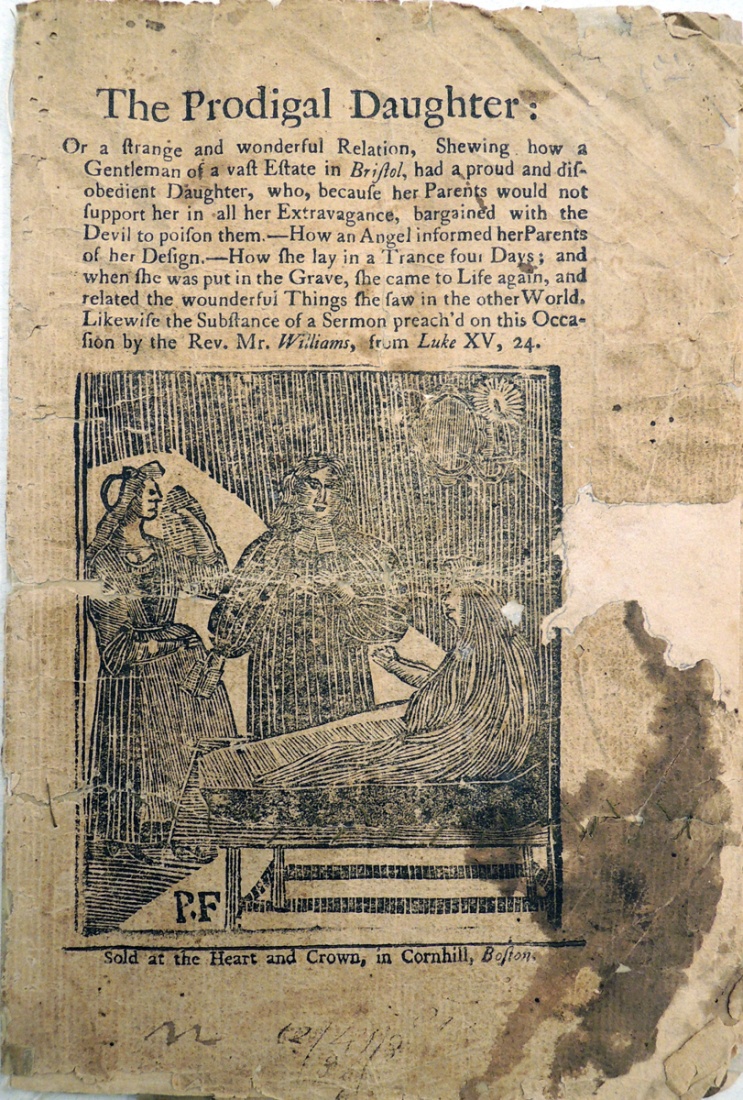
I’ve been writing about the Fleet family, enslaved to Thomas Fleet and trained in the printing business. Isaiah Thomas recalled that in the 1750s a black man named Peter Fleet carved woodcuts for ballads, and the initials “P.F” appear in a small book called The Prodigal Daughter.

On 7 Jan 1751, Thomas Fleet’s Boston Evening-Post featured a woodcut with what looks like Peter Fleet’s typical hatching as its very first item—a rare example of new art in a colonial newspaper. That image illustrated a poem titled “To Mr. CLIO, at North-Hampton, In Defence of MASONRY.”

Though nominally written in the voice of a Freemason, that poem wasn’t much of a defense. It suggested that the organization was just a cover for sodomy. Referring to treenails, or wooden pegs, instead of masons’ trowels, the verse said:

I’m sure our TRUNNELS look’d as clean
As if they ne’re up A–se had been;
For when we use ’em, we take care
To wash ’em well, and give ’em Air,
Then lock ’em up in our own Chamber,
Ready to TRUNNEL the next Member.
And lest anyone miss the sexual reference, the picture made it very clear. (Click on the image below if you want a closer look.)
In addition to the two well-dressed but half-dressed Masons, the woodcut also showed an ass braying, “Trunil Him well brother,” echoing the several references to asses in the poem.

It took work to create a woodcut with this level of detail, and it’s not an image that Thomas Fleet could have used again on broadsides. Someone probably paid the Fleet print shop a hefty sum to create this block and print it and the poem. Again, this explicit bit of gay-baiting was on the front page of a weekly newspaper.

Ironically, Peter Fleet’s younger son Caesar became a Freemason in Boston’s African Lodge in 1779.

TOMORROW: Who was behind that attack?

Sunday, April 13, 2014

The Craft of Caesar Fleet

Yesterday I described the travels of Pompey Fleet, a printer born into slavery in Boston around 1746 who ended up in west Africa by the end of the century. He was part of three mass migrations of Loyalists: from Boston in 1776, from New York in 1783, and from Nova Scotia to Sierra Leone in 1792.

What about Pompey’s younger brother, Caesar Fleet? His life took a different course. He stayed in Boston. The town’s 1780 tax assessments, published several decades ago by the Bostonian Society, list Caesar Fleet as a “Negro” living in Ward 10. The fact that he was tallied as a taxpayer indicates that he was no longer considered a slave, even before Massachusetts’s high court made slavery unenforceable in 1783.

Caesar Fleet’s name appears in another interesting source from the Revolutionary years. One of the earliest documents from Boston’s African Lodge of Freemasons, founded by Prince Hall, shows that “Sesar Fleet” joined in 23 June 1779. That was one of several civic organizations Hall and his circle founded during and after the Revolution in their bid as black men for an equal place in Boston society.

Unfortunately, I haven’t found Caesar Fleet in any other local records or newspapers. I don’t know if he lived long enough to be involved in the printing of Prince Hall’s 1797 oration, shown above. But there might be more sources out there.

Last year Caitlin G-D Hopkins wrote an article for Common-place that mentioned Pompey and Caesar’s father, Peter Fleet. She added thanks to “Gloria McCahon Whiting, whose pioneering work on the life and work of Peter Fleet, woodcut illustrator, has informed and enriched my own research.”

As it happens, Gloria Whiting is sharing a paper this Tuesday on “‘How Can the Wife Submit?’: African Families Negotiate Gender and Slavery in New England” as part of the women’s history seminar series co-sponsored by the Massachusetts Historical Society and the Schlesinger Library at Radcliffe. That conversation will take place at 5:30 P.M. on 15 April at the Schlesinger Library, 10 Garden Street in Cambridge. It’s free to the public, but to reserve a seat contact the M.H.S.

TOMORROW: Should I show Peter Fleet’s cartoon about Freemasonry from 1751? It’s “not safe for work,” as the kids say.

Friday, April 11, 2014

The Art of Peter Fleet

Finally I’m getting back to the family of enslaved printers in pre-Revolutionary Boston, Peter Fleet and his sons Pompey and Caesar.

In his history of printing, Isaiah Thomas mentioned the last two by name, so when scholars spotted the initials “P.F” at the bottom of the woodcut shown here, they guessed it had been carved by Pompey Fleet.

In fact, Thomas had written that Pompey’s father had carved woodcuts for Thomas Fleet, Sr. Once people remembered the 1743 will of a slave named Peter owned by the Fleet family, they realized that “P.F” could also stand for Peter Fleet.

I’m inclined to credit this cut to Peter, the father. According to E. Jennifer Monaghan’s Learning to Read and Write in Colonial America, Thomas Fleet first advertised this book, The Prodigal Daughter, in his Boston Evening-Post in 1736. We don’t have any definite examples of that edition because the several copies that survive don’t include printing dates. Some copies are estimated as early as 1742. So either Peter Fleet carved that woodcut or the estimated dates are way off because Pompey Fleet wasn’t old enough to do such work until the late 1750s. And Isaiah Thomas never said Pompey made woodcuts.

The Prodigal Daughter is a narrative poem describing how a wicked daughter plotted to poison her wealthy parents in Bristol, England. Luckily, those parents were saved by angels casting the girl into a coma. She lay apparently dead for a few days and then returned to repent and share a vision of the afterlife.

Naturally, the descendants of Boston’s Puritan founders thought that this story, when decorated with several woodcut illustrations of devils and near-dead people, was a wonderful gift for children. Indeed, the earliest copy in Readex’s Archive of Americana database was given to Richard Knowles by his mother.

Thomas Fleet’s sons inherited his business in 1758 and kept printing The Prodigal Daughter with the same illustrations. After the republican Revolution they changed their business sign from “the Heart and Crown” to “the Bible and Heart,” and they kept printing this book.

Isaiah Thomas issued his own edition of The Prodigal Daughter in 1772. Ezekiel Russell issued his in 1790, 1791, and 1797. Both those printers commissioned new illustrations, but the results bear a strong resemblance to those in the Fleet edition. I think Peter Fleet’s style is notable for its heavy vertical hatching.

Nathaniel Coverly, Jr., published The Prodigal Daughter in Boston in the 1810s, using the old Fleet woodcuts—but with the “P.F” scraped off. By then Peter Fleet had probably been dead for more than fifty years. This webpage from Princeton shows three different variations of the book (crediting the art to Pompey Fleet).

The Massachusetts Historical Society exhibits another image from the Fleet print shop probably carved by Peter Fleet. That woodcut originally headed a broadside titled “New England Bravery,” celebrating the conquest of Louisburg in 1745. Thirty-odd years later the (white) Fleet brothers used the same woodcut of a city on a broadside titled “Two Favorite Songs Made on the Evacuation of Boston.” Thus, generations of Bostonians saw the art of Peter Fleet.

TOMORROW: The (black) Fleet brothers go separate ways.

Friday, April 04, 2014

The Other Fleet Brothers: “brought up to work at press and case”

Last week I spoke to the Freedom Trail Foundation guides as they were preparing for a new season leading people around Boston.

I talked about newspapers and the people who printed them—a group that included not only white men but women (Margaret Draper), children (apprentices like Benjamin Russell and Peter Edes), and blacks—and for that last group I couldn’t offer any specifics beyond Isaiah Thomas’s memory of a man carving woodcuts for a rival printer.

But then I dug a little deeper, finding some information I should have remembered reading and some that appears to have been lately brought to light—and perhaps a detail that’s new.

Here’s the initial statement from the “Memoir of Isaiah Thomas” published by a descendant in 1874:
At this period there were few persons in Boston who could “cut” on wood or type metal. Thomas Fleet, the printer of the Boston Evening Post, was also a rival of [young Isaiah’s master Zechariah] Fowle in the printing of ballads. Fleet had a negro who illustrated his ballads by cuts. Young Thomas was induced to try his hand in decorating those printed by Fowle. He “cut” about an hundred plates, rude and coarse indeed, “but nearly a match,” he says, “for those done by the negro.”
Thomas had had more to say in his History of Printing in America, first published in 1810. In his entry on Thomas Fleet (1685-1758), he wrote:
But the principal performances of Fleet, until he began the publication of a news paper, consisted of pamphlets, for booksellers, small books for children and ballads. He made a profit on the latter, which was sufficient to support his family reputably. He owned several negroes, one of which worked at the printing business, both at the press and at setting types; he was an ingenious man, and cut, on wooden blocks, all the pictures which decorated the ballads and small books of his master.

Fleet had also two negro boys born in his house; sons, I believe, to the man just mentioned, whom he brought up to work at press and case; one named Pompey and the other Cesar; they were young when their master died; but, they remained in the family and continued to labor regularly in the printing house with the sons of mr. Fleet, who succeeded their father, until the constitution of Massachusetts, adopted in 1780, made them freemen.
Pompey and Caesar were very common names for male slaves in New England, almost cliché, but at least Thomas left names to look for.

In 1924, the Colonial Society of Massachusetts published a short article by Samuel Eliot Morison that quoted from Thomas Fleet’s 1759 estate inventory in a footnote. Among the people that printer owned at his death were:
  • Pompey, 14 years old, [value] £40
  • Caesar, 11 years old, £33.6.8
Isaiah Thomas himself was ten years old in 1759, apprenticed to Fowle. Thus, Pompey and Caesar Fleet were in some ways his peers, in some ways his rivals, and in some ways—since they were legally the property of another man—in a completely different category. Isaiah ran away from his master, absconding to Halifax at the age of eighteen. Caesar and Pompey remained bound to their master’s sons, Thomas and John Fleet.

TOMORROW: Pompey and Caesar’s father.

[The photograph above shows some of the printing staff at Colonial Williamsburg.]