J. L. BELL is a Massachusetts writer who specializes in (among other things) the start of the American Revolution in and around Boston. He is particularly interested in the experiences of children in 1765-75. He has published scholarly papers and popular articles for both children and adults. He was consultant for an episode of History Detectives, and contributed to a display at Minute Man National Historic Park.

Subscribe thru Follow.it


•••••••••••••••••


Showing posts with label John Montagu. Show all posts

Friday, July 12, 2024

“Town Meeting. Nothing done but Harangue.”

As recounted yesterday, in May 1774 the Boston town meeting named merchant John Rowe to its committee to formulate responses to the Boston Port Bill.

Rowe attended committee meetings on 14 and 16 May. In his diary he noted who else came but nothing more.

In contrast, Rowe had a lot to say about what happened on 17 May:
This morning Genl. [Thomas] Gage Our New Governour landed from the Castle after having breakfasted with Admiral [John] Montague on board the Captain Man of Warr—he was saluted by the Castle & the Captain Man of Warr & Rec’d at the Long Wharf by Colo. [John] Hancock’s Company of Cadets.

The [militia] Regiment was under arms in King street. The Company of Grenadiers made a good appearance. Capt. [Adino] Paddock’s Company of Artillery & Colo. [David] Phipps Company of [horse] Guards were also under arms in King street.

He came to the Town House, had his Commission Read by the Secretary [Thomas Flucker] & took the Usual Oaths—from thence he was escorted to Faneuil Hall where a good Dinner by his Majesty’s Council. There were but very few Gentlemen of the Town asked to dine there.
That last remark was Rowe consoling himself that he wasn’t invited. But the next day Rowe got to write: “I waited on Genl. Gage this morning who Received me very Cordially.”

Rowe had already expressed hope that the new governor would soften the blow of the new law: “God Grant his Instructions be not severe as I think him to be a Very Good Man.”

Notably, on the same day Gage received Rowe, the merchant skipped the next session of the town meeting. “I was so Busy I could not attend.”

He never mentioned sitting down with the town committee again. We can see Rowe’s allegiance solidify by the end of the month.
  • 24 May: “The Merchants met at the Town House on Business of Importance.”
  • 30 May: “I paid the General a visit this morning. Town Meeting. Nothing done but Harangue.”
  • 2 June: “I met the Gentlemen Merchts at the West Side of the Court House in Boston.”
TOMORROW: More merchants’ voices.

Saturday, December 23, 2023

The Fortunate Timing of the Boston Tea Party

Last Saturday we enjoyed ideal weather for the sestercentennial of the Boston Tea Party: cool enough to remind us it was December, but not bitter, rainy, or windy.

Two days later, a storm blew through eastern Massachusetts, with downpours, high winds, and many power outages.

So we were lucky.

That happy concatenation made me think about a point James R. Fichter has been making in his book Tea and his talks about it: just a couple of days’ change in how the tea ships crossed the Atlantic Ocean could have produced a very different outcome.

As soon as Bostonians raided one tea ship, Fichter argues persuasively, the royal authorities would have taken steps to guard the others, most likely by bringing them under the protection of the Royal Navy.

Why didn’t Gov. Thomas Hutchinson and Adm. John Montagu do that already? Because they adhered to the British legal system, in which the military didn’t act without civilian government requests, and the civilian government didn’t call on the military until a crime was actually under way or had taken place.

Imagine, Fichter asks, if the Dartmouth had arrived within the bounds of Boston harbor a couple of days earlier. In that case, its Customs-regulations deadline for unloading would have fallen on 14 December, when the Beaver was still in smallpox quarantine off Rainsford Island and thus not within reach of the populace.

Or if the Beaver had arrived two days later than it did, it would still have been in quarantine on the night of 16 December, when the Dartmouth’s time was up.

Either way, the men of the Tea Party could have emptied the Dartmouth and Eleanor as they did, but the navy would probably have escorted the Beaver to Castle Island, where its tea could have been stored in the fort. That was where almost all the tea from the William, wrecked on Cape Cod, would end up shortly afterward.

As it was, the Beaver was moved to Griffin’s Wharf late on 14 December, giving the town’s radical activists a day to complete their planning before the authorities made their final refusal to let the Dartmouth sail back.

Would the destruction of two cargoes of tea instead of three, more than £6,000 worth of property instead of £9,000, have changed the response from the royal government? It’s impossible to say, but the complete destruction of all the tea in the harbor at once certainly looked like a bigger triumph for the Bostonians and a bigger crime to London.

Or another possibility: What if the ship carrying tea to Charleston, the London, was delayed long enough that its Customs-reglations deadline fell after news of Boston’s destruction of the tea had arrived in the city? Would the Charleston radicals have felt emboldened to destroy that tea instead of letting it be landed and stored? Would the Charleston government officials have felt safe with the same arrangement?

And if more than one American port had destroyed expensive shipments of the East India Company’s tea, would Lord North and his colleagues have thought that Coercive Acts aimed at one colony would work?

We have no way of knowing, but we do know the men destroying the tea on 16 Dec 1773 had ideal weather for their work.

Thursday, December 21, 2023

“His hat and clothes were covered with tea dust”

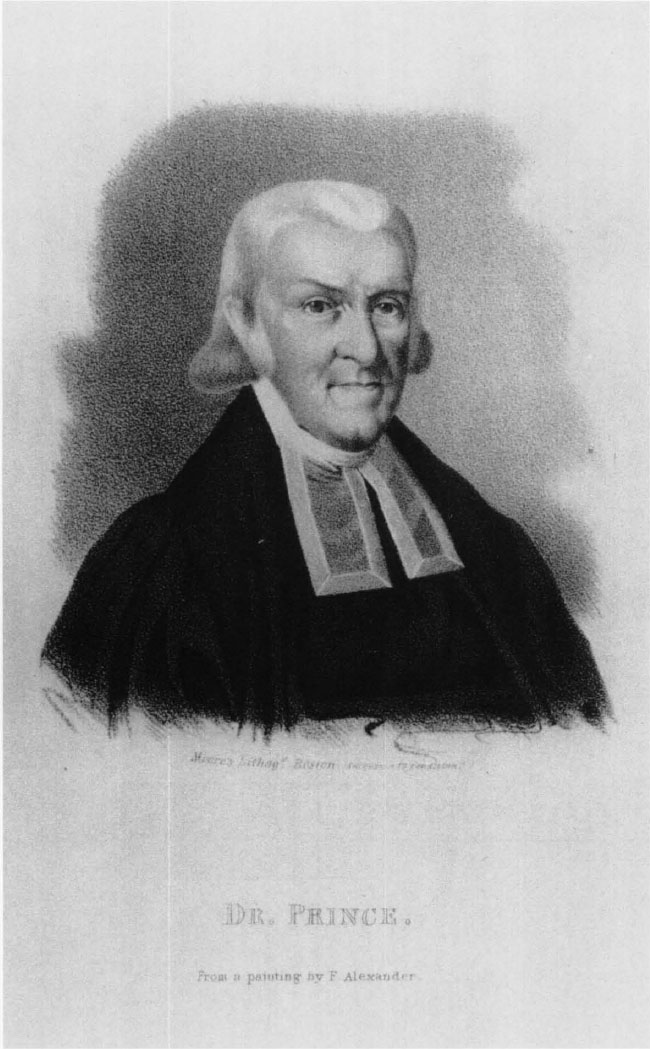
The Rev. Dr. John Prince (1751–1836, shown here) had an unusual path to the pulpit, and an unusual sideline afterward.

He was apprenticed and trained as a tinsmith and pewterer in Boston before entering Harvard at age twenty-one, several years older than a typical undergraduate of the time. After college and a master’s degree, Prince became a minister for Salem’s First Meeting.

Prince’s early practical training allowed him to become an expert on scientific instruments in the early republic. He invented, produced, evaluated, brokered, and repaired apparatus for several institutions, including his alma mater.

Back while he was an undergraduate, Prince was a close witness of the Boston Tea Party and its aftermath. He preserved his recollections of the event in a letter published in the Salem Gazette on 24 Sept 1833:
Mr. Editor,—There is a mistake in the Salem Mercury of last Wednesday, where, in speaking of the tea, it is said “there is a venerable Clergyman in Salem who took a part in the tea frolic, and assisted in emptying the chests into the sea”—

As there is but one clergyman now in Salem, who was a boy old enough to have assisted in the destruction of the tea at that time, viz. Dec. 16, 1773, it is evident who is meant by the “venerable Clergyman,” and he sends you this note to correct the mistake, and inform you that he was only a quiescent spectator of the transaction, and had no hand in destroying the tea. He stood upon the quarter deck of the vessel, leaning over the rail which crossed the deck, while the persons, disguised as Indians, were unloading her, and could plainly see what was doing, though it was principally in the evening.

Two men stood at the hatchway on the main deck, with axes in their hands, and as the chests were hoisted out of the hold they knocked off the tops and emptied the tea into the dock, and threw the chests after it. The tide was out, and the tea was piled up on the flats by the side of the ship as high as her gunwales.

The boy, as the Clergyman is called, was then more than 22 years old, and was not “an apprentice at that time.” He crossed the vessel’s deck in going on shore, and so much of the tea was scattered on it as to be over his shoes, which he found full when he got home; and his hat and clothes were covered with tea dust as a miller is with meal in his mill.

He went on to the wharf the next morning, where a great concourse of people was assembled to view what had been done the night before, (by the Mohawk Indians, it was said). Amongst the people assembled was the old British Admiral, ([John] Montague) who looked with astonishment on the scene of devastation, and said, the Devil is in this people, for they pay no more respect to an act of the British parliament, which can make England tremble, than to an old newspaper, and then went off of the wharf.

In the morning after the tea was thrown overboard the ebb tide carried most of it away, and the empty chests were seen floating down the harbor on the Dorchester shore in a line, extending to the castle. The business of destruction of the tea was conducted without any tumult or great noise; nor was any damage done to the vessel, or to any other effects whatever. The writer of the above knew several of the Indians who did the patriotic work.
Although the Salem Gazette didn’t print Prince’s name with this letter, the Gloucester Telegraph reprinted it on 28 September and blew his anonymity. Prince wrote several more reminiscences of the Revolutionary period for the Salem Gazette, their authorship not confirmed until his death notice.

This 1833 letter put Adm. Montagu at Griffin’s Wharf while complaining about the locals on the morning of 17 Dec 1773, as I discussed yesterday.

As part of its program to mark the graves of seemingly all known, suspected, rumored, or claimed Tea Party participants, the Boston Tea Party Ships & Museum has included Prince as an “honorary participant.” I think that’s more than fair, given that he was actually on board one of the ships and would surely have faced criminal charges if there had been a royal police force to break up the action.

Wednesday, December 20, 2023

“Who was to pay the fidler”?

As I wrote yesterday, George R. T. Hewes’s story of Adm. John Montagu exchanging words with Tea Party leader Lendell Pitts as the men were marching off Griffin’s Wharf on 16 Dec 1773 seems unlikely, in both its details and its essence.

And yet there is contemporaneous support for one point of that story, which might have been the seed it grew from.

On 23 December, Gov. Thomas Hutchinson wrote to his ally Israel Williams about the event. That letter said:
Because a number of Gentlemen, who without their knowledge, the East India Company made the Consignees of 400 Chests of Tea would not send it back again, which was absolutely out of their power, they have forced them to fly to the Castle [for] refuge and then have destroyed the property [commi]tted to their care. Such barbarity none of the Aboriginals were ever guilty of.

The Admiral asked some of them next moring who was to pay the fidler.
That last remark echoes how Hewes would quote Montagu:
“Well, boys, you have had a fine pleasant evening for your Indian caper—havn’t you? But mind, you have got to pay the fiddler yet!”
We also have a Massachusetts source from 1833 saying that Adm. Montagu was on Griffin’s Wharf the morning after the tea went into the harbor, complaining about what the Bostonians had done. (I’ll share that account soon.)

Thus, it’s quite plausible that Montagu asked “who was to pay the fidler” on Griffin’s Wharf the day after the Tea Party, locals who heard him told others, and Hewes incorporated the phrase into his stories of the night, jiggering the details.

Lendell Pitt’s reputed response to the admiral appears to be an example of staircase wit—what Hewes (and his audience) wished someone had a chance to say back to a royal official.

Such scholars of the Tea Party as Benjamin Woods Labaree and Benjamin Carp have recreated events this way, putting Montagu on the wharf on 17 December but not the night before.

Other accounts, built more from tradition than from analyzing early sources, continue to repeat Hewes’s anecdote—as does Johnny Tremain. So it will be with us for a while yet.

Tuesday, December 19, 2023

“The house of a Tory, named Coffin”

As I quoted yesterday, in 1835 George R. T. Hewes told a story about Adm. John Montagu scolding the Bostonians who had just destroyed the East India Company’s tea and Lendell Pitts answering him.

That exchange took place, Hewes said, “at the house of a Tory, named Coffin, who lived at the head of the wharf.”

Montagu did have a connection with a Loyalist named Coffin. Nathaniel Coffin (1725–1780) was the cashier and receiver general in the Boston Customs Office.

Nathaniel’s son Isaac (1759–1839) joined the Royal Navy in 1772, and both the Naval Chronicle and Gentleman’s Magazine stated that Montagu sponsored the teenager’s commission. (Isaac Coffin went on to become an admiral himself.)

That said, Nathaniel Coffin’s house wasn’t at the head of Griffin’s Wharf. It was on the corner of Essex Street and modern Harrison Avenue. Though that estate was waterfront property, it didn’t abut Griffin’s Wharf.

We also have the evidence of Adm. Montagu’s report to his superiors in London, written on 17 Dec 1773. In that document, he said nothing about being in town to witness the destruction of the tea. It’s plausible that if he had been that close, the admiral wouldn’t have included that detail lest it raise questions about why he didn’t use his personal authority to stop the rioters.

But that scenario wouldn’t square with what Montagu did write in that report:
During the whole of this transaction neither the governor, magistrates, owner, nor the revenue officers of this place, ever called for my assistance. If they had, I could easily have prevented the execution of this plan, but must have endangered the lives of many innocent people by firing upon the town.
That sounds like Montagu was on his flagship, fully armed with cannon crew and marines who could shoot at the men on Griffin’s Wharf—at the risk of hitting the hundreds of other people watching them.

But if Montagu had been waiting for a request from the “governor, magistrates, [or] revenue officers” to use such force against the rioters, the last place he would have been would be in a house right beside that location and thus in firing range himself.

TOMORROW: And yet…

Monday, December 18, 2023

“A fine pleasant evening for your Indian caper”?

One of the stories about the Boston Tea Party that I’ve long been skeptical about involved Adm. John Montagu’s remark on the affair to the tea destroyers themselves.

The earliest print appearance of the tale is in Traits of the Tea Party, published in 1835. Benjamin Bussey Thacher wrote that book based on interviews with George R. T. Hewes (shown here) and others.

After describing the destruction of the tea Thacher wrote:
It is remarkable, that all this transaction was carried through in plain sight (and by a fine moonlight too) of the British squadron, which partly lay perhaps less than a quarter of a mile distant from the scene, and at hours when those who belonged to it must have been generally both aboard and awake.

The Admiral, indeed, is believed to have witnessed most of the affair at a much more convenient point, and even to have come ashore for the purpose. When the people marched off, according to Hewes, he shewed himself at the house of a Tory, named Coffin, who lived at the head of the wharf, running up the window, where he sat as they came along, and crying out, “Well, boys, you have had a fine pleasant evening for your Indian caper—havn’t you? But mind, you have got to pay the fiddler yet!”

“Oh, never mind!” shouted Pitts, “never mind, ’Squire! Just come out here, if you please, and we’ll settle the bill in two minutes!”

This raised a shout—the fifer struck up a lively air—the Admiral put the window down in a hurry—and the company marched on.
Hewes identified “Lendall Pitts, a well-known Whig,” as the “commander” or his “division” in the operation.

This type of story that comes up often in nineteenth-century accounts of the Revolution: a British official expressing frustration about Yankee daring and ingenuity, with a Yankee sometimes getting in the last word as well.

It’s a good anecdote. American newspapers started to quote it soon after publication. Many non-fiction authors repeated it. Esther Forbes even used the exchange in her novel Johnny Tremain.

It’s possible Adm. Montagu chose to be in town on the night the Customs department’s deadline for the Dartmouth arrived. But how likely was it that he actually saw men coming off Griffin’s Wharf? How likely was he to have raised a window to tell those men they would have to “pay the fiddler” (suffer the consequences of their action) but do no more? Did Pitts really respond to him like this?

All told, this anecdote seemed too good to be true. It felt like a story made up of what Bostonians imagined royal officials saying and what they wished they could say back.

TOMORROW: Reasons for doubt, and yet…

Sunday, May 22, 2022

“A genuine extract of the letter from Lord Dartmouth”

On 31 Dec 1772, the printer of the Massachusetts Spy, Isaiah Thomas, had a scoop.

Setting type so hastily that he datelined the item “TURSDAY” instead of “THURSDAY,” Thomas presented to the world “a genuine extract of the letter from Lord Dartmouth, to the Governor of Rhode Island, dated Whitehall, September 4, 1772”:
The particulars of that atrocious proceeding (referring to the burning the Gaspee schooner) have by the King’s command been examined and considered with the greatest attention; and although there are some circumstances attending it, in regard to the robbery and plunder of the vessel, which seperately considered, might bring it within the description of an act of piracy; yet in the obvious view of the whole transaction, and taking all the circumstances together, the offence is in the opinion of the law servants of the crown, who have been consulted upon that question, of a much deeper dye, and is considered in no other light, than as an act of high treason, viz. levying war against the King.

And in order that you may have all proper advice and assistance in a matter of so great importance; his Majesty has thought fit, with the advice of his privy council, to issue his royal commission, under the great seal of Great-Britain, nominating yourself and the Chief Justices of New-York, New-Jersey, and the Massachusetts-Bay, together with the Judge of the Vice-Admiralty Court established at Boston, to be his Majesty’s commissioners for enquiring into and making report to his Majesty, of all the circumstances relative to the attacking, plundering and burning the Gaspee schooner.

The King trusts, that all persons in the colony will pay a due respect to his royal commission, and that the business of it will be carried on without molestation; at the same time the nature of this offence, and the great number of persons who appear to have been concerned in it make every precaution necessary. His Majesty has therefore for the further support in the execution of this duty, thought fit to direct me to signify his pleasure to Lieutenant-General [Thomas] Gage, that he do hold himself in readiness to send troops into Rhode Island, whenever he shall be called upon by the commissioners for that purpose, in order to aid and assist the civil magistrate in the suppression of any riot or disturbances, and in the preservation of the public peace.

I have only to add upon that head, that his Majesty depends on the care and vigilance of the civil magistrates of the colony, to take the proper measures for the arresting and committing to custody, in order to their being brought to justice, such persons, as shall, upon proper information made before them, or before His Majesty’s commissioners, appear to have been concerned in the plundering and destroying the Gaspee schooner.

It is his Majesty’s intention, in consequence of the advice of his privy council, that the persons concerned in the burning the Gaspee schooner, and in the other violences which attended that daring insult, should be brought to England to be tried; and I am therefore to signify to you his Majesty’s pleasure, that such of the said offenders as may have been or shall be arrested and committed within the colony of Rhode-Island, be delivered to the care and custody of Rear Admiral [John] Montagu, or the commander in chief of his Majesty’s ships in North-America for the time being, or to such officers as he shall appoint to receive them; taking care that you do give notice to the persons accused, in order that they may procure such witnesses on their behalf as they shall judge necessary; which witnesses together with all such as may be proper, to support the charge against them, will be received and sent hither with the prisoners.
In the same issue, Thomas reprinted the “Americanus” essay I quoted yesterday.

Lord Dartmouth’s instructions to Gov. Joseph Wanton—and no one seems to have doubted this long quotation was genuine—validated some of the warnings from Whigs like “Americanus.” The Crown was planning to transport people accused of attacking H.M.S. Gaspee to Britain for trial. The army and navy had orders to help.

At the same time, the secretary of state also reminded Wanton that those defendants should be able to bring along witnesses on their behalf. Not that a long sea voyage and an indeterminate time in London would be convenient for such witnesses. But the ministers in London still wanted to stick to British standards for fair trials—they just didn’t think that would happen with Rhode Island jurors.

Notably, whatever official leaked this confidential letter did so through a printer in Boston, beyond the reach of Rhode Island law. When the Newport Mercury reprinted the letter in the new year, it credited Isaiah Thomas’s Spy.

TOMORROW: Going viral.

Thursday, May 19, 2022

“The most clement measures shall be adopted towards the Americans”

By the fall of 1772, Rhode Island’s investigations of the attack on H.M.S. Gaspee had run aground as surely as the schooner itself had back on 9 June.

As was standard, Gov. Joseph Wanton had quickly issued a proclamation offering a reward for information—£100, in fact. By July, Adm. John Montagu (shown here) had collected testimony from Aaron Briggs or Biggs, who implicated some prominent merchants.

But Gov. Wanton soon had contradictory testimony from four other people.

James Helme, senior justice in Kings County, told his colleagues that at the October court session he
fully intended to give the affair of burning the said schooner and wounding the lieutenant, in charge to the jury; but having been nearly two months on the circuit, it entirely went out of my mind, when the grand jury was empannelled; and there being no business laid before said jury, they were soon dismissed.
Oops.

However, more was happening in London. In August, the secretary of state for the colonies, Lord Hillsborough, sent to Rhode Island the text of Parliament’s new Dockyards Law. Enacted that spring, it established that destroying a ship in a Royal Navy shipyard was tantamount to treason and subject to capital punishment.

Eventually Crown lawyers agreed that the Dockyards Law didn’t apply since the Gaspee hadn’t been in a naval shipyard when the raiders set fire to it. But Hillsborough’s message told Gov. Wanton how harshly the London government wanted to punish the men who attacked the schooner. (The only person ever executed under the Dockyards Law was James Aitken, alias “John the Painter,” who set fires at the Portsmouth Shipyard in 1777 in sympathy with the American cause.)

For unrelated reasons, in August the Earl of Dartmouth replaced Hillsborough as secretary of state. On 4 September the new minister sent a letter to Gov. Wanton detailing the plan for a royal commission to investigate the Gaspee incident and surrounding conflicts.

Rhode Island’s first report of this commission contained some positive details. The 30 November Newport Mercury shared the news under a 25 September London dateline, emphasizing signs of leniency:
His Majesty… [is] offering his pardon to any of the said offenders (excepting the person who wounded Lieutenant [William] Duddington, & excepting two others who assumed to be sheriffs of the colony, and the Captain or leader of the insurgents) who shall discover any of their accomplices, and also offering rewards for such discovery.

A correspondent informs us, that Lord Dartmouth has signified his determined resolution that the most clement measures shall be adopted towards the Americans.
Furthermore, Gov. Wanton was designated to chair the inquiry commission.

But soon, Rhode Islanders were hearing more ominous details.

TOMORROW: A leak from the legislature.

Monday, May 16, 2022

Rhode Island and the Royal Commission of Inquiry

Yesterday I pointed to the upcoming sestercentennial of the attack on H.M.S. Gaspee, a Royal Navy ship patrolling Narragansett Bay for smugglers.

Some of Rhode Island‘s leading merchants were involved in some way in destroying that ship, including the Browns, the Greenes, Abraham Whipple, and the notorious Simeon Potter.

The organized attackers wounded a British military officer, Lt. William Dudingston, and destroyed a British warship. Some authors, especially from Rhode Island, view it as a prelude or even the first battle of the Revolutionary War. But as I wrote yesterday, it seems significant that this event, for all its bellicosity, didn’t lead to a broader crackdown and war.

One big reason is that the Crown had far less leverage in Rhode Island. That colony was one of only two in North America (the other being Connecticut) where citizens elected their governor via the legislature. In the other colonies, London chose the governor, and usually he arrived with no local allegiances or favors owed.

Furthermore, the Rhode Island legislature chose judges for each year. Elsewhere, the royal government appointed judges for life. And elsewhere those appointed royal governors also appointed sheriffs and justices of the peace.

Rhode Island’s unusual charter left the Crown with only two groups of officials who owed their position and thus their full allegiance to London: the Customs service and the Royal Navy. And of course those arms of government had limited local popularity, as shown by the fact that Rhode Islanders had just burned a naval schooner enforcing the Customs laws.

To investigate the attack, therefore, Lord North’s government set up a Royal Commission of Inquiry. The five officials appointed to it were:
The first four men were already strong Loyalists. Wanton wasn’t yet in that camp, and he was also the only man with local knowledge. When Adm. John Montagu used testimony from an indentured servant named Aaron Briggs to demand an investigation of John Brown, Simeon Potter, and others, Wanton responded by collecting evidence that undercut what Briggs said. The commission’s investigation led nowhere.

Royal authorities in Massachusetts and London learned from the frustrations of the Gaspee inquiry and put those lessons into practice after the next big attack—the Boston Tea Party of December 1773. They didn’t wait for local authorities, even the more numerous and powerful Crown appointees, to identify individual malefactors. Instead, Parliament adopted the Boston Port Bill to pressure the whole town, installed a more forceful governor, sent in troops, and eventually tried to rewrite the provincial constitution.

Thus, for the Crown the main lesson of the Gaspee affair was what not to do.

Tuesday, March 30, 2021

A Funeral Procession for Andrew Oliver

I started this month reviewing the events of early March 1774: the return of the Massachusetts Spy, the death of Lt. Gov. Andrew Oliver (shown here), John Hancock’s Massacre oration, and the second Boston Tea Party.

That wasn’t all. Lt. Gov. Oliver had to be interred. And that funeral was scheduled for the day after the tea destruction.

In his diary, merchant John Rowe wrote one line about the tea, showing how such news had become ho-hum. But he left a long description the funeral:
This afternoon his Honour the Lieut. Governour Andrew Oliver Esq was Buried as Follows.

Colo. Hancock with his Company of Cadets & Colo. [John] Erving with the officers of his [militia] Regimt. preceded the Corps—Colo. Hancock’s Compy. under Arms.

The Bearers were Judge [Samuel] Danforth, Judge [Shrimpton] Hutchinson, Treasurer [Harrison] Gray James Russell Esq, Mr. Secretary [Thomas] Flucker, Foster Hutchinson Esq.

Then Followed the Family,…
That family contingent was smaller than normal.

The late lieutenant governor’s brother Peter Oliver was chief justice, and in February the legislature had impeached him for accepting a Crown salary—raising his public profile, and not in a good way. On the day of the funeral, Chief Justice Oliver wrote, he thought
his Risque of his Life was too great, for him to pay his final Visit to the Death Bed of an only Brother; & his Friends advised him not [to] pay his fraternal Respect to his Brother’s Obsequies—the Advice was just; for it afterwards appeared, that had he so done, it was not probable that he ever would have returned to his own home. Never did Cannibals thirst stronger for human Blood than the Adherents to this Faction…
Gov. Thomas Hutchinson also stayed away to avoid rousing the crowd. The governor’s son Thomas, Jr., had married one of Andrew Oliver’s daughters. But his friends told him that they did “not think it safe for me to attend the funeral.”

The rites didn’t go smoothly. In his history of the province, Hutchinson wrote about his late friend and colleague:
Even his funeral afforded opportunity for the spirit of party to shew itself. The members of the house of representatives, who were invited, being in one house, and the admiral, general [sic], and other officers of the navy and army, in another, the latter first came out, and followed the relatives of the deceased, which was so resented by some of the representatives, as to cause them to refuse to join in the procession, and to retire in a body.
Rowe’s version of that was:
next in order should have the Council & house of Assembly but thro some Blunder the Admirall [John Montagu] & his Core followed the Family & Relations, next them Colo. [Alexander] Lesly of the 64 Regiment & his Core, then the Gentlemen of this & the Neighboring Towns which were very few. . . .

Thro some misunderstanding or Blunder the Gentlemen of the Councill did not attend this Funerall & very few of the House of Representatives.
And that was just the start of the trouble.

TOMORROW: Three volleys and three cheers.

Saturday, August 13, 2016

A Split in the Merchants’ Club in 1771

On Tuesday, 13 Aug 1771, John Adams went into Boston for a weekly meeting of one of his gentlemen’s clubs and discovered that most of the club wasn’t there.

He wrote in his diary:
Spent the Evening at [Hannah] Cordis’s, the British Coffee house.—In the front Room, towards the long Wharfe, where the Merchants Clubb has met this twenty Years. It seems there is a Schism in that Church—a Rent in that Garment—a Mutiny in that Regiment, and a large De­tachment has decamped, and marched over the Way, to [Joseph] Ingersols.

This Evening The Commissary and Speaker, and Speaker and Commissary, Mr. [Thomas] Cushing was present. The Clerk of the House Mr. [Samuel] Adams, Mr. [James] Otis, Mr. John Pitts, Dr. [Joseph] Warren, Mr. [William] Molineux, Mr. Josa. Quincy, and myself were present.
The men left at the British Coffee House were the most politically aggressive members of the Merchants’ Club. In fact, most of those men weren’t even merchants—they were lawyers (Otis, Quincy, John Adams himself), a doctor (Warren), and a full-time politician (Samuel Adams).

Of the remainder, Cushing was pretty busy with the two high provincial offices Adams tagged him with. (Did Adams’s repetition of “Commissary and Speaker, and Speaker and Commissary” hint at some disapproval of dual office-holding?) Molineux appears to have supported himself by managing Charles Ward Apthorp’s local property while setting up a cloth factory. That left only John Pitts concerned full-time with imperial trade. (He would become a selectman in 1773-1777.)

John Adams’s other diary entries for August 1771 show that Otis’s behavior was becoming erratic. He had acted “quite wild at the Bar Meeting” the previous week. Otis had been reelected to his old seat in the Massachusetts General Court in May, but by November the authorities were stepping in. So some members of the Merchants Club might have decamped to get away from Otis.

In general, there was not much support for radical, confrontational politics in late 1771 simply because there was less to confront. The tariff on tea was the only remaining Townshend duty. There were no troops stationed in the center of town. The issues of judicial salaries hadn’t surfaced.

My big question is whether John Hancock was at Ingersoll’s Bunch of Grapes tavern with the “large Detachment” of merchants or had skipped both meetings. In this period Gov. Thomas Hutchinson perceived enough daylight between Hancock and Adams to believe he could win the young merchant over to his side. That didn’t happen, but maybe evenings like this suggested it might.

Friday, April 26, 2013

“King Hancock” and Samuel Dyer

A few days back, I quoted two appearances of the phrase “King Hancock” from 1770, noting that it was written down only when one side of the political divide was attacking the other, usually sarcastically.

That makes it very hard to figure out the phrase’s original meaning—was it ever a sincere compliment to John Hancock? It’s also hard to know who in pre-Revolutionary America actually used the term, as opposed to who was accused of using the term by political opponents.

Take, for example, this appearance of the phrase in the 20 Oct 1774 Norwich (Connecticut) Herald, reporting news from Newport, Rhode Island:
Last Tuesday arrived…Mr. Samuel Dyre, of Boston; who gives this account of himself;---That on the 6th of July last, early in the morning, he was kidnapped by the soldiers in Boston, in consequence of orders from Col. [George] Maddison, and carried into the [army] camp, confined in irons, and kept so till early the next morning, when he was conveyed on board the Captain, Admiral [John] Montague, still in chains.

When he was first confined in the camp, Col. M-------n asked him who gave him orders to destroy the tea, to which he replied nobody; the Col. said he was a damned liar, it was King Hancock, and the damned sons of liberty, and if he did not tell he should be sent home in the ship Captain, where he should be hung like a dog; then told him to prepare a good story, that General [Thomas] Gage would come to examine him, &c. . . .

We must leave time to unfold this dark, very dark affair, of governmental kidnapping, which is a true spawn of hell, nursed up by the church of Rome!
We thus have another American describing how another Briton described other Americans. More specifically, another American Whig, quoted in Whig newspapers, accused a British military man of using the term “King Hancock” to suggest that was how Americans thought of John Hancock. [And I bet you didn’t expect the Spanish Inquisition to show up at the end there.]

Adding to the confusion, Dyer is an unreliable witness. He told wild, and wildly different, stories to people on either side of the conflict. He tried to assassinate a British officer. He persecuted American prisoners. And yet he really was held captive and transported by the British military. (Someday I’ll trace Dyer’s whole twisted story.)

So I don’t think this newspaper story is solid evidence of what Lt. Col. Maddison actually said in 1774. But it is solid evidence that Americans of that time thought it was credible for a British officer to refer to one of their leaders sarcastically as “King Hancock.”

Tuesday, May 29, 2007

Captain Conner: Tea Party thief, scapegoat

You remember the moment in Johnny Tremain when the men of the Boston Tea Party discover Dove, Johnny’s lazy former bedmate, trying to steal some of the tea for himself? Esther Forbes based that incident on a real incident in the 16 Dec 1773 destruction of the tea.

As I quoted back here, merchant John Andrews identified the tea thief as “Captain Conner, a letter of horses in this place.” Shoemaker George R. T. Hewes remembered him as “Captain O’Connor,” and took credit for detecting his pilferage. (Hewes said that “a tall aged man, who wore a large cocked hat and white wig,” stole tea as well.)

I think that man was Charles Conner, an Irishman who owned an inn and stable in Boston. He had testified for the town about the Boston Massacre, having accompanied victim Patrick Carr to that event. I wrote more about his professional and political activity in Boston back in March. But in late 1773 and 1774 he was probably very unpopular in Boston for endangering the nobly disinterested image of the Tea Party.

I’ve come across Conner’s name in one more interesting place. On 30 July 1774, Adm. John Montagu was sailing home to England on the Royal Navy ship Captain (which name sounds like the start of an Abbot & Costello routine, but I digress). He took down a deposition from a sailor named Samuel Dyer, who incriminated three of Boston’s top leaders and “Captain Conner” in enticing British soldiers to desert:

And this Deponant further maketh Oath that Mr: Samuel Adams did promise him, at the House of Doctor [Thomas] Young in June last. that he this Deponant should, (if he could by any means prevail with any of the Soldiers to Desert.) Receive Four pounds sterling for every Soldier so deserting. and that every Soldier should receive the like sum of Four pounds, or three Hundred acres of Land, and a Quantity of Provision, so soon as they arrived at a certain part of the Country. provided they would cultivate the said Land.

and as a further encouragement he this Deponant was authorised by said Adams. to assure each Soldier he could Prevail upon to desert. that Cloaths to disguise them should be Lodged at proper places.

and this Deponant had Authority likewise to call upon Captain Conner Inn Holder near the Mill Bridge in Boston for what Horses he might have occasion for to carry the Soldiers off. and that a Boat should always be ready at Hancocks Wharf if that method of conveying them off. should be Judged the most Eligible, likewise that a Room, or Store belonging to said Conner was provided to conceal them in, until a proper opportunity offered for their leaving the Town, The Key of which this Deponant had in his possession.
Dyer signed this deposition with a mark.

However, there are reasons to find this document suspicious. First of all, putting an army deserter on horseback at Capt. Conner’s inn, near the center of Boston, would be a terrible way to sneak him out of town.

Furthermore, Dyer could sign his name when he wanted to. The day after this deposition, he signed a letter to the Earl of Dartmouth, Secretary of State, asking for protection and support since, he said, people from Boston were asking about what he’d told the admiral.

Finally, when he didn’t get what he wanted from the imperial government, Dyer began to complain loudly that he’d been kidnapped, shipped to England under cover of impressment, and harshly interrogated by high officials. He received support from the Lord Mayor of London (who opposed the party then in power), returned to America, and was warmly welcomed by the Whigs at Newport. Then over the next two years Dyer behaved so erratically that I have doubts about his sanity.

So what does this mean about Charles Conner? I think that Dyer told Adm. Montagu what he wanted to hear about Adams, Young, and Hancock. And I think he pointed the finger at Conner because he knew the Irishman was then an unpopular scapegoat back in Boston. But it’s really hard to guess what was in Samuel Dyer’s mind.

Friday, December 08, 2006

Governor Hutchinson's Military Response

Gov. Thomas Hutchinson's first response to Boston's open meetings about the tea was to invoke his civil authority. On 3o Nov 1773, royal sheriff Stephen Greenleaf brought a document from the governor declaring the gathering in Old South Meeting-House illegal, and ordering the crowd to disperse. Boston town clerk William Cooper noted the moment this way:

A letter from Governor to S. Greenleaf, Esq., read. The sheriff is charged with a message from Governor. Voted, [the message] to be read.

The message from Governor read and hissed.
As I described yesterday, those meetings also established volunteer patrols on the wharf where the tea ship Dartmouth was docked to prevent its taxable cargo from being unloaded. These patrols had the form, if not the legality, of militia units. Admiral John Montagu (whose portrait is shown here) described men on the wharf patrolling "like Sentinels in a garrison."

On 2 December, the Eleanor arrived at the wharfs with its own cargo of tea, and on the 7th the Beaver appeared in the harbor (though it had to stay away from the docks for a week because of smallpox).

Faced with a defiantly militant town, Hutchinson responded by using his own military authority. As governor, he nominally commanded the militia—but what good was that if very few men would obey him? Instead, he called on the regular military. On 8 December, the governor told the admiral to prevent the Dartmouth from leaving Boston without a Customs clearance. Montagu ordered warships to block the channels out of the harbor. A pseudonymous writer in the Boston Gazette also claimed that the British army regiment in Castle William had loaded the cannons in that island fort.

The governor's threat came through loud and clear to the ships' captains. On the 14th, Capt. James Bruce of the Eleanor told the crowd at Old South that he had no personal objections to sailing away without unloading the tea, but that he “was liable to be shot at by 32-pounders” if he tried.

On the 16th, as the deadline for the Dartmouth's unloading or confiscation loomed, Hutchinson and Montagu offered to have the ship towed out to the naval fleet, where the warships could protect it. Francis Rotch, the twenty-three-year-old son of the ship's owner who was trying to negotiate an end to the stand-off, thought that few sailors would agree to help with this maneuver, and the mob would surely punish him and any man who did. He declined.

Therefore, that night the tea ships still floated near Griffin's Wharf, guarded only by local patrols.

CORRECTED: Originally this posting was illustrated by a monument in Westminster Abbey that, Manfred Mondt kindly informed me, honored not Admiral John Montagu but his son Capt. John Montagu. The picture above comes to us from Newfoundland, where Admiral Montagu was governor in 1776-78.