






“It was not the Butler who fell in Battle”
Hastings started by referring to “Your Brother’s Letter of 18th. May.” Later he wrote, “John intends to write to your Brother.” The writer had a younger brother named John, born in 1754 and graduating from Harvard College in 1772. Heitman’s Historical Register of Officers of the Continental Army says John Hastings “Served in the Army in 1775” but doesn’t specify a unit until 1777. Massachusetts Soldiers and Sailors of the Revolutionary War likewise documents his service from 1777 on, rising to brevet major.
It looks like the Hastings brothers, Jacob, and Jacob’s unnamed brother were all part of the same crowd in Cambridge, probably connected with Harvard. Jonathan expected Jacob to know where “the Red House leading to Charlestown” was. Jacob and the Hastings family had financial dealings.
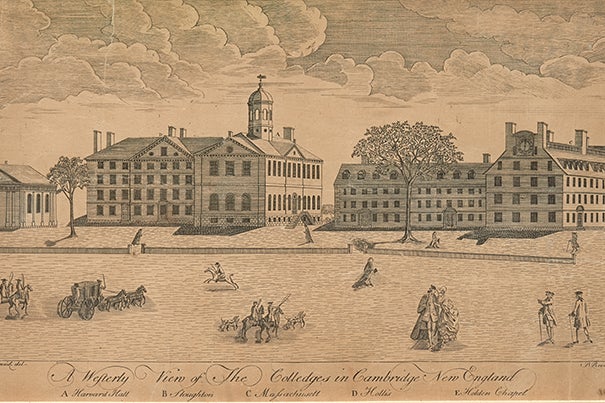
That link offers an explanation for Jonathan Hastings’s line “It was not the Butler who fell in Battle, but a Samuel Cooke from Danvers.” Harvard had a staff position called the butler. This man oversaw the buttery, which sold snacks and other little items to undergraduates. Unfortunately, the Harvard archives says, “there is no complete list of all of the Harvard Butlers.” It looks like the college reserved the job for master’s students to hold for two or three years before moving on.
Harvard’s class of 1772 included Samuel Cooke, Jr. (1752–1795), son of the minister in Cambridge’s Menotomy precinct. Some college documents say Cooke filled in as librarian while reading for his master’s degree. I suspect that he was the college butler in that period, thus known to his classmates and those who came after as well as to the administration.
After Samuel Cook of Danvers was widely reported as killed in the fighting at the Jason Russell House, Jonathan Hastings assured his friend Jacob that this wasn’t the fellow they knew from the buttery. The Menotomy Samuel Cooke, Jr.’s most significant action on 19 Apr 1775 was dragging his father away from the fighting.
TOMORROW: A man on the move and on the make.

No comments:
Post a Comment