J. L. BELL is a Massachusetts writer who specializes in (among other things) the start of the American Revolution in and around Boston. He is particularly interested in the experiences of children in 1765-75. He has published scholarly papers and popular articles for both children and adults. He was consultant for an episode of History Detectives, and contributed to a display at Minute Man National Historic Park.

Subscribe thru Follow.it


•••••••••••••••••


Wednesday, February 29, 2012

The Harrison-Gerry Anecdote

In his Military Journal, published in 1823, Dr. James Thacher inserted this anecdote into his entry for 18 July 1776, which described the reading of the Declaration of Independence at Boston’s Town House:
I am credibly informed that the following anecdote occurred on the day of signing the declaration. Mr. [Benjamin] Harrison, a delegate from Virginia, is a large portly man—Mr. [Elbridge] Gerry of Massachusetts is slender and spare [as shown here]. A little time after the solemn transaction of signing the instrument, Mr. Harrison said smilingly to Mr. Gerry, “When the hanging scene comes to be exhibited I shall have the advantage over you on account of my size. All will be over with me in a moment, but you will be kicking in the air half an hour after I am gone.”
Obviously, Thacher couldn’t have heard that story on 18 July 1776 since the calligraphic copy of the Declaration we know so well wasn’t ready for anyone to sign until early August. But his Military Journal is really a memoir aided by a contemporaneous journal and hindsight.

Thacher appears to have been the first man to publish that story. Niles’s Weekly Register picked it up in its 20 Sept 1823 issue, and it was reprinted in the 1825 Memoir of the Life of Richard Henry Lee and in an 1832 issue of the magazine Atkinson’s Casket of Gems of Literature, Wit and Sentiment.

Just as quickly, however, some critics attacked the tale as preposterous. A review of Thacher’s book in the 18 October Literary Gazette and Journal of Belles Lettres, published in London, cited it a “specimen of his ‘historical facts.’” However, the other example it provided, about the attack on Charlestown during the staging of The Blockade of Boston on 8 Jan 1776, was absolutely true, with contemporaneous reports from both sides of the conflict.

TOMORROW: Thacher’s source, published at last?

Tuesday, February 28, 2012

A Brief Glimpse of Jane Austen at the Bod, 1 March

On Thursday, and for that day only, the Bodleian Library at Oxford University will display two items related to author Jane Austen.

One is the portrait made public last year, said to show Austen as an adult. Its authenticity is under debate. For many decades the only Austen portrait accepted as authentic was a watercolor made by her sister when they were both teenagers.

The second item is a needlework sampler dated 1787, when Austen was eleven. (The Guardian reports the stitches are so worn it looks like it’s dated 1797.)

Both the sampler and the portrait are in private hands, so folks don’t get to see them often. They’re on display Thursday because that’s World Book Day.

Monday, February 27, 2012

March Lectures from the Friends of Minute Man National Park

The Friends of Minute Man National Park is sponsoring a series of lectures on Sunday afternoons in March.

4 March: Hilary Anderson Stelling, “Sowing the Seeds of Liberty: Lexington and the American Revolution”
On a spring day more than 200 years ago, battles at Lexington and Concord launched the American war for independence. “Sowing the Seeds of Liberty: Lexington and the American Revolution” will introduce some of the members of the Lexington community who played a role in these important events, discuss the political and social circumstances that led to the armed confrontation and explore what the choices made on April 19th meant for Lexington residents in the years to come.
11 March: Emily Murphy and Alicia Paresi, “Town and Country: An Exploration of Archeological Collections”
One of the best ways that we can get an idea of how people lived in past centuries is through what they left behind. Join National Park Service historian Emily Murphy and NPS archaeologist Alicia Paresi to explore what the archaeological records say about life in Salem and Lincoln in the late 18th and early 19th centuries, and the surprising similarities between the two.
18 March: George Quintal, “Patriots of Color at Battle Road and Bunker Hill”
At the outbreak of the Revolutionary War, a little more than 20 Patriot men of color responded to the alarm and actively engaged the British on the Battle Road. In the weeks leading up to the Battle of Bunker Hill, hundreds of men of color converged from all over New England to assist at the Siege of Boston. More than 100 fought at Bunker Hill. For decades, these men were forgotten. This talk is one small step in telling their story.
25 March: David Wood, “The Greatest Events of the Present Era: Collecting History at the Concord Museum”
The events of April 19, 1775, permanently changed the way Concord has viewed itself. One example of that is the collection that was begun in 1850 and in 1886 became the Concord Antiquarian Society, now the Concord Museum. In an illustrated presentation Concord Museum curator David Wood will discuss some examples from the museum’s remarkable collection, including objects associated with April 19th and the people who were there on that epochal day.
All these lectures start at 3:00 P.M. at the Minute Man Visitor Center in Lincoln, and all are free—though the Friends suggests a friendly $5 donation.

Sunday, February 26, 2012

Persons of Bronze

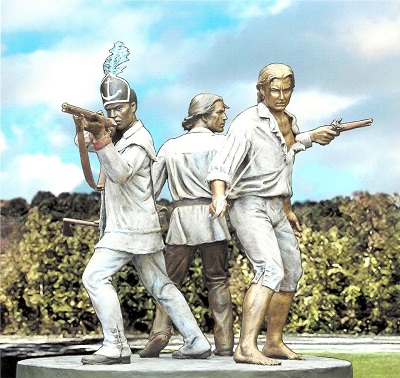
Michael Aubrecht at Blog, or Die just posted information about the choice of a design for the Battle of Pines Bridge Monument in Virginia. That model, by Jay Warren, is striking, to be sure.

The Pines Bridge Monument Committee explains its subject this way:
On May 14, 1781, just after sunrise there was a surprise attack on the first Rhode Island Regiment headquartered at the Davenport House in Croton Heights. This regiment was comprised of African American, Native American and European American soldiers under the command of Colonel Christopher Greene.
Earlier in the war, the First Rhode Island was known for being mostly composed of soldiers of color. Other regiments of the Continental Army had some black and Native soldiers, but they were interspersed among a larger number of whites. That made the First Rhode Island a source of pride for some Americans, but not to others.

On 29 June 1780, Gen. George Washington responded to news of its recruiting difficulties by telling Gen. William Heath, “The objection to joining Greenes Regiment may be removed by dividing the Blacks in such a manner between the two [regiments], as to abolish the name and appearance of a Black Corps.” After that the First Rhode Island’s enlisted ranks were racially integrated like other Continental regiments. Of course, it still had a disproportionately large number of veteran soldiers with African and Native American ancestry.

Coincidentally, at the David Library of the American Revolution’s blog, Judith Van Buskirk just shared thoughts on the challenge of researching the individual men of that regiment.

And I might as well mention that on Saturday, 3 March, I’ll have a public conversation with Marty Blatt, historian of Boston National Historical Park, about Washington’s changing thoughts on black soldiers while he was in Massachusetts in 1775-76. That will take place at noon in the National Park Service visitor center at 15 State Street.

Saturday, February 25, 2012

A Right Gentleman’s

The University of Otago in New Zealand has put up an online exhibit about The Gentleman’s Magazine, the magazine that helped to define the British upper class in the eighteenth century.

The images are slow to download, perhaps because the pixels have to come all the way around the world. Still, it’s useful to see an antipodean judgment of what’s interesting in the magazine. The “Battles” section doesn’t include the major North American battles, and the “Americas” section shows how little people knew.

A lot of the online exhibit focuses on the magazine’s pictures—which are often the best part of any magazine. The portrait of an armadilla comes with a helpful description, but other images speak for themselves, such as the conjoined twins, royal procession, and “Apparatus for conveying Heat to Bodies apparently dead”.

But some material is far too truncated. For example, there’s the introduction to a letter from a father to his fourteen-year-old daughter, but only a little of the letter itself. Fortunately, Google Books also has a lot, if not all, of The Gentlemen’s Magazine in its database, so we can read the rest there. The letter turns out to be all about grammar and commonly confused words (prebendary/prebend). Quite disappointing, really.

Another example is this “Plan of an American Country Town”, showing a carefully symmetric grid. When did that appear? Who created that plan? Was any town actually laid out along those lines? More context shows the answers are: 1770, it’s impossible to say, and almost definitely not.

The university’s exhibit is subtitled “the 18th Century Answer to Google,” but frankly Google is still the answer.

(Thanks to Jeremy Dibbell at PhiloBiblos for the pointer.)

Friday, February 24, 2012

John Adams on Benjamin Harrison’s “Pleasantries”?

Yesterday I quoted John Adams’s critical description of Benjamin Harrison, a Virginian delegate to the Continental Congress, in his autobiography. At another point in that manuscript, Adams wrote of Harrison, “This was an indolent, luxurious, heavy Gentleman, of no Use in Congress or Committees, but a great Embarrassment to both.”

So Adams really didn’t like Harrison. But some people, particularly folks writing about Virginia, really want Adams to have said something nice about Harrison. Clifford Dowdey wrote in The Great Plantation (1957):
Although later Adams conceded Harrison’s contributions and “many pleasantries” that steadied rough sessions, the clashing passions involved in united action are illustrated by venomousness of even John Adams to a fellow patriot…
And in America’s Political Dynasties (1966), which lists Dowdey’s book as a source, Stephen Hess wrote:
Even John Adams, who wrote that Harrison was “of no use in Congress,” had later to admit that the Virginian had contributed “many pleasantries” that steadied rough sessions.
On Wikipedia that’s become:
Adams also commented that “Harrison’s contributions and many pleasantries steadied rough sessions.”
Citation needed, of course.

In a similar process, Freeman Cleaves’s Old Tippecanoe (1990) says:
While Randolph filled the President’s chair, Harrison’s tongue and temper and his “many pleasantries,” according to John Adams, helped to steady a groping Congress.
In Mary Jane Child Queen’s William Henry Harrison: General and President (2006), which lists Cleaves’s book as a source, that became:
It was John Adams who stated, “Harrison’s tongue and temper and his many pleasantries helped to steady a groping congress (Continental).”
So a lot of Cleaves cleaved to the two words he actually ascribed to Adams.

And what’s the source of those two words, “many pleasantries”? Darned if I can find it. That phrase doesn’t appear in the Massachusetts Historical Society’s digital editions of the Adams Papers. To be sure, that project doesn’t yet cover the letters Adams wrote late in his retirement. But the phrase also doesn’t pop up in searching the mid-1800s edition of Adams’s collected writings. It doesn’t appear anywhere in connection with Adams and Harrison before 1957.

Adams was favorably impressed with Harrison when they met. On 2 Sept 1774, at the start of the First Continental Congress, Adams recorded first impressions of the Virginians in his diary:
After Coffee We went to the Tavern, where we were introduced to Peyton Randolph Esqr., Speaker of Virginia, Coll. Harrison, Richard Henry Lee Esq., and Coll. [Richard] Bland. Randolph is a large, well looking Man. Lee is a tall, spare Man. Bland is a learned, bookish Man.

These Gentlemen from Virginia appear to be the most spirited and consistent, of any. Harrison said he would have come on foot rather than not come. Bland said he would have gone, upon this Occasion, if it had been to Jericho.
Later Adams came to dislike Harrison intensely. Not only were they on opposite sides of a lot of debates, but Harrison was big, jovial, and very rich—all things that Adams was not.

Thursday, February 23, 2012

Tell Us How You Really Feel, Mr. Adams

In his manuscript autobiography, John Adams looked back on his Continental Congress colleague Benjamin Harrison:
Although Harrison was another Sir John Falstaff, excepting in his Larcenies and Robberies, his Conversation disgusting to every Man of Delicacy or decorum, Obscæne, profane, impious, perpetually ridiculing the Bible, calling it the Worst Book in the World, yet as I saw he was to be often nominated with Us in Business, I took no notice of his Vices or Follies, but treated him…with uniform Politeness.
Adams’s grandson edited that passage down when he published the autobiography in the mid-1800s, removing the phrases that touched on Harrison’s religious remarks.

Interestingly, in the Congress and in early state politics Harrison was a conservative, whatever his conversation, habits, or thinking.

TOMORROW: Adams has more to say about Harrison.

Wednesday, February 22, 2012

“Mr. Daulton a Tory”?

One of my favorite Revolutionary War memoirs is that of Daniel Granger (born 1762), published in the Mississippi Valley Historical Review in 1930.

Daniel was only thirteen when he showed up on the siege lines in December 1775 to serve in place of his older brother, who was sick and needed to go home. The brothers switched places again around the end of February 1776, so Daniel served less than three months of the siege. But his memories of those months are very vivid, probably because it was such a short, intense time. In December, I was able to use Daniel’s memory of a password to date one of his anecdotes.

However, there’s one detail I just can’t find a match for. Apparently referring to Lechmere Point in Cambridge, Granger wrote:
I well recollect that on the Westerly part of this Point stood a very beautiful Seat, which belonged to a Mr. Daulton a Tory as I was informed with a beautiful Yard, Garden, Trees & Serpentine walks &c &c. But every thing had been cruelly mutillated by the Soldiers out of spite to Toryism.
I can’t find a prominent man named “Daulton” in this area. It’s possible that Daniel heard or remembered the name wrong, or that it was garbled in transcription. Or that the estate he remembered was somewhere else. Or that I haven’t searched for the right spelling variation. Still looking.

Tuesday, February 21, 2012

Upcoming Lectures in Falmouth, Mass.

The Falmouth Historical Society is hosting a couple of off-season lectures about Revolutionary history in the coming weeks.

Wednesday, 22 February
William Fowler on An American Crisis: George Washington and the Dangerous Two Years after Yorktown, 1781-1783
Most people believe the American Revolution ended in October, 1781, after the battle of Yorktown; in fact the war continued for two more traumatic years. During that time, the Revolution came closer to being lost than at any time in the previous half dozen. Fowler, former director of the Massachusetts Historical Society and emeritus professor of history at Northeastern University, examines how Washington held the Revolution together at a time when all of his victories might have been for naught.
This lecture and signing will start at 6:30 P.M. at the Cape Cod Conservatory, 60 Highfield Drive, Falmouth.

Friday, 30 March
Harlow Giles Unger on American Tempest: How the Boston Tea Party Sparked a Revolution
On Thursday, December 16, 1773, an estimated seven dozen men, many dressed as Indians, dumped roughly £10,000 worth of tea in Boston Harbor. Whatever their motives at the time, they unleashed a social, political, and economic firestorm that would culminate in the Declaration of Independence two-and-a-half years later.
This event will start at 6:30 P.M. at the First Congregational Church of Falmouth, 68 Main Street.

The cost for each program is $4 for members of the society, $5 for non-members. Tickets can be purchased at the venue or at the society, 65 Palmer Avenue.

Monday, February 20, 2012

U.S. News Gets Around to the American Revolution

A few months back, I chatted by phone with Michael Morella, Associate Editor at U.S. News & World Report, about the Boston Massacre. That magazine’s editors had decided to assemble a special issue devoted to the American Revolution.

That timely magazine hit the market this month, and it looks like a solid introduction to the topic built from recent books and interviews with recognized experts. The articles are grouped under four themes:
  • Turning Points
  • Diplomacy & Discord
  • In the Trenches 
  • Myths & Legends
As a grab-bag of basic information and intriguing facts, the magazine reminds me of a little paperback I picked up in the Bicentennial and still have. It could well spark some other young person’s interest in the future.

The pictures are a combination of illustrations from the nineteenth and early twentieth centuries that reflect the outlook of their times, photographs that reflect the outlook of ours, and a few eighteenth-century images.

The articles I’ve sampled are all reasonably solid on facts (with the exception of Harlow Giles Unger’s brief description of the tar-and-feathering of Thomas Ditson, Jr., from his book about the Tea Party). I wouldn’t have included four pages on John Peter Zenger’s libel trial a full generation before the Revolution, but then I’m not in the news-printing business. We all have our biases.

Sunday, February 19, 2012

House Tours at Washington’s Headquarters, 22 Feb.

On Wednesday, 22 February, Longfellow House–Washington’s Headquarters in Cambridge is offering free tours focusing on the house’s Revolutionary history every half-hour from 11:30 A.M. to 3:30 P.M. Tours usually take about an hour, and there’s a limit to how many people can be in each group.

George Washington moved into this mansion, left behind by Loyalist John Vassall and family, in the middle of July 1775. Martha Washington joined him in December. The couple was living there during the general’s birthday in 1776, when he turned forty-four. At the time, he was probably more engrossed in deciding whether to move onto the Dorchester peninsula than in celebrating.

This year’s Washington’s Birthday open house marks a changing of the guard at the site. Nancy Jones, Supervisory Park Ranger for several years, is retiring from the National Park Service at the end of the month. Meanwhile, Garrett Cloer has arrived as a new ranger, bringing experience from Independence National Historical Park in Philadelphia. Both will be leading tours on Wednesday. Stop in and say hi!

Saturday, February 18, 2012

How to Make Your Own Prophetic Egg

From volume 9 of The Percy Anecdotes, published in London in 1826:
THE WONDERFUL EGG.

In the year 1819, there was exhibiting in Boston in America, a wonderful egg, said to have been found at a farm house near Bordeaux, having thereon the following inscription:

“Ceci avertit, que Napoleon Bonaparte, remontera sur la trone de France, le 15th Novembre, 1818.”

“This is to give notice, that Napoleon Bonaparte will re-ascend the throne of France, November 15, 1818.”

The advertiser says, “this egg was boiled for breakfast, and discovered by a Lieutenant Patterson, of the British army; and was sold in London in September, for three hundred guineas.”

We should hardly have supposed, that the good folks of Boston could be deceived by such a miserable hoax as this. Nothing is more simple or easy, than the art of making inscriptions upon eggs. Write any words you please upon an egg, with grease, and boil the egg in lime water, with a little onion juice; or place the egg in strong vinegar, for a few hours; and the inscription will appear prominent. We have likewise seen letters raised upon an egg so ingeniously, as hardly to be discovered, with no other instrument than a sharp penknife. The Yankee who can manufacture wooden nutmegs, can make prophetic eggs with as little trouble or expense.
In searching for Plymouth’s “prophetic egg,” I found references to others appearing in Portugal during the Peninsular War and in Macon, Georgia, during the U.S. Civil War. They seem to appear in times of crisis. And now you can make your own for the next time.

(Photograph by Marie Richie, via Flickr under a Creative Commons license.)

Friday, February 17, 2012

“A speaking Egg they substitute”

As I quoted yesterday, a parodic item in the Freeman’s Journal of Portsmouth on 28 Jan 1777 stated that the following lines were discovered on a marble rock by a highly symbolic hermit. They were an answer to the “prophetic Egg” found in Plymouth around that time, warning that Gen. William Howe would conquer America.
——Britannia– sinks beneath her Crimes,
She dies——she——dies——Let Empire rise,
And Freedom cheer the Western Skies.

When every art and menace fails,
And Tory lies and Tory tales,
Are universally abhor’d,
They now pretend to fear the Lord.
Instead of virtue, a long face;
Instead of piety, grimace;
Pretend strange revelation giv’n,
And intimation sent from Heav’n.

To carry on the schemes of Bute,
A speaking Egg they substitute,
A strange Phænomenon indeed,
The stratagem must sure succeed;
And every mortal die with fear,
When they the sad prediction hear.

The Egg was laid without the Tent
Ergo it was from Heav’n sent;
The Egg was found within a barn,
Ergo from it we surely learn,
When Eggs can speak what Fools indite,
And Hens can talk as well as write,
When Crocodiles shed honest tears,
And truth with Hypocrites appears;
When every man becomes a knave,
And feels the spirit of the Slave;
And when veracity again,
Shall in a Tory's bosom reign;
When vice is virtue, darkness light,
And Freemen are afraid to fight;
When they forget to play the men,
And with the spirit of a hen,
Desert the just, the sacred cause,
And op’ning Heaven smiles applause;
On such a bloody barbarous foe,
Then I’ll be conquered by a Howe.
AMERICA.
“Bute” means the third Earl of Bute, tutor to George III and prime minister for less than a year in the early 1760s. American Patriots continued to invoke him as a villain because he was Scottish, because he was a Tory in British politics, and because his name was easy to rhyme.

Frank Moore reprinted this poem (without citing a source) in his Songs and Ballads of the American Revolution in 1855. More people probably saw it in that book than in the original newspaper.

TOMORROW: How to inscribe a message on an egg.

Thursday, February 16, 2012

“About the Time the prophetic Egg was laid in the Town of Plymouth”

After reading the nineteenth-century reports of a pro-William Howe message appearing mysteriously on an egg in Plymouth during the Revolution, I went looking for contemporaneous sources. I found only one reference in the America’s Historical Newspapers database.

That calls into question Dr. James Thacher’s statement in 1832 that “the story of the egg was the subject of newspaper speculation in various parts of the country.” Of course, there might be other articles not picked up by that system, or I may not have searched for the right terms. (Additional mentions welcome!)

The lone response to the egg appeared in The Freeman’s Journal, or New-Hampshire Gazette, published in Portsmouth, New Hampshire, on 28 Jan 1777. That date supports Elkanah Watson’s memory of this event occurring at the same time that Plymouth received word of the American victory at Trenton in late December 1776.

The item started by dismissing superstition—but then it went on to both parody and exploit that credulity:
To the PRINTER.

SIR,

As the Superstition and Weakness of human Nature is such, that sometimes the most trivial Circumstance or grossest Absurdity, is attended with serious Consequences; you are desired to acquaint the Timid & Credulous, that Characters inscribed on Adamant are much more durable than when wrote only on an Egg-Shell. And also to inform the Public, that about the Time the prophetic Egg was laid in the Town of Plymouth, with this wonderful Prediction wrote on its Shell, “Oh, oh, America Howe shall be thy Conqueror,” a Hermit resembling the Genius of America, who had resided in a certain Forest from the first Settlement of the Country, found the following Lines inscribed on a Fragment of Marble near his Cave, visited by the Curious from all Parts of Europe, for the remarkable Eccho which oft reverberated in loud Peals, heard beyond the Atlantic,
TOMORROW: The following lines.

Wednesday, February 15, 2012

Dr. James Thacher’s Story of the Egg

In 1832, Revolutionary War veteran Dr. James Thacher (1754-1844) published a History of the Town of Plymouth that included this anecdote:
An innocent trick was devised by some persons in this town, which occasioned at that time a general surprise and agitation. An egg was produced with the following words imprinted on the shell by the artifice of some tories. ‘O America, America, Howe shall be thy conqueror.’

The egg being taken from the hen roost of Mr. H. on Sunday morning, and exhibited to a concourse of people assembled for public worship excited the greatest agitation, and the meeting was for some time suspended. The tories affected to believe that the phenomenon was supernatural, and a revelation from heaven favoring their cause and predictions; and some whigs were ready to fall into the delusion, when one less credulous, observed that it was absurd to suppose that the Almighty would reveal his decrees to man through the medium of an old hen.

Thus ended the farce; but the story of the egg was the subject of newspaper speculation in various parts of the country, and the alarm which it occasioned in the minds of some people here was truly astonishing.
This story appears to be independent of the first-hand account I quoted yesterday from Elkanah Watson. Thacher inserted the story among anecdotes from before the war while Watson linked it to a Sunday in late 1776 or early 1777 when word of the Battle of Trenton reached Plymouth. Watson misspelled the name of the town’s Whig minister, which appears several times in Thacher’s book: Chandler Robbins.

The two writers also show different attitudes toward the event. Watson had to be convinced by “an ingenious painter” that the message could have been put onto the egg artificially. Thacher, on the other hand, suggested the notion of divine messages by that channel was prima facie “absurd” and a “farce.” Watson and his friends thought the egg was a Tory’s dirty trick. Thacher called it “an innocent trick.”

Both authors independently agreed on one detail: that the egg came from a hen owned by a family with the initial H.

TOMORROW: Tracking back to 1777.

Tuesday, February 14, 2012

Elkanah Watson’s Magic Egg

This anecdote is from Men and Times of the Revolution, the posthumously assembled memoirs of Elkanah Watson (1758-1842). It starts in December 1776 just after young Watson and some friends were inoculated against smallpox:
About the time we left the hospital, Major Thomas, of the army, arrived at Plymouth, from head-quarters. He had left Washington retreating through New-Jersey. I spent the evening with him, in company with many devoted Whigs. We looked upon the contest as near its close, and considered ourselves a vanquished people. The young men present determined to emigrate, and seek some spot where liberty dwelt, and where the arm of British tyranny could not reach us. Major Thomas animated our desponding spirits by the assurance that Washington was not dismayed, but evinced the same serenity and confidence as ever. Upon him rested all our hopes.

On the ensuing Sunday morning, as the people were on their way to church, I suddenly witnessed a great commotion in the street, and a general rush to the back door of Mrs. H—’s dwelling. Supposing the house to be on fire, I darted into the crowd, and on entering the house, heard the good woman’s voice above the rest, exclaiming, with an egg in her hand—“There, there, see for yourselves.” I seized the magic egg, and to my utter astonishment read upon it, in legible characters formed by the shell itself, “Oh, America, America, Howe shall be thy conqueror!”

The agitation and despondency produced, will hardly be appreciated by those unacquainted with the deep excitability of the public mind at that period. We were soon relieved from our gloom and apprehension, by ascertaining from an ingenious painter, who happily came in, that the supernatural intimation was the effect of a simple chemical process. We were convinced it was a device of some Tory to operate on the public feeling.

In the afternoon, an express arrived from Boston; a hand-bill was sent into the pulpit, and at the close of the service our venerable Whig Parson [Chandler] Robins, read from his desk the heart-thrilling news of the capture of the Hessians at Trenton—a happy retort upon the Tories.
Watson’s memoir was published in 1856, or nearly eighty years after this reported event.

TOMORROW: An earlier version of the same anecdote.

(Click on the portrait above or here for the Princeton University Art Museum’s exploration of John Singleton Copley’s 1782 portrait of Elkanah Watson.)

Monday, February 13, 2012

The King’s Bathtub Rediscovered

From the Guardian, 5 February:
As two centuries of lumber was cleared out of the abandoned Georgian kitchens at Kew Palace in west London – the smallest of the royal residences – a unique and poignant piece of royal history was uncovered.

The brown tin tub found stashed away in a chimney opening was the bath in which King George III took regular soakings in hot water, a prescription to calm him as he and his attendants wrestled with his terrifying bouts of mania.

At that time, the early 1800s, he was assumed to have been mad; he is now believed to have developed the hereditary condition porphyria. He was virtually imprisoned at Kew to prevent a political crisis if the full extent of his condition became known, as the previously gentle and clever king roared obscenities and terrified his wife, Queen Charlotte.

The discovery bears out a Kew legend that the tormented king took his baths not in the sumptuously furnished main house, but amid the domestic clatter of the royal kitchen.
Here’s the link to the Guardian article, but I have to warn you that page kept crashing my browser. It doesn’t show the actual tub, which will go on display at the palace.

Sunday, February 12, 2012

George Washington: “when I was young”

On 28 May 1754, Lt. Col. George Washington of Virginia was involved in an embarrassing skirmish that helped to spark the global conflict called the Seven Years’ War. (This little event is sometimes grandly called the Battle of Jumonville Glen.)

Three days later, the twenty-two-year-old officer wrote a letter to his brother John Augustine (Jack) Washington about the experience. It included the line: “I heard the bullet’s whistle, and believe me, there is something charming in the sound…”

That letter got to the Virginia press, and thence to other North American newspapers, and eventually to the August issue of the London Magazine. It made George Washington famous across the British Empire—as an idiot. Or at least a callow youth.

According to Horace Walpole, even George II commented on Washington’s claim to be charmed by whistling bullets: “He would not think so, if he had been used to hear many.”

Meanwhile, Washington suffered a well-deserved and embarrassing loss at Fort Necessity. The next year, he volunteered as an aide to Gen. Edward Braddock. That commander’s British column was caught in an ambush by Native and French soldiers, and Washington was the only aide not killed or wounded. He helped to lead the surviving British forces to safety, keeping the disaster from being even worse.

Once again, reports of that battle, many including Washington’s name, spread across the empire. On 31 Mar 1756, the Earl of Halifax wrote: “I know nothing of Mr. Washington’s character, but that we have it under his own hand, that he loves the whistling of Bullets, and they say he behaved as bravely in Braddocks action, as if he really did.”

More than twenty years after his first skirmish, Washington arrived in Massachusetts as general of the newly adopted Continental Army. The Rev. William Gordon wrote that at some point a gentleman—probably Gordon himself—asked the general about that old “heard the bullet’s whistle” line. Gordon said Washington answered, “If I said so, it was when I was young.”

Saturday, February 11, 2012

Fun & Games at the Paul Revere House, 22-23 Feb.

School vacation week is coming up, and the Paul Revere House in Boston’s North End is planning two special programs on “Fun and Games in the 1700s” on Wednesday morning and Thursday afternoon.

The site’s write-up says:
In colonial Boston did men, women, and children work from sunrise to sunset? The answer is a resounding NO! During a tour of the Revere House, children (and accompanying adults) search for beans, a thimble, bed wrench and other examples of household items the Reveres likely used for both work and play. Then, all participants will try their hands at popular colonial games such as Snail, Ninepins, Jackstraws, and Beast-Fish-Fowl.

Families will leave inspired to turn everyday objects into toys and games and with rules for these and other colonial amusements!
The two sessions are:

  • Wednesday, 22 February, 10:30 A.M. to 12:00 noon
  • Thursday, 23 February, 2:00-3:30 P.M.

The fee is $4.50 for children aged 7-11 and accompanying adults. The price includes admission to the Revere House. Each presentation is limited to 20 people, and reservations are required; call the Revere House at 617-523-2338.

(Picture on top: Thomas Rowlandson’s “Dr. Syntax Playing a Game of Ninepines” from the 1810s but set in an earlier time.)

Friday, February 10, 2012

Dr. Rush’s Bilious Pills

This is a little outside my self-imposed period, but it’s too good to ignore. From Romeo Vitelli’s Providentia blog:
Even today, archaeologists tracing the campsites used by Meriwether Lewis and William Clark in their historic expedition across the Great Plains from 1804 to 1806 can still rely on the relatively high mercury deposits to be found in the soil where the explorers dug their latrines. According to Sam Kean and his excellent book, The Disappearing Spoon, not only did Lewis and Clark set out on their expedition armed with microscopes, compasses, three mercury thermometers, and other scientific instruments, they also carried more than six hundred mercury laxatives, each four times the size of an aspirin, to be used for any digestive problems that they might encounter along the way.

The laxatives, marketed under the name of Dr. Rush’s Bilious Pills, were supplied by Meriwether Lewis’ chief medical advisor and the foremost health authority for the still-growing United States, Dr. Benjamin Rush.
The rest of that posting discusses Rush’s eminence as a physician in the early republic. Vitelli’s Part 2 mainly discusses Rush’s ideas on mental illness and how he had to treat his own son.