J. L. BELL is a Massachusetts writer who specializes in (among other things) the start of the American Revolution in and around Boston. He is particularly interested in the experiences of children in 1765-75. He has published scholarly papers and popular articles for both children and adults. He was consultant for an episode of History Detectives, and contributed to a display at Minute Man National Historic Park.

Subscribe thru Follow.it


•••••••••••••••••


Showing posts with label Peter Fleet. Show all posts

Saturday, November 18, 2017

Preserving the Memories of Lesser-Known Bostonians

This month the city of Boston announced that it had established a “pattern library” for city websites and applications.

One purpose is to ensure that city websites have a common look so citizens recognize them as official and familiar. Another is to cut down on the number of decisions that city employees and contractors must make in setting up a new webpage.

Boston’s pattern library is named Fleet. That name also probably has two purposes. One is to signal the speed that it’s supposed to bring to the task of communicating with constituents.

The second is to keep alive the memory of Peter Fleet, the enslaved engraver and printer who worked on the Boston Evening-Post and many books and pamphlets in eighteenth-century Boston. In making that announcement, the city linked to this Boston 1775 posting about Peter Fleet.

So that’s cool.

Another piece of news this week: The Old North Church has received a generous “Mars Wrigley Confectionery US, LLC Forrest E. Mars, Jr. Chocolate History Research Grant” to fund new research into the life of Capt. Newark Jackson, owner of a chocolate mill in the North End in the early 1700s, and to share that work with the public in various forms, including a comic. I played a small part in that grant application and look forward to tasting the results.

Monday, April 14, 2014

The Fleets Get N.S.F.W.

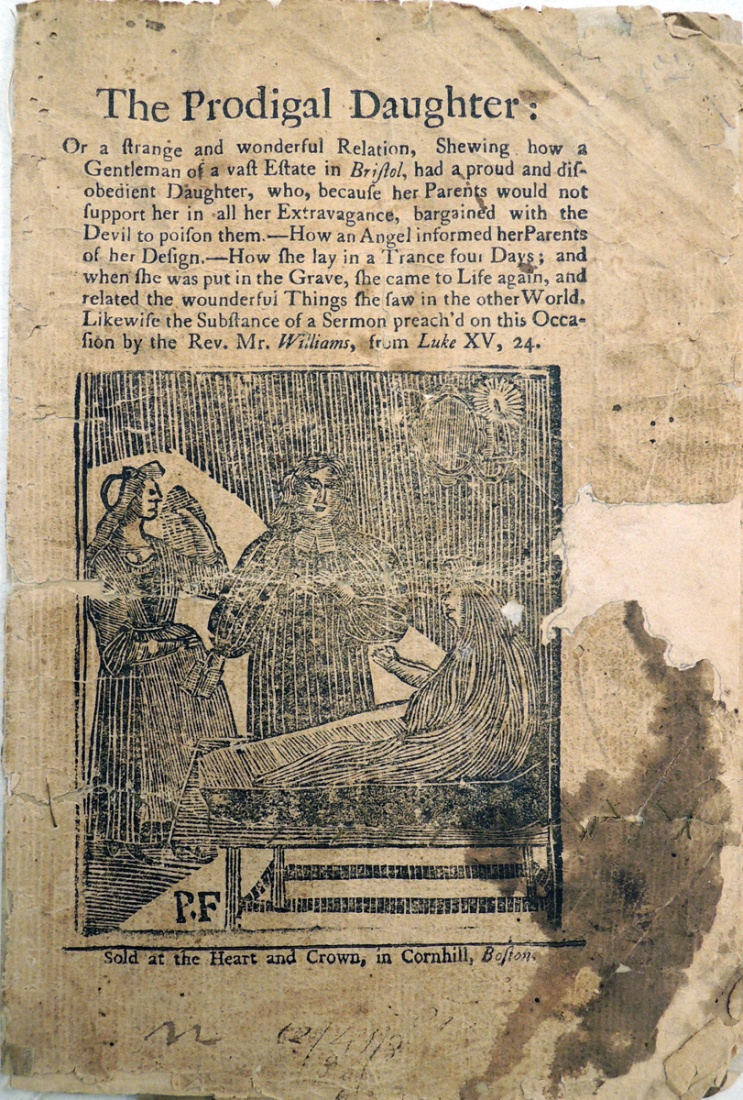
I’ve been writing about the Fleet family, enslaved to Thomas Fleet and trained in the printing business. Isaiah Thomas recalled that in the 1750s a black man named Peter Fleet carved woodcuts for ballads, and the initials “P.F” appear in a small book called The Prodigal Daughter.

On 7 Jan 1751, Thomas Fleet’s Boston Evening-Post featured a woodcut with what looks like Peter Fleet’s typical hatching as its very first item—a rare example of new art in a colonial newspaper. That image illustrated a poem titled “To Mr. CLIO, at North-Hampton, In Defence of MASONRY.”

Though nominally written in the voice of a Freemason, that poem wasn’t much of a defense. It suggested that the organization was just a cover for sodomy. Referring to treenails, or wooden pegs, instead of masons’ trowels, the verse said:

I’m sure our TRUNNELS look’d as clean
As if they ne’re up A–se had been;
For when we use ’em, we take care
To wash ’em well, and give ’em Air,
Then lock ’em up in our own Chamber,
Ready to TRUNNEL the next Member.
And lest anyone miss the sexual reference, the picture made it very clear. (Click on the image below if you want a closer look.)
In addition to the two well-dressed but half-dressed Masons, the woodcut also showed an ass braying, “Trunil Him well brother,” echoing the several references to asses in the poem.

It took work to create a woodcut with this level of detail, and it’s not an image that Thomas Fleet could have used again on broadsides. Someone probably paid the Fleet print shop a hefty sum to create this block and print it and the poem. Again, this explicit bit of gay-baiting was on the front page of a weekly newspaper.

Ironically, Peter Fleet’s younger son Caesar became a Freemason in Boston’s African Lodge in 1779.

TOMORROW: Who was behind that attack?

Friday, April 11, 2014

The Art of Peter Fleet

Finally I’m getting back to the family of enslaved printers in pre-Revolutionary Boston, Peter Fleet and his sons Pompey and Caesar.

In his history of printing, Isaiah Thomas mentioned the last two by name, so when scholars spotted the initials “P.F” at the bottom of the woodcut shown here, they guessed it had been carved by Pompey Fleet.

In fact, Thomas had written that Pompey’s father had carved woodcuts for Thomas Fleet, Sr. Once people remembered the 1743 will of a slave named Peter owned by the Fleet family, they realized that “P.F” could also stand for Peter Fleet.

I’m inclined to credit this cut to Peter, the father. According to E. Jennifer Monaghan’s Learning to Read and Write in Colonial America, Thomas Fleet first advertised this book, The Prodigal Daughter, in his Boston Evening-Post in 1736. We don’t have any definite examples of that edition because the several copies that survive don’t include printing dates. Some copies are estimated as early as 1742. So either Peter Fleet carved that woodcut or the estimated dates are way off because Pompey Fleet wasn’t old enough to do such work until the late 1750s. And Isaiah Thomas never said Pompey made woodcuts.

The Prodigal Daughter is a narrative poem describing how a wicked daughter plotted to poison her wealthy parents in Bristol, England. Luckily, those parents were saved by angels casting the girl into a coma. She lay apparently dead for a few days and then returned to repent and share a vision of the afterlife.

Naturally, the descendants of Boston’s Puritan founders thought that this story, when decorated with several woodcut illustrations of devils and near-dead people, was a wonderful gift for children. Indeed, the earliest copy in Readex’s Archive of Americana database was given to Richard Knowles by his mother.

Thomas Fleet’s sons inherited his business in 1758 and kept printing The Prodigal Daughter with the same illustrations. After the republican Revolution they changed their business sign from “the Heart and Crown” to “the Bible and Heart,” and they kept printing this book.

Isaiah Thomas issued his own edition of The Prodigal Daughter in 1772. Ezekiel Russell issued his in 1790, 1791, and 1797. Both those printers commissioned new illustrations, but the results bear a strong resemblance to those in the Fleet edition. I think Peter Fleet’s style is notable for its heavy vertical hatching.

Nathaniel Coverly, Jr., published The Prodigal Daughter in Boston in the 1810s, using the old Fleet woodcuts—but with the “P.F” scraped off. By then Peter Fleet had probably been dead for more than fifty years. This webpage from Princeton shows three different variations of the book (crediting the art to Pompey Fleet).

The Massachusetts Historical Society exhibits another image from the Fleet print shop probably carved by Peter Fleet. That woodcut originally headed a broadside titled “New England Bravery,” celebrating the conquest of Louisburg in 1745. Thirty-odd years later the (white) Fleet brothers used the same woodcut of a city on a broadside titled “Two Favorite Songs Made on the Evacuation of Boston.” Thus, generations of Bostonians saw the art of Peter Fleet.

TOMORROW: The (black) Fleet brothers go separate ways.

Saturday, April 05, 2014

The Will of Peter Fleet

Yesterday I mentioned an article by Samuel Eliot Morison that the Colonial Society of Massachusetts published in 1924. That article presented the transcript of a will written by Peter, an enslaved printer working for Thomas Fleet.

The original document was then “owned by Miss Mary Lincoln Eliot of Cambridge,” a descendant of Thomas Fleet. Morison, whose racial condescension is well documented (P.D.F. download; see page 55), described it as “written in a crude and semi-legible hand.” Which it might well be, but I’m not convinced Morison would have written any better if he’d been brought up in slavery.

Be that as it may, the will read:

Here Children I leave you some thing, that’s more than any Richest Master’s, Servant would leave to their Master’s Children considering what profit I have to my trade. Thomas Fleet jun Ten shillings and a pair of Buckles; but shall not wear them in three years from ye. time he has them. John Fleet—five shillings. Anne Fleet—five shillings. Elizabeth Fleet—five shillings. Simon five Shillings. Nathan Bowen junr. five Shilllings. Thomas Oliver five Shillings.

What little I had thought to give it to Molley; but thought her sister Anne would make a scuable, and take it from her; that made me continue [ADDENDUM, 3 Aug 2017: Caitlin G. DeAngelis reports this word looks more like “contrive” in the manuscript] so to do, &c.—There is more than enough, yet, left for Molley, because she is very good to servants.

Master and Mistres, I would not have you think that I got this money by Rogury in any thing belong’d to you or any body else, I got it honestly; by being faithful to people ever since I undertook to carry ye. Newspapers, Christmas-days, & New-years days, with contribution with gentlemen sometimes 3 pounds 10/s. and sometimes 4 pounds 10/s. and in ye. years 1743, 5 pounds I would Give you a true account; in my Box you may find a little cask with money, yt. I had when Mr. Wollington was here, I could say when Mr. Vaux was here, that I had some of his money, but I had so much dealing with a wench, yt: I don’t think that I have any of his money. One Way I and Love use to have when we had a great Work for ye. Booksellers, when money we use to have for to get Drink we kept it. I am not great Drinker Nor no Smooker, and I have a little more wit than I use to have formerly amongst ye. wenches.—You may find in my box a 3 pound Bill which I had for my Robin.

All that’s left is for Moley & Venis.

Boston, June ye. 2, 1743. Peter Fleet
The document was also signed by witnesses “Nathan Bowen Junr.” and “Thomas Oliver ye. 3.,” who had also been named as beneficiaries. Nathan wrote, “Sign’d Seal’d & deliver’d in presents of us, the abov Nam’d, & deliver’d to / N. Bowen junr.” Morison didn’t comment about whether that last line was any more or less “crude and semi-legible” than the rest.

Morison suggested that Bowen and Oliver were playmates of the Fleet children. The Thomas Oliver who grew up to be lieutenant governor was born in 1734, which makes him two years younger than Thomas Fleet, Jr., and one year older than John Fleet, so he could be a candidate. The most visible Nathan Bowen, Jr., of the time came from Marblehead, but perhaps he was in Boston for schooling or training.

What are we to make of this will? If Peter Fleet feared he was dying in 1743, those fears were unfounded: he lived long enough to inspire Isaiah Thomas’s attempts at woodcuts in the late 1750s, though he wasn’t listed as part of Thomas Fleet’s estate in 1759. Perhaps Peter Fleet was ill in 1743, or the “New Light” religious revival affecting Boston in the early 1740s had made him think more keenly about morality and mortality.

That said, another clue to this document’s purpose arises from doing the math. Peter Fleet had saved up some of the tips that subscribers to Thomas Fleet’s Boston Evening-Post had given him at New Year’s. In the most recent year those gifts totaled £5, and in other years they were over £4—considerable sums. (This document thus sheds an interesting light on those carriers’ verses I share every New Year’s.)

The will’s references to “Mr. Wollington” and “Mr. Vaux” might name journeymen printers who, arguably, should have shared in those tips. In fact, by law Thomas Fleet probably could have taken all that money in the same way that owners collected their slaves’ wages when they bound them to another employer. But Peter Fleet was at pains to argue in this document that he had come by that cash honestly.

By writing gifts to the Fleet children into this will—more than other slaves would give to their owners’ children, he noted—Peter Fleet may have been preserving his master’s good will and the greater part of his fortune for his own family. The specified bequests total to 40 shillings, or £2, and a pair of buckles. At the same time, Peter Fleet appears to have wanted to pass £3 on to “my Robin,” whom Morrison says was a son. And he leaves the residual of his saved-up cash to Venus, then an enslaved girl seventeen years old (a daughter?), and little Molly Fleet, “because she is very good to servants [i.e., slaves].”

Some authors have characterized this document as “obsequious,” but it may also have been a well-crafted attempt to preserve the private property Peter Fleet had been able to accumulate for his own family.

COMING UP: Peter Fleet the artist.