


J. L. BELL is a Massachusetts writer who specializes in (among other things) the start of the American Revolution in and around Boston. He is particularly interested in the experiences of children in 1765-75. He has published scholarly papers and popular articles for both children and adults. He was consultant for an episode of History Detectives, and contributed to a display at Minute Man National Historic Park.

Subscribe thru Follow.it


•••••••••••••••••


Showing posts with label Dr. John Cuming. Show all posts

Saturday, September 07, 2024

Gunshots in the Countryside
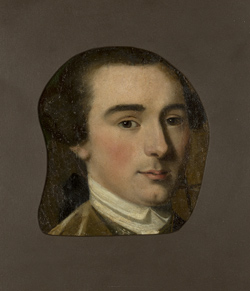
On 7 Sept 1774, 250 years ago today, Henry Vassall was riding in Lincoln when he heard a gunshot.

The only Henry Vassall I was able to find on the family tree at this time was a nineteen-year-old son of William Vassall, discussed yesterday.

Henry was either visiting or staying with his cousin Elizabeth, wife of Dr. Charles Russell (1739–1780, shown here). I wonder if he was studying medicine.

Later that month Henry Vassall told the Charlestown committee of correspondence about his experience. He then wrote out an account for two Middlesex County magistrates, Henry Gardner of Stow and Dr. John Cuming of Concord:
Passing between the House of Mrs. Rebecca Barons [?] & Doct. Russell’s between the Hours of 7 & 9 in the Evening of the 7 instant [i.e., this month] & to the best of my Knowledge as I rose [?] a little Hill a little a past the first Canopy [?] I heard the report of a Gun saw the light and a Ball Enter’d the Carriage which I was in being Doct. Russells.

I immediately step’d out of the Carriage & stood about five or six Minutes & then stepp’d into the Carriage Again & road in haste to the Doctor when I had gone a small Distance from the Place where the Gun was discharged I met a person on Horse back

when I had past a small Distance further I met several Persons riding on two Horses,

whether the Ball was aim’d at the Carriage I can’t say I further declare I do not know or even suspect who the Person was that Discharg’d the Gun as above mentioned . . .

NB. The above affair I declar’d to no person in Lincoln but the Revd. Mr. [William] Lawrence & desired him to keep it secret—Till the Friday Following.
Gardner and Cuming also gathered statements from a local man named Joseph Peirce and Luck, enslaved to Dr. Russell. Both declared that they had been traveling near young Vassall and had heard no gunshot.

Three members of the Lincoln committee of correspondence then wrote back to Charlestown agreeing that they detested “the Crime of Assassination” but casting doubt on Vassall’s complaint:
We shall only add that as the evening on which this event was said to have happened was very calm it is the general opinion here that it is very improbable if not utterly impossible that a gun should be Discharged at that time & place without being heard by many persons, you have Doubtless seen the impression in the Carriage & are able to judge & Declare whether it is the efect of a Bullet Discharged from a Gun or Not as well as any person in this town
This incident provided yet another reason for members of the Vassall family to seek safety surrounded by the king’s soldiers. (And on the same day that the magistrates wrapped up their investigation, people in Bristol, Rhode Island, threw stones at the chaise of Henry’s father and stepmother, William and Margaret Vassall. Newspapers reported that “next morning [they] set out for Boston.”)

This shot in Lincoln is only the second example I’ve found of someone in Massachusetts firing a gun at a supporter of the royal government. The first had occurred a couple of weeks earlier in Taunton.

According to Daniel Leonard, a veteran of the last war named Job Williams came to his house with a warning that “the People were to assemble” to protest how he had joined the mandamus Council. Leonard left, thinking that would head off the problem. Instead, on 22 August , or perhaps make it clear he wouldn’t be welcomed back. That crowd did arrive. Leonard wrote:
about five hundred persons assembled, many of them Freeholders and some of them Officers in the Militia, and formed themselves into a Battalion before my house; they had then no Fire-arms, but generally had clubs. . . .

My Family supposing all would remain quiet, went to bed at their usual hour; at 11 o’Clock in the evening a Party fixed upon the house with small arms and run off; how many they consisted of is uncertain, I suppose not many; four bullets and some Swan-shot entered the house at the windows, part in a lower room and part in the chamber above, where one Capt. Job Williams lodged. The balls that were fired into the lower room were in a direction to his bed, but were obstructed by the Chamber floor. . . . I conclude it possible that the attack upon the house was principally designed for him.
Back in 1769–1770, there had been three increasingly notorious incidents of government supporters shooting at crowds of protestors: the “Neck Riot,” Ebenezer Richardson killing Christopher Seider, and of course the Boston Massacre. But even in that period Massachusetts protestors had never shot at royal officials or their supporters.

These untraceable gunshots in the late summer of 1774 show that some people in Massachusetts were starting to think it was acceptable to use that level of violence against Loyalists.

Thursday, May 16, 2019

“Bateman, he thinks, could not have made the deposition”

When the Rev. William Gordon visited British prisoners of war in Concord in the spring of 1775, he reported that Pvt. John Bateman was “too ill to admit of my conversing with him.”

Bateman didn’t get any better. In 1835 local historian Lemuel Shattuck wrote that this wounded redcoat “died and was buried on the hill.” That was Concord’s elevated burying-ground, shown in the right foreground of the Amos Doolittle print of regulars searching the town.

In 1825 Elias Phinney’s History of the Battle of Lexington argued that the militiamen of Lexington were the first to shoot back at the redcoats. Two years later, the Rev. Ezra Ripley of Concord published A History of the Fight at Concord to refute that claim; five years later, Ripley brought out an expanded edition.

Both Phinney and Ripley gathered new testimony from veterans of the battle to support their case. Ripley also republished John Bateman’s deposition from 1775, which had said, “I testify, that I never heard any of the [Lexington] inhabitants so much as fire one gun on said troops.”

A few weeks back, I quoted some statements that Ralph Waldo Emerson wrote into his diary after a visit from Thaddeus Blood, a long-lived veteran, on 5 Aug 1835. (Thanks to Joel Bohy for alerting me to this latter-day source.) After recording Blood’s recollection of Lt. Isaac Potter, Emerson wrote:
Bateman, he thinks, could not have made the deposition in Dr. R[ipley]’s History. A ball passed through his cap and he cried, “A miss is as good as a mile.” Immediately another ball struck his ear and passed out at the side of his mouth, knocking out two teeth. He lived about three weeks, and his wounds stunk intolerably. It was probably Carr’s or Starr’s deposition.
Evidently Bateman’s wound became infected, and he died in American custody. Don Hagist tells me the muster rolls of Bateman’s regiment, the 52nd, state he died on 21 April, but his deposition was dated 23 April and Gordon encountered him after that. He probably died in early May.

Was Blood correct in saying that Bateman was never well enough to give the testimony published over his name? Probably not. In addition to magistrates Dr. John Cuming and Duncan Ingraham on 23 April, four other people told Gordon that they “heard the said Bateman say, that the Regulars fired first, and saw him go through the solemnity of confirming the same by an oath on the bible.” Those four reported witnesses were Bateman’s fellow prisoners in Concord.

I therefore think Bateman’s 23 April deposition was authentic, though he may well have been under the duress of being a prisoner and needing medical care.

TOMORROW: So who was “Carr” or “Starr”?

Wednesday, May 15, 2019

“The prisoners at Concord in free conversation”

The Rev. William Gordon visited British prisoners in the Concord jail and wrote about it in the form of a letter dated 17 May 1775.

Though from England, Gordon served a meeting in Roxbury and was a strong supporter of the Massachusetts cause. He happily accepted and spread stories that told the provincial side of how the shooting had started on 19 April.

Gordon wrote:
The simple truth, I take to be this, which I received from one of the prisoners at Concord in free conversation, one James Marr, a native of Aberdeen, in Scotland, of the Fourth Regiment, who was upon the advanced guard, consisting of six, besides a sergeant and corporal:

They were met by three men on horseback before they got to the meeting-house a good way; an officer bid them stop; to which it was answered, you had better turn back, for you shall not enter the Town; when the said three persons rode back again, and at some distance one of them offered to fire, but the piece flashed in the pan without going off. I asked Marr whether he could tell if the piece was designed at the soldiers, or to give an alarrm? He could not say which.

The said Marr further declared, that when they and the others were advanced, Major [John] Pitcairn said to the Lexington Company, (which, by the by, was the only one there,) stop, you rebels! and he supposed that the design was to take away their arms; but upon seeing the Regulars they dispersed, and a firing commenced, but who fired first he could not say.

The said Marr, together with Evan Davies of the Twenty-Third, George Cooper of the Twenty-Third, and William McDonald of the Thirty-Eighth, respectively assured me in each other’s presence, that being in the room where John Bateman, of the Fifty-Second, was, (he was in an adjoining room, too ill to admit of my conversing with him,) they heard the said Bateman say, that the Regulars fired first, and saw him go through the solemnity of confirming the same by an oath on the bible.

Samuel Lee, a private in the Eighteenth Regiment, Royal Irish, acquainted me, that it was the talk among the soldiers that Major Pitcairn fired his pistol, then drew his sword, and ordered them to fire…
Most of the prisoners Gordon spoke to were cooperative or even friendly to their captors. Pvts. Marr and Bateman had given depositions to local magistrates back on 23 April, as quoted here.

Pvt. Samuel Lee would end up marrying a local woman named Mary Piper in July 1776. Local tradition says she worked for the Concord physician Timothy Minot. The Lees settled in Concord and raised a family, supported by his skills as a master tailor.

George Cooper was likewise remembered for marrying a local woman, in his case “a woman who lived with Dr. [John] Cuming” as a servant.

That leaves only Pvts. Evan Davies and William McDonald. And they were still left in the Concord jail as of December, shown by another document from the Massachusetts archives that Joel Bohy shared with me.

TOMORROW: How was Pvt. Bateman “too ill to admit of my conversing with him”?

Tuesday, May 14, 2019

Dr. John Cuming, Justice of the Peace

The other Concord magistrate who collected depositions from captured British soldiers on 23 Apr 1775 was John Cuming according to one printed version and John Cummings according to another.

Dr. John Cuming (c. 1728-1788) was from a branch of an aristocratic Scottish family that had settled in Concord. His sisters Ame and Elizabeth Cumings were shopkeepers and “she-merchants” in Boston. They defied the non-importation boycott of 1769-1770, at one point publicly criticized as “enemies of the country.” The Cumings sisters would remain loyal to the Crown.

John Cuming, in contrast, established deep roots in Massachusetts. He became a Concord selectman, chairman of the committee of correspondence, colonel of the local militia, in 1776 a representative to the state legislature, and in 1779 a delegate to the convention to write a new state constitution. He owned slaves and lots of land. He left substantial bequests to Harvard College and the poor of Concord. Even today there’s a building at the local hospital named for him.

After the battle on 19 April, Cuming treated the wounded, including redcoats. According to Concord historian Lemuel Shattuck, based on an interview with Mary Barrett in 1831, “Eight of the wounded [prisoners] received medical attendance from Dr. Cuming, at the house then standing near Captain Stacy’s.” (I don’t know if that’s the same as the Cuming house shown above, but let’s assume.) Reportedly those men included Pvt. John Bateman, one of the redcoats who gave a deposition.

But Bateman doesn’t appear to have been Cuming’s patient yet on 23 April. That deposition was said to have been signed in Lincoln, not Concord. An invoice from Dr. Joseph Fiske that Joel Bohy found in the Massachusetts state archives shows that on 20 April he dressed two prisoners’ wounds in Lincoln, and one of those men was probably Bateman.

After Pvt. Bateman recovered somewhat, the provincial authorities moved him out to Concord to be held with other British men at the county jail. That’s when Dr. Cuming presumably took over caring for him.

TOMORROW: A visit to the jail.

Monday, May 13, 2019

Duncan Ingraham, Justice of the Peace

Yesterday I quoted two depositions of British soldiers taken prisoner on 19 Apr 1775—John Bateman of the 52nd Regiment and James Marr of the 4th.

Both depositions were dated 23 April and attested to by justices of the peace from Concord: Dr. John Cuming (also spelled Cumings, Cumming, and Cummings, of course) and Duncan Ingraham. Interestingly, both those magistrates had Loyalist ties.

First, Ingraham (1726-1811). A sea captain, he was one of the Boston merchants who attacked Loyalist printer John Mein in late 1769.

After a wealthy marriage, Ingraham settled in Concord in 1772 and moved away from the Whig movement. He refused to participate in the renewed boycott of British imports, was ready to hold court sessions in late 1774, and even hosted British army officers at dinner. His neighbors showed their disapproval of that behavior by hanging a sheep’s head and guts on his chaise.

The people of Concord also confiscated Ingraham’s property. In October 1774 the town took four four-pounder cannon from Ingraham—quite possibly the four that were still in town on 19 April. On 3 Jan 1775, Dr. Joseph Lee (another Crown supporter) wrote in his diary, “The mob unloaded Capt. Ingraham’s Bords that were to go to Boston,” where the army might have used them to build barracks.

Because of those conflicts, I’ve even suspected Ingraham of being the “Concord spy” discussed in The Road to Concord, but there’s no smoking cannon to reveal that informant’s identity.

Within a few days after the battle, however, Ingraham was helping to gather and certify depositions from local militiamen, as well as those two captive soldiers, for the Patriot cause. He remained in America through the war and eventually gained enough trust from his neighbors to be elected to the Massachusetts General Court. (That’s when he finally got paid for those cannon.)

After another wealthy marriage, Ingraham moved on to Medford for the last decades of his life. A detail from his gravestone appears above.

TOMORROW: Coming to Dr. Cuming.

[The crossed-out sentence above was corrected in a series of 2021 postings including this one.]

Friday, May 17, 2013

“They came three thousand miles and died”

So how many British soldiers died at the North Bridge in Concord? How many were buried nearby? Those questions have answers, but not definite ones.

As I quoted earlier in the week, one of the British officers there, Lt. William Sutherland, described leaving two men “dead on the Spot.” But Capt. Walter Sloane Laurie reported losing three men overall. And Capt. Lawrence Parsons reportedly saw three men dead at the bridge as he later passed that spot—or was that count influenced by Laurie’s report?

When Zechariah Brown and Thomas Davis, Jr., described burying corpses of the regulars who died at the bridge, they said “neither” had been scalped, suggesting there were two. But their testimony was probably selective. Had another corpse already been moved away?

In 1827, Concord minister Ezra Ripley wrote that in the firing at the North Bridge “Two of the British were killed and several wounded,” with the dead still lying “near the bridge” when their comrades returned from Col. James Barrett’s. Furthermore:
The two British soldiers killed at the bridge were buried near the spot where they fell, both in one grave. Two rough stones mark the spot were they were laid. Their names were unknown. Several others were buried in the middle of the town.
Ripley wrote nothing about Ammi White and his hatchet.

In his 1835 history of Concord, Lemuel Shattuck wrote that “Three British soldiers were killed” at the bridge, but only two were “left on the ground” there and later interred nearby. “One of the wounded died and was buried where Mr. Keyes’s house stood,” Shattuck added. Many later authors have therefore written that two British soldiers were killed immediately at the bridge and another badly wounded, making it back to the center of Concord before dying there.

And who were the “Several others” that Ripley said were interred in central Concord? Shattuck reported that one was Pvt. John Bateman, who died under the care of Dr. John Cuming “at the house then standing near Captain Stacy’s”—Daniel Bliss’s house, according to other authors. (This despite Bateman giving a deposition in Lincoln, not Concord, on 23 Apr 1775.) Bateman “was buried on the hill,” Shattuck wrote.

Don Hagist has reported that Bateman was a grenadier in the 52nd Regiment. The companies at the bridge came from the 4th, 10th, and 43rd. So Bateman must have been fatally wounded in the British withdrawal from Concord, not at the bridge. (It’s notable that some founding settlers of Concord were named Bateman; perhaps people of that town brought him back out of some feeling of kinship.)

According to Shattuck, therefore, there were four British soldiers buried at three sites in Concord soon after 19 Apr 1775. According to Ripley, there might have been “Several others,” but that’s too vague to track down.

TOMORROW: Commemorations and looking for names.

Thursday, April 25, 2013

The Soldier Who Died in Buckman Tavern

I was planning to start this entry by stating: “Because Pvt. John Bateman left a deposition on 23 Apr 1775, we know he hadn’t died from his wounds by that date. And that suggests he wasn’t the soldier buried near Buckman Tavern in Lexington, as memorialized by this stone.”

Except that last night Don Hagist kindly left a comment on yesterday’s posting to report that a British army muster roll says grenadier Bateman died on 21 April—two days before that deposition.

Now I believe the most likely explanation is that the muster roll is in error, based on information transmitted to the British command across the siege lines during an exchange of prisoners or talks leading up to it. My experience is that Patriot depositions were one-sided and incomplete, but not made up out of whole cloth and signed with a dead man’s signature. So I think it most likely that Bateman died after 23 April. Still, it’s a good reminder that our sources might be a crucial day or two off.

As for that stone in Lexington, the basis for it seems to be this passage from an article by Dr. Francis H. Brown, published by the Lexington Historical Society in 1905:
A British soldier was buried in the ground of the Munroe purchase. He was wounded on the 19th of April, and carried to the Buckman Tavern, where he died on the 22d. He was buried at a spot near the Eustis monument. Mr. Eli M. Robbins had the exact spot pointed out to him by Abijah Harrington, who died within a few years. Harrington’s father was sexton in 1775, had buried the soldier and knew the spot well. The exact spot has been pointed out to the writer. The grave should have a permanent mark.
At the same time Brown, Robbins, and the historical society published a collection of “Lexington Epitaphs” which included one non-epitaph for that soldier with an unfortunate typo:
An English soldier
wounded April 19, 1775; died
April 12, 1775; no stone marks
his grave.
The Abijah Harrington “who died within a few years” seems to be the man who lived from 1804 to 1893. His father was Nathan Harrington (1762-1837)—old enough to remember the fighting in Lexington but not old enough to have been the sexton at that time. So there seems to be some confusion along the line: Brown was referring to another Abijah Harrington, the sexton was really that man’s grandfather, or something else. In any event, we can only hope the information about the soldier’s death date was transmitted accurately in one form.

Charles Hudson’s 1913 history of Lexington reprints a bill from Dr. Joseph Fiske (1752-1837) to the Massachusetts Provincial Congress for treating wounded British soldiers, which hints at how many there were. Here are the appointments Fiske billed for:
  • 19 April: one soldier in Woburn, another at the Buckman Tavern in Lexington.
  • 20 April: seven British soldiers at that tavern (probably including the man who died two days later), two in Lincoln (perhaps including Bateman), three more at his uncle’s house in Lexington.
  • 23 April; one soldier in Cambridge.
  • 26 April: back at Buckman Tavern; he dressed the wounds of that last soldier “three times.”
Fiske submitted his bill in June, suggesting that was his complete work for the congress. Meanwhile, as I quoted yesterday, Concord historians say Dr. John Cuming was treating another batch of wounded soldiers in their town.

(Photograph of the modern marker for this soldier’s grave by Caitlin G. D. Hopkins.)

Wednesday, April 24, 2013

The Mysterious Prisoner of Ephraim Flint

To follow up yesterday’s deposition from Pvt. John Bateman of His Majesty’s 52nd Regiment of Foot, here’s another guest-blogger essay from Richard C. Wiggin.

Ephraim Flint “shouldered his musket” on April 19, 1775, “and as one of the results, captured a British Soldier at Lexington, and took him home with him, where he worked some time on the farm of his captor peacefully.” So we are told, at least, by Flint family lore.

The origin of the lore is somewhat obscure, and whatever details might once have filled out the story have long since been lost. The story survives as a one-sentence teaser, repeated by a descendant in the 1904 printed record of the 150th Anniversary Celebration of the incorporation of Lincoln. Is it possible that there could be some truth to this story? And if so, where would one look to find corroborating evidence?

There is a record of a British soldier in Lincoln four days later, on April 23, 1775. John Bateman, of the 52nd Regiment, was deposed in Lincoln as part of the Provincial campaign to document that the British Regulars fired unprovoked upon the locals. His is the only deposition (of twenty taken over three days) that was executed in Lincoln.

In it, Bateman gives no hint as to how or why he happened to be in Lincoln, but he is presumed to be either a prisoner or a deserter. Concord’s Rev. Ezra Ripley suggests that there may have been a fine line between the two. “Willing captives,” he called them in 1827. “They designedly separated themselves from their companions, in order to be taken...prefer[ing] this method to desertion, which would be attended with danger.”

Nor is it clear from Bateman’s deposition at what point he fell into the hands of the Provincials, or whether he may have been wounded. The content of the deposition ends with the firing on the Lexington Green, suggesting that he could have separated from the column before it reached Concord, or at least that he was probably not part of the patrol at the North Bridge. But this is speculative. All we know is that he was in Lincoln four days later.

Can anything be deduced from the fact that Pvt. Bateman was deposed in Lincoln? Nine Lincoln men had traveled to Lexington to be deposed on the same day; another was deposed in Lexington two days later. Is there a reason he could not have gone (or been taken) to Lexington, as well? Why was it necessary for the deposers to travel to Lincoln? Could John Bateman be Ephraim Flint’s prisoner of war?

That essay was adapted from Rick’s new book Embattled Farmers: Campaigns and Profiles of Revolutionary Soldiers from Lincoln, Massachusetts, 1775-1783, available at local bookstores and by mail from the Lincoln Historical Society.

In his 1835 history of Concord, Lemuel Shattuck wrote that Bateman was one of eight wounded soldiers whom Dr. John Cuming cared for; according to other sources, that was at the house of Loyalist Daniel Bliss, who had gone into Boston. Among those soldiers, only Bateman “died and was buried on the hill” in Concord. If Bateman was indeed suffering from a fatal wound, that suggests this man could not have “worked some time” on Ephraim Flint’s farm. It would also explain why he didn’t travel to Lexington to meet with magistrates there.

But Shattuck’s statement raises other questions. If Bateman was wounded, he presumably experienced parts of the battle beyond the skirmish at Lexington; did he have anything to say about those events? Why was Bateman in Lincoln four days after the battle instead of at Dr. Cuming’s improvised hospital in Concord? And finally there’s still the mystery of who was Ephraim Flint’s captive, if indeed there was one.

Thanks, Rick!