J. L. BELL is a Massachusetts writer who specializes in (among other things) the start of the American Revolution in and around Boston. He is particularly interested in the experiences of children in 1765-75. He has published scholarly papers and popular articles for both children and adults. He was consultant for an episode of History Detectives, and contributed to a display at Minute Man National Historic Park.

Subscribe thru Follow.it


•••••••••••••••••


Showing posts with label Robert Pierpont. Show all posts

Tuesday, October 20, 2026

“Remaining unpaid of Mr. Adams Debt to the Town”

A couple of days ago I recounted how in March 1771 the Boston town meeting appointed the merchant William Whitwell and four other men to look into the town’s finances.

That committee finally reported on its inquiry on 9 Mar 1772. Among its conclusions was:
We also find that there still remains to be paid into the Province Treasury on Account of Mr. Samuel Adams the Sum of Fifty Pounds and from the information given us by Mr. Robert Peirpoint it appears that there is no probability of any part of the Sum of £1149 10 0 1/4 remaining unpaid of Mr. Adams Debt to the Town, will ever be received and paid into the Treasury——
Adams had been one of Boston’s tax collectors from 1756 to 1765. He turned over a lot less money than he was supposed to collect. No one believed Adams had kept funds for himself, however. Rather, he hadn’t pressed citizens for everything they legally owed. If the townspeople pressured him for more money, they knew he’d have little choice but to squeeze them back, and no one wanted that.

According to Gov. Thomas Hutchinson, John Hancock had spurred that inquiry while knowing it could harm Adams. The finding that Adams owed more than £1,000 might indeed have been embarrassing except that the town meeting had already voted to sue him for uncollected taxes back in 1767. Hutchinson had presided over an appeal of that suit. Boston had granted Pierpont, one of Adams’s bondsmen, authority to collect back taxes on his behalf. In sum, the outstanding sum was old news.

Whitwell and his committee also found that a couple of more recent tax collectors owed £148 and £432, minus their premiums. The town was in legal negotiations with another former tax collector, Jonathan Payson. Such disputes weren’t uncommon, though Adams’s deficit was much bigger than others.

In addition, the committee found that Thomas Cushing owed £155 and John Ruddock £82 from selling lottery tickets for the town. Both those men were politically active Whigs. Hutchinson suspected Cushing had been another of Hancock’s targets.

Yet later in the same afternoon, the meeting considered the even older debt of “the Linnen Manufacturing Company” that had built the Manufactory building beside the Common. Three “Surviving Members” of that company—Lt. Gov. Andrew Oliver, commissary general Thomas Hubbard, and Dr. Silvester Gardiner—asked the town to write off the remaining amount. The meeting refused. Those gentlemen were on Hutchinson’s side in the political disputes.

One more financial question remained: William Molineux petitioned the town for more money for his spinning enterprise, which provided employment for poor women and children. Or at least to forgive the £300 it had loaned him years before. Molineux was among the Boston Whigs’ most radical leaders.

That question was so involved that the discussion was adjourned to the next day. A “printed Paper” criticizing Molineux was spread around by persons unknown. “After considerable debate,” the meeting heard justice Richard Dana’s judgment that the law wouldn’t let the town forgive Molineux’s debt. So the men at the meeting voted to take no action at all beyond rejecting “unjust Reflections on Mr. Mollineuxs Character” and thanking the man for “his faithful discharge of a Contract.”

Meanwhile, Massachusetts’s royal judges took advantage of how Molineux and his supporters were busy in Faneuil Hall on that 10 March to deliver a royal pardon to convicted murderer Ebenezer Richardson so he could slip out of town unnoticed.

All in all, I see the 1772 inquiry into debts owed the town as fairly ordinary business. I’m sure Hutchinson was pleased that people had to pay attention to Samuel Adams’s “defalcation.” But I doubt the governor was accurate in believing Hancock was secretly, deliberately poking at Adams’s sensitive spot.

TOMORROW: Mr. Adams’s debt.

Monday, September 28, 2026

Hopestill Capen Still in the Boston Jail

We left the Boston merchant Hopestill Capen locked up in the Boston jail in mid-1777.

As a Sandemanian, Capen had stayed loyal to the British Crown—but then he’d stayed in Boston after the British military left. He refused to pledge allegiance to the colonies declaring independence in July 1776, rendering himself suspicious.

As I previously quoted, Capen tried a public plea for his release. His wife Patience petitioned the state government. His friends in the merchant community vouched for him.

On 20 June 1777, the Massachusetts Council approved a petition from merchant Robert Pierpont and others for Capen’s release. The lower house of the General Court “concurr’d as taken into a new Draught.”

A resolution is printed in Massachusetts Acts and Resolves, stipulating that Pierpont and friends would give “Give bond to the Treasurr. of This State in the sum of five hundred Pounds” that Capen would “appear before any Court in the County of Suffolk.”

But apparently the House never agreed to that wording, or those terms. Capen remained in jail.

On 24 Feb 1778, the Council took up a new petition from Patience Capen. That board named Benjamin Austin to a committee to consider it along with whatever members the House named.

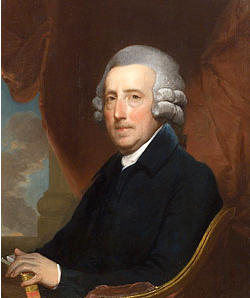
On 3 March, the Council accepted that committee’s recommendation. Moses Gill (shown above) delivered the news to the House. And the House disagreed, telling the committee instead to “enquire of the Committee of Correspondence, &c. of the Town of Boston, respecting Mr. Capen.”

A week later, there was a new report. The Council again agreed with the committee, Jabez Fisher reported. The House again disagreed, and voted to set the petition aside.

The Council, made up of richer men, was apparently inclined to be more lenient, but the House, dominated by rural delegates, was still not in a forgiving mood.

The Massachusetts government had exchanged some of its Loyalist prisoners to bring captives back from New York. That wasn’t an option for Capen since he didn’t want to go over to the enemy.

And thus the legislative term ended in the spring of 1778 with Hopestill Capen still in the Boston jail.

TOMORROW: Change of heart.

Monday, September 14, 2026

“We have esteemed him to be an honest and peaceable citizen”

In May 1777 Boston had a series of town meetings concerned chiefly with its military defenses.

On 17 May that discussion went further to assembling a list of “Persons belonging to this Town, as have been endeavouring since the 19th. of April 1775, to counteract the united Struggles of this & the neighbouring States.”

The town meeting voted to have those twenty-nine men “apprehended & confined”—while recognizing that would require an order from the Massachusetts Council.

Boston’s official list of suspected Loyalists included the Rev. Dr. Mather Byles, Dr. James Lloyd and four other physicians, William Jackson of the Brazen Head, and others. Three of those men were already in jail: Hopestill Capen, Thomas Edwards, and Benjamin Davis, Sr.

On 22 May the town elected seven representatives to the Massachusetts General Court, with John Pitts and Ellis Gray getting the most votes—more than 500.

Some prominent people disagreed with the town’s list of Loyalists. Soon after the new legislative session started, the Council received a petition “praying the Court to give Orders for the Removal of Hopestill Capen, a Prisoner in Boston Goal.” That petition came from a group headed by Robert Pierpont, a Roxbury merchant and official with impeccable Patriot credentials.

Furthermore, it appears Patience Capen had collected ninety signatures on this statement, transcribed in American Archives:
We, the subscribers, inhabitants of Boston, do hereby certify, that Mr. Hopestill Capen is well known to us, and we have esteemed him to be an honest and peaceable citizen; some of us in particular, have experienced his kind and faithful services in securing and saving our interest and property when we were out of the town; and we all join with the petitioner that he may be released from gaol and restored to his family.
The phrase “when were were out of the town” referred to the siege of Boston. Capen had evidently looked after other shopkeepers’ goods or real estate.

Again, those signers included some men deeply involved in Boston’s Patriot movement and town government: William Dawes, Samuel Dashwood, Moses Grant, Timothy Newell, Edward Payne, John Scollay, Pool Spear, Henry Bass, and so on. Other signers were more moderate Whigs—Ezekiel Price, John Andrews, Thomas Fleet, Thomas Handysyd Peck, Duncan Ingraham. But none of those names would raise political or religious suspicions.

Ninety signatures on a petition was a very impressive number. Nonetheless, those men would have been a decided minority in a town meeting attended by up to 500 citizens worried about the town being attacked from without or undermined from within.

On 18 June, Council member Dr. Samuel Holton brought the businessmen’s petition to the House with a proposal to form a committee “to examine the Commission of the Court of Enquiry, and their Doings thereon at large, together with this Petition, and report what is best to be done thereon.” The House approved that step the next day.

And then, it appears, nothing happened for months.

COMING UP: The repetition of Patience Capen.

Monday, November 17, 2025

The Coroners Who Oversaw Inquests after the Boston Massacre

The most famous piece of coroners’ paperwork from the Boston Massacre is a verdict from the inquest into the death of Michael Johnson—or Crispus Attucks, as he was soon to be identified.

That document is in the collection of Revolutionary Spaces and has been on display in the Old State House. It’s been reproduced and transcribed in several places. Here’s an article about its conservation.

The coroner for that proceeding was Robert Pierpont, a Whig who lived at the far southern end of town.

I knew that the Boston Public Library’s Special Collections Department holds several more inquest documents. Mellen Chamberlain collected those papers for the library in the late 1800s, for both their historical value and their autographs.

Last last month, therefore, I made an appointment to look at the Chamberlain Manuscripts. I’ve done research at the B.P.L. for years, but the Special Collections Department upgraded its facilities and tightened its procedures since my last visit, so this required making an appointment and learning some new procedures.

I’m pleased to report that I found the verdicts of two inquests overseen by coroner Thomas Crafts. One examined the body of James Caldwell on 5 Mar 1770, and the second examined Samuel Maverick the next day.

In addition, Chamberlain acquired verdicts from two inquests headed by Thomas Dawes (shown above). He handled the cases of Samuel Gray (6 March) and Patrick Carr (15 March).

The collection also includes testimony for the Gray inquest from Richard Palmes, Robert Goddard, Joseph Petty, and Richard Ward, plus a deposition about aggressive soldiers from John Leach, Jr., that Dawes took in on 6 March. All but one of those witnesses also testified for Boston’s Short Narrative of the Horrid Massacre report or the trials or both. (Frankly, they couldn’t shut Palmes up.)

Thus, we should list Thomas Dawes among the coroners who did the first investigations of the Boston Massacre. In fact, he did more than Pierpont, and more evidence from his inquiries survive.

TOMORROW: So am I satisfied that Thomas Crafts, Jr., was a coroner in 1770?

Thursday, May 08, 2025

“The Body of Michael Johnson then and there being Dead”

Revolutionary Spaces preserves what might be the first piece of legal paperwork arising from the Boston Massacre: the report of an inquest convened the day after the shooting.

This document a printed form filled out with specific details on the deceased and the names and signatures of the coroner and his jury. I’ve transcribed it with the printed words in boldface:
Suffolk, ss.

AN Inquisition Indented, taken at Boston within the said County of Suffolk the Sixth Day of March in the tenth Year of the Reign of our Sovereign Lord George the third by the Grace of God, of Great-Britain, France and Ireland, King, Defender of the Faith, &c. Before Robert Pierpont Gentm. one of the Coroners of our said Lord the King, within the County of Suffolk aforesaid;

upon the View of the Body of
Michael Johnson then and there being Dead, by the Oaths of Benjamin Waldo Foreman Jacob Emmons John McLane William Fleet John Wise John How Nathaniel Hurd William Baker junior William Flagg William Crafts Enoch Rust Robert Duncan William Palfrey & Samuel Danforth good and lawful Men of Boston aforesaid, within the County aforesaid; who being Charged and Sworn to enquire for our said Lord the King, When and by what Means, and how the said Michael Johnson came to his Death: Upon their Oaths do say,

That the said Michael Johnson was wilfully and feloniously murdered at King Street in Boston in the County aforesaid on the Evening of the 5th. instant between the hours of nine & ten by the discharge of a Musket or Muskets loaded with Bullets, two of which were shot thro’ his body, by a party of Soldiers to us unknown, then and there headed and commanded by Captain Thomas Preston of his Majesty’s 29th. Regiment of foot against the peace of our Sovereign Lord the King his Crown and dignity and so by that means he came by his death as appears by evidence.

In Witness whereof, as well I the Coroner aforesaid, as the Jurors aforesaid, to this Inquisition have interchangeably put our Hands and Seals, the Day and Year aforesaid.
This document was made so early that Bostonians hadn’t realized that “Michael Johnson” was really named Crispus Attucks.

Revolutionary Spaces shared an essay about this document’s history as a museum artifact and the work that’s been done to conserve it.

Tonight I’ll speak online to the American Revolution Round Table of New Jersey about how Massachusetts’s legal system responded to the Boston Massacre. Four criminal trials followed that event, though we usually hear about only one or two (so I might end up talking more about the others). 

Friday, March 06, 2020

EXTRA: Collecting “information respecting the Massacre”

As I described earlier, the first order of business at Boston’s town meeting on 6 Mar 1770, 250 years ago today, was to collect “information respecting the Massacre of the last night.” This produced the earliest surviving eyewitness testimony related to that event.

The first man in line with such info was the painter John Singleton Copley, who reported:
that Mr. Pelham and his Wife and some Person of Mr. Samuel Wenthrops Family, heard a Soldier to say after the firing on the last Night, that the Devil might give quarters he should give them none—  
In other words, this soldier would use deadly force in any fight. [The published town records say “fixing” instead of “firing.”]

I interpret “Mr. Pelham and his Wife” to mean Copley’s half-brother Henry Pelham and his own wife Susanna (though conceivably the artist’s other half-brother Charles Pelham and his wife Mary had come in from Newton that night). Hearing this threat might explain why Pelham drew the accusatory picture of the shooting that Paul Revere later copied.

Samuel Winthrop was clerk of the Massachusetts Superior Court, where the soldiers would be tried. Copley painted him in his court robe around this time.

At the same town meeting, John Scott volunteered that “a Lad of Mr Peirpoints said at Mr. [Peter?] Cherdons, that a Soldier was heard to say that his Officer had acquainted them, that if they went abroad at Nights, they should go armed and in Companies.” This may have been the same John Scott chosen for jury duty that fall.

Robert Pierpont himself said: “before the firing on the last Night he had disarmed a Soldier who had struck down one of the Inhabitants.” Pierpont was an active Whig from the South End who had prompted his own riot the previous October. Cpl. Hugh McCann later complained that Pierpont had attacked him soon after the shooting, probably the same incident. Within days, Pierpont was overseeing inquests of the shooting victims as one of the town coroners.

The tailor Pool Spear reported: “last Week he heard one Kilson a Soldier of Pharras Company say…Inhabitants…had broke an Officers Windows [and]…that Parties of Soldiers were ordered with Pistols in their Pockets, and to fire upon those who should assault said House again, and that Ten Pounds Sterling was to be given as a Reward, for their killing one of those Persons, and fifty pounds sterling for a Prisoner.” Spear was then being sued for tarring and feathering the Customs service sailor George Gailer. Apothecary Robert Palmes reported that Spear had been near King Street the night before but went home, sensing trouble.

In such a small town, it seems, almost everyone had a link to the disputes that led to the shooting and a link to the legal system that would adjudicate it.

Another early witness was the shoemaker George Robert Twelves Hewes. His testimony wasn’t entered into the town records appended to more testimony published later, showing his determination to get this story out. Hewes said:
last night, about one o’clock, as he was returning alone from his house to the town-house, he met Sergeant Chambers of the 29th, with eight or nine soldiers, all with very large clubs and cutlasses, when Dobson, a soldier, spoke to him and ask’d him how he far’d, he told him very badly, to see his townsmen shot in such a manner, and asked him if he did not think it was a dreadful thing, said Dobson swore by God it was a fine thing, and said you shall see more of it; and on perceiving I had a cane, he informed Sergeant Chambers of it, who seized and forced it from me, saying I had no right to carry it; I told him I had as good a right to carry a cane as they had to carry clubs, but they hurried off with it into the main guard.
Was this Sgt. Chambers the same who had spent Sunday in a “house of pleasure”? I asked Don Hagist, editor of the Journal of the American Revolution. He said a Sgt. Charles Chambers is listed on the muster rolls of the 29th Regiment in October 1769 and June 1770. A Sgt. Joseph Chambers pops up on the latter roll, never having appeared in the record of the regiment before. So it’s not certain which sergeants were where.

(I was pleased Don could confirm that Matthew Chambers, who serves as an example of a redcoat with a wife and small children through much of Serena Zabin’s The Boston Massacre: A Family History, was a private and thus not the man who visited the brothel.)

It’s striking how none of this testimony that survives from that 6 March meeting directly related to the shooting on King Street, even though people like Hewes had been present. Instead, citizens were warning town officials about the ongoing threat that all the soldiers—not just those already in custody—posed to the people of Boston.

Sunday, October 27, 2019

The Riot against the Neck Guard

I have still more to share about the Otis-Robinson brawl, but sestercentennial anniversaries are catching up, so I’ll have to get back to that story. That fight was just the start of an uptick of violence in the fall of 1769.

The next confrontation started on the night of 23 October, when a housewright and Whig activist named Robert Pierpont (also spelled “Peirpoint”) went to the British army guardhouse on Boston Neck. Pierpont owned land nearby, and he had already complained about soldiers stealing his firewood.

Under the Quartering Act of 1765, when the British government stationed soldiers in a town, the local government was supposed to supply housing and firewood. Boston had already balked at the housing back in 1768, and I don’t doubt they resisted supplying firewood as well. As the nights grew cooler, soldiers might not have worried about the such legalities.

The officers of the Neck guard sent Peirpoint away. Sgt. James Hickman and four men of the 14th Regiment later testified that the local man warned “he would go home where he had a brace of Pistols, would Load them and Fire at the first Soldier that came in his way belonging to the Guard.”

The next morning, a little before 10:00 A.M., a constable came to the guardhouse and asked for the officer in charge, Ens. John Ness. He brought a warrant from justice of the peace Richard Dana for “Stealing wood, assaulting, and knocking down one Robt Peirpoint,” in the ensign’s words.

Ens. Ness refused to leave his post until his shift was done. In other words, he placed the authority of the army over the authority of the local legal system. Instead, the young officer promised to obey the summons after he went off duty. The constable was satisfied with that. And really he didn’t have the force to make an army officer protected by armed soldiers do anything.

But there was force in numbers. Ness recalled: “Some minutes after, Peirpoint with a Number of People, came to the Front of the Guard room abusing, and pressing in upon the Centinels.” Ness assembled his whole guard with their bayonets fixed. For fifteen minutes there was a stand-off, during which “the Mob increased, keeping a little distance from us, throwing dirt, and Giveing a great deal of abuse.”

Then another squad of soldiers arrived to take over the post on the Neck. Ness formed his troops into lines to march them back to their barracks. The crowd, seeing no sign of the officer obeying the legal summons, grew angry. They started “Throwing Stones” at the soldiers. One man was hit “in the Face which made the Blood flow from his mouth and nose,” comrades recalled.

Ens. Ness declared:
In forming the Guard again, which by the Crowding in of the People had been divided, a Firelock, which had been loaded unknown to me went off, on hearing the report I turned about to the Guard, and gave positive orders for no Soldier to Load or Strike any of the Mob.
But that shot had hit the doorway of a forge where a young blacksmith named Obadiah Whiston was working. This was, as far as I can tell, the first gunshot in Boston’s Revolutionary history.

Enraged, Whiston ran after the squad to attack the soldier who had fired, Pvt. William Fowler. Ness said the blacksmith caught up opposite “the Officers Barracks of the 14th Regiment,” coming up on the right side of the troops. Fowler said Whiston “Struck him with a piece of a brick, which Cutt his head in a desperate manner, and for some time deprived him of his Sences.”

Whiston charged up a second time. Sgt. Hickman testified that he “placed the Butt end of my Halbred before him to hinder him from passing, but without striking or doing the said Whiston the least Violence.” Ens. Ness kept his soldiers moving, Fowler now staggering. He got the men “into the Barrack yard” and reported to the regimental commander, Col. William Dalrymple. Despite the crowd throwing rocks, despite Fowler’s musket firing, despite Whiston’s counterattacks, no one had been killed.

The conflict then moved to the courts. Ens. Ness reported to Justice Dana to answer Pierpont’s warrant. Meanwhile, Whiston hurried to a magistrate to swear out a complaint against Sgt. Hickman for assaulting him. The next day, Pvt. Fowler tried to start an action against Whiston, and Ness received a second summons, issued by Dana, John Ruddock, and Samuel Pemberton, for having his men fire on the people.

The proceedings that followed over the next few days showed how biased those Whig magistrates were against the soldiers. They tried to put off Fowler’s complaint. They ignored Pierpont shaking his fist and threatening Ness during the proceedings. They refused to hear testimony from soldiers. They declined to accept bail from a British officer and a Customs solicitor. When Sgt. Hickman was finally released, the crowd yelled, “Bail him with a Rope!” Soldiers said the hatter Thomas Handysyd Peck was particularly abusive. After officers complained about that behavior, Justice Dana declared “that he was deaf and could not hear…any abuse.”

Eventually all those court cases fizzled out. But the Neck guard riot raised tensions in Boston in late October 1769, 250 years ago.

(The map above shows the British fortifications on the Neck during the siege of 1775-76. Back in 1769, there was just a gate and a guardhouse. And a pile of firewood.)

Saturday, January 05, 2019

“The late Company of Jackson and Charles”

As proprietor of the brazier’s shop at the Sign of the Brazen Head, Mary Jackson managed a largely male staff of colleagues, journeymen, and apprentices.

The probate file for Jackson’s late husband James listed five males questioned about goods in the shop when he died: William Coffin, Benjamin Simons, George Reston, Abraham Bennet, and Isaac Beal (as near I can read the handwriting). The clear implication is that those were employees.

I looked for all five names in my usual places and could find only one, but he was a brazier. Late in the winter of 1737, Coffin took out ads in the Boston Gazette and Boston Evening-Post to state:
WILLIAM COFFIN, at the Ostrich, near the Draw-Bridge Makes & Sells Mill Brasses, Chambers for Pumps, Brass Cocks of all Sizes, Knockers for Doors, Brasses for Chaises and Sadlers. Brass Doggs of all sorts, Candlesticks, Shovels and Tongs, Small Bells, and all other Sorts of Founders Ware.

Also all sorts of Braziers and Pewterers Ware, Small Stills and Wormes, and all sorts of Plumbers Work; likewise Buys old Copper, Brass, Pewter and Lead.
Coffin had thus gone into business for himself after working for the Jacksons. But he did so up near the border of the North End.

The 29 Nov 1736 Boston Gazette named another expert working in the Jackson shop:
If any Persons desire to know the true Value of Ores, Minerals, or Metals, of what kind soever, may have them justly Essay’s on reasonable Terms, by Robert Baden, at Mrs. Jackson’s Founder, at the Brazen Head in Cornhill, Boston.
Obviously Baden’s expertise as an assayer of metals was helpful for Jackson as well.

Mary Jackson’s most important coworker—legally her partner in the early 1740s—was a man named Robert Charles. I don’t know if he was from New England or Britain. He was in Boston by 1740 when he was initiated into the St. John’s Lodge of Freemasons.

Records shows at least two Massachusetts craftsmen doing business with the firm of Mary Jackson and Robert Charles (with Jackson always listed first as the senior partner). The clockmaker Benjamin Bagnall bought “wire, brass plates, hinges, locks, and escutcheons, as well as ‘Dolphins for Clock,’” between 1739 and 1743, according to Charles L. Venable’s American Furniture in the Bybee Collection. The Dallas Museum of Art has a Bagnall clock featuring just such dolphin ornaments, shown above.

Helen Schatvet Ullmann’s The Pierponts of Roxbury, Massachusetts says that housewright Robert Pierpont bought £14.6.7 worth of “pew hinges, roundhead nails, a hand saw, a penknife, and other items, including a candlestick and a brass skillet.”

We know about the Pierpont purchases because Jackson and Charles took the housewright to court as they settled accounts to split up their business. The Boston Evening-Post for 9 Apr 1744 ran this notice:
Robert Charles, in Copartnership with Mrs. Mary Jackson, being obliged speedily to go for England, hereby desires all Persons that have any Accounts open with the said Copartnership, to come and settle them before he goes, to prevent further Trouble.

N.B. the said Jackson and Charles have a likely Negro Girl about fourteen Years old to dispose of.
That enslaved girl probably worked in the Jackson household. At the time, Mary’s two sons were a little younger than that girl.

It’s not clear if Robert Charles ever made it to England. On 6 Nov 1745, the same probate judge who oversaw the settlement of James Jackson’s estate appointed Mary Jackson an administrator of Charles’s estate. The last reference to the partnership that I’ve found is an announcement in the 6 Oct 1746 Boston Evening-Post:
All Persons that have any Demands on the late Company of Jackson and Charles, are desir’d to bring in their Accounts to Mrs. Mary Jackson, Administratrix, in order to a Settlement; and all those indebted to said Company are desir’d to pay their respective Dues, as they would avoid being sued.
Ten years after her husband’s death, Mary Jackson was once again on her own.

COMING UP: What was on sale at the Brazen Head.

Friday, July 22, 2011

Joseph Reed and “the property of the Horse”

Yesterday I transcribed a letter from the Rev. Samuel West of Dartmouth (New Bedford), who in the fall of 1775 served as a chaplain and code-buster for the Continental Army.

West asked George Washington if he had to return the horse that the general’s secretary, Joseph Reed (shown here), had provided when he needed to return home from Cambridge.

Washington turned that letter over to Reed, who replied on 17 October:

The General received your Letter of the 11th. Inst. [i.e., of this month] and has directed me to answer it. Mr. [Robert] Pierpont was mistaken in his notion of the Loan of the Horse, which we understood was only requested to accommodate you in your Journey home. I was not at Liberty to go farther. We also understood you proposed to return to the Army shortly; the General having given me no farther Direction upon the Subject, I can only say that if your Business should again call you up here, you can make application, if you do not, you can keep the Horse you have, until you hear farther on the Subject from this. But the property of the Horse in the mean Time is not changed.
Which I interpret as, “I’m not authorized to say the horse is yours, but you can keep it indefinitely if you please please please don’t write us another letter.”

Thursday, July 21, 2011

A Horse for the Rev. Dr. West

In early October 1775, the Rev. Samuel West of Dartmouth (New Bedford) came to Gen. George Washington’s headquarters in Cambridge with a deciphered copy of a letter Dr. Benjamin Church, Jr., had tried to send into Boston.

West had seen that the symbols Church had used to write his letter (shown back here) came in the same frequency pattern as the letters of the alphabet in ordinary prose—i.e., Church had used a simple substitution cipher, one symbol for each letter. West presumably then tried replacing the most common symbol with E, the next most common with T, and so on, looking for common letter groupings. By that method the minister uncovered the complete text.

After West delivered his work, the commander called his generals together for a council of war. The documents showed that Dr. Church, director of the Continental Army’s medical wing, member of the Massachusetts House, and top-level organizer of the Boston Whigs, was secretly sending information to the enemy. This was obviously an intelligence crisis.

At some point in those discussions, news came that the Rev. Mr. West had lost his horse.

When I read that fact in the start of the correspondence that followed, I thought that loss was a result of West’s legendary absent-mindedness. But it turns out losing the horse wasn’t his fault. Even so, the letter he wrote to Washington from Plymouth on 11 October suggests a certain insensibility to how he was coming across:
Sire, When I was at Head quarters the other Day, my good friend mr [Robert] Pierpoint informed your Excellency, that I had lost my horse, and proposed that I should have one of the provincial horses presented to me to supply my loss: the manner in which mr Pierpoint introduced the Subject gave Me a great deal of pain and uneasiness: because I thought it had the Appearance of a design to beg a favor of the Gentlemen of the Army; when therefore Colonel [Joseph] Read offered to Send me an horse to ride home; I was under so much confusion as not to know certainly whether the horse was only lent me to ride home, or whether it was designed to be presented to me for my own: Mr Pierpoint thought that the horse was presented to me as a gift, but I judged from Several things that it was only lent me to ride home; and accordingly had fully determined as soon as I had gotten home to send the horse back by the first opportunity: But several Gentlemen of my Acquaintance upon hearing the Account of the matter judgd that I had a just right to have Satisfaction made me by the continent for my loss, inasmuch as I had preached in the camp five Sabbaths and a fast, and expected no reward for my Services, they thought that I had a right to be made whole by the continent for any Damage I might suffer while I was doing duty in the camp

Colonel [James] Warren of Plymouth Speaker of the house of representatives was so full in this sentiment, that he advised me to present a memorial to your Excellency; and to represent the matter with proper light; not doubting but that your Excellency would judge it proper that the continent should make good the damage that I have sustained. It is in consequence of his Advice, that I have now written this letter to your Excellency. In order, that your Excellency may form a true judgment of the matter, I must briefly state the fact which is thus—Mr. [Samuel] Spring, who is now gone chaplain to Quebec, had liberty granted him by Dr [Nathaniel] Cogswell to take his horse and ride him to Newbury port and to sell him for Nine Pounds, he thro a Mistake took my horse and sold him in the journey to a man belonging to Salem; hearing of this I went to Salem, and when I came there was told that the horse was gone off, the stable door being left open—diligent search was made but he could not be found: Now as there is no person, of whom I can legally demand satisfaction for my loss, except mr Spring, and as it is very uncertain when he will return from Quebec, and as I stand in need of an horse every Day almost when I am at home, if your Excellency thinks my request to be rational and that the publick ought to make good the Damage that I have sustained; I should be glad to have liberty granted me to keep the horse that Colonel Read lent me, till I have proper satisfaction made me by mr. Spring for the loss I have suffered. If your Excellency will send a line to me by the bearer of this Mr. Joseph Howland to let me know whether I must return the horse back by the first opportunity, or whether I may keep him till I am otherwise satisfied it will lay a peculiar obligation upon your Excellencys most humble and obedient Servant Samuel West
And all in rather bad handwriting crowded into uneven sloping lines.

When this arrived, Gen. Washington was still dealing with the fallout from Church’s treachery, anticipating the arrival of three Continental Congress delegates come to review his progress, considering an attack on Boston, trying to launch schooners from Beverly, and looking ahead to the dissolution of his army at the end of the year. But West wanted an answer about that horse.

TOMORROW: The reply from Washington’s headquarters.

Monday, February 14, 2011

A “Romantic” Mansion in Roxbury

In 1874, Emily Pierpont Delesdernier (1840-1915) published Fannie St. John: A Romantic Incident of the American Revolution. Though inspired by family lore, that book was fiction.

Delesdernier described an old Roxbury mansion, built in 1723 by Francis Brinley and bought just before the Revolution by her great-grandfather Robert Pierpont, like this:

It was situated in the midst of a large domain of park and wooded hills, and presented a picture of grandeur and stateliness not common in the New World. There were colonnades, and a vestibule whose massive mahogany doors, studded with silver, opened into a wide hall, where tessellated floors sparkled under the light of a lofty dome of richly painted glass. Underneath the dome two cherubs carved in wood extended their wings, and so formed the centre, from which an immense chandelier of cut glass depended. Upon the floor beneath the dome there stood a marble column, and around it ran a divan formed of cushions covered with satin of Damascus of gorgeous coloring. Large mirrors with ebony frames filled the spaces between the grand staircases, at either side of the hall of entrance. All the paneling and woodwork consisted of elaborate carving done abroad, and made to fit every part of the mansion where such ornamentation was required. Exquisite combinations of painted birds and fruits and flowers abounded everywhere, in rich contrast with the delicate blue tint that prevailed upon the lofty walls.

The state rooms were covered with Persian carpets, and hung with tapestries of gold and silver, arranged after some graceful artistic foreign fashion.

The traditions of the princely grandeur of the ancient home have often been recalled at family reunions, but the old place has suffered many changes at the hands of its various owners, who, in attempting modernizing, have destroyed almost every vestige of former magnificence.
When Gen. George Washington arrived in Cambridge, Gen. Artemas Ward took command of the American army’s southern wing, and used this house as his headquarters. Later, in 1809, Gen. Henry Dearborn, who had started his military career as a young officer from New Hampshire in the siege of Boston, moved into the mansion.

By the mid-1800s, the building had been modified almost beyond recognition. Soon after the publication of Fannie St. John, a fire damaged the eastern portion. By then a Catholic order, the Redemptorist Fathers, owned the property and was building a cathedral nearby.

Delesdernier’s novel provided the only detailed description of the building as it had appeared in the Revolution—even though she hadn’t been alive then, and her description was highly romanticized and fairly Victorian. Several local historians quoted the passage from Fannie St. John, and reprinted the nineteenth-century engraving of the house shown above. Francis S. Drake’s history of Roxbury cited Delesdernier’s “somewhat fanciful description” and added with Yankee hospitality:
This once charming locality has completely lost its identity, and the region from the Parker Hill quarries to “Grab Village” is now largely occupied by natives of the Emerald Isle and their numerous progeny.
In The Glories of Mary in Boston: A Memorial History of the Church of Our Lady of Perpetual Help (1921), the Rev. John F. Byrne quoted the passage and added:
Some of our readers, we presume, will consider the foregoing description overdone, but the lady who wrote it, stoutly maintains its truth and adds that “traditions of the princely grandeur of the ancient home have often been recalled at family reunions.” Moreover, several old residents of Roxbury who were in a position to know, have assured the writer that even in their childhood days the house was famous for its magnificent mirrors.
Of course, those mirrors could have arrived well after the Revolution.

Most recently, the description surfaces in Thomas B. Allen’s Tories: Fighting for the King in America’s First Civil War, a lively history of Loyalists’ experiences. However, through a mix-up of generals’ headquarters, that book presents it as a description of the John Vassall mansion in Cambridge, where Gen. Washington lived starting in late July 1775.

Washington did visit the old Brinley mansion when it was Ward’s headquarters. He presided over councils of war there in November 1775 and again in March 1776, as the Americans were on the verge of victory. So it was the site of historic events, whether or not it was romantic.

Tuesday, March 03, 2009

Dueling Depositions about the 5th of March

Yesterday I quoted from Edward Crafts’s deposition, dated 17 Mar 1770, about what he’d heard from a British corporal named “McCan.” Crafts was testifying about his encounter with soldiers in the hours shortly after the Massacre:

on Monday evening, the fifth instant [i.e., this month], between 11 and 12 o’clock, Mr. Joseph Ayers [Eyres] met me at my gate, and I asked him where he was going. He answered, “To call Mr. Thomas Theodore Bliss to attend at the Council-chamber, to give evidence of the Captain’s giving the soldiers orders to fire on the inhabitants.”

On leaving Mr. Bliss’s door, there passed by us two corporals with about twenty soldiers, with muskets and fixed bayonets; and on their observing our moving towards the Town-house [shown here], the soldiers halted, and surrounded us, saying we were a pack of damn’d rascals, and for three coppers they would blow our brains out.

One of the corporals (viz. Eustice), gave orders for one-half the soldiers to cock, and the rest to make ready. On which we told them, we had nothing to say to them, but were on other business. The corporal, Eustice, struck Mr. Haldan, then in company, and turning to me, aimed a blow at my head with his firelock, which I took upon my arm, and then, with all his might, he made a pass at me, with his fixed bayonet, with full intent to take my life, as I thought. This I also parried with my naked hand. Then a soldier stepped out from among the rest, and presented his musket to my breast, and six or seven more at about eight or ten feet distance also presented.

Upon this I called Corporal McCan, who came to me with a drawn sword or cutlass in his hand, and pushed the gun from my breast, saying, “This is Mr. Crafts, and if any of you offer to touch him again I will blow your brains out.”

Corporal Eustice answered and said, “He is as damn’d a rascal as any of them.”

The next evening about dusk coming by Rowe’s barrack, I saw Corporal McCan who saved my life. He asked me if my arm was broke, I answered no. He said the gun with which Eustice struck me, was broke to pieces. And continued, “You would have been in heaven or hell in an instant if you had not called me by name. One man in particular, would have shot you, seven more presented at you!”
We also have a deposition from Cpl. Hugh McCann of the 29th Regiment about his memories of that night. He was interviewed on 28 July 1770 in Perth Amboy, New Jersey, where the unit had been sent after the Massacre. At the time, royal officials were trying to gather information about how badly Bostonians had treated the soldiers. That effort might even have been designed to respond directly to details in the town report that contained Crafts’s deposition, and that might have reshaped the soldiers’ testimony. In any event, here’s McCann’s recollection:
on the fifth of March at the South End of said Town, in the Evening, as he was walking near the Neck Guard, he was assaulted and struck by Mr. Pierpoint without provocation given and A Mob with him, and with much ado got away with his Life, that the said Pierpoint struck this Deponent with A Broad Bludgeon, and said that the Soldiers were Murdering the Towns People at the Town House, that he the said Pierpoint would never be satisfied while there was A Soldier in the Town.
So who is this “Mr. Pierpoint”? That was almost certainly Robert Pierpont, who owned land near the Neck and made many complaints about soldiers stationed nearby stealing his firewood. In fact, his attempt to serve a writ on an officer there in October 1769 had prompted a nearly fatal riot.

And what do you know? Pierpont also left a deposition about the night of 5 Mar 1770:
that [while he was] going to see a sick neighbor between the hours of seven and eight on Monday evening, the fifth current [i.e., this month], two soldiers armed, one with a broad sword, the other with a club, passed him near the hay market, going towards the town-house, seeming in great haste. In a few minutes they returned and hollowed very loud, “Colonel.”

Before the deponent reached Mr. West’s house, where he was going, they passed him again, joined by another, with a blue surtout, who had a bayonet, with which he gave the deponent a back-handed stroke, apparently more to affront than hurt him. On complaint of this treatment, he said, the deponent should soon hear more of it, and threatened him very hard
Pierpont was one of Boston’s two elected coroners in 1770, so he got to preside over the inquiries into some of the Massacre victims’ deaths—which involved collecting more depositions.

All that legal testimony is wonderful for historians, but it’s vital not to look at the complaints from just one side. As these documents show, almost everybody resented the other side’s actions, and told only part of the story.

Monday, October 15, 2007

The Autopsy of Crispus Attucks

CSI: Colonial Boston continues with the sworn report of Dr. Benjamin Church, Jr., about his examination of the body of Crispus Attucks after the Boston Massacre:

I, Benjamin Church, Jun., of lawful age, testify and say, that being requested by Mr. Robert Pierpont, the Coroner, to assist in examining the body of Crispus Attucks, who was supposed to be murdered by the soldiers on Monday evening the 5th instant, I found two wounds in the region of the thorax, the one on the right side, which entered through the second true rib within an inch and a half of the sternum, dividing the rib and separating the cartilaginous extremity from the sternum, the ball passed obliquely downward through the diaphragm and entering through the large lobe of the liver and the gall-bladder, still keeping its oblique direction, divided the aorta descendens just above its division into the iliacs, from thence it made its exit on the left side of the spine. This wound I apprehended was the immediate cause of his death.

The other ball entered the fourth of the false ribs, about five inches from the linea alba, and descending obliquely passed through the second false rib, at the distance of about eight inches from the linea alba; from the oblique direction of the wounds, I apprehend the gun must have been discharged from some elevation, and further the deponent saith not.

BENJ. CHURCH, Jun.
This deposition was dated 22 Mar 1770, and published in Boston’s official report on the shootings, titled A Short Narrative of the Horrid Massacre. More than two weeks had passed since the event, and the British soldiers who had been on King Street on the 5th of March were already jailed and indicted.

Church’s autopsy report was significant because it pointed the finger at other suspects as well. The fact that the two musket balls “passed obliquely downward” through Attucks’s body implied that they had entered his chest on a slant. But how could that be if they had come from guns held by men of the same size (or possibly a bit smaller), standing no more than a few feet in front of Attucks on King Street?

To Boston’s Whigs, this autopsy helped to confirm an accusation that people employed by the Customs service had fired down on the crowd from the upper storey of their office behind the soldiers. “From some elevation,” as Church said. Four days after the doctor wrote out his deposition, a Suffolk County jury indicted four Customs employees for murder.

Eventually those suspects were all acquitted, and their main accuser convicted of perjury. So how did the musket balls travel “obliquely downward” through Attucks’s torso? One explanation I’ve seen connects this detail with some testimony that Attucks was leaning on a piece of firewood when he was shot. If he was somewhat crouched, and perhaps ducking after Pvt. Edward Montgomery’s opening shot, then one of the next shots could have sent two balls through his chest on a slant—but it was his chest that was oblique, not the trajectory of the balls.