J. L. BELL is a Massachusetts writer who specializes in (among other things) the start of the American Revolution in and around Boston. He is particularly interested in the experiences of children in 1765-75. He has published scholarly papers and popular articles for both children and adults. He was consultant for an episode of History Detectives, and contributed to a display at Minute Man National Historic Park.

Subscribe thru Follow.it


•••••••••••••••••


Showing posts with label diplomacy. Show all posts

Wednesday, September 09, 2026

Forsaken and Lost Founders at the Athenaeum

This month the Boston Athenaeum will host two presentations about Founders less known to the public than the big six. To forget one Founder may be a misfortune, but to lose memory of two would be sheer carelessness.
16 September, 6 to 7 P.M.
The Forsaken Founder
Scott S. Greenberger

When George Washington and the Continental Army faced starvation, he turned to Gouverneur Morris to help devise a plan to provision the troops. When the fledgling nation needed a financial system to sustain the Revolution, Morris again was called upon to help design its first national bank and currency.

When the compromises between North and South, large states and small, had to be stitched into a single governing document, the task of shaping the Constitution’s final language fell largely to him. At the Constitutional Convention, Morris spoke more often than any delegate save James Madison—and more forcefully against slavery. When Alexander Hamilton died in a tragic duel, his widow insisted that Hamilton’s closest friend, Gouverneur Morris, deliver the eulogy.

Morris continued to serve the republic after its founding as envoy to France during the Revolution and Reign of Terror, and as an early visionary who grasped that New York, not Philadelphia, could become the nation’s economic capital if a canal opened the interior to the sea.

In this deeply researched biography, The Forsaken Founder, Scott Greenberger restores this indispensable figure to history and asks why one of the most prescient and principled founders faded from memory. Was it his uncompromising opposition to slavery? His unapologetic aristocratic style? His belief that liberty required structure as well as passion?

Scott S. Greenberger is coauthor of the New York Times bestseller Critical: What We Can Do About the Health-Care Crisis and author of The Unexpected President: The Life and Times of Chester A. Arthur. Currently the executive editor of Stateline, he has been a newspaper reporter at the Austin American-Statesman and the Boston Globe. Greenberger has a bachelor’s degree in history from Yale University and a master’s degree in international relations from George Washington University.

Tickets are required for this event. Athenaeum members can attend with up to three guests at no cost. Visitor tickets are $20.
28 September, 6 to 7 P.M.
The Lost Founder
Jesse Wegman

As a young lawyer, James Wilson made a celebrated case for American independence in an essay that inspired the famous words “We hold these truths to be self-evident, that all men are created equal.” He wrote the first draft of the Constitution and, along with the more famous James Madison, played perhaps the essential role in its ultimate creation.

Wilson believed that the people are the ultimate source of all power. He argued successfully for a strong central government and a powerful presidency, and fought unsuccessfully for a direct vote for the President and the Senate. Appointed as a justice to the first Supreme Court, he was later brought down by reckless land speculation and died of malaria in the back room of a North Carolina tavern while hiding from his creditors.

Instead of being remembered as one of the nation’s great political thinkers, Wilson was virtually written out of history. But in The Lost Founder, Wegman brings to life the most prescient of the earliest patriots and makes a convincing argument that scandal should not diminish the life and impact of a brilliant, complicated man whose vision for his country could not be more relevant today.

Jesse Wegman is a senior fellow at the Brennan Center for Justice, where he works with the Kohlberg Center on the U.S. Supreme Court and the Future of the Constitution Advisory Committee. From 2013 through 2025, Wegman was a member of the New York Times editorial board. His work was part of a package that won the Pulitzer Prize for Public Service in 2018. Wegman is the author of Let the People Pick the President: The Case for Abolishing the Electoral College.

Tickets are required for this event. Athenaeum members can attend with up to three guests at no cost. Visitor tickets are $20.

Wednesday, May 13, 2026

“Stimuli to induce him to be useful to this Country”

One of the questions asked after yesterday’s talk on young Benjamin Thompson’s life in America was whether he interacted with any representatives of the U.S. of A. during his European career.

For example, did the former Woburn farmboy, royal government undersecretary, and British cavalry officer cross paths with John Adams, minister to Britain in the 1780s?

It appears that the two men never met since the first letters they exchanged, in 1796, show no personal acquaintance. By then Thompson had become the celebrated Count Rumford, and he was sending Adams a volume of his scientific papers and a large sum to endow a prize through the American Academy of Arts and Sciences. Rumford continued sending volumes to Adams through the Rev. William Walter.

In 1799, Abigail Adams wrote of “Rumfording our Chimney’s, which I shall be for trying. I am persuaded half the expence of fuel may be saved, and Rooms kept equally warm.” The Woburn native had become famous enough to be a verb.

In 1820, John Adams sent off multiple letters pursuing the theory that “the late learned ingenious scientific public Spirited and benevolent Count Rumford” was a descendant of “the well known Rev. William Tompson of Braintree.” (He was not.)

But the most striking intersection between Rumford and Adams arose in June 1799, when Adams’s secretary of war, James McHenry, wrote about inducing the count to offer his talents to the U.S. Army:
I think it was mentioned to you, some time last winter, by the Secretary of State [Timothy Pickering], in consequence of a letter he had just received from Mr. [Rufus] King [minister to Britain 1796–1803 and 1825–26], that Count Rumford intended to visit his native country, at which you seemed pleased, and expressed yourself favourably of his talents.

Mr. King has renewed the subject to the Secretary of State, and in a letter to me, which I have the honour to inclose. As the reference of the subject to me, can only be meant so far as it respects the military department, I beg leave to submit for your consideration, whether it would not be to the advantage of the United States to make such a proposal to the Count, which if accepted, would ensure to the army the full benefits of his skill and experience.

There is still a vacancy of Lt. Colonel, to be filled for one of the Regiments of Artillerists & Engineers. . . .

1. He may be offered the vacant commission of Lt. Colonel and be made also Inspector of Artillery. Or if he prefers it. 2d. He may be invited to accept of the office of Engineer…

As I consider him to be less of an Engineer than an Artillerist, altho in this I may be mistaken I should think it most adviseable to give a preference to the first proposition. If he accepts of it, he can also superintend the establishment of a military academy which the laws so far contemplate, as to have made provision for books, instruments, and teachers.

At any rate, if the Count should refuse himself to either office, the offer cannot be otherwise than grateful, and if he wanted any stimuli to induce him to be useful to this Country, to the extent of his talents, it might have its effect.
Adams had no idea that back in 1775 Thompson had been slipping secret intelligence to Gen. Thomas Gage—a fact that would probably have changed his admiration for the man.

As for Rumford, it’s hard to imagine that a man who had administered an entire country in Europe could be swayed by the prospect of being a lieutenant colonel in America. He never did come back.

Friday, February 20, 2026

The J.A.R.’s Books of the Year

The Journal of the American Revolution has announced its 2025 Book of the Year Award.

The winner is The American Revolution and the Fate of the World by Richard Bell (no relation, for the record).

The citation says:
The American Revolution undoubtedly changed world history. Many nations seeking their own independence tried to emulate the ideals of the Declaration of Independence, a document whose words still influence national and world events. What many people do not realize was that, at the time, the Revolution directly affected places all over the world. It was truly a global happening, reaching not only Europe, but also Latin America, India, China, and even Australia.
This is a book of synthesis, bringing together recent scholarship by many people to provide a global look at.

One of the runners-up took the opposite approach, looking at one community within one Massachusetts port: Enemies to Their Country: The Marblehead Addressers and Consensus in the American Revolution by Nicholas W. Gentile.
Gentile demonstrates how, even before a single shot was fired, the Revolution lived in the minds of this town’s residents as they harshly reacted to thirty-three signers of a letter of support to the departing governor Thomas Hutchinson. What follows is an interesting look at dynamics in this town—heavily influenced by Puritan theology—and the ways in which residents exerted social pressure to essentially coerce the signers back to the Patriot cause, placing ultimate importance on maintaining unity. Signers (“Addressers,” as they were called) ended up recanting through written and published statements, showcasing the growing importance of print culture during this period and the role that it played in creating a uniform identity going into the conflict. Gentile traces the fate of each of the thirty-three as they recanted and either rejoined the Patriot cause or, in the case of several, led lives in exile.
The other runner-up, The Course of Human Events by Steven Sarson, is a study of the intellectual roots and immediate impetuses behind the Declararion of Independence.

Thursday, January 29, 2026

America’s History Conference in Glen Allen, Virginia, 27–29 Mar.

America’s History, L.L.C., will hold its thirteenth Annual Conference of the American Revolution in Glen Allen, Virginia, on 27–29 March.

Here’s the lineup of speakers:
  • Richard “Rick” Bell on “The American Revolution and the Fate of the World”
  • Todd W. Braisted on “‘You must expect to hear me talked of as a monster of cruelty’: Colonel Francis Lord Rawdon and the Revolutionary War”
  • Denver Brunsman on “Prisoners, Press Gangs, and the Battle for Sailors in the Revolutionary War”
  • Iris de Rode on “Something New to Think About: The Dutch in the American Revolution”
  • William “Larry” Kidder on “Defending Fort Stanwix: New York’s Frontier During the Revolutionary War”
  • Stephen L. Kling (the Lorna Hainesworth Sponsored Speaker) on “An Underappreciated Victory: Bernardo de Gálvez’s Mississippi River Campaign Against the British in 1779”
  • Mark Edward Lender on “War Without Mercy: Liberty or Death in the American Revolution”
  • Charles P. Neimeyer on “Revolutionary Riverine Warfare: The War for Independence on America’s Rivers and Lakes”
  • Gordon Blaine Steffey on “‘Trust Not Professions’: Feuding Founders and Diplomatic Disorder in the Arthur Lee–Silas Deane Affair”
  • Andrew Waters on “Backcountry War: The Rise of Francis Marion, Banastre Tarleton and Thomas Sumter”
In addition to the conference, attendees can sign up for a bus tour on Friday, 27 March, visiting Ferry Farm, Gunston Hall, and Historic St. John’s Church to learn about “More Virginia Founding Fathers: Essentially Important for Independence” from Edward G. Lengel and site staff.

For more information and registration, visit this page.

Thursday, October 30, 2025

“Complicated US peoples’ relationship with Loyalists”

H-Net’s online collection Remembering the American Revolution at 250 shares G. Patrick O’Brien’s article “‘Men who Deserve Nothing Better from a Wronged and Insulted Country than Exile’: The Loyalists and Popular American Misunderstanding.”

Here’s a taste of its analysis:
In the early twentieth century, the emergence of the United States as a world power and its strengthening political and cultural ties with Britain led English-speaking people on both sides of the Atlantic to reexamine the historical relationship between the two nations. During the so-called Great Rapprochement, scholars in the United States again revisited the revolution eager to highlight the ways the war grew from, rather than rejected, British traditions. Like [Lorenzo] Sabine decades before, these historians took the view that the Loyalists had been unjustly exiled, not only depriving the young nation of strong leaders, but also unnaturally dividing English-speaking people. . . .

But these scholarly approaches to revolutionary loyalism appear to have done little to sway popular opinion. If anything, they may have further complicated US peoples’ relationship with Loyalists at a time when traditional conceptions of US nationalism were being reworked. Those who decried what they saw as an increasingly Anglophilic US identity came in myriad forms, but a new wave of anti-Loyalist sentiment was among the most popular. . . .

Isolationists criticized prominent historians for rewriting US history in favor of the Anglo-American alliance. “It is in order now to admit that the Loyalists had a fair cause to defend,” balked one writer for the Nonpartisan Leader, who also predicted that Anglophilic promoters “will put into our schools and universities a series of royalist textbooks to poison the minds of our youth against the American Revolution.”
That didn’t happen. And in this century, we’ve seen hyperpatriotism and royalist policies grow closer together.

It’s very hard for the public to resist identifying “good guys” in our national origin story, as this anecdote from the Bicentennial period shows:
In Boston’s famed Quincy Market, an exhibit installed by Boston 200, the nonprofit agency created in 1972 to plan celebrations in the city, used a computer program to probe visitors’ loyalties by asking them how they would respond to events leading up to and in the earliest days of the war. For the price of admission—$1.50 for adults and 75 cents for children—the computer labeled respondents on a scale from vehement Patriot to resolute Tory, and even compared visitors’ views to those of historical figures, including Thomas Hutchinson and Samuel Adams. Unsurprisingly, most visitors, especially Boston locals, tried to skew their answers to earn a Patriot label. Visitors could also take with them a “Patriot” or “Tory” button as a souvenir, with most choosing the former.
This past 18 April I spoke about what led up to Paul Revere’s ride at the U.S.S. Constitution Museum. On the street afterward I met a couple of ladies who’d heard my talk, and one told me that, to her surprise, she’d ended up siding with the Loyalists.

That wasn’t my intention, but I did try to illuminate the real political arguments—not just us vs. them, but how we got to the point of drawing the line between us and them when we started with so much in common.

Monday, October 27, 2025

“Great Trade to Bilbao” Symposium in Salem, 8 Nov.

On Saturday, 8 November, Salem State University will host a symposium titled “’To Drive a Great Trade to Bilbao’: Rediscovering New England’s Iberian Ties, 1640s–c.1830.”

This scholarly event coincides with the Marblehead Museum’s ongoing exhibition “Bilbao Bound,” created with the Itsasmuseum Bilbao (Bilbao Maritime Museum).

The symposium brings together an international group of historians and curators to examine a largely forgotten aspect of early New England history: the trading connections between Boston’s North Shore and the Spanish Basque port of Bilbao. Those commercial ties played a part in securing Spanish Crown support for the American Revolution.

10 to 11:30 A.M.
“Bilbao Bound” exhibit tour
Donald C. Carleton, Jr., guest curator
Marblehead Museum

All the symposium presentations will take place in the Petrowski Room of Marsh Hall at Salem State University.

1:30 to 1:45 P.M.
Greetings and Welcome
Brad Austin, Chairman, History Department, Salem State University
Rafael Orbegozo Guzmán, Advisor to the Chairman, Iberdrola

1:45 to 2:05 P.M.
“James G. Lydon and the Rediscovery of New England’s Iberian Trade(s)”
Donald C. Carleton, Jr., exhibit curator

2:15 to 3:45 P.M.
New England and Iberia: Peoples, Ports, Perspectives
  • “Dowries of Cod and Prayers against Shipwreck: Women and Their Atlantic World in the Early Modern Basque Country” by Amanda L. Scott, Associate Professor of History and Women’s, Gender, and Sexuality Studies, The Pennsylvania State University
  • “El papel de cádiz en las primeras redes comerciales atlántico-mediterráneas de nueva inglaterra (1770–1820)” [“The Role of Cádiz in the early Atlantic-Mediterranean Commercial Networks of New England (1770–1820)”] by Guadalupe Carrasco-Gonzalez, Profesora Titular, Universidad de Cádiz via Zoom
  • “Fish for Faience: Archaeological Evidence of Early New England’s Trade with Portugal” by Emerson Baker, Professor of History, Salem State University
Moderator: Donald C. Carleton, Jr.

4:00 to 5:15 P.M.
Yankees, Cod, Spain, and Revolution
  • “Spain and the American Revolution: The View from Madrid” by Larrie D. Ferreiro, George Mason University
  • “Fish to Firearms: How Lee, Gerry, and Gardoqui Helped Arm a Revolution” by José Manuel Guerrero Acosta, Project Director and Curator, Spain and the Support for the American Revolution, a Project by Iberdrola
Moderator: Dane Morrison, Professor Emeritus of Early American History, Salem State University

5:15 to 5:30 P.M.
Concluding Remarks
Brad Austin

The symposium is free, but attendees must register in advance. For in-person seats, sign up here. To watch the presentations online, use this link.

Sunday, October 26, 2025

A New Job for the Rev. Edward Bass

As the Revolutionary War wore on, the Rev. Edward Bass of Newburyport sent letters to the Society for the Propagation of the Gospel in Foreign Parts (S.P.G.) in London, begging to remain in good standing as an Anglican minister.

Bass asked congregants and colleagues to write and even speak to people in London on his behalf. They argued that he’d never embraced the new American governments and merely compromised on small matters for the good of his congregation.

By the end of 1781 the S.P.G. had considered Bass’s case three times, and each time it came to the same conclusion: he was no longer behaving like a loyal representative of the Church of England.

In 1786 the minister appears to have given up on getting anything but the last word since he paid to publish his side of the case in London:
A Brief Account of the Treatment which Mr. Bass, Late Missionary from the Society for the Propagation of the Gospel in Foreign Parts, at Newburyport, New England, Hath Received from Said Society. Drawn up by Himself, with Remarks upon Particular Parts of It, and Addressed to the Impartial Public.
Even as Bass burned his personal bridges, other American Anglicans were trying to build new ones before the supply of priests ran out.

American ministers were casting about for how to institute a national church hierarchy while being independent from the British Crown. Previously all aspiring Anglican priests had gone to England to be ordained since there were no bishops in North America. (Indeed, the threat of a bishop had kept many New Englanders in a state of alarm for years before the war.) And as part of that ordination, men swore the Oath of Supremacy, promising loyalty to the monarch of Great Britain.

In 1783 the formerly Anglican clergymen of Connecticut gathered and elected their first bishop: Samuel Seabury (1729–1796, shown here). Yes, this was the same pamphleteer who serves as the voice of Loyalism in Hamilton. Seabury went to Britain, seeking people in authority to consecrate him as an American bishop, and eventually found those officials in the Scottish Episcopal Church, which had slightly different rites.

In 1785 Seabury began to ordain new ministers in America, and a general convention of former Anglicans drafted a constitution and proposed an American Book of Common Prayer. American representatives negotiated with Church of England officials. To preserve some authority, the English episcopate decided to make some compromises.

In February 1787 bishops in London consecrated two American ministers as bishops. A second general convention in Philadelphia in July–August 1789, with delegations from New York south to South Carolina, approved an Episcopal Church constitution and formed a House of Deputies and House of Bishops.

Meanwhile, in May 1789 formerly Anglican ministers from New England had convened in Salem. They elected a bishop for Massachusetts and Rhode Island. And the man they chose was the senior minister in the state, the chair of their convention, a man who had stuck it out through the war: the Rev. Edward Bass.

The convention in Philadelphia approved of that choice. However, New Englanders had come to value having some say in the choice of their clergy, and only ministers had voted for Bass. Therefore, there was another, broader election for a bishop of Massachusetts, Rhode Island, and New Hampshire seven years later in 1796. The Right Rev. Mr. Bass was officially consecrated the following year.

Saturday, September 13, 2025

Rev. Samuel Madden, the Lover of His Country

Samuel Madden was born in Dublin in 1686. His father was a physician, and his mother was part of the prominent Molyneux family.

Even before completing his studies at Trinity College Dublin in 1705, Madden inherited a considerable estate from his father. Therefore, while he became the Church of Ireland minister for the parishes of Galloon and Drummully, he never had to rely on those salaries.

(Some sources say Madden was chaplain or tutor to Frederick Lewis, Prince of Wales, but I don’t see when that would have been.)

Madden married Jane Magill (also written as Jean McGill) in 1709, and the couple had ten children over the next twenty-five years.

According to the Rev. Philip Skelton, who lived with the family as a curate and tutor early in his career, Mrs. Madden was “haughty” about her family background, indulgent to her children, and so strict in managing the family finances that she “took care to keep [her husband’s] pocket empty of money” so he couldn’t give it away.

The Rev. Mr. Madden was known for his charity. He made donations, collected money for causes, and helped to set up the Dublin Society. Through that organization and Trinity College he offered prizes or “premiums” for various discoveries and feats to benefit the nation, and was thus remembered as “Premium” Madden.

Madden’s other talent was for writing. In 1729 his play Themistocles, the Lover of His Country was performed in London to good reviews. Nine years later, his Reflections and Resolutions Proper for the Gentlemen of Ireland, as to their Conduct for the Service of their Country, as Landlords, as Masters of Families, as Protestants, as Descended from British Ancestors, as Country Gentlemen and Farmers, as Justices of the Peace, as Merchants, as Members of Parliament described Irish society and the responsibilities of its ruling class. Madden corresponded with Dr. Samuel Johnson and other British literary lights.

In 1733, between those two major works, Madden anonymously wrote and published Memoirs of the Twentieth Century: Being Original Letters of State under George the Sixth, volume 1. In the vein of Gulliver’s Travels, published seven years before by the Rev. Dr. Jonathan Swift, this book critiqued contemporary society through a fictional narrative set at a distance. But instead of going to outlandish places, Madden invited readers into the far future—1997!

Madden’s first narrator, in the preface, is an opportunistic politician who’s lost his seat in Parliament and is sliding toward becoming a Jacobite. He describes how in 1728 his “good Genius” appeared to him during an illness. This spirit showed him “several large Volumes” of letters written to his descendant, the Lord High Treasurer of Great Britain at the end of the twentieth century.

By that time, these dispatches from British diplomats report, Jesuits ruled much of the world. Their pope held vast lands in Africa, Paraguay, and China; dominated the weak governments of Spain, France, and the Holy Roman Empire; and was making inroads among the Russians and Tatars. But Britain was standing firm and united under the House of Hanover. The narrator therefore returns to his patriotic support of the British system, and his Protestant determination to oppose Jesuits.

Memoirs of the Twentieth Century was a milestone in speculative fiction, the first fictional narrative built around time travel. In daring to imagine a future, it denied the possibility of imminent end times. The book may not qualify as science fiction, however, since Madden didn’t imagine technology any different from what he knew in 1733. And it had very little literary influence since hardly anybody got to read it.

According to a footnote in John Nichols’s Biographical and Literary Anecdotes of William Bowyer: Printer (1782):
A thousand copies were printed, with such very great dispatch, that three printers were employed on it (Bowyer, Woodfall, and Roberts); and the names of an uncommon number of reputable booksellers appeared in the title-page. In less than a fortnight, however, 890 of these copies were delivered to Dr. Madden, and probably destroyed. The current report is, that the edition was suppressed on the day of publication.
The promised five additional volumes never appeared.

Madden had apparently trodden on some sensitive toes, but it’s not clear whose. The picture of parliamentary politicking isn’t flattering, and some sources guess that Sir Robert Walpole suppressed the book. There’s a long dedication to the Prince of Wales, who would be estranged from his father, George II—but that young prince wasn’t yet the anchor of formal opposition. Modern scholars suggest that Madden had the bad luck to publish just when Britain had to deal with the War of the Polish Succession, and continental turmoil made any hint of sympathy for the Stuarts problematic.

Few copies of Memoirs of the Twentieth Century survived. This one is at Oxford University. Charles James Fox owned another. But word of the book must have gotten around because by the end of the 1700s it was famous for being rare.

In the fall of 1757, the Rev. Mr. Madden sent a letter to the Royal Society praising Benjamin Franklin’s Proposal for Promoting Useful Knowledge among the British Plantations in America. He wrote:
I am rejoiced at Mr. Franklin’s coming over with so good a Plan which to the shame of Governments has been overlooked such a number of years. If our Colonies be not properly modelled and protected nothing but Ruin and disgrace can follow.
That proved to be a better prophecy than Memoirs of the Twentieth Century.

The Rev. Dr. Samuel Madden died in 1765. A few years after that, his grandson Thomas Hawkshaw joined the British army, only to be wounded on the first day of the American war.

Wednesday, September 10, 2025

Call for Papers on “Finance and the American Revolution”

The Program in Early American Economy and Society at the Library Company of Philadelphia is planning a symposium on the topic “Finance and the American Revolution, 1763-1794,” to take place in Philadelphia on 24–25 September 2026.

Organizers are now inviting scholars to propose papers for that symposium, to be circulated to attendees and then discussed in panels. They say, “We are broadly interested in papers that speak to public and private finance, credit, trade, and exchange in political and social contexts.”

The call for papers continues:
We are interested in thinking capaciously about finance and the American Revolution. To give a sense of some, but by no means all, possible topics:
  • British fiscal policy in the coming of and prosecution of the war
  • US diplomatic efforts on behalf of trade, credit, and financial assistance
  • Free trade, free ports, smuggling, privateering, and the role of merchants
  • Monetary policies and institutions, including currency, credit, banks, and insurance
  • Trade, gift-giving, and plunder relating to Native nations
  • Dispossession, speculation, and landownership
  • Taxation and populist resistance
  • Inflation, scarcity and price-fixing, price-gouging
  • Slavery, the slave trade, and their relationships with finance
  • Women and finance on the homefront and after the war
  • Loyalists, property seizures, and post-war claims
To propose a paper, researchers should submit a 300-word abstract and a two-page CV to peaes@librarycompany.org with the subject line “Finance and the American Revolution Workshop” by 25 October 2025. The papers should be about 25 pages long, and drafts will be due in August 2026. Eventually the University of Pennsylvania Press will publish a volume of articles developed from this event.

Wednesday, August 20, 2025

“According to Dick Penns bon Mot”

As quoted here, in April 1776 Carter Braxton wrote home to Virginia from the Continental Congress: “It is a true saying of a Wit—We must hang together or separately.”

Was Braxton referring to a generic “Wit,” or had he heard this remark from a specific person, or attributed to a specific person? His letter didn’t say.

Editors of the Benjamin Franklin Papers suggested that Braxton might have been alluding to Franklin. But given how Alexander Graydon credited the remark to Richard Penn speaking in 1774 or 1775, Braxton might have been referring to that lieutenant governor of Pennsylvania instead.

Graydon didn’t publish his Memoirs of His Own Time until 1811, however. While that’s decades before anyone attributed the remark to Franklin, it’s also decades after Penn allegedly spoke. Is there any closer evidence?

Indeed, there is. In April 1786, John Adams wrote home from London to his brother-in-law Richard Cranch. At the time Britain and the new U.S. of A. were trying to sort out their trading arrangements, and states were starting to compete with each other.

Charles Jenkinson (1729–1808, shown here) was the new president of the Council for Trade and Plantations overseeing British overseas commerce. Jenkinson had served in the administrations of Lord Bute, George Grenville, and Lord North, and Adams viewed him as part of a cabal inimical to America. (Later in 1786 Jenkinson became Baron Hawkesbury, and in 1796 the first Earl of Liverpool.)

Adams wrote:
Mr Jenkinson, I presume, has, by his late Motions in Parliament, all of which are carried without opposition, convinced the People of America, that they have nothing but a ruinous Commerce to expect with England.

Our Crisis is at hand, and if the states do not hang together, they might as well have been “hanged Seperate,” according to Dick Penns bon Mot in 1784.
Did Adams write the wrong date, meaning 1774 instead of “1784”? That would be in accord with Graydon’s memory and Braxton’s 1776 mention of “a Wit.” Penn left Pennsylvania for Britain in 1775, carrying the Olive Branch Petition, and I don’t think he returned during the war (contra Graydon). Or did Adams hear Penn voice or repeat this remark in London in 1784?

TOMORROW: Looking for eighteenth-century uses.

Sunday, July 20, 2025

“There are always joys while going through manuscripts”

Last month, Commonplace published Jayne Ptolemy’s “The Record Scratch: Uncovering Documents Relating to William Ansah Sessarakoo,” and I recommend reading the whole article.

Ptolemy, who’s on the staff of the William L. Clements Library in Ann Arbor, wrote:
The Clements holds the papers of Charles Townshend (1725-1767), who served as Secretary of War during the Seven Years’ War and the Chancellor of the Exchequer in the decades leading up to the American Revolution. These days, he is mostly known as the straw man for incendiary British taxation policies due to his role in sponsoring the infamous Townshend Acts.

Internally at the library, however, we mostly grumbled about him under our breath because his papers were in a complicated arrangement, the finding aid was difficult to navigate, and the boxes even harder to pull for researchers. It needed someone to puzzle out what was in each box and add descriptive information to the finding aid to make it more manageable. Unfortunately, I don’t have a penchant for economic history, so figuring out how to describe the contents of “Miscellaneous Treasury Papers” meant trying to disambiguate a great many reports on tariffs, duties, and excises.

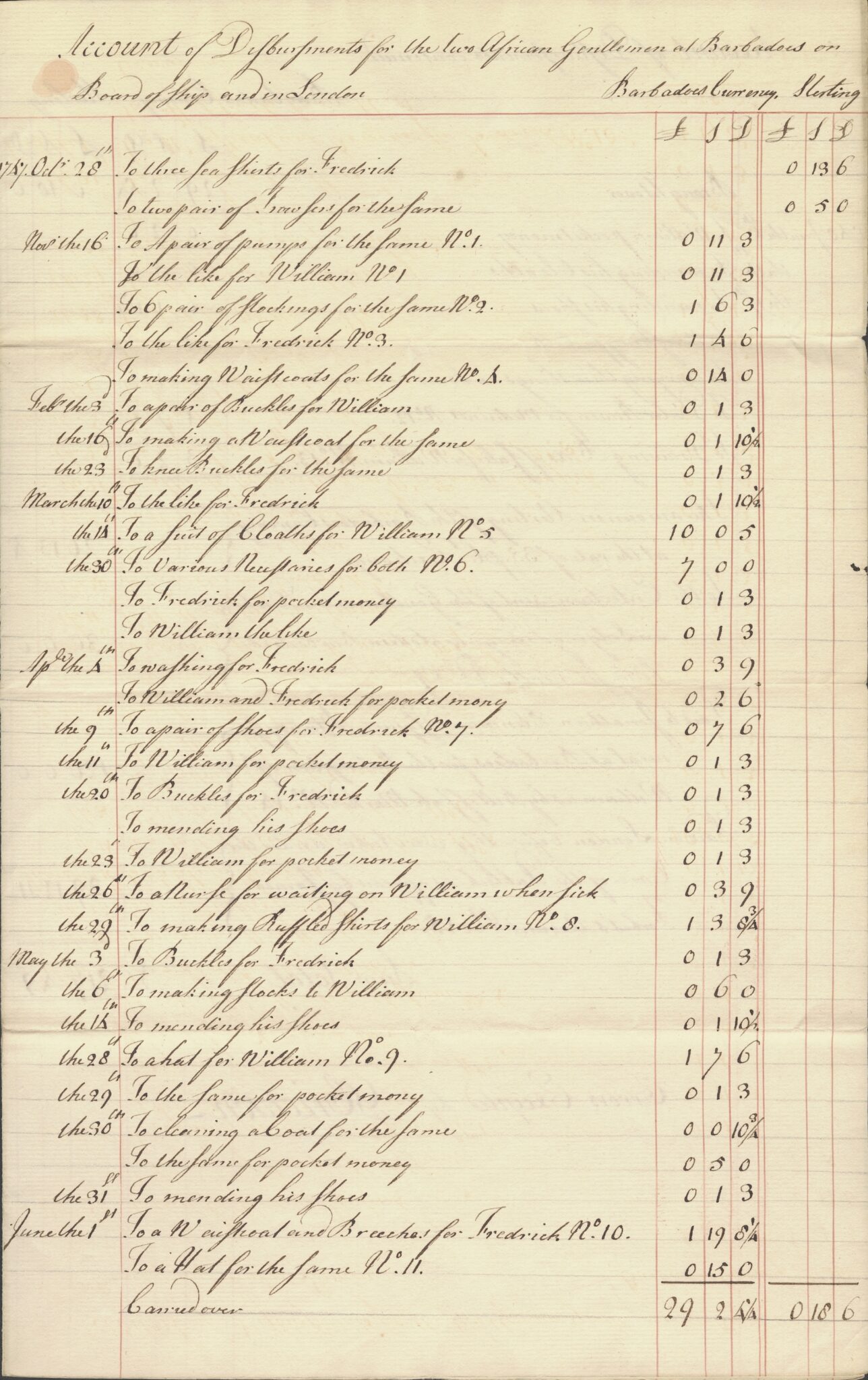
There are always joys while going through manuscripts—an unexpected doodle, a funny quote, beautiful papers—but most of what I was encountering was financial document after financial document–Until one stopped me right in my tracks. It referred to expenses “for the two African Gentlemen at Barbadoes.” Written in 1747, the use of “Gentlemen” to describe African peoples was eye-catching enough, but glancing down at the accounts, the entries for making waistcoats, providing pocket money, buying ruffled shirts, and more signaled something extraordinary. . . .

And then, a document written from Bridgetown, Barbados, laid it all out:
Whereas John Corrantee and the Caboceers of Annamabo are at present exceedingly well disposed towards the British Nation, and beg the resettlement of that place by the English, and the fort to be rebuilt

And whereas a Son of John Corrantee’s Named Ansah was sold here by Captain Hamilton who he (Corrantee) is very anxious to have redeemed

We hereby give it as our Opinion that the Redemption of the said Ansah will be very acceptable to John Corrantee (who is the leading man at Annamabo) . . . and will be a means to conciliate Corrantee to, and rivet him in the Interest of the British Nation in opposition to the French, who have been aiming for some Years past at the aforesaid settlement.
OH.

OH NO.
“The Record Scratch” is a fine metaphor for that moment, though I don’t think it gives a good sense of the rest of this article.

Saturday, July 19, 2025

Nominees for the 2025 George Washington Book Prize

The finalists for the 2025 George Washington Book Prize, all history titles published last year, have been announced.

In alphabetical order of the author’s surname, they are:
  • Jane E. Calvert, Penman of the Founding: A Biography of John Dickinson (Oxford University Press)
  • Francis D. Cogliano, A Revolutionary Friendship: Washington, Jefferson, and the American Republic (Harvard University Press)
  • Michael D. Hattem, The Memory of ’76: The Revolution in American History (Yale University Press)
  • Tyson Reeder, Serpent in Eden: Foreign Meddling and Partisan Politics in James Madison’s America (Oxford University Press)
  • Cara Rogers Stevens, Thomas Jefferson and the Fight against Slavery (University Press of Kansas)
The sponsors of this prize are Mount Vernon, the Gilder Lehrman Institute of American History, and Washington College. Mount Vernon will host an event featuring all the authors on 12 August, and the winner will be announced at a gala dinner in New York on 8 October.

Tuesday, April 01, 2025

“Merely a private individual traveling for curiosity”

As recounted yesterday, over champagne Julien-Alexandre Achard de Bonvouloir divulged to a British secret agent that he’d been meeting with the French ambassador to Britain, the Comte de Guines.

The young Frenchman had just come from Massachusetts, where war had broken out months before. He offered to be a liaison between the French government and the American rebels.

De Guines consulted by letter with the Foreign Minister of France, the Comte de Vergennes (shown here—that letter is reproduced and translated in B. F. Stevens's Facsimiles of Manuscripts in European Archives Relating to America, 1773-1783). The two officials agreed to send Bonvouloir back to North America as their own secret agent.

The terms were:
  • De Guines and Bonvouloir agreed the young man would present himself as “a merchant of Antwerp,” then part of the Austrian Netherlands.
  • The French government would pay Bonvouloir a “salary of two hundred louis.”
  • Bonvouloir couldn’t tell his family what he was up to, not even “His brother, an officer in the Lyons regiment, [who] was in London at the time.”
The mission was just as restricted. Bonvouloir was to meet with delegates to the Continental Congress in Philadelphia, but he couldn’t confirm that he was an emissary of the French government and he couldn’t make any promises of aid. According to the historian Edwin Erle Sparks, he could “assure the American leaders that France had no intention on Canada”—though of course a promise from “merely a private individual traveling for curiosity” carried no weight.

The whole episode reads very much like a modern spy novel—not an Ian Fleming type but the more cynical sort like John Le Carré’s The Looking-Glass War. Bonvouloir was hungry to make his mark, to rise above his status as a younger, disabled son sent off to the colonies, to do something for his country. His government took advantage of that eagerness.

Almost a year later, on 16 June 1776, De Guines wrote another letter to Vergennes about Bonvouloir. By this time the British royal authorities in America were hunting for him. His French government contacts weren’t sure how to get him off the continent, or whether it would be worth it. De Guines had to prod Vergennes into authorizing the payment of another year of salary as promised. The ambassador planned to ask Bonvouloir’s brother to write to him via Québec, but he assured the minister “he and his brother are always liable to be disavowed if any inconvenience should result from their action.”

Not aware of that future, in October 1775 Bonvouloir sailed for Philadelphia “in the ‘Charming Betsy,’ Captain John Farmer.” That information comes from another document in the Earl of Dartmouth’s papers—evidence that the British government was already tracking this operation.

I plan to return to Bonvouloir later in the year, around the 250th anniversary of his meetings in Philadelphia.

Monday, March 31, 2025

“Some Vin de Champagne produced the desired effect”

I’ve been quoting from the report of a British secret agent on his—or possibly her—conversations with Julien-Alexandre Achard de Bonvouloir and the Chevalier d’Amboise at their hotel in London in the summer of 1775.

Those were aristocratic Frenchmen who had spent a few weeks in New England. Based on that deep knowledge, they told their acquaintance that all the fighting in Massachusetts could be settled:
Lastly, that it appears to them both, the Americans had no settled, regular, well digested plan, that there exists among their Chiefs more Jealousy than unanimity: that many of the Settlers, and mostly all the Commercial people of Substance, begun to be tired of the present situation, and that they (the two french Officers) thought it probable Government would fall on Methods to disunite them, which if employed with success, would necessarily facilitate a reconciliation.
The agent thought there was more to find out, though. These two Frenchmen were happy to talk about the British colonists in New England, but what about their own secrets? What were they really up to?

The agent used a time-honored method: “stimulating the pride of Monsieur Le Comte de Beauvouloir in the moment that some Vin de Champagne produced the desired effect on his prudence.” The powerful combination of alcohol and flattery.

Bonvouloir then divulged that “he had had two Audiences of Le Comte de Guines,” the French ambassador to the British government (shown above). He boasted “that his Excellency had made him great offers of Service and had asked him twice to dinner.” As the younger son of a French nobleman, disabled enough that his military appointments were basically honorary, Bonvouloir yearned for recognition from such an important official.

The agent told whichever British Secretary of State he or she worked for (probably the Earl of Rochford though the report survives in the papers of the Earl of Dartmoouth):
My Opinion is that the two french Officers are at this Instant in the Service of the Rebel Americans, and are paid by them; that they came over either with proposals to the Courts of France and Spain, or some other Commission in the American Interests, and that they intend to return to their Employers by means of some English Ship.
In fact, there’s no surviving evidence that anyone in New England had even noticed Bonvouloir and D’Amboise, much less sent them to Europe with “proposals to the Courts of France and Spain.”

The situation was quite the reverse. Bonvouloir was trying to become an emissary of his own government.

TOMORROW: Diplomatic missions.

Monday, February 10, 2025

Identifying John Adams’s Mystery Correspondent

Sometime in 1778, John Adams, on his first diplomatic mission for the U.S. of A., passed on a bunch of reading material to Edmé Jacques Genet, director of the French Foreign Ministry’s bureau for translation.

Genet was assembling items for Affaires de l’Angleterre et de l’Amérique (Affairs of England and America), a surreptitious propaganda effort by the French government. (This Genet was the father of Edmond-Charles Genet, the French diplomat whose activities in America irked George Washington while Adams was Vice President.)

Among the material that Adams turned over was the 1775 volume of The Remembrancer, a round-up of the year’s news published in London by John Almon. And in that book Adams discovered a couple of letters he had written himself:
Looking over the Remembrancer, for the Year 1775, found to my Surprize, having never seen this Remembrancer before, two Letters from a Gentleman in the Province of Massachusetts Bay, to his Friend in London, one dated Feb. 10 1775 and the other Jany 21. 1775. They are found in Pages 10.11 and 12 of the Remembrancer for that Year.
Genet never had those letters translated, but many American authors have reprinted the two letters from The Remembrancer, not knowing who wrote them.

Accepting Adams’s claim, the editors of the John Adams Papers included those two letters from early 1775 in their 1977 volume of his correspondence. At the time they lamented, “he failed to mention the intended recipient.”

One clue might be that the letters were published as sent “to his Friend in London” as opposed to “to a Gentleman in London.”

The answer started to become clear when scholars spotted the second of those letters in the Gilder Lehrman Collection. Adams’s correspondent was the British historian Catharine Macaulay. His exchange with her went on longer than previously recognized.

There appear to be some unanswered questions still. The letter published with the date of 10 Feb 1775 (250 years ago today) was actually dated 28 Dec 1774. Did Almon assign the February date from when that text was published in a British newspaper?

That full letter was published in 2020 in The Correspondence of Catharine Macaulay. The part that appeared in The Remembrancer was just part of the complete text.

Finally, the letter that Almon dated to 21 Jan 1775 isn’t part of the Macaulay Papers, at the Gilder Lehrman Institute or published. It’s possible that Adams sent it to someone else in London. But he knew hardly anyone there, and there’s no hint in The Remembrancer or Adams’s letter to Genet that the two letters went to different people. So probably the missing letter went to Macaulay but just hasn’t been found.

Judging by the 10 February/28 December letter, that 21 January letter probably:
  • contained more material than Almon printed.
  • wasn’t dated 21 January.

Monday, January 13, 2025

“Growing Up in the Gore Family” in Waltham, 19 Jan.

On Sunday, 19 January, I’ll speak at Gore Place in Waltham on “Growing Up in the Gore Family: Class and Conflict in Revolutionary Boston.”

That estate was built by Christopher and Rebecca-Payne Gore in the early republic after they returned from a diplomatic mission. Christopher had made his fortune as an early corporate lawyer, setting up some of the region’s first large industrial companies.

Among those companies was a glass factory co-owned by Christopher’s older brother Samuel and their twice-over brother-in-law Jonathan Hunewell. That factory supplied the glass for the mansion’s first windows.

But I’m going to talk about the American Revolution before America’s Industrial Revolution. As the event description says:
Christopher Gore grew up in a family on the verge of entering Boston’s genteel class. The Gores were active in the Revolutionary resistance—organizing protests at Liberty Tree, hosting spinning bees for Daughters of Liberty, and even being hurt in a riot before the Boston Massacre. But as that conflict heated up, Christopher’s father chose to side with the royal government and left America in 1776. This talk explores the difficult choices that one family worked through.
If that sounds staid, rest assured there’s bloodshed, bigamy, effigies, and weapons theft along the way.

This event is scheduled to start at 3:00 P.M. After we’re done with questions, attendees will have a chance to walk through the mansion. The cost is $10, free to Gore Place members and through Card to Culture. Reserve tickets through this link.

Wednesday, December 25, 2024

“This is a great day with the Roman Catholics”

On Saturday, 25 Dec 1779, John Quincy Adams was in the coastal town of La Coruña.

He and his younger brother Charles were accompanying their father on his second diplomatic mission to Europe. Aiming for France, their ship had run into trouble, and the captain had chosen to dock in allied Spain instead.

That provided the occasion for John Quincy to experience another culture. Which his diary shows him doing with characteristic primness:
This is a great day with the Roman Catholics. “Fete de Nouailles” Christmas. However I find they dont mind it much. They dress up and go to mass but after that’s over all is. So if they call this religion I wonder what is not it; after Mass, almost all the Shops in town are open’d.

But stop. I must not say any thing against their religion while I am in their country but must change the subject.

This forenoon Madame Lagoanere [wife of the American consul] sent us some sweetmeats: for my part I was much obliged to her for them, but I shall diminish them but little.
John Quincy’s idea of a proper religious holiday involved closing the shops. That was how people observed fast days in New England, after all. And the gift of sweets seems to have puzzled him. I suspect Charles wasn’t so bothered.

Monday, November 04, 2024

“Demagogues never were nor will be Patriots”

The way the Federalists told it, the biggest danger to the new American republic would be some form of “anarchy” leading to a demagogue gaining power.

This was, they warned the voting public, more likely than some form of aristocracy or oligarchy leading to a tyrant gaining power.

That fear motivated George Washington to come out of retirement and chair the Constitutional Convention in Philadelphia, as he explained to Lafayette on 6 June 1787:
The pressure of the public voice was so loud, I could not resist the call to a convention of the States which is to determine whether we are to have a Government of respectability under which life—liberty, and property secured to us, or whether we are to submit to one which may be the result of chance or the moment, springing perhaps from anarch⟨ie⟩ Confusion, and dictated perhaps by some aspiring demagogue who will not consult the interest of his Country so much as his own ambitious views.
That convention produced a blueprint for government with a stronger national chief executive than anyone had envisioned before, albeit not as strong as it would become later. And of course the Federalists felt they were the best qualified to exercise those powers.

The fear of demagogues remained, now directed at any popular opposition to their policies. After negotiating a treaty with Britain that he knew would provoke complaints, John Jay wrote home to President Washington on 25 Feb 1795:
Demagogues will constantly flatter the Passions and Prejudices of the multitude; and will never cease to employ improper arts against those who will not be their Instruments. I have known many Demagogues, but I have never known one honest man among them. These are among the Evils which are incident to human Life, and none of them shall enduce me to decline or abandon Pursuits, in which I may concieve it to be my Duty to embark or persevere. All creatures will act according to their nature, and it would be absurd to expect that a man who is not upright will act like one that is.
Over a decade later, Jay was a retired jurist, diplomat, and New York governor, but he still expressed distaste for politicians who played to the public in an 18 Apr 1807 letter:
All Parties have their Demagogues, and Demagogues never were nor will be Patriots—Self Interest excites and directs all their Talents and Industry; and…by that Principle they regulate their conduct towards Men and Measures—nor is this all—They not only act improperly themselves, but they diligently strive to mislead the weak the Ignorant and the unwary—as to the corrupt they like to have it so—it makes a good market for them.
While I share these Federalists’ worry about demagogues, I think they directed that worry at the wrong targets, their view distorted by class prejudices and (try as they might) their own self-interests.

Firstly, the politicians the Federalists of the 1790s feared would be demagogues, such as Thomas Jefferson or even Matthew Lyon, didn’t threaten the republic, only Federalist domination of that republic.

Beyond that, history has shown that bigoted inertia was a bigger obstacle to liberty and economic growth than allowing the American government to be more responsive to the whole American people.

Wednesday, February 07, 2024

The J.A.R. Books of the Year for 2023

Last month the Journal of the American Revolution announced its 2023 Book of the Year and the runners-up.

The top honor went to The Lionkeeper of Algiers: How an American Captive Rose to Power in Barbary and Saved His Homeland from War by Des Ekin:
[James Leander] Cathcart was one of many captured on the high seas by the Barbary pirates, who were eager to take advantage of the young nation’s inexperience and weakness. The city of Algiers becomes a subject in the book, for its politics and physical layout made escape impossible. Ekin tells the story of how Cathcart was always in the right place at the right time. Being so fortunate, he readily took advantage of his situation to go from being the chief lionkeeper in the Dey’s personal zoo to becoming the Dey’s most important non-Muslim advisor and clerk. Although Cathchart had to endure the violent and unpredictable temperament of the Dey, he was able to take care of other American captives.

Cathcart’s true importance was as a liaison between Algiers and the American government under President George Washington. The administration appeared inept and unable to handle the captured sailors’ predicament, so Cathcart became instrumental in negotiating for their release. Although he could have purchased his own freedom at any time, Cathcart made sure that all the Americans were well-cared for. Ekin’s book is an easy and exciting narrative, making the reader eager to turn the page to see how long Cathcart’s luck would hold out.
Here are the two other books held up for praise.

Disunion Among Ourselves: The Perilous Politics of the American Revolution by Eli Merritt:
Merritt argues that the men who sat in Congress between 1774 and 1783 were constantly preoccupied by fears that the states would descend into conflict over borders and resources that would shatter the Union. As a result, “the American Union was an unwelcome alliance formed by bitterly conflictual colonies”; in other words, the creation of the United States was “a shotgun wedding.”
The Untold War at Sea: America’s Revolutionary Privateers by Kylie A. Hulbert:
This reconsideration of the role privateers played in the American Revolution challenges their place in the accepted popular narrative of the conflict. Despite their controversial tactics, Kylie Hulbert illustrates that privateers merit a place alongside minutemen, Continental soldiers, and the sailors of the fledgling American navy. This book offers a redefinition of who fought in the war and how their contributions were measured.

Wednesday, August 23, 2023

Two Online Discussions of John Adams

Here are a couple of online events focusing on John Adams folks might be interested in.

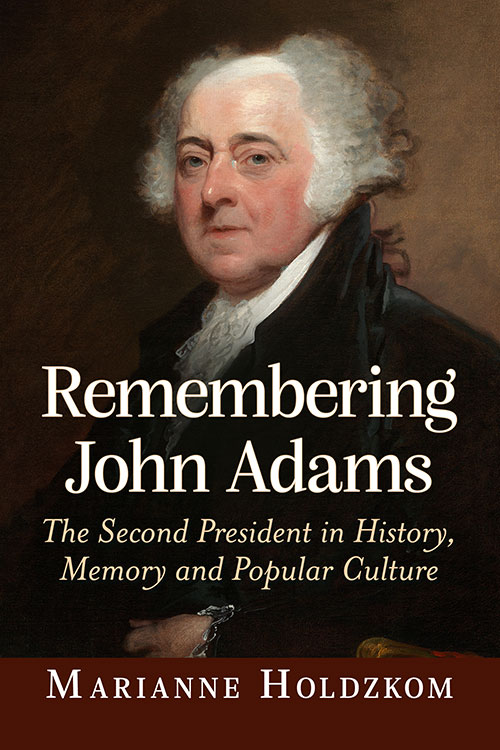
On Thursday, 24 August, the hosts of the History Camp discussions will talk about Remembering John Adams: The Second President in History, Memory and Popular Culture with author Marianne Holdzkom.

The copy for the book says, “The second president is one-dimensional at times, and perhaps best known to the public as ‘obnoxious and disliked,’ but he is always fascinating.” That phrase comes from the musical 1776, which gives Adams the central role. It doesn’t come from any of Adams’s contemporaries writing about him. Indeed, the closest antecedents are in memories Adams himself wrote about how his political opponents viewed him, and he tended to puff up the severity of the opposition he faced.

According to reviews like this one, Holdzkom considers how Adams appears in his descendants’ writings, in more recent historians’ books, in the two big Broadway musicals and the H.B.O. miniseries, and even in Ezra Pound’s Eleven New Cantos.

This discussion will become available through the History Camp website and allied pages at 8:00 P.M.

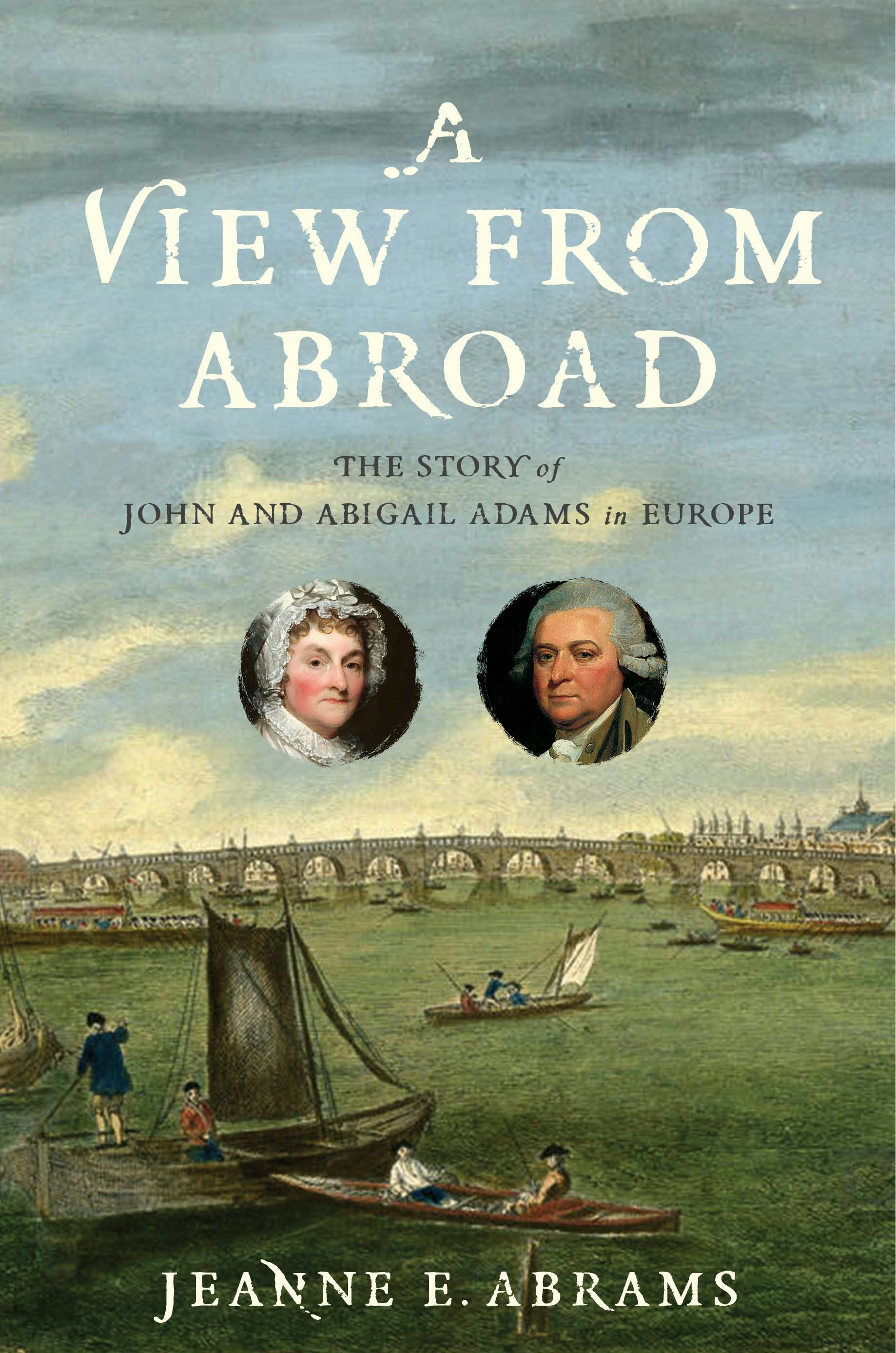
On Tuesday, 29 August, the American Revolution Institute will share an online lecture by Prof. Jeanne E. Abrams of the University of Denver based on her book A View from Abroad: The Story of John Adams and Abigail Adams in Europe.

The Adamses spent a few years together in Europe in the 1780s during his diplomatic work. Abrams will discuss how in this time “the Adamses and their American contemporaries set about supplanting their British origins with a new American identity.”

That event is scheduled to take place from 6:30 to 8:30 P.M., leaving ample time for questions. Sign up through this page.