J. L. BELL is a Massachusetts writer who specializes in (among other things) the start of the American Revolution in and around Boston. He is particularly interested in the experiences of children in 1765-75. He has published scholarly papers and popular articles for both children and adults. He was consultant for an episode of History Detectives, and contributed to a display at Minute Man National Historic Park.

Subscribe thru Follow.it


•••••••••••••••••


Showing posts with label Ebenezer Stedman. Show all posts

Wednesday, February 16, 2022

Grandmothers’ Tales and Grenadier Gibson

The story from Sarah H. Swan that I shared yesterday, about a British grenadier killed in the Battle of Lexington and Concord, has all the hallmarks of what I call “grandmothers’ tales.”

It was literally a story Swan heard from her grandmother, who in 1775 was Mary Stedman, wife of a Boston doctor. The anecdote comes in a meaningful shape, with a little lesson in fate and family patriotism that a good republican woman might want to pass on to her grandchildren.

I don’t think anyone involved in the story was still around when Mary Stedman first told it to the children of her second marriage, who passed it down. Mary’s first husband, Dr. John Stedman, was dead of yellow fever. Dr. Benjamin Church, Jr., to whom Stedman had reportedly passed intelligence, had been lost at sea. Dr. Joseph Warren, who dispatched the riders to Lexington, died at Bunker Hill. Of course the unfortunate Pvt. Gibson was dead, and his wife had probably left Boston in 1776. So no one could contradict this claim.

As I poked into the background of the tale, I was struck by how little information remains about Dr. John Stedman. He and his twin brother Ebenezer were the sons of a well established Cambridge farmer, tavern-keeper, militia officer, and town official. They both graduated from Harvard College in 1765, having lived at home instead of in the dorms. The college granted them the usual M.A. degree three years later.

Ebenezer became the Cambridge schoolmaster and his father’s heir while John went into Boston and trained to be a doctor. In 1769, according to a family historian, he wrote in an almanac: “I am a young man just entering into the world with nothing to recommend me but my education and a few friends whom I obtained while I was assistant to a noted Physician in Boston who has recommended me to the world.”

In 1773, Dr. Stedman married Mary Quincy, daughter of merchant Henry Quincy. They moved into a house on Marlborough Street. But I can’t find mentions of Dr. Stedman as prominent in either political or medical circles. He unfortunately died too early for Dr. Ephraim Eliot’s rundown of the town’s medical men, published in the Massachusetts Historical Society’s Proceedings.

Was the “noted Physician in Boston” who served as John Stedman’s mentor Dr. Benjamin Church? In addition to this anecdote, I found another tenuous connection: In October 1776, when Dr. Church was locked up on suspicion of treason, Dr. Stedman bandaged Benjamin Church, Sr.’s head. (That bill was still unpaid after Stedman died in 1780 and the elder Church died a year later.)

If Dr. John Stedman was known to be a protégé of the duplicitous Dr. Church, then perhaps his widow and her descendants felt a need to burnish the family’s Patriot credentials. What better way than to say the Stedmans provided crucial intelligence that helped John Hancock and Samuel Adams evade capture in Lexington? (Even if it’s questionable whether Dr. Church would have passed on that information, and the redcoats weren’t searching for Hancock and Adams anyway.)

As for the unfortunate grenadier private, the name Gibson is common enough to seem plausible. Indeed, there’s a Gibson back in the Stedman family tree.

So Sarah H. Swan’s family lore might belong in the category of myth, a “grandmother’s tale” developed for entertainment or moral guidance that a later generation grew up believing whole-heartedly and inserted into the national history during the Colonial Revival. Some of those late-blooming tales flourished, like the story of Betsy Ross and the first flag. Others have long been dismissed.

But this tale comes with one more wrinkle. Don N. Hagist, author most recently of These Distinguished Corps: British Grenadier and Light Infantry Battalions in the American Revolution, amasses images from British army muster rolls in this period to track individual soldiers as much as possible. I asked him if those documents had information relevant to this story.

Don answered:
In the regiments for which we have complete muster rolls, there was no soldier named Gibson in the grenadier or light infantry companies. I haven’t looked at all at the regiments in Percy’s relief column, so there’s that possibility.

There are no known rolls for the Marines, and that battalion suffered the most casualties on April 19. And there are no rolls for the 5th Regiment for 1775, so we don’t know which men of that regiment died on or soon after April 19.

BUT: on the 5th’s rolls for the second half of 1774, prepared on 16 January 1775, there is a grenadier named John Gibson. And he’s not on the next set of rolls covering the first half of 1776. That’s true for a lot of men in the 5th, and I suspect most of the missing are Bunker Hill casualties, but it’s entirely possible that John Gibson was among the April 19 casualties.

Saturday, February 13, 2021

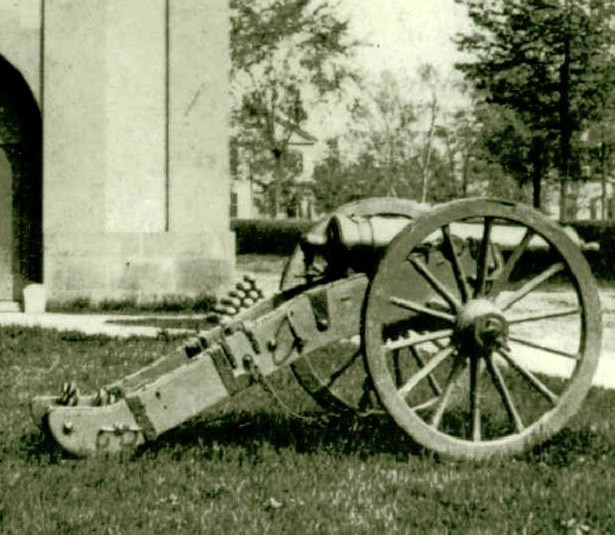
Who Should Pay for Mr. Molineux’s Cannon?

I’m at last getting to the original purpose of the 3 Feb 1775 petition to the Massachusetts Provincial Congress’s committee of safety that I’ve been discussing.

All four men who signed the petition were delegates to the provincial congress that started meeting in Cambridge on 1 February. After explaining that their towns had undertaken to mount and equip eight iron cannon obtained by William Molineux inside Boston in the fall of 1774, they wrote:
Since which the late Congress held [in] Cambridge have Agreed to to [sic] provide Warlike Stores, &c, at the Expence of the province

Wherefore the Inhabitants of Said towns think it Reasonable that the Expence of equiping Said Cannon for Service Should be borne in the Same manner as other Supplys and Desire yould Consider the matter & act thereon [as] you Shall think proper
In other words, this petition is rather similar to what sometimes seems like the majority of correspondence among towns and other governmental bodies in colonial New England—trying to get someone else to pay for something.

This example wasn’t about poor people needing relief or roads having to be mended, but about preparation for war. Yet the principle was the same. As long as the provincial congress was going to spend money on weapons, shouldn’t it also cover “the Expence of equiping Said Cannon for Service”?

The committee of safety actually met at Ebenezer Stedman’s tavern in Cambridge that day and came to some decisions about the provincial artillery. However, the only specific actions placed on the committee’s records involve the four brass cannon hidden at Lemuel Robinson’s tavern in Dorchester. (Yes, those are the Four Stolen Cannon at the center of The Road to Concord.)

The men of Watertown were hoping for a positive response to the petition. On 6 February, the town meeting voted “that the Committe appointed to mount ye great Guns do not Compleat the Same till after the Congress Rises.” On 11 February the congress took up the question of how its committees should handle military supplies, but four days later it decided to defer that decision until the next session at Concord in late March. On 20 February, the Watertown voters gave up waiting and decided “that the Committe appointed to mount the Great Guns Compleat the Same as Soon as may be.”

The delay and uncertainty had consequences. As of 21 February, committee of safety member Dr. Benjamin Church secretly reported to Gen. Thomas Gage, “Gun Carriages are making at Water Town by McCurtain—an Irishman, who has fallen out with the Select Men there, as he will not permit them to be taken away untill the Cash is forthcoming.”

It’s not clear to me who came up with the necessary cash. But starting on 23 February, the joint committee of safety and supplies became more involved in managing the nascent artillery force. It appointed officers and divvied out guns.

Among other things, the committee directed “That eight field pieces, with the shot and cartridges, and two brass morters with their bombs, be deposited at Leicester,” just west of Worcester, with militia colonel Joseph Henshaw. Those might be the same eight cannon that the towns of Watertown, Concord, Lexington, and Weston had been working on, or they might be eight other cannon. There were dozens being quietly moved around Massachusetts in those months.

TOMORROW: Ready for war?

Thursday, April 26, 2018

The Grave of Cato Stedman/Freeman

Earlier this month the Cambridge Chronicle reported on the mystery of Cato Stedman/ Freeman’s gravesite.

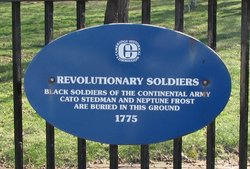
Cambridge records show that Cato Stedman was buried in the public cemetery across from the common. A historical marker memorializes him as well as Neptune Frost, a fellow Continental Army veteran. (That marker includes the date of 1775, but that’s not when they died.)

Ruth Wallis Herndon collected information on Stedman/Freeman in her book Unwelcome Americans. She reports that he was owned as a child and young man by tavern owner and militia captain Ebenezer Stedman of Cambridge. Cato served in the town militia company at the start of the war and became free about the time of the Battle of Bunker Hill in June 1775. He then enlisted in Col. Thomas Gardner’s regiment of the Continental Army under the name of Cato Freeman.

In his report on soldiers of color in the early Continental Army, George S. Quintal states that Stedman is “also listed on a 27 May 1777 roll as having joined the Continental Army from Cambridge, for the length of the war.” His regiment, commanded by Col. William Shepard, served in the Saratoga campaign.

Herndon, however, writes that Freeman/Stedman was at Valley Forge in 1777-78, followed by West Point in 1781. That appears to be based on information the veteran gave to Cranston, Rhode Island, authorities in the early 1800s when he became impoverished. Those authorities sent him back to his original home parish of Cambridge, which is why he was back there using the name Cato Stedman when he died.

Lesley University student Jonathan Hill has noted that sources from the early 1900s say Cato Stedman was buried either in the Stedman family tomb or in a plot next to his former owner. Hill therefore posits that the now-unmarked space next to Ebenezer Stedman’s grave is where Cato Stedman was buried. Unfortunately, a tradition first in print a century after a man’s death isn’t the strongest evidence.

The Cambridge city council has voted to have officials seek more information about Stedman/Freeman and Frost to determine their specific grave sites and mark them. The head of the city’s historical commission isn’t certain that enough evidence will come to light to make that possible. Meanwhile, the veterans’ names continue to appear prominently on the cemetery fence.

Sunday, May 16, 2010

Lydia Barnard: “a woman of strong mind and massive physique”

Yesterday I continued this year’s exploration of the stories of the Battle of Lexington and Concord with the story of Lydia Barnard (born Lydia Warren and died Lydia Spofford), as first set down in an 1880 history of Boxford, Massachusetts.

Another version of this tale appeared in Jeremiah and Aphia Tenney Spofford’s 1888 genealogy of the family. This book calls Lydia Spofford “a woman of strong mind and massive physique,” and quotes what it says is her own account of 19 Apr 1775, “transcribed by her grandson, Benjamin S. Barnes, of Boxford”:

The day of the battle of Lexington, I was living in Watertown. The able-bodied men had all gone to the battle, leaving only women, children, and a few old men, at home, anxiously awaiting the result. Toward night several women came running to my house, crying, “Mrs. Barnard, the Regulars are coming!”

I looked up the street, and saw a redcoat riding toward us on a horse. He came up and inquired if that was the road to Boston. I stepped to his side, took the horse by the head with one hand, and the soldier by the collar with the other, saying, “You villain; you’ve been killing our folks, and deserve death yourself” (my husband and five brothers had gone to the fight). I pulled him to the ground, while he begged piteously for his life.

I then gave him up to some old men, who took him to the tavern and kept him till the proper authorities had him exchanged for one of our men. It was asserted that he was wounded, and was trying to find his way to Boston, having stolen the horse from the roadside, where it had been tied by its owner, Col. Stedman, of Cambridge, who had ridden him to Lexington that morning, whither he had gone to fight for his country. He was made glad, a few days after, by the recovery of his valuable horse.
I don’t know of any colonel named Stedman in Cambridge, but Capt. Ebenezer Stedman (1709-1785) was a selectman and important Patriot activist in that town. Local historian Lucius Paige wrote: “He kept a tavern many years on the southerly side of Mount Auburn Street, about midway between Brighton and Dunster streets.” We know from contemporaneous notes that Stedman sent express riders up to Woburn between midnight and dawn on 19 Apr 1775, so he got word of the British march early. Still, he was in his late sixties that day, and might have left the actual riding and fighting to younger men.

This version of the tale offers an explanation of how a Watertown woman could have grabbed a redcoat when the main British column never passed through that town: this particular soldier was separated from the rest, and lost. He also seems to have been wounded, and not carrying a gun—easy prey for “a woman of strong mind and massive physique.”

TOMORROW: Apparently, yet more details of Lydia Spofford’s tale.