J. L. BELL is a Massachusetts writer who specializes in (among other things) the start of the American Revolution in and around Boston. He is particularly interested in the experiences of children in 1765-75. He has published scholarly papers and popular articles for both children and adults. He was consultant for an episode of History Detectives, and contributed to a display at Minute Man National Historic Park.

Subscribe thru Follow.it


•••••••••••••••••


Showing posts with label Joshua Loring. Show all posts

Thursday, November 10, 2022

Archeology at the Loring-Greenough House
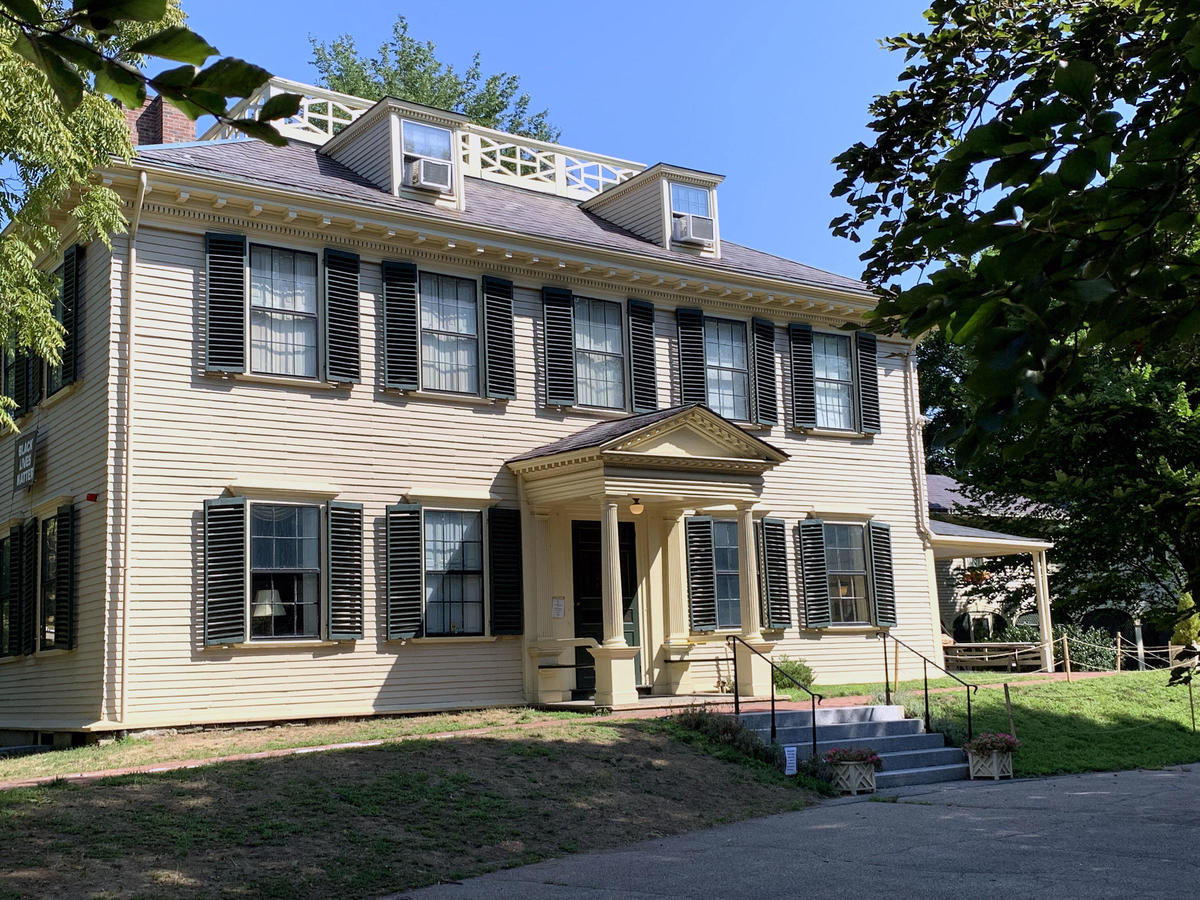
This week the city of Boston’s archaeology program is undertaking a dig at the Loring Greenhough House in Jamaica Plain.

According to the city’s announcement, “The goal of this project will be to survey the basement of the house’s early 19th century summer kitchen and areas of the door yard ahead of planned improvements.”

On Facebook the team elucidated:
Ahead of plans to lower the floor of the basement under the 1811 summer kitchen, we will conduct an archaeological investigation on the use and functions of that space so no potential cultural deposits are impacted by these improvements.

The kitchen basement where we will be digging has three chambers: the western chamber labeled on historic plans as being part of a cistern, the center chamber containing the main supporting arch for the building extension and sitting directly under the fireplace in the kitchen above, and the eastern chamber which is accessible by a small doorway and may have been used for smoking food. We also want to determine if there are any pre-kitchen deposits or features that survived the creation of the basement.
Many people have used the site over the centuries:
  • Indigenous Massachusett people left stone tools found in previous surveys.
  • The Polley family were the first English people to build a home on the property, in the 1650s.
  • Joshua Cheever, a Boston selectman from the North End, bought the Polley house in 1746; it’s unclear whether that became his country house or an investment property.
  • Joshua Loring, who gained the rank of commodore in King George’s War, purchased the property, tore down the earlier building, and commissioned the Georgian mansion that survives today.
  • After the Lorings left as Loyalists, the provincial and Continental Army used the deserted house for barracks and a hospital during the siege of Boston.
  • The state confiscated the property and sold it to the widow Anna Doane, who then married lawyer David Stoddard Greenough.
The team wrote:
Previous archaeological surveys of the Loring Greenough property don’t mention the presence of enslaved individuals on the property. We plan to address this by sharing their stories and hopefully locating deposits within the south yard that date to the pre-1785 time period when there is documentary evidence of enslaved people at the house.
Cheever and Loring are known to have owned slaves while Stoddard set up an indenture for a small child born into slavery (as I’ll discuss tomorrow).

Early this week came this update:
We think that the parged [mortar-covered brick] surface to the west was the bottom of the cistern, which basically took up a whole third of the basement! That means that the brick wall was the only thing holding back thousands of gallons of water from the rest of the basement.
People can visit the Loring-Greenough House from 9:00 A.M. to 4:00 P.M. on weekdays to see the archaeologists at work.

Friday, April 23, 2021

Dots on the Ensign’s Map

Yesterday I started to discuss a hand-drawn map from the Library of Congress that Ed Redmond has identified as likely coming from British army spy Ens. Henry DeBeniere weeks before the march to Concord.

That map marks several individual homes. Some of those are places where DeBerniere and his fellow scout, Capt. William Brown, visited on their two treks into the Massachusetts countryside in early 1775.

Others aren’t mentioned in the officers’ report but were the estates of Loyalists, and therefore potential safe houses or places for troops to camp.

Here’s a list of all those marked properties:

“Hatch’s”: Nathaniel Hatch of Dorchester, Loyalist.

“Davis’s”: This site is a bit of a mystery. My best guess is that this is Dr. Jonathan Davies, who bought half of the old Auchmuty estate in the 1750s. Unlike almost all the other homeowners named on the map, Davies wasn’t a Loyalist. Another possibility is that this is the house of Aaron Davis, which ended up on the front lines of the siege.

“Auchmuty’s”: Robert Auchmuty of Roxbury, attorney and Vice Admiralty Court judge, Loyalist.

“Hollowel’s”: Benjamin Hallowell, Jr., in Jamaica Plain, Commissioner of Customs.

“Comm. Loring”: Joshua Loring, Sr., in Jamaica Plain, Loyalist. His mansion remains as the Loring-Greenough House.

“Mr. Fanuil”: Benjamin Faneuil, merchant, Loyalist.

“Mr. Greenleaf”: I’m guessing this home was managed by Sheriff Stephen Greenleaf, who normally lived in Boston. In 1765 his daughter Hannah married John Apthorp, who inherited his father’s Little Cambridge mansion. John and Hannah Apthorp sailed to Charleston, South Carolina, for his health in late 1772, but their ship was lost at sea. Sheriff Greenleaf became the guardian for their young children, and thus probably the custodian of the Apthorp property. Sheriff Greenleaf was seen as a stalwart of the royal government before the war, but he remained in Boston after the siege.

“Brewers”: Jonathan Brewer’s tavern on the Watertown-Waltham line. Unlike the other people named on the map, Brewer was a Whig, as DeBerniere wrote in his report. But the officers did make a memorable stop there, so it was worth mapping.

“Major Goldthwaits”: Joseph Goldthwait of Weston, Loyalist.

“Colonl: Jone’s”: Isaac Jones of Weston, a Loyalist before the war and a supporter of the Continental Army during it. Brown and DeBerniere used his Golden Ball Tavern as a base, and it’s still standing.

“Doctor Russell”: Dr. Charles Russell of Lincoln, Loyalist. His house survives in altered form as the Codman House.

“Nineteen Mile Tavern”: This establishment appears to be in Sudbury, but I haven’t found any mention of such a place. The most famous surviving tavern in Sudbury is the Wayside Inn, but this appears to have been closer to the center of town.

TOMORROW: The map’s proposition.

Thursday, April 30, 2020

“A certain Number to be employed in cleaning the Streets”

My curiosity about how colonial Boston periodically coerced free black men into mending town highways began years ago when I came across an item in the New-England Chronicle and Essex Gazette printed on 24 Aug 1775.

[That issue covered 17-24 August while the next covered 24-31 August, so it’s not the issue now dated 24 August in the Readex newspaper database.]

At that time, printers Samuel and Ebenezer Hall had brought their press down from Salem to Cambridge and were publishing just behind the siege lines for the Continental Army and its supporters. During the siege they reported about what they heard from the besieged capital, as in:
We are informed that the Negroes in Boston were lately summoned to meet at Faneuil-Hall, for the Purpose of chusing out of their Body a certain Number to be employed in cleaning the Streets; in which Meeting Joshua Loring, Esq; presided as Moderator. The well known Cesar Meriam opposed the Measure, for which he was committed to Prison, and confined till the Streets were all cleaned.
One possibility is that this event never happened, or was distorted beyond the facts by the time the news reached Cambridge. I haven’t found mentions of it in any other source. But there aren’t many sources on civilian life in Boston at this point in the siege. I think this event did happen because of the specific names involved, and it reflected an attempt by Loyalists to resume “normal” life in Boston.

Those men convened something approximating a town meeting in Faneuil Hall. Most of Boston’s selectmen had remained in the town to preserve the community, but without town clerk William Cooper they didn’t keep normal records. Selectman Timothy Newell’s surviving diary focused on military developments and didn’t mention this gathering.

The men who came to Faneuil Hall elected Joshua Loring, Sr., as moderator, as a normal town meeting would do. He was no longer an inhabitant of Boston, having moved out to Roxbury in 1752 (his house shown above), but the Whigs had set a precedent for meetings of the Body of the People with everyone welcome.

The gathering then tried to reinstate the custom of drafting free black men to repair the roads, with a little alteration: the white men reportedly summoned all the town’s black men and told them to choose who had to do this work. But that system of forced labor hadn’t really been workable for decades.

The New-England Chronicle credited “The well known Cesar Meriam” with protesting the measure. This was Caesar Marion, a formerly enslaved blacksmith in the North End. He had worked for a white blacksmith named Edward Marion. In 1769 Edward promised to manumit Caesar in his will and leave him all his tools and the use of his shop, assuming he provided for Edward’s widow Mary. In Boston’s 1771 tax list, Caesar Marion was listed as a property-owner.

The New-England Chronicle printers expected their readership of Boston neighbors and refugees to recognize Caesar Marion’s name. Apparently he was prominent in town, possibly a leader in the town’s African community. Certainly at this moment he took the lead in protesting for them.

Joshua Loring’s son Joshua, Jr., was Gov. Thomas Gage’s new sheriff, overseeing the jail. The news item says that the Loyalists locked up Marion to keep him quiet and as a sort of hostage to force other men to clean the roads. Peter Edes, stuck in the Boston jail that summer and keeping a diary, didn’t describe Caesar Marion being “committed to prison.” But perhaps it wasn’t long before “the Streets were all cleaned.”

After the siege ended, Massachusetts revised its militia laws. With a war on, and black men serving in the Continental Army, the government no longer saw value in excluding blacks from militia service. That erased the justification for making them work for free on the highways, and this legal custom disappeared for good.

Friday, January 10, 2020

“The notion of Vampyres” in Early America

The 1784 Connecticut Courant report about Isaac Johnson having the bodies of his children dug up, hoping to save other members of his family from consumption, didn’t use the word “vampire.”

Two years before, the Connecticut poet John Trumbull had used that word in the fourth canto of M’Fingal while discussing British prison commissary Joshua Loring:
Aloft the mighty Loring stood,
And thriv’d like Vampyre on their blood.
But Trumbull also included a footnoted explanation for his readers:
The notion of Vampyres is a superstition, that has greatly prevailed in many parts of Europe. They pretend it is a dead body, which rises out of its grave in the night, and sucks the blood of the living.
Clearly the concept of vampires wasn’t yet common knowledge for Americans, even those who read satirical poetry.

The word “vampire” appeared more often in American newspapers during the following decades. One source was European literature. In 1786, for example, the French author Louis-Sébastien Mercier published a collection titled Mon Bonnet de nuit, soon translated into English as The Nightcap.

On 24 Nov 1787 the Pennsylvania Evening-Post published one piece by Mercier called “Opulence: A Vision.” Its narrator described obtaining the philosopher’s stone, which leads to wealth and a pretty young wife. Then, when everything seems to be going well—
a crowd of Vampires entered the room, and began to unfurnish my apartment. In vain did I make signs to them to desist; they carried every thing away, making many low bows. . . .

Then I turned to my dearly beloved, and, in the effusion of my soul, said to her, “The Vampires have stripped me of all I had; but still I have thee.” She wept—I thought it proceeded from tenderness; but my wife so mild, so open, sprang from my arms, ran over the apartment with the looks and gesture of a fury, and, seeing it was stript, seized on a purse the Vampires had forgot in one of my waistcoat pockets, came to me, and, applying a vigorous stroke to my cheek, disappeared.

Stunned with this scene, I got up in bed, in order to run after my wife, for I loved her. I had grown fat from living well; but a little Vampire, thinner still than the others, sprang upon me, and began to suck me alive. He swelled on my body as I grew lank; he dried me up from head to foot, gorging himself with my blood, and I became so light, that the wind carried me off my magnificent bed with rich curtains through the window.
(Spoiler: It was all a dream.)

American newspapers also printed extracts from Dr. Erasmus Darwin’s Botanic Garden (composed 1789-1793), which made a poetic hero of Benjamin Franklin and included such lines as this:
So, born on sounding pinions to the West,
When Tyrant-Power had built his eagle nest;
While from his eyry shriek’d the famish’d brood,
Clenched their sharp claws, and champ’d their beaks for blood,
Immortal FRANKLIN watch’d the callow crew,
And stabb’d the struggling Vampires, ere they flew.
Darwin used vampires, sucking blood from innocents, as a political metaphor. American authors couldn’t resist doing the same:
  • Joel Barlow: “Courts and Kings, / These are the vampires nurs’d on nature’s spoils” (Gazette of the United States, 14 July 1792)
  • “The Versifier”: “You’ll foil that Treasury Vampire who from spite, / Sucks from our coin its blood night after night” (Connecticut Courant, 4 Feb 1793)
The word appeared in prose as well, such as this line from the 7 Mar 1800 Salem Gazette: “AMERICANS—Will you permit a few Democratic Vampires, which infect the United States, to lull you into a state of slumbering security, that they may suck the dearest blood of your country?”

In fact, one of the earliest uses of ”vampires” as a political metaphor in English had a link to the American Revolution. It appeared during debate over how Parliament should respond to the Boston Tea Party in April 1774, as reported in London newspapers and eventually the 9 June 1774 Massachusetts Spy:
Mr. [Edmund] Burke rose to explain, that he did not mean to cast the least slur upon the character of Mr. [George] Grenville; and concluded with saying, he would not raise the bodies of the dead, to make them vampires to suck out the virtues of the living.
That line isn’t as well remembered as the two-hour speech Burke had given earlier that day, usually titled “On American Taxation.” But it shows how the idea of vampires had penetrated British culture on its way to America.

Of course, poets and propagandists could write about vampires without believing that they actually existed. And New England farmers didn’t need to know the word “vampire” to hold out hope that digging up bodies and burning those that seemed too well preserved might cure the dying. But as the word became more common in the 1800s, the belief might have spread along with it.

Friday, December 13, 2019

“All possible exertions to stem the current of the mob”

Richard Clarke and Sons weren’t the only merchants tapped by the East India Company to import tea into Boston in 1773. The others were:
  • Business partners Benjamin Faneuil, Jr. (1730-1787) and Joshua Winslow (1727-1801).
  • Thomas Hutchinson, Jr. (1740-1811), and his brother Elisha (1745-1824). They were sons of royal governor Thomas Hutchinson, who had invested about £1,000 in their business—what some of us today would call a conflict of interest. 
Those firms didn’t treat each other as competitors. In fact, Richard Clarke was Joshua Winslow’s uncle by marriage. Winslow and the Hutchinsons were third cousins. Everyone was in close contact with the governor.

When all three firms received the unwelcome invitation to Liberty Tree on 3 Nov 1773 that I quoted yesterday, they agreed to act in concert. The Clarkes later wrote:
The gentlemen who are supposed the designed factors for the East India Compy, viz: Mr. Thos. Hutchinson, Mr. Faneuil, Mr. Winslow & Messrs. Clarke, met in the forenoon of the 3rd instant, at the latter’s warehouse, the lower end of King Street. Mr. Elisha Hutchinson was not present, owing to a misunderstanding of our intended plan of conduct, but his brother engaged to act in his behalf.

You may well judge that none of us ever entertained the least thoughts of obeying the summons sent us to attend at Liberty Tree. After a consultation amongst ourselves and friends, we judged it best to continue together, and to endeavour, with the assistance of a few friends, to oppose the designs of the mob, if they should come to offer us any insult or injury. And on this occasion, we were so happy as to be supported by a number of gentlemen of the first rank.
There appear to have been over a dozen friends and supporters in the Clarkes’ warehouse, in addition to the family and the other importers.
About one o’clock, a large body of people appeared at the head of King Street, and came down to the end, and halted opposite to our warehouse. Nine persons came from them up into our countingroom, viz: Mr. [William] Molineux, Mr. Wm. Dennie, Doctor [Joseph] Warren, Dr. [Benjamin] Church, Major [Nathaniel] Barber, Mr. Henderson, Mr. Gabriel Johonnot, Mr. [Edward] Proctor, and Mr. Ezekiel Cheever.
Caleb H. Snow’s 1825 History of Boston didn’t list anyone named Henderson on this impromptu committee. Francis S. Drake’s Tea Leaves identified this man as Henderson Inches, and Bernhard Knollenberg’s Growth of the American Revolution, 1766-1775 guessed he was tax collector Benjamin Henderson.

This man was almost certainly Joseph Henderson, who this same week signed a letter asking the selectmen to call an urgent town meeting about the tea tax. On that document his name appears right below those of Samuel Adams, Church, and Proctor. Henderson was then a merchant and proprietor of Long Wharf; later he became commissary of prisoners and sheriff of Suffolk County. (Interestingly, John Rowe wrote that in July 1771 a crowd “Routed the Whores” at a waterfront house that Henderson owned.)

Henry Pelham estimated the crowd behind that committee of nine as “about 300 People.” A similar crowd, including most of the town’s top elected officials, were waiting behind at Liberty Tree. The Clarkes’ report goes on:
Mr. Molineux, as speaker of the above Comtte., addressed himself to us, and the other gentlemen present, the supposed factors to the East India Comy. and told us that we had committed an high insult on the people, in refusing to give them that most reasonable satisfaction which had been demanded in the summons or notice which had been sent us, then read a paper proposed by him, to be subscribed by the factors, importing that they solemnly promise that they would not land or pay any duty on any tea that should be sent by the East I. Comy, but that they would send back the tea to England in the same bottom, which extravagant demand being firmly refused, and treated with a proper contempt by all of us, Mr. Molineux then said that since we had refused their most reasonable demands, we must expect to feel, on our first appearance, the utmost weight of the people’s resentment, upon which he and the rest of the Comtte. left our countingroom and warehouse, and went to and mixed with the multitude that continued before our warehouse.

Soon after this, the mob having made one or two reverse motions to some distance, we perceived them hastening their pace towards the store, on which we ordered our servant to shut the outward door; but this he could not effect although assisted by some other persons, amongst whom was Nathaniel Hatch, Esqr. one of the Justices of the inferior Court for this country, and a Justice of the Peace for the county.
Nathaniel Hatch (1723-1784) was born in Dorchester and graduated from Harvard in 1742. He became a bureaucrat, accumulating royal appointments: clerk of the Massachusetts Superior Court, comptroller of the Customs office, justice of the peace and of the quorum, member of a commission to wind down the Land Bank. In 1771 he was seated on the Suffolk County court of common pleas, and at the end of 1772 Thomas Hutchinson, Jr., joined him on that bench.

Hatch also had a family tie to at least one tea agent. In 1768 his stepdaughter Elizabeth Lloyd had married Joshua Loring, Jr., whose sister was the wife of Joshua Winslow.
This genm. made all possible exertions to stem the current of the mob, not only by declaring repeatedly, and with a loud voice, that he was a magistrate, and commanded the people, by virtue of his office, and in his Majesty’s name, to desist from all riotous proceedings, and to disperse [i.e., he read the Riot Act], but also by assisting in person; but the people not only made him a return of insulting & reproachful words, but prevented his endeavors, by force and blows, to get our doors shut, upon which Mr. Hatch, with some other of our friends, retreated to our counting-room.

Soon after this, the outward doors of the store were taken off their hinges by the mob, and carried to some distance; immediately a number of the mob rushed into the warehouse, and endeavored to force into the counting-room, but as this was in another story, and the stair-case leading to it narrow, we, with our friends—about twenty in number—by some vigorous efforts, prevented their accomplishing their design.

The mob appeared in a short time to be dispersed, and after a few more faint attacks, they contented themselves with blocking us up in the store for the space of about an hour and a half, at which time, perceiving that much the greatest part of them were drawn off, and those that remained not formidable, we, with our friends, left the warehouse, walked up the length of King Street together, and then went to our respective houses, without any molestation, saving some insulting behavior from a few despicable persons.
Thus ended the first physical confrontation of the tea crisis in Boston. According to Gov. Hutchinson, “This seems to have been intended only as an intimation to the consignees, of what they had to expect.”

TOMORROW: Shooting on School Street.

Saturday, June 29, 2019

“Masters Leach and Lovell were brought to prison”

On 29 June 1775, John Leach, a mariner in Boston’s North End, began to keep a journal. He started it out of anger because he had just been arrested by the British military authorities and he wanted to document what was happening to him.

Leach wrote:
Memorandums, began Thursday, June 29th, 1775.—At 3 this afternoon, a few steps from my House, I was seized upon by Major [Edward] Cane, of the Regulars, accompanied by one [Joshua] Loring, who is lately made a Sheriff: they obliged mo to return to my House, where Major Cane demanded my Keys of my Desks, and search’d all my Drawings, Writings, &c, and told me I had a great deal to answer for.

I replyed, it was very well, I stood ready at a minute’s warning to answer any accusation; I had a drawn Hanger, I could have took hold of in a moment, and cut them both down. I had both Courage and inclination to do it, tho’ they had each their swords by their sides, but I suddenly reflected, that I could not escape, as the whole Town was a prison. God wonderfully restrained me, as I should have lost my Life, either by them, or some of their Companions.

They then conducted me from my House to the Stone Gaol, and after being lodged there 20 minutes, the said Cane and Loring brought in Master James Lovell, after searching his Papers, Letters, &c. as they had done mine.

Cane carried my drawings to show Gen. [Thomas] Gage, next day, and returned them.
Leach’s diary was printed in the New England Historical and Genealogical Record in 1864.

Already in the Boston jail since 19 June was eighteen-year-old Peter Edes, son of the radical printer Benjamin Edes. The elder Edes had slipped out of town just before the war began and set up a press in Watertown.

Peter was also keeping a diary, and on 29 June he wrote:
Masters Leach and Lovell were brought to prison and put into the same room with me and my companions.
Peter Edes’s diary, which shares text with John Leach’s, was published in 1901.

Leach and Lovell both received the title “Master” because they kept schools. Leach taught navigation and other skills privately in the North End. Lovell was actually the usher, or assistant teacher, to his father, Master John Lovell, at the South Latin School, but the town valued him enough to pay him far more than any other usher. Lovell had also delivered the first official town oration in memory of the Boston Massacre back in April 1771.

The imprisonment of Lovell and Leach is one more thread of the story of Bunker Hill. And not just because the officer who arrested them was being promoted to major in the 43rd Regiment only because Maj. Roger Spendlove had died in that battle. (Spendlove had survived wounds at Québec, Martinique, and Havana, but not Charlestown.)

Lovell and Leach were locked up after the battle because the British commanders thought one of them was a spy.

TOMORROW: Incriminating letters.

Monday, December 25, 2017

Moses Brown’s Malden Christmas

In December 1775, Moses Brown led a delegation of Quakers from Rhode Island up to the Boston siege lines to bring relief to the suffering poor.

Brown and his comrades went to Gen. George Washington in Cambridge and explained how they wanted to go into Boston with money they had collected. A siege is of course an attempt to deny resources to the enemy, so the commander-in-chief couldn’t have been enthused about this idea.

Quartermaster general Thomas Mifflin was even more negative, thinking that such charity would prove unpopular with the Massachusetts populace.

In consultation with Washington and members of the Massachusetts General Court, the Quakers decided they would meet some of their contacts at the siege lines and hand over the money. But Sheriff Joshua Loring and Maj. John Small came out and told them that the poor in Boston didn’t need money and the town had adequate food.

So the Quakers went off to hand out their money to the poor people they found in Marblehead, Salem, Lynn, Chelsea, and the smallpox hospital at Point Shirley.

Soon enough it was Christmas Day, as Brown described in his report on the journey:
We went to Malden and Lodged at —— where were the Select men upstairs on business and below a Noisey Company of Soldiers fidling and Danceing after supper.

David [Buffum] and I proposed to see the Select Men and Inform them of our Business went up stairs and I spoke to them of the Noise etc not being sufferable it was not only rong in itself but contrary to Every prospect of the present time and Even the Congress Discouraged it by Resolves.

They allowed it was not agreeable but thought as they were Soldiers it must be allowed. It was what they called a Christmas frolich and they had been up all the Night before, were principaly of the Riflemen.
As an eighteenth-century Quaker, Brown didn’t celebrate Christmas. Neither did most New Englanders. But these riflemen were from the Middle Colonies, many of them transplants from Britain, and they didn’t adhere to Puritan customs. And thus we discern the limits of Moses Brown’s charity.

Sunday, September 24, 2017

“Fight or Flight” at Loring Greenhough House, 30 Sept.

[ADDENDUM: This event has been canceled because of volunteer organizers’ family responsibilities.]

On Saturday, 30 September, the Loring Greenough House in Jamaica Plain will host “Fight or Flight,” a recreation of householders Joshua and Mary Loring’s departure in 1774.

The event starts at 11:00 A.M. as visitors are invited to tour the Loring Mansion. In the following hour, “Mary and servants consider packing, 18th-century friends and relations (and curious onlookers) will gather on the lawn, offering opinions and pleading their case.’ Visitors can hear and enter into the debate on the state of post-“Powder Alarm” politics and what friends of the royal government like Commodore Loring should do.

At 1:00 P.M. [spoiler!] the Loring family departs for Boston, unaware that they’ll never see this home again. At 2:00 interpreters gather “at the recreated 18th-century Bunch of Grapes Tavern to discuss the fate of the Lorings’ abandoned property.” That is followed by an auction. Children’s games and carriage rides will also be going on.

This event is free to all. It’s scheduled to last from 11:00 A.M. to 3:30 P.M. The Loring Greenough House is at 12 South Street in Jamaica Plain.

Friday, August 05, 2016

Living History in Boston, 13 and 14 August

On the weekend of 13-14 August, a group of dedicated historical reenactors who call themselves the Middling Sort will be in Boston participating in a couple of living history events.

On Saturday, 13 August, the Old State House will host “Echoes of the Past,” “a one-day transmedia game in the streets of Boston that will immerse players in the story of Boston’s famous Stamp Act protest” through a “fusion of interactive theatre and puzzle solving.”

Boston’s first anti-Stamp demonstration took place on Thursday, 14 Aug 1765—a market day, when farmers from the countryside brought in fresh wares to sell to townspeople and bought supplies to carry home. The Middling Sort will help to recreate Market Day based on actual vendors and what they sold. Their goods will also be part of the game.

There will be three sessions of the “Echoes of the Past” game, starting at 1:00, 2:00, and 3:00 P.M., followed at 4:00 by a recreation of the anti-Stamp procession through the streets of Boston, led by shoemaker Ebenezer Mackintosh.

On Sunday, 14 August, the action moves to the Loring-Greenough House in Jamaica Plain (shown above), which is commemorating the 300th birthday of Commodore Joshua Loring this month.

From noon to 4:00 P.M., “Fight or Flight” will explore the choices that the Loring family faced as Loyalists in 1774 and beyond. Should they move into Boston? Prepare to leave New England? What would happen to their estate?

Saturday, January 16, 2010

“Silver Bowl, Belonged to Joshua Loring”

Yesterday I quoted a press release from the Sotheby’s auction house about a big silver punch bowl up for bids later this month. Sotheby’s suggests that the bowl was hidden in a well on Commodore Joshua Loring’s estate in Jamaica Plain (shown above, courtesy of the Boston Public Library’s Flickr collection), then retrieved at the end of the war.

What’s the evidence for that account? Sotheby’s catalogue offers more detail:

This bowl is accompanied by two 19th century letters. One letter dated 29 November 1873 states: “The chased silver bowl, valued at nineteen guineas, left to me as an heirloom by my father in 1852, I hereby give to my brother Adml. Loring C.B. instead of leaving it to him in my will. - Henry N. Loring.”

The second letter states: “Silver Bowl, Belonged to Joshua Loring & was buried in a well during the War of American Independence (the Loring family was then living in America) & brought up when it was over.”
So we have no contemporaneous evidence for how the Loring family came into or preserved the bowl—only tradition written down decades and generations later. And the auction house has read some assumptions into the documents it has.

Sotheby’s story of the bowl states two details that the second letter doesn’t corroborate:
  • that Commodore Joshua Loring owned the bowl; the note simply says “Joshua Loring,” and two men of that name—father and son—lived through the Revolution.
  • that the bowl was hidden in Jamaica Plain; the note just mentions a well in America.
And the big question remains: How could the younger Joshua Loring have retrieved the punch bowl from Massachusetts when the war was over, as Sotheby’s suggests? He was in British-occupied New York City, was terribly unpopular with Americans, had no leverage anymore, and had a strict deadline for getting the hell out. The Jamaica Plain property had been legally confiscated and was in possession of another family.

How could Loring have even begun the search? “My dear Mr. Greenough: You don’t know me, and you shouldn’t believe what you’ve heard about me. I used to live in your house before your government took it from my father—but no hard feelings! By the way, have you found anything heavy in your well? Please don’t bother to clean it off. Just ship it to me in New York, and if you could do that so it arrives before the 25th of November, I’d be especially grateful. Your humble servant, &c., &c.”

I think it might be worthwhile to go back and ask how the Lorings came to possess an expensive silver bowl made in the early 1700s by a New York silversmith who catered to that colony’s Dutch elite. Sotheby’s even suggests that it might have been made for
Col. Abraham de Peyster, Mayor of New York (1692-94). De Peyster’s will, probated in 1734, lists “1 large silver Punch Bowl”, whose recorded weight with a serving spoon approximates that of the offered bowl.
So how did a New York punch bowl come to the Lorings?

One possibility is indeed that Joshua Loring, Sr., acquired it before the Revolution. He was in charge of a small fleet on Lake Champlain and Lake Ontario during the Seven Years’ War, which is how he got the title “Commodore.” So he had dealings in upstate New York, where he might have met Dutch aristocrats, and connections to merchants in the city.

Second, Joshua Loring, Jr., spent more than five years in New York during the Revolution as commissary of prisoners. He was a powerful figure in the British military administration. He had a habit, Americans grumbled, of lining his own pockets. (Some say supplying the military prisons in New York was an impossible job for anyone.) Perhaps Commissary Loring took possession of the bowl at that time, and the family preferred to remember it as older patrimony that had been hidden from the rebels.

A third theory: Joshua’s wife Elizabeth was from the Lloyd family of Long Island. Members of that family dealt with Abraham De Peyster and other members of the Dutch business elite. We even have records of the New York Lloyds ordering silver in mid-century, so they were that sort of people.

Perhaps the silver punchbowl was hidden in a well in New York—either the city or Long Island—during the 1775-76 period when Patriots dominated the state. Then the Lloyds retrieved the bowl sometime after the British military’s return in late 1776. It came to Elizabeth (Lloyd) Loring as an inheritance or gift. She and her husband used it to entertain during the war, then brought it with them to England in 1783.

Friday, January 15, 2010

The Mystery of the Loring Bowl

I’m delaying the return of CSI: Colonial Boston to discuss this big silver punch bowl from the early eighteenth century.

A story in the Boston Globe alerted me to Sotheby’s plan to auction the bowl on 22 January. It was made by Cornelius Kierstede of New York, its style dates it to 1700-1710, and the estimated price is $400,000-$800,000. That’s an unusually wide range because, the Globe says, there has never been any piece of American silver this big on the auction market.

Sotheby’s press release (PDF) says:

The bowl has descended in the family of Commodore Joshua Loring, whose stately home in Jamaica Plain, Massachusetts, the Loring-Greenough House, has been preserved as an historic site.

In March of 1776, Loring and his wife evacuated to London, escaping the Revolutionary War. Loring’s son, Joshua Jr., remained in America and continued to fight with the British army. Soon after, however, Loring Jr. fled to London, taking with him few possessions.

Among the pieces taken was the present lot, which had been buried in the family well for safekeeping during the war. Once Loring Jr. was reunited with his family in London, the monumental bowl was stored in a bank vault, where it has remained unused for over 230 years.
That story doesn’t make sense to me.

Both Joshua Lorings and their families indeed moved into Boston for the siege. According to Stark’s Loyalists of Massachusetts, the commodore left Jamaica Plain on the morning of 19 Apr 1775. As for his wife, son, daughter-in-law Elizabeth, and other relatives, they may have gone behind British lines before or afterward.

In the summer of 1775 the younger man jockeyed for appointment as (ironically) auction manager and royal sheriff of Suffolk County. The latter appointment put him in charge of the Boston jail and the wounded prisoners from the Battle of Bunker Hill, many of whom died. By the end of the siege, Joshua, Jr., had a very poor reputation among Massachusetts Patriots.

All the Lorings evacuated to Halifax with the British military. The older generation then went to England while Joshua and Elizabeth Loring accompanied the Crown forces to New York in late 1776: Joshua as commissary of prisoners and Elizabeth as Gen. William Howe’s mistress.

Joshua Loring, Jr., managed supplies for the British military prisons in New York through the end of the war. Americans accused him of starving prisoners of war to enrich himself; his reputation sunk even lower. In 1783 Loring settled in England, and six years later he died. His father had died in 1781.

I’ve heard suggestions that the Lorings hid possessions, including toys, in their Jamaica Plain house, expecting to return after the political turmoil died down. But that didn’t work: Massachusetts confiscated the entire property in 1778 and sold it to a new owner. This is the first statement I’ve found that the family actually got anything out—and it’s a big, extremely valuable object.

TOMORROW: What’s the evidence for the well story?

Friday, November 20, 2009

Still Debating What to Do with Doctor Church

We last left Dr. Benjamin Church back in the Boston jail in early July 1777. The Massachusetts General Court had agreed to trade him for Dr. James McHenry, but a crowd objected. The legislature then voted to certainly not trade him for Dr. McHenry without getting the Continental Congress to take the heat.

I’ve mentioned a letter from Joshua Loring, Jr., formerly of Jamaica Plain, proposing that prisoner exchange. Last night I found a copy of that document in the Papers of the Continental Congress material online at Footnote. It says:

New York 3d: June 1777

Doctr: Benj: Church,

Capt: [Colin] McKenzie of the 71st Regt: having made his Excellency Sir William Howe acquainted with your Situation; I have Authority to Assure you that on your Arrival here Doctr: McHenry of Philadelphia shall be immediately Exchanged for you.

I hope this Proposal will be accepted & that you may soon be sett at Liberty & in order the more speedily to Effect this purpose, I shall write to Mr. Boudinott on the Subject.

I am Sir Your Most Humbl: Servant
Josha. Loring Commis. of Prisrs.
It’s striking that Loring first proposed this trade by writing to Church himself, and only then promised to write to the American Commissary of Prisoners. I’ve found no evidence that Elias Boudinot, who had taken on that job less than a month before, passed Loring’s proposal on to Congress. (Boudinot’s picture later in life, above, comes courtesy of the U.S. Mint.) Rather, Church himself kept pushing the idea.

Even after the debacle in July, Church kept pushing. It wasn’t until 17 September that the president of the Massachusetts Council, Jeremiah Powell, wrote to Congress, enclosing a copy of Loring’s letter. He asked for a reply “as soon as possible” because “Doctr. Church has applied in a very pressing Manner for Liberty as soon as possible to proceed to New York.” At the same time, Powell insisted that the state did “not incline to sett him at Large to permit the Exchange without the Directions of the Congress.”

That letter went south in the week after the big British victory at Brandywine, when Congress was busy getting out of Philadelphia. Delegates reassembled in York, Pennsylvania, and on 2 October they considered Powell’s letter. John Hancock wrote back to Boston with the decision about his old colleague:
York Town: Pennsylvania, Octr. 3d. 1777.

Gentlemen,

Your Favour of the 17th ult[im]o. [i.e., last month] enclosing a Copy of a Letter from Mr. Loring Commissary of Prisoners, relative to the Exchange of Doctor Church for Doctr. McHenry, was duely received and laid before Congress:

In Consequence of which I am to inform you, they immediately, and in the strongest Terms, expressed their Disapprobation of the Proposal, and put their Negative upon it.

I have the Honour to be, with the greatest Respect, Gentlemen,
your most obed & very hble Servt.
John Hancock Presidt.
So Dr. Church remained in jail through the end of 1777.

TOMORROW: A breakthrough in the new year.

Saturday, November 14, 2009

“Doctor McHenry now a prisoner”

As I said yesterday, in mid-1777 the British military proposed exchanging suspected spy Dr. Benjamin Church for a “Doctor McHenry now a prisoner with the British Troops.” That offer came from the British Commissary of Prisoners, Jamaica Plain’s own Joshua Loring, Jr.

I haven’t seen any identification of McHenry in the articles about Church that I’ve read, but it seems reasonable to conclude that this was young Dr. James McHenry, a rather significant figure in American history. The only other Continental doctor named McHenry I’ve found served on a Pennsylvania privateer from April 1776 to Mar 1777, and there’s no mention of his being captured.

Dr. James McHenry (shown here in middle age) was born to a genteel family in Ireland in 1753. He came to America in 1771, apparently for his health, and liked it so much that he persuaded his family to emigrate and set up a mercantile business in Maryland. James himself lived mostly in Philadelphia, studying medicine under Dr. Benjamin Rush.

When the Revolutionary War began, McHenry volunteered in the lines outside Boston. He worked as an assistant surgeon under Dr. Church in the military hospitals, and collaborated in keeping them going after Church’s resignation and arrest. McHenry offered to set up a hospital in the “northern department,” the upstate New York war against Canada, but before he could go there was made surgeon for a Pennsylvania regiment.

McHenry was at Fort Washington on Manhattan Island in 1776, and was among the many men taken prisoner by the British army on 16 November. Five days later he wrote to Rush, then a Continental Congress delegate:

I have not as yet reflected so deeply on the fate of a prisoner as to make me unhappy. And perhaps I shall not. For I am no admirer of that philosophy which is constantly in tears or beating itself to pieces against the impassable bars of its prison. Methinks I feel something within me like that kindly resignation which when duly attended to never fails to befriend the unfortunate. But

Altho’ I am resigned with regard to my own fate, yet it were to be wished that an exchange of prisoners could be brought about as soon as possible. The officers thro’ the goodness of his Excellency General [William] Howe—have the liberty of the City—but the privates are crouded into Churches and the like. Prodire tenus, si non datur ultra. [Horace: “To reach a certain point, if not to go beyond.”]

Col. Magaw is ill of a fever, tho’ in my opinion not dangerous. I am at private lodgings with him, Col. Miles, Atley, Swoope &c. Their evening and morning devotions begin and end with Horace’s O rus, quando ego te aspiciam. [“Countryside, when shall I behold you.”]
However, McHenry never got to send that letter. He kept it, marked, “The commissary of prisoners Mr. Loring rejected this letter It would not pass”. Which meant Loring knew McHenry, whatever he said about “kindly resignation,” hoped to be exchanged.

Loring had McHenry set up a hospital for the captured Americans, though the two men debated over lines of authority. In a June 1777 report to Gen. George Washington, McHenry mentioned that the wounded prisoners were under the care of “Dr. Oliver, a refugee from Boston.” This was probably Dr. Peter Oliver of Middleborough, son of the Loyalist Chief Justice of the same name.

The British command paroled McHenry on 27 Jan 1777. This treatment, usually available only to gentlemen, meant that he was free to go home after promising not to engage in war again unless he was formally exchanged for someone the Americans freed. (If a man still on parole was recaptured in arms, he was liable to be hanged.) Thus, when Loring proposed the trade for Church, McHenry would not have been actually “now a prisoner with the British Troops,” just legally so.

It looks like the British thought that would be a fair exchange since both men were doctors. There’s no indication that McHenry was a spy, though British commanders might have seen him as more treasonous than the average American since he was born on the east side of the Atlantic. Then again, those authorities might simply have been trying for a bargain—a twenty-four-year-old who was already free for a locked-up spy who’d been in the top ranks of the Boston resistance.

TOMORROW: How that exchange went down.

Saturday, December 06, 2008

Consider Howland, Privateer Captain

Yesterday I wrote that I don’t know what American prisoner the British gave up for the young midshipman John Loring. But I know it wasn’t privateer captain Consider Howland, even though that man was originally supposed to be part of the deal.

Howland, born in Plymouth in 1745 and given an old family name, was master of the Washington, which sailed out on 2 Dec 1775. And was captured the very next day, as the Pilgrim Hall Museum explains.

Howland and his fellow prisoners were sent to Britain on board the same ship as Ethan Allen and other Americans captured while invading Canada. Many of them died of disease during the voyage, and others got pressed into service in the Royal Navy. Most of the rest were then sent back across the Atlantic to Halifax to be ready for a prisoner exchange.

Howland and some comrades escaped from jail there, but the British authorities recaptured him. In September 1776, when John Loring was probably annoying neighbors in Framingham, Howland, Allen, and some prisoners from the Battle of Bunker Hill were all locked in one chamber of the Halifax jail.

After the British military took the city of New York in a series of battles that fall, the Commissary of Prisoners had Howland and other captives brought south and incarcerated on ships moored off Brooklyn. At that time those ships were probably no worse than the other places they had been held—in later years the New York prison ships would become infamous.

Royal officials let Howland go on 25 Dec 1776, after slightly more than a year in custody. They ordered him to travel to Boston to be exchanged for Midshipman Loring—who was, oddly enough, the little brother of the British Commissary of Prisoners, Joshua Loring, Jr. (His wife, Elizabeth Loring, was becoming notorious as the mistress of Gen. Sir William Howe.)

However, when Howland arrived in Massachusetts, he discovered that the young midshipman had already been exchanged for someone else. In a letter dated 1 Feb 1777, the Commissary of Prisoners told Howland that he should still consider himself as on parole, bound by oath not to take part in the war. He wouldn’t be legally free until he was traded for a prisoner to be named later. After seven months Howland was exchanged for Capt. Gideon White, another Plymouth man who was loyal to the British.

In July 1780 Capt. Consider Howland received the command of the privateer Phoenix, a schooner that carried “2 carriage guns, 6 swivel guns & 12 men.” It was lost at sea that fall. His brother’s headstone in Plymouth contains the additional notice:

In memory of Consider Howland who was lost at sea Octr 1780 aged 35 years.

Wednesday, December 03, 2008

John Loring, Midshipman

John Loring was born in 1761, one of the younger sons of Commodore Joshua Loring and his wife Mary. He and his twin brother Thomas may well have been the first children born in the Loring-Greenough House, built in 1760 and still standing today in Jamaica Plain. Thomas died at age seven.

Commodore Loring got his naval title from service to the Crown on Lake Ontario during the French and Indian War. His oldest son, also named Joshua, was a lieutenant in the army’s 15th Regiment during that same conflict. When the next war came around, young John decided to enter the British military as well, but he chose the saltwater navy.

John Loring was commissioned as a midshipman at age fourteen in 1775. I’m not sure what month he entered the Royal Navy, but his first assignment was apparently on the man-of-war Scarborough, commanded by Capt. Andrew Barkley, and that ship wasn’t in Boston for the first seven months of the year. It was patrolling the harbor of Portsmouth, New Hampshire, disabling the defenses at Fort William and Mary and seizing ships with any sort of food. In August the Scarborough returned to Boston, bringing along royal governor John Wentworth and his family. Presumably Midshipman Loring went on after that.

In early January 1776, the Scarborough captured a schooner named Valent that was said to be heading from Salem to Winyaw, North Carolina. (Winyah Bay is actually in South Carolina, so I can’t explain that.) Barkley apparently made that schooner part of a little fleet he took down to Georgia.

There Capt. Barkley rescued another royal governor, James Wright. In March 1776, the Royal Navy and the local Patriots fought over some rice ships on the Savannah River. Barkley’s forces seized a lot of supplies, but the Georgians burned other vessels to keep them out of royal hands and felt that they had won a great victory.

Barkley sent the Valent back to Boston with a cargo of “rum, sugar, &c.” from Georgia. According to the usual procedures for capturing a ship, he had replaced its captain, who was named Cleveland, with some of his own officers. The two “prize masters” on the schooner were mate Edward Marsh, and young John Loring.

TOMORROW: Midshipman Loring returns home.

Tuesday, October 30, 2007

Gen. Howe Endorses the Loyal American Association

Boston selectman Timothy Newell reported two disparate events in his journal entry for 30 Oct 1775:

A soldier, one of the Light-horse men was hanged at the head of their camp for attempting to desert.

Proclamation issued by General [William] Howe for the Inhabitants to sign an Association to take arms &c.
The general’s proclamation was dated 28 October, and the Institute for Advanced Loyalist Studies offers its full text. The picture of Howe comes from NNDB.com.

“Association” meant a sort of Loyalist militia, responsible for patrolling the streets of Boston. Some members of Association companies went on to serve in other Loyalist units or the regular British army.

On the 29th, a group calling itself “Royal North British Volunteers,” a socially acceptable way of referring to their origins in Scotland, formed a similar group. They included printer John Fleeming, a link in the Dr. Benjamin Church spy case. On 7 December, the Loyal Irish Volunteers officially formed; their officers included James Forrest and Ralph Cunningham, apparently son of provost-martial William Cunningham.

By 17 November, the main Loyal American Association had formed its official command structure under Timothy Ruggles, who had been a brigadier in the pre-war militia. Ruggles’s orders to company captain Francis Green, dated two days before, give a sense of the group’s duties:
I have it in command to acquaint you, that the General expects (for the present) you take charge of the District about Liberty Tree & the Lanes, Alleys & Wharves adjacent, & that by a constant patroling party from sunset, to sunrise you prevent all disorders within the district by either Signals, Fires, Thieves, Robers, house breakers or Rioters;
Again, that text comes courtesy of the Loyalist Institute.

However, other documents indicate that the Loyalists in Boston had formed themselves into companies as early as the preceding July, so Howe was merely giving his official blessing to those groups. Those early muster rolls from that month show some familiar names and intriguing patterns. Capt. Adino Paddock was head of Boston’s militia artillery company before the war. Without any cannon to command, he became an infantry captain in July 1775. Among his troops were shopkeeper Theophilus Lillie; the younger John Lovell, balanced on the edge of madness; Joshua Loring, Jr., whose wife became Howe’s mistress; Martin Gay, who had supported the Whigs in 1770 and would return to Boston after the war; &c.

An especially intriguing name is Sgt. Hopestill Capen, who was briefly the employer of Benjamin Thompson and the landlord of Isaiah Thomas. Capen was jailed by Massachusetts authorities after the British evacuation. He told them that his religion (Sandemanian Christianity) forbade him from taking up arms against a government, and some historians have treated that to mean it was a pacifist sect. But Capen’s church preached against taking up arms in rebellion; defending a government was apparently just fine.

Sunday, July 01, 2007

John Leach and the "Aides-de-Diable"

As I mentioned last month, British officers apparently found letters from Boston schoolmaster James Lovell on Dr. Joseph Warren’s body after the Battle of Bunker Hill. (At left is a detail from an engraving of the Death of Warren as painted by John Trumbull, courtesy of the Massachusetts Historical Society.)

But whatever evidence pointed to Lovell doesn’t seem to have been exact because on the same day the authorities detained him, they also arrested Boston’s other Patriot teacher with the initials J.L.

That was John Leach (1724-1799), a native of England who had settled in Boston’s North End after spending several years at sea. He wasn’t a public school teacher like Lovell, but rather offered private lessons in navigation and mathematics to aspiring sea captains. He and his wife Sarah had seventeen children, the youngest born in 1774. Among those children, son John, Jr., had witnessed the Boston Massacre in 1770. According to Annie Haven Thwing’s Crooked and Narrow Streets of Boston, Leach was known for wearing his hats until they wore out because he disliked taking on any debt.

Maj. Edward Cairn (whose Scottish name Bostonians insisted on spelling “Kane” or, more biblically, “Cain”) arrested Leach on the afternoon of 29 June 1775, seizing his papers—probably maps and other drawings that seemed suspicious. About twenty minutes after Leach arrived at Boston’s jail, the new Suffolk County sheriff, Joshua Loring, Jr., and Cairn brought in Lovell as well.

At some point Leach began to keep notes on his confinement with the help of eighteen-year-old printer’s apprentice Peter Edes, who had been locked up since 19 June. Both Leach and Edes recorded this incident in their diaries for 1 July 1775:

Major Harry Rooke took a Book of Religion from Mr. Joseph Otis, the Gaol keeper, who told him the Book belonged to some of the Charlestown prisoners, taken at Bunker’s Hill fight, and was given them by a Clergyman of the Town.

He carried it to Show General [Thomas] Gage, and then brought it back, and said, “It is your G–d Damned Religion of this Country that ruins the Country; Damn your Religion.”
Rooke was one of the general’s aides de camp—or “Aids-de-Diable,” as Edes would have it. (I’ve seen Rooke’s formal rank stated as lieutenant.) Leach, the Englishman, added:
I would only add this remark, that this Pious officer holds his Commission by a Sacramental Injunction, from his most Sacred Majesty King George the 3d.
British army officers had a hard time understanding New England Congregationalism. They often confused it with Presbyterianism, the established church in Scotland. They couldn’t figure out why Congregationalist ministers weren’t supporting the king, who was head of the Church of England back home. And they distrusted the fervency of New England’s Puritan descendants—the fervency that inspired young Edes to label his enemy as the “Diable.” But as Leach remarked, both sides thought God was on their side.

Sunday, July 30, 2006

Dr. John Jeffries: physician, Loyalist, aeronaut, part 2

Yesterday's post left Dr. John Jeffries on his way to London in early 1779, seeking a more lucrative post within the British military medical establishment. At that time, British government appointments still came largely through the patronage system. To rise within the administration, a man had to find a powerful sponsor and offer money, either to the appointer or to the previous holder of the office. The rewards were a nearly guaranteed income from the best posts, and the chance to make more money from lower-level appointees and from eventually selling the office.

Jeffries decided on a strategy of lobbying Benjamin Thompson, "an American, the present Favourite of Lord Germain," as he wrote in his diary. Lord George Germain was the British Secretary of State for the colonies. Thompson (pictured here) was his personal aide, a Loyalist from Massachusetts but not one whom Jeffries had met before. Sanborn Brown, Thompson's biographer, says that the doctor offered two things to win the aide's favor:

  • A collection of letters between the Rev. Dr. Samuel Cooper, one of Boston's most prominent Patriot clergymen, and such London figures as Benjamin Franklin and former governor Thomas Pownall. Jeffries had apparently pilfered these letters during a trip home to see his father. Thompson took the letters, had them handsomely bound, and presented them to King George III. They remain British government property today.
  • Mrs. Jeffries. At least, diaries record that Sarah Jeffries spent many evenings visiting Thompson without her husband during the summer of 1779.

John and Sarah Jeffries would not have been the first couple to curry favor this way. They were well acquainted with Elizabeth (Lloyd) Loring, niece and ward of the doctor's medical mentor, who had become Gen. Sir William Howe's mistress back in America. "Mrs. Loring" became notorious in letters and bawdy songs. Meanwhile, her husband, Joshua Loring, Jr., obtained several lucrative posts from Howe, apparently as a reward for his acquiescence. Even Benjamin Thompson himself was said to have obtained his high position in the British government from sexual services, to Lord Germain, or Lady Germain, or their daughters, or the whole family.

But the Jeffrieses' efforts came to nothing. Thompson rarely felt bound by unspoken agreements, or even spoken ones. Dr. John gave up, frustrated and angry, and sailed off to the navy in Savannah. Sarah died in 1780 while he was away. The doctor then returned to England and sold his post as Surgeon-General to none other than Joshua Loring, Jr.—who had no medical training, but had also reached a career dead end once Howe was no longer the main commander in North America. Philip Young's Revolutionary Ladies also notes a secret correspondence between Dr. Jeffries and Mrs. Loring in 1781.

And Benjamin Thompson went on his way, securing a cavalry command in North America just as Lord Germain's royal support was waning and thus keeping his own brillliant career alive. Eventually Thompson became Count Rumford, the celebrated scientist and inventor, Bavarian government official, and husband to Marie-Anne Lavoisier. No one played the patronage system better than he.

So in the early 1780s, Dr. John Jeffries was in England, cut off from his family in Boston, widowed with two children (in boarding schools, probably). Reportedly, a family of American Loyalists insisted he accept the gift of a carriage “as they could not be regularly attended by a physician who walked”—so his practice was solid. But Jeffries was still hungry for a way to distinguish himself. Then in June 1783 came startling news from France: the Montgolfier brothers had launched a balloon.

[Yes, Dr. Jeffries still hasn't made his aerial voyage, but there was plenty of gossip in this posting, wasn't there? And Jeffries does leave the ground in Part 3.]