J. L. BELL is a Massachusetts writer who specializes in (among other things) the start of the American Revolution in and around Boston. He is particularly interested in the experiences of children in 1765-75. He has published scholarly papers and popular articles for both children and adults. He was consultant for an episode of History Detectives, and contributed to a display at Minute Man National Historic Park.

Subscribe thru Follow.it


•••••••••••••••••


Showing posts with label Benjamin Woodbridge. Show all posts

Wednesday, September 16, 2026

“Behind Enemy Lines” along Lake Champlain, 25 Sept.

On Friday, 25 September, America’s History, L.L.C., is offering a unique tour titled “Behind Enemy Lines: General Benjamin Lincoln’s Pawlet Expedition and the Battle of Diamond Island.”

The event description explains:
In September 1777 during Lt. Gen. John Burgoyne’s campaign to capture Albany, American militia commanded by Maj. Gen. Benjamin Lincoln staged a daring raid on the British army’s supply line from Fort Ticonderoga to Lake George and Skenesborough. It is one of the most unappreciated operations of the campaign.

Although the Pawlet Expedition had some successes and some failures, in the main, it created major consternation in Burgoyne’s mind, forcing him to roll the dice in a failed attempt to turn the left flank of Maj. Gen. Horatio Gates’s army at Bemis Heights. Burgoyne’s defeat on October 7, 1777 paved the way for an ultimate retreat back to Saratoga (Schuylerville, New York) and the surrender of his army on October 17.

During this tour we will trace the march of Col. John Brown’s force from Pawlet to Ticonderoga Landing and Mount Defiance, Col. Samuel Johnson’s attack on Mount Independence, and Col. Benjamin Woodbridge’s actions at Skenesborough. We will take a boat ride to interpret Brown’s attack by water on the British supply depot on Diamond Island. Weather permitting (for docking purposes), we will land on the island, unlike Col. Brown, to see it from the British perspective.
This tour is limited to 39 participants. The bus will leave the parking lot of Fort Ticonderoga at 8 A.M. and return by about 5 P.M. (Fort Ti’s American Revolution conference starts that evening, with most presentations over the weekend.)

The $195 tour registration cost covers transportation by bus and boat; all admissions and gratuities; lunch, snack, and beverage breaks; a map and materials package; and the expertise of Bruce Venter as guide.

Dr. Venter is the author of The Battle of Hubbardton: The Rear Guard Action that Saved America. He created and co-manages the annual American Revolution conference in Virginia, as well as symposia, tours, and other events for students of American history.

For more information on this tour and to register, see this event page.

Sunday, June 26, 2016

Following the Money after the Phillips-Woodbridge Duel

As I prepared yesterday’s posting about the duel between Henry Phillips and Benjamin Woodbridge, I noticed there’s a considerable literature about it. Samuel G. Drake wrote about the event in 1856. The Massachusetts Historical Society heard a paper on the topic in 1861 and another in 1904. In 1874 the Overland Monthly published another telling titled “A Duel on Boston Common.” Brent Simons devoted a chapter to the incident in Witches, Rakes, and Rogues.

Why do we have so much information about this event? Both duelists were from the social elite, but they weren’t really important. As I said yesterday, Phillips had graduated from Harvard. At age thirteen, Woodbridge was one of the people whom Dr. Zabdiel Boylston inoculated against smallpox in the first year of that controversial treatment. But neither young man did anything truly noteworthy before their duel.

The duel itself was unusual because it was reportedly the first in colonial America to end in death, and because colonial Massachusetts society reacted so strongly to it. “The town is amazed!” wrote Judge Samuel Sewall in his diary. Acting governor William Dummer issued a reward for Phillips’s capture; the Massachusetts Historical Society offers a look at that proclamation.

In addition to the new law I mentioned yesterday, there was also an angry sermon from the Rev. Joseph Sewall, the judge’s son, published with a preface by all the town’s clergymen. (The Sewalls had a personal connection to the case; Woodbridge’s business partner was Jonathan Sewall, the judge’s nephew and minister’s first cousin.) But the newspapers, legal documents, and sermons don’t tell us much about the duel itself.

Instead, those details come from the unusually large amount of testimony about the event that was collected and preserved, and those documents were created for a very powerful reason—there was money involved.

Not in the duel itself. The two young men had apparently quarreled over a gambling debt, but ultimately they dueled because their sense of honor exceeded their sense. The big money was the nearly £4,000 in real estate that Henry Phillips owned.

After fleeing to France, Phillips ended up dying in less than a year. Moralists of the time attributed his death to guilt for killing Woodbridge. Today we might wonder about the effect of depression or stress—i.e., a different way of linking the two deaths. Of course, there’s always the possibility Phillips died of a virus or congenital condition that didn’t care about the duel at all.

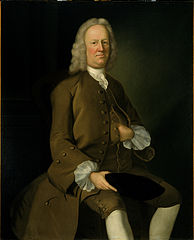
Whatever way he died, Phillips left no will. Under British common law, his property would go mostly to his older brother, Gillam Phillips (shown above). In contrast, Massachusetts law divided the estate in five among the deceased’s brother, mother, and three sisters (or their children).

Gillam sued, seeking to take a considerable sum from his female relatives (or their husbands). Losing in the Massachusetts courts, he appealed to London. It was apparently as part of that transatlantic lawsuit that Gillam Phillips gathered several depositions from witnesses to the men’s quarrel and the discovery of Woodbridge’s body.

Ten years after the duel, Gillam Phillips finally lost that case. The Privy Council ruled that Massachusetts law applied. In The Transatlantic Constitution, Mary Sarah Bilder of Boston College Law School wrote that that was an important precedent in establishing that colonial law could sometimes differ from British law. Gillam Phillips’s collection of documents eventually came to the Harvard Law School archives, becoming the source material for a no-doubt endless stream of articles about his brother’s fatal duel on Boston Common.

Saturday, June 25, 2016

The First Fatal Duel on Boston Common

In 1719 Massachusetts enacted a law against dueling, establishing the punishment as a fine of up to £100, imprisonment for up to six months, and/or corporal punishment “not extending to member or pillory.” (I think “member” refers to cutting off body parts, such as ears.)

Given all the things that the Puritans forbade, it may seem odd that they never took a stand against dueling. The fathers of the Massachusetts Bay Colony probably had more important things on their mind. Only after 1692 when Massachusetts became a province with a royally appointed governor, bringing other Anglican aristocrats and merchant adventurers, did the practice of dueling become a concern.

At the Old North Church’s blog, Mark Hurwitz just told the story of the province’s first fatal duel, nine years after this law went onto the books.
In July of 1728, Henry [Phillips] and Benjamin Woodbridge drank and played cards at the Royal Exchange Tavern on the corner of State and Exchange Street. The card game turned into an argument, which led to a challenge to a duel with swords at Boston Common that same night. According to Henry, troubles between the two had been growing for some time and according to him, a friend of Woodbridge’s encouraged him to challenge Henry to a duel with swords.

Henry suffered minor wounds to his abdomen and fled Boston Common after wounding Woodbridge in the chest. Henry sought out the medical attention of Dr. [George] Pemberton who dressed his wounds. As he was being treated for his wounds, he confessed to participating in an illegal duel and wounding Woodbridge. He brought Dr. Pemberton to Boston Common and the both of them were unable to locate Woodbridge. He was found dead the next day. It is believed that Woodbridge had sought shelter several yards away under a tree when it began to rain, and thus he expired there.

Because dueling was illegal in Massachusetts, Henry’s friends and family helped to smuggle him out of town aboard a ship departing for England that evening. Several weeks later, Henry reached London and went on to La Rochelle, France where his brother’s brother-in-law, Peter Faneuil, had family, and they agreed to take him in.
Woodbridge was a “pretty young man,” according to a diarist. Only nineteen years old, thus below the age of majority, he was nonetheless a “young gentleman-merchant,” according to the New-England Weekly Journal. His father was an Admiralty court judge in Barbados.

Phillips was also fairly young, twenty-three years old. A Harvard graduate, he had joined his older brother’s bookselling and mercantile business. They were Anglicans, but also Boston natives.

Reportedly Phillips and Woodbridge were friends before their duel. Some contemporaries blamed another man for pitting them against each other. Traditionalists blamed the new bad habits coming from England.

The Massachusetts General Court passed a new law that increased the punishments for dueling. Among the new provisions, anyone killed in a duel or convicted of killing another was denied church burial.