J. L. BELL is a Massachusetts writer who specializes in (among other things) the start of the American Revolution in and around Boston. He is particularly interested in the experiences of children in 1765-75. He has published scholarly papers and popular articles for both children and adults. He was consultant for an episode of History Detectives, and contributed to a display at Minute Man National Historic Park.

Subscribe thru Follow.it


•••••••••••••••••


Showing posts with label Maine. Show all posts

Thursday, September 03, 2026

“Environmental Histories of New England” in Boston, 18 Sept.

On Friday, 18 September, the Massachusetts Historical Society will host the New England Quarterly Symposium on Environmental Histories of New England, 1600-2026.

Papers relevant to our period include:
  • “Preserving the Catch: Curing Practices, Environmental Agency, and the Eighteenth-Century New England Commercial Cod Fishery” by Morgan S. Hardy, University of Tennessee
  • “Beyond ‘Hot Girl Summer’: Rural Life and Gendered Experiences of Seasonal Variability in Eighteenth-Century Northern New England” by Emma C. Moesswilde, Elon University
  • “Many Are These Awfully Sudden Deaths: Mapping the Environmental History of Boston’s 1721 Epidemic” by Christopher Parsons, Northeastern University, and Molly Nebiolo, Butler University
  • “Environmental history with/for Indigenous communities: Examples from Acadia” by Catherine Schmitt, Schoodic Institute at Acadia National Park
  • “‘A Fishay Noyse’: Taunton’s Herring Crisis and New England Energy Futures” by Zachary Bennett, Norwich University
The keynote address at the end of the day will be “Tom Paine’s Sunshine Soldiers” by Joyce Chaplin, the James Duncan Phillips Professor of Early American History at Harvard University.

Registration, which includes food, costs $20. The event is free for graduate students, teachers, and adjunct faculty.

On the afternoon before the symposium, the Norman B. Leventhal Map & Education Center, a co-sponsor of the event, will host an open house in its facilities at the Boston Public Library central building.

For the full program and registration information, start at this page.

Saturday, April 18, 2026

“Thus did I engage in the arduous Struggle in the commencement of that revolution”

In the summer and fall of 1783, Lt. Joseph Wheaton was feuding with another Continental Army officer. Among the issues was the accusation that he sold rum to the soldiers at a personal profit. There were court-martial proceedings.

Lt. Wheaton wrote what Henry Knox Papers cataloguers call a “Long letter describing his service in the army and denouncing the accusations made in ‘envy’ against him.” That letters said that he’d “been in the army close to eight years,” or since 1775.

In fact, in early 1776 Wheaton appears to have been inside British-held Boston. The earliest evidence he was helping the American side was in late 1777, and his first Continental commission came in early 1779. But suggesting he had been fighting the war from the start sounded more impressive.

Wheaton also appears in the correspondence of the first five Presidents, usually asking for better jobs on the basis of his past services. For example, as John Adams left office, Wheaton sent him this letter:
Having been honord by you with a request to State Some circumstances which took place in the eastern part of the State of Massachusetts in the early part of our revolution, I have taken the liberty now to inclose that Statement to you, and permit me to add, that thus did I engage in the arduous Struggle in the commencement of that revolution with a zeal commensurate With the object, and continued in the armies of my country until tranquility was restored and the object of our contention obtained, Since which I need not add how my feble efforts have been imployed—Notwithstanding I have much reason to fear, that tho’ I am grown grey in Service, I shall be heard of Soon (if any Should deign to enquire after me) in retirement, and in poverty, unable to Support a wife and two young Children my feelings have lately been much agitated by the political disquietude and changes of this Country, on which I make no comment…
After the War of 1812, Wheaton spent years lobbying the U.S. Congress to reimburse him for expenses he allegedly incurred as a quartermaster. Once again he demanded respect for “Having served nine campaigns in the revolution under experienced officers,—commencing on the 11th day of May. 1775, in the capture of the Margaretta…” (Which actually took place in June 1775, and had nothing to do with his financial accounts forty years later.)

Wheaton even passed that mission on to his progeny. Decades after he died in a Baltimore asylum, his heirs were still petitioning Congress for compensation. Wheaton’s Revolutionary War pension file doesn’t have the usual reminiscences from the petitioner and his witnesses in the early 1800s. Instead, it’s all about what congressional committees were deciding about him after the Civil War.

As I said yesterday, it’s possible Joseph Wheaton did take part in attacking H.M.S. Margaretta in June 1775, just as he claimed—over and over. And it’s possible that those claims were exaggerated or completely made up as a way to improve his social standing in the new republic.

All we can be sure of is that the first contemporaneous evidence of Wheaton’s activity during the Revolutionary War shows him seizing a civilian boat on behalf of the Royal Navy.

TOMORROW: Marblehead harbor in 1776.

Friday, April 17, 2026

“The honor of this enterprise belongs to Joseph Wheaton”

Yesterday I shared part of a letter Joseph Wheaton wrote in 1818 about how men from Machias, Maine, captured H.M.S. Margaretta early in the Revolutionary War.

In 1824, Charles W. Goldsborough quoted that letter in The United States Naval Chronicle. Many other chroniclers drew on it to describe the fight, sometimes said (by people not from Fairhaven) to be the first naval battle of the war.

In The Pictorial Field-book of the Revolution (1852), Benson J. Lossing said in a footnote:
The honor of this enterprise belongs to Joseph Wheaton, a native of New York, then residing at Machias. He was an energetic young man of twenty years. He proposed the expedition, but modestly named [Jeremiah] O’Brien for commander. He was active in the whole affair, and in person seized the colors of the Margaretta.
However, in a 1975 article for Maine History titled “The Historiography of The Margaretta Affair, Or, How Not To Let the Facts Interfere With a Good Story,” Edwin A. Churchill grouped Wheaton’s description of events with other unsupported or untenable tales. Churchill referred to “the self-centered bragging of Joseph Wheaton” and said his memory was “notoriously bad.”

Churchill’s main targets were two big errors that he said “traditionalist” authors kept making in their accounts of the Margaretta affair. It wasn’t sparked by conflict over a Liberty Pole, he insisted, and Benjamin Foster’s ship didn’t run aground before the fight. Wheaton wrote nothing about a pole, but he left Foster out of his account entirely. 

I won’t continue to quote Wheaton’s account, which you can read in full here, thanks to Maine Memory. Nor will I try to pick apart its details, much as I like doing that. Other people, closer to Machias geographically and emotionally, can handle that task.

Instead, I’ll consider how Joseph Wheaton’s account of the Margaretta capture fits, or doesn’t fit, with his status in March 1776: in the family of a royal appointee evacuating Boston with the British military.

It’s possible that Joseph Wheaton did take part in the attack on the Royal Navy sloop in 1775, despite (or because of) how that would have angered his father, a local Customs officer and Loyalist. He wouldn’t have been the only Revolutionary veteran to muddle details of events forty years before and put himself and his friends at the center of an event. He definitely did join the Continental Army a couple of years later.  

On the other hand, coming from a Loyalist family gave Joseph Wheaton a strong incentive to play up his Patriot credentials. In 1776 Massachusetts authorities even confined him as a suspected Loyalist. Telling the story of helping to capture the Margaretta let Wheaton claim that he’d fought for what became the U.S. from (nearly) the start of the war.

And Wheaton told that story a lot.

TOMORROW: Over the decades.

Thursday, April 16, 2026

“I said to him—Dennis let us go and take that Schooner”

Where were Caleb Wheaton, Sr.’s sons when the Revolutionary War began in April 1775?

Wheaton made his home on a substantial riverside plot in Machias, Maine, but he also owned real estate in Dedham. It’s conceivable an older son was farming that land.

The newspaper articles I quoted here suggest Wheaton himself was traveling in his home town of Rehoboth and nearly Providence, Rhode Island, in February.

But I haven’t found any statement from Caleb Wheaton about why or when he left Machias, when he went into Boston, or how many family members were with him.

In contrast, Caleb’s son Joseph Wheaton left a definite and detailed account of how he saw the war begin. In a letter to Gideon O’Brien, written on 23 Apr 1818 and held and published by the Maine Historical Society, Joseph Wheaton stated:
Before the Battle of Concord 19. Apr 1775—the Margarette Schooner Capt Moore—saild from Boston and came to Machias to escort convoy two sloops owned by Ichobod Jones with lumber for Boston & for the use of the British Governmt

while those vessels were loading. their came to Machias a vessel, & brought the news of the Battle of Concord—and communicated it to the people, on a Saturday Evening—

the next Morning Sunday it was proposed to take the officers when at public worship, and thereby obtain the vessel in retaliation for Concord & Lexington,

in attempting this, the officers Capt Moore & others escaped and got on board the Schoon—and fell down to Scotts Wharf—Where they were fired upon by a party who had come there headed by Mr [Benjamin] Foster from the East river—but as it fell dark very soon the Margarette fell down the river near where my family then lived

on Monday morning the people being yet together at Scotts—the Schooner in view. Your Brother Dennis and Myself were Standing on the Wharf by ourselves—when I said to him—Dennis let us go and take that Schooner—

how will you do it Said Dennis—

I said, we can take Job Hains’s Sloop, get the people on board her, the Sloop will out Sail the Margarette, we can board her and take her—

with all my heart said Dennis—

we then called to our aid two youths and renewed the proposition to which they agreed—we four immediately steped into a boat and went on board the Job Hains’s sloop and demand him to take the sloop to Scotts Wharf which with some little opposition was effected—

so soon as we steped on shore and gained the Bank before Scotts house, we four took off our Hatts and gave three cheers—when your Brother Jeremiah steped forward, yourself & Brother John & called upon the people to undertake the interprise to which all consented
We know from other sources that Lt. James Moore brought H.M.S. Margaretta to Machias in early June 1775, well after news that a war had started. That should be our first tip-off not to take the story that Joseph Wheaton told more than forty years later at face value.

TOMORROW: Maine memories. 

Monday, April 13, 2026

Caleb Wheaton “industriously vindicating the Measures of the Ministry”

In yesterday’s discussion of how the Massachusetts legislature dealt with Loyalists captured on the Elizabeth in April 1776, I left out Caleb Wheaton and his sons: Caleb, Jr.; Joseph; and John.

That’s because their story is complex and detailed enough to deserve a few postings on their own. And even then there will be holes and mysteries.

Vital records of Rehoboth show Caleb Wheaton born there in 1713. There were lots of Wheatons in that region, however, including across the nearby border in Rhode Island. Unfortunately for us, that means there were other men with the same name moving in and out of the eighteenth-century record.

Documents in Caleb Wheaton’s filing to the Loyalist Commission in 1784 show that he served in the Massachusetts army raised by Gov. William Shirley to hold Annapolis Royal in 1744. Later he was “Commandant of St. George’s Fort in the Eastern Part of the Province of Massachusetts,” now Thomaston, Maine.

Customs Commissioner Charles Paxton certified that his agency made Wheaton “a preventive Officer at Machias in which he conducted himself faithfully and diligently to the Acceptance of the Board.” That couldn’t have been a full-time position, given the size of trade in the region.

By 1774, Wheaton owned 200 acres in Machias, Maine, where he lived, and 173 more acres in Dedham. Capt. Solomon Smith wrote that he “was Situated in the most advantagest place for traid in the harbour of Machias.” Wheaton’s family consisted of a wife and nine children, some grown.

That year, Caleb Wheaton testified, he was “obliged to fly from his Estate and Property…on Account of his Attachment to the British Government.”

The 13 Feb 1775 Newport Mercury ran these two articles:
Rehoboth, February 3, 1775.

A Number of the Inhabitants of this Town assembled on Monday last [28 January], to enquire into the Conduct of Mr. Caleb Wheaton, who lately came here from the Eastward, and who had rendered himself obnoxious, by openly espousing & vindicating the Plan of Despotism now carrying on against the Colonies. A Committee was appointed to wait on him, and after making an Acknowledgment of his Villany, asking Forgiveness, and promising Amendment, he was ordered to depart the Town in twelve Hours. . . .

PROVIDENCE, Feb. 4.

Mr. Caleb Wheaton, who some Time since was obliged to quit this Town for industriously vindicating the Measures of the Ministry, returned here from Rehoboth the Beginning of this Week, which Place he had likewise been obliged to leave; and Yesterday a Number of the Inhabitants paid him a second Visit, to remind him of their former Request, when he thought proper to make a precipitate Flight.—So many all the Enemies to America become destitute of a Resting-Place for the Soles of their Feet.
The reference to “the Eastward” makes me think these items referred to Caleb Wheaton, Sr., from Maine.

Like other New England Loyalists, Wheaton found protection in army-occupied Boston. Gen. Thomas Gage certified that “he was employ’d as an Officer of Guides in the Kings Service.” According to E. Alfred Jones’s Loyalists of Massachusetts, “By orders of General Sir William Howe he pulled down the Old North Meeting House,” which happened on 16 Jan 1776.

TOMORROW: The Wheaton brothers.

Friday, April 03, 2026

All Aboard the Elizabeth

When Cdre. John Manley captured the brigantine Elizabeth, evacuating from Boston, in April 1776, he saw that he’d hooked an important—and potentially lucrative—prize.

Manley sent some of the people aboard that ship to Gloucester on the Lee under Capt. Daniel Waters. He kept the rest on the Elizabeth and escorted that ship to Portsmouth, New Hampshire.  

That harbor was appropriate since it was the Elizabeth’s home port. Back in October 1775 H.M.S. George had captured that brig on its way back from Montserrat. The local merchant Richard Hart (c.1744–1820) was glad to see his ship return.

The Elizabeth was still carrying the seventeen hogsheads of rum and four hogsheads of sugar that it had picked up in the West Indies. And it was loaded with other cargo. There were household and mercantile goods that passengers were taking with them from Boston and, most valuably, a large quantity of linen and woolen cloth.

Sadly, the property on board the ship also included four enslaved people, listed in a public document a couple of months later as:
A negro man named Adam, John Rowe, Esq owner.
A negro man named Scip, Harrison Gray Esq: owner.
A negro woman named Belinder, Benjamin Austin Esq: owner.
A negro woman named Brada, a widow Kitpath, owner.
Rowe, Gray, and Austin were all rich Boston merchants, but they were in different political situations. Gray, also royal treasurer of Massachusetts, had left with the fleet. Austin was on the Patriot side. And Rowe was trying to find his usual place in the middle, having stayed in Boston through the siege but then stayed in town after the siege as well. (I can’t identify the widow.)

The Elizabeth was also carrying “a Serjeant & twelve privates of the 4th or Kings own Regiment,” who were now prisoners of war. At least some of those soldiers had wives and children with them.

In all, there were forty-six civilians on board the Elizabeth, including the ship’s captain, Peter Ramsey, and the crew. The most prominent of the Loyalist passengers were:
And Brush had made himself notorious inside besieged Boston.

TOMORROW: Where those woolens came from.

Sunday, December 21, 2025

The Burdicks after the Boston Massacre

In the year after the Boston Massacre, Benjamin Burdick became the proprietor of the Freemason’s Arms tavern—better known as the Green Dragon Tavern, owned by the St. Andrew’s lodge.

I imagine his wife Jane did a lot of the hosting since Benjamin remained Constable of the Town House Watch through 1774.

As the London government cracked down and war approached, the Burdicks moved out to Marblehead. Benjamin opened a “large, genteel, and commodious” inn opposite Jeremiah Lee’s mansion. Soon he was watching over auctions of captured goods and vessels. Later the inn hosted auctions of estates confiscated from absent Loyalists.

By 1786 Burdick had relocated to Danvers, at the Sign of the Flag, but that property was sold the next year. Jane was back in Boston when she died in 1791. I haven’t found a record of Benjamin’s death. (It doesn’t help that genealogists have intertwined him with a man of the same name from Westerly, Rhode Island.)

In 1778, the Boston merchant Samuel Phillips funded the opening of a new academy in Andover with Eliphalet Pearson as preceptor. The inaugural class of that school included Malcolm McNeil Burdick, born in Boston 1764—the Burdicks’ oldest son. (His first and middle name appeared with different spellings.) Malcolm was in his teens but for some reason listed as age ten in school records.

Later Malcolm M. Burdick went to sea, appearing in advertisements as master of the Minerva sailing from Baltimore to Liverpool in 1801 and of the John out of New York in 1807. By 1812 he had settled in Windham, Maine, where he advertised that someone else’s livestock had gotten onto his land.

Another of Benjamin and Jane Burdick’s sons, William, born in 1774, went into printing. In July 1795 he and Benjamin Sweetser cofounded a newspaper in Boston called the Courier. Soon that became The Courier, Boston Evening Gazette and Universal Advertiser. Burdick signed over his portion of the business to Sweetser in December, and it ceased publishing in March 1796 after a fire.

[ADDENDUM: From 1798 to 1800 William Burdick was the junior partner in publishing the Oriental Trumpet newspaper in Portland, Maine. He then returned to Boston.]

In 1809 William Burdick married Lucretia Sprague (1788–1849), daughter of Continental artillery veteran Samuel Sprague (1753–1844). According to her brother, the banker and poet Charles Sprague (1791–1895), their father was also part of the Boston Tea Party.

William Burdick reused the Boston Evening Gazette name for a new periodical in 1813. His printing office at Congress and State Streets was next to the Exchange Coffee House, and he bought stock in that jittery enterprise. The printer’s older brother Malcolm sold subscriptions up in Maine.

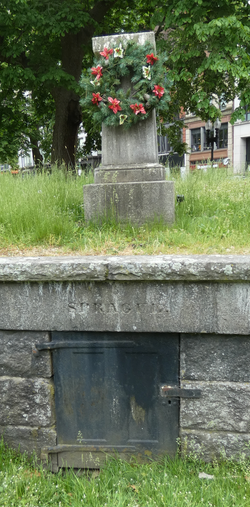
That Boston Evening Gazette evolved into the the Boston Intelligencer in August 1816. Burdick sold the business the following January and died on 30 May 1817, under Dr. John Collins Warren’s care. He was intestate but solvent, so his widow Lucretia could settle the estate and live for three more decades. She was interred in the Sprague family tomb in Boston’s Central Burying-Ground, shown above.

Tuesday, October 21, 2025

“A Sett of Globes (which came over by Mistake)”?

In eighteenth-century New England, booksellers sold more than books, pamphlets, and magazines. 

As the business letters of Thomas Hancock and Henry Knox show, they also purveyed medicines, tea, “Instruments,” quills, stationery, snuff, and other genteel goods.

In the spring or summer of 1773, Knox received a set of globes from one of his London suppliers. This set probably consisted of a terrestrial globe—the spherical representation of Earth that we’re used to—and a celestial globe showing the constellations and other stars.

We have a bunch of Knox’s incoming correspondence, published by the Massachusetts Historical Society in 1928, but I don’t see a clue about who sent those globes.

Some London merchants, such as the publisher Thomas Longman, just shipped Knox the latest magazines and the books reviewed in those magazines without waiting for an order. So it’s possible one of the young bookseller’s suppliers put those globes on a ship expecting he would find a market for them.

Fortunately, a customer appeared. On 6 August, the schoolmaster John Vinal wrote to Knox from Newburyport:
Mr. [Tristram?] Dalton informed me that you had a Sett of Globes (which came over by Mistake) that you would dispose of at the Sterling Cost and Charges. I was just going to write to London for such a Sett; but if you have not disposed of yours, and the price is agreeable, and they are the right sort I will purchase them. I should be glad of a Line immediately; you may inclose one to me directed to my Friend Mr. Wm. Miller Collector.

I should be glad to know the following particulars, vizt. Whither they are Senex’s Globes—who they are made by, if they have a Magnetic Needle and Card, if they have a Nonius Scale and Analemma, Quadrant of Altitude, etc. and what Cases they are in. . . .

Please to express the Price either in Sterling or L[awful] M[one]y.
As published, this letter told Knox to send mail through “Wm. Millen,” but the deputy collector of customs in Newburyport was another of Knox’s customers, William Miller. Since Vinal was officially a handwriting master, you’d think he’d render his friend’s name unmistakably.

As a teacher of adult classes in navigation, among other subjects, Vinal’s wanted to know this product’s features. “Senex’s Globes” meant those modeled on the work of cartographer John Senex (1678–1740). A “Nonius Scale” was the invention of the Portuguese scientist Pedro Nuñez (1492–1577). An “Analemma” is the figure-8 pattern traced by the Sun when viewed from the same spot day after day over a full year.

As for the price, that probably depended on how large these globes were. Sets ranged from small enough to fit in a pocket to large enough to count as furniture, and their price tags were proportional.

Did Knox and Vinal close the deal? We don’t know because we don’t have both sides of the bookseller’s correspondence. But on 27 June the Rev. John Murray had written to Knox from Boothbay in Maine asking for “one pair of 18 inch Globes.” (Murray also complained about how Knox had supplied “Copies of the Classical authors,” nonetheless ordered some other books, and asked how to reach Knox’s childhood friend the Rev. David McClure.) So if those globes from London were 18 inches across, they were probably on their way past Newburyport to Boothbay.

TOMORROW: Mr. Vinal’s notices.

Wednesday, August 27, 2025

“Are you serious, Dr. Church?”

In a letter to the Rev. Dr. Jeremy Belknap, Paul Revere recalled a dramatic moment on 21 Apr 1775:
The Friday evening after [the Battle of Lexington and Concord], about sun set, I was sitting with some, or near all that Committee [of safety], in their room, which was at Mr. [Jonathan] Hastings’s House at Cambridge. Dr. [Benjamin] Church, all at once, started up—

Dr. Warren, said He, I am determined to go into Boston tomorrow—

(it set them all a stairing)—

Dr. [Joseph] Warren replyed, Are you serious, Dr. Church? they will Hang you if they catch you in Boston.

He replyed, I am serious, and am determined to go at all adventures.

After a considerable conversation, Dr. Warren said, If you are determined, let us make some business for you. They agreed that he should go to git medicine for their & our Wounded officers.

He went the next morning; & I think he came back on Sunday evening.
As part of his medical mission, Dr. Church carried in a note from Dr. John Homans of Brookline to his mentor Dr. Joseph Gardner, asking for surgical knives.

Revere recalled speaking to Church after his return:
After He had told the Committee how things were, I took him a side, & inquired particularly how they treated him? he said, that as soon as he got to their lines on the Boston Neck, they made him a prisoner, & carried him to General [Thomas] Gage, where He was examined, & then He was sent to Gould’s Barracks, & was not suffered to go home but once.
In Igniting the American Revolution, Derek W. Beck guessed that the Gould of “Gould’s Barracks” was Lt. Edward Thoroton Gould, who on that day was a wounded prisoner of war outside of Boston. But I think the answer appears in a letter of merchant John Andrews on 11 January:
This morning the soldiers in the barrack opposite our house, left it, and took quarters with the royal Irish in Gould’s auction room or store—in the street leading to Charlestown ferry.
Bostonians often referred to barracks by the name of the local landlord who had rented those buildings to the army, making “Gould’s barracks” a big building on Back Street in the North End.

Robert Gould was a merchant who in August 1773 announced that the Boston selectmen had authorized him to set up as an auctioneer. He advertised heavily over the next several months (usually signing those notices “R. Gould”) before the Boston Port Bill hit. Renting his store to the army might have seemed like the best possible deal.

Robert Gould had also invested in Maine land along with Francis Shaw, Sr., a settlement that became Gouldsboro. He had trained Francis Shaw, Jr., in business, and newspaper ads in 1770 show that the younger man was selling ceramics out of “the store lately improved by Mr. Robert Gould.” In June 1776, Francis, Jr., and his wife Hannah had a boy they named Robert Gould Shaw. That man would pass the name on to his grandson, the Civil War hero.

Robert Gould remained in Boston after the British evacuation, but the Patriot authorities were suspicious of his dealings with the king’s army. The selectmen recommended detaining him for questioning, but the Massachusetts General Court decided to drop him from the list. Gould went back to advertising as a regular merchant in late 1776. But then he died unexpectedly, intestate and in debt, in January 1777, aged 57.

TOMORROW: The doctor’s documents.

Thursday, March 27, 2025

The Short Military Career of Lt. Col. Thomas Williams, Jr.

The Journal of the American Revolution just published Tim Abbott’s article about Lt. Col. Thomas Williams, Jr. (1746–1776), of Stockbridge.

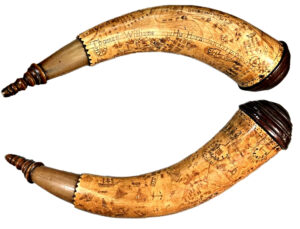
Williams left behind an engraved powder horn, now in the collection of the Stockbridge Library Museum and Archives. It shows Boston landmarks.

(This is different from the Dr. Thomas Williams powder horn recorded by Rufus Alexander Grider in 1888 and now lost.)

The siege lines around Boston contained some professional horn carvers selling their work to men who wanted souvenirs of military service. I suspect the Williams horn is one like that. As an officer and as a lawyer in civilian life, he probably didn’t have the time or inclination to do his own carving.

As Abbott’s article recounts, Williams was one of two minute company captains who responded to the Lexington Alarm from Stockbridge. The other company included a score of men from the town’s Native community and thus gets more attention.

As the troops besieging Boston organized themselves into an army enlisted through the end of the year rather than an emergency militia force, Williams became part of Col. John Paterson’s regiment. In September he volunteered for Col. Benedict Arnold’s expedition through Maine to Québec.

However, Williams was in the rear guard led by Lt. Col. Roger Enos (1729–1808), who in late October decided to turn back. That was controversial. Enos was tried and acquitted in a court-martial. He was probably lucky to go through that procedure before the army at Cambridge received “Colonel Arnolds evidence,” as Gen. George Washington reported.

Williams left Paterson’s regiment at the end of 1775, but on 9 Jan 1776 he became lieutenant colonel of a new regiment under Col. Elisha Porter to be sent up to Québec along Lake Champlain and the St. Lawrence River. This time Williams made it to the outskirts of the city, but smallpox was weakening the Continental forces.

Those Americans were trying to inoculate and fight the war at the same time. Abbott writes:
The timing for the deliberate exposure of Porter’s Regiment to smallpox could not have been worse. The inoculation process required effective quarantine for three to four weeks, during which the men were both weak and contagious. Even for those under treatment, severe cases could still develop and mortality rates under the best conditions still ran 1 to 2 percent. Porter’s men had no more than three days in hospital after they were inoculated before the siege was dramatically lifted by the arrival of a British fleet on May 6 and the American forces were soon driven back upriver in full retreat. Not only were they exposed to physical stress while they developed smallpox symptoms, but they became a significant vector for the spread of the disease to others in its more deadly form.
The American commander, Gen. John Thomas, died on 2 June. Lt. Col. Williams led his men back to Crown Point, New York, before falling ill. He didn’t make it home to Stockbridge.

Williams doesn’t appear to have left behind his own diary or letters—his powder horn might have been his only personal record of military service, and it probably wasn’t his own creation. Abbott has therefore done the work of reconstructing his career by weaving together official records and other officers’ accounts.

Friday, January 17, 2025

“The Judge supposes he is possessed of the secret”

Before returning to Dr. John Newman, I’ll share some other sources on the treatment of cancers in New England on the eve of the Revolutionary War.

In January 1773, the Massachusetts judge Peter Oliver went to Rhode Island to serve on the royal commission investigating the attack on H.M.S. Gaspée.

Politically the Rev. Ezra Stiles was opposed to Oliver and the inquiry, but he was still polite enough to host the man.

On 11 January, Stiles wrote in his diary:
This Afternoon the hon. Judge Oliver came to drink Tea with me and spent the Evening at my house in Company with Mr. [Robert?] Stevens, Major [Jonathan] Otis and Dr. Jabez Bowen of Providence.

The Judge told us that his Wife had been last year cured of a Cancer in her Neck of 30 years standg. by a young man Mr. [John] Pope of Boston. . . .

His remedy is a secret, but he explained the operation of it to Mr. Oliver in a philosophical Manner, though Mr. Pope is not a man of Letters nor does he make pretension to any other part of Medicine or Surgery.
Peter and Mary (Clarke) Oliver’s son Peter (1741–c. 1831) was a respectable sort of doctor: upper-class, male, practicing standard medicine for his time. Nonetheless, Mary sought treatment from John Pope.

How good that treatment was over the long term is another question. Mary Oliver died on 24 Mar 1775 at the age of sixty-one. Among the pictures of Judge Oliver is one, reproduced above, showing the man mourning at his wife’s grave. It’s one of the rare portraits from the time of a person displaying strong emotion.

Stiles wrote down some of Oliver’s other medical remarks in 1773:
The Judge said that the late Mr. Little of Plymouth found an absolute Remedy for the Quincy, called white Drops, and offered me the Receipt. I suppose it the same as Dr. Bartlets which is only volatile Sp[iri]ts. as Hartshorn or Salarmoniac mixed with Oyl Olive. . . .

The Judge knew an illiterate physician to cure his (the Judge’s) Negro of a bilious Colic or perhaps the Illiac passion in a few Minutes—but would not disclose his Remedy. But the Judge supposes he is possessed of the secret, though that physician died without communicating it even to his own son. For being on the Circuit of the Superior Court in the Co. of York he found a Countryman to the Eastward [i.e., in Maine] who had a Cure for the bilious Colic, which Dr. Lyman had proved infallible in 100 instances.

The Judge bought it of the Man for 30. and it was only the Root of Meadow Flags, or Flower de Luce. Not every flag—but such only whose Root was flat with prongs—that flag root which was surrounded with bushy Fibres will not answer.
The most common name for those flowers today is wild iris.

Monday, December 16, 2024

The Cochrans of New Hampshire

The Cochran family came to New England from northern Ireland. They settled in towns named to attract such migrants: Belfast in what would be Maine and Londonderry in New Hampshire.

At least that’s according to a family history recorded in Lorenzo Sabine’s American Loyalists, based on the account of a daughter of John and Sarah Cochran living in Portsmouth, New Hampshire, in 1845.

However, some details of that account don’t match what contemporaneous documents tell us about the confrontations over Fort William and Mary in 1774 and 1775. That daughter might have been too young to grasp the details and chronology.

It’s also not clear how the daughter (never named, alas) came to be in Portsmouth when her parents had moved with four of their children to New Brunswick, Canada, in 1783.

Multiple Cochran households settled in the region in the early 1700s. Leonard A. Morrison’s History of Windham in New Hampshire (1883) has an extensive genealogy for one family, but focuses on descendants that remained in the U.S. of A. The Cochrans I’m interested in may have been related, and they certainly used the same common given names, but I have no hope of sorting them all out.

The best I can say is that it looks like John’s father James was born in Ireland about 1710 and made the trip across the Atlantic. John was born in America in 1730. He went to sea for some years. The New-Hampshire Gazette reported a captain of his name in charge of the Berwick in 1762, the Onondaga in 1763, and the Londonderry in 1769 and 1770.

John Cochran then returned to the family farm in Londonderry. His wife Sarah and their children lived there—possibly as part of an extended clan. They ultimately held deeds for well over a hundred acres of land.

In 1770 John accepted the post of commander of Fort William and Mary from Gov. John Wentworth, which took him back to the sea—or at least to an island in Portsmouth harbor. On St. John’s Day in 1771 and 1774, Brother Cochran hosted a Freemasons’ dinner at the fort.

As I recounted here, John and Sarah were in the fort on the afternoon of 14 Dec 1774 when John Langdon led in a militia force that took away all but one barrel of gunpowder.

James Cochran joined his son at the fort, perhaps brought by news of that confrontation. He was still there the next night when John Sullivan, recently returned from the First Continental Congress, showed up with more militiamen to collect artillery pieces and ordnance.

According to Gov. Wentworth, the older Cochran laid into Sullivan:
The honest, brave old Man stop’d him short, call’d him and his numerous party perjur’d Traitors & Cowards, That his Son the Capt. Shou’d fight them two at a time thro their whole multitude, or that He would with his own hands put him to death in their presence, Which the Son readily assented to, but none among them wou’d take up the challenge, relying on and availing themselves of their numbers to do a mischief which they never wou’d have effected by Bravery.
Sullivan had been struggling all day to figure out how to handle this event, pushed by more radical militiamen while trying not to go too far in defying the king. He probably didn’t care to hear James Cochran’s opinion.

But the New Hampshire forces left the Cochrans alone. John continued to command the fort, soon protected and probably rearmed by the Royal Navy. Sarah and their children, and probably James, continued to farm in Londonderry, even as war began down in Massachusetts.

On 23 Aug 1775, as I said yesterday, Gov. Wentworth and John Cochran sailed away from Fort William and Mary for Boston. That left Sarah and the children behind. And the environment had changed.

TOMORROW: Cochrans on the move.

Tuesday, October 08, 2024

“Quite free from Lifes Distressing Care”

In August 1774, a woman named Mary Nasson died in York, Maine, at the age of twenty-nine.

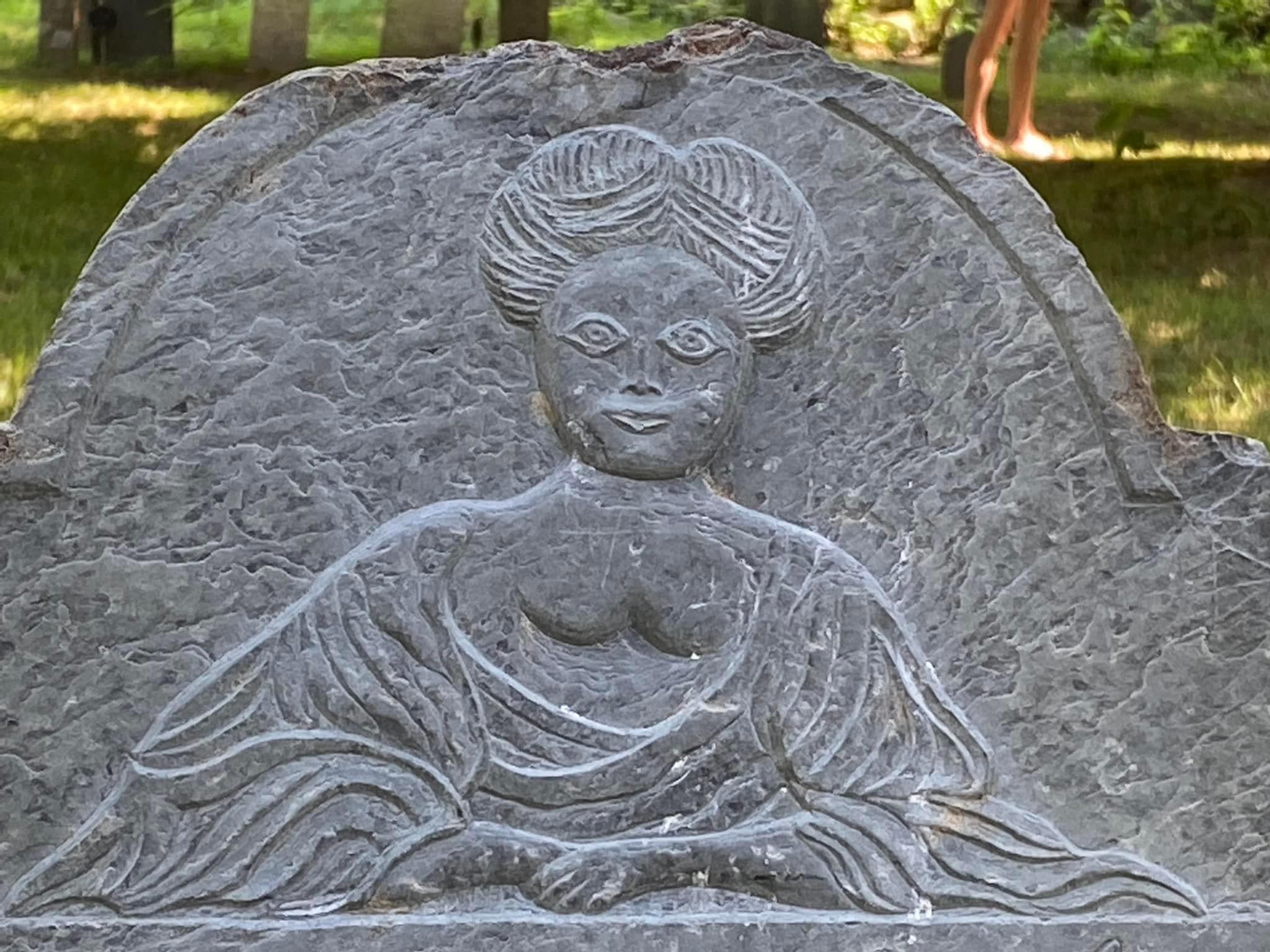
Mary’s husband, Samuel, commissioned a slate gravestone with a carved portrait and these words:
Here rests quite free from Lifes
Distressing Care,
A loving Wife
A tender Parent dear;
Cut down in midst of days
As you may see,
But—stop—my Grief!
I, soon, shall equal be,
When death shall stop my breath
And end my Time;
God grant my Dust
May mingle, then, with thine.
Samuel Nasson also arranged for a large stone to lie over the grave, probably to stop animals from digging up his wife’s remains.

Unfortunately for the couple’s memory, that stone appears to have inspired people in the early nineteenth century to think that it was placed to keep her from rising from the dead. Books and then websites came to refer to Mary Nasson as a witch.

In an essay at Early American Studies Miscellany, “Not a Witch: Public History in a Maine Graveyard,” Daniel Bottino and Hannah Peterson state:
Visitors to the grave today marvel at the stone slab, which according to stories available online was put there to keep Mary’s maleficent ghost from rising from her coffin and bewitching the townspeople of York. No matter how many attempts are made to clean the slab, it is always cluttered with coins and a wide variety of various tokens.

There is no evidence that Mary Nasson was ever considered a witch during her lifetime, a fact that has not stopped the popularity of the witch’s grave legend. She was an ordinary woman; that is what makes her story interesting. The historical fantasy of Mary as a witch distracts us from learning about the lives of women like Mary in early New England and presents an erroneous image of her which would have shocked both her and her family.
Bottino and Peterson have tried to set the record straight for the public by using ghost tours and other staples of public history to discuss the facts.

(They also coauthored an article in Early American Studies’ summer 2023 issue, “‘I Hope I Have a Treasure in Heaven, Because My Heart Is There’: Salvation and Damnation in the Conversion Narrative of Patience Boston.” Boston also died in York at a young age, but in very different circumstances.)

Friday, August 09, 2024

“Mr. Adams Goes to Philadelphia” in Quincy, 10–11 Aug.

This weekend, 10–11 August, the Adams National Historical Park will commemorate John Adams’s departure for the First Continental Congress in Philadelphia.

The event description says:
Special programming for the 250th anniversary of the First Continental Congress will be held at the Adams Farm at Penn’s Hill, located at 141 Franklin Street in Quincy.

Ranger talks focused on the role of John Adams in the First Continental Congress will take place outside of the John Adams and John Quincy Adams Birthplaces at the Adams Farm at Penn’s Hill on both Saturday and Sunday at 10 am, 12 noon, and 2 pm.

John Adams, portrayed by Michael Lepage, will be on-site at the Adams Farm at Penn’s Hill throughout the day on both Saturday and Sunday. Visitors can talk with Adams as he prepares for his journey to Philadelphia and for the First Continental Congress.
These are outdoor events, free to the public and weather-dependent. The nearest public restrooms are at the Adams National Historical Park Visitor Center at 1250 Hancock Street.

I’ve seen some Bicentennial-era books say John Adams had never left Massachusetts before this trip. In fact, he regularly traversed New Hampshire while appearing in front of Massachusetts’s county courts since some of those counties were in Maine.

Adams also spent time at a spa in Connecticut in 1771, after concluding his year in the Massachusetts assembly. His diary of those days is transcribed here.

This trip to Philadelphia was, however, the first time Adams had traveled outside of New England. He visited two cities larger than Boston and met colleagues from as far away as Charleston, South Carolina. In August 1774, Adams might well have been feeling a little trepidatious about his trip.

Thursday, July 25, 2024

Sorting Out the Solemn League and Covenants

In his 1915 study of the Solemn League and Covenant for the Colonial Society of Massachusetts, Albert Matthews concluded that the text of that boycott agreement he called Form A was the original text from the Boston committee of correspondence, and Form B the variation from Worcester.

Matthews based that conclusion on several points:
(1) As the form sent out from Boston was frequently, if not generally, regarded as too drastic, it is reasonable to infer that the more drastic of the two forms was the one sent out from Boston, and of the two forms A and B, A is the more drastic.

(2) Every town in Massachusetts received a copy of the Boston form. Westford is in Middlesex County and so presumably would have received only the Boston form. The document [from Westford] exhibited to-day is form A.

(3) Every town in Worcester County received a copy of the Boston form and also a copy of the Worcester form. At the bottom of the broadside (form B) owned by the American Antiquarian Society is written, in the hand of Isaiah Thomas, the words “This came from Sutton.” Since Sutton is in Worcester County, the Sutton document might conceivably be either the Boston form or the Worcester form; but as a matter of fact the Sutton document is form B, and so presumably is the Worcester form.

(4) Five newspapers were published in Boston in 1774, but only two of these printed the Solemn League and Covenant,…and this is form A. It is reasonable to assume that the only form printed in the Boston papers was the form sent out by the Boston Committee of Correspondence.
When I started this series of postings, I thought that was convincing. But as I looked at Matthews’s sources and others, I found myself coming to the opposite conclusion.

Here are some points Matthews missed. First, he assumed that people objected to the Boston committee’s draft as “too drastic,” and indeed the merchants of the town did make that complaint. But in a footnote Matthews acknowledged that organizers in Worcester had circulated “even more drastic” language, so we have to consider the possibility that those men thought the Boston draft wasn’t drastic enough.

Matthews assumed that the Worcester committee sent its draft only to other towns in Worcester County. But he quoted evidence that Braintree considered text “much like the Worcester covenant” on 27 June and Falmouth (now Portland, Maine) had received “the non-importation Agreement form’d at Worcester” by 30 June.

The Boston News-Letter did indeed print Form A, but it prefaced it this way: “The foregoing is a Copy of a Covenant, which I am told great Pains are now taking to promote in the Country.” The newspaper didn’t specify the agreement that followed was the Boston committee’s proposal. Rather, the phrase “in the Country” hinted at a rural origin.

The 22 June Pennsylvania Journal printed Form B below “a Circular Letter, written by the Committee of the Town of BOSTON,” suggesting that printer William Bradford had received them together. The Boston text sent on 8 June most likely reached Bradford days before the Worcester text sent on 13 June. Even if he had both in hand, Bradford clearly cited documents from Boston.

We know that the Boston committee spread its text outside of Massachusetts. Silas Deane wrote a letter responding to a copy in Wethersfield, Connecticut, on 13 June, before he could have received the Worcester committee’s version. That appears to have been Form B. [Deane’s letter casts doubt on that book’s assertion that Wethersfield actually adopted the Solemn League on 15 June; I’ve found no official town action.] Form B was also the basis of the Portsmouth, New Hampshire, variation (Form C).

In contrast, we don’t know that the Worcester committee sent its text outside Massachusetts. Its letter referred to recipients as “fellow-countrymen,” which in this period usually meant people from the same colony.

Finally, here are two facts that Matthews acknowledged but set aside. A copy of Form A at the Massachusetts Historical Society is labeled “Worcester Covenant.” The printer’s type and watermark of that copy match the printed letter issued by Worcester’s committee on 13 June—though Matthews explained that away by saying all these documents must have been printed in Boston since Isaiah Thomas hadn’t yet set up the first press in Worcester.

Looking at all that evidence, I reconstruct the sequence of events this way:
  • late May and early June: The Boston committee of correspondence and Worcester County radicals both drafted calls for a stronger boycott on British goods until the Boston Port Bill was repealed.
  • 8 June: The Boston committee sent out its printed circular letter and suggested Solemn League and Covenant (Form B) to all towns in Massachusetts and to allies in other colonies.
  • by 10 June: After feedback from Worcester, if not other places, the Boston committee sent a second printed circular letter approving other language as long as it led to the same broad boycott.
  • 13 June: The Worcester committee of correspondence wrote a new Solemn League and Covenant (Form A) based mostly on the Boston text but incorporating some of its earlier draft and sent that out with a printed circular letter to all towns in Massachusetts.
  • 20 June: Worcester formally adopted its form of the Solemn League and Covenant.
  • 22 June: The Pennsylvania Journal printed the Boston committee’s draft.
  • 23 June: The Boston News-Letter printed the Worcester committee’s draft, saying it was being promoted “in the Country.”
  • 27 June: Braintree adopted the Solemn League and Covenant in a form “much like the Worcester covenant,” according to the 30 June Massachusetts Spy.
  • before 28 June: The Portsmouth, New Hampshire, committee of correspondence sent out its variation on the Boston draft (Form C).
  • 30 June: Falmouth considered “the non-importation Agreement form’d at Worcester” and decided to ask other towns what they were doing.
  • 4 July: Westford adopted the Solemn League and Covenant with the Worcester text and started gathering signatures.
  • 14 July: Attleboro adopted the Solemn League and Covenant with the Worcester text and started gathering signatures.
In sum, Worcester’s version of the Solemn League and Covenant became the standard text within Massachusetts while Boston’s version spread outside the colony. This was an early example of Worcester’s radicals (who were, of course, not living under military occupation) being more confrontational than the usual troublemakers in Boston.

TOMORROW: One town’s debate.

Saturday, May 25, 2024

John Malcom: The Early Years

Back in January I wrote about the mobbing of Customs officer John Malcom on the Sestercentennial anniversary of that event.

The standard study of that attack is “Tar and Feathers: The Adventures of Captain John Malcom,” written by Frank W. C. Hersey in 1941 and available through the Colonial Society of Massachusetts. Alfred F. Young’s The Shoemaker and the Tea Party looks at the same day through the eyes of George R. T. Hewes.

I collected some additional information about Malcom that I didn’t have time to dig through and share in January, so now I’m doubling back to his story. We can call this series “The Further Adventures of Captain John Malcom.” Though really it’s more of a prequel.

First of all, a note about nomenclature: Capt. John Malcom spelled his name without a second L, as did his brother Daniel Malcom. However, many people writing about him spelled the surname in the traditional Scottish style as “Malcolm.” Indeed, Hersey transcribed a petition signed by Malcom which a clerk then labeled as coming from “Mr. Malcolm.”

Because so many historians rendered the name as “Malcolm,” I followed that style in making a Boston 1775 tag for the man years ago. However, in these postings I’m going to use the spellings that individuals preferred.

This story starts in 1721, when Michael and Sarah Malcom arrived in Boston from Ulster, Ireland, where their ancestors had moved from Scotland in the previous century. They brought young children named William and Elizabeth.

On 20 May 1723 Sarah gave birth to a second boy, whom they called John. The family then moved to Georgetown in the district of Maine. Another baby boy, Daniel, arrived on 29 Nov 1725, followed by Allen in 1733 and Martha in 1738.

Michael Malcom invested in the Massachusetts “Land Bank or Manufactory Scheme.” In 1745 he was assessed to pay £16, on the high side of those investors.

Also in 1745, wrote Hersey, young John Malcom “served as an ensign in the Second Massachusetts Regiment, commanded by Colonel Samuel Waldo, at the siege of Louisbourg; and this same year he was captain of a vessel which carried dispatches from Louisbourg to Boston,” presaging his maritime career. However, John Malcom’s name also appears as a private enlisting in Capt. Elisha Doane’s company in August 1746.

In 1750 John Malcom married Sarah Balch at Boston’s Presbyterian Meeting-House. The Rev. John Moorhead baptized five of their children between 1751 and 1758.

Younger brother Daniel Malcom also came to Boston and married Ann Fudge, and they also had children starting in 1751. He became a prominent member of the Anglican Christ Church’s congregation. While John named one of his sons Daniel, I’ve found no evidence Daniel named any of his boys John.

Both John and Daniel went to sea, made Boston their home port, and rose to be merchant captains. By the late 1740s a captain or two named Malcom was sailing out of Boston for Cape Fear, North Carolina; Antigua; Annapolis; Philadelphia; Honduras; Bristol, England; and Youghal, Ireland. By the 1750s the Malcoms were owners or part-owners of ships. They traded all over North America, the Caribbean, and Britain—and occasionally Cadiz and Lisbon.

It wasn’t illegal to trade with Portugal, Spain, or Caribbean islands claimed by other empires, but there were higher tariffs on most goods traded that way. Ship captains usually tried every trick they could to minimize those tariffs. Many of those methods made that trade into illegal smuggling, but in that period Boston merchants generally figured that as long as they didn’t get too blatant the Customs service wouldn’t come down hard on them.

The real hazards in ocean trade were natural disasters and war.

TOMORROW: Wrecked and captured.

Monday, February 12, 2024

“Command of a vessel without arms, and with but one eye”

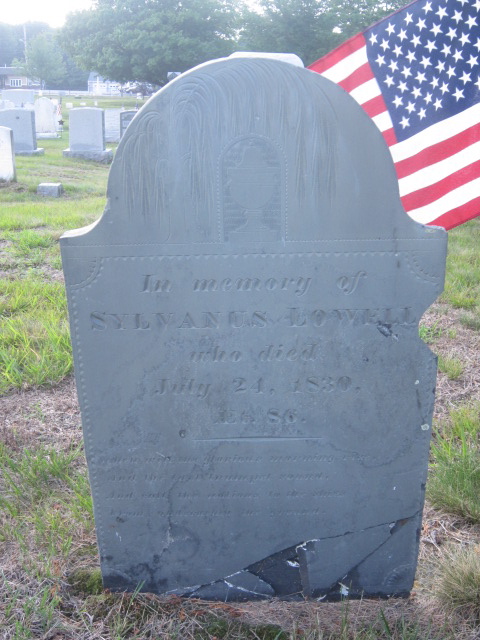
Aside from having several children, what did Sylvanus Lowell do after being so badly injured at the Marblehead smallpox hospital in 1773?

First he returned to the maritime business, as shown by this advertisement from the 23 Mar 1774 Essex Journal, published in Newburyport:
For NEWFOUNDLAND,
THE Schooner ROSE, JACOB LOWELL, master, now lying at Marquand’s wharf, will sail by the first of April.—For Freight or Passage apply to Robert Jenkins, or Silvanus Lowell.
Newbury Port, March 21st, 1774.
Shortly after that, Parliament closed the port of Boston to most trade from outside Massachusetts, thus making secondary ports like Newburyport more important for about a year.

But then the war began, and sailing out of any Massachusetts port put ships at risk for being seized by the Royal Navy. At the same time, the province needed military supplies, and there was money to be made in privateering.

Sylvanus Lowell, despite his injuries, went back to sea. As the Newburyport Herald copied from the Saco Democrat in 1830:
No better evidence of his enterprising spirit is watnng, than the fact of his obtaining command of a vessel without arms, and with but one eye. It is said he was enabled to do much of his own writing, by screwing a pen into the hook attached to his arm.
In February 1777, the Massachusetts board of war commissioned Lowell to sail to St. Eustatia to trade for salt and these goods:
500 Effective Fire Arms, fit for Soldiers, with Bayonets —
500 Soldiers Blankets —
50 Barrels Gun-powder —
200 ps Ravens Duck or Tent Cloth —
300 lb Twine —
25 Casks 20d Nails —
30 do 10d do
15 do 4 do
If the above Articles are not to be got, bring the proceeds in Russia Duck, Cordage from 4½ Inches downwards, Coarse Checks & Linnens —
He commanded a crew of at least nine men. The captain was back by July, when he bought a house in Newbury for his growing family.

In 1779 Lowell became captain of a privateering brig listed as the Porgee (also Porgee and Pauga), with a letter of marque from New Hampshire. Though descendants recalled it as “a large war-ship,” the American War of Independence at Sea website says it carried only four guns and eleven men.

Nonetheless, the Porgee managed to capture a ship called the Lively, as shown by a legal notice in the 17 July 1780 Boston Gazette. AWIatsea.com says the ship then received a Massachusetts letter of marque and went out under another captain.

In 1781 Capt. Lowell invested in a privateering sloop named the Betsey, and reportedly he commanded other privateers himself. According to his 1830 obituary:
About 3 days before Peace was concluded, he was captured by the British; but by the time they reached the shore, this news was received, and he was liberated and sent home.

After this, he followed the sea 7 years, as master of a vessel out of Newburyport, in the employ of Tristram Dalton.
Dalton had backed many privateers during the war, including the Betsey.

Levi Mills of Newburyport sailed under Capt. Lowell to Richmond on the “good ship Diana” one winter in the mid-1780s. According to an item about Mills’s journal published by the Colonial Society of Massachusetts, this tobacco-buying trip meant navigating the ice and shoals of the James River.

In 1791, as I wrote yesterday, Lowell’s second wife Elizabeth died. By the end of the year he married a third wife, also named Elizabeth. It also appears that the captain’s remaining eye started to fail around this time, eventually leaving him totally blind.

Lowell “quit the sea,” sold that Newbury house, and moved his whole blended family up to Maine, where some of his siblings had already settled. His stepdaughter Fannie later described the part of Biddeford where they made their new home as “then a wilderness.”

I’m not sure how Sylvanus Lowell supported his family after that, but reportedly the children grew up “in comfort.” In Biddeford the captain was “greatly esteemed.” Around 1825 Lowell “was visited with a severe shock of the numb palsy,” and he died on 21 July 1830, aged 86. His third wife survived him for another nine years.

Sunday, February 11, 2024

The Families of Sylvanus Lowell

Looking at the vital records from various Massachusetts towns helps to fill in the details of the life of Sylvanus Lowell, the ship’s captain maimed by a cannon in December 1773.

But those records also show some gaps and mysteries.

The vital records of Amesbury show the future mariner born to Moses and Francis (usually spelled Frances) Lowell on 2 May 1746. His name was apparently spelled as “Salvenas,” which looks more like church Latin than classical. He had siblings named Sarah, Thomas, Moses, Affea, Daniel, and Willebe (Willoughby). Their mother died when Sylvanus was two.

The vital records of Bradford say that on 2 Aug 1770 “Silvanus Lowell of Amesbury” married Hannah Hopkinson, daughter of Ens. Solomon Hopkinson of Bradford. That marriage is also noted, without an exact date, in the Amesbury records.

The Bradford records add that Hannah Lowell died on 20 Sept 1771, or possibly 26 September, “in her 26th year.” Thus, Sylvanus Lowell quickly became a widower.

There’s no child listed of that marriage in Amesbury or Bradford. However, the Bradford records are notably sparse if you weren’t named Kimball. The next sign of the family appears in the vital records of Newburyport, which say that Hannah Lowell, daughter of Sylvanus and Hannah, was baptized there on 20 June 1775. Was this a daughter of the captain’s first marriage, baptized at about age four? There’s no answer.

Likewise, I’ve found no answer about Sylvanus Lowell’s second marriage to a woman named Elisabeth. She pops up in the Newburyport records as mother of several children by him:
  • Elisabeth, baptized 6 Oct 1776 and buried 3 Sept 1777.
  • Elisabeth, baptized 12 Apr 1778.
  • Harrison, baptized 30 Jan 1780, probably died young.
  • Sylvanus, baptized 12 Aug 1781.
  • Sally, baptized 2 Feb 1783.
  • Thomas, baptized 11 Sept 1785 and buried 3 Sept 1786.
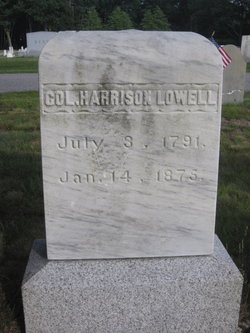
Newburyport also recorded the baptism of Harrison Lowell, son of Capt. Sylvanus and Elisabeth, on 29 Jan 1799. This may be the Maine legislator Harrison Lowell whose gravestone (shown above) gives his birthdate as 3 July 1791—though, again, that baptism would have been delayed.

Even more mysteriously, on 9 Mar 1791, Newburyport’s Essex Journal reported: “Died, Mrs. Lowell, wife of Capt. Silvanus Lowell of this town.” The vital records say that Elizabeth Lowell was buried that day. Obviously, she couldn’t have given birth to a son in July. Maybe the second Harrison was actually born in 1789 or 1790, and both the baptismal record and gravestone are off?

On 10 Oct 1791, just a few months after being widowed for the second time, Capt. Sylvanus Lowell married a widow about thirty-six years old named Elizabeth (McCard) Barriere or Berryer. She had a daughter, Fannie, from her first marriage.

I haven’t found any sign of Sylvanus having children by his second wife named Elizabeth. Each brought young children to the marriage to raise. Several of those children grew up, married, and had long lives. Both parents lived into their eighties.

This genealogical data shows Capt. Sylvanus Lowell having a fairly typical life for a New England patriarch of his time. Looking just at his three marriages and possibly eight children over more than a decade, one wouldn’t know that he’d come close to dying and lost significant portions of his body just before the Revolutionary War.

TOMORROW: What did you do in the war, Papa?

Tuesday, January 30, 2024

“Some excuse for such an outrageous action”

Another source on the circumstances of the mobbing of John Malcolm was Gov. Thomas Hutchinson, reporting to the Earl of Dartmouth, Secretary of State for North America in London.

This text is from the Colonial Society of Massachusetts’s publication of Hutchinson’s correspondence:
I am sorry that I must acquaint your Lordship with a barbarous & inhumane act of violence upon the person of John Malcom the night after the 25th. instant, by a great number of rioters in the Town of Boston. Mr Malcom is a preventive Officer for the port of Falmouth in Casco bay, and lately seized a Vessel, in that port, for want of a Register. I have heard no complaint of any irregularity in this execution of his Office, but a great number of persons, in that part of the Province, thought fit to punish him by tarring and feathering him, & carrying him about in derision.

As he was not stripped, and the chief damage he sustained was in his cloaths, upon his making complaint to me I only sent for one of the principal Justices of peace for the County, and directed him to make inquiry into the affair, and to oblige such of the Actors as he should have evidence against to find security to answer at the next Assizes for the County, or to commit them.

He has, since his being in Boston, made frequent complaints to me of his being hooted at in the streets for having been tarred & feathered and, being a passionate man, I have as often cautioned him against giving way to his passion, or making any other Return than neglect & contempt; but having met with a provocation of this sort, in the afternoon of the 25th. from a tradesman, who, he says, had several times before affronted him, he struck him with his cane.

The tradesman applied to a Justice, who issued a warrant to a Constable, but the Constable not being able to find him, a mob gathered about his house in the evening and, having broke his windows, he pushed through the broken window with his sword, and gave a slight scratch with the point to one of the Assailants; soon after which the mob entered his house and treated him in the manner related in the News paper which I shall inclose.

This account is given to me by the Relations of Mr Malcom, who are persons of good characters in the Town. He has, for some time past, been threatned by the populace with revenge for his free and open declarations against the late proceedings [i.e., the Boston Tea Party], and has, I believe, sometimes indiscretely provoked them, which it is pretended may be some excuse for such an outrageous action.

I am informed, to day, that, although he is terribly bruised, it’s probable he will recover. I will do every thing in my power to bring the guilty persons to condign punishment. I have not heard of any except the lowest class of the people suspected of being concerned in this Riot.

The next night there was an attempt to raise another mob to search for Ebenr. Richardson lately found guilty by a Jury of Murder, but judgment being suspended His Majesty’s pardon was applied for & obtained. He is now in some very inferior employment in the service of the Customs in Pensilvania and, it is thought, a report of his being in town was spread for the sake of raising a mob. Some of the more considerate people appeared and opposed the leaders in the beginning of the affair and put a stop to it.

I am the more particular in these accounts, because I have heretofore been thought negligent in not transmitting the earliest advice of every attack upon the Officers of the Customs, though of the lowest rank. The town continuing in this state the friends of the Consignees of the East India Company judge it unsafe for them to appear there, though they are sensible that any further compliance with the demands of the people could not have been justified, and that the whole proceedings with respect to them have been unjust & tyrannical. There is no spirit left in those who used to be friends to Government to support them or any others who oppose the prevailing power.
Among the notable additions to the record from this letter are that the name of pardoned killer Ebenezer Richardson was still toxic enough to arouse the Boston crowd. Gov. Hutchinson was correct that the man had gone to Philadelphia to work for the Customs office there.

However, in November 1773 the Boston newspapers ran articles from the Pennsylvania Journal suggesting that its coverage had made that town too hot for him, and he might go to New York or elsewhere. It wasn’t out of the question, therefore, that Richardson could be back in Boston. (He did return to Massachusetts by the summer of 1774 and was found in Stoneham that September.)

Hutchinson’s letter also says, based on an account from Malcolm’s relatives, that the “tradesman” he struck (George R. T. Hewes) had “affronted” him “several times before.” Neither the immediate newspaper stories nor Hewes’s later recollections indicate that history, but it’s clear that Hewes knew who Malcolm was.

Notably, Malcolm’s own narrative skipped over that first encounter entirely, except to deny the “False pretence of his haveing the Same day used a Boy Ill in the Street.” Instead, he began the confrontation with people coming to his house and breaking windows for no good reason.

TOMORROW: John Malcolm’s street fights.