J. L. BELL is a Massachusetts writer who specializes in (among other things) the start of the American Revolution in and around Boston. He is particularly interested in the experiences of children in 1765-75. He has published scholarly papers and popular articles for both children and adults. He was consultant for an episode of History Detectives, and contributed to a display at Minute Man National Historic Park.

Subscribe thru Follow.it


•••••••••••••••••


Showing posts with label George Gailer. Show all posts

Tuesday, April 06, 2021

Looking Back on the Owen Richards Attack
Last December, starting here, I wrote about the tar-and-feathers attack on a Customs employee named Owen Richards in May 1770.

The fallout from that event lasted for years, so I’m going to resume the story.

But first, for review, here’s the merchant John Rowe’s summary of the attack in his diary for 18 May:
Just as I was going to bed there was a very great Hallooing in the street & a mob of upwards a thousand people—it seems they had got an informer & put him in a Cart, covered with Tar & Feathers & so exhibited him thro’ the Streets.
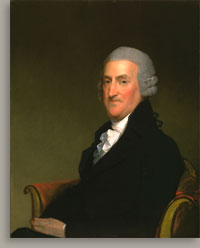
For a more detailed description, we can turn to Esther Forbes’s Paul Revere and the World He Lived In, quoting the merchant Samuel Salisbury (shown above, decades later):
I perceived candles in a number of windows,

what, thinks I, is there an illumination tonight?

Getting home I was informed that an Informer had been carted through the streets, Tarred and feathered.

After I had been to the Barber’s my Curiosity led me to the point at New Boston [the western tip of the peninsula] where I found the Informer in a Cart before Capt [John] Homer’s door surrounded with a great number of People

he had his shirt taken off & his bare skin tarred & Feathered. Sometimes they would make him say one thing sometimes another. Sometimes he must hold the Lanthorn this way, sometimes that, then he must hold up a glass Bottle & Swear he would never do so agin & let the bottle fall down & break & then Huzzah—

from thence they carried him into King Street Let him get out of the Cart made a lane down the street where 3 or 4 carried him off from the multitude in safety, being about nine o’clock.
The mob that attacked George Gailer, another man accused of helping the Customs service, in October 1769 also made him “carry the lantren in his hand & calling to all the inhabitince to put Candles in their Windoes.”

I can’t find a precedent for making Richards swear an oath and drop a bottle, though. It looks like a folk ritual of some sort, with the extra appeal of breaking stuff.

As Salisbury reported, the crowd eventually let Richards’s friends pull him away and get him home safely.

TOMORROW: Going to court.

Monday, November 25, 2019

The Devil and George Gailer

Here’s a final note on the riotous events of 28 Oct 1769—the merchants’ confrontation with printer John Mein and the tarring and feathering of sailor George Gailer.

In 2011 Dr. Caitlin G. D. Hopkins shared a passage from a letter by Elizabeth Cumings, a shopkeeper who witnessed both events from inside nearby buildings. Cumings, from a Concord family, hadn’t had much formal education, so her spelling offers a fun challenge.

Here’s what Cumings had to say about the attack on Gailer:
it was Dark our house shut up & we alon trimbling lick Courds [“trembling like curds,” I think], when a larg Mob of ful a thousand Man & boys aranged themselves befor our Dorr & on a Kart a Man was Exibited as we thought in a Gore of Blod; & poor meen [John Mein] we was shure was the sufrer but we was happyly mistaken it was an informer they had caught the moment Meen found Shalter, & instintly posted him on a kart tard him all over the town then fathered him all under our windo thin carid him threu the town obliging him to carry the lantren in his hand & calling to all the inhabitince to put Candles in their Windoes
Elizabeth Cumings and her older sister Ame were becoming unpopular for defying the non-importation movement. Hopkins has also shared her analysis of the Cumings sisters’ situation in “Enemies to Their Country”:
After Mein’s escape, the crowd had caught a suspected customs informer, George Gailer, who was beaten, tossed into a cart, and jostled through the streets. At strategic points along the route, men poured buckets of tar over Gailer’s bare skin, scalding his flesh and filling his wounds with hot, gummy resin. When the torturers “aranged themselves befor [the Cumings’] Dorr,” they applied this treatment once more, this time finishing it off with feathers. As they moved away, down Cornhill, someone thrust a lantern into Gailer’s hand, obliging him to stay conscious, lest he drop the flame and set himself afire.
In his legal filing, Gailer didn’t mention the lantern or any fear of being set on fire. Instead, he emphasized how the crowd beat him. And I’m not convinced that the purpose of the lantern was to threaten Gailer with being burned.

Indeed, the crowd could simply have held a flame to the feathers. The Customs officer Owen Richards later testified that in 1770 a mob “put him into a Cart, Tarr’d and Feathered him, then set the Feathers on Fire on his Back.”

Richards’s account was probably the source for the “Recipe” for tar and feathers in Peter Oliver’s Origin and Progress of the American Rebellion including the lines: “Then hold a lighted Candle to the Feathers, & try to set it all on Fire; if it will burn so much the better. But as the Experiment is often made in cold Weather; it will not then succeed.”

My immediate thought of seeing Cumings’s description of Gailer being made to hold a lantern was the Pope Night wagons. In 1767 Pierre Eugène du Simitière sketched three wagons in Boston. In the back of all three was an oversized effigy of the devil, and all three devils held lanterns out in one hand. Du Simitière’s image of the North End gang’s devil appears above, dangling his lantern off the back of the wagon.

Judge Oliver, Isaiah Thomas, and other witnesses also wrote of those devil figures being covered with tar and feathers. In other words, the 29 October mob turned George Gailer into a living preview of one of the effigies that would roll around town on 6 November, a little over a week away.

[Incidentally, this month I got to see Caitlin Hopkins speak about the extended Vassall family and their slaveholding at Longfellow House–Washington’s Headquarters in Cambridge. She has also turned in a report to the Harvard University administration about the college’s links to slavery, which seems like it should be issued as part of the newly announced initiative.]

Thursday, November 14, 2019

David Bradlee: “Windows broke when I got there”

We’ve come to the last of the men George Gailer sued for tarring and feathering him in October 1769, the man his legal filing identified as a “Taylor” named “David Bradley.”

As it happens, David Bradlee was one of the first individuals in Boston I dug into, about twenty years ago. I wrote a short article about him for the Bostonian Society newsletter then.

Bradlee hasn’t made a lot of appearances on Boston 1775, but I may have been saving him for the Sestercentennial of when his political activity started to appear in the historical record.

David Bradlee was born in Dorchester on 24 Nov 1742, according to Samuel Bradlee Doggett’s History of the Bradlee Family (1878). David was the sixth child and third son in the family, and two more boys followed. Most moved into Boston.

Bradlee became a tailor. On 22 Mar 1764 he married Sarah Watts of Chelsea. Doggett said her father was a judge, but Mellen Chamberlin’s Documentary History of Chelsea shows she was a daughter of Richard Watts, Harvard 1739, innkeeper and militia captain. His father was the judge—Samuel Watts, justice of the peace, member of the Massachusetts General Court and the Council. In other words, David Bradlee married up in society.

David and Sarah Bradlee’s first son arrived on 20 October, or seven months after their marriage. That baby received the name David Watts Bradlee. The couple then had Sarah (1766), Samuel and Mary (twins in 1768, but Mary died at nine months), and eventually another Mary (1770).

As I’ve written, it’s not clear why George Gailer named David Bradlee as one of the people who attacked him on 28 Oct 1769. I’m assuming Bradlee really was involved in assaulting the sailor in some way. But Bradlee had the connections to secure John Adams as his attorney. He and his fellow defendants eventually won their case on default, and he paid Adams 19s.4d.

Well before that lawsuit was resolved, however, Bradlee was present at another riot and involved into another court case about it. He was on the scene on 22 Feb 1770 when Customs officer Ebenezer Richardson shot into a crowd of boys and young men mobbing his house, killing little Christopher Seider.

Robert Treat Paine’s notes on the Richardson trial summarize Bradlee’s eyewitness testimony this way:
Windows broke when I got there. I saw 3 or 4 Stones come out of the Window. I saw one or two Men in the Room with Guns in their hands. R put a Gun on edge of Window. I heard the Gun, and run to the back of the house. R clapt the Gun at me.
In this case, the word “clapt” seems to mean that Richardson had fired a load of powder but no shot at Bradlee—in other words, he fired a blank to scare the man off. Even though Bradlee’s testimony was all about the stones and gunshots coming from inside the house, one has to wonder what he was doing so close to that house to provoke Richardson’s action.

TOMORROW: Two weeks later.

Tuesday, November 12, 2019

Unboxing Pool Spear

Yesterday I noted the difficulty of finding out more information about a sailor with a common name. Luckily, the next person on George Gailer’s list of people who tarred and feathered him in October 1769 has an unusual name: Pool Spear.

Even with the alternative spelling of Poole, it’s easy to track someone who sounds like a toy the Nerf company sends to families posting “unboxing” reviews on YouTube.

In 1864 the New England Historical and Genealogical Register published a confusing “Spear Family Record.” Fortunately, that article offers enough leads to other records that confirm Pool Spear was born 21 Sept 1735 in Hull.

Pool was the younger son of a captain of a packet ship to Philadelphia who died of smallpox in May 1738, when the boy was three. His older brothers included Joseph, a lighterman; Gershom and David, coopers; Nathan, one of the Bostonians who complained about Capt. John Willson in 1768; and Paul. How the parents decided to have successive boys named Paul and Pool is unclear.

In late 1755 Spear did three months of militia service at Crown Point, New York, in Capt. Thomas Stoddard’s company. The men chose him to be an ensign. Back home, Pool became a tailor. I’ve seen estimates that about one in seven mechanics made clothing in some way during those pre-industrial times.

In May 1761, at the age of twenty-five, Pool Spear married Christiana Turner from Pembroke. The family listed their children as Joseph, Daniel, Oliver, Paul, Christiana, and Abigail. However, I’ve found no published church records to confirm that.

In February 1768, Spear declared bankruptcy, part of the wave kicked up by Nathaniel Wheelwright’s failure three years earlier. He listed as his trustees his brother David Spear, Edward Blanchard, and John Soren. That episode was the only time Spear’s name appeared in the Boston newspapers before the war.

Pool Spear was aged thirty-four during the attack on Gailer in late 1769. The other men I’ve been able to identify were all in their twenties (assuming Daniel Vaughan was the younger of the two candidates). However, that wasn’t the last political disturbance Spear was present for.

TOMORROW: Pool Spear and the Boston Massacre.

Monday, November 11, 2019

The Mysteries of David Province

When George Gailer sued for damages after being tarred and feathered, he named four people from Boston: “David Bradley, Pool Spear, Taylors, and David Provence Infant and Edward Mathews Mariner.”

I’ve come up blank on “Edward Mathews[,] Mariner.” Ordinary sailors don’t leave a lot of records, and this man’s name is too common.

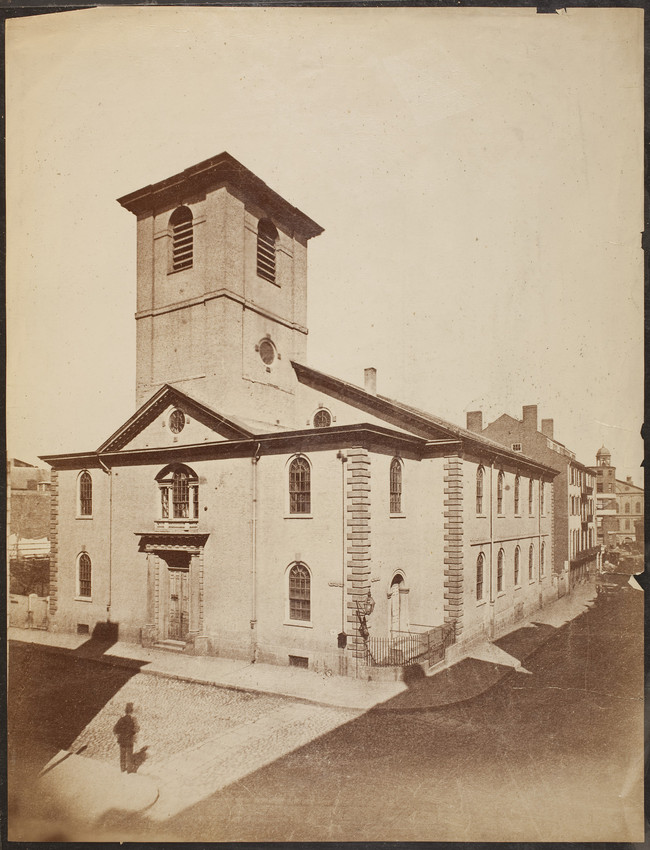
For David Province I have limited information about his childhood. David’s father, John Province, married Sarah Prince in late December 1747. Brattle Street Meetinghouse (shown here) recorded that they had Mary in 1752, Sarah in 1757, and twins Abigail and Elizabeth in 1763. However, there’s no sign of a son named David in those published records.

In 1758 Sarah (Prince) Province’s father, a ship’s captain named John Prince, died. His estate included a house and land on Milk Street, an enslaved man named Jack, and a two-masted, fully rigged boat. But he left only 20s. to his daughter Sarah, saying he had already supported her in life. He left a larger sum—£13.6s.8d.—to her children. That bequest may have been a way to make sure her husband John Province didn’t control much of his estate.

In September 1760 Thomas Hutchinson, in his capacity as a probate judge, assigned John Province to be guardian for his son David Province, who was under the age of twelve. In other words, Province ended up controlling any bequest from his father-in-law to his son anyway, but he had to keep accounts under court supervision.

(I note the possibility that David Province was John Province’s son by another woman, born after his marriage to Sarah Prince. That would be unusual, but could explain the anomalous details. Of course, there might just be gaps in the surviving records.)

The Province family lost their home in the great fire of 1760—the one that had started at the Sign of the Brazen Head. [Whatever happened to that storyline, anyway?] But the Province children were among the fortunate Bostonians who received public support. That September, John Province bought new real estate on Lynde Street.

By 1767 John Province was established securely enough to join the Scots Charitable Society. Later he took in apprentices through the Overseers of the Poor. He died in 1792 at the age of 72, and the Columbian Centinel reported that the funeral would be out of his home in West Boston. His will mentioned two married daughters, one in Nova Scotia and one in Albany, but no son.

Indeed, I found no records of David Province after the 1770 lawsuit, in which he played only a minor [!] part. He was probably the right age to serve in the military during the war, but he’s not listed in Massachusetts Soldiers and Sailors… He may have died before 1775.

As to the attack on George Gailer, the most pertinent information about David Province may be that his father was a tailor. That’s stated in both the probate and Overseers records. David may therefore have been an apprentice tailor. Two of the three Boston men in the lawsuit were tailors, the only men not connected with the maritime trade.

Why, I wondered, were tailors so interested in tarring and feathering a sailor for informing on a smuggler? Then I realized that might not be the right question. Out of all the crowd that attacked him, how did Gailer learn the names of two or three tailors? The answer might have something to do with how Gailer “took Shelter in a House” for most of the day before being grabbed. Perhaps workers in a nearby tailor shop kept a watch for him, or something like that.

TOMORROW: Pool Spear and the long arm of the law.

Friday, November 08, 2019

Searching for Daniel Vaughan

The third Rhode Islander that sailor George Gailer sued for tarring and feathering him in October 1769 was “Daniel Vaun[,] Mariner.”

Unfortunately, as this webpage shows, there were a lot of men with that name (surname also spelled Vaughan and Vaughn) documented in eighteenth-century Rhode Island. I think there are a couple of top candidates.

One is the man whom the Newport Mercury and a headstone both reported dying in March 1800 at the age of 56. This Daniel Vaughan was therefore a contemporary of Eleazer and Benjamin Trevett, the brothers from Newport that Gailer also accused. He could have been another sailor on their father’s ship Success.

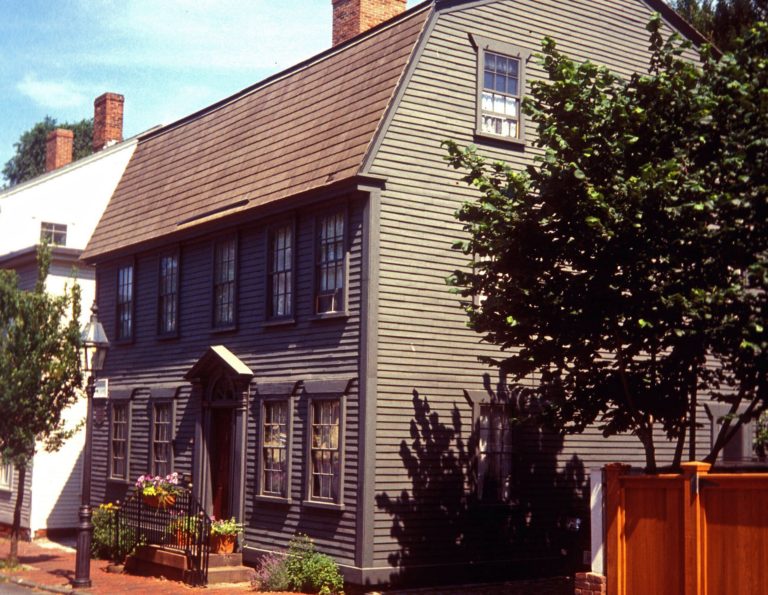
This man was also the right age to have been the Daniel Vaughan who became one of the first third lieutenants commissioned in the Continental Navy in December 1775. And he could have been the owner of the Daniel Vaughan house in Newport, built after the war and shown above.

Another possibility is an older Daniel Vaughan, born in 1716 or 1722. Such a man appears to have been the right age to have been involved in all of these incidents:
  • A Daniel Vaughan was first lieutenant under Capt. Simeon Potter on the privateer Prince Charles of Lorraine during King George’s War in 1744. Potter and his crew sacked a settlement in French Guiana. A priest’s detailed report suggests Lt. Vaughn took the lead in trying to hunt down slaves and plunder villages. Potter eventually stranded a lot of his men and took their shares of the loot, as Vaughan testified in the ensuing controversy back in Rhode Island.
  • A Daniel Vaughan was first lieutenant on the Tartar under Capt. James Holmes in 1748 when it captured a schooner carrying sugar. There was another inquiry about that capture since the schooner had been flying a flag of truce.
  • In 1764, a Daniel Vaughan was the gunner at Fort George on Goat Island off Newport. The local authorities ordered him to fire cannon at H.M.S. St. John. Ostensibly they were trying to stop the Royal Navy ship from sailing away with sailors suspected of stealing hogs, but the real reason for their animosity was that its captain had clamped down on molasses smugglers. Vaughan’s gun crew reportedly fired thirteen shots, striking the warship’s sails and rigging. This was the first of several examples of Rhode Islanders attacking royal government vessels in the years before the Revolutionary War.
In 1773, a man named Daniel Vaughan—who could have been either of these candidates—testified in the investigation of the burning of H.M.S. Gaspee, the most famous of those Rhode Island attacks. The leader of that assault was almost certainly none other than Simeon Potter, acting with the encouragement of the Browns and the Greenes. Vaughan’s testimony, however, discredited one of the Crown’s only cooperating witnesses. This Vaughan was also involved in salvaging iron out of the destroyed warship.

It’s possible those Daniel Vaughans were related. It’s also possible that another Daniel Vaughan got into the mix. But all in all, I’d say either man’s activities are consistent with helping to tar and feather an unpopular informer in Boston in 1769.

COMING UP: The tailors from Boston.

Thursday, November 07, 2019

Tar, Feathers, and the Trevett Brothers

A couple of days ago, I quoted George Gailer’s court filing after he was assaulted with tar and feathers (and other things) on 28 Oct 1769.

That legal document named seven individuals as having taken part in the attack. Those were the people Gailer must have recognized or been told were involved. So, even though he never proved his case against them in court, that’s one of our best indications of exactly who participated in tarring and feathering in Revolutionary America.

And of course I love nothing more than ferreting out info on individuals from Revolutionary New England. So let’s look at those seven names.

Three men were from Newport, whence Gailer had sailed. According to the Boston Gazette, he had arrived on “the Sloop Success from Rhode Island.” Issues of the Newport Mercury from February 1768 show that Eleazer Trevett, Sr., was managing a sloop called Success.

Trevett was a merchant prominent enough to settle other men’s estates and serve on civic committees. He often advertised wine in the Newport Mercury, so it’s notable that the Boston Gazette accused Gailer of informing the Customs office that the Success had “a Cask or two of Wine on board.”

And indeed the first two people on Gailer’s list of attackers—“Eleazar Trevett Junior and Benjamin Trevett, Merchants”—have the same names as two of Eleazer Trevett, Sr.’s sons:
  • Eleazer Trevett, Jr. (1743-1782?), followed his father in becoming a merchant captain. By October 1768 he was commanding a voyage to Tenerife, a wine island off the African coast. In June 1770 he brought a ship into Marblehead, only for him and his father to run into a dispute with locals over non-importation. In May 1773 the younger Trevett was wrecked off Antigua. Later that year, as James Roberts has described in a Rhode Island Jewish Historical Notes article (P.D.F. download), Trevett got into a legal dispute over mahogany with Aaron Lopez. That lawsuit pushed the captain into declaring bankruptcy in 1774. In the summer of 1775 Trevett sailed again to Antigua. I can’t find information on what he did when the war finally came to Rhode Island, but at some point Eleazer, Jr., was captured by the British and died at the age of thirty-nine in a prison ship off New York.
  • Benjamin Church Trevett (1748-1826) reached the age of majority in 1769. He appears to have gone inland, served a couple of terms in Continental regiments raised in Massachusetts and Vermont, and settled in western New York, where he drew a pension from the federal government.
They had an intermediate brother, John Trevett (1747-1823), who served in the Continental marines and left a diary.

It looks like Eleazer and Benjamin came to Boston either on the Success or as soon as they learned that the Customs office had seized that sloop. Unable to retrieve the family property, the Trevett brothers directed or led the attack on Gailer.

In much the same way, Nathaniel Shaw, Jr., had overseen the attack on the Customs ship Liberty and the rescue of his ship Sally back in July.

TOMORROW: The third Rhode Islander.

Tuesday, November 05, 2019

“Grosly threatning to Hoist him up in the Cart”

The 28 Oct 1769 tarring and feathering of sailor George Gailer was a public event in Boston. The mob meant to humiliate Gailer for giving information to the Customs service and to intimidate anyone else who might consider becoming a whistleblower. Today we’d call that obstruction of justice.

We know how much noise the procession made from the way gentlemen wrote about it. Province secretary Andrew Oliver described “a great noise of halloing & huzzaing by people who I could easily perceive shifted their Stations, by the Noise coming from different quarters successively.” He called the event a “tumultuous affair.”

Merchant John Rowe wrote:
In the evening a large Mob Assembled & got hold of one George Greyer an informer who they stript naked & painted him all over with Tar & then covered him with Feathers & put him in a Cart & carried him thro’ all the main Streets of the Town huzzaring &c and at nine dismissed him—this matter occasioned much terror &c in some fearfull People among the Inhabitants—When this happened I was with the Possee.
All that occurred in a town that contained about 800 soldiers who had been sent there specifically to protect the Customs officers. So how did the military react to that disturbance?

We know the army and navy were helpful in hiding printer John Mein from both the mob and the civic authorities who hunted him late that same afternoon. But the army doesn’t appear to have made any move to save Gailer.

Here’s the account of Cpl. Thomas Burgess of the 29th Regiment, taken down by a justice in Amboy, New Jersey, in the summer of 1770:
A numerous Mobb assembled in King Street Boston, who proceeded up to the Main Guard, in pursuit of one Mr. Mein A Printer insisting that said Mein had taken refuge there and wanted to get him out.

That dureing the time of the said Mobb being at the Main Guard the relief was ordered out to go Sentry, the Mobb being very numerous would not fall back in order that said Relief (of which this Deponent was one) might form According to Military Discipline, upon which the Officer of the Guard Lieutinant [James] Basset ordered said relief off to their respective posts and not to Offend any one.

That said Deponant was planted at his Majesties Custom House, and shortly after heard A Mobb in some part of King Street who Directed their way towards the Custom House with an uncommon Noise and stoped at his post, haveing a Naked Man in A Cart who they called an Informer.

That said Mobb left his Post at that time, but soon returned again makeing a full Stop as before, haveing the above mentioned Man in the Cart all over Tared and Feathered.

That the said Mobb gave three Shouts, and kept closeing on this Deponant, whereupon he this Deponent desired them to Desist and keep off his Post, the Mobb then directed their way though Royal Exchange Lane and some of them Broke some Windows in the Custom House where upon this Deponant desired a second time that the[y] would desist upon which the Mobb surrounded said Deponant who thinking himselfe in danger began to load his Firelock thinking to fright the Mobb away but to no Effect for they closed him up and struck at and abused him most grosly threatning to Hoist him up in the Cart and use him as the did the Man they had tared and Feathered
So the presence of armed sentries throughout Boston certainly didn’t deter this mob. Burgess saw the crowd carting Gailer around without his shirt and then saw the procession return after the sailor had been “all over Tared and Feathered.” According to the corporal, people even threatened him with the same treatment.

In 1773 the 29th Regiment listed Lt. James Bassett as twenty-three years old with eleven years of service. That means in 1769 he was as young as nineteen, though he had been in the army (at least nominally) since the age of twelve. Bassett was officer of the day again on 5 Mar 1770, when there was more trouble between the crowd and the sentry at the Custom house.

TOMORROW: Pope Night in 1769.

Monday, November 04, 2019

“An assault, on the Body of the said George Gailer”

George Gailer, the first victim of tarring and feathering in Boston, was an ordinary sailor. He was therefore not the type of person who typically left letters, journals, newspaper essays, or other writings.

However, we do have Gailer’s perspective on that assault through a lawsuit he filed three months later in January 1770.

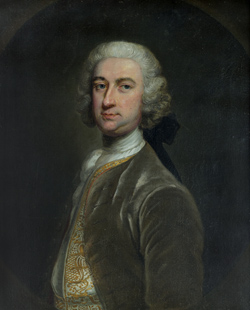
The sailor’s attorney was Robert Auchmuty (c.1722-1788, shown here as a young man, courtesy of Amherst College), who also had Crown appointments. Since Auchmuty was probably beyond Gailer’s price range, I suspect the Customs office helped pay his fees.

John Adams represented one of the defendants, the Boston tailor David Bradlee. Adams also copied Auchmuty’s initial filing into his “Pleadings Book,” just in case he needed to file a similar motion for another client. We’re lucky he did so because the original court file has been lost.

Gailer’s warrant said:
Attach &c. Eleazar Trevett Junior and Benjamin Trevett, Merchants, Daniel Vaun Mariner, all of Newport in the County of Newport and Colony of Rhode Island and Providence Plantation, and David Bradley, Pool Spear, Taylors, and David Provence Infant and Edward Mathews Mariner all of Boston in our County of Suffolk.

To answer unto George Gailer of Boston aforesaid Mariner, in a Plea of Trespass, for that the said Eleazar Trevett Jnr., Benjamin Trevet, Daniel Vaun, David Bradley, Pool Spear, David Provence, and Edward Mathews, at said Boston in the Evening of the twenty Eighth Day of October last, together with diverse other Persons to the said George Gailer unknown, with Force and Arms, an assault, on the Body of the said George Gailer did make, and then and there with Force as aforesaid did strip the said George Gailer naked, tar and feather his Skin, and carry the said George Gailer naked, tarred and feathered, as aforesaid in a Cart about said Boston for the space of Three Hours, and with Clubbs, Staves, and a hand saw did then and there strike him the said George Gailer, sundry heavy and grievous Blows, upon the said George Gailers naked Body, and greatly bruise, and wound him and hit him the said George Gailer diverse grievous Blows, with Stones:

By Reason of all which the said George Gailers Life was put into great Hazard and Danger, and greatly despaired of, and many other Enormities, and Cruelties, the said Eleazer Trevett Jnr., Benja. Trevett, Daniel Vaun, David Bradley, Pool Spear, David Provence, and Edward Mathews, with others unknown to the said George Gailer did then and there commit, on the said George Galer, against the Peace of our Lord the King and to the Damage &c. £2000.
This description of the assault differed in some details from what was in the newspapers. The warrant said the crowd “did strip the said George Gailer naked.” However, the Boston Post-Boy said “his Cloaths except his Breeches [were] pulled or torn off,” and other papers agreed. So this is an example of the period usage of “naked” not being stark naked.

On the other hand, the warrant described more violence than the newspapers, saying the crowd hit Gailer “with Clubbs, Staves, and a hand saw” and “Stones.” The press, particularly the Whig press, might have suppressed those blows, or decided they were few and exceptional and didn’t deserve mention. It’s also possible Gailer and Auchmuty pumped up those details because they were fighting a perception that a tar-and-feathering wasn’t a real assault. Yet that “hand saw” doesn’t seem like the sort of detail one could make up.

According to The Adams Legal Papers, Gailer’s case was initially “decided in the defendants’ favor on demurrer,” meaning the defendants didn’t address the truth of the allegation but argued that those actions weren’t enough to justify a legal judgment. Adams received 19s.4d. from Bradlee. Auchmuty filed an appeal in March 1770. None of the parties appeared when the case came up in the August 1771 term, and the case was dropped. I’ve never come across any other mention of George Gailer.

TOMORROW: An eyewitness account from a soldier.

Thursday, October 31, 2019

“Carting the feather’d Informer thro’ the principal Streets in Town”

John Mein going under cover didn’t end the violence in Boston on Saturday, 28 Oct 1769. In fact, that date saw the town’s first tarring and feathering.

Though Boston became notorious in the British Empire for tar-and-feathers attacks in the 1770s, the town adopted that form of public punishment late. The first documented example took place in Norfolk, Virginia, in 1766.

A couple of years later, crowds used tar and feathers three times in Salem and once in Newburyport. (With typical Massachusetts chauvinism, Judge Peter Oliver later wrote that the ritual was invented in Salem.) In his 2003 article for the New England Quarterly, Ben Irvin then listed incidents in New Haven, New York, and Philadelphia.

In all those attacks, the victims were men who worked at a low level for the Customs service or were thought to have given Customs officers information about smuggling. Several were identified simply as “informers.” The attackers were usually sailors and waterfront workers directly affected by Customs seizures. The 16 Oct 1769 Boston Gazette and Boston Evening-Post reprinted a favorable report on the New York attack. (Irvin lists two attacks in that city, based on reports with differing details, but an item in the 5 Oct 1769 New-York Journal shows they were the same event.)

Many histories of pre-Revolutionary Boston depict the tar-and-feathers attack as an outgrowth of the uproar over Mein. Indeed, witnesses of the time had to sort them out. Province secretary Andrew Oliver wrote on 11 November:
Just before Sunset I heard that Mr. Mein had fired a pistol upon some people in the street & had betaken himself to the Main guard for protection. Soon after this there was a great noise of halloing & huzzaing by people who I could easily perceive shifted their Stations, by the Noise coming from different quarters successively: upon which I concluded that the populace had got Mr. Mein & were carrying him about the Town in an abusive manner; but I was afterwards told that it was an informer whom they were serving in this manner. It was thought a lucky incident for Mr. Mein that his Man fell in their way, as it diverted the Attention of the People from Mr. Mein.
However, the Boston Gazette’s sympathetic report on the tarring and feathering says that during the day, before the merchants confronted John Mein, people were already preparing to attack sailor George Gailer. The crowd may have grown larger and more worked up because of the excitement over Mein, but it looks like the two incidents developed independently and in parallel. The upper-class merchants confronted the printer while working-class sailors lay in wait for one of their own. We historians might have been tempted by the longer paper trail and political roots of the Mein attack to treat the other event as subordinate.

Here’s the Boston Gazette report from 30 Oct 1769, which also appeared in the Boston Evening-Post:
Saturday Afternoon, a Person who lately belonged to the Sloop Liberty, and came round to this Place in the Sloop Success from Rhode Island, and soon after his Arrival informed of her having a Cask or two of Wine on board, which occasioned the Vessel’s being seiz’d, was discovered and pursued, but took Shelter in a House where he secreted himself till the beginning of the Evening, when thinking the Coast clear he ventured out, but, the Avenues to the House being strictly watched the whole of the Time, he was immediately seized upon by the Populace, and soon placed in a Cart, his Jacket and Shirt taken off, and his naked Skin well tarr’d and feather’d; they oblig’d him to hold a large Glass Lanthorn in his Hand that People might see the doleful Condition he was in, and deter others from such infamous Practices:—

He was then carted from the Town-House thro’ the main Street up to Liberty Tree, amidst a vast Concourse of People, where he was made to swear never to be guilty of the like Crime for the future; but in their going thither, as they pass’d Mein and Fleming’s Printing-Office a Gun was fired from thence and two others snap’d at them just as they got by, upon which some of the Company rushed into the Office in order to secure the Offenders, but they had fled; however they bro’t off three Guns, two of them well charg’d, as Evidence against them whenever they can be taken:—

This imprudent Conduct of those in the Printing Office (for what Reason we know not, as no injury seemed designed them) did not interrupt the Carting the feather’d Informer thro’ the principal Streets in Town for about three Hours, when they bro’t him back to Kingstreet, and after renewing his Obligation of behaving better for time to come, and asking Pardon for his past Offence, he was dismissed without further Damage, after having his Cloaths returned him again, and then all peaceably dispersed about Nine o’Clock.
A few more observations about this article. First, historians often report Gailer’s service on the Customs sloop Liberty, which would make this yet another Liberty riot tied to North America’s resistance to the Townshend duties. It looks like his more recent informing about the “Cask or two of Wine” (the same issue as in the New York attack) was the bigger reason.

Second, in a letter Mein complained that after threatening him the Boston crowd “attacked the House & Printing Office, broke open the great Gate, & our other Doors, and our Ware room.” Was he referring to the same forcible search this article described? If so, that’s another example of an event pegged to Mein that had at least a mix of motives. The crowd didn’t go the print shop immediately after the confrontation on King Street. They went by during their procession that night, perhaps even making a special stop to jeer the people inside. Gunfire from inside prompted people to break in and seize weapons.

TOMORROW: More on the shots from the printing office.

Saturday, November 04, 2017

“He fitted himself with a Pair of Women’s Shoes”?

I’ve been discussing the public image of Customs official Charles Paxton (shown here in the Massachusetts Historical Society’s portrait).

Paxton’s neighbors teased him for his elaborate courtesy and his bachelor status. A big part of those criticisms, I suspect, was that Paxton didn’t fit New England’s model of masculinity.

That becomes quite clear in this anecdote, which appeared in the 18 Dec 1769 Boston Gazette:
Whereas a Sett of naughty Boys, not having the Fear of the reforming Justice, nor of his M[ajest]y’s Troops here stationed, before their Eyes, did in a very tumultuous and outrageous Manner assemble themselves together in Order to Tar and Feather a rascally Informer [George Gailer on 28 Oct 1769], to the great Terror of sundry of his M[ajest]y’s timorous Subjects usually distinguished by the opprobious Name of C[o]mm[issione]rs;

and whereas the right valiant and right worshipful and right noble Charles Froth, Esq [the way Whig newspapers had referred to Paxton since 1761]; on seeing the woful Spectacle exhibited, was then seized with an unusual panic and trepidation to the great discomfort of his delicate Nerves, and to the evident Disorder of his weak Intellects, insomuch as to Occasion a precipitate Retreat thro’ Back and By-Ways to his Kinsman Ph—ps’s, and when there thro’ the Excess of bodily Fear, all pale and trembling, he betook himself to a close Chamber, which was fast shut and barricaded strong, and to the disordering of the grisly Locks and gallant Apparel of the said antiquated Beau, he was necessitated for further Security to conceal himself beneath a huge Feather Bed, where he sweat most profusely for several Hours, to his great Damage, as he saith, and was at last with great Difficulty perswaded to emerge from Durance to take some Refreshment:

And further to the Loss of his necessary Repose there continued at his Cousin’s till near Day-break, at which Time having collected some small Share of Resolution, he formed the bold Design of venturing to his own Home; to which Purpose he fitted himself with a Pair of Women’s Shoes borrowed of Mrs. C—— [perhaps Paxton’s sister Susannah Cunningham], and a Ridinghood supplied him by his humane Cousin, and thus accoutred sallied forth under the Auspices of the Night, and the friendly Attendance of a brawny African, and without further Damage reached his own House.

This is therefore to caution these unruly Boys, that at any Time hereafter when they propose a Game of Foot-Ball, or any other noisy Diversion, that they take timely Care to advertise the said Charles Froth, Esq; that they intend him no Injury.
I doubt Paxton really tried to disguise himself in women’s shoes and a “Ridinghood.” But his enemies were happy to portray him as an “antiquated Beau” who could be scared by a football game and needed the protection of “a brawny African.” Eighteenth-century British society didn’t think about gender and sexuality exactly as we do today, but that newspaper item looks a lot like gay-baiting.

Paxton’s personal manners probably wouldn’t have made the newspapers if he hadn’t thrown himself into his work as a Customs officer and become one of the Commissioners of His Majesty’s Customs. But the other men appointed to that board never got the sort of personal criticism that Paxton did.

Three of those Commissioners disembarked from Britain on 5 Nov 1767 (as reenacted this afternoon around Faneuil Hall). Paxton was the only one whom the Pope Night processions individually lampooned. And his effigies bore labels like “poor charles the bachelor.”

Thursday, March 13, 2008

Tar, Feathers, and Other Historical Details

Some historians had a chance to see parts of the upcoming H.B.O. miniseries on John Adams in their role as reviewers for the news media. And of course historians are particularly touchy about details of, well, history. Here are a couple of the responses I’ve seen.

In a review for The New Yorker, Harvard professor Jill Lepore suggests that, while this miniseries might reflect how John Adams would have liked to see history portrayed, maybe—just maybe—he wasn’t responsible for everything good that happened in the American Revolution. It was, after all, a mass movement that involved millions of people.

Lepore likes some of the dirty detail of eighteenth-century life:

Actually, the inoculation of Abigail and the Adams children against smallpox—more blood; also pus—is nearly the most terrifying scene in the four episodes made available to reviewers. It’s second only to the tarring and feathering of a British customs official in Boston, the brutality of which Adams watches with horror, in a masterly sequence that exposes the violence of insurrection and helps explain the future President’s enduring fear of democracy.
But the manners ring false for her: “Everyone is far too frank with everyone else (the eighteenth century was nothing if not coy).”

And what about that tar and feathers scene? Boston 1775 reader Ira Stoll, who’s working on a biography of Samuel Adams, sent me a link to his New York Sun critique:
In the first episode of HBO’s “epic seven-part miniseries event” John Adams, one of the most riveting scenes occurs at Boston Harbor, when a customs inspector or informant challenges John Hancock (Justin Theroux) for evading the taxes imposed by the British. “Teach him a lesson, tar the bastard,” Hancock commands a mob, which proceeds to do exactly that to the poor accessory of the crown. This being HBO, there’s a glimpse of full frontal nudity that is promptly drenched with hot tar. Hancock looks on, as do John Adams (Paul Giamatti) and his cousin Samuel (Danny Huston). “God, Sam, that’s barbarism,” John cries to his cousin, who stands silent. “Do you approve of this? Answer me, Sam, can you?”

It’s a telling scene, because there is no historical evidence that it ever happened. . . . There was a riot in June of 1768 over Hancock’s ship, the Liberty, in which customs officials were beaten, but there is no evidence that Hancock or either Adams was at the scene of that riot, nor is there any record that anyone was tarred in the event. . . .

The scene does convey, accurately, John Adams’s hostility to mob violence. . . . But it does so by inaccurately, well, tarring the reputations of Hancock and Samuel Adams, and by conjuring a situation that there is no evidence existed.

Such are the compromises attendant in turning history into a seven-part miniseries for television. . . . [David] McCullough is so deservedly celebrated as an author not only for his skill as a storyteller but for his care with research and facts. So it is disappointing to see the television version of his bestselling biography make such departures.
Indeed, both the Liberty riot on 10 June 1768 and the first tar-and-feathering in Boston on 28 Oct 1769 are documented in detail through the complaints of the victims and other Customs officials. If any of those men had seen or heard about Hancock, Adams, or any other well-known Whig leader directing, encouraging, or even silently watching the mobs, they would have publicized that detail.

As Stoll notes in his review, the top Whig leaders actually discouraged violent attacks on Crown officials and supporters, on the grounds that they discredited the cause. At different times in 1770 William Molineux kept a crowd from lynching Ebenezer Richardson after he shot young Christopher Seider, and Dr. Thomas Young helped to prevent Scottish merchant Patrick McMasters from being tarred and feathered.

There’s actually a link between the seizure of the Liberty and that first tar-and-feathers attack, which might have been why scriptwriter Kirk Ellis combined them. Though the smuggling case against Hancock was eventually dropped, the Customs service kept his ship and used it to chase down smugglers off Rhode Island. One of the sailors it employed, George Gailer, was spotted in Boston in October 1769. A mob seized him, stripped him, and covered him with tar and feathers.

Gailer sued seven people for this assault: Newport merchants Eleazar Trevett, Jr., and Benjamin Trevett; Newport mariner Daniel Vaughan; Boston mariner Edward Mathews; Boston tailors David Bradlee and Pool Spear; and a minor named David Provence. The defendants responded with a demurrer in Inferior Court, neither affirming nor denying the allegation but suggesting Gailer had no cause to sue. That court decided in their favor in January 1770. Gailer appealed but failed to appear in August 1771, and the case was dropped.

Based on an account-book entry, the attorney who represented David Bradlee in this matter was that opponent of mob violence, John Adams.

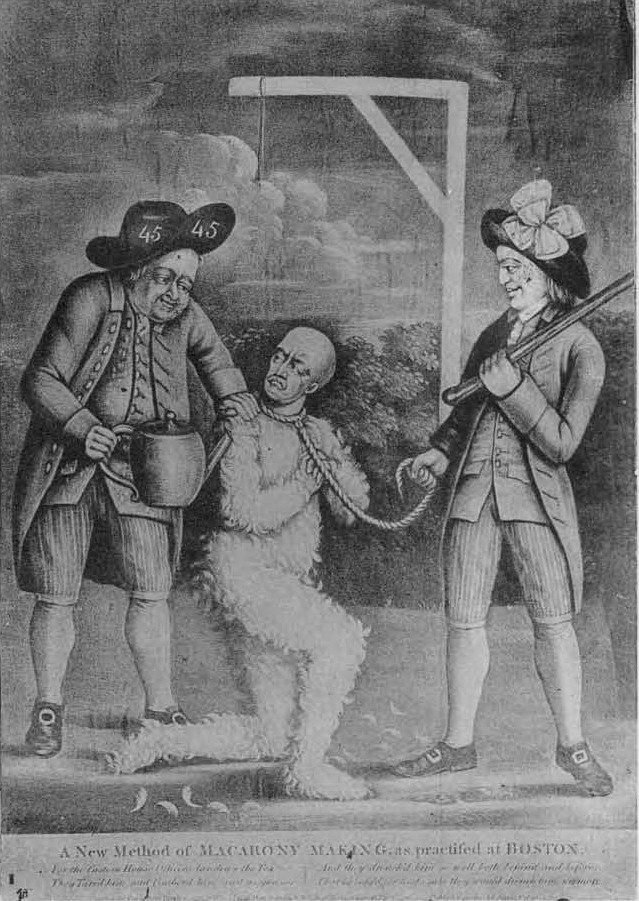
(The details of Gailer’s case appear in the first volume of The Legal Papers of John Adams. The picture above is a London portrayal of a Boston mob’s tar-and-feathers attack on John Malcolm in 1774.)