J. L. BELL is a Massachusetts writer who specializes in (among other things) the start of the American Revolution in and around Boston. He is particularly interested in the experiences of children in 1765-75. He has published scholarly papers and popular articles for both children and adults. He was consultant for an episode of History Detectives, and contributed to a display at Minute Man National Historic Park.

Subscribe thru Follow.it


•••••••••••••••••


Showing posts with label Powder Alarm. Show all posts

Wednesday, September 02, 2026

“Those who have something to lose who are now ye. Zealous Patriots of the Day”
Since this is the anniversary of the 1774 “Powder Alarm” in Cambridge, I’m quoting from a letter that discusses that event and the surrounding political environment.

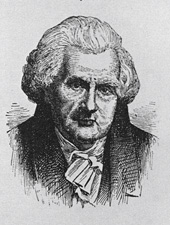
Stephen Mix Mitchell (1743–1835, shown here) was a lawyer in Wethersfield, Connecticut, having spent the 1760s as a student and then tutor at Yale College.

On 19 Sept 1774, Mitchell wrote to the merchant Peter Verstille in Boston. He first discussed his recent trip to the Rev. Eleazar Wheelock’s school, the challenges of collecting debts that season, and land that Gov. Francis Bernard might have been granted in Vermont.

Then Mitchell turned to the political turmoil in New England, addressing Verstille as representative of Boston and Massachusetts (which he wasn’t, but that’s another story):
We in the Country are more engaged for your Liberties (as I am told) than you are yourselves, you cannot conceive the Ardor of our people when the late Alarm happend. They flew to their Arms as readily as if they had been told their Wives & Children were captivated & carried of by a foreign foe,

I am fully convinced that the Country will never swallow these Acts of Parliament untill four fifths of the people are slain, the general say is “Tis a Country for which our fathers fought, bled & died with Savages, a Country for which we are not beholden to Great Britain, whose Liberties we will not give up but with our Lives——[”]

The Unanimity is beyond all Expectation. I have had Opportunity to enquire particularly in four or five Towns round about us which contain each about 4000 [sic] Inhabitants & not a Man whom the warmest Sons of Liberty do even suspect would not sacrifice his Life rather than submit....if this matter should come to blows, God only knows what would be the Event of it,

the Day is come when the friends of government at home can not say tis a Rabble who oppose them for tis now the land holders the freemen of our Towns those who have something to lose who are now ye. Zealous Patriots of the Day, & they will send their Sons to defend their Liberties; those who in the late warr would give 50 & 60 Dollars to hire a man to go into ye warr to get their Sons excused, are now determind. to trust the Defence of their Liberties in the hands of none but of their own families…

they say they chuse to live on their wonted good Terms with Great Britain, they chuse peace they chuse dependance on their mother Country, but if they must have warr or submit to these Duties & Marks of Slavery they have no Hesitancy in chusing the former;

they look up their old Deeds of patents from the Govt. & Company of the Colony when they read your Bill for regulating the Government of the Massachusetts Day, & then argue with themselves thus, “tis by this Deed I tho’t I held my land, this Deed is founded on our own Charter & what prevents our Charter from being taken from us, as that of our Neighbours has been? Then what security have I that I can hold my land by?”

Upon this the old Gray heads draw their old rusty Swords & order them to be cleand. & say like the brave Earl of Warren in another Case, “by this my father held & won his Land & by this I & my Children will defend it”—

This is no fiction but the cool deliberate Determination of the people, people who are friends to order & good government, & they are determind. this Time not to trust solely to the Virtue of the Merchants respecting non Importation, they will suffer no Mercht. To bring Goods.
It took some effort to track down Mitchell’s allusion to the “brave Earl of Warren.” Tobias Smollett’s Complete History of England told the story of John de Warenne, 6th Earl of Surrey (1231–1304), this way:
the earl of Warenne, who being required by the judges to produce his charter, unsheathed an old rusty sword, as the instrument by which his ancestors had acquired their lands, and with which he resolved to preserve them to the last drop of his blood. This bold answer gave [King] Edward to understand, that his inquisition would be attended with very dangerous consequences…
In the mid-1780s Mitchell represented Connecticut in the Confederation Congress. He was later appointed to the U.S. Senate to serve out Roger Sherman’s term, but his main government service was as a judge on Connecticut’s supreme court.

Mitchell’s letter is now at the American Philosophical Society and has been scanned as part of its Revolutionary City website. I haven’t found it transcribed anywhere before.

Sunday, December 28, 2025

“Under the hieroglyphical similitude of tropes and figures?”

As a prominent gentleman in Connecticut, Israel Putnam couldn’t ignore what “A New-York Freeholder” wrote about him in the New-York Gazette, as quoted yesterday.

However, Putnam faced a couple of challenges in replying. First, if he appeared to be flying off the handle, that would simply validate what the “Freeholder” had written.

Second, Putnam wasn’t a highly educated man, and in particular his spelling and punctuation were even more irregular than the eighteenth-century norm.

Even Putnam’s biographers acknowledge that he probably had help in shaping his reply in the 7 October 1774 Connecticut Gazette of New London, either from a friend or from printer Timothy Green. Because it doesn’t look like his usual writing.

The preface reads:
Mr. GREEN,

As my letter to Capt. [Aaron] Cleveland, wrote in consequence of the late alarm, has circulated far and wide, and made unfavourable impressions on the minds of some, ’tis desired that you and the several printers in the other colonies upon the continent, would give the following piece a place in your paper, and you will oblige
Your humble Servant,
ISRAEL PUTNAM.

POMFRET, 3d. October 1774.
The first line of the ensuing essay makes clear what it was really responding to: “In Mr. [Hugh] Gaine’s New-York Gazette of the 12th of September…”

Putnam described how the rumor of a British military attack on Boston had reached him through “Capt. Keyes”—most likely Stephen Keyes (1717–1788, gravestone shown above courtesy of Find a Grave). Keyes had heard the news from “Capt. Clarke of Woodstock,” who heard from his son in Dudley, Massachusetts, who heard from an Oxford man named Wilcot, who heard from his father and also found confirmation in Grafton.

With “only four gentlemen,” Putnam rode toward Boston, traveling “about thirty miles from my house.” In Douglas, Massachusetts, the party met the local militia captain, probably Caleb Hill (1716–1788), who with his company had just returned from their own march to “within about thirty miles of Boston.” Having thus learned that the earlier report was false, Putnam returned home, spreading the new word.

Putnam posited that the false alarm started with Customs Commissioner Benjamin Hallowell having “informed the army that he had killed one man and wounded another” while escaping from Cambridge. Hallowell’s own account of the “Powder Alarm” said nothing of the sort.

As for presenting himself as a gentleman in prose, Putnam acknowledged that he’d written his letter passing on that misinformation in haste and not in high style; he said he “aimed at nothing but plain matters of fact, as they were delivered to him.”

But Putnam also showed himself capable of deploying complex sentences and classical allusions in response to the “New-York Freeholder”:
Paying all due defference to this author’s learning, and his undoubted acquaintance with the rules of grammar and criticism, I would beg leave to ask him, whether he does not betray a total want of the feelings of humanity, if he supposes in the midst of confusion, when the passions are agitated with a real belief of thousands of their fellow countrymen being slain, & the inhabitants of a whole city just upon the eve of being made a sacrifice by the rapine and fury of a merciless soldiery, and their city laid in ashes by the fire of ships of war, he or any one else could set down under the possession of a calmness of soul becoming a Roman senator, and attend to all the rules of composition, in writing a letter, to make a representation of plain matters of facts, under the hieroglyphical similitude of tropes and figures? . . .

Now I submit it to the determination of every candid unprejudiced reader, whether my conduct in writing the aforementioned letter, merits the imputation of imprudence asserted by said writer; or whether they would have had me tamely set down, and been a spectator to the unhuman sacrifice of my friends and fellow-countrymen, or (in other words) Nero like, have set down and fiddled, while I really supposed Boston was in flames, or exerted myself for their relief?
Well, when he put it that way…

TOMORROW: Who was the “New-York Freeholder”?

Saturday, December 27, 2025

“This letter betrays the state of the poor Colonel’s mind”

engraved portrait of Israel PutnamOne of the key nodes in the spread of the “Powder Alarm” was Israel Putnam. On 3 Sept 1774 he summoned the militia in eastern Connecticut and sent urgent messages to other parts of the colony.

On 6 September one of those messages arrived at the First Continental Congress. Robert Treat Paine recorded that from Putnam’s letter “we were informed that the Soldiers had fired on the People and Town at Boston.”

In fact, British soldiers had done no such thing. That became clear over the next few days.

Whigs spun the false alarm into a Good Thing, saying it showed how the populace was united and ready to defend Boston in an actual military emergency. “It is surprising and must give great satisfaction to every well-wisher to the liberties of his country, to see the spirit and readiness of the people to fly to the relief of their distressed brethren,” said an item in the 9 September Connecticut Gazette.

But other newspaper writers were more critical. Most of the front page of Hugh Gaine’s New-York Gazette on 19 September was filled with an open letter “To the Inhabitants of North-America” from “A New-York Freeholder” that said in part:

Col. PUTNAM’s famous letter, (forwarded by special messengers to New-York and Philadelphia) and the consequences it produced, are very recent and fresh in our memories. He informs Capt. [Aaron] Cleaveland [of Canterbury]---
“That the men of war and troops had fired on Boston—that the artillery played all night—that six were filled at the first shot, and a number wounded—that the people were universally rallying from Boston as far as Pomfret in Connecticut—and he begs the captain would rally all the forces he could, and march immediately for the relief of Boston.”
The evident confusion of ideas in this letter betrays the state of the poor Colonel’s mind, whilst writing it, and shews he did not then possess that calm fortitude which is so necessary to insure success in military enterprizes. . . .

What the design of this infamous report was—whether to inflame the other colonies, and to learn how they would act on such an emergency if real, or to influence the deliberations of our congress now sitting, I shall not taken upon me to determine.

One thing it has eventually made evident past all doubt, that many in the New-England colonies are disposed and ripe for the most violent measures: For it is certain that some thousands of armed men, in consequence of it, proceeded on their march from Connecticut towards Boston. . . .

These circumstances are mentioned with no other view than to shew that the apprenhension of a civil war is justly founded; and it is no more than justice to say that I think Col. PUTNAM himself was deceived when he wrote the above letter, tho’ still he acted imprudently in writing it. The authors of the report are to me unknown.
The “New-York Freeholder” went on to write about the horrors of a civil war, closing with Tobias Smollett’s poem “The Tears of Scotland,” composed after the Jacobite uprising of 1745. That would have annoyed the New England Whigs, not just because they were telling people that a firm, unified militia response would help stave off civil war but also because they hated being equated with Jacobites.

TOMORROW: How Putnam responded.

Friday, December 26, 2025

“The Powder Alarm” in Essex, Connecticut, on 4 Jan.

I’ll start off the Sestercentennial year with a talk in the America 250 Winter Lecture Series of the historical society in Essex, Connecticut.

My topic on the afternoon of Sunday, 4 Jan 2026, will be “The Powder Alarm: The Breakdown of Royal Rule in New England, September 1774.”

Here’s our event description:
Before dawn on September 1, 1774, the royal governor of Massachusetts ordered some of the colony’s gunpowder moved into army-occupied Boston. That action put thousands of militiamen on the march. As rumors spread, they grew more dire. People in Connecticut heard that the king’s army and navy had attacked Boston. In Milford, a 13-year-old boy went to bed fearing he would “be dead or a captive before to-morrow morning.” But the real result of this event, dubbed the “Powder Alarm” by later historians, was that almost all of New England was free of royal rule—almost two years before the Declaration of Independence.
I’ve spoken about the “Powder Alarm” before, and this time I’ll emphasize Connecticut’s experience through figures like Israel Putnam, Silas Deane, and Joseph Plumb Martin.

Here’s an account of the colony’s reaction from the 8 Sept 1774 Massachusetts Spy:
By letters from Connecticut, and by several credible gentlemen arrived from thence, we are informed that there were not less than 40,000 men, in motion, and under arms, on their way to Boston, on Saturday, Sunday, and Monday last [3–5 September], having heard a false report that the troops had fired upon Boston, and killed several of the inhabitants: Twelve hundred arrived at Hartford from Farmington, and other places forty miles beyond Hartford, on Sunday last, on their way to this place, so rapidly did the news fly. But being informed by expresses that it was a false report, they returned home, declaring themselves ready at a minute’s warning to arm again, and fight for their country, and distressed brethren of Boston.
That report from printer Isaiah Thomas was no doubt exaggerated. In 1774 Connecticut’s total population was just under 200,000. More than half of those people were under the age of sixteen, and half the adults were women, so “no less than 40,000 men” would be virtually the entire adult male population.

Nonetheless, it’s clear the alarm was widespread, reflecting the urgency that people had come to feel about what was happening in Massachusetts. Several other newspaper articles about the “Powder Alarm” also included the phrase “a minute’s warning,” popularizing it just as citizens were discussing how to improve their militia system.

This talk is scheduled to run from 3:30 to 4:30 P.M. in Hamilton Hall at Essex Meadows, 30 Bokum Road in Essex, Connecticut. It’s free and open to the public. The society asks people to register through this page. Doors will open at 3 P.M., and seating will be on a first-come, first-served basis.

(The modern town of Essex appears on the map above as “Putty Pogue” on the Connecticut River.)

Monday, May 12, 2025

“Townspeople took four brass cannon”

Here are all the entries from Thomas Newell’s 1774–74 diary that pertain to artillery and thus show the coming of war.
  • 4 June 1773: “King’s birthday; general training; the grandest appearance ever known in these parts.”
John Rowe wrote about this same militia exhibition in honor of the king:
Colo. [John] Hancock & Company of Cadets, Major [Adino] Paddock & Artillery, Colo. [John] Erving & the Regiment, Colo. [David] Phipps & Company all made their appearance in the Common — Such a Quantity or Rather Multitude of People as Spectators I never saw before, they behaved very well.
Phips commanded the horse guards.
  • 1 July: “Major Paddock’s son drowned at Cambridge River.”
Adino Paddock was a coachmaker as well as commander of Boston’s militia artillery company. His son John was a student in Harvard College’s class of 1776, carrying the family’s hopes to secure their rise into gentility, when he died at age seventeen.
  • 15 September: “General training.”
  • 22 September: “General training for the last time this year.”
  • 12 November: “Workmen began to set another row of elms in the common.”
Paddock instigated the planting of trees along Tremont Street, opposite his coachyard. Years after he had left Boston as a Loyalist, those would still be called the “Paddock elms.”

Gen. Thomas Gage arrived as the new royal governor in May 1774, and the following summer was punctuated by the arrival of more army units, including companies of Royal Artillery:
  • 2 July: “A.M. Artillery from Castle William landed, with eight brass cannon, and encamped in the common. 258 sheep given for the relief of this town by the town of Windham, in Connecticut. (I cut my hair off.)”
  • 6 August: ”The Scarboro. man-of-war arrived, nine weeks from England; P.M. three transports from Halifax, with the 59th Regiment on board, and company of artillery, and brass cannon, eight days out.”
  • 7 August: “A.M. three transports from New York with the Royal Regiment of Welsh Fusileers and detachment of Royal Artillery, and a quantity of ordnance stores, &c.”
  • 8 August: “Company of artillery landed; encamped in common.”
Soon after Gage put the Massachusetts Government Act into effect, he had his soldiers remove militia gunpowder from the storehouse in Charlestown. That set off a big reaction in the countryside:
  • 1 September: “This morning, half after four, about 260 troops embarked on board thirteen boats at the Long Wharf, and proceeded up Mystic River to Temple Farm, where they landed; went to the powder-house on Quarry Hill, in Charlestown bounds, from whence they have taken 250 half-barrels of gunpowder, the whole store there, and carried it to the castle. A detachment from this corps went to Cambridge and brought off two field-pieces.”
  • 2 September: “From these several hostile appearances, the county of Middlesex took the alarm, and on last evening began to collect in large bodies, with their arms, provisions, and ammunitions, &c. This morning some thousands of them advanced to Cambridge, armed only with sticks. The committee of Cambridge sent express to Charlestown, who communicated the intelligence to Boston, and their respective committee proceeded to Cambridge without delay. Thomas Oliver, S[amuel]. Danforth, J[oseph]. Lee, made declaration and resignation of a seat in the new constituted council, which satisfied the body. At sunset, they began to return home. At dark, rain and thundered very hard.”
That “Powder Alarm” uprising prompted Gen. Gage and Adm. Samuel Graves to strengthen Boston’s military defenses against attacks from land.
  • 3 September: “Four large field-pieces were dragged from the common by the soldiery and placed at the only entrance into this town by land. The Lively frigate, of twenty guns, came to her mooring in the ferry-way between Boston and Charlestown.”
  • 5 September: “Artillery training.”
  • 15 September: “Last night all the cannon in the North Battery were spiked up: it is said to be done by about one hundred men (who came in boats) from the man-of war in this harbor.”
  • 17 September: “Last night, townspeople took four brass cannon from the gun-house near very near the common.”
Newell conflated two events in that last entry. Maj. Paddock’s militia artillery had two gunhouses, each containing one pair of small cannon. As other sources show, persons unknown spirited away the two cannon in the old gunhouse on the night of 14–15 September. When Royal Artillery officers opened the new gunhouse on 17 September, they discovered its two cannon were gone, too.

Newell’s diary entry shows that many Bostonians knew about those events even though they were never reported in the newspapers or in Gen. Gage’s letters to the government in London.
People had tried to smuggle these guns up the Charles River, but their boat got hung up on the dam that formed the Mill Pond and they had to abandon it.
  • 3 October: “Artillery training for the last time this year.”
Since the train’s weapons had vanished, and most of the company’s men were refusing to serve under Maj. Paddock, there probably wasn’t a lot of artillery training accomplished that day.
  • 22 October: “This morning, about 7 o’clock, after three days’ illness, Mr. William Molineaux died, in the fifty-eighth year of his age. (A true son of liberty and of America.) It may with truth be said of this friend, that he died a martyr to the interest of America. His watchfulness, labors, distresses, and exertions to promote the general interest, produced an inflammation in his bowels, of which he died. ‘Oh, save my country, Heaven,’ he said, and died.”
Molineux was involved in many acts of resistance, and among the last was buying four cannon from Duncan Ingraham, Jr., in September or October 1774. Those guns were sent out to four rural towns to be equipped for use by spring. 
  • 23 October: “This day four transports arrived here from New York, with a company royal artillery, a large quantity of ordnance stores for Castle William, three companies of the Royal Regiment of Ireland, or the 18th Regiment, and the 47th Regiment on board.”
This one document thus shows us both sides of the political conflict preparing for military action—with cannon.

Ultimately those efforts led to the British army’s march to Concord and to war. I’ll tell that story at the Scituate Historical Society this week.

Thursday, 15 May, 7–8:30 P.M.
Secrets on the Road to Concord
G.A.R. Hall, 353 Country Way, Scituate

Admission is $15, or $10 for society members. Reservations are recommended, but payment will be accepted at the door. I look forward to meeting folks there.

TOMORROW: Thomas Newell and the tea.

Wednesday, April 23, 2025

“Putting all matters of politicks out of view”?

Esther Quincy married Jonathan Sewall in January 1764, after a courtship of more than four years.

She was the daughter of the Boston merchant and magistrate Edmund Quincy, who had come back from bankruptcy a couple of years before.

He was a young lawyer of sharp wit and moderate means trying to establish himself, building up from the position of justice of the peace.

Jonathan Sewall didn’t enter the political debate over the Stamp Act, but in December 1766 he came out swinging on behalf of Gov. Francis Bernard and royal policy in newspaper essays signed “Philantrop.”

The governor rewarded Sewall with appointments as the province’s solicitor general and then attorney general. He later got to be a judge in the Vice Admiralty Court as well.

Esther’s father was on the other side of the political divide. He was one of the justices the Boston Whigs called on when they had a complaint about a royal official or soldier. He joined other magistrates in resisting Gov. Bernard’s call for barracks in 1768. He took the (conflicting) testimony of Charles Bourgate after the Boston Massacre. He issued the warrant to arrest John Malcolm for assault.

Most of Esther Sewall’s other male relatives were also Whigs. Uncle Josiah Quincy, Sr., in Braintree was on the Council, one of several thorns in the royal governors’ sides. Cousin Josiah, Jr., practiced law in Boston, wrote newspaper essays, counseled local activists, and traveled to meet fellow Whigs in the southern colonies and London. The major exception within the Quincy family was cousin Samuel Quincy, who followed in Jonathan’s wake as the province’s solicitor general.

Many of Jonathan’s old friends were Whigs, including John Adams, and that produced some awkward social moments. Jonathan prosecuted John Hancock on smuggling charges (eventually dropping the case for lack of solid evidence). But in 1772 the merchant wrote to him expressing
my inclination and wish (putting all matters of politicks out of view) that a perfect harmony and friendship may be kept up between us, and wish rather more familiarity than the common shew of friendship expresses, considering the connection I have formed with the sister of your Lady.
That was Esther’s sister Dorothy. She became Hancock’s fiancée, their engagement almost as long as the Sewalls’ had been.

By 1774 the Sewalls were living in Cambridge in a country mansion bought from Richard Lechmere. Their household included three small children, three young men studying the law, and at least one enslaved young man.

Early on 1 September, Gen. Thomas Gage’s soldiers seized militia gunpowder in Charlestown and cannon in Cambridge. Around noon, Jonathan Sewall suddenly left home and headed to Boston. The governor might have sent for him, or he might have feared how the neighbors would react to the army operation. Or he might have had a whim.

After dark, those neighbors came to the Sewalls’ house. They refused to take Esther’s word that Jonathan was out. Some men pushed into the house, and the young men inside beat them back. One of those boarders, Ward Chipman, fired a pistol inside the house—some sources say accidentally, some not. Either way, that noise got everyone’s attention. The two groups of men agreed not to do further violence as long as they could enjoy some of the Sewalls’ wine.

Soon afterward, Esther took the children into Boston to be with Jonathan. That might have been as early as 2 September when the “Powder Alarm” brought thousands of militiamen into the street outside.

Unlike some people threatened by crowd violence, Esther Sewall never renounced Massachusetts. Her family ties were too strong. In 1778 she wrote to her father: “I had not forgot my own Country, and Friends no, my D[ea]r Father, I should as soon forget myself.” But as of September 1774 she was stuck inside Boston with her unpopular husband.

TOMORROW: Can this marriage be saved?

Friday, October 25, 2024

“With Geat diffickalty We Exaped With our Lives”

Ebenezer Richardson and George Wilmot evidently met with Gen. Thomas Gage in Salem in the middle of September 1774.

The royal governor moved back to Boston in the last week of that month after an unsuccessful confrontation with the local committee of safety.

Richardson and Wilmot went to the Stoneham home of Kezia and Daniel Bryant, Richardson’s sister and brother-in-law, as I recounted yesterday. They were there on 3 September.

When I first wrote about Wilmot’s story for what was then New England Ancestors magazine, I didn’t realize the significance of that date. That was the day after the “Powder Alarm.”

That event showed how powerless Gov. Gage was outside of Boston. Up to five thousand militiamen had marched into Cambridge, demanded that royal appointees resign, chased Customs Commissioner Benjamin Hallowell for miles, and surrounded Lt. Gov. Thomas Oliver’s mansion until he signed a resignation. And there was no response from the royal government.

If Gage couldn’t protect high officials in Cambridge, right across the Charles River, he certainly couldn’t protect an infamous child-killer up in Stoneham. And on 3 September, a rural mob came for Richardson.

According to Wilmot’s petition to Secretary of State Dartmouth:
about Eleven a Clock at Night thee came forty men armed with Goons and Suronded the house of Mr. Brayant—and broke his Windows Strocke out on of his Wife Eyes, and swore they would distroy us for we Ware Toary and Enemys to there Countery—and With Geat diffickalty We Exaped With our Lives and Came to Boston under the protection of the fourth Rigment of foot Quartred there.
His Majesty’s 4th Regiment of Foot was camped on Boston Common.

Richardson and Wilmot must eventually have gotten on board H.M.S. St. Lawrence as planned. They were in London on 19 January when they signed their petitions to Lord Dartmouth. Judging by the handwriting (and spelling), Wilmot wrote both petitions, and Richardson added his signature.

On January, undersecretary John Pownall sent those papers to his counterpart at the Treasury Office, Grey Cooper. He wrote:
As the inclosed Petitions relate to Services performed and Hardships sustained by the Petitioners as Officers of the Revenue, I am directed by the Lord of Dartmouth to transmit them to you and to desire that you will communicate them to Lord North.
In other words, this is a Customs service problem, so it’s up to your department to deal with it.

Treasury officials read the papers on 26 January, and a note on the outside of the bundle states that the two men were paid £10 each.

And with that, “the rank, bloody, and as yet unhanged Ebenezer Richardson” departed from the historical record.

Monday, September 16, 2024

Reading the Middlesex Resolves

On 30–31 Aug 1774 delegates from “every town and district in the county of Middlesex” met at Concord to discuss the political situation in Massachusetts.

The body chose a committee headed by Jonathan Williams Austin of Chelmsford to draft its response to Parliament’s recent Coercive Acts. Austin was a young lawyer, raised in Boston, educated at Harvard, and trained by John Adams.

At the end of that convention, the body voted 146 to 4 to adopt the Austin committee’s report offering nineteen resolutions. Here’s the preface, as printed in a broadside:
IT is evident to every attentive Mind, that this Province is in a very dangerous and alarming Situation. We are obliged to say, however painful it may be to us, that the Question now is, Whether by a Submission to some late Acts of the Parliament of Great Britain, we are contented to be the most abject Slaves, and entail that Slavery on Posterity after us, or by a manly, joint and virtuous Opposition assert & support our Freedom.

There is a Mode of Conduct, which in our very critical Circumstances we wou’d wish to adopt, a Conduct, on the one Hand, never tamely submissive to Tyranny and Oppression, on the other, never degenerating into Rage, Passion and Confusion. This is a Spirit, which, we revere as we find it exhibited in former Ages, and will command Applause to latest Posterity.

The late Acts of Parliament pervade the whole System of Jurisprudence, by which Means, we think, the Fountains of Justice are fatally corrupted. Our Defence must therefore be immediate in Proportion to the Suddenness of the Attack, and vigorous in Proportion to the Danger.

We must NOW exert ourselves, or all those Efforts, which for ten Years past, have brightened the Annals of this Country, will be totally frustrated. LIFE & DEATH, or what is more, FREEDOM & SLAVERY are in a peculiar Sense now before us, and the Choice and Success, under God, depend greatly upon ourselves. We are therefore bound, as struggling not only for ourselves, but future Generations, to express our Sentiments in the following Resolves; Sentiments, which we think, are founded in Truth and Justice, and therefore Sentiments we are determined to abide by.
The Middlesex County resolutions complained about three acts of Parliament: the Boston Port Bill, the Massachusetts Government Act (in detail), and the Administration of Justice Act. This convention said nothing about the revised Quartering Act or the Quebec Act, often grouped with those others.

Resolution 17 called out Samuel Danforth and Joseph Lee by name as “judges of the Inferior Court of Common Pleas for this county, [who] have accepted commissions under the new act by being sworn members of his Majesty’s Council.” It’s no surprise, therefore, that those two men were the first targets of the “Powder Alarm” two days after the convention ended. They indeed had enough warning to write out their resignations from the Council.

TOMORROW: A question of style.

Sunday, September 15, 2024

Where Was the Charlestown Powderhouse?


Before departing from the “Powder Alarm” entirely, I’ll draw on guest blogger Charles Bahne to address a pertinent question: Where was the powderhouse?

That may seem like a silly question since it’s a stone building that has stood atop the same hill since it was built shortly after 1700.

But some of our sources from 1774 refer to that location in different ways:
  • William Brattle: “This morning the Select Men of Medford, came and received their Town Stock of Powder, which was in the Arsenal on Quarry-Hill.”
  • Boston Gazette: “the powder house on quarry hill in Charleston bounds”
  • Rev. Dr. Samuel Cooper: “You have heard of the taking ye. Windmill, at Cambridg with the Province Powder.”
  • Rev. Ebenezer Parkman: “The Contents Magazine of Powder at Winter Hill had been carryed off.”
  • John Adams: “the Provincial Powder from the Magazine at Cambridge”
Charles Bahne wrote in an email:
Legally, the powder house was in Charlestown. But it was closer (both crow-flies distance, and actual roads) to the populated centers of either Medford or Cambridge, or even Menotomy, than it was to Charlestown.
  • Powder House Sq. to Medford Sq. = 1.23 miles airline, 1.47 miles by road, according to Google Maps
  • Powder House Sq. to Harvard Sq. = 1.90 miles airline, 2.14 miles by road
  • Powder House Sq. to Menotomy [Arlington Center] = 2.13 miles airline, 2.17 miles by road
  • Powder House Sq. to Charlestown Neck [Sullivan Sq.] = 2.47 miles airline, 2.49 miles by road
Once you got "beyond the Neck", Charlestown got long and skinny. And hardly anyone lived there. . . . While the powder house itself was in the town of Charlestown, the property just across the street was in Medford. The town/city boundaries in that area were adjusted at some point in the 1800s.

I suspect that one reason for choosing that site for a powder house—besides the fact that the old windmill was available—was that the area was unpopulated. If by chance it blew up, there was no one nearby to be killed or injured, no other property that might be destroyed.

But it was conveniently at a crossroads. Broadway was a straight line road between Charlestown Neck and Menotomy, although I suspect that it was a lightly used, poorly maintained thoroughfare, and not a highway. . . . The other crossroad was more important, the road from Medford to Cambridge, present day Harvard St., Warner St., and College Ave.
The picture above is a detail from an 1833 map, before the western arm of Charlestown became Somerville. The arrow points to the powderhouse. The circles show the population centers of Medford, Cambridge, and (at the lower right) Charlestown.

Proximity helps to explain why the man who “for a Number of Years had the Care of [the gunpowder] as to sunning and turning it,” William Gamage, lived in Cambridge. Proximity might explain why the Medford selectmen were the last to remove their town’s powder from the tower in August 1774; it was, after all, quite convenient where it was.

As for Winter Hill, that was fairly nearby and large. But the powderhouse stood atop its own drumlin, called Quarry Hill for decades because locals had taken stone from it, including the stone used to build the tower itself. That spot is now known as Powder House Hill.

Friday, September 13, 2024

“Boston was quiet & no hurt done”

On 8 Sept 1774, two days after the men at the First Continental Congress heard dire reports about the Crown military attacking Boston, accurate information arrived in Philadelphia.

The army had not killed half a dozen civilians. The navy had not bombarded the town. In fact, over two tense days nobody had been hurt at all.

Robert Treat Paine recorded the new news in his diary:
By the Post came advice from N. York that a person had arrived from Boston & Newport since the time Supposed in [Israel] Putnams Letters & that Boston was quiet & no hurt done.
John Adams did likewise, characteristically with more emotion:
The happy News was bro’t us, from Boston, that no Blood had been spill’d but that Gen. [Thomas] Gage had taken away the Provincial Powder from the Magazine at Cambridge [sic]. This last was a disagreable Circumstance.
Roger Sherman of Connecticut wrote the next day:
We were Alarmed a few Days ago with a report that Boston was fired upon by the Land and Sea forces, but it has been Since Contradicted.
Also on 9 September, Caesar Rodney of Delaware wrote about news from Massachusetts: ”A letter to Mr. [Thomas] Cushing by Express from Boston informs that all is Quiet as Yet…” He went on to discuss other forms of resistance snarling up the Suffolk County court sessions and mandamus Council.

People in the eighteenth century were used to hearing false reports and contradictory information to sort out. They knew that news could take days and weeks to travel, and be garbled along the way. They must have been used to rethinking how they understood distant events based on new facts.

Nonetheless, those reports of the British military attacking Boston must have tinged how the delegates at this Continental Congress viewed the ongoing dispute with the Crown. The news arrived just as those men were getting acquainted and setting out the rules for their body.

On 6 September, the same day that the false rumors prompted the Congress to adjourn early, Samuel Adams was proposing that the Rev. Jacob Duché, an Anglican, lead the body in prayer. As I wrote way back here, that “masterly stroke of policy” helped allay worries that the New Englanders were all religious bigots who would drag the whole continent into an unnecessary fight. And now Adams’s home town was under attack?

Philadelphians began to ring their church bells “muffled” in mourning for the Boston dead. According to Silas Deane, Christopher Gadsden (shown above) of South Carolina was “for taking up his Firelock, & marching direct to Boston.” John Adams wrote, “Every Gentleman seems to consider the Bombardment of Boston, as the Bombardment, of the Capital of his own Province.”

Then came the better news. Deane reported, “The Bells of the City are now ringing a peal of Joy on Acct. of the News of Boston’s having been destroy’d being contradicted.” The Congress didn’t have to consider military matters after all. At least, not right away. But for a couple of days, the delegates had faced the possibility of a war against the imperial government. Could their actions keep that from happening, or did they need to prepare for it—or was it possible to do both?

Thursday, September 12, 2024

“In what Scenes of Distress and Terror”?

On the afternoon of 6 September, news of the “Powder Alarm” reached Philadelphia, where the First Continental Congress had just started meeting in Carpenter’s Hall.

Of course, that news consisted of the dreadfully exaggerated rumors that had spread through New England after British soldiers had seized gunpowder on the morning of 1 September.

James Duane of New York kept private notes on each day’s session, and he wrote:
N B. During the meeting of the Congress an Express arriv’d to the Jersey Members giving Intelligence that the soldiers had seized the powder in one of the Towns near Boston. That a party was sent to take this; & that six of the Inhabitants had been killd in the Skirmish. That all the Country was in arms down to [blank] in Conneticut. That the Cannon fired upon the Town the whole Night.
Naturally, the Massachusetts delegates were most concerned. Robert Treat Paine wrote in his diary:
About 2 o Clock a Letter came from Israel Putnam into Town forwarded by Expresses in about 70 hours from Boston, by which we were informed that the Soldiers had fired on the People and Town at Boston, this news occasioned the Congress to adjourn to 8 o Clock pm. The City of Phila. in great Concern, Bells muffled rang all pm.
According to Samuel Ward of Rhode Island, the news of “the Troops & Fleets cannonading the Town of Boston &c occasioned an Adjournment to 5 o’Clock P.M.”

John Adams held out hope for better news:
Received by an express an Intimation of the Bombardment of Boston—a confused account, but an alarming one indeed.—God grant it may not be found true.
The next day, Silas Deane (shown above) of Connecticut wrote home to his wife:
An express arrived from N York confirming the Acct. of a rupture at Boston. All is in Confusion. I can not say, that all Faces, gather paleness, but they all gather indignation, & every Tongue pronounces Revenge. The Bells Toll muffled & the people run as in a Case of extremity they know not where, nor why.
As of the morning of 8 September, the Congress was still anxious for news. Adams wrote to his wife Abigail:
When or where this Letter will find you, I know not. In what Scenes of Distress and Terror, I cannot foresee.—We have received a confused Account from Boston, of a dreadfull Catastrophy. The Particulars, We have not heard. We are waiting with the Utmost Anxiety and Impatience, for further Intelligence.

The Effect of the News We have both upon the Congress and the Inhabitants of this City, was very great—great indeed! Every Gentleman seems to consider the Bombardment of Boston, as the Bombardment, of the Capital of his own Province. Our Deliberations are grave and serious indeed.
And Deane wrote:
We are all in the greatest anxiety, that of a most cruel suspence as to the certainty of the Boston rupture, as No fresh intelligence has as yet arrived.
TOMORROW: Fresh intelligence at last.

Wednesday, September 11, 2024

“The purport was, Boston was in action…”

One important element of the “Powder Alarm” of 1774 was that although the British army operation ended peacefully on the morning of 1 September, reports of what happened kept spreading for days.

And as those reports spread, they grew more dire.

Rev. Dr. Ezra Stiles recorded from an eyewitness that in Shrewsbury in the early morning hours of 2 September the rumor was “six men killed.”

Exaggerations like that brought thousands of Middlesex County militiamen into Cambridge that day. That event produced fear about more British military action, which apparently produced more rumors.

At noon on 3 September, Israel Putnam tried to rouse the militia around Pomfret, Connecticut, because of and with this news:
I have this minute had an express from Boston that the fight between Boston and Regulars [began] last night at sunset, the cannon began to and continued playing all night, and they beg for help
Early on 4 September, Titus Hosmer (shown above) in Middletown, Connecticut, was woken by the sheriff, who had received a letter from Putnam. Hosmer wrote:
The purport was, Boston was in action by the “troops sending out to seize all the powder in the country, especially at Framingham [sic] about 20 miles from Boston; which when discovered occasion’d the country people to collect and offer to rescue the powder [i.e., grab it back]. Six of the country people were shot dead at the very time, and many wounded—an Artillery planted at the Neck—the Ships were heard to fire all night of a Friday.
By noon that day, Hosmer heard a less drastic report via Hartford:
[William] Brattle at Cambridge, a high tory, had petitioned [Gen. Thomas] Gage for troops to protect him at his house, which Gage granted; a mob gathered and demand of Brattle to renounce his toryism or whatever you may term it; but after a short parley the troop fired, kill’d some right out, a large numr. wounded. No news from the town itself.
On Sunday, 4 September, the worst rumors reached Longmeadow, Massachusetts. The Rev. Stephen Williams heard that the Royal Navy was involved:
the Ships in ye Harbour—of Boston, & ye Army on ye Land Side were allso fireing upon ye Town so yt. it was like ye Town was Demolishd.
In Milford, Connecticut, young Joseph Plumb Martin heard the talk at church that Sunday afternoon and went to bed fearing redcoats would attack his family’s home before morning.

Of course, none of that happened. But it took a while for the real news to catch up.

TOMORROW: How the news reached the Continental Congress.

Tuesday, September 10, 2024

“Behold, the Guns Were Gone” Commemoration at Minute Man Park, 14 Sept.

On Saturday, 14 September, Minute Man National Historical Park will host a special event called “‘Behold, The Guns Were Gone’: 250th commemoration of stolen cannon and political turmoil in September 1774.”

This has been in my calendar for a long time as “cannon fun day.” But the formal event description is:
Enjoy a day of lectures, artillery firing demonstrations, and interactive ranger programs focused around cannons and the politics of 1774. Today, Minute Man National Historical Park proudly displays the original “Hancock” 3pdr cannon in our North Bridge Visitor Center. This cannon was one of four recovered by Patriots from British-controlled Boston in September 1774 and smuggled to Concord in early 1775.
And here’s the schedule of events.

10:00 A.M. to 4:30 P.M.
Informal Living History
North Bridge Visitor Center, parking at 174 Liberty Street, Concord

10:30 A.M.
A September to Remember: The Powder Alarm and Court Closures
Park Ranger Jim Hollister explores how the events of September 1774 put Massachusetts on the path to war in 1775.
North Bridge Visitor Center

11:00 A.M., 2:30 P.M., and 3:30 P.M.
Artillery Firing Demonstration
Park Living Historians demonstrate the safe firing of a 3pdr artillery piece. (30 Minutes)
North Bridge Visitor Center

11:30 A.M., 3:00 P.M., and 4:00 P.M.
Join the Artillery!
See if you have what it takes to be an 18th-century artillerist in this non-firing hands-on experience. Join a Park Ranger for an interactive program about 18th century cannons and their use on the battlefield. (30 minutes)
North Bridge Visitor Center

1:00 P.M.
The Gunhouse Heists and the New England Arms Race
Join historian J. L. Bell at Minute Man Visitor Center for a lecture about September 1774 and how patriot forces managed to steal cannon from their safehouses guarded by British soldiers in Boston. (60 minutes)
Lexington Visitor Center, parking at 210 North Great Road in Lincoln (allow five minutes to walk to the visitor center)

My talk will of course draw from The Road to Concord—and from what I’ve learned since writing that book.

Sunday, September 08, 2024

Raphael on “The Massachusetts Revolution of 1774,” 10 Sept.

On Tuesday, 10 September, the Paul Revere House will host an online talk by Ray Raphael on “The Massachusetts Revolution of 1774.”

Ray is based in California and doesn’t come to Massachusetts as often as he once did [I’ve asked him twice this year!], so this is the best opportunity to hear him speak about the momentous events 250 years ago this month.

The event description says:
In response to the Boston Tea Party, Parliament not only shut down the port of Boston but also revoked the Massachusetts Charter of 1691, which guaranteed the people considerable say in their government. Their sacred rights withdrawn, the people rose up as a body and rebelled. They forced all crown-appointed officers to resign. Everywhere except Boston, where British troops were stationed, they shut down county courts, which administered British authority, executive as well as judicial, on the local level. To fill the vacuum, they formed a Provincial Congress that levied taxes, gathered arms, and raised an army.

When British soldiers marched on Lexington and Concord the following spring, they were trying to take back a province they had just lost. That’s when other colonies joined in, broadening the Massachusetts Revolution of 1774 into the American Revolution of 1775.
Ray wrote about these events in The First American Revolution: Before Lexington and Concord and with his wife Marie in The Spirit of ’74: How the American Revolution Began. He’s written many other books on the Revolutionary period, including A People’s History of the American Revolution, Founding Myths, and Founders.

The Paul Revere House says its lectures this season will focus on the silversmith’s lesser-known express assignments. Speakers will share the importance of Revere’s courier work not only as an individual act of patriotism but also as part of communications systems.

Ray Raphael’s lecture will be livestreamed by the GBH forum network here on YouTube. Though not every webpage agrees, this event will start at 6:30 P.M. Anyone can log on.

Friday, September 06, 2024

The Flight of the Cambridge Loyalists, part 3

When the ministry in London chose supportive gentlemen for the Council under the Massachusetts Government Act, one was William Vassall (1715–1800, shown here with his son Leonard wanting help with homework).

William was the last male in his generation of Vassalls, thus the head of a wealthy Anglican family that generally supported the Crown.

However, he wasn’t a politician, and former governor Thomas Hutchinson called him “naturally timid.” And since marrying Margaret Hubbard, he was living on her very nice estate in Bristol, Rhode Island.

On 25 August, Gov. Thomas Gage wrote to Secretary of State Dartmouth that William Vassall was among three men who “plead age and infirmities, but I believe choose to avoid the present disputes.” Those disputes were taking the form of angry rural crowds pressuring the new-fangled mandamus Councilors to resign or leave town.

Some of William’s relatives witnessed the even bigger crowds in Cambridge on 2 Sept 1774, later dubbed the “Powder Alarm.” His niece Elizabeth was married to Lt. Gov. Thomas Oliver, and his sisters Susanna and Anna were the wives of George Ruggles and John Borland, respectively.

And then there was William’s nephew John Vassall, owner of the richest estate in Cambridge—now the Longfellow House–Washington’s Headquarters National Historic Site.

As a rich country gentleman, John Vassall had the usual appointments of justice of the peace and militia colonel. But he’d never sought to serve in a political office.

Until that week. On the morning of 2 September, Gov. Gage wrote to Dartmouth:
I have given Your Lordship in my letter of this date, the names of several of the New Council who desire to resign their Seats; and I have now the honour to transmit you the names of Three Gentlemen who desire to be of the Council, vizt.—Mr. John Vassall of Cambridge, Mr. Eliakim Hutchinson, and Mr. Nathaniel Hatch.
John Vassall probably thought that by joining the Council he would not only be supporting his king but also stepping up act as head of the family.

When he wrote, Gage didn’t know that thousands of men with sticks were marching along the road in front of John Vassall’s house. Nor did those men know that John Vassall had volunteered to be on the Council.

At that moment only John Vassall knew how close he was to receiving a summons from those thousands of men, as Joseph Lee and Samuel Danforth did. By the end of the day, he and his wife must have heard from their siblings, Elizabeth and Thomas Oliver, about the threatening crowd that surrounded the lieutenant governor’s house and demanded he resign.

In 1784, John Vassall told the British government’s Loyalists Commission: “He was afraid of the Mob who knew his principles & he went to Boston a Day or two after Govr. Oliver’s House was attacked.” 

On 23 Feb 1775, the Boston News-Letter published a long article about how various Loyalists had been driven from their homes. It said: “Col. Vassall, of Cambridge, from intolerable threats, and insolent treatment to his friends and himself, has left his elegant seat there, and retired to Boston, with his amiable family, for protection.”

The lack of specific examples of “insolent treatment” and Vassall’s report of leaving Cambridge within a couple of days after the “Powder Alarm” suggest that there may not have been many real confrontations. But there was a lot of real fear.

In the fall of 1774 the London government sent a writ of mandamus appointing John Vassall and others to the Council. On 15 December, Gov. Gage wrote back: “Messrs. Erving, Vassal and Hatch have accepted the honour conferred upon them, but desire that it may be kept secret for a time, and that they may not be called upon till they are prepared.”

The next Council meeting Gage convened was on 17 July. But Vassall didn’t participate. In 1784 he told the Loyalists Commission that “he was never sworn in owing to an Accident which made him lame.” Natural timidity might have run in the family. 

Thursday, September 05, 2024

The Flight of the Cambridge Loyalists, part 2

One direct target of the “Powder Alarm” protest in Cambridge on 2 Sept 1774 was Joseph Lee, a judge and appointee to the mandamus Council.

He tried to get ahead of the crowd’s demands by writing out a resignation from that Council in the morning, then reading it aloud on Cambridge common at midday.

But Lee and his wife Rebecca were still nervous. Her brother, Sheriff David Phips, and her niece’s husband, Lt. Gov. Thomas Oliver, took refuge in Boston, as recounted yesterday. Toward the middle of the month, the Lees decided to leave town, too.

Instead of seeking the protection of the troops, the Lees headed south. To make their journey secure, they obtained this certificate from Isaac Foster, Jr., on 16 September:
To our Bretheren the Friends of Liberty

Whereas the honourable Joseph Lee Esqr has proposed to take a Tour through the Country for his [insert: Ladys] health, and it is possible that some Persons unacquainted with the Transactions at Cambridge on the 2d. instant, (when so great a Part of this County were collected there) may still be uneasy at his having taken the Oath as Councellor, on the intended new and unconstitutional Plan; these may certify that the said honourable Joseph Lee Esqr. had voluntarily, before he was called upon, and as we trust from a Conviction of the unconstitutionality of his Appointments, resigned his seat at the Council Board; which resignation he publickly and politely declared to the respectable Inhabitants of this County, with a promise that in future he would accept of no Office inconsistent with the Charter of this Province; and that the said Declaration and Promise was by the People assembled as aforesaid, unanimously voted satisfactory, having given such ample Satisfaction, we doubt not he will be treated by all the Friends of our happy Constitution, with such Civility and Respect, as shall do honour to our common Cause.

By order of the Committee of Correspondence for Charlstown
That’s another document from the Massachusetts Historical Society’s Miscellaneous Bound Manuscripts collection.

During Monday’s commemoration of the “Powder Alarm” in Charlestown, Karen Falb alerted me to a glimpse of Joseph and Rebecca Lee on their journey south. It appears in a letter from Henry Pelham to his half-brother John Singleton Copley, dated 2 November from Philadelphia. Pelham wrote:
I wish I had a more satisfactory account to give than that I have taken this Journey in search of lost Health; but still Happy should I be could I say I had entirely recovered it. I have been for near 10 Months [i.e., pretty much since the Tea Party] past very subject to nervous complaints which shewed themselves in an almost continued Dizziness, Headack, Loss of Appetite, Trembling of the Nerves, and Lowness of Spiritts. for these I early put myself under the Care of Doct’r [William Lee or Nathaniel] Perkins, who ordered me a course of Steel and frequent Riding, and recommended a long journey in the fall which my friends much advised too.

Mr. and Mrs. [Charles and Sarah] Startin [Susanna Copley’s sister and her husband] returning home, I thought it a favourable time for the excursion, and have come thus far in Company with them and Judge Lee and Lady, our Cambridge Friends, who propose passing the winter here. In a few days I intend to sett out for home, stoping for about a fortnight at New Haven, where Mr. [Adam] Babcock has engaged me to do two or three minature Pictures.
This letter shows that Pelham was friendly with the Lees before he drew his monumental map of the siege of Boston. (Another letter in the collection shows that Copley had visited Judge Lee at his home.) That has a bearing on the question of how much accuracy we can assign to Pelham’s rendering of the “Tory Row” estates, shown above.

Joseph and Rebecca Lee sat out the first years of the war in New Jersey and returned to their Cambridge home in 1777. Since they were no longer ”absentees,” Massachusetts did not confiscate that property.

The next mansion west from the Lees belonged to George and Susanna Ruggles. She was a Vassall by birth, thus a paternal aunt to Elizabeth Oliver.

George Ruggles made a unique arrangement for leaving the neighborhood: he swapped houses with the Boston merchant Thomas Fayerweather. On 31 October, Fayerweather deeded his house on Summer Street to Ruggles, and Ruggles deeded his estate on the Watertown road to Fayerweather. That estate included more than fifty acres of land, and Fayerweather paid Ruggles £2,000 to make an even swap.

That’s why Henry Pelham’s map of the siege of Boston labels that property as belonging to “Mr. Fairwather”—the one “Tory Row” estate no longer legally owned by a Loyalist at the start of the war.

TOMORROW: John Vassall’s secret.

Wednesday, September 04, 2024

The Flight of the Cambridge Loyalists, part 1

The Cambridge neighborhood later dubbed “Tory Row” became a lot less populous after the “Powder Alarm” of 1774—which was only natural since all of those estates’ owners were either targets of the crowds or related to targets.

Attorney general Jonathan Sewall was the first to depart. He arrived in Boston “between 12 & one” on 1 September, having been “advised to leave his house,” according to a letter from his father-in-law, Edmund Quincy. (That letter is in the Massachusetts Historical Society’s Miscellaneous Bound Manuscripts collection.) 

William Brattle also left Cambridge on 1 September after learning that his letter to Gov. Thomas Gage, quoted here, had become public in Boston that afternoon. And that evening, a local crowd came looking for Brattle and Sewall.

Late the next afternoon, Lt. Gov. Thomas Oliver faced off against what he counted as 4,000 men demanding his resignation from the Council. After signing their document under protest, he also hightailed it to Boston.

If Elizabeth Oliver and her children didn’t accompany Thomas to Boston then, they followed within days. So did Esther Sewall and her children.

William Brattle’s daughter, the widow Katherine Wendell, remained in the family’s Cambridge home—not only for the next several months but through the siege of Boston. She thus kept ownership of the house for the family while several nearby properties were confiscated by the state during the war.

Thomas Oliver’s wife Elizabeth was a Vassall by birth, and thus related to several other families in the area. One of her maternal uncles was David Phips, the royal sheriff of Middlesex County. Notes taken by the Loyalists Commission say:
He apprehended that his Life was in danger after he had removed the Gunpowder to Boston. . . . In Consequence of this treatment he removed himself to Boston & his family soon followed him.
Elizabeth Vassall’s paternal aunt Anna had married her stepbrother John Borland when she was thirteen and he twenty. In 1774 they lived in a Cambridge mansion originally commissioned by the Rev. East Apthorp, not counted as part of “Tory Row” since it wasn’t on the road to Watertown but near Harvard College. (In fact, today that house, shown above, is in the middle of the university’s Adams House.)

The Borlands also felt the “Powder Alarm” was too close for their comfort and moved into Boston. The 8 June 1775 New-England Chronicle reported:
DIED ] At Boston, on the 5th Instant [i.e., of this month], John Borland, Esq; aged 47 [actually 46]. His Death was occasioned by the sudden breaking of a Ladder, on which he stood, leading from the Garret Floor to the Top of his House.
According to none other than Jonathan Sewall, Borland “lost his life by a fall in attempting to get upon the top of his house to see an expedition to Hog Island.”

TOMORROW: More departures.

Tuesday, September 03, 2024

“Hostilitys have commenced at Cambridge”?

Here’s another primary source on the “Powder Alarm” of 1774 that I’ve quoted before, but only eight years ago.

These are two entries from the diary of the Rev. Ebenezer Parkman of Westboro.

Parkman really didn’t like conflict, so he hung back from political actions his parishioners and even his sons advocated. I recently traced his losing battle to keep people in town from committing to the Solemn League and Covenant boycott; that comes up here, too.

Naturally, Parkman was most uncomfortable with the idea of his farmworker, neighbors, son, and others marching off to confront the redcoats.

But the real story of these entries is how much misinformation and confusion the people of central Massachusetts were dealing with. The false rumor that the regulars had killed people in Cambridge on 1 September ended up reaching Westboro first as a false rumor that there was shooting on 2 September and “Some [victims] at least may be of Westborough.” That wasn’t completely refuted until the next day.
1774 September 2 (Friday). This morning was ushered in with Alarms from every Quarter, to get ready and run down to Boston or Cambridge. The Contents Magazine of Powder at Winter Hill had been carryed off — namely [550?] Barrells; by Treachery; etc. This is told as the Chief Affair.

72 of our Neighbours marched from Gales (tis said) by break of Day; and others are continuely going. My young man [Asa Ware] goes armed, with them.

About 5 p.m. Grafton Company, nigh 80, under Capt. Golding, march by us.

N.B. Squire [Francis] Whipple here. Says he is ready to sign [the Solemn League and Covenant] etc.

It is a Day of peculiar Anxiety and Distress! Such as we have not had — Will the Lord graciously look upon us; and grant us Deliverance — for we would hope and trust in His Name! We send for Mrs. Spring and her two Children to be here with us, while her husband is gone with the People. Breck [the minister’s son] returned from Lancaster.

At Eve we have most sorrowful News that Hostilitys have commenced at Cambridge, and that Six of our people are killed; that probably Some at least may be of Westborough. Joshua Chamberlin stood next (as it is related) to one that was slain. We have many Vague accounts and indeed are left in uncertaintys about Every Thing that has occurred.

Sutton soldiers — about 250, pass along by us — but after midnight are returning by reason of a Contrary Report. Mr. Zech. Hicks stops here. Breck is employed in the night to cast Bulletts. A Watch at the Meeting House to guard the Town stock etc. Some Towns, we hear, have lost much of theirs, as Dedham, Wrentham etc.
Westboro was using its meetinghouse as its militia armory, as Lexington would do in April 1775.
1774 September 3 (Saturday). Capt. Benjamin Fay came here between 2 and 3 o’Clock in the morn in much Concern and knew not what to do. After Light and through most of the forenoon, vague uncertain Reports. Sutton men that had gone to Deacon Wood, came back to go down the Road again.

My son Breck with provisions, Bread, Meat, etc., Coats, Blanket etc., for it was rainy, rides down towards Cambridge to relieve Asa Ware, Mr. Spring, and others who were unprovided.

About noon the Sutton Companys come back again and go home, Rev. [Ebenezer] Chaplin among them. So do the Grafton men.

Mr. Abraham Temple relates to me, that he, having been as far as to Cambridge and himself Seen many of the Transactions, that there were no Regulars there, no Artillery, no body Slain — but that Lt. Gov. [Thomas] Oliver, Messrs. [Samuel] Danforth, Joseph Lee, Col. [David] Phips (the high Sheriff) had resigned and promised that they would not act as Counsellors — that Mr. Samuel Winthrop computed there were about 7000 of the Country people had gathered into Cambridge on this Occasion — that it was probable, as he (Mr. Temple) conceived, that the Troubles would subside.

N.B. When the Sun run low, Our Company returned (consisting of Horse and Foot about 150). With them were my Son and my young man — all without any Evil Occurrance. To God be Praise and Glory! I Suppose Capt. [Jonathan] Maynard and those who were with him are returned also.
It’s also notable that the Sutton minister Ebenezer Chaplin accompanied men on this militia alarm. He was much more politically active than Parkman, chosen for the 1779 convention to write a constitution for Massachusetts and the 1788 convention to consider the new U.S. Constitition.

Chaplin also seems to have been a volatile man. In 1775 Isaiah Thomas declined to run some of his essays in the Massachusetts Spy, and the minister responded by preaching that the printer was an atheist and a Tory.

In 1791, the Rev. Mr. Chaplin locked up his daughter when she wanted to marry a popular young man. She died. The parish (which eventually became Millbury) dismissed Chaplin from their pulpit. Quite a change from seventeen years earlier, when they went off to possible war together.