J. L. BELL is a Massachusetts writer who specializes in (among other things) the start of the American Revolution in and around Boston. He is particularly interested in the experiences of children in 1765-75. He has published scholarly papers and popular articles for both children and adults. He was consultant for an episode of History Detectives, and contributed to a display at Minute Man National Historic Park.

Subscribe thru Follow.it


•••••••••••••••••


Showing posts with label Benjamin Tupper. Show all posts

Wednesday, March 25, 2026

“Near or quite fifty Sail are got out to Sea”
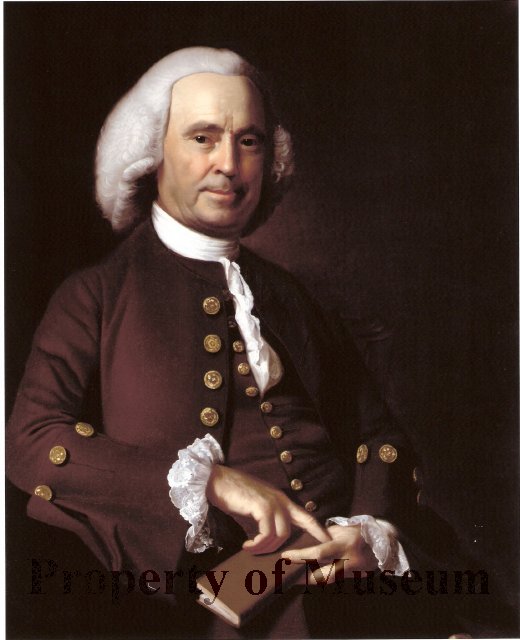
Lt. Nahum Ward, son of Gen. Artemas Ward, carried Gen. George Washington’s letter (quoted yesterday) to Josiah Quincy, Esq. (shown here), of Braintree on 24 Mar 1776.

The squire, encouraged, started to make detailed notes about what the British fleet was doing out on the Nantasket Road, the shipping channel in the outer harbor.

“The Admiral [Molyneux Shuldam] has a Signal now flying at his main top mast Head,” Quincy wrote the next day, 250 years ago today. “I wish it was in my Power to construe it.” Yes, that would have been more helpful.

But then he saw movement.
11 OClock. This Moment an Explanation of the above Signal occurrs: Part of the Fleet are come to Sail: I shall proceed, journalwise, to inform your Excellency of their Movements, ’till the Bearer, who is gone to see Colo. [Benjamin] Tupper, returns.

1 OClock They are still coming to sail: near or quite fifty Sail are got out to Sea; about half of them Brigs, Schooners, and Sloops; one or two Frigates, and the remainder Transport Ships; their Course shaped for Cape Cod: May not this Division be bound for Martha’s Vineyard, and the Islands in that Sound to procure fresh Provision for the Fleet, which is to rendevous at Hallifax, and from thence to proceed to Quebec?

3 OClock My Servant, who was directed to take an Account of the Number that have sailed, informs me, there are in all fifty two: One transport Brig: is just arrived: . . .

5 OClock The Adml has just now hoisted another Signal a Pendant under his Flagg two more Ships are under Sail going out of the Harbor: 7 O’Clock, Mr Ward & Colo. Tupper are just arrived: They are of Opinion, that the Ships which sailed to Day, have carried off the Tories, and are bound with them to Lewisburgh.

Tuesday Morng [26 March] Mr Ward’s tarrying in Town, gives me a further Opportunity to inform your Excellency that the Fleet, consisting of about 100 Sail, chiefly large Ships, remain as they were last Night.

10 OClock The same Signal is now flying at the Admiral’s Main top mast Head as was hoisted yesterday morning: Scarce hoisted before it was lower’d again, & in abt ½ an hour a blew [blue] flag is flying at mizen Top mast Head and a Pendant at his mizen Peek.

11 O’Clock The above Signals are changed, for a red Ensign hoisted just under his Mizen Yard: A signal is just now hoisted upon the Top of the Light House, for Vessels in the Offing; and immediately followed, by a blew broad Pendant from the middle of the Tower: In less than 10 Minutes the Signal first mentioned vizt a Pendant is flying from his main top mast Head.

12 O’Clock A red Ensign is now flying at his mizen top mast Head; a blew Ensign at his starboard mizen Shrouds, and a pendant thrown out between, by hand, & immediately taken in again.

2 OClock The 60 gun Ship in King Road is come to Sail & going down to Nantasket: The Admiral’s red Ensign is struck; the blew one remains: a large transport Ship and a Brig are just arrived within the Light.
Quincy wasn’t sure all that detail could be useful, but he promised Washington he’d keep sending it until the general said otherwise. He really wanted to be part of the effort to defeat the British.

About half of the fleet had moved off, heading for the safe port of Halifax, Nova Scotia. Most of the rest would follow by the end of 26 March. A few warships stayed behind to patrol Boston harbor.

TOMORROW: Aboard one of those ships.

Tuesday, March 24, 2026

“Fire Ships and fire Rafts, covered by the Smoke of Cannon”?

After evacuating Boston on 17 Mar 1776, the British military was gone—and yet not gone.

The troops, their families, their support staff, royal appointees, and more than a thousand Loyalists had embarked on more than a hundred ships, but those ships were bobbing in the outer harbor.

People worried that the army or navy would attack Boston or other coastal towns, either for supplies or for revenge. The Continental forces had a few armed schooners, good for capturing isolated merchant ships but not up to taking on a royal frigate, much less a fleet.

On 21 March, Josiah Quincy wrote to Gen. George Washington about what he could see from Braintree:
Since the Ships and Troops fell down below, we have been apprehensive of an Attack from their Boats, in Pursuit of live Stock; but, yesterday in the Afternoon, we were happyly relieved, by the Appearance of a number of Whaleboats, streching across our Bay, under the Command (as I have since heard) of the brave Lieut. Colo. [Benjamin] Tupper, who in the forenoon had been cannonading the Ships, with one or more field Pieces from the east Head of Thompson’s Island; and, I suppose, last Night cannonaded them again from the same Place, or from Spectacle Island.

This judicious Manœuvre had its genuine Effect; for, this Morning, the Admiral [Molyneux Shuldam], and all the rest of the Ships, except one of the Line came to sail, and fell down to Nantasket Road; where a countless Number is now collected:

In Revenge for their burning the Castle last Night; were we provided with a sufficient Number of fire Ships and fire Rafts, covered by the Smoke of Cannon from a few Row Gallies; this Night, might exhibit, the most glorious Conflagration, that was ever seen upon the watery Element, and the probable Consequences of it, a Period to the present War, otherwise, Humanity revolts at the Destruction of so great Number, even of our Enemies.
A fireship, as Samuel Johnson defined it, was “A ship filled with combustible matter to fire the vessels of the enemy.” Sometimes they carried not just combistibles but explosives. The tactic was to send such a ship toward a group of enemy vessels, set it afire, and get off safely while it continued on. A flaming fireship was probably the most fearsome single weapon of eighteenth-century warfare. Even if it didn’t damage enemy ships, they had to scramble to stay out of its way, and captains might decide to move on.

It seems significant that the Americans at this time wrote mostly about “fire Rafts.” That seems like a cheaper form of fire ship, not able to carry as much or be steered as easily, dependent on prevailing currents.

Quincy was a senior member of the Massachusetts Council and energetic supporter of the war. Gen. Washington wrote back to him on 24 March, 250 years ago today: 
The continuance of the Fleet in Nantasket Road affords matter for Speculation—it surpasses my comprehension—and awakens all my Suspicions—I have taken every step in my power to guard against Surprizes, but the temper of your People, seems to me to be, to apprehend no danger till it stares them in the Face—

I do not think there is cause to apprehend such Marauding parties as you dread—if any stroke is aimd, it will be a capitol one, for which reason I wish to be much upon my guard; & therefore have appointed Guard Boats, lookouts, &ca—there is one evil I dread, & that is their Spies, I could wish therefore that the most attentive watch was kept to prevent any Intercourse between the Ships & Main
He urged Quincy to set up a shore guard watching for such infiltrators, promising to pay those men’s wages.

Washington sent that reply through Gen. Artemas Ward and added this order for his second-in-command:
As these favourable Winds do not waft the fleet from Nantasket, my Suspicion’s are more and more roused. I wish therefore the Fire Rafts talkd of by Colo. Tupper, could be attempted in a Windy, or dark Night, I think this would discover their designs if no other good effect resulted from it.
TOMORROW: The next day’s action.

Wednesday, August 10, 2022

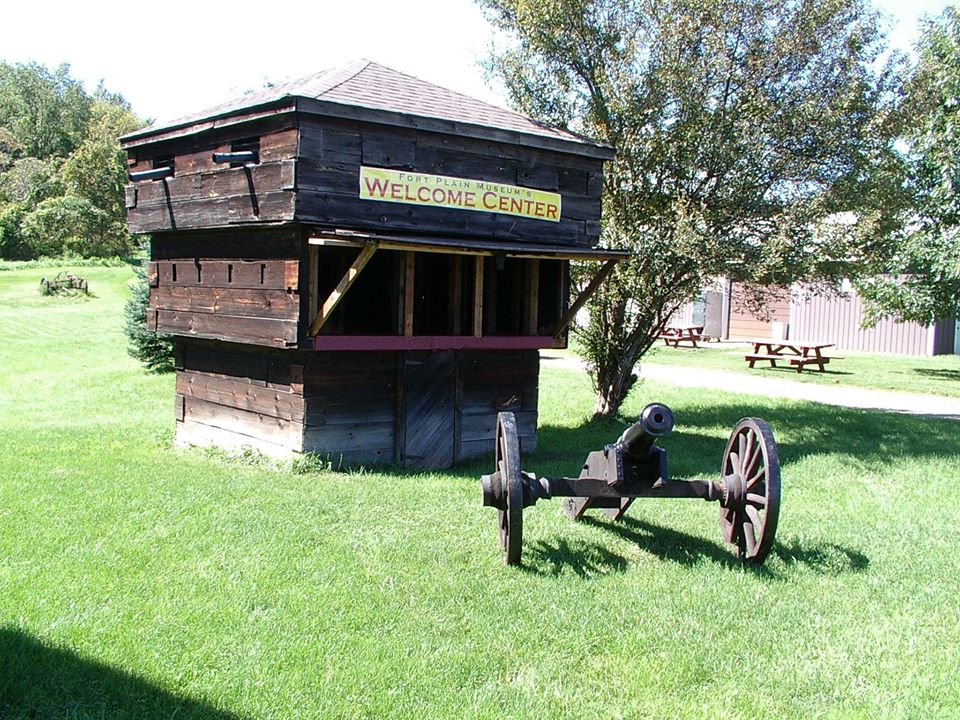
Getting Fort Plain Sorted Out

The year that The Road to Concord was published, I spoke at the American Revolution Conference organized by the Fort Plain Museum, and I had enough fun to go back in other years.

I’ve also enjoyed the Fort Plain Museum’s online bookstore, which stocks a wide range of books about the American Revolution, well beyond the titles on its region. The store often offers generous discounts on recent titles and free shipping for larger orders.

But on my visits I’d never had time to visit the museum itself, not until this week. It provides a thorough account of the fight between the U.S. of A. and the British Empire over New York’s Mohawk Valley.

I must confess I’d need to take better notes to sort out all the “forts” in the area, ranging from a large construction like Fort Stanwix to little more than a big farmhouse with shutters and a bunch of soldiers assigned to it.

I felt reassured, though, that I’m not alone in that confusion. In fact, the struggle to tell the Mohawk Valley fortifications apart apparently reached up to the highest level of the Continental Army. For this I’m relying on a roundup of period quotations from Norm Bollen (P.D.F. download).

As early as 1780, an invoice documents that people living around where Otsquago Creek joined the Mohawk River called their fortification Fort Plain. But when Gen. Robert Van Rensselaer made it his headquarters later that year, he dubbed it Fort Rensselaer.

There was a geographic and class division between the frontier farmers and Gen. Van Rensselaer, aggravated by a court-martial pitting him against the county’s militia officers. This resentment came out in people living near the fort continuing to call it “Fort Plain.”

Even when Col. Marinus Willett took over and proved more popular and more militarily successful, locals still sent him messages about “Fort Plain.” Willett regularly crossed out that name and wrote in “Fort Rensselear” (close enough by 18th-century standards).

In February 1782 the French military engineer Villefranche de Genton sent Gen. George Washington a “plan of a Redoubt with a Block-house the inside proper to contain two hundred men, and large magazines, as well for ammunition as provisions” for “Fort Ranceler,” as requested by Willett.

Washington thanked the engineer for his work, and in April sent a bunch of paperwork to Gen. Philip Schuyler, including a contract to finish that blockhouse at Fort Rensselaer. Schuyler was Gen. Robert Van Renssalaer’s brother-in-law, so we can be sure of what he called that location.

At the end of May, Col. Benjamin Tupper of Massachusetts took over at that fort. But when he wrote to Washington about the situation, he used the local name:
There is an unfinished Blockhouse at Fort plain which if compleated would be a strong barrior in that Country; I think if some money could be sent on for the Meterials we can procure workmen among the levies to compleat it.
Washington immediately wrote back to say it was “out of my Ability to furnish you with any Money for the Completion of the Block House at Fort plain.” This despite how he’d already asked Schuyler to start work on the blockhouse at Fort Rensselaer.

On 24 June, Gen. Washington traveled up to the Albany region to inspect the Continental posts and supply depots. As part of that trip, he appears to have learned that Fort Rensselaer and Fort Plain were the same place, and it still needed a blockhouse. On 2 July he ordered the quartermaster to send supplies there. Meanwhile, the latest commander of the post, Col. George Reid, was careful to refer to it in his letters to the commander-in-chief as “Fort Plain, or Ransler.”

After the war, the fortification was no longer needed. It disappeared by the end of the century. But the memory of it was strong enough that when the settlers living around Otsquago Creek needed a name for their village, they chose Fort Plain.

Thursday, May 12, 2022

The Mysterious “Negro Co. from Sharon”

Earlier this spring, my eye was caught by a description of this document on the Internet Archive:
Muster roll of Negro Co. from Sharon.
The document is a Revolutionary War muster roll in the collection of the Boston Public Library.

The document and description also show up on Umbra Search, aggregating material related to African-American history from thousands of library catalogues.

I knew about the Rhode Island regiments that recruited from men of African and Native descent. But I also knew those were exceptions to how the Continental Army operated, and after a couple of years commanders decided to spread out the veterans of those regiments among others. On the enlisted level, all sources say, the Continentals were integrated.

So what was up with this “Negro Co. from Sharon”?

I looked more closely at the document. None of the men is designated as “Negro.” None have names that suggest they had been enslaved, such as Quock, Prince, or Caesar. In fact, the label “Negro Co[mpany]” appears nowhere on this paper.

Here’s what I’m sure happened. The commander of this company was Capt. William Burley of Ipswich. In February 1780 he was captured by Crown forces in the Battle for Young’s House outside New York that I happened to write about back here. Burley’s name still appears first on this muster roll, but he was listed as a prisoner of war.

The regimental commander, Col. Benjamin Tupper from the part of Stoughton became Sharon in 1775, therefore took direct command of Burley’s company. In British regiments, the colonel often had a company assigned to him, though a captain-lieutenant or lieutenant usually did all the real work. The Continental Army didn’t follow that pattern after the first months of the war, but this was a special case.

In September, Col. Tupper reported, “There is a very considerable deficiency of Officers in the Regiment,” and recommended several men for commissions. Recognizing the need, Gen. George Washington gave blanket approval for new officers.

Nevertheless, at the end of 1780, when Lt. Nehemiah Emerson of Haverhill made out this muster roll, Tupper was still the acting company commander. Emerson therefore labeled this listing as “the Colo. Company”—the colonel’s company.

At some point a cataloguer looked at that abbreviation and interpreted it to mean “the colored company.” Then or later, that language was updated to “the Negro company.” And that label hung around in the cataloguing data long enough to catch my eye and make me scratch my head for a while.

Thursday, July 31, 2008

The Last of the Boston Light

Earlier this month, Christopher Klein, author of Discovering the Boston Harbor Islands, contributed two articles about the Boston Light on Little Brewster Island and the Continental Army’s raid on that lighthouse on 20 July 1775. But that wasn’t the end of the story, or the end of the lighthouse.

Here’s Chris’s conclusion:


Just 11 days after their first attack on Boston Light, the patriots hit again. This time, a detachment of 300 men led by Major Benjamin Tupper set out in whaleboats from Nantasket during the night of 30 July 1775 and landed on Little Brewster Island in the early hours of the morning on 31 July.

The patriots overcame the guard, gained the upper hand on the British marines stationed on the island, and burned the lighthouse and buildings on the island. Tupper’s men killed between 10 and 12 British troops and made prisoners of the rest while suffering only one fatality of their own.

In his letter to the Continental Congress dated August 4 and 5 of 1775, General George Washington reported:

A Number of Workmen having been sent down to repair [Boston Light] with a Guard of 22 Marines & a Subaltern, Major Tupper last Monday Morning about 2 oClock landed there with about 300 Men, attack’d them killed the Officer, & 4 Privates, but being detained by the Tide, in his Return he was attack’d by several Boats, but he happily got through with the Loss of one Man killed & another wounded. The Remainder of the ministerial [i.e., British] Troops, 3 of which are badly wounded, he brought off Prisoners, with 10 Tories all of whom are on their Way to Springfield Gaol.
Washington’s general orders of 1 August 1775 also included this item:
The General thanks Major Tupper, and the Officers and Soldiers under his Command, for their gallant and soldierlike behaviour in possessing themselves of the enemy’s post at the Light House, and for the Number of Prisoners they took there, and doubts not, but the Continental Army, will be as famous for their mercy as for their valour.
By June 1776, the British had evacuated Boston but their ships still lurked in the harbor. When they were finally driven out of the harbor for good on 13 June 1776, the British returned the favor to the colonists and blew up the tower of Boston Light using a timed charge. It was an ignominious “parting gift” from the Redcoats, who were led by the aptly named Captain Bangs.

The British destruction of the lighthouse is the reason why the beacon at Sandy Hook, New Jersey, which dates to 1764, has the distinction of being the oldest lighthouse structure in America, although Boston Light is still the oldest light station in the country. Boston Light would lay dark for seven years before it was rebuilt under orders from John Hancock in 1783.

Today, the distinguished, bold pillar of Boston Light is a postcard-perfect lighthouse, and it is the last to retain a Coast Guard keeper. Tours of Boston Light run from Thursday to Sunday through early October. For more information, visit www.bostonislands.org.

Thanks again, Chris!

Tuesday, July 10, 2007

Burgoyne, Lee, and Enoch Brown's Tavern

On 8 July 1775, a trumpeter came out of occupied Boston with a letter from Gen. John Burgoyne (at right) to Charles Lee, a British officer who had served under him in Europe. Lee had become a general in the Polish army, then traveled to North America. In early June, a few days before receiving a commission as major-general from the Continental Congress, Lee had written a long, critical letter to Burgoyne. It said:

I sincerely lament the infatuation of the times, when men of such a stamp as Mr. Burgoyne and Mr. [William] Howe can be seduced into so impious and nefarious a service by the artifice of a wicked and insidious Court and Cabinet. . . .

What I have seen of Courts and Princes convinces me, that the power cannot be lodged in worse hands than in theirs; and of all Courts, I am persuaded that ours is the most corrupt and hostile to the rights of humanity. I am convinced that a regular plan has been laid (indeed every act since the present accession evinces it) to abolish even the shadow of liberty from amongst us. It was not the demolition of the tea, it was not any other particular act of the Bostonians, or of the other Province which constituted their crimes; but it is the noble spirit of liberty pervading the whole Continent which has rendered them the objects of ministerial and royal vengeance.
Burgoyne responded with a proposal that the two officers meet at Enoch Brown’s tavern to discuss matters. That tavern sat on Boston Neck between the town’s fortified gates and the provincial lines; the British army was using it as a forward base.

Lee wanted to take up this invitation, and asked the Massachusetts Provincial Congress to send someone along with him. The congress named Elbridge Gerry of Marblehead as their representative, but also expressed worry that the two generals might end up negotiating without due regard for Americans’ chosen representatives.

As it turned out, the New England army prevented any meeting from taking place, at least at Enoch Brown’s tavern. Boston selectmen Timothy Newell recorded what happened that night:
8th [July]. Saturday morning at half past 2 waked up with roaring of cannon and small arms upon the lines which continued two hours. Brown’s house burnt.
Gen. William Heath of Roxbury recorded the provincial attack in his diary:
A little after two o’clock in the morning, a number of volunteers, under the command of Majors [Benjamin] Tupper and [John] Crane, attacked the British advance guard at Brown’s house, on Boston Neck, and routed them, took a halbert, a musket, and two bayonets, and burnt the two houses.
Crane led an artillery company with two brass field-pieces that raked the tavern with grapeshot, forcing the British soldiers inside to run away.

Newell also described the British response on the 9th: “The Regulars last night made an advance battery near Browns on the Neck.” And then the American response to that: “10th July. Provincials last night attacked the Centinels at the lines, and burnt Brown’s shop.” Burgoyne and Lee never had their meeting.