J. L. BELL is a Massachusetts writer who specializes in (among other things) the start of the American Revolution in and around Boston. He is particularly interested in the experiences of children in 1765-75. He has published scholarly papers and popular articles for both children and adults. He was consultant for an episode of History Detectives, and contributed to a display at Minute Man National Historic Park.

Subscribe thru Follow.it


•••••••••••••••••


Showing posts with label Plymouth. Show all posts

Thursday, October 08, 2026

Visiting with Mercy Warren

Among the Massachusetts Historical Society’s ongoing crowd-sourced transcription projects is the Mercy Otis Warren Papers, including both political and family letters.

I found an example of a document from Mercy Warren showing the wrinkles of this sort of project. It’s a letter dated 16 June 1775. There’s no recipient noted on the paper, nor on the webpage or caption for the images.

The transcription begins:
With the highest pleasure I Receved the several Letters of my Dearest Friend. & now having Returned to my own Habitation I have Leasure to answer them I Returnd from a Visit to my Father [James Otis, Sr.] yesterday. the two miss Otis’s sister Hannah & Miss Otis Came away with me Designing only to accompany me to Sandwish but it being a very fine Day they Came as far as Plimouth. & after spending the afternoon & Evening & Regaling several times on the finest strawberys I have seen Left me this morning at 10 o clock. but the Beauties of Nature. the Bounties of providence nor the social Intercourse of Friends Can I taste with unalloyed Delight so Long as my Country is threatned with Desolation & Bloodshed. & my Beloved Husband not only Long abscent from me but stationed on Duty in a place where I am Greatly Apprehensive of personal Danger to him.
Eventually the letter is signed “your Mercy Warren.”

Folks who read a bunch of Warren letters will recognize that she often addressed her husband James as “my Dearest Friend.” When she wrote of “my Beloved Husband,” she was being arch and literary, not describing him to a third party. 

Jeffrey H. Richards and Sharon M. Harris recognized that intended recipient in Mercy Otis Warren: Selected Letters, which they published in 2009. Unaccountably, though, they dated this letter to 15 June.

James Warren responded on 18 June. His letter has already been transcribed and published in the Massachusetts Historical Society’s Proceedings and Collections volumes—not because it came from the man in the marriage, but because he had a lot to say about the Battle of Bunker Hill.

In his reply James also told Mercy: “I hope your Strawberries are well taken care of and that you have fine feasting on them.”

TOMORROW: The general’s diary.

Monday, October 05, 2026

Reading Documents about the Governor and the Towns

I plucked out a couple more documents from the digitized Thomas Gage Papers to see how well the automated handwriting-recognition program Transkribus has worked there.

Here’s a bit of “Intelligence” dated 25 Feb 1775. It’s a casual note, written quickly for Gov. Gage’s files, rather than an official letter. The transcription reads:
St.
It having been reported that aquantity of Shan Outs &c is
confesting of persons
now buying up for the use of the Army a Committee, from
all the Towns round met last might to consult measures to
prevent this supply from being bro: down & effectually
hinder the people from selling any hereafter & also to him,
der any large quantity of any kind of Provisions beyond
what may be daily expended from being sent into Town
I read it as:
It having been reported that a quantity of Straw Oats &c is now buying up for the use of the Army a Committee consisting of persons from all the Towns round met last might to consult measures to prevent this supply from being brot: down & effectually hinder the people from selling any hereafter & also to hinder any large quantity of any kind of Provisions beyond what may be daily expended from being sent into Town
The phrase “consisting of persons” is an insert between lines marked by a caret, and the second “hinder” fell over a line break, so it’s less surprising the program glitched on those. The “St.” at the beginning of the automatic transcription appears to be an echo of “It”—in other words, the program transcribed those marks twice. All told, not a bad start, but still falling short.

Here’s a crowded document with bleeding through the paper: a 3 Feb 1775 petition from the selectmen of six towns urging Gov. Gage not to send troops to Marshfield. It begins:
We his Addutys loyal Subjects, Selectmen of the Sevent
town of Otimouth, Kingston, Dubord, Pembrook Hanour
& Lastrate, alenly affected with a Sence of the Encreasincy
Danger Realamities, which menace one of the most prom-
ifing country upon tenth, with Political Action, cannot
but lement, that while we are Endeavouring to preserve
peace & maintain the authority of the laws; at a perod
When the bunds of Government are relieved, by Violent
Infructions on the Chinster of the Province, our Enemies
are prutifing Every Mydim, Strutages, to Seduce the
people into act of Violance, & ontrage.
My reading of those lines:
We his Majestys loyal Subjects, Selectmen of the Several towns of Plimouth, Kingston, Duxborô, Pembrook, Hanover & Scituate, deeply affected with a Sense of the Encreasing Danger & calamities, which menace one of the most promising countrys upon Earth, with Political Exition; cannot but lament, that while we are Endeavouring to preserve peace & maintain the authority of the laws; at a period When the bonds of Government are relaxed, by Violent Infractions on the Charter of the Province, our Enemies are practising Every Insidious Strategem to Seduce the people into acts of Violance, & outrage.
Then software had a much tougher time with this one. Though I can’t blame a large language model for not recognizing the word “Exition,” which the Oxford English Dictionary says went out of use by 1820. I had to look that up myself.

Perhaps the biggest flaw in the automatic transcription is the town names. Those are important since researchers might scan for those terms. Granted, the selectmen didn’t help by using unorthodox spellings. To their credit, the cataloguers at the Clements Library listed all the towns in their standard forms in the metadata for this document, so it will come up in a local-history search.

Peter Force included this petition in his American Archives, changing the spelling, capitalization, and punctuation to conform to the standards of 1837. So historians have already had the chance to see local office-holders refer to Massachusetts as “one of the most promising countrys upon Earth.”

A quick scan of the automated transcription would probably bring the phrase “we are Endeavouring to preserve peace & maintain the authority of the laws” out of the unrecognizable gobbeldygook. That might lead one to think these selectmen were supporting Gov. Gage’s policies.

In fact, these selectmen were protesting the idea of stationing soldiers in Marshfield. They said those redcoats would provoke “the people,” already upset by the Massachusetts Government Act. That law-and-order language was a way to head off criticism and turn it against the local Loyalists asking for military protection. Another lesson in the value of reading the whole document in its historical context.

TOMORROW: The present and future of transcription.

Saturday, August 29, 2026

“15,000 people over 4,000 days”

Robert Parkinson is the author of The Common Cause: Creating Race and Nation in the American Revolution, its distillation as Thirteen Clocks: How Race United the Colonies and Made the Declaration of Independence, and Heart of American Darkness: Bewilderment and Horror on the Early Frontier.

John Fea at the Way of Improvement Leads Home site interviewed Parkinson on the publication of his 2026 book, Tyrants and Rogues: Understanding the Declaration of Independence, looking at the grievances of the Declaration of Independence and the British officials blamed for them.

But the parts of the conversation that interested me most looked back and ahead:
JF: When and why did you decide to become an American historian?

RP: At a very impressionable age, I lived halfway between Lexington Green and Plymouth Rock. Each weekend I tried to convince my parents to take me to one or the other. Early American history seeped into my bones from these public history sites in the years after the Bicentennial. (Hopefully, a similar process is happening among little boys and girls in these days after the 250th, too…)

JF: What is your next project?

RP: I am embracing that original thrill. Boston in the years before the Revolution was my first love. I’ve decided to return to that place in those years. Boston in the middle years of the 18th century was a very small place. And in just a few years a few among them recognized they had a political emergency on their hands and took steps to organize and craft an effective resistance campaign. How 15,000 people over 4,000 days faced (and refaced) a decision to either embrace resistance – or not – is a fascinating story. No one yet has tried to encompass the whole story of Boston’s Revolution. If you can explain Boston, you can learn a lot about the causes of the Revolution. By featuring the rivalry between the families fighting for control of the city’s politics – the Adams/Otis and the Hutchinson/Olivers – I propose to do just that in Boston’s Revolution, 1754-1774.
Four thousand days is just less than eleven years, not twenty, but the preceding nine will probably serve to establish the situation most Boston politicians viewed as better and wanted to get back to.

In 1755 William Shirley was not only governor of Massachusetts but commander-in-chief of the British forces on the continent. I think that let Bostonians think they still lived at the center of British North America, despite Philadelphia and New York growing larger and richer. That status changed during the war.

In the late 1750s the royal governor was Thomas Pownall, a Whig willing to cooperate with the local legislature. Pownall departed for his own career reasons in 1760. Lots of Massachusetts politicians viewed his brief administration as the way the province ought to be run.

Tuesday, November 04, 2025

“So soon as any coroner shall be certified of the dead body”

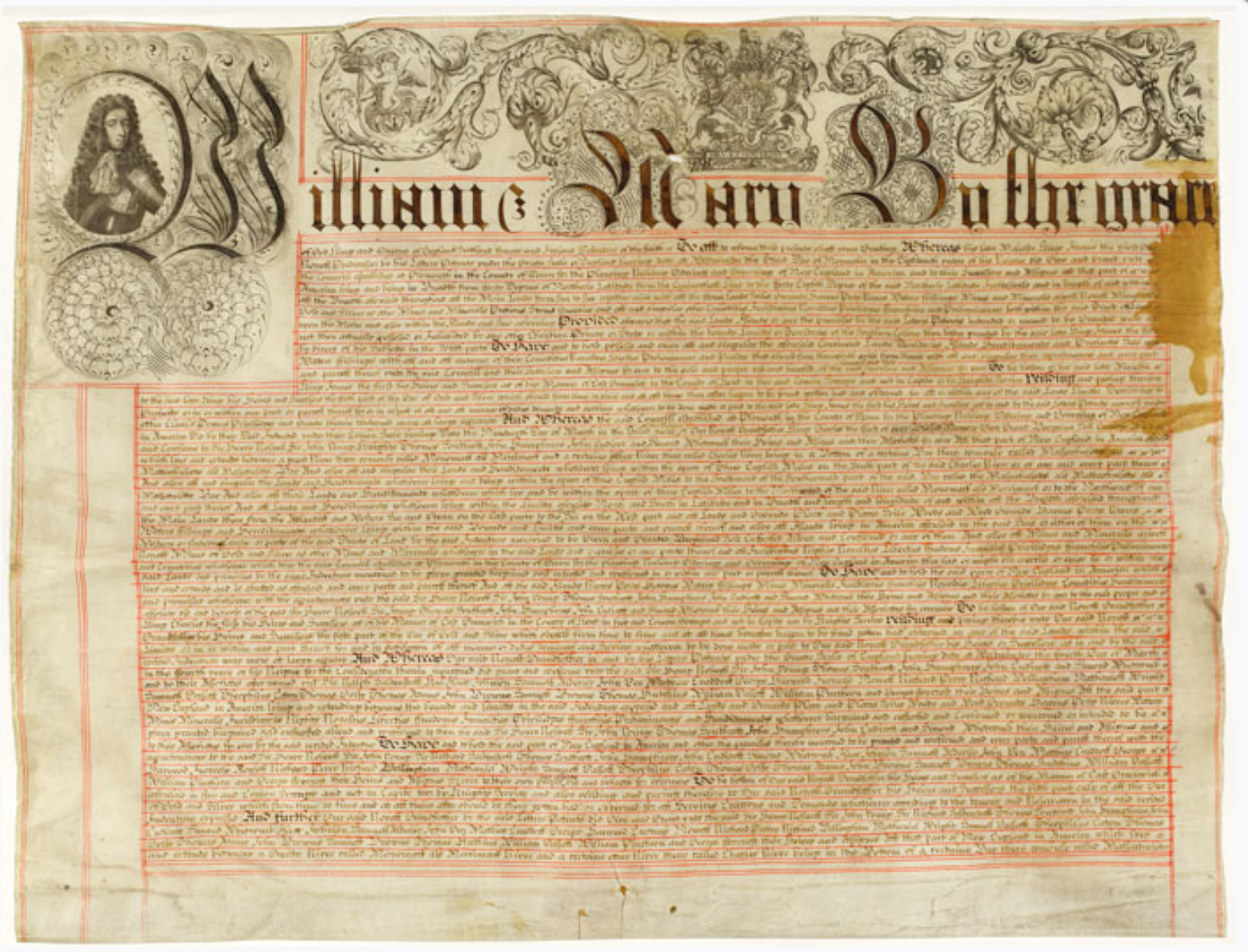
The Pilgrims of the Plymouth Colony established coroners as an elected office in 1636. By the end of the century, however, that colony had been absorbed into the province of Massachusetts Bay, and the monarchs William and Mary had issued a new charter for the province (shown above).

That 1691 charter stipulated:
it shall and may be lawfull for the said Governour with the advice and consent of the Councill or Assistants from time to time to nominate and appoint Judges Commissioners of Oyer and Terminer Sheriffs Provosts Marshalls Justices of the Peace and other Officers to Our Councill and Courts of Justice belonging…
The charter didn’t mention coroners, but everyone probably assumed they fell within the “other Officers” category. Such officials had presided over inquests in England for centuries, and in Massachusetts for decades. The big difference was that now the royal governor of Massachusetts, appointed by the ministry in London, would name coroners in every county, subject to the consent of the Council.

In 1700 the Massachusetts General Court got around to passing an act on “the office and duty of a coroner.” It stated:
every coroner, within the county for which he is appointed, shall be, and hereby is empowered to take inquests of felonies, and other violent and casual deaths committed, or happening within his precinct.
The law then devoted many more words to spelling out the oath that coroners would swear.

The next section said:
when and so soon as any coroner shall be certified of the dead body of any person supposed to have come to a violent and untimely death, found or lying within his county or precinct, he shall make out his warrant directed unto the constables of the same town where such dead body lies, or of three or four of the next adjacent towns, if need be, requiring them forthwith to summon a jury of good and lawful men of the same town, or such number as shall be sufficient, with those sent for from the neighbouring towns to make up eighteen in all, to appear before him at the time and place in the said warrant expressed
Then the law specified the language of the summons, the oath for the jury foreman chosen by the coroner, the oath for those jurors, and the fines to be levied if the constables or prospective jurors didn’t do their duties. I’m pleased to report that the law let the coroner swear in jurors “by three or four at once,” or else we’d still be waiting.

Out of the pool of eighteen men called, the coroner would choose “fourteen or more” for a jury and give them this charge:
You shall diligently inquire, and true presentment make, on the behalf of our sovereign lord the king, how and in what manner A. B. here lying dead, came to his death; and you shall deliver up to me, his majesty’s coroner, a true verdict thereof, according to such evidence as shall be given to you, and according to your knowledge. . . .

to declare of the death of the person, whether he died of felony, or by mischance and accident? and if of felony, whether of his own or of another’s? and if by mischance or misfortune, whether by the act of God or of man? and if he died of another’s felony, who were principals and who accessaries? who threatened him of his life or members? with what instrument he was struck or wounded? and so of all prevailing circumstances that can come by presumption.

And if by mischance or accident, by the act of God or man, whether by hurt, fall, stroke, drowning, or otherwise, to inquire of the persons that were present, the finders of the body, his relations or neighbours, whether he was killed in the same place, or elsewhere? and if elsewhere, by whom and how he was thence brought? and of all other circumstances.

And if he died of his own felony, then to inquire of the manner, means or instrument, and circumstances concurring.
Coroners could also summon witnesses, and of course they had their own oaths to swear.

The jury findings were specified in such detail that coroners came to use printed forms, filling in the blanks with information about the dead person, the date, the jurors, and so on.

The 1700 law said coroners could collect 10s. per day for travel and expenses, plus 2s. per day for each juror, to be collected from the dead person’s estate (or a dead child’s parents). If not enough money was available, the county treasurer would pay out what was needed.

In 1726 a new law allowed coroners to appoint deputies. In 1739 the legislature decided “some of the coroners within this province have of late greatly multiplied their deputies, and under colour of such deputation persons have pretended to be exempted from duties,” so it made such deputies a temporary appointment.

In contrast, coroners, like justices of the peace, kept their jobs for life—but that meant either their own lifespan, or the lifespan of the monarch under whom they were appointed.

COMING UP: Up for renewal.

Friday, January 17, 2025

“The Judge supposes he is possessed of the secret”

Before returning to Dr. John Newman, I’ll share some other sources on the treatment of cancers in New England on the eve of the Revolutionary War.

In January 1773, the Massachusetts judge Peter Oliver went to Rhode Island to serve on the royal commission investigating the attack on H.M.S. Gaspée.

Politically the Rev. Ezra Stiles was opposed to Oliver and the inquiry, but he was still polite enough to host the man.

On 11 January, Stiles wrote in his diary:
This Afternoon the hon. Judge Oliver came to drink Tea with me and spent the Evening at my house in Company with Mr. [Robert?] Stevens, Major [Jonathan] Otis and Dr. Jabez Bowen of Providence.

The Judge told us that his Wife had been last year cured of a Cancer in her Neck of 30 years standg. by a young man Mr. [John] Pope of Boston. . . .

His remedy is a secret, but he explained the operation of it to Mr. Oliver in a philosophical Manner, though Mr. Pope is not a man of Letters nor does he make pretension to any other part of Medicine or Surgery.
Peter and Mary (Clarke) Oliver’s son Peter (1741–c. 1831) was a respectable sort of doctor: upper-class, male, practicing standard medicine for his time. Nonetheless, Mary sought treatment from John Pope.

How good that treatment was over the long term is another question. Mary Oliver died on 24 Mar 1775 at the age of sixty-one. Among the pictures of Judge Oliver is one, reproduced above, showing the man mourning at his wife’s grave. It’s one of the rare portraits from the time of a person displaying strong emotion.

Stiles wrote down some of Oliver’s other medical remarks in 1773:
The Judge said that the late Mr. Little of Plymouth found an absolute Remedy for the Quincy, called white Drops, and offered me the Receipt. I suppose it the same as Dr. Bartlets which is only volatile Sp[iri]ts. as Hartshorn or Salarmoniac mixed with Oyl Olive. . . .

The Judge knew an illiterate physician to cure his (the Judge’s) Negro of a bilious Colic or perhaps the Illiac passion in a few Minutes—but would not disclose his Remedy. But the Judge supposes he is possessed of the secret, though that physician died without communicating it even to his own son. For being on the Circuit of the Superior Court in the Co. of York he found a Countryman to the Eastward [i.e., in Maine] who had a Cure for the bilious Colic, which Dr. Lyman had proved infallible in 100 instances.

The Judge bought it of the Man for 30. and it was only the Root of Meadow Flags, or Flower de Luce. Not every flag—but such only whose Root was flat with prongs—that flag root which was surrounded with bushy Fibres will not answer.
The most common name for those flowers today is wild iris.

Thursday, September 19, 2024

Kenneth Lockridge and the New Social History

Kenneth A. Lockridge died last month at the age of seventy-nine. He was Professor Emeritus of History at the University of Montana, having previously taught at the University of Michigan and the University of Illinois, Chicago.

Lockridge’s first book, published in 1970, was A New England Town: The First Hundred Years: Dedham, Massachusetts, 1636–1736.

It was one of a bevy of studies of rural New England communities published in the 1970s, including John Demos’s A Little Commonwealth, Michael Zuckerman’s Peaceable Kingdoms, and Philip J. Greven’s Four Generations.

Robert A. Gross applied and extended that approach in The Minutemen and Their World, about Concord in the Revolutionary period.

This “new social history” focused on the lives of ordinary men and women rather than political elites, on long-term social and economic trends rather than individual narratives. Eventually it was no longer new, and younger historians developed other approaches, such as looking at the experiences of people who weren’t ordinary because of race, sex, or other factors.

Lockridge went on to write such books as Literacy in Colonial New England, Settlement and Unsettlement in Early America, and On the Sources of Patriarchal Rage: The Commonplace Books of William Byrd and Thomas Jefferson and the Gendering of Power in the Eighteenth Century.

He also published studies of Sweden, his wife’s home, and after retirement moved to that country to be with family.

The University of Montana has named its workshop for historical works in progress after Lockridge.

Wednesday, April 17, 2024

Mercy Warren in History

Since I’ve been writing about the Warrens of Plymouth in 1775, it seems appropriate to mention that there’s a push to increase Mercy Warren’s visibility as the Sestercentennial proceeds.

Last month Nancy Rubin Stuart published this profile of Mercy Warren as “America’s First Female Historian” in the Saturday Evening Post.

Michele Gabrielson portrayed Warren in two episodes of the Calling History podcasts, which records first-person interpretations of historical figures.

And those folks and others launched a nonprofit organization called Celebrate Mercy Otis Warren, which can be found on Facebook.

One of that group’s goals is to have a bust of Warren installed in the Massachusetts State House, perhaps in the one empty spot in the senate chamber.

A bill promoting that plan has been moving through the legislature. As of today, the proposed language is:
The superintendent of state office buildings shall, subject to the approval of the State House Art Commission as to size and content, install and maintain in a conspicuous place of the Art Commission’s choosing in the State House, a memorial honoring Mercy Otis Warren, of Barnstable, Massachusetts, a leading author, playwright, satirist, and patriot in colonial Massachusetts, whose essays contributed to the creation of the Constitution’s Bill of Rights, and whose book, History of the Rise, Progress, and Termination of the American Revolution became this country's first published history of the American Revolution. Said memorial shall be the gift of Cape Cod artist David Lewis who will bear all costs associated with the creation, transportation, and installation of the artwork.
Lewis has already created a full-size statue of Warren shown above. It towers in Barnstable, the town where she was born.

Now I realize part of the Massachusetts legislature’s job is to boost the state’s products, but there were histories of the American Revolution published before Warren’s in 1805. At the time people pointed to David Ramsay’s History of the American Revolution from 1789. Michael Hattem’s superb chronology of the historiography likewise pairs Ramsay and Warren.

(A year even before Ramsay came the Rev. William Gordon’s History of the Rise, Progress, and Establishment, of the Independence of the United States of America. I suppose it doesn’t get counted as “this country’s first” because it was printed in Britain, and in some part written there. However, Gordon clearly composed a lot of material while living in Roxbury. Like Mercy Warren, he knew most of the local players.)

Of course, by coming later Warren’s book could cover the establishment of the federal government. Her final chapter describes the Shays’ Rebellion, the Constitutional Convention, and George Washington’s terms as President, with particular attention to the Jay Treaty. And then some remarks on John Adams that caused a deep rift between him and the Warrens.

I think that although Warren wrote history (just as she had earlier written poetry and closet dramas), her calling and strength were as an opinion writer. She didn’t disguise her feelings about Adams or the Federalist program overall. Writing in a Jeffersonian era, however, Warren was optimistic:
The wisdom and justice of the American governments, and the virtue of the inhabitants, may, if they are not deficient in the improvement of their own advantages, render the United States of America an enviable example to all the world of peace, liberty, righteousness, and truth.

Tuesday, April 16, 2024

“The Inhabitants of Boston are on the move”

Among the items in the London newspapers that arrived in Marblehead in the first week of April 1775 was this:
Yesterday a messenger was sent to Falmouth, with dispatches for General [Thomas] Gage at Boston, to be forwarded by a packet boat detained there for that purpose.
It didn’t take long for the Massachusetts Patriots to figure out that if this report had gone into the newspapers, and those newspapers had traveled to New England, then those dispatches could have made it to New England, too. And in that case, the royal governor might already be preparing to act on them.

Decades later, Mercy Warren wrote of the royal authorities in Massachusetts: “from their deportment, there was the highest reason to expect they would extend their researches, and endeavour to seize and secure, as they termed them, the factious leaders of rebellion.”

I can’t actually find those italicized words in the writings of royal officials, and “deportment” is a lousy basis for such a conclusion. But the Patriots may have had a more solid basis for expecting arrests, possibly from sympathetic people in Britain.

On behalf of the imperial government, the Earl of Dartmouth had written to Gage: “the first & essential step to be taken towards re-establishing Government, would be to arrest and imprison the principal actors & abettors in the Provincial Congress.” That letter didn’t arrive in Massachusetts until 14 April, but it looks like Patriots anticipated it after those Marblehead arrivals.

Most of the rest of the letter from James Warren to his wife Mercy that I’ve been discussing is about that worry—that Gage’s government would start arresting resistance leaders. On 6 April, James wrote from Concord:
The Inhabitants of Boston begin to move. The Selectmen and Committee of Correspondence are to be with us, I mean our Committee, this day. The Snow Storm yesterday and Business prevented them then. From this Conference some vigorous resolutions may grow. . . .

I am with regards to all Friends and the greatest Expressions of Love and regard to you, your very affect. Husband, JAS. WARREN

Love to my Boys. I feel disposed to add to this long letter but neither time nor place will permit it.
Then on 7 April James went back to his letter with more information and a warning:
I am up this morning to add. Mr. [Isaac] Lothrop [another Plymouth delegate] is the bearer of this and can give you an Acct. of us.

The Inhabitants of Boston are on the move. [John] H[ancock] and [Samuel] A[dams] go no more into that Garrison, the female Connections of the first [Lydia Hancock and Dorothy Quincy] come out early this morning and measures are taken relative to those of the last [Elizabeth Adams, who didn’t make it out before the siege]. The moving of the Inhabitants of Boston if effected will be one grand Move. I hope one thing will follow another till America shall appear Grand to all the world.

I begin to think of the Trunks which may be ready against I come home, we perhaps may be forced to move: if we are let us strive to submit to the dispensations of Providence with Christian resignation and phylosophick Dignity.

God has given you great abilities; you have improved them in great Acquirements. You are possessd of eminent Virtues and distinguished Piety. For all these I esteem I love you in a degree that I can't express. They are all now to be called into action for the good of Mankind, for the good of your friends, for the promotion of Virtue and Patriotism. Don’t let the fluttering of your Heart interrupt your Health or disturb your repose. Believe me I am continually Anxious about you. Ride when the weather is good and don’t work or read too much at other times. I must bid you adieu. God Almighty bless you. No letter yet. What can it mean? Is she not well? She can't forget me or have any Objections to writing.
James Warren appears to have gone home to Plymouth a few days later and then immediately gone on to Rhode Island to try to convince that elected government to help prepare a New England army. He was in that colony when word came of shooting at Lexington.

Thursday, May 18, 2023

“Indigenous Histories in New England” in Deerfield, 23–24 June

The Dublin Seminar for New England Folklife has announced the program of its 2023 conference on “Indigenous Histories in New England: Pastkeepers and Pastkeeping,” to take place on 23–24 June in Deerfield.

The Dublin Seminar website states:
This year’s seminar will address the gaps in Indigenous voice and visibility in public views of the past. We will critically consider who has claimed responsibility for “keeping” the Indigenous past in New England, including how it has been represented, how historical research can be decolonized and improved, and what museums and tribal nations have done to engage the public in better understandings.
The conference schedule starts with an optional visit on Friday morning to Amherst College Library, where its Special Collections staff will introduce the Amherst College Collection of Native American Literature.

Sessions inside the Deerfield Community Center begin at 1:30 P.M. on Friday. That afternoon and evening offers three panel discussions:
  • Indigenous Histories and Intergenerational Collaboration: Honoring Neal Salisbury, Pastkeeper, Spacemaker
  • Confronting Colonization at a Commemorative Moment: Reflections on Plymouth 400
  • Re-Covering and Re-Visioning: Indigenous Histories in New England Museums
On Saturday, a series of scholars will present their research in sessions built around these themes:
  • New Stories for Familiar Histories
  • Relocation, Resistance, & Resilience
  • Archives and Identity: Reciprocal Conversations
  • Land and Indigenous Values
Registration at the conference includes lunch on Saturday with fellow attendees.

Thursday, July 29, 2021

“Plimouth has producd lately a Prophetical Egg”

Back in 2012 I wrote about the “prophetic egg” found in Plymouth at the end of 1776, forecasting victory for the Howes.

I quoted a couple of men with Plymouth roots, Dr. James Thacher and Elkanah Watson, recounting the story, plus a poem published in January 1777 which appeared to be the only comment about it.

Boston 1775 reader JPC just asked if the author of that poem might be Mercy Warren, as Alice Brown stated in her 1896 biography:
When an egg was found in Plymouth, bearing the legend, “Howe will conquer,” it was Mrs. Warren who at once sat down—possibly in an interval of needlework or brewing—and wrote a counterblast in her customary satirical vein, reducing egg and prophecy to naught.
Brown cited no evidence for that statement, so it’s possible that she merely assumed any Patriot poetry linked to Plymouth must have come from Mercy Otis Warren.

I looked into the question and, while I found no conclusive evidence, found more contemporaneous references to the egg and a provocative link.

On 14 Jan 1777, Hannah Winthrop, wife of Harvard College professor John Winthrop, wrote to her friend Warren:
I hear Plimouth has producd lately a Prophetical Egg that bodes no good to America for the year 77, but as it is said to be laid by a Tory hen I interpret it to be what is wishd, rather than what will happen. The inscription on it is said to be. Howe will Conquer America. but I believe the Prophesy will prove as Brittle as the Tablet on which it is engravd.
Thanks to the Massachusetts Historical Society, that letter can be viewed here. It shows that Mercy Warren was informed about the egg, and more importantly—since she’d surely already heard that news by word of mouth in Plymouth—that she knew people in the Boston area were discussing it.

Back in 2012, I wrote that I’d found only one newspaper commenting on the egg, the 28 January issue of The Freeman’s Journal, or New-Hampshire Gazette.

I can now report that Portsmouth newspaper reprinted almost exactly a letter and poem that Benjamin Edes had published on the front page of the Boston Gazette one week earlier, on 20 January. That appearance makes it more likely the author of that poem was based in Massachusetts instead of New Hampshire.

Furthermore, Edes had been the first to print Mercy Warren’s closet dramas The Defeat and The Group and her poem “The Squabble of the Sea Nymphs.”

Of course, Warren had supplied some of her work to other printers, such as Isaiah Thomas, and had seen some published without her approval. On his side, Edes published many other poets. So while their previous connection makes it possible Warren sent the egg poem to Edes for publication, it’s not conclusive.

To both JPC and myself, the poem about Plymouth’s prophetic egg doesn’t fit well into Warren’s usual style. But there is one phrase to examine more closely.

TOMORROW: “The Genius of America.”

Monday, March 16, 2020

Michael Angelo Warwell, Bit Player in the Boston Massacre

In 1741, in the English market town of Totnes, a baby was baptized with the name Michael Angelo Warwell.

The reason for such a baroque name was that the boy’s parents, John and Maria Warwell, were artists. According to the Rev. Samuel Reynolds, writing in 1740, John Warwell was “a painter and a player.” He was the first professional visual artist to confirm the “very great genius for drawing” of the minister’s son Joshua.

Warwell wasn’t a portraitist, as Sir Joshua Reynolds would be. Instead, he specialized in decorative painting, particularly as architectural accent. In the 1750s he did some sort of work for the the shellwork grotto at Goldney Hall, shown above.

Michael Angelo Warwell followed his father’s other career path, into the theater. Sometime before 1765, he sailed for North America. We know this because his parents followed, putting an advertisement in the 19-31 Oct 1765 South Carolina Gazette:
THIS IS TO INFORM Mr. MICHAEL ANGELO WARWELL…that his father and mother are arrived in the Planters Adventure, Miles Lowley, commander, at Charles-Town, South Carolina, with intent to settle there…
The Warwells set up a household in Charleston near Gov. Thomas Boone’s. John advertised that he painted “HISTORY PIECES: HERALDRY: ALTAR PIECES: COACHES, LANDSCAPES: WINDOW BLINDS, SEA PIECES: CHIMNEY BLINDS, FLOWERS: SKREENS, FRUIT: GILDING.” He also offered to mend and clean pictures, paint rooms, and construct “Deceptive Temples, Triumphal Arches, Obelisks, Statues, &c. for Groves or Gardens.”

On 9 June 1767, the South Carolina Gazette reported that “Mr. Warwell, Sr., a noted limner,” had died. The “Sr.” indicated that the younger Mr. Warwell, still only in his mid-twenties, had made a name for himself locally.

On 11 August, Maria Warwell announced that she was planning to leave South Carolina and wanted to settle her debts. She added:
And while she waits for a passage, she will be much obliged to those who will employ her, in mending in the neatest and most durable manner, all sorts of useful and ornamental china, viz. beakers, tureens, jars, vases, and busts; statues, either in china, glass, plaster, bronze, or marble; should a piece be wanting, she will substitute a composition in its room, and copy the pattern as nigh as possible.
By April 1768, the Warwells’ Charleston house had become the new Customs House. That agency might have been expanding as it collected new revenue through the Townshend duties. I have no idea whether the Warwell family owned the house and thus dealt with the Customs service themselves, but that link seems notable in light of Michael Angelo Warwell’s future friendship with a Customs officer.

The younger Warwell became part of David Douglass’s American Company, a set of theatrical entertainers who came together to perform plays and also offered concerts solo or in small groups. The company was in New York in July 1769.

Warwell collaborated with an actor named Hudgson and a tavern owner named Burns to deliver, “By Permission of his Excellency the GOVERNOR,…an Attic Evenings ENTERTAINMENT.” The two performers read extracts of poetry and plays and sang songs. Admission cost five shillings. According to advertisements in the New-York Gazette and New-York Journal, Warwell’s repertoire included “Bright Author of my present Flame,” “A Song in the Anacreonick Taste,” “A Song set by Dr. Henry Purcel,” “A Martial Song, in Character,” and “a Two Part Song by Mr. Warwell and Mr. Hudgson.”

Warwell then headed north. New England wasn’t a fertile field for theater. In fact, in Boston it was illegal. But that meant there was an upper-class set curious about theater-adjacent entertainment. Performers like Warwell could offer “lectures” and “concerts” that gave people just a taste of the London stage.

On 5 Jan 1770, the New-Hampshire Gazette ran this item, sent from Marblehead on New Year’s Day:
Mr. Hall, by giving the following a Place in your useful Paper, you will oblige one of your Readers.

GENEROSITY and COMPASSION united.

ON Monday the 18th Instant, in the Evening, Mr. M. A. Warwell, Gent. read (at the Assembly Room in this Town) the Beggar’s Opera, to a Number of Gentlemen and Ladies, and to universal satisfaction. His Tickets amounting to £.7-6-9 lawful Money, the whole of which he generously gave as a Charity to the poor and distressed Widows & Orphans of this Place, who are real Objects of Pity and Commiseration.—May the above Example excite others, in their several Capacities, to go and do likewise.
The next month, Warwell was in Plymouth, sitting in on the 7 February meeting of the Old Colony Club. The record of the next day’s meeting says:
This evening was read at the Hall the “Provoked Husband,” a comedy, by Mr. M. A. Warwel, to a company of about forty gentlemen and ladies, by invitation of the Club.
Warwell sat in on two more club meetings that month.

But on 5 March, he was in Boston. And that’s how Warwell got involved in the legal maneuverings around the Boston Massacre.

(I haven’t found any trace of Michael Angelo Warwell after March 1770. However, in the spring of 1771 a Thomas Warwell read The Provoked Husband and sang songs on the Caribbean island of St. Croix—maybe that was a brother.)

COMING UP: Warwell’s memorable fifth of March.

Thursday, November 28, 2019

A Dinner in “Plymouth, the great mausoleum”

On 24 Dec 1770, the Old Colony Club of Plymouth met to celebrate Forefathers’ Day, a tradition that went back a whole year but which commemorated an event a century and a half earlier.

The club first proclaimed Forefathers’ Day in 1769 to celebrate the Pilgrims’ landing at Plymouth. That had occurred on 11 Dec 1620 according to the Julian Calendar that the English then used. Club members knew that the British Empire had skipped eleven days to catch up to the Gregorian Calendar in 1752, so they calculated that landing must have happened on 22 December in the new system. In fact, it had happened on 21 December; the Julian Calendar had been only ten days behind in 1620.

Forefathers’ Day remained on 22 December, except when it didn’t, as in 1770. In that year the date fell on a Saturday, and the club decided that propriety demanded putting off their celebration until after the Sabbath.

One part of the 1770 celebration was an address by Edward Winslow, Jr. Another was a song written by local schoolteacher Alexander Scammell (shown here) to the tune of “The British Hero” (which I haven’t been able to identify). The lyrics were:
All hail the day that ushers in
The period of revolving time,
In which our sires of glorious fame
Bravely through toils and dangers came,

Novanglia‘s wilds to civilize
And wild disorder harmonize:
To plant Britannia’s arts and arms,—
Plenty, peace, freedom, pleasing charms.

Derived from British rights and laws
That justly merit our applause,
Darlings of Heaven, heroes brave,
You still shall live though in the grave,—

Live, live within each grateful breast,
With reverence for your names possessed;
Your praises on our Tongues shall dwell,
And sires to sons your actions tell.

To distant poles their praise resound;
Let virtue be with glory crowned;
Ye dreary wilds, each rock and cave,
Echo the virtues of the brave.

They nobly braved their indigence,
Death, famine, sword, and pestilence;
Each toil, each danger they endured,
Till for their sons they had procured

A fertile soil profusely blest
With Nature’s stores, and now possessed
By sons who gratefully revere
Our fathers’ names and memories dear.

Plymouth, the great mausoleum,
Famous for our forefathers’ tomb!
Join, join the chorus, one and all,
Resound their deeds in Colony Hall!
The Old Colony Club broke up just a few years later under the political pressure of the Revolution. Winslow moved to Nova Scotia and later helped to found the new colony of New Brunswick. Scammell became an officer in the Continental Army.

Other organizations in Plymouth later took on the celebration of Forefathers’ Day, including the Pilgrim Society behind the Pilgrim Hall Museum, the revived Old Colony Club, and the Mayflower Society.

This year marks the sestercentennial of the first Forefathers’ Day celebration in Plymouth. The Pilgrim Society and Old Colony Club together are hosting a dinner on Saturday, 21 December. Tickets are available here. I have the honor of being this year’s after-dinner speaker.

Thursday, September 05, 2019

The First and Ongoing Pauline Maier Seminar Series

The Boston Area Early American History Seminar has changed its name to the Pauline Maier Early American History Seminar, honoring the late M.I.T. professor who was an enthusiast for these discussion and many other ways of delving into the national past.

The seminar series continues to provide a forum for scholars and interested members of the public to discuss many aspects of North American history and culture. Sessions are free, though there is a $25 cost to order copies of the papers in advance of each discussion, which I recommend as a bargain.

All the seminars begin at 5:15 P.M. at the Massachusetts Historical Society, 1154 Boylston Street in the Back Bay. Formal conversation lasts for about ninety minutes, and then participants can enjoy light refreshments and further chat until 7:30.

Here are the sessions scheduled for the upcoming calendar year.

Thursday, 26 September 2019
Toward the Sistercentennial: New Light on Women’s Participation in the American Revolution
Woody Holton, University of South Carolina
Comment: Mary Bilder, Boston College Law

Tuesday, 5 November
Native Lands and American Expansion in the Early Republic
Emilie Connolly, Dartmouth University, and Franklin Sammons, University of California, Berkeley
Comment: Nancy Shoemaker, University of Connecticut

Tuesday, 19 November
Murder at the Manhattan Well: The Personal and the Political in the Election of 1800
Paul Gilje, University of Oklahoma
Comment: Katherine Grandjean, Wellesley College

Tuesday, 10 December
Who Was “One-Eyed” Sarah?: Searching for an Indigenous Nurse in Local Government
Gabriel J. Loiacono, University of Wisconsin, Oshkosh
Comment: Cornelia Dayton, University of Connecticut

Tuesday, 7 January 2020
Supplying Slavery: North America, Jamaica, and British Intra-Imperial Trade, 1750-1770
Peter Pellizzari, Harvard University
Comment: Richard Dunn, American Philosophical Society

Tuesday, 3 March
The 1621 Massasoit-Plymouth Agreement and the Genesis of American Indian Constitutionalism
Daniel Mandell, Truman State University
Comment: Linford D. Fisher, Brown University

Tuesday, 10 March
Military Metabolism and the Environment in the War of Independence
(Co-sponsored by the Boston Seminar on Environmental History)
David Hsiung, Juniata College
Comment: James Rice, Tufts University

Tuesday, 7 April
“Our Turn Next”: Slavery and Freedom on French and American Stages, 1789-99
Heather S. Nathans, Tufts University
Comment: T.B.D.

Tuesday, 12 May
Honoring Dan Richter: McNeil Center for Early American Studies Alumni on their Experiences and Research
Round-table Discussion
(Richter is retiring, not being honored in the same way Maier is, so I expect he’ll be in town to enjoy the discussion.)

The Massachusetts Historical Society hosts similar series of seminars or discussions on African American History; Environmental History; Modern American Society and Culture; the History of Women, Gender, and Sexuality; and New England Biography.

Friday, December 29, 2017

Extracts of Letters from Boston?

On 29 Dec 1774, Rivington’s New-York Gazetteer ran the following items:
Extract of a letter from Boston.

“Every thing is at present quiet here, and the governor takes all possible precautions to keep things so. The people are continually tampering with the soldiers to desert; a corporal of the 38th regiment was last Monday addressed by one of their Agents, he pretended to consent to go off with him, upon which the fellow took him to a house, gave him a suit of plain cloathes and put his regimentals into the saddle-bags, he then put the corporal upon his horse and got up behind; they rode on together till they came to the Fusileers barrack, into which the corporal turned, the fellow instantly jumped off and made his escape, leaving the horse, saddle-bags and clothes, all of which have been given to the corporal as a reward for his wit and spirit.[”]

A Gentleman in Boston, writes to his friend here, of the 12th instant;—

Two ships of the line, viz. the Asia and Boyne, are arrived here, and the Somerset is now firing guns in the offing. The day before yesterday it was moved in Provincial Congress, that arms be immediately taken up against the King’s Troops; but one of the members got up and told them such a move was infamous, when at the same time the Members knew, that neither Connecticut nor any of the southern colonies meant to oppose his Majesty’s arms, on which account the Congress immediately dissolved, and a new one is to be chosen, to meet the tenth of next month.

At Plymouth they are now beating up for volunteers to attack the troops; the parties sent for a parson to pray for them, who refused to comply; but he was obliged to attend on being sent for a second time, on penalty of being shot.
James Rivington was then a strong supporter of the Crown, on his way to being put out of business by a Patriot mob and then sponsored by the royal government in occupied New York through the war.

On 1 Jan 1774, Nathaniel Mills and John Hicks reprinted the entire article in their Boston Post-Boy. In the preceding May they had taken over from Green and Russell and turned the Post-Boy into a strongly pro-government paper.

On 5 January, Isaiah Thomas printed the part about plans to attack soldiers instead of to suborn them in the Patriot Massachusetts Spy, crediting “the New-York Gazette,” but he added at the bottom:
[A d——d lie.]
And indeed there’s no evidence supporting the article’s claims about the congress. If Rivington had actually seen a letter from Boston with that story, he fell for an alarmist rumor—and it’s quite possible he just made it up.

Even so, the letter from “A Gentleman in Boston” was reprinted in several British magazines in early 1775, helping to shape public opinion there.

[ADDENDUM: Follow-up from Don Hagist.]

Thursday, November 02, 2017

Charles Paxton, Customs Commissioner

Charles Paxton (1708-1788, shown here in a portrait at the American Antiquarian Society) was a major figure in Boston’s 1767 Pope Night procession.

Not as a member of the North End or South End Gangs, to be sure. Paxton was the target of those processions, which became a protest against the Townshend duties and the new Commissioners of His Majesty’s Customs. (The daytime protest will be part of the “Devil and the Crown” reenactment this Saturday.)

Paxton was one of those five Commissioners, having risen in the Customs service in Massachusetts. He had tried to join that agency as early as 1734, proposing a new office at Plymouth with himself in charge. He got a post in Marblehead and Salem in the early 1740s.

Paxton also became marshal of Boston’s vice-admiralty court, which helped to enforce the Customs laws. So he made money from seizures of smuggled goods in all sorts of ways. Some said he played favorites with whose goods he seized, though it’s possible they just meant he should be as lenient as other Customs officers.

Naturally, Paxton’s work made him unpopular with the maritime community in Essex County. In 1752 he gained the post of Surveyor of Customs in Boston, allowing him to become just as unpopular with an even larger maritime community.

When Boston’s merchants sued to overturn writs of assistance in 1761, Paxton was the nominal defendant. He won that case, and others, in the Massachusetts courts. The fact that Chief Justice Thomas Hutchinson was one of Paxton’s oldest friends didn’t mollify their opponents.

During the first Stamp Act riot on 14 Aug 1765, Paxton reportedly offered shelter to the stamp agent, Andrew Oliver. So during the second Stamp Act riot on 26 August, a mob went to Paxton’s home and threatened to pull it apart.

Paxton’s landlord, Thomas Palmer, came out and convinced the crowd not to harm his property. He bought them a barrel of punch at a nearby tavern. So instead those people headed to the North End and ripped apart Hutchinson’s house, among others.

In July 1766 Paxton sailed for London, nominally for his health. He happened to be in the capital when Chancellor of the Exchequer Charles Townshend proposed new tariffs and a new board to enforce them. Bostonians blamed Paxton for suggesting those measures, but there’s no evidence for that. He no doubt did lobby to be named as one of the Commissioners, and succeeded.

Thus, when Paxton arrived back in Boston on 5 Nov 1767, he had made himself into the most unpopular royal appointee in the colony. In 1768 Samuel Adams would look back on Paxton’s trip in a newspaper essay published under the name of “Candidus”:
Happy for America’s sons had mother Ocean taken him into her bosom (father Abra’m surely never will)

happy I say had it been for America, nay thrice happy for the mother country had he never reached Albion’s shore: less treasure had been expended by her; less animosity had taken place between the mother and her children; less villainy had been perpetrated here, had he never returned.
When your neighbors publicly wish you had drowned at sea for the good of the nation, you are not popular.

Another thing made Paxton a target of Boston’s crowds: he was queer.

TOMORROW: Poor Charles the Bachelor.

Monday, February 06, 2017

Dinner with the Old Colony Club in 1769

The Old Colony Club started as a group of seven young gentlemen from Plymouth. They formed their club in January 1769, and on 22 December of that year had a dinner to commemorate the landing of the first British settlers in what was then the Plymouth Colony but was subsumed into Massachusetts.

The dinner took place at the inn of Thomas Southworth Howland, another descendant of the first settlers, starting at 2:30 P.M. According to club records, the food consisted of:

1. A large baked Indian whortleberry pudding.

2. A dish of sauquetash.

3. A dish of clams.

4. A dish of oysters and a dish of codfish.

5. A haunch of venison roasted by the first jack brought to the Colony.

6. A dish of sea-fowl.

7. A ditto of frost-fish and eels.

8. An apple pie.

9. A course of cranberry tarts, and cheese made in the Old Colony; dressed in the plainest manner (all appearances of luxury and extravagance being avoided, in imitation of our worthy ancestors whose memory we shall ever respect).
At 4:00 the club walked solemnly back to “Old Colony Hall,” the procession “headed by the steward carrying a folio volume of the laws of the Old Colony” of Plymouth. Other descendants gathered as a military company and “discharged a volley of small arms, succeeded by three cheers.”

Peleg Wadsworth brought out the boys from his “Private Grammar School opposite the Hall,” who sang “a song very applicable to the day.” Young Elkanah Watson might have been among those boys; his namesake father, his teacher Wadsworth, and the school’s other teacher, Alexander Scammell, were among the men who joined the club members for toasts that afternoon.

The public part of the ceremony ended at sunset with a cannon being fired and the club taking down their “elegant silk flag” inscribed “Old Colony 1620.”

Friday, July 15, 2016

When Minutemen Marched into Marshfield

So in 1775 there were a hundred British soldiers stationed in Marshfield, mostly on the estate of Nathaniel Ray Thomas. Their commander was Capt. Nisbet Balfour of the 4th Regiment.

And on the morning of 20 April, according to Isaac Thomas (who was nine years old at the time), the Marshfield militia was summoned by musket shots and drum.

I wouldn’t just leave the story there, would I?

The colonel of the Plymouth County militia was Theophilus Cotton (detail of his gravestone shown above, courtesy of Find-a-Grave). We have many documents about militia companies that he commanded that day, such as this roster from Hanson. That’s because the men who turned out in April 1775 expected to be paid, so the Massachusetts government asked for and kept paperwork with their names and days of service.

However, we don’t have, to my knowledge, contemporaneous narratives of what happened in Marshfield, from either the locals or the British troops. Instead, we have accounts written decades later by the historians of nearby towns, based and focused on the activities of men from those towns.

Dr. James Thacher’s History of the Town of Plymouth (1832) relates two detailed and flattering anecdotes about how Plymouth’s “watchful sons of liberty” intimidated British officers visiting from Marshfield. As for the military activity in Marshfield, he wrote:

Capt. Balfour, with his company remained at Marshfield for several weeks unmolested, but the day after Lexington battle, governor [Thomas] Gage, apprised of their danger, took off his troops, by water, to Boston.

At this period minute companies were organized in town, and immediately on hearing of the bloodshed at Lexington, Col. Theophilus Cotton, of this town, marched to Marshfield with a detachment of militia under his command. There were at the same time about sixty fishing vessels with their crews on board at anchor in Plymouth harbor. The fishermen voluntarily left their vessels, and speedily marched to Marshfield with their arms, resolutely determined to attack the company of British troops. When arrived at Marshfield, their numbers had increased to near one thousand men, collected from the different towns, burning with the feelings of revenge: they might have surrounded and captured the whole company before they could get to their vessels, but were restrained by Col. Cotton, who it is said had received no orders for the attack.
A more detailed account appeared seventeen more years on in Justin Winsor’s History of Duxbury (1849):
Immediately after the news arrived of the bloodshed at Lexington, Col. Cotton with his regiment formed for an attack on Balfour’s party. On the 20th Col. Cotton and Maj. [Ebenezer] Sprout met in Duxbury, at Col. Briggs Alden’s for consultation. Maj. Judah Alden, who was in Rhode Island when the news came of the fight, had just returned, having ridden all day on horseback, and soon after learning the circumstances of the case, he met Cato, a negro who had been sent by Capt. Balfour to ascertain the numbers of the men who were marching against him. Maj. Alden suspecting his design, told him to tell Balfour, they were coming in a host after him, and dismissed him.

Col. Cotton again returned to Plymouth; and, about 7 o’clock, on the morning of the 21st, marched for Marshfield with a portion of his regiment, consisting of the Plymouth company under Capt. [Thomas] Mayhew, the Kingston under Capt. Peleg Wadsworth, and the Duxbury under Capt. Geo. Partridge. They proceeded to Col. Anthony Thomas’ [sic], about a mile N. W. of Capt. John Thomas’, where were Balfour’s troops.

At this juncture Col. Cotton and Lt. Col. Alden held a long conference, as to the course to be taken. At noon there were assembled about 500 men, including the crews of many fishing vessels in the harbor. In the afternoon Capt. [Earl] Clapp’s company from Rochester and Capt. [Jesse] Harlow’s from Plympton arrived. Capt. Peleg Wadsworth was greatly dissatisfied with the delay, and moved forward his company until within a short distance of the enemy, and then halted as his numbers were too small to venture an attack.

About 3 o’clock, P. M., two sloops hove in sight and anchored off the Brant rock. Balfour then conveyed his company through the Cut river [Green Harbor] in boats, and reaching the sloops soon sailed for Boston, leaving however several sentinels behind to watch the movements of the Americans, who also set guards for the night.

The British watch finally left and in going to their boats, they passed one of the American sentry posts, where were stationed Blanie Phillips, and Jacob Dingley, both of Duxbury. Dingley was seized, and conveyed to their boat, when they concluded to release him. Phillips escaped, fired his gun, and gave an alarm, which roused the country for many miles around.

Balfour, it is reported, said that if he had been attacked, he should have surrendered without a gun. In their hurry to escape they left much of their camp equipage behind.
That final detail is the sort that always makes me skeptical: no source for information from the other side of the war, flattering to the author and readers as local descendants. In the following sentences Winsor cited “an inhabitant of Duxbury” whom Balfour spoke with in New York later in the war, so it’s possible the captain told that person. But it’s also possible that’s what the Plymouth County men told themselves.

With Capt. Balfour and the regulars went Nathaniel Ray Thomas, who settled in Nova Scotia, and possibly some other Marshfield Loyalists. His Patriot son John regained the mansion at the center of the estate after the war. Later Daniel Webster bought that house and enlarged it, creating the Victorian structure which (after a fire) is now reproduced on the property. Locals point out that could have been the site of the second battle of the Revolutionary War.

Wednesday, July 13, 2016

Rev. Ebenezer Thompson, Minister to the Marshfield Loyalists

Ebenezer Thompson was born in West Haven, Connecticut, in 1712. He graduated from Yale College in 1733, married the following March, and then did what Yale graduates weren’t supposed to do: start worshipping in the Church of England. In fact, in 1743 Thompson took holy orders in England, becoming an ordained Anglican minister.

At that time the Church of England considered most of New England to be missionary territory, hostile or indifferent to the established denomination. The Society for the Propagation of the Gospel in Foreign Parts (seal shown here) paid ministers to take posts there since the congregations were too small to support them.

The S.P.G. sent Thompson to Scituate, Massachusetts, at the end of 1743 with a salary of £40 per year. His job was not only to serve Anglicans in that town, where St. Andrew’s Church had been built in 1731, but also to proselytize in the neighboring towns.

In November 1748 Thompson wrote back to his employer:
I beg leave to acquaint the Venerable Society that by the blessing of God on my sincere Endeavours, the Church of England continues to increase in these parts, and people in general begin to conceive a much better opinion of it than they had when I first came here. The good people of Marshfield have so far finished the new Church that on Sunday the 18th of September last, I preached in it to a large Congregation and administered the Sacrament of the Lord’s Supper to 18 regular Communicants. I hope the Honorable Society will be pleased to favour this new Church with a Bible and Prayer Book.
Thompson’s reports back to the S.P.G. appear to be almost the only records of Marshfield’s first Anglican church, called Trinity. The presence of that place of worship was a big change for the community. Marshfield was one of Massachusetts’s oldest settlements, its earliest English inhabitants defining themselves by not being Anglican. When Thompson reported performing a service in nearby Plymouth in 1755, he added, “although the town had been settled more than 120 years, the Liturgy of the Church of England had never before been used in public.”

By 1754 Thompson was preaching “once a Month to the New Church at Marshfield, where, and at his own Church of Scituate he has the Pleasure to see the neigbouring Indians come frequently to Church.” Four years later the S.P.G. understood his three churches “at Scituate, Marshfield, and Bridgewater” to be “in a flourishing and encreasing State.” He received a raise to £50 per year.

In March 1760 Thompson reported that his three congregations “live among themselves and with the Dissenters their Neighbours in Friendship and Love; some of whom, of various Denominations, observing the Order and Regularity of our Church, begin to have a much better Opinion thereof than heretofore.” As of 1763 he counted “700 Families of various Persuasions” in those towns, “50 of which profess themselves of the Church of England, and attend the publick Worship with Seriousness, Decency and Devotion.” He had forty-seven white communicants and three Indians, and preached once every five weeks in Marshfield.

Thompson’s Anglican community continued to grow through conversions. In 1771 the minister wrote, “there has been added to the Church four families of good reputation from among the Dissenters.” In 1774 the S.P.G. understood, “The Rev. Mr. Thompson's congregation at Scituate and Marshfield have received an addition of 8 families from the Dissenters.” The Anglican communicants were up to 57 people in 1774, the year that Marshfield had its open political split.

Clearly most of Thompson’s adherents were in Scituate, but it appears some of the most prominent were in Marshfield. Without surviving church records, I can’t say for sure which of Marshfield’s political leaders became Anglican. Cynthia Hagar Krusell’s 1976 pamphlet Of Tea and Tories says the White and Little families did, and Loyalist leader Nathaniel Ray Thomas was definitely C. of E. after he settled in Nova Scotia in 1776.

In the early 1770s the S.P.G. reported, “The Rev. Mr. Thompson Missionary at Scituate and Marshfield, informs the Society that there is more harmony than formerly between his People and the Dissenters.” But that denominational difference was probably significant in the split of 1774. The Anglican ministers of New England were among the strongest proponents of remaining loyal to the government of the king, who was also the head of their church. Thompson’s work was a likely factor in how Marshfield had more Loyalists, and more fervent Loyalists, than nearby towns—even Scituate.

The Rev. Mr. Thompson died on 2 Dec 1775, after the outbreak of the Revolutionary War. In reporting his death to the S.P.G. the following April, the Rev. Edward Winslow of Braintree said:
He continued firm to his principles to the last. In the support of them, and of his duty to the Church, he met with some harsh treatment, under which he gave substantial evidence of a truly Christian temper, as he also did under a long and painful exercise from bodily infirmities.
The Rev. Dr. Henry Caner of Boston’s King’s Chapel wrote, “It is said that his death was partly owing to bodily disorder, and partly to some uncivil treatment from the rebels in his neighbourhood.” An 1899 book went further: “Being a Royalist he felt it imperative upon him, during the Revolution, to continue praying for the King and was imprisoned therefor, dying from the accompanying exposure.” That was too far, in fact—there are no records of Thompson’s imprisonment. But political stress probably contributed to Thompson’s death at sixty-three.

Thompson’s widow stayed in Scituate and died there in 1813 at the age of ninety-nine. After 1775 the Anglican church in Marshfield lacked both a minister and enough parishioners to remain open. Not until decades later did Trinity Church have a significant presence in the town again.

TOMORROW: A child’s view of Marshfield’s Revolution.

Wednesday, July 06, 2016

A Plymouth County Protest “as if written with a sunbeam”

The letters I quoted yesterday described the arrival of about a hundred British soldiers in Marshfield on 23 Jan 1775, sent by Gen. Thomas Gage to support the local Loyalists. Those letters also reported that Patriots in the region had started to muster against those troops but hung back.

Instead, the nearby communities protested through their civil representatives and some high-flying rhetoric. They sent a letter to the governor that was published in the 27 Feb 1775 Boston Evening-Post:

We, his majesty’s loyal subjects, selectmen of the several towns of Plymouth, Kingston, Duxbury, Pembroke, Hanover, and Scituate, deeply affected with a sense of the increasing dangers and calamities which menace one of the most promising countries upon earth with political excision, cannot but lament, that, while we are endeavoring to preserve peace and maintain the authority of the laws, at a period when the bonds of government are relaxed, by violent infractions on the charter of the province, our enemies are practising every insidious stratagem to seduce the people into acts of violence and outrage.

We beg leave to address your excellency, on a subject which excites our apprehensions extremely: and, in the representation of facts, we promise to pay that sacred regard to truth, which, had our adversaries observed, we flatter ourselves, it would have precluded the necessity of our addressing your excellency, on this occasion.

We are informed, from good authority, that a number of people from Marshfield and Scituate, have made application to your excellency, soliciting the aid of a detachment of his majesty’s troops, for the security and protection of themselves and properties. That their fears and intimidation were entirely groundless, that no design or plan of molestation, was formed against them, or existed but in their own imaginations, their own declarations, and their actions, which have a more striking language, abundantly demonstrate.

Several men of unquestionable veracity, residing in the town of Marshfield, have solemnly called God to witness, before one of his majesty’s justices of the peace, that they not only never heard of any intention to disturb the complainants, but repeatedly saw them after they pretended to be under apprehensions of danger, attending to their private affairs, without arms, and even after they had lodged their arms a few miles from their respective houses. They frequently declared, in conversation with the deponents, that they were not apprehensive of receiving any injury in their persons or properties, and one of them, who is a minor, as many of them are, being persuaded to save his life by adjoining himself to the petitioners, but afterwards abandoning them by the request of his father, deposeth, in like solemn manner, that he was under no intimidation himself, nor did he ever hear any one of them say that he was.

It appears as evident, as if written with a sunbeam, from the general tenor of the testimony, which we are willing to lay before your excellency if desired, that their expressions of fear, were a fallacious pretext, dictated by the inveterate enemies of our constitution, to induce your excellency to send troops into the country, to augment the difficulties of our situation, already very distressing; and, what confirms this truth, if it needs any confirmation, is, the assiduity and pains which we have taken to investigate it. We have industriously scrutinized into the cause of this alarm, and cannot find that it has the least foundation in reality.

All that we have in view in this address is, to lay before your excellency a true state of facts, and to remove that opprobrium, which this movement of the military reflects on this country: and as a spirit of enmity and falsehood is prevalent in the country, and as every thing which comes from a gentleman of your excellency’s exalted station naturally acquires great weight and importance, we earnestly entreat your excellency to search into the grounds of every report, previous to giving your assent to it.
(This transcription was published in the journals of the Massachusetts Provincial Congress with 1800s spellings and punctuation. A contemporaneous printing is preserved in the Harbottle Dorr newspaper collection.)

Those towns also petitioned to the Massachusetts Provincial Congress, which on 15 February voted:
That the Congress do highly approve of the vigilance and activity of the selectmen and the committees of correspondence of the several towns of Plymouth, Kingston, Duxbury, Pembroke, Hanover, and Scituate, in detecting the falsehoods and malicious artifices of certain persons belonging to Marshfield and Scituate, not respectable either in their numbers or their characters, who are, with great reason, supposed to have been the persons who prevailed upon General Gage to take the imprudent step, of sending a number of the king’s troops into Marshfield, under pretence of protecting them: whereby great and just offence has been given to the good people of this province, as very fatal consequences must have arisen therefrom, if the same malevolent spirit which seems to have influenced them, had actuated the inhabitants of the neighboring towns; or if the same indiscretion which betrayed the general into the unwarrantable measure of sending the troops, had led this people to destroy them.
At this point the Massachusetts Patriots were anxious to deny or play down any reports of violence and intimidation, presenting themselves to the world as peaceful citizens. The Boston Gazette’s first comment on the troops in Marshfield carried a similar message.

No matter that there had indeed been some documented incidents of violence in the Massachusetts countryside. Or that fear of crowds had driven many supporters of the Crown out of their home towns and into Boston. Or that the Provincial Congress was secretly, as I discuss in The Road to Concord, gathering cannon.

TOMORROW: The Marshfield town meeting.