


J. L. BELL is a Massachusetts writer who specializes in (among other things) the start of the American Revolution in and around Boston. He is particularly interested in the experiences of children in 1765-75. He has published scholarly papers and popular articles for both children and adults. He was consultant for an episode of History Detectives, and contributed to a display at Minute Man National Historic Park.

Subscribe thru Follow.it


•••••••••••••••••


Showing posts with label John Graves Simcoe. Show all posts

Sunday, June 29, 2025

“The victory was ruinous to our best soldiers”
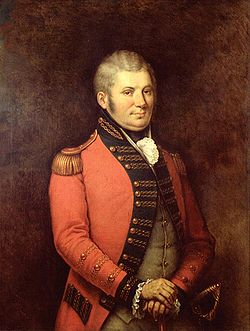
In 1775 John Graves Simcoe was a lieutenant in the 35th Regiment of Foot, which had been sent to Boston.

Simcoe would go on to a notable career in the Crown forces and then in the government of Canada, but he missed the Battle of Bunker Hill, as he described in a letter written before the end of June 1775:
On the 17th of this month, the first act of civil commotion commenced. The ship, I was in, was at sea; but, at a distance, we heard the sound of cannon, and, at midnight, saw two distinct columns of fire ascending. In this horrid state, well knowing we were the last of the fleet, ignorant whether Boston or some hostile town was in flames, were we kept for two days.

When we anchored, we saw Charles-Town burnt to ashes, and found our army had been engaged; that our troops were victorious, but that the victory was ruinous to our best soldiers, and particularly so to our officers, ninety-two of whom were killed and wounded.

The loss fell heavy on the flank companies of our regiment. [Edward] Drewe commanded the light infantry; exerting himself, at the head of that fine company, he received three shots through him, one in the shoulder, one in the bend of the thigh, the other through his foot. He also received two contusions, and his shoulder was dislocated. [Hugh] Massey is shot through the thigh, but says it is as well to be merry as sad. Poor [William] Bard was the third officer of the company. He was killed, speaking to Drewe. His dying words were, “I wish success to the 35th; only say I behaved as became a soldier.”

The sergeants and corporals of this heroic company were wounded, when the eldest soldier led the remaining five, in pursuit of the routed rebels. The grenadiers equalled their brethren, and, I fear, were as unfortunate. The brave and noble spirited Captain [James] Lyon, is dangerously wounded; and, to aggravate the misfortune, his wife, now with child, a most amiable woman, is attending on him. Both his Lieutenants were wounded.

The loss we have sustained, in the most warm and desperate action America ever knew, draws tears from every eye interested for brave and unfortunate spirits. Had I time to enumerate to you the many instances which the soldiers of our companies, alone, afforded the most generous exertions of love, fidelity, and veneration for their officers, and of the glowing, yet temperate resolutions of these officers, your tears would be those of triumph, and you would confess that in war alone human nature is capable of the most godlike exertions. I think you will believe me abstracted from friendship, when I say, that I never heard of more courage and coolness than Drewe displayed on that day; and his spirits are, even now, superior to any thing you can conceive.
That extract was published in 1782. As we might guess, it was brought to the public’s attention by Edward Drewe, whom Simcoe had such high praise for.

Tuesday, May 29, 2018

Meeting “Capt. Yoking”

Here’s more from the diary of the Rev. David Avery, who as chaplain accompanied a regiment to Chelsea in the wake of the fight over Hog and Noddle’s Island.

This is Avery’s entry from 29 May 1775 as the provincial forces finished salvaging useful material from H.M.S. Diana, which had run aground during the fighting.
29. Monday. Lodged last night in a comfortable bed. Went down to the Ferry, much treasure was got out to-day. Two large anchors & one Kedge & several large square pig iron as ballast, with several articles of consequence & a barrel of pork. 
When this diary was published in the D.A.R.’s American Monthly Magazine in 1900, the word I typed as “Kedge” (a sort of small anchor) was transcribed as “Kelly.” I haven’t seen the original document to confirm my guess.

Avery’s entry continued:
About noon Capt. Yoking, a Stockbridge Indian & I reconnoitered the Ground East of the schooner & judged that the taking off the cattle was practicable. The Capt. with 3 men took a canoe & went about a mile & a quarter upon the north side of the river from the Ferry & went across to Noddle’s Island & reconnoitered & scouted round about an hour & a quarter, when he fixed his centuries & another canoe went over to his assistance & soon took 2 horses & mired a 3d when a cannon ball fell pretty near them & four barges landed upon which all the scout retreated to the main shore & came over.

Upon that I advised that they should go back & get the stock. Accordingly they got off the Stock about sunset.

Stood upon guard two hours near Winnisimmit Ferry. Prayed with company.
The reference to “Capt. Yoking, a Stockbridge Indian” is very interesting.

Massachusetts Soldiers and Sailors of the Revolutionary War notes one state record of a captain named Jehoiakim Youkin in Col. John Paterson’s regiment. The same name also shows up on the records of Gen. George Washington’s headquarters. In August 1775 the general’s military secretary, Joseph Reed, paid Jehoiakim Youkin for digging necessaries—though perhaps he was collecting money for other men.

According to Patrick Frazier’s The Mohicans of Stockbridge, Jehoiakim Yokun or Yokum was a Mahican leader and landowner in western Massachusetts in the mid-1700s. Sites in the region still bear the Yokun name.

When the war began, Jehoiakim’s son Timothy Yokun became the first sergeant in Capt. William Goodrich’s company of Stockbridge Indians within Col. Paterson’s regiment. These soldiers were part of the Massachusetts forces and yet set apart in their style of living and fighting. Most company records don’t list Jehoiakim Yokun’s name at all. But evidently he was in command alongside Goodrich, perhaps particularly in combat. Less than two months into the war, Avery was calling him “Captain.”

One historian appears to have conflated father and son, saying Timothy gained the rank of captain during the war. Yet other authors list Timothy Yokun among the Stockbridge soldiers killed by Lt. Col. John Graves Simcoe’s rangers near Yonkers, New York, in August 1778. Diaries of the Sullivan expedition, the postwar diaries of the Rev. Samson Occom, the pension application of David Freemoyer, and an early history of the town of Stockbridge all refer to a “Captain Yoke or Yokun” active later in the war and returning to Stockbridge afterwards. That was most likely Jehoiakim.

Another source tells us the name of one of the Stockbridge men who went out onto Noddle’s Island and brought back those two horses. As quoted here, he was Henries Vomhavi. The Provincial Congress granted him the smaller of those two horses as a reward.

Friday, May 16, 2014

John Graves Simcoe in Boston

John Graves Simcoe, the British army officer whose evil twin is a character in the Turn television series, arrived in Boston as a lieutenant soon after the Battle of Bunker Hill. Characteristically, he came with a bright idea.

Simcoe described that idea in his postwar memoir (writing modestly of himself in the third person):
His intimate connection with that most upright and zealous officer the late Admiral [Samuel] Graves, who commanded at Boston in the year 1775, and some services which he was pleased to entrust him with, brought him acquainted with many of the American loyalists: from them he soon learned the practicability of raising troops in the country whenever it should be opened to the King’s forces; and the propriety of such a measure appeared to be self-evident.

He therefore importuned Admiral Graves to ask of General [Thomas] Gage that he might enlist such negroes as were in Boston, and with them put himself under the direction of Sir James Wallace, who was then actively engaged at Rhode island, and to whom that colony had opposed negroes; adding to the Admiral, who seemed surprised at his request, “that he entertained no doubt he should soon exchange them for whites:” Gen. Gage, on the Admiral’s application, informed him that the negroes were not sufficiently numerous to be serviceable, and that he had other employment for those who were in Boston.
Simcoe came from a naval family and, as his middle name evidenced, he was godson to Adm. Graves. The young lieutenant expected that gentleman to be his mentor and sponsor in the British military hierarchy in North America. Simcoe probably didn’t realize that Gage and Graves were already feuding, and any ideas that the admiral sent to the general were probably dead on arrival.

Since Simcoe recalled a response from Gage, that conversation must have taken place before the general sailed for England on 11 Oct 1775. That was weeks before Lord Dunmore, governor of Virginia, issued his proclamation promising freedom to slaves who joined his royal forces in that colony.

However, Lt. Simcoe wasn’t the first to raise that idea. American Whigs had been warning (without much evidence) that the royal authorities might instigate a slave uprising for years. As it turned out, both sides in the war freed and armed the slaves of adherents of the other side while maintaining slavery for masters on their own side.

The only thing Simcoe seems to have accomplished in Boston was buying a captaincy and thus advancing one rank in the army before the New York campaign.

Saturday, May 10, 2014

Historical Diaries Panel at Plymouth, 13 May

On Tuesday, 13 May, I’ll be at the Plymouth Public Library as part of a panel discussion on using diaries in historical research. This event will run from 7:00 to 8:30 P.M. in the Otto Fehlow Meeting Room, and is free and open to the public.

The other panelists will be Michelle Marchetti Coughlin, author of One Colonial Woman’s World: The Life and Writings of Mehetabel Chandler Coit, and Ondine Le Blanc, Director of Publications at the Massachusetts Historical Society and thus one of the people behind the publication of Ellen Coolidge’s travel diary.

I’ll describe my work on boys’ diaries in the Revolutionary period, including those of John Quincy Adams, Peter Thacher, and Quincy Thaxter. I also plan to share secrets from the diary of John Rowe.

Donna Curtin, Executive Director of the Plymouth Antiquarian Society, will moderate the discussion and question session to follow.

As long as I’m talking a bit about me, here are links to a couple of articles that appeared on the web last week: