J. L. BELL is a Massachusetts writer who specializes in (among other things) the start of the American Revolution in and around Boston. He is particularly interested in the experiences of children in 1765-75. He has published scholarly papers and popular articles for both children and adults. He was consultant for an episode of History Detectives, and contributed to a display at Minute Man National Historic Park.

Subscribe thru Follow.it


•••••••••••••••••


Showing posts with label Weston. Show all posts

Friday, November 15, 2024

“There is one very bad place in this five miles”

A few days back, I linked again to a hand-drawn map at the Library of Congress that appears to be the work of Ens. Henry DeBerniere. The locations on that map match DeBerniere’s first spying trip to the west with Capt. William Brown in February 1775.

Gen. Thomas Gage had those two British officers make a second foray into the countryside starting on 20 March, this time to look for cannon and other military supplies in Concord.

We know the two officers went out to Concord on roads that appear on this map, as shown in the detail above. DeBerniere wrote:
We went through Roxbury and Brookline, and came into the main road between the thirteen and fourteen mile-stones in the township of Weston; we went through part of the pass at the eleven mile-stone, took the Concord road, which is seven miles from the main road.
But Brown and DeBerniere came back by a different route:
Mr. [Daniel] Bliss…told us he could shew us another road, called the Lexington road. We set out and crossed the bridge in the town, and of consequence left the town on the contrary side of the river to what we entered it. The road continued very open and good for six miles, the next five a little inclosed, (there is one very bad place in this five miles) the road good to Lexington.

You then come to Menotomy, the road still good; a pond or lake at Menotomy. You then leave Cambridge on your right, and fall into the main road a little below Cambridge, and so to Charlestown; the road is very good almost all the way.
That “Lexington road” doesn’t appear on the hand-drawn map. It’s possible that DeBerniere produced another map to show it. That would have been useful since that’s the road that Lt. Col. Francis Smith followed to Concord on 18–19 April and then withdrew along.

Donald L. Hafner of Boston College drew my attention to that omission when he left this comment to my recent posting:
It is unfortunate that the surviving map attributed to Ensign DeBerniere does not include the alternate route through Lexington and Menotomy that he and Capt William Brown took on their return to Boston, because it leaves a puzzle about where on that route was the "one very bad place" that DeBerniere describes in his written report to Gage. DeBerniere's sentence is a bit garbled, but he is referring to some location between Lexington and Menotomy center. A good guess would be those locations where the main road is hemmed in to the south by sharply-rising hills, and on the north by wetlands and the Mill Brook. A good candidate would be near the current Lexington/Arlington border. But that is just a guess. Are there better candidates that a soldier would describe as "one very bad place"?
DeBerniere wasn’t clear about where in Concord he started estimating distances, but it is about six miles from the center of Concord to Lexington common, and about five from Lexington common to the modern Arlington town hall. So that does suggest somewhere in the second stretch the officers judged the road “good” but “a little inclosed” with “one very bad place.” The area between Liberty Heights and the Mill Brook in east Lexington indeed seems to be the best candidate—about where Wicked Bagel sits, in fact.

Notably, Smith’s column had its worst experiences before reaching Lexington center at places like Merriam’s Corner, Elm Brook Hill, and the “Parker’s Revenge” site—other spots where the road turned and/or narrowed, but not so much as to make DeBerniere worry.

Monday, June 19, 2023

“I should not have chose this town for an Asylum”

On 17 June 1775, as I quoted yesterday, John Adams complained that five friends from Massachusetts hadn’t sent him any letters with news about the province since he’d left for the Second Continental Congress.

I decided to look into what those men did in the previous two months.

The Rev. Dr. Samuel Cooper had fled from Boston on 9 April, halfway through Sunday services, wary that Gen. Thomas Gage might order his arrest. He settled in with Samuel P. Savage in Weston. By the end of the month Cooper had his wife, daughter, and clothing with him, but not his library or all his letters.

In early May, Cooper arranged to stand in as the minister in Groton. Or rather, since that town was far away and he liked being near the seat of Patriot power, he made deals with other ministers to go out and preach in Groton while he preached in their churches close by. For a while, at least, he could coast on his celebrity as Boston’s most silver-tongued minister and recycle his old sermons.

Prof. John Winthrop of Harvard College lived in Cambridge. As the king’s troops marched through town on 18–19 April, he and his wife Hannah fled for safety, first to the Fresh Pond area, then further the next day, fearing the redcoats would return.

Later Hannah Winthrop wrote to her friend Mercy Warren:
Thus with precipitancy were we driven to the town of Andover, following some of our acquaintance, five of us to be conveyd with one poor tired horse & Chaise. . . .

I should not have chose this town for an Asylum, being but 20 miles from Seaports where men of war & their Pirates are Stationed, but in being fixd here I see it is not in man to direct his steps. As you kindly enquire after our Situation, I must tell you it is Rural & romantically pleasing.
Back in Cambridge, militia companies arrived en masse, taking over the college buildings and larger mansions. Most of the townspeople left.

By mid-June, however, the Winthrops were back home, though only temporarily. The professor helped to pack up the Harvard College library and scientific equipment. College classes resumed in Concord in October, and the Winthrops settled there for the rest of the school year.

Adams’s list started with three lawyers, all from Boston. All also had ties of family or friendship to Loyalists, and that complicated their choices as the war broke out.

Benjamin Kent at some point got a pass out of Boston and, according to his profile in Sibley’s Harvard Graduates, stayed with various friends in the countryside through the siege. Though he remained in the U.S. of A. through the war, in the mid-1780s he moved to Canada to spend his last years with his children.

William Tudor was just starting his legal career. He was also courting Delia Jarvis, a young lady from a Loyalist family. According to a family memoir, after the fighting started, Tudor tried to wrangle passes for himself, her, and her family from the Adm. Samuel Graves’s secretary, but that effort was fruitless.

On 12 May, Tudor “broke from Boston by the roundabout way of Point Sherly” in Chelsea (now Winthrop), leaving Delia and her family behind. He sought a position in the Patriot service. With John Adams championing him, Tudor became the Continental Army’s judge advocate general in the summer of 1775.

TOMORROW: The legend of Samuel Swift.

Sunday, September 11, 2022

“General Gage’s Spies” via the Golden Ball Tavern, 15 Sept.

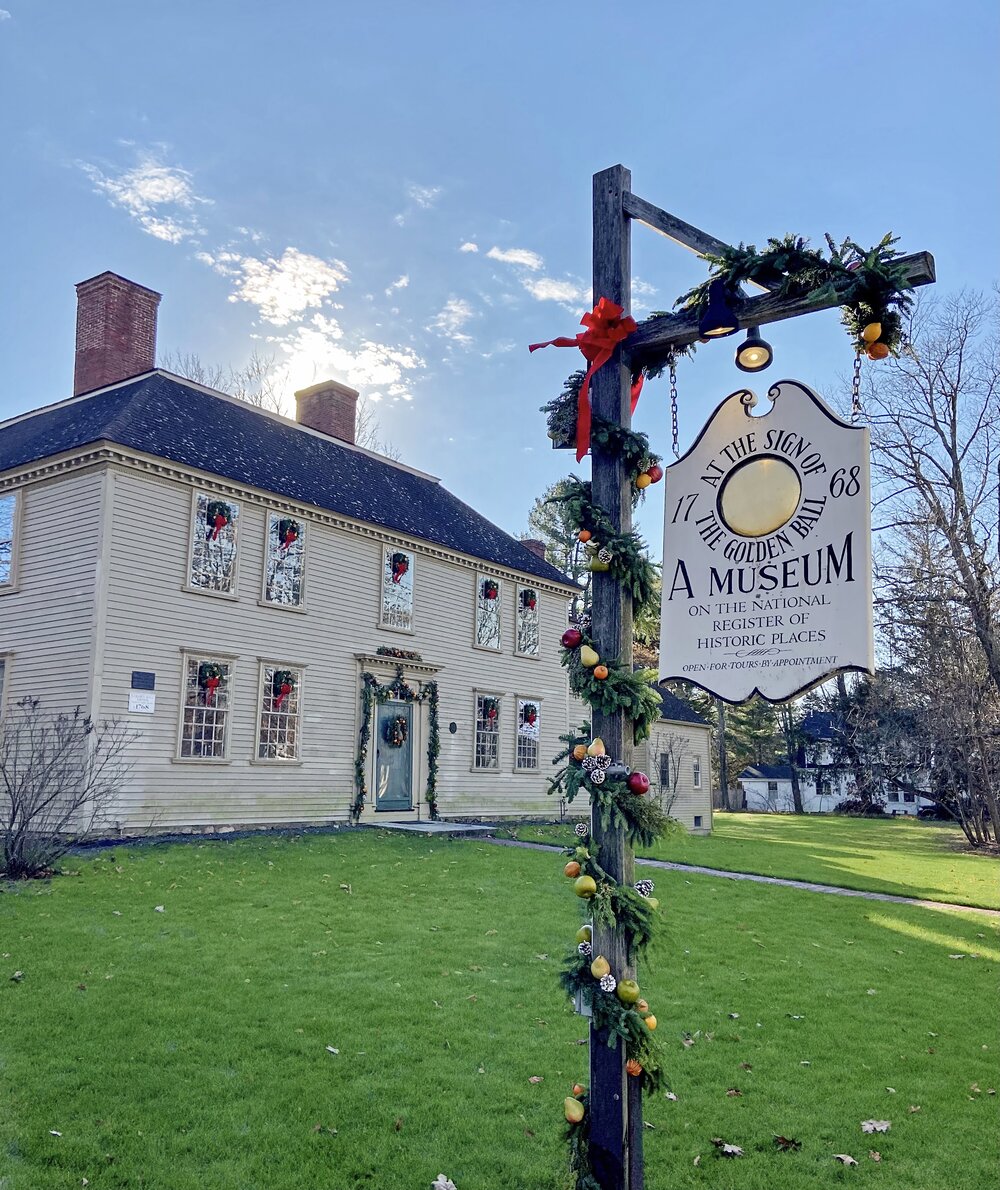
On Thursday, 15 September, I’ll deliver an online lecture for the Golden Ball Tavern Museum in Weston.

The talk will be titled “General Gage’s Spies,” and here’s our event description:
On February 23, 1775, three men arrived at Isaac Jones’s tavern in Weston, saying they were surveyors from Boston. They were actually two officers and a private from the king’s army. The royal governor, General Thomas Gage, had assigned them to find cannons and other military supplies that the rebel Massachusetts government was collecting outside of Boston. Drawn from new research, this talk discusses who those men were, the crucial role they played in the Battle of Lexington and Concord, and what happened to them after the Revolutionary War.
The spies’ visit to Jones’s Golden Ball Tavern is fairly well known. In The Road to Concord I showed how their mission fit into Gen. Gage’s larger strategy to locate and neutralize the artillery that rural Patriots were hiding. Since then I’ve gathered some more information about the two army officers, which will be part of this talk.

Yet another new wrinkle is that even as those spies were staying at the Golden Ball on their way to Worcester, people elsewhere in Weston were preparing two cannon for battle. Braddyll Smith, recently chosen to be both Weston’s representative to the Massachusetts Provincial Congress and colonel of the local militia regiment, knew about that effort and was probably in charge.

Smith’s predecessor in those posts was Elisha Jones, a Loyalist who had left for Boston around the turn of the year. Presumably Smith and his Patriot neighbors made sure that Elisha’s cousin Isaac, proprietor at the Golden Ball, never heard about their two cannon. After all, you didn’t know who might come through town.

My talk is scheduled to start at 6:00 P.M. Here’s the link to register. This event is free, thanks to support from the Weston Cultural Council, and folks can also join or donate to the Golden Ball Tavern Museum to support and learn about more such events.

Tuesday, November 09, 2021

Sorting Out Samuel Hobbs

This morning folks from the Boston Tea Party Ships & Museum have arranged a ceremony in Sturbridge to mark the grave of Samuel Hobbs, remembered as a participant in the Boston Tea Party.

The announcement I received from the museum says, “Samuel Hobbs was born in 1750 in Sturbridge,” and I think that’s an error, but there’s a lot of slightly conflicting information about this man.

When Hobbs died in May 1823, the Independent Chronicle and Boston Patriot newspaper ran this death notice:
In Sturbridge, 10th inst. Mr. Samuel Hobbs, aged 70—a valuable citizen.
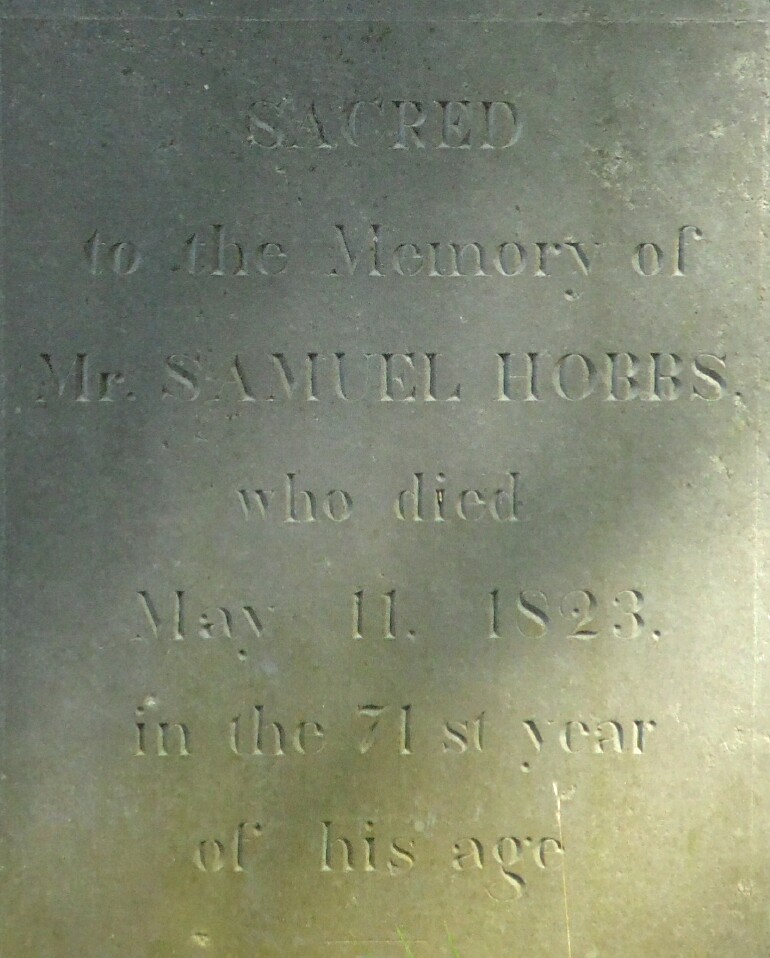
The vital records of Sturbridge contain multiple entries, saying Hobbs died on 11 or 12 May in his 71st year or at age 71. His gravestone says he died “May 11, 1823 / in the 71st year / of his age,” so I’m sticking with that.

There’s no mention of this Samuel Hobbs’s birth in the Sturbridge records. Nor in the published vital records of Lincoln, which I checked because Samuel F. Drake’s Tea Leaves stated that Hobbs was born in that town in 1750.

But Hobbs’s reported age at death matches an entry in the vital records of Weston, saying that Ebenezer and Eunice Hobbs had a son named Samuel born on 3 July 1752 and baptized on 12 July. Furthermore, George Davis’s A Historical Sketch of Sturbridge and Stockbridge, published in 1856, stated, “Mr. Hobbs was a native of Weston.”

The printed vital records of Weston also say this Samuel died in 1756, which would make authors wary of saying he survived to the Tea Party and beyond. But that entry has been corrected in the American Ancestors database to say that a sister Susanna died and Samuel survived.

The Rev. Samuel Woodward of Weston married Samuel Hobbs to Lucy Munroe of Lexington in November 1774. In October 1776 they had a son named Cyrus in Sturbridge.

Massachusetts Soldiers and Sailors of the Revolutionary War doesn’t list this Samuel Hobbs as serving in the army in the intervening months or later. His older brother Isaac, born in 1735, led Weston’s militia company later in the war, and his older brother Matthew served several years in the Continentals.

Samuel Hobbs prospered in Sturbridge, building a large house that lasted well into the twentieth century. He served in town offices. As the death notice above says, he was considered “a valuable citizen.” However, that notice didn’t say anything about the destruction of the tea.

In 1855 the New England Historical and Genealogical Register published a genealogy of the Hobbs family. The compiler, George Hobbs of Maine, wasn’t sure about Samuel’s birthdate (“1750 or 52”), but he stated:
He was a farmer, but the business of a tanner and currier he also followed with some success. He was an ardent patriot, and, in 1773, while a journeyman in the employ of Simeon Pratt, of Roxbury, joined the famous party, who, in disguise, threw overboard the tea in Boston. He used to say that the whole chests of bohea, weighing 360 lbs., were rather heavy to lift. He settled in Sturbridge, where his four sons remained. He was a most excellent man, and ever held an elevated position in society. He died in May 1823, aged 72 years.
Again, Hobbs was seventy years old when he died.

That published genealogy was enough for Samuel Hobbs’s Tea Party connection to be mentioned by local historians like George Davis. Francis S. Drake listed him among the participants in the Tea Party “derived principally from family tradition.”

Sunday, May 30, 2021

The Service of Pvt. Amos Harrington

Earlier this month I wrote about Lt. Col. Abijah Brown, and how a Continental Army court-martial in October 1775 found him guilty of “employing Harrington for fourteen days, and Clarke for eighteen days, out of Camp, upon his own business.”

In other words, while those two enlisted men were supposed to be on the siege lines with the rest of Col. Benjamin Ruggles Woodbridge’s regiment, Brown actually had them working on his farm in Waltham.

It was a pleasant surprise to be able to identify one of those men from army records. He was Pvt. Amos Harrington of Waltham. That’s the only man named Harrington in the Woodbridge regiment, and of course his home town matches Lt. Col. Brown’s.

Amos Harrington was born in Waltham on 18 Nov 1755, making him almost twenty years old when he became a legal matter.

On 19 April, he marched with Capt. Abraham Peirce’s Waltham militia company. The alarm reached Waltham late, so its men didn’t engage with the British troops that day, but on orders from regimental colonel Thomas Gardner they “served as guards until Saturday, the fourth day after the fight at Concord.”

As of 30 Sept 1775, Amos Harrington was listed in Capt. Seth Murray’s company in Col. Woodbridge’s regiment, assigned to Prospect Hill. Whether he was actually there or not during the harvest season was another question.

Harrington appears to have gone home at the end of the year, but then he mobilized with his local company from 4 to 8 March 1776. At Gen. George Washington’s request, Massachusetts called up militia troops to support the push onto Dorchester Heights and reinforce the lines against possible counterattack.

On 10 Oct 1779 Amos Harrington married his cousin Esther, and their first son arrived less than six months later. According to Frederick Lewis Weis’s Harrington genealogy quoted at this Find a Grave page, they had ten children in all, three dying in infancy. Esther died in October 1794, several months after giving birth to her last daughter, who survived her.

After that, I lose track of Pvt. Amos Harrington. He never applied for a Revolutionary War pension, suggesting that he died before the law made those available for nearly all veterans.

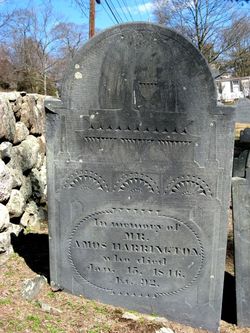
Weis’s genealogy says Harrington died in Weston on 15 Jan 1846. However, Weston vital records make clear that was another man of the same name, born in that town in 1754 and still “single” when he died. He was called up for militia service under Capt. Jonathan Fisk in August 1777, as Gen. John Burgoyne was coming down from Canada. I put his gravestone above.

I’d been hoping the Amos Harrington from Waltham did indeed live into the Polk administration, apply for a pension, and leave some comment about his service under (and work for) Lt. Col. Brown in 1775. But no such luck.

Monday, April 26, 2021

The Lost DeBerniere Manuscripts

On 30 June 1775, Ens. Henry DeBerniere was promoted to the rank of lieutenant in the 10th Regiment of Foot.

Nine months later, on 17 March 1776, he evacuated Boston with the rest of the British military.

That departure was rushed enough that Lt. DeBerniere left behind some of his papers, which locals eventually found. Exactly which locals remains a mystery.

In 1779 the printer John Gill issued a collection of those documents, described on the title page as “Left in town by a British Officer previous to the evacuation of it by the enemy, and now printed for the information and amusement of the curious.”

That title page (shown here) rendered the ensign’s name as “D’Bernicre.” Which is only one of the many ways it was spelled at the time.

The documents in that booklet were:
  • Gen. Thomas Gage’s orders to DeBerniere and Capt. William Brown to scout the countryside—thus giving the publication the title General Gage’s Instructions.
  • DeBerniere’s detailed and dramatic narrative of how he and Brown visited Worcester, Framingham, Marlborough, and Weston, barely making it back home in a snowstorm.
  • A much shorter report on the officers’ similar trek to Concord.
  • DeBerniere’s account of the expedition to Concord and the return to Boston under fire on 19 April.
  • A list of the casualties from that action, naming each killed or wounded officer but giving simple body counts for the enlisted men.
The Massachusetts Historical Society has shared scanned and transcribed pages here.

The year before Gill published, the Massachusetts General Court had passed laws banishing Loyalists and empowering the state to confiscate their property. Citizens who read DeBerniere’s narratives could easily recognize the Loyalists who offered them assistance. Most had left the country, but Isaac Jones of Weston was still at the Golden Ball Tavern. By then, though, he had apparently worked his way back into his neighbors’ graces.

The Massachusetts Historical Society reprinted the text of John Gill’s booklet in a volume of its Collections series in 1815, which is how it shared material before the internet.

That reprint was probably the source for another version of the story told in the voice of Brown and DeBerniere’s servant and published as The Journal Kept by Mr. John Howe While He Was Employed as a British Spy; Also, While He Was Engaged in the Smuggling Business by Luther Roby in 1827.

There was a young printer named John Howe working in Boston in 1775. A Sandemanian and partner of Margaret Draper in the last months of the Boston News-Letter, he evacuated Boston at the same time as Lt. DeBerniere. Eventually he settled in Nova Scotia, and his son became an important figure in early Canadian politics. So he wasn’t the “John Howe” narrating that “Journal.”

In fact, the “Journal” was just a hyped-up version of DeBerniere’s original report, using all the dramatic bits and adding to them, eventually reaching the point of implausibility. Nonetheless, extracts can seem credible, and many authors have been fooled into thinking that 1827 publication is an authentic historical source.

TOMORROW: Another DeBerniere manuscript, and another mystery.

Sunday, February 14, 2021

“Two peices of Cannon Brought From Watertown to ye Towns”

The 3 Feb 1775 petition to the Massachusetts Provincial Congress’s committee of safety about eight iron cannon can’t answer the question of what happened to those guns.

Did the congress assume control of them and add them to their other weapons? Or did they remain under the control of the four towns that had undertaken to equip them for use?

Or did the congress and the towns come to some sort of compromise, in which the towns continued to assume responsibility for those guns but expected the province to pay for the work eventually?

We don’t appear to have enough records from two of the four towns to provide definite answers. For Lexington, Alex Cain has written:
Unfortunately, what became of the guns after February 1775 is unknown. Lexington’s town meeting minutes from the Spring of 1775 were stolen years ago. Records from December 1775 through the remainder of the war do not mention the cannons.
The Weston town records show no payments related to cannon in 1775. In March 1776 the town treasurer’s account for the preceding year includes 12 shillings “Recd. of Capt. Samel. Baldwin for the Use of two Guns Belonging to the Town,” but that price suggests those were muskets, not artillery.

On the other hand, we know there were mounted cannon in Watertown on 30 March. On that day, Col. Percy led troops in a march that was part springtime exercise, part an attempt to get the provincials used to seeing redcoats come through their towns. Capt. John Barker wrote in his diary:
The 1st. Brigade marched into the Country at 6 oclock in the morning; it alarmed the people a good deal. Expresses were sent to every town near; at Watertown about 9 miles off, they got 2 pieces of Cannon to the Bridge and loaded ’em but nobody wou’d stay to fire them; at Cambridge they were so alarmed that they pulled up the Bridge.
Lt. Frederick Mackenzie noted that march, as well as another on 10 April: “The 38th. and 52ed. Regiments marched out this Morning as far as Watertown.” Later, just after the war began, he wrote: “The 38th & 52ed Regiments marched once to Watertown, which indeed occasioned some alarm, and Cannon were fired, bells rung, and expresses sent off, to give the alarm.” So not only did the Watertown militia company have two cannon, but its men could move, load, and fire those guns, and the British army knew about them.

As for Concord, we have the documentation from James Barrett of what ordnance and other material he was storing for the provincial congress. That included:
Two peices of Cannon Brought From Watertown to ye Towns
Eight Peices of Cannon Brought to ye Town by Mr Harrington
Four Peices of Brass Cannon & Two Mortar from Col Robertsons [sic—Lemuel Robinson]
Thus, when Barrett wrote this note, he controlled two iron cannon secured by William Molineux in 1774, sent out to Watertown, and then sent on to Concord for mounting. But he also had the Boston train’s four brass cannon, the two mortars that James Brewer claimed to have smuggled out of Boston, and eight more guns from some guy named Harrington (which is a whole other mystery for me). And in March more ordnance arrived from Salem.

No wonder James Warren wrote to his wife Mercy from Concord on 10 April: “This Town is full of Cannon…” A royal spy specified there were twelve cannon mounted around the Concord courthouse under twenty-four-hour guard, three 24-pounder siege guns in the courtyard of the prison, plus the brass field-pieces from Boston back at Barrett’s farm.

In mid-April, after warnings from Boston, Barrett and his family and neighbors began to move those artillery pieces even farther away. Four cannon reportedly went to the neighborhood of provincial congress receiver-general Henry Gardner in Stow. But four remained behind in Concord at the courthouse, according to Gen. Thomas Gage’s local informant. I suspect those were owned by the town, and it didn’t want to let them go.

I still don’t know who Gage’s spy was, but one candidate is Duncan Ingraham, the merchant captain who had retired to Concord a couple of years before. As described back here, his son had sold four iron cannon to Molineux in October 1774. Those comprised half of the artillery pieces that the 3 Feb 1775 petition discussed. In other words, there was a 50% chance that the pair of cannon assigned to Barrett had come from Ingraham. Had the captain spotted what he still considered his own property rolling through town?

Once again, my thanks to Joel Bohy of Bruneau & Co. and Antiques Roadshow for sharing the document from the Massachusetts archives that added new clues to this inquiry.

TOMORROW: The cannon that didn’t bark.

Friday, February 12, 2021

Four Representative Men

I’ve been analyzing a letter about cannon sent to the Massachusetts Provincial Congress’s committee of safety in February 1775.

This posting looks at the four men who signed that letter, in order of their signatures.

James Barrett (1710-1779) of Concord is already a big presence in The Road to Concord and on Boston 1775. He was a sixty-five-year-old farmer, patriarch, and community leader. In the fall of 1774, the town made Barrett a militia colonel and a representative to the Massachusetts Provincial Congress.

Secretly, Barrett oversaw the collection of provincial military supplies in Concord in the early months of 1775. This letter is one piece of evidence about that effort. Barrett’s lists of weapons, equipment, and food survive in the collection of the American Antiquarian Society. His farmhouse was the furthest target of the British march in April 1775, and that building is now part of Minute Man National Historical Park.

Jonas Stone (1710-1790) was born in Concord, grew up in Sudbury, and then established himself on land his father had purchased in Rutland. In 1751 Stone moved back east to Lexington, having inherited a family estate there. He soon married his second wife in that town.

Starting in 1755, Stone served in many Lexington offices, including treasurer, selectman, and assessor. In the 1770s he became the town’s representative to the Massachusetts General Court and Provincial Congress. Stone was also a deacon and member of the committee of correspondence.

The letter addresses Lexington’s work to prepare two iron cannon for use in 1775. Stone himself may not have been personally involved in that work but rather speaking for neighbors. He didn’t hold an officer’s rank in the militia and did only four days’ of duty himself in May 1775. But his son Jonas, Jr., was among the local militiamen on the town common on the morning of 19 April.

Braddyll Smith (1715-1780) was a long-time town official in Weston. He was clerk of the town militia company in the 1750s and captain by 1774, a selectman from 1758 to 1771, town clerk from 1758 to 1768, and treasurer from 1771 to 1773.

Smith was also a wealthy man. The town’s 1759 tax list, made in part by himself, said he owned more personal property and far more real estate than anyone else on the north side of town. Three men on the south side had larger fortunes, and Elisha Jones (the only “Esquire” on the list) owned more valuable land. In 1773 Smith also held title to two enslaved people, as many as anyone else in Weston; one was named Salem Middlesex, but this seems to have been a different man from the man who became Peter Salem of Framingham.

Smith had several children by his first wife, Mary Hagar, before she died. He remarried to Sarah White of Medford in 1763 and again to widow Ruth Flint of Lincoln in 1766—finding wives in the upper echelon of other towns.

In January 1774, as I mentioned yesterday, Braddyll Smith led a group that petitioned the town meeting to “To Chuse a Committe to take into Consideration the circumstances of our Publick affairs and to Corrospond with the NEIGHBOURING Towns and to Consider what is Best to be Done that our Injured Rights and Priviledges may be Restored and Secured”—i.e., to form a committee of correspondence and participate in Massachusetts’s political resistance. Under the influence of militia colonel and General Court representative Elisha Jones, the town rejected that idea.

But after the Boston Port Bill, Massachusetts Government Act, and other royal measures, local histories say that on 29 September Weston voted to form that committee and to send representatives to the first Massachusetts Provincial Congress. The voters replaced Jones as the town’s representative with none other than Braddyll Smith. Jones soon moved into Boston. By the end of the year Smith replaced Jones as militia colonel and was overseeing the town’s preparations for defense—including cannon.

Jonathan Brown (1724-1797) of Watertown was captain of the town’s military company at Lake George in 1758. When he returned, he began serving in town offices as clerk, treasurer, justice of the peace, and representative to the General Court starting in 1772.

In 1774 Brown as clerk kept the town records showing himself elected to the provincial congress. On 12 December, Watertown also chose him to be “Capt of the train”—the artillery company. That was a couple of weeks after the town had voted to equip two of the eight cannon brought out from Boston that fall.

During the war, Brown remained in town, working in civil posts. He kept busy recruiting soldiers, paying them for their service, and collecting supplies. He continued to represent Watertown in the Massachusetts legislature until 1786.

All four of these men were thus elders in their communities; the youngest was fifty years old. They were all farmers, not professionals and not college-educated, but well off. They had served in town offices for years, and now those civic responsibilities included representing their neighbors in an illegal legislature and preparing for war with the Crown.

TOMORROW: Who will pay for it all?

Thursday, February 11, 2021

Mounting Expenses for Four Towns

This posting continues the analysis of a 3 Feb 1775 letter that I started quoting yesterday, from men in four different towns to the Massachusetts Provincial Congress’s committee of safety.

Yesterday’s extract shows the letter was about eight cannon purchased by William Molineux in Boston in the fall of 1774. Somehow the Patriots got those guns out to Watertown. And then…
…and after Some time Information was given yt it was desired that Watertown & the Neighboring Towns would mount them & git them Ready for emediate Service which is now Nearly Compleated (Viz, two by Watertown, two by Concord two by Lexington, & two by Weston[)],…
The Patriots weren’t just spreading those cannon around to make them harder for the British army to confiscate them. They were also spreading around the heavy expense of mounting and equipping those guns so they could be used in battle.

Artillery pieces themselves were big metal tubes, with a wide hole at one end and a very narrow hole near the other. On board ships and in shore batteries and fortifications, they were mounted on heavy, solid, small-wheeled carriages, and most if not all of those had been left behind.

To become ”field-pieces” suitable for a moving army, those cannon needed to be mounted on large-wheeled carriages that were both strong and maneuverable. Gun crews also needed rammers, swabs, worms, and other tools for loading and maintaining those guns. To “git them Ready for emediate Service” would require the best work of wheelwrights, blacksmiths, carpenters, and other craftsmen.

On 17 October, the Watertown town meeting considered the challenge:
Then the Question was put whether the town will mount & Equip two pieces of Cannon now lodged in the Town at their own Charge and it past in the affeirmative.—

Then it was Voted to Choose three persons a Committe to git Said work don
The cost “to git Said work don” became an issue. The selectmen called another town meeting on 21 November to consider how “to Grant money to pay for the two Carriages to the two pieces of Cannon that were ordered to be procured at the Expence of the town.” The men of Watertown voted to allocate £20 for those carriages, and only £15 for their schools.

Concord followed a similar course, as its town records (transcript now online) show. On 15 October the selectmen called a meeting with the top item being: “To See if the Town will Mount the Cannon brout into this Town by the Committee of Correspondance, and also Provide ammunition for Said Cannon agreeable to the Request of Said Committee.”

That meeting took place on 24 October, and the townspeople agreed that “the Selectmen take the Care that the Cannon brought into this Town by the Committee of Correspondance be Mounted at the Expence of the Town and that there be provided one hundred pound weight of Cannon Ball 4 pound Each Ball, and two hundred weight of Grape Shot, and Seven half Barrels of powder.” How was Concord to pay for all that? From tax revenues collected by the town constables but not yet forwarded to the provincial treasurer, Harrison Gray.

Lexington held its vote early the next month, as Alexander Cain has recounted:
On November 3, 1774, the town selectmen relented and announced the issue would be addressed at the next town meeting. Specifically, “Upon a request of a numbre of Inhabitants to see if the Town will fetch two small pieces of cannon from Watertown, offered by said Town for the use of the Company in this Towne.”

A week later, the town approved the purchase of two guns. “Voted. . . to bring the two pieces of Cannon (mentioned in the warrant) from Watertown & mount them, at the at the Town charge.”

After approving the purchase of two cannons, in true Yankee fashion, the residents voted to create a committee to explore the cheapest methods of mounting of the guns on carriages and building of ammunition boxes. “That a Comtee of three persons go to Watertown & see what the cost of mounting sd pieces will be & whether the carriages cannot be made by work men in this town”
Lexington men didn’t go to Watertown and actually pick up those guns until after 28 November, though.

Weston’s published town records recorded only one meeting in all of 1774, on 13 January. With militia colonel Elisha Jones in the chair, the town voted “by a very great majority” to reject the idea of forming a committee of correspondence. And yet, by the end of the year, Jones had fled into Boston as a Loyalist and the man who had made that proposal was overseeing two cannon at the expense of the town.

TOMORROW: The signatories.

(The picture above shows the Watertown meetinghouse, site of town meetings.)

Monday, July 27, 2020

“As we intended to go to Mr. Barns’s”

On Sunday, 26 Feb 1775, Capt. William Brown, Ens. Henry DeBerniere, and their bodyservant were in Worcester. They were all soldiers in the British army, but undercover in civilian dress.

Because New England colonies had laws against traveling from town to town on the Sabbath except for emergencies, the two officers stayed in their inn all day. DeBerniere later reported that “we wrote and corrected our sketches” of the roads out from Boston to Worcester. When the sun set, they went out to the hill around town and sketched some more.

Worcester was one of the places that the Massachusetts Provincial Congress had started to gather cannon for its army. The officers had seen some of those guns in town. Their mission was to spot such weapons and collect information that Gen. Thomas Gage would need in planning a march to seize them.

That same day in Essex County, Lt. Col. Alexander Leslie led just such an expedition to capture other cannon being prepared for the congress in the north part of Salem. He couldn’t move fast enough and withdrew empty-handed.

News of that confrontation appears to have riled up the Patriots of Worcester. About eight o’clock some men came to the inn to ask about Brown and DeBerniere, eventually telling the landlord they knew his guests were “officers of the army.”

Brown and DeBerniere decided to leave the next day at dawn, buying some roast beef and brandy from their landlord for the journey. Traveling east on foot, they were overtaken by a horseman who looked at them narrowly before riding off along the Marlborough road. Later generations identified this man as Timothy Bigelow, a Marlborough native who had become a successful blacksmith and political activist in Worcester.

The officers chose to turn off to Framingham, where they got to see a militia company drill outside their tavern. The next day they moved on to Isaac Jones’s Golden Ball Tavern in Weston, where they had also stayed on their hike west (shown above). Brown and DeBerniere sent their sketches back to Boston with their servant. Then they decided that, since no one had bothered them for a couple of days, it was safe to keep scouting the roads.

A snowstorm kept the officers indoors until two in the afternoon, but finally they set out for Marlborough. It was snowing again as they arrived about three miles from the center of town. DeBerniere wrote:
a horseman overtook us and asked us from whence we came, we said from Weston, he asked if we lived there, we said no; he then asked us where we resided, and as we found there was no evading his questions, we told him we lived at Boston; he then asked us where we were going, we told him to Marlborough, to see a friend, (as we intended to go to Mr. Barns’s, a gentleman to whom we were recommended, and a friend to government;)
Henry Barnes may have made peace with his Marlborough neighbors in 1770, but he was still a Loyalist. The British command in Boston expected he would provide a safe house for these scouts. So, however, did his suspicious Patriot neighbors.

The rider eventually came out and asked Brown and DeBerniere if they “were in the army.” They said they weren’t, but “were a good deal alarmed at his asking.” After some more “rather impertinent questions,” the man rode on into town.

The officers guessed that horseman intended “to give them intelligence there of our coming.” Indeed, as the two men reached the more thickly settled village, “the people came out of their houses (tho’ it snowed and blew very hard) to look at us.”

A baker asked Brown were they were going (addressing the captain as “master” to butter him up). Brown dropped Barnes’s name. That doesn’t seem like very good spycraft, but the captain probably figured everyone was watching where they would go anyway.

TOMORROW: Inside Henry Barnes’s house.

Wednesday, April 24, 2019

Upcoming Events in Charlestown and Weston

Here are a couple of interesting Revolutionary history happenings in the next few days.

On Thursday, 25 April, the Bunker Hill Museum will host a talk by Salem Maritime National Historic Site historian Emily Murphy titled “‘I Am An Honest Woman’: Female Revolutionary Resistance.”

Dr. Murphy will describe how middling-class women in Boston, Salem, and other towns of eastern Massachusetts participated in the colony’s resistance in the years before 1775. Though restricted by law and society, colonial women still found ways to express their political convictions.

This talk is scheduled to start at 7:00 P.M. in the lower-floor meeting room of the museum, 43 Monument Square in Charlestown. It is free and open to the public.

On the afternoon of Sunday, 28 April, Brian Donahue, associate professor of American environmental studies at Brandeis, will lead a walking tour of Weston, exploring its eighteenth-century landscape.

Donahue, author of The Great Meadow: Farmers and the Land in Colonial Concord, has created G.I.S. maps detailing how Weston big man Isaac Jones assembled and used his farm. This tour will start at the Golden Ball Tavern with a short presentation showing how innkeeper Jones’s farm developed over several generations and was divided among heirs.

Participants will then walk for one to two hours south, crossing Route 20 and on trails and roads back to Chestnut Street and into Highland Forest—all part of the Jones farm—and then back by a slight variation. We will look at lanes and stone walls and talk about what various parcels were likely used for (meadow hay, tillage, orchard, pasture, woodland) along the way. (There will be a turning-off point for those who do not want to continue up into Highland Forest.)

To join in all or part of this walk through history, please send an R.S.V.P. to gbtmuseum@gmail.com and hope for a lovely spring day. The Golden Ball Tavern is at 662 Boston Post Road in Weston.

Thursday, March 21, 2019

Seeking Out a Statement by “Samuel Savage”

On 21 Mar 1760, Bostonians were assessing the damage from the great fire that had started in Mary Jackson’s shop the night before. So this is a good day to resume The Saga of the Brazen Head.

I’ll start a peek behind the scenes of tomorrow’s posting. I really wanted to find a first-person, close-up account of that fire. I’ve quoted newspaper reports, a broadside, a sermon, and diaries from men in other neighborhoods. But all those descriptions had a distanced quality, produced by either actual physical distance or their collective voice.

I spotted a couple of short quotations in Stephanie Schorow’s Boston on Fire: A History of Fires and Firefighting in Boston (2002) which gave me hope of tracking down more. Schorow’s notes pointed me to the books that she’d (inexactly) quoted from, including Carl Seaburg’s Boston Observed (1971).

And there the trail went dead. Boston Observed is a reader made up mostly of a lot of quotations about Boston from across the centuries, Seaburg noted the sources of those long quotations reasonably well—but not the shorter quotations in his introductory essays. And that’s where the sentences in question appeared.

Seaburg credited certain comments on the 1760 fire to a man he called “Samuel Savage.” He also wrote that the fire had started in “the Brazen Head tavern on King Street.” This whole series of postings started simply because I wanted to correct the misunderstanding (which goes back to a town publication in the late 1800s) that the Sign of the Brazen Head was a tavern rather than a hardware shop. Also, that shop was on Cornhill, not King Street. So I wasn’t completely confident about Seaburg’s quoting.

I made a self-educated guess that “Samuel Savage” was Samuel Phillips Savage (1718-1797, shown above), a Boston merchant and town official in the early 1760s who then moved out to Weston. He came back to chair some of the big public meetings in Old South during the tea crisis. Some of the letters Savage received from his old colleagues and neighbors are valuable sources about what was going on in the big town during the pre-Revolutionary turmoil.

The Massachusetts Historical Society holds Samuel Phillips Savage Papers. In fact, it holds four series of S. P. Savage Papers, apparently because descendants have donated those documents in batches. Unfortunately, the M.H.S. doesn’t have a finding aid for that collection, which would make it easier to look for a particular document, or at all documents from the spring of 1760. Instead, each series has its own chronological sequence.

M.H.S. reference librarian Anna Clutterbuck-Cook helped me understand those nuances of the S. P. Savage Paperses. She also suggested it was worth looking in the Catalogue of Manuscripts of the Massachusetts Historical Society, a nine-volume reference printed in 1969 (with a supplement in 1980). Since Seaburg wrote in 1970, I could probably ignore manuscripts acquired after then.

And that worked! One of the items listed in the printed manuscript catalog was S. P. Savage II’s 3 Apr 1760 “Letter to [unknown] about fire in Boston.” That told me which series of Savage Papers to request in the reading room.

(The manuscript catalogue described another letter in that series this way: “Letter to Mr. Joslyn about young Savage’s conduct,” dated 5 Feb 1756. So of course I made a note to look at that, too. Just a taste: “…it seems a little Strange if they are married, they should be ashamd or afraid to say by whom . . . you have the facts as to his Conduct with Bety Wyre and his Child, whose Care is peculiar and really calls for Pitty—I wish that young Creature may be the only One he has ruined—I should be glad if you would inform me, if Mary Sharrad (for Mary Savage I really believe is not her name), is brought to bed…” Savage conduct indeed.)

TOMORROW: Samuel Phillips Savage at the Great Boston Fire.

Thursday, March 22, 2018

Upcoming Talks in Bedford, Weston, and Burlington

As we continue to look forward to spring weather and the approach of Patriots Day, I’m giving multiple Road to Concord talks over the next few weeks.

Sunday, 25 March, 2:00 to 4:00 P.M.
“What the Bedford Minutemen Went to Guard in Concord”
Bedford Historical Society
Great Room, Old Town Hall, 16 South Road

On 18 Apr 1775, militiamen in Lexington spotted British officers passing through town on horseback. Locals quickly sent riders to Bedford, with the result that Bedford’s minute and militia companies were among the first to arrive at the North Bridge in Concord from neighboring towns. But why were all those communities on high alert in the spring of 1775?

This free event will start with refreshments, and I’ll speak at about 2:30. There will be book sales and signing after the talk.

Thursday, 29 March, 11:15 A.M. to 12:45 P.M.
“The Boston Revolution and the End of Tory Row”
Regis College Lifelong Learning, “Lunch, Listen & Learn” series
Fine Arts Center, Atrium, Regis College

On September 1, 1774, the Cambridge estates along the road to Watertown comprised a prosperous community, linked by bonds of family, religion, and politics. The following morning, thousands of rural militiamen crowded into town, demanding that royal officials resign. By the end of the month most of those families had moved out of their mansions, never to return. And inside Boston, Gov. Thomas Gage realized that he was witnessing a revolution.

This event is for members of Lifelong Learning at Regis College. I don’t think the public is allowed, but the organization might welcome new members.

Thursday, 5 April, 7:00 to 8:30 P.M.
“The Road to Concord: How Middlesex County Went to War”
Burlington Historical Society
Human Services Building, 61 Center Street, Burlington

Burlington was incorporated in 1799; before then, the area was part of Woburn. Like their neighbors, the farmers of that village were caught up in the “Powder Alarm” of 1774 and the Lexington Alarm of 1775. On the morning of 19 April, John Hancock and Samuel Adams found refuge in what’s now Burlington before moving on to Billerica. So what was all that fighting about?

Friday, January 08, 2016

Open House at the Golden Ball Tavern, 10 Jan.

On Sunday, 10 January, the Golden Ball Tavern in Weston will hold the first in a series of “Second Sunday” Open Houses running each month through June.

From 1:00 to 3:00 P.M. this Sunday, guides will lead tours of the site and answer questions about the museum. The event is “free, open to the public, and family-friendly!”

Capt. William Brown and Ens. Henry DeBerniere certainly found it friendly while they were scouting the countryside dressed as civilian surveyors for Gen. Thomas Gage in February 1774. Here’s part of their report:
we stopped at a tavern at the sign of the golden ball, with an intention to get a drink and so proceed; but upon our going in the landlord pleased us so much, as he was not inquisitive, that we resolved to lye there that night; so we ordered some fire to be made in the room we were in, and a little after to get us some coffee; he told us we might have what we pleased, either tea or coffee.

We immediately found out with whom we were, and were not a little pleased to find, on some conversation, that he was a friend to government; he told us that he had been very ill-used by them some time before; but that since he had shewed them that he was not to be bullied, they had left him pretty quiet.
The Golden Ball’s landlord at the time, Isaac Jones, had attracted the wrath of his neighbors by selling tea. And he was still doing it! His offer of tea or coffee alerted the British officers that he would be friendly to them. Of course, by partaking of his hospitality they marked themselves as suspicious outsiders.

Sunday, April 14, 2013

The Mystery of James Nichols, Reluctant Soldier

One of the most striking anecdotes of the confrontation at the North Bridge in Concord is the story of an Englishman who mustered with his local militia, but decided to go down to talk to the redcoats at the bridge. After that chat he took his gun and went home, not wanting to be part of the fight. However, only one witness recounted this story, and that seventy-five years after the battle. Back in the spring of 2001, D. Michael Ryan pondered the mystery for Concord Magazine, wondering if it was just a legend.

Richard C. Wiggin, author of
Embattled Farmers: Campaigns and Profiles of Revolutionary Soldiers from Lincoln, Massachusetts, 1775-1783, has found a longer trail for that Englishman, with a different ending from what the one witness recalled. I asked Rick to share that essay from the book here as a guest blogger.

In 1850, 75 years after the battle at Concord’s North Bridge, Lincoln’s Amos Baker recalled an interesting anecdote about one of the men present:

Before the fighting begun, when we were on the hill, James Nichols, of Lincoln, who was an Englishman, and a droll fellow, and a fine singer, said, “If any of you will hold my gun, I will go down and talk to them.”

Some of them held his gun, and he went down alone to the British soldiers at the bridge and talked to them some time. Then he came back and took his gun and said he was going home, and went off before the fighting. Afterwards he enlisted to go to Dorchester and there deserted to the British, and I never heard of him again.
The story has fascinated generations of history buffs. Amos Baker may never have “heard of him again,” but James Nichols did leave a small trail in the historical records through which we can piece together the rest of the story...and test the mental acuity of the 94-year-old Baker.

The record tells us that shortly after leaving Concord, Nichols enlisted in the provincial army besieging Boston, and he participated in the Battle of Bunker Hill. He served through that summer and fall, and into the following spring. He appears to have served through the fortification of Dorchester Heights—but without deserting to the British. Baker, too, served at Dorchester Heights, albeit in a different unit.

That summer (1776), Nichols appears to have left Lincoln, gone to Weston, then taken up residence in Acton, perhaps an itinerant worker moving from job to job. By wintertime, he was back in militia service at Dorchester—this time in the same unit as Baker, and they evidently renewed their friendship. During their three-month stint, Nichols was recruited into the Continental Army, and one January day Baker discovered his friend gone.

The Continental unit Nichols joined had a handful of other Lincoln men in it. They were marched northward in chase of the British army of General John Burgoyne, who was threatening to split the country along the Hudson River/Lake Champlain corridor. In September 1777, after eight months of Continental service, Nichols was reported as having deserted. He may have become disillusioned at the not-so-rosy life of a Continental soldier. Or gotten cold feet with the approach of what was certain to be a climactic battle. Or perhaps he simply succumbed to itinerant tendencies. The historical record does not reveal what was going on in his head. Two months later, he appears to have returned to militia service in Cambridge, guarding the British and German troops surrendered by General Burgoyne following the climactic battles at Saratoga.

Somewhere along the line, Amos Baker learned of the reported desertion by Nichols, probably from one of the Lincoln men serving in the same unit. Perhaps in the years that followed, he occasionally thought about the good times they had together—the singing, the humor, the storytelling. He recalled the incident at the bridge. He remembered last seeing his friend at Dorchester....

Seventy-plus years later, Baker was feted as the last known surviving participant of the fight at the Concord bridge. Old memories returned, a little worn with age. He was coaxed to write them down for posterity. And he left us with a wonderful snippet of the human side of the developing conflict. He got it almost right; he passes the acuity test. But even he did not know the rest of the story.

Thanks, Rick! The launch party for Embattled Farmers, published by the Lincoln Historical Society, is on Monday, 15 April (Patriot’s Day), at 5:00 P.M. in the Lincoln Public Library.

Thursday, May 19, 2011

Groton Seeks a New Minister

By April 1775, as described yesterday, the Patriot majority in Groton and their Loyalist minister, the Rev. Samuel Dana, were at a stalemate. Dana refused to call a meeting of the church members, where they could dismiss him. The congregation apparently felt they couldn’t call a meeting on their own authority, at least in part because Dana said he wouldn’t show up.

According to historian Caleb Butler, local tradition held that at some point, probably after war began at Lexington and Concord, “the inhabitants were so enraged, that they shot bullets into Mr. Dana’s house, to the great danger of his life and the lives of his family.” Nevertheless, the minister didn’t leave town and seek the protection of the British army in Boston.

Groton’s town leaders sought a replacement. On 5 May, the Rev. Dr. Samuel Cooper (shown here), a Patriot who had slipped out of Boston to Weston just before the war, received a visit from Dr. Oliver Prescott of Groton. The physician “propos’d my Supplying their Pulpit.”

Cooper was apparently reluctant, perhaps because Groton was far from the political action in Watertown and Cambridge. He suggested that his host, the Rev. Samuel Woodward, should handle the Groton job while he filled in for Woodward. But the Weston minister didn’t agree.

As I discussed back here, on Saturday, 13 May, Cooper heard that Concord’s minister, the Rev. William Emerson, “was to supply Groton,” so he promised to preach the next day at Concord, no doubt happy to escape the long trip. Instead, both men showed up at Concord’s meeting-house, and the Groton congregation was presumably left waiting.

On 21 May, Cooper wrote that he preached at Concord and “Mr. Emerson for me at Groton,” indicating that he felt some responsibility to serve that town. On Saturday, 27 May, he finally set out “in my Chaise for Groton,” stopping along the way at Acton, Littleton, and the house of a man named Rogers for coffee. The next day, Cooper wrote, he:
Pch’d all day at Groton; spoke with Mr. Dana after Service a.m. din’d at Dr. Prescot’s baptiz’d a child P. M. Slept and Horse kept at Dr. Prescot’s.
The Groton church record notes that Cooper did something else as well:
Rev. Dr. Cooper, of Boston, preached, and was desired by the deacons and some of the brethren of the church to appoint a church meeting, to be held at the public meeting-house on the next Monday.
Cooper issued that call for a meeting, breaking the stalemate. Between then and 18 October, he preached in Groton on six Sundays, and received £60 Old Tenor. The congregation might have thought that money well spent because they got to fix their Dana problem.

TOMORROW: Class conflict over dealing with Dana.

Saturday, April 09, 2011

Rev. Samuel Cooper’s View of the War Reconstructed

The Huntington Library in California reports that it has acquired and reunited parts of the Rev. Samuel Cooper’s diary recording the start of the Revolutionary War. The library’s blog says:

The first portion covers events through April 18, 1775. The Library’s previously acquired diary picks up the narrative on the following day. Cooper then returned to this fragment of the diary on May 6 to recap the events that had taken place since his leaving Boston, where “the Troubles” were increasing.

Among the fascinating entries is Cooper’s description of his encounter with “a Lad of about 16 in ye Neighborhood…ardent to join his Friends & Neighbors in going to meet ye British Forces who had unprovok’d fired upon the People at Lexington.” The boy was begging for “ye Loan of a Gun” and finally obtained “a small old & almost useless Piece…declaring He w’d soon obtain a better.” That he did: “soon after He shot a Br. Soldier—stript him of his Arms & Cartrach [Cartridge] Box.”

Visitors will be able to view the manuscript for themselves during the month of April, when it will be on view in the Treasures Case in the east foyer of the Library Exhibition Hall.
The “Neighborhood” that the ardent lad came from was probably Weston. Cooper had left Boston for that town in early April, apparently worried about being arrested as a Whig leader. He recorded the anecdote about the boy on 18 April.

The portion of Cooper’s diary starting 19 Apr 1775 was published in the American Historical Review in 1901. The part up to 18 April is mentioned in The Divine Politician, Charles W. Akers’s 1982 biography of Cooper, but to my knowledge hasn’t been published.

Friday, June 11, 2010

The Documented Life of Hezekiah Wyman

There really was a Hezekiah Wyman in Middlesex County on 19 Apr 1775. In fact, there were two, father and son.

The son was born in Woburn in 1747 and married in Weston in 1770. Daniel S. Lamson’s History of the Town of Weston (1913) lists this Hezekiah Wyman as marching with the Weston militia company on 19 April and serving seven days in all. But he was only twenty-eight years old, presumably far from having white hair. So we have to focus on his father.

At the start of this series of postings, what seems like so many weeks ago, I quoted David H. Fischer’s Paul Revere’s Ride: “On the morning of April 19, 1775, Hezekiah Wyman turned fifty-five.” I suspect that was a misreading of a sentence in Henry Smith Chapman’s History of Winchester (1936): “Hezekiah was fifty-five on the morning of the Lexington alarm.” Chapman meant only that Wyman was that age, not that he turned fifty-five on 19 April.

But Chapman’s math was wrong. The vital records of Woburn, published in 1890, say that Hezekiah Wyman was born on 5 Aug 1720. He was therefore fifty-four years old during the Battle of Lexington and Concord. Not “sixty years last November,” as “The White Horseman” says.

This Hezekiah Wyman was also living in the southern part of Woburn, which later became Winchester. But according to “The White Horseman,” he lived within sight of Lexington common: “the window of [his] house overlooked the ground where these murders were committed.”

Samuel Sewall’s History of Woburn (1868), one of the best nineteenth-century local histories of Middlesex villages and towns, has only one thing to say about this Hezekiah Wyman’s military service. As of 1777 he had been called up for service, but had either served or paid for a substitute. Sewall recorded no details about him on 19 Apr 1775, and his name doesn’t appear on the muster lists of Woburn’s companies that day.

Is there any detail that the real Hezekiah Wyman of Woburn shares with the hero of “The White Horseman”? Chris Hurley kindly sent me this quotation from Wyman’s will, which is docket #25880 in the Middlesex County Probate records:

I give unto my son Daniel my pair of red Oxen, my Stears coming two Years old, one red & two speckled Cows, & three Heifers one coming three, & two coming two years old, and my white mare
So Hezekiah Wyman really did have a white horse. He wrote that will shortly before dying in 1779.

TOMORROW: The literary life of Hezekiah Wyman.