J. L. BELL is a Massachusetts writer who specializes in (among other things) the start of the American Revolution in and around Boston. He is particularly interested in the experiences of children in 1765-75. He has published scholarly papers and popular articles for both children and adults. He was consultant for an episode of History Detectives, and contributed to a display at Minute Man National Historic Park.

Subscribe thru Follow.it


•••••••••••••••••


Showing posts with label William Smith. Show all posts

Sunday, March 16, 2025

“Phebe Oliphant (a Black woman)”

At the Eleven Names Project, Wayne William Tucker shared a long essay about the preferred names of the black woman who helped to raise Abigail Adams and was part of her household later in life.

As Abigail grew up and married, that woman was enslaved to her father, the Rev. William Smith, probably coming from the family of her mother, formerly Elizabeth Quincy. The Quincy and Smith families referred to her by her first name only: Phoebe.

After becoming free in 1783, Phoebe married a man whom Abigail referred to as “Mr. Abdee.” Seeking to treat her in the same way as white women, the Adams Papers editors therefore referred to her as Phoebe Abdee.

Following that lead, I’ve tagged her under the name Phoebe Abdee. So did Woody Holton in one of the few articles written about her.

Tucker has found a more complex story in local records, however, indicating that Phoebe did adopt her husbands’ surnames—but Abdee wasn’t one of them.

First, Tucker brings up the possibility that Phoebe married and had children while enslaved to the Smiths, based on mentions of other people in the accounts settling the minister’s estate in 1784. That’s just a possibility, though.

In 1777, the Rev. Mr. Smith read out an intention to marry for his “Phebe” and “Brester Sternzey of Boston.” There’s no confirmation this union went through. (Boston’s town records don’t mention this intention. They state that the Rev. Joseph Eckley married Bristol Stenser and Deborah Foster on 16 Dec 1784.)

In 1784, Phoebe married a man Abigail Adams identified as “Mr. Abdee whom you know.” His name appears in town records as Abdi and Abda, elsewhere as Abdy. Tucker connects this man to “Abde Deacon Savil’s negro man,” who had married a woman enslaved to a Braintree minister back in 1754. It appears that Abdee (however spelled) was his given name, and that after emancipation (if not before) he used Savil as his surname. This man died in the first week of 1798, according to Abigail’s sister Mary Cranch.

On 19 Sept 1799, Quincy vital records show a woman named Phebe Savil marrying William Olifant. A month later, John Adams mentioned that Phoebe had remarried. In 1800, Abigail referred to Phoebe’s husband as William for the first time.

Finally, on 7 Oct 1812, weeks after Abigail referred to Phoebe as “sick and dying,” the Quincy records state that “Phebe Oliphant (a Black woman”) died at age eighty-three.

As Tucker says, the coincidences of the dates strongly suggest that the Adamses were referring to Phebe Savil/Oliphant, the woman Abigail had known all her life, without using her surnames.

Thus, it appears that “Phoebe Abdee” went by:
  • Phebe as an enslaved woman, not by choice—her choice of surname, if any, unknown.
  • Phebe Savil from 1784 to 1799, after her husband Abdee.
  • Phebe Oliphant from 1799 to 1812, after her husband William.
This is a nice piece of research, supported by clips of the documents themselves, which helps to fill out a life we’ve known only through the Adams family.

Thursday, January 30, 2025

Lincoln’s Sestercentennial Series

The town of Lincoln is observing the Sestercentennial with a series of exhibits at the library and a series of events.

The January exhibit was about Lincoln’s vote to send delegates to the Massachusetts Provincial Congress 250 years ago this month. The February exhibit will be on the theme “Enslaved in the American Revolution.”

Here are the presentations and other events announced so far.

Thursday, 30 January, 7:00 P.M., online
Causes of the American Revolution
Dane Morrison

Increasing taxation created dissent in Massachusetts. In 1774, Great Britain issued more punitive measures to suppress dissent and restore order, such as the revocation of the Massachusetts Bay Colony Charter of 1691. Former Salem State Professor Dane Morrison will discuss Lincoln at the beginning of the Revolution, exploring why an inland agricultural village would feel threatened by the new royal and Parliamentary initiatives. Register here.

Sunday, 2 February, 12:30–4:00 P.M., in and around Bemis Hall
The Lincoln of 1775
Co-hosted by the Bemis Free Lecture Series, the Lincoln Historical Society, the Lincoln Minute Men, the Middlesex County 4-H Fife & Drum, and Lincoln250

What was life like for families 250 years ago in Lincoln? Talk with reenactors about the attire, the food, and the amusements of family life of the day. The event will include musket demonstrations and music. At 2:00 P.M., a dance party will begin with instruction for all who wish to join. Refreshments will be served.

Thursday, 27 February, 7:00 P.M., online
Entangled Lives, Black and White in Lincoln, Mass.
Don Hafner

In the 18th century, the town of Lincoln had dozens of Black residents, enslaved and free, who helped the town thrive. They plowed the fields, hoed the gardens, and harvested the food. They did the cooking, they did the laundry, they cared for the children, they tended the sick and the elderly. They worked the blacksmith shops and the sawmills, made the nails and cut the boards for Lincoln’s first meeting house and houses that still stand. More than a hundred white residents of Lincoln lived in a household with an enslaved person. Come hear what we know about their entangled lives with historian Don Hafner. Register here.

Saturday, 8 March, 2:00 P.M., at the library
Meet Abigail Adams
Sheryl Faye

Lincoln250 celebrates Women's History Month! All ages are invited to Sheryl Faye’s engaging portrayal of Abigail Adams, wife of second President John Adams and sister of Lincoln Minute Men captain William Smith. Ms. Faye will portray Abigail as an adult and a child as she navigates life in colonial New England and stands up for the rights of women during the turbulence of War for Independence. All ages welcome. No registration necessary.

Thursday, 13 March, 7:00 P.M., at the library
Women in the American Revolution
Audrey Stuck-Girard

While the experiences of individual women during the American War of Independence have been largely left out of the historical record, they were nonetheless active participants of the cultural shift known as the American Revolution. Rural Massachusetts women in 1775 managed household budgets and property while being legally barred from owning any of that property. As the primary influence and educators of young children, they instilled moral and cultural values and ethics to the first generation of independent Americans. And when many of the men in their lives were away serving or killed in the war, women endeavored (with varying levels of success) to fulfill both male and female roles in their absence. Register here.

Tuesday, April 04, 2023

The Patriots’ Day 2023 Season at Minute Man Park

The Patriots’ Day 2023 season starts this upcoming weekend, well before Patriots’ Day (17 April this year), much less the actual anniversary of the Battle of Lexington and Concord on 19 April.

The Friends of Minute Man Park has a good rundown of events planned in and around that national park, all of them free. Check the park’s own site for updates. Here are some highlights.

Saturday, 8 April, 11:00 A.M. to 2:00 P.M.
Meriam Open House
Nathan Meriam House, 24 Old Bedford Road, Concord
Parking is available at the Meriam’s Corner Lot at 751 Lexington Road in Concord.

Saturday, 8 April, 1:00 to 2:00 P.M.
Meriam’s Corner Exercise
Meriam’s Corner, 24 Old Bedford Road, Concord

Saturday, 8 April, 3:00 to 4:00 P.M.
Paul Revere Capture Ceremony
Paul Revere Capture Site, 180 North Great Road, Lincoln
Additional parking at the Minute Man Visitor Center at 210 North Great Road, Lincoln.

Saturday, 15 April, 9:30 to 11:45 A.M.
Hartwell Tavern and Smith Open House
North Great Road, Lincoln

If you had to leave your home in a hurry, uncertain of your return, what would you take with you? Learn about the locals who struggled to save their families and belongings from the path of war.

Saturday, 15 April, 11:15 to 11:45 A.M.
Trepidation, Fever and Rushing to Arms
Captain William Smith House, North Great Road, Lincoln

See alarm riders in action, militia marching to the scene of battle, and civilians preparing to leave home. The Ladies Association of Revolutionary America will tell the stories of the common people who experienced the horrors of war first-hand.

Saturday, 15 April, 12:45 P.M.
Battle Road Tactical Demonstration
Meet at the Minute Man Visitor Center, North Great Road, Lexington

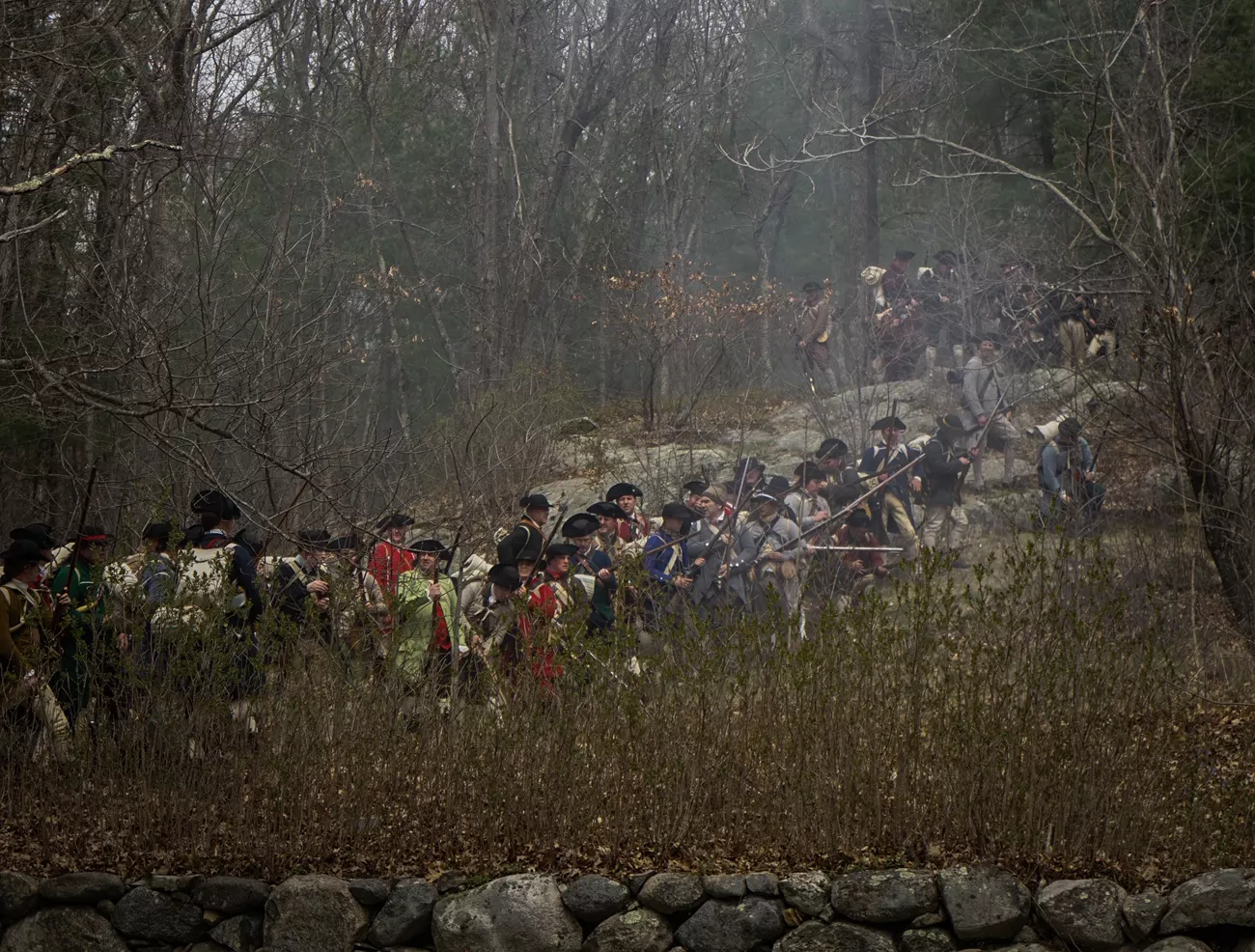
Watch hundreds of British and Colonial Reenactors engage in a battle demonstration showing the running fight that took place along this deadly stretch of road on the border of Lincoln and Lexington.

Parking is available in the Hartwell Tavern and Minute Man Visitor Center parking lots. There’s about a mile and a half between those sites, so people planning to attend this whole series of events should be ready to walk twice that distance.

Saturday, 15 April, 2:30 to 3:30 P.M.
Explore the Elm Brook Hill (Bloody Angle) Battle Site
Meet at Hartwell Tavern, 136 North Great Road, Lincoln

Edmund Foster, a militiaman from Reading, Massachusetts (portrayed by park volunteer Ed Hurley), will lead a tour to this key battle site where he fought on 19 April 1775, joined by Lincoln historian and author Don Hafner.

Sunday, 16 April, 1:30 to 4:30 P.M.
The Search of the Barrett Farm
Colonel James Barrett House, 448 Barrett’s Mill Road, Concord

Talk with costumed park rangers and volunteers about colonial military preparations. Around 3:30 P.M. British soldiers will arrive to search the property, as they did in 1775.

Monday, 17 April, 8:30 A.M.
North Bridge Fight Commemoration
North Bridge, Monument Street, Concord

This dramatic battle demonstration involving colonial minute men, British regulars, and musket fire marks what R. W. Emerson dubbed the “shot heard ’round the world.” The roads in Concord close at 8:30 A.M.

Tuesday, 18 April, 7:45 P.M.
Patriot Vigil
Lantern light procession from the North Bridge Visitor Center, 174 Liberty Street, Concord, to the North Bridge

As darkness descends upon the North Bridge battlefield, reflect on the events of 1775 and the meaning of liberty. This ceremony will feature a lantern-light procession, poetry, music, and a recitation of the names of the men who gave their lives on that “ever-memorable” 19th of April.

To participate in the procession, leave weapons at home and bring your own enclosed candle lantern–real candles only, no flashlights or LED lights.

Saturday, July 30, 2022

Two Captains and the “disagreeable necessity” of Money

In the eighteenth-century British army, officers were expected to pay their predecessors when they were promoted into a new rank.

Thus, a captain might retire while receiving £750 from an ambitious lieutenant, who in turn would receive £300 from an ensign, whose father would pay £200 to get him into the army in the first place.

Since the captain had paid his own predecessor, he thought receiving £750 was only fair. And this system promised officers some money for their retirement. Of course, it also limited the officers’ ranks to men with wealth—which that society saw as a Good Thing. No matter that some competent officers languished without promotions for years because they couldn’t scrape up the cash.

A similar system appears to have taken hold in the East India Company maritime service, even though the corporation didn’t like it. (Probably because it wasn’t receiving a cut of the money changing hands.)

At the British Library blog, curator Margaret Makepeace just highlighted the case of Capt. James Munro of the East India Company’s fleet. Munro had gone to sea in 1766 at the age of ten, serving under his uncle William Smith [yes, another one] on the Houghton. By 1778 he was second mate, and by 1782 he was sailing to China on the York.

Makepeace writes:
In 1782 James Monro succeeded his uncle William Smith as captain of the Houghton, making four voyages to China and India before resigning and passing the command to Robert Hudson in 1792. Captains were appointed by the ship owners and approved by the East India Company . . .

In April 1792, William Smith wrote to his nephew, addressing him as ‘Dear Jim’. Smith understood that Monro had sold the command of the Houghton for 8,000 guineas, having paid him £4,000 for it. Although Monro had not promised him anything, Smith thought he should receive half the profit. Smith claimed that he could have sold his command at a far higher price, perhaps as much as £7,000, but he had his nephew’s interest too much at heart to consider such offers. He regretted the ‘disagreeable necessity’ of speaking his mind.

James Monro’s reply began ‘My dear Sir’. He felt that he was being put in a very unpleasant position, and put forward his side as he would to someone not related.

Monro was away on board the York when it was decided that he should succeed as commander of the new Houghton which was being built to replace Smith’s ship. On his return to England he was told to pay Smith £4,000. He had no idea that any future demand would be made on him until a chance conversation with his uncle some time later.

Both the East India Company and the owners had been trying to lessen the price given for ships, or to prevent totally the sale of commands. If they had succeeded, would Smith have refunded part of his £4,000? Smith had not paid for his own command but had received interest on Monro’s £4,000 for ten years.

Monro had always thought to offer his uncle £1,000 when he sold the command. He would cheerfully give him 1,000 guineas and nothing more need be said.
I should note that 1,000 guineas was 5% more than £1,000—though still far less than half the difference between what Capt. Munro had paid his uncle Capt. Smith ten years before and what he had received from his successor.

Did the two captains work this out and maintain friendly family relations? See Makepeace’s article here.

Saturday, February 12, 2022

More Praise for the Doctor’s Glassy-Chord

Last month I wrote about Benjamin Franklin’s musical invention, the glassy-chord or, as he rebranded it in 1762, the armonica.

Franklin brought one of those glass instruments back home to Philadelphia in the early 1760s and showed it to friends. He was already famous for his lightning rod, and this looked like another product of American scientific genius.

Among the people who heard the instrument was Nathaniel Evans, who turned twenty-one in 1763. Son of a merchant, he was one of the first boys to attend the Academy of Philadelphia, which Franklin had helped to found in 1750. Evans then served an apprenticeship in a mercantile countinghouse.

On coming of age, Evans decided he preferred the life of the mind and convinced the College of Philadelphia (the higher level of the academy, also co-founded by Franklin) to treat him as a graduate student. After earning a master’s degree in 1765, Evans sailed for London to take holy orders in the Church of England.

Franklin was back working in the imperial capital by then, too. He was no doubt pleased to see the poem that Evans placed in the London Chronicle for 31 Aug–3 Sept 1765. Indeed, Dr. Franklin might have had a hand in that publication.

Evans’s poem was headed “To Benjamin Franklin, esq; ll.d. f.r.s. Occasioned by hearing him play on the Armonica. Written in Philadelphia, 1763”:
Long had we, lost in grateful wonder, view’d
Each gen’rous act thy patriot soul pursu’d;
Our little State resounds thy just applause,
And pleas’d from thee new fame and honour draws.

Envy is now, by merit overthrown,
Oblig’d in thee superior worth to own.
The Muse to sacred virtue ever bound,
Beams the bright ray her glorious sons around;
And sure in thee those virtues are combin’d,
That form the true pre-eminence of mind.

How were we fixt with rapture and surprize,
When first you told the wonders of the skies!
By simple laws deducing truths sublime,
Before, deep-bosom’d in the womb of time.

With admiration struck, we did survey
The lambent lightnings innocently play,
And the red thunder from th’ ethereal round
Burst the black clouds and harmless smite the ground,
As down thy Rod was seen the dreaded fire,
In a swift flame to vanish and expire:
Blest use of art! apply’d to serve mankind,
The noble province of the sapient mind!

This, this be wisdom’s, this the sage’s claim,
To trace the godhead thro’ this wondrous frame;
For this the soul’s grand faculties were giv’n,
To search the chain connecting man with heav’n.
But not alone those weightier thoughts controul
Thy comprehensive far-pervading soul;
The softer studies thy regard command,
And rise with fair refinement from thy hand.

Aided by thee, Urania’s heavenly art
With finer raptures charms th’ extatic heart;
Th’ Armonica shall join the sacred choir,
Fresh transports kindle, and new joys inspire.
Hark! the soft warblings, rolling smooth and clear,
Strike with celestial ravishment the ear,
Conveying inward, as they sweetly roll,
A tide of melting music to the soul.

And sure if aught of mortal-moving strain,
Can touch with joy the high angelic train,
’Tis such a pure transcendent sound divine
As breathes this heart-enchanting frame of thine.
Shall not the Muse her slender tribute pay?
Her’s is no venal, but the grateful lay;
Apollo bids it, where such virtues shine,
And pours a graceful sweetness thro’ each line;
Her country too, responsive to the sound,
Swells the full note, and tells it all around.
After being ordained, Nathaniel Evans returned to America. With the sponsorship of the Society for the Propagation of the Gospel, he became the Anglican minister in Haddonfield, New Jersey. But the young Rev. Mr. Evans died only two years later of tuberculosis.

In 1772, the head of the College of Philadelphia, the Rev. Dr. William Smith, published a collection of Evans’s poems. The young minister had bequeathed a manuscript to Smith and a young lady he’d met on his trip home who also wrote poetry. The published collection included this poem about Franklin’s armonica, but a version that conveys the same message in less than two-thirds the length.

Saturday, September 14, 2019

Minute Man Park Celebrates Its Sixtieth

Minute Man National Historical Park is celebrating the sixtieth year since its creation by act of Congress this month.

This weekend there are a couple of recurring programs.

Saturday, 14 September, 1:00-4:00 P.M.
In the News
What were local people talking about in 1775? Visit the William Smith House, talk politics with local residents of 1775, and discuss the potential impact of events.

Sunday, 15 September, 1:00-4:00 P.M.
The British Redcoat
Far from home, the British Redcoat of 1775 was faced with numerous challenges at home and abroad. Join Park Ranger Roger Fuller, dressed as a British Redcoat, at the Visitor Center to explore the experience of the British soldier of 1775.

Next weekend will be the big celebrations.

Friday, 20 September, 7:00-9:00 P.M.
Realizing the Vision
Lou Sideris, former Chief of Interpretation and Park Planner at Minute Man, will reflect the founding and ongoing development of Minute Man National Historical Park. Reception and refreshments to follow. At the Lexington Historical Society’s Depot Building, 13 Depot Square in central Lexington. This event is free, but space is limited, so please reserve seats by emailing mima_info@nps.gov.

Saturday, 21 September, 10:00 A.M.-2:00 P.M.
Threads of Resistance: Revolutionary Roles of Women
In 1769 colonial women protested British policies by making cloth in the home, reducing reliance on British imports. Experience the process and learn about the political impact of home manufacturing at the Jacob Whittemore House in Lexington.

Saturday, 21 September, 10:00 A.M.-4:00 P.M.
Historic Trades Day
At Hartwell Tavern in Lincoln, learn about various hands-on trades of the period and see skilled artisans at work.

Saturday, 21 September, 4:00-6:00 P.M.
Patriotic Music with the Concord Band
As 2019 marks the 60th anniversary of both the Minute Man National Park and the Concord Band, the park and the band have teamed up to present a concert of patriotic inspired music on the field overlooking the North Bridge. The public is invited to bring a blanket or lawn chairs and a picnic while enjoying the performance. The Friends of Minute Man National Park will present a special birthday cake to the park during the event and will provide free cupcakes while supplies last. As parking is limited, locals are invited to walk to the park. The rain location is 51 Walden Performing Arts Center in Concord.

Finally, on Monday, 23 September, work will begin on preserving the exterior of the North Bridge Visitor Center, also known as the Buttrick Mansion, located on the hillside overlooking the historic North Bridge. The building will be closed to visitors from November to April 2020. This federal contract covers the 1911 building’s roofing system, masonry, doors, windows, trim, portico, and loggia, with a new accessible ramp to be installed. Interior work will include repairing ceilings, restrooms, plumbing, electrical systems, and air conditioning. The building is scheduled to reopen in April 2020.

Thursday, August 30, 2018

“Through the Multitude, to the End of Murray’s Wharf”

On the night of 22 Apr 1774, New Yorkers emptied eighteen chests of tea belonging to Capt. James Chambers into the harbor while hundreds of people watched. This eventually became known as the New York Tea Party.

According to diarist William Smith, the crowd then carried the empty wooden chests to the Merchants Coffee House (shown here) and built a bonfire in the street. This blaze both celebrated the merchants’ unity and warned those gentlemen not to break the boycott as Chambers had.

The city’s activists had already summoned the public to the waterfront on Saturday morning to see off Benjamin Lockyer, captain of a ship carrying 698 chests of tea waiting outside the harbor near Sandy Hook. Again, that demonstration was supposed to both thank Lockyer for agreeing to sail that tea back to London and to make sure he understood how unwelcome it was.

On Saturday morning, the 25 April New-York Gazette reported, all the ships in the harbor flew the British flag, and “a large flag was hoisted on the Liberty Pole.” At 8:00 all the church bells rang. Then:
About 9, the greatest Number of People were collected at and near the Coffee-House, that was ever known in this City. At a Quarter past Nine the Committee came out of the Coffee-House with Captain Lockyer, upon which the Band of Musick attending, played, God save the King.

Immediately there was a Call for Captain Chambers,—where is he? where is he? Capt. Lockyer must not go till we find Capt. Chambers to send him with the Tea Ship.

This produced Marks of Fear in Capt. Lockyer, who imagining some Mischief was intended him; but upon Assurances being given him to the contrary, he appeared composed.

The Committee, with the Musick, conducted him through the Multitude, to the End of Murray’s Wharf, where he was put on board the Pilot Boat, and wished a safe Passage; upon which the Multitude gave loud Huzza’s, and many Guns were fired, expressive of their Joy at his Departure.
Lt. Gov. Cadwallader Colden added in a letter that Chambers “thought it was best to go off himself next Day with Captain Lockyer.”

For a while, some of Lockyer’s crew didn’t want to make that voyage. The Whigs’ committee of observation reported:
that the sailors of the Tea Ship, being unwilling to proceed with her to London, made a raft of spars and boards, in order to quit the ship with the tide of flood, but were observed by the Captain, and being aided by the Committee, who offered their assistance to him, they desisted from their project.
The merchants’ committee didn’t want ordinary sailors to get too independent, after all.

At 10:00 A.M. on Sunday the Nancy finally weighed anchor and headed back out to sea, still carrying the 698 chests of East India Company tea loaded the preceding fall. The committee’s sloop followed the ship for three leagues to be sure it was leaving and then turned back to New York.

TOMORROW: Fallout from the New York Tea Party.

Saturday, April 07, 2018

Patriots’ Day Season at Minute Man Park, 7-21 Apr.

The Patriots’ Day season is upon us, so I’ll focus for several days on details and commemorations of the Battle of Lexington and Concord and the start of the Revolutionary War.

Minute Man National Historical Park has a bunch of free events lined up, starting today. For additional information, check its website. In addition, there are commemorations and events not on park land but in nearby towns such as Lexington, Bedford, and Arlington; visit the Battle Road website for those.

Saturday, 7 April, 1:00 P.M. 
Meriam’s Corner Exercise
737 Lexington Road, Meriam’s Corner, Concord
The Town of Concord, joined by area minute companies, fife and drum units, and the Concord Independent Battery, pay remembrance to the fight at Meriam’s Corner that marked the beginning of the six-hour running battle back to Boston.

Saturday, 7 April, 3:00 P.M. 
Paul Revere Capture Ceremony
Paul Revere Capture Site, 200 North Great Road, Lincoln
The Lincoln Minute Men and the Town of Lincoln, joined by other reenactment units, observe the historic capture of Paul Revere with fife and drum music and a musket fire salute.

Saturday, 14 April, 7:00 A.M.
Tough Ruck and Captain Brown’s Company of Minute Men
Step off at The Old Manse field, adjacent to North Bridge, Concord
Minute Man National Historical Park is honored to once again host the “Tough Ruck,” military personnel marching in memory of our fallen soldiers. Support our soldiers and veterans in this 26.2-mile hike along the historic Battle Road Trail. The ruck will kick off with a musket volley from the North Bridge.

Saturday, 14 April, 9:30 A.M. to 5:30 P.M.
Life at Hartwell Tavern
136 North Great Road, Lincoln
Park staff, Lincoln Minute Men, and living history volunteers will be demonstrating various aspects of life in Massachusetts at the beginning of the American Revolution.

Saturday, 14 April, 10:00 A.M. to 12:00 noon and 2:00 to 5:00 P.M.
Visit Whittemore House 
Behind Minute Man Visitor Center, Rte. 2A, Lexington
Whittemore House will be staffed by costumed park volunteers demonstrating what life was like in 1775. Try on colonial children’s clothing, gather ingredients for a meal, and listen to stories of the Whittemore family and their experience of April 19, 1775.

Saturday, 14 April, 10:30 A.M.
Explore Bloody Angle with Edmund Foster
Hartwell Tavern, 136 North Great Road, Lincoln
Edmund Foster, a volunteer from Reading, Massachusetts (portrayed by Park Volunteer Ed Hurley), will lead a tour to this key battle site where he fought in 1775.

Saturday, 14 April, 11:30 A.M.
1st Michigan Colonial Fife and Drum Corps
Amphitheater, Minute Man Visitor Center, Rte. 2A, Lexington
Listen to military music of the American Revolution and get into the spirit of Patriots’ Day!

Saturday, 14 April, 9:30 A.M. to 12:15 P.M.
Caught in the Storm of War: Civilians of April 19th
Captain William Smith House, 136 North Great Road, Lincoln
What would you take with you if you had to leave your home in a hurry, uncertain of your return? Learn about the local civilians on April 19, 1775. Once the refugees leave the Smith house, you may encounter them along the Battle Road Trail heading towards Lexington and the Minute Man Visitor Center just prior the the Parker’s Revenge Battle Demonstration. The Smith house will remain open until 4:00 P.M.

Saturday, 14 April, 1:00 P.M.
Parker’s Revenge Battle Demonstration
Battle Road Trail behind Minute Man Visitor Center, Rte. 2A, Lexington
Hundreds of British and colonial reenactors will engage in a tactical weapons demonstration with musket firing and fast-paced battle action along a stretch of the actual Battle Road of 1775. This is one of this year’s major events, newly informed by archeological findings.

Sunday, 15 April, 1:00 to 4:00 P.M.
Warlike Preparations: British Soldiers Search the Barrett House
Colonel James Barrett House, 448 Barrett’s Mill Road, Concord
In 1775, Colonel James Barrett of Concord was responsible for safeguarding all the military supplies in town, and his house was searched by British soldiers during their mission to Concord. Visit the Barrett House and learn about the intense military preparations that helped launch America into the Revolutionary War. Around 3:00, redcoats will arrive and search the property for arms and supplies.

Sunday, 15 April, 2:00 P.M.
Revolutionary Dogs: “Paws for the Cause!”
Minute Man Visitor Center, Rte. 2A, Lexington
Join Park Ranger Roger Fuller for a walk on the Battle Road to explore the lives of dogs in colonial America and in the Revolution. The 45-minute walk starts at Minute Man Visitor Center and is open to all, including well-behaved, friendly dogs on leashes.

Monday, 16 April, 8:45 A.M. 
Commemoration of the North Bridge Fight and Concord Parade
North Bridge, Concord
British reenactors will be joined by the Acton Minutemen and other local companies for a special commemoration of the North Bridge Fight featuring musket volleys. The Concord Parade will arrive at North Bridge around 9:30 A.M. All of the roads in the center of town are closed to vehicles beginning at 8:30 A.M.

Wednesday, 18 April, 7:50 to 8:45 P.M.
The Patriot Vigil
North Bridge, Concord
As darkness descends upon the North Bridge battlefield, we invite you to come and reflect on the events of April 19, 1775, and the meaning of liberty. The evening ceremony will feature a lantern-light procession stepping off from North Bridge Visitor Center at 7:50, poetry, music, and a recitation of the names of Patriots who gave their lives on that “ever-memorable” 19th of April. (To participate in the procession, bring an enclosed real candle lantern; no flashlights or L.E.D. bulbs.)

Thursday, 19 April, 6:00 A.M. to 12:00 noon
Salutes from the Bridge
North Bridge, Concord
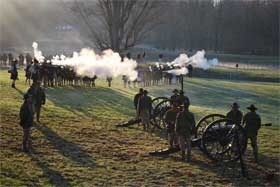
A series of musket and cannon salutes from the bridge at various times of the day. 6:00 A.M.: The Concord Minute Men and the Concord Independent Battery. 10:00 A.M. (approximately): The Molly Cutthroats, a living-history group dedicated to the role of women in the Revolution. 11:30 A.M.: The Sudbury Companies of Militia and Minutemen. 12:00 noon (approximately): Sons of the American Revolution, Henry Knox Color Guard.

Saturday, 21 April, 4:30 - 8:30 p.m.
After the Battle: The War Has Begun
Hartwell Tavern, 136 North Great Road, Lincoln
War between the people of Massachusetts and Gov. Thomas Gage and the British regulars has just broken out. Thousands of men are preparing to leave home for the front lines around Boston. Whole communities are faced with numerous challenges demanded by this frightening new reality. Step back into the year of 1775 and get involved. Recommended donation: $5 per person, $10 per family. Children wearing a Junior Ranger badge (which can be earned on 14 or 21 April) admitted free.


Wednesday, October 25, 2017

Abigail Adams Birthplace Tour in Weymouth, 4 Nov.

On Saturday, 4 November, the Abigail Adams Historical Society will welcome visitors for “Behind the Scenes at the Abigail Adams Birthplace,” a tour of the building with preservation carpenter Walter Beebe-Center.

The organization says:
The Abigail Adams Historical Society concludes its year-long commemoration of the 70th anniversary of the rescue of the ca. 1685 Abigail Adams Birthplace from demolition with this special behind-the-scenes tour. Led by Walter Beebe-Center, owner of Essex Restoration, the program will feature an overview of the 2012–2013 restoration which Beebe-Center oversaw and which confirmed the building’s 17th-century construction date. It will also include a structural tour of the home from basement to second floor, sites usually not shown to the public.
There will be two tours, the first from 10:00 A.M. to noon and the second from 2:00 to 4:00 P.M. Each tour is limited to fifteen people. Tickets are $25 per person, or $20 for members.

Tickets must be reserved in advance through AAHS1947@yahoo.com. People who register will receive a reply email stating whether they have a reservation or are wait-listed. All attendees receiving a confirmation should be prepared to pay by check or cash at the door.

The Abigail Adams Birthplace is at 180 Norton Street in North Weymouth. Its last day this year open for regular tours is Sunday, 12 November, from 1:00 to 4:00 P.M.

Monday, May 15, 2017

The Rittenhouse Orreries

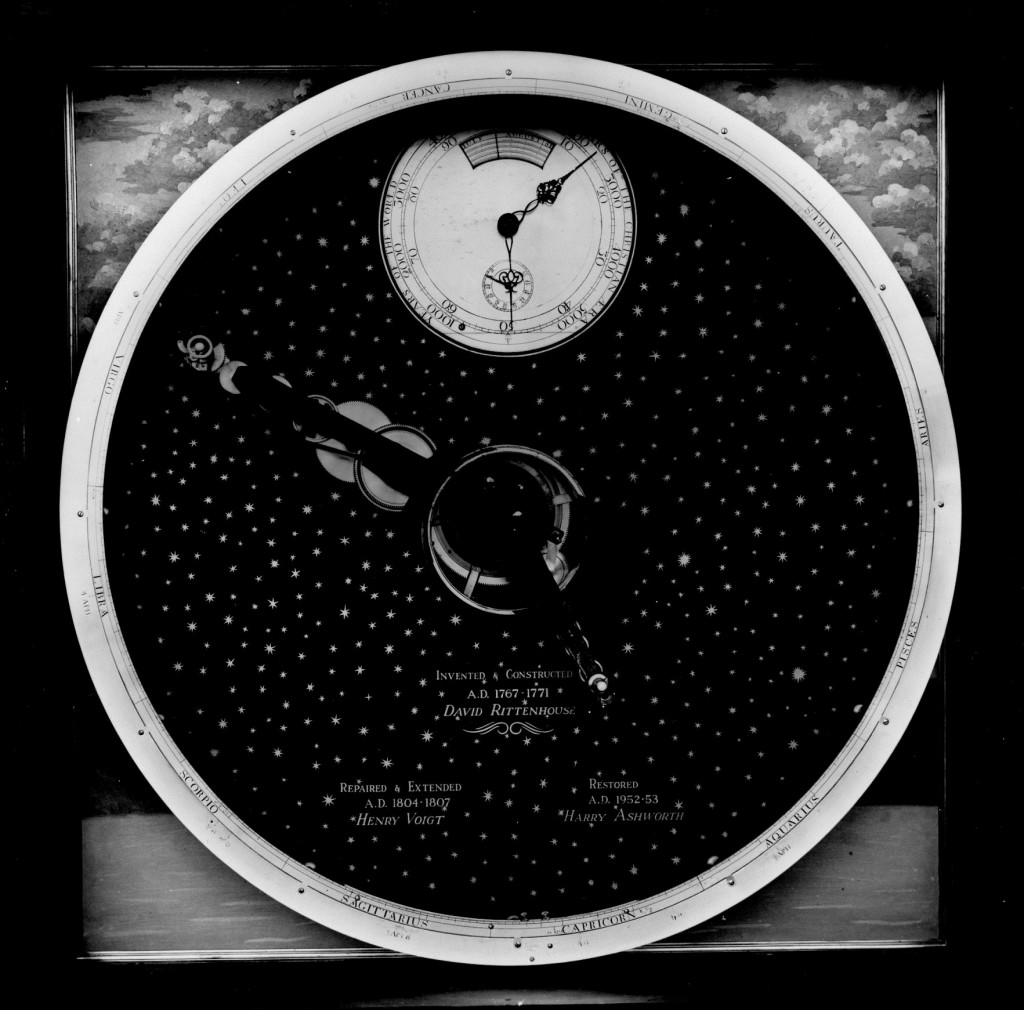
On 5 May 1768, the Pennsylvania Gazette ran an article headlined, “A Description of a new ORRERY, planned, and now nearly finished, by Mr. DAVID RITTENHOUSE, of Norriton, in the County of Philadelphia.”

An orrery was a machine that simulated the movements of the solar system through axles and gears. The term had been coined early in the 1700s in honor of the fourth Earl of Orrery. He didn’t invent the device, but he was the patron and funder of the man who did, George Graham. [It was good to be an earl.]

Like Graham, Rittenhouse was a clockmaker. Their orreries were based on the idea that the solar system ran like a clock.

Rittenhouse’s orrery was just one of the machines he invented in Revolutionary Philadelphia. He was also a surveyor and astronomer, and one of the Philadelphia Whigs.

In honor of his orrery, Princeton College gave Rittenhouse an honorary degree. The college president, the Rev. John Witherspoon also raised nearly £300 to buy the machine in April 1770. It was installed in Nassau Hall the following year.

John Adams viewed the Princeton orrery on 27 Aug 1774, on his way to the First Continental Congress, writing:
Here we saw a most beautifull Machine, an Orrery, or Planetarium, constructed by Mr. Writtenhouse of Philadelphia. It exhibits allmost every Motion in the astronomical World. The Motions of the Sun and all the Planetts with all their Satellites. The Eclipses of the Sun and Moon &c.
However, the sale to Princeton had miffed the Rev. William Smith, head of the College of Philadelphia (precursor of the University of Pennsylvania). He thought he’d wooed Rittenhouse into giving his institution first refusal on the device. So Smith convinced the Pennsylvania legislature to “purchase from Mr. Rittenhouse a new Orrery, for the use of the Public, at any sum not exceeding four hundred pounds.”

This new machine, apparently delivered by the end of the year, was bigger and more sophisticated than the first. Rittenhouse followed the same basic design but added some new features. British-Americans viewed the “Rittenhouse orrery” (they seem to have treated the two machines as one) as a convincing argument of their society’s sophistication.

TOMORROW: Orreries at war.

Tuesday, May 09, 2017

“Landmarks of Slavery and Freedom” in Hingham, 13 May

On Saturday, 13 May, the Abigail Adams Historical Society, which is the steward of the Abigail Adams Birthplace (shown here), and the Hingham Public Library will present a panel discussion on “Landmarks of Slavery and Freedom: Exploring Local African-American Historic Sites.”

The event description says:
Abigail Smith Adams strongly opposed the institution of slavery, yet she grew up in a slave-owning household. Her father, the Reverend William Smith, owned a male servant named Tom and a female servant named Phoebe; both played significant roles in Adams’s life. As part of the Abigail Adams Historical Society’s continuing efforts to explore the subject of colonial New England slavery, it is co-sponsoring with the Hingham Public Library a panel discussion on local African-American historic sites.

Representatives from the Abigail Adams Birthplace, Museum of African American History (MAAH), Parting Ways Historic Site, and the Sojourner Truth Memorial Committee/Florence’s African-American Heritage Trail will describe the stories behind these landmarks and the important role they play in the community.

Providing insight into the lives of African Americans in early New England will be historian Kerima Lewis.
This event will run from 3:00 to 5:00 P.M. at the Hingham Public Library, 66 Leavitt Street, in Hingham. It is free and open to the public, with no reservations necessary.

Monday, September 05, 2016

September Events at Minute Man National Historical Park

Minute Man National Historical Park has a busy schedule of events for the rest of the month. They’re all free, and I’m definitely going to attend the last one.

Sunday, 11 September
Revolutionary Dogs walking tour from the visitor center at the Lexington/Lincoln line, 2:00 P.M.
Colonial Music at Hartwell Tavern, 2:40 P.M.

Saturday, 17 September
Battle Road Homes Open House, 10:00 A.M. to 4:00 P.M.
The Lincoln Minute Men will be drilling at the Captain William Smith House, “Sophia Hawthorne” will greet visitors at the Wayside, and other homes will host historic tradesmen.

Sunday, 18 September
Amos Doolittle, Combat Artist walking tour from Old Hill Burying Ground, Concord, 2:00 P.M.

Saturday, 24 September
Warlike Preparations at the Barrett Farm, 455 Barrett’s Mill Road, Concord, 10:00 A.M. to 4:00 P.M.

Sunday, 25 September
The British Redcoat at the Lexington/Lincoln visitor center, 1:00 and 3:00 P.M.

Thursday, 29 September
“Cannons in Concord, and Why the Regulars Came Looking” at the Lexington/Lincoln visitor center, 7:00 P.M.

Massachusetts’s military preparation in 1774-75 went beyond militia elections and infantry drills. The Provincial Congress also assembled an artillery force, with several cannon and mortars stored in Concord—including the “Hancock” gun now on display at the North Bridge visitor center.

J. L. Bell, author of The Road to Concord, describes how those cannon came to the town, how Gen. Thomas Gage learned about them, and what happened next.


Wednesday, February 11, 2015

Slaves at the Smith Parsonage in Weymouth, 26 Feb.

On Thursday, 26 February, the Abigail Adams Historical Society will present a program on “Slavery at the Abigail Adams Birthplace” in cooperation with Weymouth Public Libraries.

As an adult, Abigail Adams strongly opposed the institution of slavery, yet she grew up in a slaveowning household. Her father, the Rev. William Smith, owned a male servant named Tom and a female servant named Phoebe, and they both played significant roles in Abigail’s life.

The fact that Weymouth’s town minister owned slaves was not unusual in New England. Indeed, ministers were part of a community’s elite, and sometimes independently wealthy. It was common for a genteel young woman marrying a minister to receive an enslaved person as a wedding present to help her set up her new household.

Michelle Marchetti Coughlin, author of One Colonial Woman’s World, will speak about the details of Tom’s and Phoebe’s lives within the Smith household and in the larger context of New England slavery.

Admission to this even is $15 per person, $10 for members of the society. It will take place from 7:00 to 8:00 P.M. at the Tufts Library, 46 Broad Street in Weymouth. Reservations are not necessary.

Friday, October 17, 2014

Celebrating Abigail and John Adams, 24-26 October

Saturday, 25 October, will be the sestercentennial of the marriage of Abigail and John Adams.

The Abigail Adams Historical Society, Adams National Historical Park, and First Church in Weymouth will commemorate that 250th anniversary with a series of events over the weekend. Those events will take place at the Abigail Adams Birthplace and First Church in Weymouth and at the Adams National Historical Park in Quincy. The schedule includes:

Friday, 24 October, 11:00 A.M.
Reenactment of the Wedding of Abigail and John Adams
First Church in Weymouth

Descendant Abigail Elias LaCroix will portray Abigail Smith preparing for her wedding at her home, then traveling by horse and carriage to the church, where reenactor Michael LePage will be waiting for her as groom John Adams. Henry Cook IV will act the part of Abigail’s father, the Rev. William Smith, and officiate at the marriage. Rain or shine, free to all, but reservations are highly recommended. Organizers invite the public to wear eighteenth-century attire to the wedding reenactment and reception that follows at the Abigail Adams Birthplace.

In the evening, there will be another reception at the Abigail Adams Birthplace in Weymouth. Admission to that is $125, or $100 for members of the Abigail Adams Historical Society.

Saturday, 25 October, 9:00 A.M. to 12:00 Noon
Symposium: Abigail & John: 250 Years Together
First Church in Weymouth

The scholars sharing papers will be:
  • Steven C. Bullock, Worcester Polytechnic Institute, “Power and Politeness in the ‘Remember the Ladies’ Exchange”
  • Sara Martin, Adams Papers, and Neal Millikan, George Washington Papers at the Library at Mount Vernon, “Reflections on the Courtship Writings of John, Abigail, John Quincy and Louisa Catherine Adams”
  • Andrew Wehrman, Marietta College, “Inoculations of John and Abigail Adams and the Politics of Smallpox in Revolutionary Massachusetts”
  • Robina Mitchell, Museum of Fine Arts, “Adams Family Objects at Boston’s Museum of Fine Arts”
Admission is free; reservations are recommended because seats are limited. This symposium is co-sponsored by the Adams Papers project at the Massachusetts Historical Society.

At noon, there will be a luncheon at the Abigail Adams Birthplace with Stanford professor Edith Gelles speaking on “Abigail and John: Portrait of a Marriage.” Admission is $25, $20 for members; reservations are recommended.

Saturday, 25 October, 3:00 P.M.
“Songs on Letters of John and Abigail Adams”
Carriage House, Adams National Historical Park

The Lydian Quartet and soloists Clara Osowski and Paul Max Tipton perform the world premiere of James Kallembach’s seven-song cycle inspired by the couple’s correspondence. Admission is free, but seating is first-come, first-served; limited to capacity. Parking available on Adams Street.

Sunday, 26 October, 10:00 A.M. to 12:00 Noon
Celebration of Independence Service
First Church in Weymouth

An ecumenical service celebrating American independence, featuring readings from some of the nation’s founding documents. Admission is free; seating is first-come, first-served and limited. A coffee reception follows immediately at the Abigail Adams Birthplace. Following the reception, guests will be invited to proceed to the adjacent North Weymouth Cemetery for the laying of wreaths at the graves of Abigail Adams’s parents, Elizabeth and William Smith.

Saturday, September 20, 2014

Today at Minute Man Park

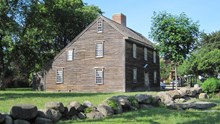
Today the Minute Man National Historical Park is hosting a “Battle Road Open House” from 10:00 A.M. to 4:00 P.M. Visitors can stop in on some of the restored colonial houses in the park, known as “witness houses” since they were already present during the Battle of Lexington and Concord.

Among those houses is the William Smith House in Lincoln, home to the captain of the Lincoln Minute Men and his family. Today’s reenactor Lincoln Minute Men have helped to refurbish and refurnish that house with what a typical eighteenth-century farmhouse held:
the walking wheel, for spinning wool; the infant's cradle with reproduction tick and blanket, the kitchen cupboard stocked with redware and pewter; items for cooking on the hearth, a tilt-top table set for tea, a gate-leg table set for Catharine and William's dinner, a desk where the Smiths could pay bills and write correspondence, and much more!
Members of the Lincoln Minute Men will be present in period clothing to welcome visitors. They plan to provide musket-firing demonstrations at 10:00, noon, and 1:00 P.M., as well as drills for children, fife & drum music, and demonstrations of sewing and spinning throughout the day.

In addition, the park and its volunteers have special activities scheduled at other houses:
  • Jacob Whittemore House: Hands-on 1775, experience life in colonial times
  • Hartwell Tavern: Historic Trades and Colonial Food Preparation
  • Meriam House: Site of the beginning of the 16-mile running battle back to Boston
  • Barrett Farm: British Army Uniforms of the American Revolution with the recreated 63rd Regiment of Foot
There’s no entrance fee for this day. Park in the Hartwell Tavern lot to visit that building and the William Smith House.

Saturday, June 29, 2013

Abigail Adams Birthplace Open House, 30 June

On Sunday, 30 June, the Abigail Adams Birthplace in Weymouth is reopening after a two-year restoration, the Quincy Patriot-Ledger reports. The 1685 house has been structurally reinforced, equipped with climate control to allow year-round programs, and spruced up with new clapboards.

I should note that this birthplace isn’t quite in the same place as it was in 1744, when baby Abigail Smith was born there, or 1764, when she married John Adams in the parlor. The house was moved to a new site by oxen in the early 1800s. After World War 2, it was sawed in half, moved back to its original neighborhood, and reassembled. The Boston Globe shares a photo of the latter move as well as the image above.

Three of Weymouth’s ministers lived in the house, with the Rev. William Smith being the second. But apparently it wasn’t officially the town parsonage—it appears to have been the property of the ministers themselves, and each family sold to the next. The building is now the property of the Abigail Adams Historical Society.

The newspapers disagree, but the society’s website says that after a members’ reception it will host a reopening ceremony for the public from 1:00 to 5:00 P.M. The house will then be open for visits this summer on 13 and 28 July and 10 and 25 August. Admission will be $5 for adults and teens, $1 for children under age twelve.

Saturday, December 15, 2012

The Desk Calendar Contest Answers!

Here are the answers to this week’s Desk Calendar Challenge, challenging readers to identify men related to the American Revolution who were named either William Smith or John Robinson, for the most part.

1) Member of Parliament and Secretary of the Treasury in London from 1770 to 1782, he was Lord North’s principal political fixer.

This was John Robinson (1727-1802). The phrase “before you can say Jack Robinson” appeared in the late 1700s, so some authors have theorized that it referred to this man, but that seems unlikely.

Col. William Stephens Smith ai... Digital ID: 423419. New York Public Library2) Aide-de-camp to Gen. John Sullivan, Gen. Lafayette, and finally Gen. George Washington, he served as a diplomat and a Congressman, and became an in-law to John Adams.

William Stephens Smith (1755-1816), who married the younger Abigail Adams. (Shown here, courtesy of the New York Public Library.)

3) An officer in the Westford militia company in 1775, he took part in the provincials’ advance toward the North Bridge without his men. Eleven years later he returned to Concord to help close the county courts during the Shays’ Rebellion.

John Robinson (1735-1805).

4) Appointed a Commissioner of Customs, he went into hiding after a coffee-house brawl and sailed secretly to London with a set of pro-Crown reports about the Boston Massacre.

Another John Robinson (died before 1783). He was the man who clubbed James Otis, Jr., in 1769. Wondering whether this guy surfaced at Lord North’s side made me notice how many John Robinsons there were.

5) A historian of colonial New York, he railed against the idea of an Anglican bishop for America and sought compromises between Patriots and the Crown. He served as Chief Justice of both New York and Québec/Lower Canada.

William Smith (1728-1793).

6) Born in Charleston, South Carolina, he spent the entire Revolutionary War as an attorney in England. Back in America, he was elected to the first five Congresses under the new Constitution.

William Loughton Smith (1758-1812), as opposed to William Smith (1751-1837), who fought in the Revolutionary War, represented South Carolina in the U.S. House for only one term, and was in the opposite party.

7) Invited to America by Benjamin Franklin, he helped to set up both the University of Pennsylvania and Washington University. He lobbied for an Anglican bishop for America and was driven from Philadelphia as a suspected Loyalist.

The Rev. William Smith (1727-1803), shown at right.

8) By training a carpenter, he had to leave Cambridge, Massachusetts, after the “Powder Alarm.” After convincing the Crown to support a settlement at Penobscot Bay in Maine, where he owned land, he endured a siege by Massachusetts forces.

This is our odd man out: John Nutting (1740-1800).

9) He’s one of America’s leading historians on the poor in the late colonial and early national period, particularly in Philadelphia.

Billy G. Smith, Distinguished Professor of Letters & Science at Montana State University.

10) He died in office after serving for many years as both Speaker of the House of Burgesses and Treasurer in Virginia, and the government discovered he’d embezzled large sums of money.

John Robinson (1705-1766).

11) Theologically liberal minister of the town of Weymouth, Massachusetts, he became an in-law to John Adams.

The Rev. William Smith (1707-1783), father and tutor of First Lady Abigail Adams. Yes, John Adams’s father-in-law and son-in-law were both named William Smith.

And the winner of the Colonial Williamsburg desk calendar for 2013 is commenter G. Lovely! Please send me an email with your surface-mail address, and that prize will be in the mail next week.

Sunday, December 09, 2012

The 2013 Desk Calendar Contest

If you didn’t win last week’s wall calendar contest, don’t despair! I also have an extra Colonial Williamsburg desk calendar for the coming year. It’s spiral-bound, about 9 inches wide by 8 tall, with a page for each month and each week, all facing color photographs of Williamsburg sights. And I’m going to give this one away, too.

I’ve written capsule descriptions of eleven men linked to the American Revolution, broadly defined. Some of them were named John Robinson. Some of them were named William Smith. One of them was named neither John Robinson nor William Smith. The challenge is to identify the Robinsons and Smiths and name the odd man out.

1) Member of Parliament and Secretary of the Treasury in London from 1770 to 1782, he was Lord North’s principal political fixer.

2) Aide-de-camp to Gen. John Sullivan, Gen. Lafayette, and finally Gen. George Washington, he served as a diplomat and a Congressman, and became an in-law to John Adams.

3) An officer in the Westford militia company in 1775, he took part in the provincials’ advance toward the North Bridge without his men. Eleven years later he returned to Concord to help close the county courts during the Shays’ Rebellion.

4) Appointed a Commissioner of Customs, he went into hiding after a coffee-house brawl and sailed secretly to London with a set of pro-Crown reports about the Boston Massacre.

5) A historian of colonial New York, he railed against the idea of an Anglican bishop for America and sought compromises between Patriots and the Crown. He served as Chief Justice of both New York and Québec/Lower Canada.

6) Born in Charleston, South Carolina, he spent the entire Revolutionary War as an attorney in England. Back in America, he was elected to the first five Congresses under the new Constitution.

7) Invited to America by Benjamin Franklin, he helped to set up both the University of Pennsylvania and Washington University. He lobbied for an Anglican bishop for America and was driven from Philadelphia as a suspected Loyalist.

8) By training a carpenter, he had to leave Cambridge, Massachusetts, after the “Powder Alarm.” After convincing the Crown to support a settlement at Penobscot Bay in Maine, where he owned land, he endured a siege by Massachusetts forces.

9) He’s one of America’s leading historians on the poor in the late colonial and early national period, particularly in Philadelphia.

10) He died in office after serving for many years as both Speaker of the House of Burgesses and Treasurer in Virginia, and the government discovered he’d embezzled large sums of money.

11) Theologically liberal minister of the town of Weymouth, Massachusetts, he became an in-law to John Adams.

Some of these William Smiths and John Robinsons had middle names as well, but the descriptions are all straightforward. All research resources are allowed and encouraged.

Instead of challenging individuals to identify all the men at once, I’m inviting you folks to “crowdsource” the answers. If you can name one or more of the numbered men, do so in a comment with a confirming link or reference. (For example, if you think number 7 was the odd man out and named Dr. Samuel Gardner, your comment could say that and include a link to a webpage about him or cite a book that mentions him.) Make sure your comment has a name or unique pseudonym attached.

I’ll run the complete set of correct identifications next Saturday. And I’ll choose a Boston 1775 reader who contributed to the answer to receive the desk calendar. Happy searching!

Wednesday, August 12, 2009

Jefferson’s Words on the Constitution and the “Tree of Liberty”

This television image shows William Kostric protesting outside President Barack Obama’s event in Portsmouth, New Hampshire, yesterday. Kostric attracted attention because he was wearing a pistol in a holster. He later appeared on Chris Matthews’s television show, as described here:

Matthews asked Kostric to say the rest of the quote—the part not on his sign. He only responded that was for people to “look up. It’s not a sound bite.”

“I’m not advocating violence,” he said. “I’m advocating an informed society, an armed society, a polite society.”
So, in the public interest, here’s the full quotation in context. It comes from a letter Thomas Jefferson wrote in France on 13 Nov 1787. William Smith, husband of the younger Abigail Adams, had sent him a copy of the proposed new U.S. Constitution. Jefferson didn’t think the new structure of government was a good idea:
I do not know whether it is to yourself or Mr. [John] Adams, I am to give my thanks for the copy of the new constitution. I beg leave through you, to place them where due. It will yet be three weeks before I shall receive them from America. There are very good articles in it; and very bad. I do not know which preponderate.

What we have lately read in the history of Holland, in the chapter on the Stadtholder, would have sufficed to set me against a chief magistrate, eligible for a long duration, if I had ever been disposed towards one: and what we have always read of the elections of Polish Kings, should have forever excluded the idea of one continuable for life.

Wonderful is the effect of impudent and persevering lying. The British ministry have so long hired their gazetteers, to repeat and model into every form, lies about our being in anarchy, that the world has at length believed them, the English nation has believed them, the ministers themselves have come to believe them, and what is more wonderful, we have believed them ourselves. Yet where does this anarchy exist? Where did it ever exist, except in the single instance of Massachusetts [i.e., “Shays’ Rebellion”]? And can history produce an instance of rebellion so honorably conducted? I say nothing of its motives. They were founded in ignorance, not wickedness.

God forbid we should ever be twenty years without such a rebellion. The people cannot be all, and always, well informed. The part which is wrong will be discontented, in proportion to the importance of the facts they misconceive. If they remain quiet under such misconceptions, it is a lethargy, the forerunner of death to the public liberty. We have had thirteen States independent for eleven years. There has been one rebellion. That comes to one rebellion in a century and a half, for each State. What country before, ever existed a century and a half, without a rebellion? And what country can preserve its liberties, if its rulers are not warned from time to time, that this people preserve the spirit of resistance? Let them take arms.

The remedy is to set them right as to facts, pardon and pacify them. What signify a few lives lost in a century or two? The tree of liberty must be refreshed from time to time, with the blood of patriots and tyrants. It is its natural manure. Our [constitutional] convention has been too much impressed by the insurrection of Massachusetts: and on the spur of the moment, they are setting up a kite to keep the hen yard in order. I hope in God, this article will be rectified, before the new constitution is accepted.
Jefferson came to different ideas of the value and power of a chief magistrate once he assumed that office himself. He also felt that his election had produced a sort of revolution in government that meant no more rebellions were needed during his terms. (Of course his notion of beneficial rebellions for liberty didn’t include those by enslaved people.)

Very few of Jefferson’s contemporaries were so sanguine about bloodletting, so he didn’t make this sort of argument in public. The letter was published after his death by his grandson, Thomas Jefferson Randolph, and the sentence about refreshing “the tree of liberty” has attracted various fans over the decades. It appeared, for instance, on the T-shirt Timothy McVeigh was wearing when he was caught after bombing the Oklahoma City federal offices.

Me, I always thought the goal of a constitution, regular elections, and protected rights was that the nation could progress without needing a series of fatal rebellions. I also think the quotation “Wonderful is the effect of impudent and persevering lying” is more appropriate to the current clamor over the federal health-insurance bill, considering all the misinformation people are shouting.

Thursday, July 09, 2009

“Dashed the Body of the Sulky all to Pieces”

So what did John Adams have to say about the Massachusetts delegates’ entrance into New York on 7 May 1775? Unlike John Hancock and Silas Deane, he didn’t write home about how the crowd had tried to honor those men by unhitching their horses and pulling their carriages along.

For one thing, Adams didn’t have a carriage, only a “sulky,” or two-wheeled cart, borrowed from his father-in-law, the Rev. William Smith. For another, his servant Joseph Bass seems to have been riding in it alone; Adams was apparently in another delegate’s carriage. But most important, things hadn’t gone so well for him.

On 8 May 1775, John told his wife Abigail:

Jose Bass met with a Misfortune, in the Midst of some of the unnecessary Parade that was made about us. My Mare, being galled with an ugly Buckle in the Tackling, suddenly flinched and started in turning short round a Rock, in a shocking bad Road, overset the sulky which frightened her still more. She ran, and dashed the Body of the Sulky all to Pieces. I was obliged to leave my sulky, ship my Bagage on board Mr. [Thomas] Cushings Carriage, buy me a Saddle and mount on Horse back. I am thankfull that Bass was not kill'd. He was in the utmost danger, but not materially hurt.

I am sorry for this Accident, both on Account of the Trouble and Expence, occasioned by it. I must pay your Father for his sulky. But in Times like these, such Little Accidents should not affect us.
When the delegates entered Philadelphia a few days later, the Loyalist Samuel Curwen noted “John Hancock and Samuel Adams in a phaeton and pair,...John Adams and Thomas Cushing in a single horse chaise; behind followed Robert Treat Paine, and after him the New York delegation and some from the Province of Connecticut etc. etc.”

(The thumbnail above is Carl Rakeman’s vision of the Boston Post Road in 1763, painted for the Bureau of Public Roads sometime between 1921 and 1952. The man in the chaise is supposed to be Benjamin Franklin, the woman on horseback his daughter.)