J. L. BELL is a Massachusetts writer who specializes in (among other things) the start of the American Revolution in and around Boston. He is particularly interested in the experiences of children in 1765-75. He has published scholarly papers and popular articles for both children and adults. He was consultant for an episode of History Detectives, and contributed to a display at Minute Man National Historic Park.

Subscribe thru Follow.it


•••••••••••••••••


Showing posts with label Deerfield. Show all posts

Saturday, July 11, 2026

New Dramas at Old Places in Newport, Deerfield, and East Granby

This is a very busy summer for Plays in Place, which works with historic sites to create new plays built on their past, informed by their archives, and designed for their spaces.

At the Hunter House in Newport, Rhode Island, Newport Mansions presents Loyalty or Liberty, a trio of short plays set between 1778 and 1781 as control of that port changed hands.

“Dinah” by Ken Green follows an enslaved woman in a Loyalist household whose husband plans to enlist in the Continental Army, seeking freedom for the family. “For Love and Glory” by Patrick Gabridge dramatizes the conference between Axel von Fersen, aide-de-camp to Gen. Rochambeau, and Adm. de Barras, who has to be convinced to sail his fleet to Yorktown. “Where We Once” by Lily Mathews picks up the story of Dinah’s enslaver, Sarah Wanton, as she faces life in an independent republic. These plays are directed by Rachel Walshe and produced by Jessica Chace.

Loyalty or Liberty will run Tuesday and Saturday evenings through 1 September. Normally the plays will be staged outdoors, overlooking Narragansett Bay, but in bad weather the production will move into the Guild Hall at St. John’s Church. Buy tickets here.

Historic Deerfield is hosting A Stake in the Ground: 1774, three short plays about conflicts in that Loyalist-leaning town as Massachusetts slid out of royal control.

In the summer of 1774, Patriots brought a Liberty Pole into Deerfield. “The Liberty Lark” by Talya Kingston, “Jinny and Cato” by Valyn Lyric Turner, and “Sparks on Dry Tinder” by Patrick Gabridge explore the political divisions, tangled family relations, and complexities of enslavement stirred up by that political act and the protest against it. These dramas are directed by Brianna Sloane and produced by Talya Kingston.

Performances will take place on Friday and Saturday evenings and Sunday afternoons through 16 August. A Stake in the Ground will be staged outside, with the audience walking to each location and sitting on folding chairs. On 31 July–2 August, and in very bad weather, the same plays will be performed inside the Deerfield Community Center for a more traditional and accessible theatrical experience. Tickets available here.

At the Old New-Gate Prison & Copper Mine in East Granby, Connecticut, visitors can take in The Slippery Truth: Prisonbreak at New Gate by Patrick Gabridge, directed by Zoë Golub-Sass and produced by Nicole Young-Martin.

On 18 May 1781, a group of captive Loyalists rushed up a 35-foot ladder and overpowered their guards, killing one man before escaping into the night. Was this brave resistance by political prisoners or a desperate blow by criminals? Did they have inside help? Prison trustee John Forward interrogates guards and recaptured prisoners to find the truth.

The Slippery Truth will be produced indoors—to be precise, inside the mine. The audience will enter via 33 steps and a 100-yard loop starting at 35 feet below ground and descending to 75 feet below. The shortest tunnel is 4 feet. The mine is always 52 degrees and wet. Strollers, wheelchairs, walkers, and similar devices are not permitted, and visitors should consider their medical history and physical limitations before attending.

Performances will happen on Friday, Saturday, and Sunday evenings through 30 August. Tickets at this page.

Monday, February 02, 2026

Flagging a Call for Presentations at the 2026 HistoryFest in Westfield

In the summer and fall of 1774, New England towns competed to put up Liberty Poles, the taller the better.

On 28 July, Ephraim Potter and Edward Lawrence brought such a flagpole into Deerfield, though they didn’t have time to set it up that day. Young Dr. Elihu Ashley estimated that it was “about fifty feet.”

Dr. Ashley got a good look at that pole because that evening he sawed through it with the help of some friends.

The next day, Ashley wrote in his diary, the talk of the town was “nothing but Liberty, and ye Poles being Sawd.” Soon “ye Liberty Pole was set up and also a Tory Pole as they in their infinite wisdom are pleased to call it.” I wonder if together those poles measured fifty feet.

On 30 July, an anonymous public letter was posted in town. It declared Potter, Lawrence, and their comrades to be “a pack of ignorant villains.” Also, whoever wielded the saw was “some Malicious Person, Inimical to his Country”—though that was meant ironically, since it’s now thought the anonymous letter came from Dr. Ashley. It went on:
Where are things going, that so sensible people as you know the Town of Deerfield are, should suffer these Rascals to carry matters on so. I cannot help feeling, and very sensibly, when I think what the Consequences of these things will be & have no reason to think but that they will issue in blood…
Today Deerfield’s Liberty Pole is commemorated in a stone marker and in a flagpole in Historic Deerfield, as I photographed it above last year. (It was flying a version of the Taunton flag.)

That’s just one Revolutionary story from the Connecticut River valley, also called the Pioneer Valley.

On 11 April, the Pioneer Valley History Network and the Westfield State University History & Philosophy Department will host their 2026 HistoryFest in Westfield. Like History Camp Boston, this is a chance for local chroniclers and researchers to share their work with other people curious about history.

The organizers say:
Our Homespun History Conference thrives on the stories, ideas, and passions of people who care deeply about the history of the Pioneer Valley, Massachusetts, and the many ways history connects to museums, historical societies, and community life today. Whether your focus is local history, material culture, public history practice, education, preservation, or an untold story waiting to be shared, we invite you to submit a proposal to present.
That process starts with their invitation to propose a session through this form.

The organizers say they aren’t necessarily looking for formal “experts” but for:
  • Fascinating stories and fresh perspectives
  • Practical or thought-provoking workshop topics
  • Case studies, community projects, or works-in-progress
For people with questions, they have scheduled some brief Zoom information sessions at different times of the day on 3, 13, and 19 February. For more details, click on the proposal link above.

Tuesday, January 13, 2026

Online Lecture Series from Historic Deerfield

Here’s another series of online lectures exploring the Revolution during the Sestercentennial, this time from Historic Deerfield.

Sunday, 25 January, 2 P.M.
Mighty Microbes: The Deadly 1775 Massachusetts Dysentery Epidemic and the Other Diseases That Shaped the American Revolution
Woody Holton, Professor of History at the University of South Carolina, author of Liberty Is Sweet

Sunday, 22 February, 2 P.M.
Spain, Native Nations, and the American Revolution
Kathleen DuVal, Carl W. Ernst Distinguished Professor of History the University of North Carolina, author of Native Nations

Sunday, 29 March, 2 P.M.
Picturing the American Revolution
Paul Staiti, Professor of Fine Arts on the Alum Foundation at Mount Holyoke College, author of Of Arms and Artists

Historic Deerfield says this series will “explore the American Revolution not just as a political conflict, but as a broad and complex global event that profoundly shaped the lives of everyone in the colonies. The war’s impact extended far beyond political fervor, crucially affecting Native nations seeking autonomy, free and enslaved Black people across the continent, and every sphere of social, cultural, and economic life—from material culture and daily labor to political ideology.”

All three lectures will be free of charge and presented virtually via Zoom webinar. Register for the links through this page.

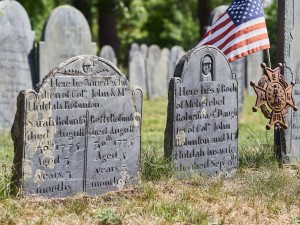
(The picture above shows the gravestones of young sisters Betty, Huldah, and Mehetebel Robinson, dead of dysentery in late 1775, courtesy of the Westford Museum.)

Sunday, December 08, 2024

The Ashley Family’s “commitment to tea-drinking”

Last month Historic Deerfield’s blog highlighted the consumption habits of the Rev. Jonathan Ashley (1712–1780), “Deerfield’s notorious Loyalist minister,” as the Revolution proceeded:
Reverend Ashley purchased his house lot in 1733 on the northern end of what is now Old Main Street. His successful career as a minister and his marriage into an elite Connecticut Valley family allowed him to emphasize his status through the furnishings and commodities with which he filled his home.

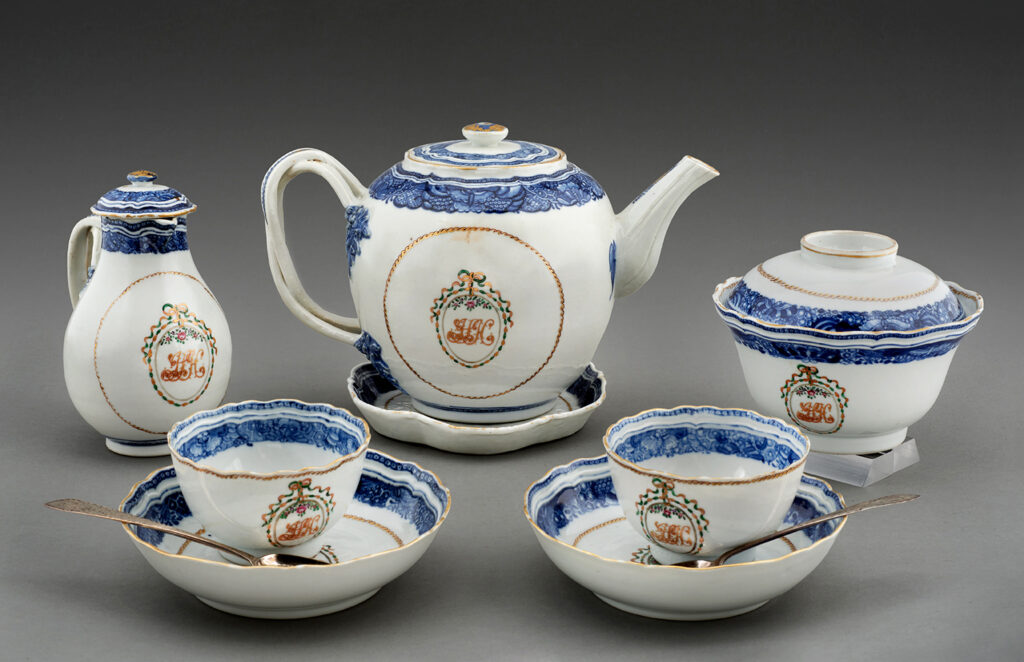
Few objects in Historic Deerfield’s collection have Ashley provenance, though a 30-piece Chinese export porcelain tea set belonging to the Ashley family bespeaks not only their desire to “maintain sufficiently affluent standards of hospitality,” but also their commitment to tea-drinking as it fell out of favor during the American Revolution.

The tea set consisting of a teapot and teapot stand, sugar bowl, cream pot, pickle or sweetmeat dish, six teacups, coffee cups, and saucers is decorated in a blue “Fitzhugh” butterfly pattern with the initials “H.H.” in a gilded oval cartouche. The Fitzhugh pattern is thought to be derived from the English Fitzhugh family, who held several positions within the English East India Company and is characterized by underglaze blue with a medallion, spearhead and trellis-diaper border, and four floral groups. . . .

as imported teas became symbolic of loyalism during the American Revolution—because of the taxes that were imposed on tea in 1773—several colonists turned to locally grown teas such as raspberry leaf to replace the imports from the British East India Company. Coffee, though not a new commodity in British North America, likewise became a popular drink amongst colonists, as it was a hot, caffeinated beverage that did not represent British economic interests. . . . Reverend Ashley continued to support the Crown by importing tea.
Collections Care Technician and blog writer Samantha Frost drew on Elizabeth Stillinger’s Historic Deerfield: A Portrait of Early America (1992) for details about the Ashleys’ purchases.

Speaking of tea, on Saturday, 14 December, the Lexington Historical Society will commemorate and recreate that town’s burning of local tea stocks in 1773, days before the Boston Tea Party. That event will take place at Buckman Tavern from noon to 3 P.M.

Friday, November 29, 2024

“Recalling the Revolution in New England” at the 2025 Dublin Seminar

The Dublin Seminar for New England Folklife has announced that its 27–28 June 2025 conference at Historic Deerfield will focus on the topic “Recalling the Revolution in New England.”

The seminar says:
On September 11, 1765, political leaders in Boston attached a plaque to a majestic elm and named it “Liberty Tree” to honor its role in an anti-Stamp Act protest the previous month. New Englanders thus started to commemorate the events of the American Revolution even before they had any idea there would be such a revolution. Over the following centuries, people from New England shaped the national memory of that era through schoolbooks, popular poetry, civic celebrations, monuments, and more.

On the 250th anniversary of the outbreak of the Revolutionary War in 1775, the Dublin Seminar for New England Folklife welcomes proposals for papers and presentations that address the broad range of ways the people of New England have looked back on the nation’s founding—and what they forgot, or chose to forget, in the process.
For this year the seminar invites proposals for papers and presentations that illuminate how the peoples of the region have commemorated, memorialized, documented, invoked, fictionalized, and even forgotten the American Revolution through the Bicentennial period. Papers should examine events and trends in New England and adjoining regions.

The Seminar encourages papers grounded in interdisciplinary approaches and original research, particularly material and visual culture, manuscripts, government and business records, the public press, oral histories, and public history practice or advocacy. Papers addressing such contemporary themes as gender dynamics, racial dimensions, and environmental aspects of Revolutionary commemoration are strongly encouraged.

Some possible topics might include:
  • Efforts to recover the stories of marginalized participants in the American Revolution
  • The processes of local commemoration in orations, pageants, reenactments, and more
  • Recreating and depicting the American Revolution in popular fiction, theater, prints, and toys
  • The collecting and preservation of Revolutionary-era artifacts and material culture
  • Activating, maintaining, and interpreting historic sites, battlefields, monuments, homes, and other spaces
  • The formation and activities of historical societies and heritage organizations
  • Contesting the memory and meaning of the American Revolution
Researchers whose proposals are accepted will be invited to prepare a 20-minute presentation of that work and present it on site in Deerfield. They’ll be expected to make a written version of about 7,000 words available for inclusion in the Dublin Seminar Proceedings.

The Seminar will convene on 27–28 June. That will be a hybrid program with both on-site and virtual registration options for attendees. The conference keynote will be provided by Dr. Zara Anishanslin of the University of Delaware, author of the forthcoming book The Painter’s Fire: A Forgotten History of the Artists who Championed the American Revolution.

To submit a proposal, scholars should prepare (as a single email attachment, in MS Word or as a PDF, labeled LASTNAME.DubSem2025) a one-page prospectus that describes the paper and the archival, material, or visual sources on which it is grounded, followed by a one-page vita or biography. Send that to dublinseminar@historic-deerfield.org by noon on Monday, 23 Jan 2025.

One last detail about the 2025 Dublin Seminar: I’m one of the co-chairs of the organizing committee along with Erica Lome of Historic New England.

Monday, June 10, 2024

“Into the Woods” with the Dublin Seminar, 28–29 June

On 28–29 June, the Dublin Seminar for New England Folklife will convene at Historic Deerfield for its annual conference, with this year’s theme being “Into the Woods: New England Forests in Fact and Imagination.”

The conference organizers explain:
This year’s program will address the rich and varied histories of the relationship between the peoples of New England and adjacent areas and their forests. The seminar will explore the economic, cultural, and social significance of trees and forests in New England history.

Anyone interested in parks and conservation, visual and literary representations of wooded landscapes, indigenous relationships with forests, wood-dependent industries, and folklore involving New England’s woods and forests will find plenty of interest in this two-day program.
For an overview, see this page. Presentations and discussions will take place live in the Deerfield Community Center, be streamed for online registrants, and be recorded for all registrants to view in the coming month.

The schedule of the 2024 conference includes:
  • optional tours of Historic Deerfield’s Memorial Libraries and Flynt Center to see resources on New England forestry, woodcarving, and furniture-making.
  • optional walking tour along the Channing Blake Footpath with naturalist Laurie Sanders, co-director of Historic Northampton.
  • keynote address on “The Lumber and the Trees: Fitz H. Lane, Winslow Homer, and the Nineteenth-Century Forest” by Margaretta Lovell, the Jay D. McEvoy, Jr. Chair of the History of American Art at the University of California, Berkeley.
  • eighteen papers, divided into six sessions, on such topics as “Turpentine Extraction & the Metamorphosis of the Local Woodlands, 1689–1713”; “Maple Sugaring Before Syrup”; “Waney Edges: Dendroarchaeology, and What the Timbers Tell Us”; “Reconstructing the Landscape: The Hidden Ecology of New England’s Historic Houses”; and “A View from the Land: 400 Years of New England Forests, Lumber, and Dwellings.”
  • Lunch on Saturday will fellow in-person registrants.
Register for the 2024 Dublin Seminar for New England Folklife with Historic Deerfield through this page. In-person registration costs $110, virtual registration $75, with discounts for Historic Deerfield members and students.

Sunday, July 02, 2023

Walks and Talks from Historic Deerfield in July

For the next two Sundays, 9 and 16 July (weather permitting), Historic Deerfield will offer an evening walking tour on the topic “Deerfield in the American Revolution.”

The event description says:
Enjoy a special guided evening walking tour along Old Main Street that explores life in a small town during the American Revolution. Incorporating music and stories from the period, this special tour looks at the experience of Revolution in lives of ordinary people, both Patriot and Loyalist. It highlights the experience of women, enslaved people, and others often left out of the story of the Revolution.

As one Deerfielder lamented, “all nature seems to be in confusion; every person in fear of what his neighbor will do to him. Such times were never seen in New England.”
(That Deerfielder was Elihu Ashley, a young doctor in training from a Loyalist family. No wonder he didn’t like how things were heading. Still, Deerfield was notable in having a stronger Loyalist contingent than many Massachusetts towns, producing more political conflict.)

It looks like each walking tour takes about half an hour, starting from the Visitor Center at Hall Tavern. The first will depart at 5:00 P.M., and the next fifteen or thirty minutes after that.

Walking tour tickets cost $10 and must be purchased in advance through the Historic Deerfield website or, on each Sunday until 4:30 P.M., at the Flynt Center.

Ticket purchasers can also dine in Champney’s Restaurant and Tavern at the Deerfield Inn with a 20% discount on the entrees. The restaurant recommends scheduling those reservations for an hour after the start of one’s tour.

In July Historic Deerfield will also host its 2023 Summer Lecture Series, this year focusing on Native communities in the region. Those talks are:

Thursday, 6 July, 7:00 P.M.
“Life and Times of the Pocumtuck”
Peter Thomas, local historian

Thursday, 13 July, 7:00 P.M.
“The 1735 Deerfield Conference: Indigenous Diplomacy in Action”
Colin Calloway, Dartmouth College

Thursday, 20 July, 7:00 P.M.
“Hiding in Plain Sight? Reconsidering Native Histories Along the Kwinitekw”
Margaret Bruchac, University of Pennsylvania

Thursday, May 18, 2023

“Indigenous Histories in New England” in Deerfield, 23–24 June

The Dublin Seminar for New England Folklife has announced the program of its 2023 conference on “Indigenous Histories in New England: Pastkeepers and Pastkeeping,” to take place on 23–24 June in Deerfield.

The Dublin Seminar website states:
This year’s seminar will address the gaps in Indigenous voice and visibility in public views of the past. We will critically consider who has claimed responsibility for “keeping” the Indigenous past in New England, including how it has been represented, how historical research can be decolonized and improved, and what museums and tribal nations have done to engage the public in better understandings.
The conference schedule starts with an optional visit on Friday morning to Amherst College Library, where its Special Collections staff will introduce the Amherst College Collection of Native American Literature.

Sessions inside the Deerfield Community Center begin at 1:30 P.M. on Friday. That afternoon and evening offers three panel discussions:
  • Indigenous Histories and Intergenerational Collaboration: Honoring Neal Salisbury, Pastkeeper, Spacemaker
  • Confronting Colonization at a Commemorative Moment: Reflections on Plymouth 400
  • Re-Covering and Re-Visioning: Indigenous Histories in New England Museums
On Saturday, a series of scholars will present their research in sessions built around these themes:
  • New Stories for Familiar Histories
  • Relocation, Resistance, & Resilience
  • Archives and Identity: Reciprocal Conversations
  • Land and Indigenous Values
Registration at the conference includes lunch on Saturday with fellow attendees.

Wednesday, January 18, 2023

Dublin Seminar Call for Papers on “Indigenous Histories”

The Dublin Seminar for New England Folklife has announced the subject of its June 2023 conference: “Indigenous Histories in New England: Pastkeepers and Pastkeeping.”

The seminar’s call for papers says:
Three decades have passed since the 1993 publication of the Seminar’s proceedings Algonkians of New England. Over that space of time, both the study of Indigenous histories in the region (encompassing present-day New England and adjacent areas of New York and Canada), and understanding of the memory work of pastkeepers and pastkeeping, have been transformed. The 2023 Seminar Indigenous Histories in New England: Pastkeepers and Pastkeeping will explore long traditions of Indigenous pastkeeping and the wide variety of ways in which Native peoples have stewarded history and memory.

The Seminar invites proposals for papers that focus on addressing the gaps in Indigenous voice and visibility in public views of the past. We wish to critically consider who has claimed responsibility for “keeping” the Indigenous past in New England, including how it has been represented (for better or worse), how historical research can be decolonized and improved, and what museums and tribal nations have done to engage the public in better understandings.

Papers offering historical perspective might explore, for instance:
  • Indigenous forms of memory-making and pastkeeping, on landscapes and in oral tradition
  • Native American authors of the eighteenth, nineteenth, and twentieth century, including autobiography and tribal histories
  • collections of material culture; histories of tribal museums
  • repatriation and cultural recovery
  • language reclamation
  • artwork as vehicles for historical reflection
The Seminar will give particular attention to the work of museums, archives, historic preservation organizations, cultural centers, and initiatives that over the past thirty years have worked to provide more holistic and inclusive representations of regional Indigenous peoples and histories.
The Seminar will convene at Historic Deerfield on 23–24 June. It will be a hybrid program, with both on-site and virtual registration options for attendees.

For more detail on how to propose a paper, go to the Dublin Seminar webpage. The program and registration details for this conference will also appear on the Dublin Seminar website in the spring.

Thursday, April 28, 2022

“Styling: Historic Hair” at Historic Deerfield, 29 Apr.

Historic Deerfield is hosting a symposium on historic hairdressing and wigs tomorrow, and it’s still possible to register for online viewing by 1:00 P.M. today.

“Styling: Historic Hair and Beauty Practices” explores the visual and material culture of hairdressing in the eighteenth- and nineteenth-century Atlantic World.

At the start of that period, influential men like the Rev. Increase Mather and Samuel Pepys expressed misgivings about the new fashion for wigs. Eventually wigs for men became de rigueur, a style we have a hard time understanding now. But maybe this one-day forum can help.

The event description says:
For the fashionable, interest in hair and hairdressing became as integral as clothing to the creation of a cosmopolitan appearance. The resulting confections reached new literal and figurative heights in the quest for distinction on both sides of the Atlantic.

Influences on hair and head dressing came from many sources. France was an acknowledged leader in all things à la mode, but other countries also contributed styles, materials, talent, and inspiration to dress the head. As important as appearance was, the question of who had access to the latest news and services of hairdressers and fashion merchants, and who did not, is also noteworthy. By the eighteenth and nineteenth centuries, people traditionally marginalized from the dominant fashion conversations nonetheless expressed themselves through hair and inspired others in equally inventive ways.
The presenters are:
  • Debbie Turpin, Colonial Williamsburg, “18th Century Wig-Making, From Shaven Head to Style.”
  • Philippe Halbert, Yale University, “War Paint and Rouge: Keeping up Appearances in New France.”
  • Ned Lazaro, Historic Deerfield, “‘This famous roll’: New England’s Hairstories.”
  • Jonathan Michael Square, Parsons School of Design, “Hair, Headwrapping, and Black Beauty Culture.”
  • Kimberly Chrisman Campbell, fashion historian, “Poufs and Politics: Women, Hair, and Power in the Reign of Louis XVI.”
For the schedule and registration information, go to this webpage by 1:00 P.M. today

Monday, February 14, 2022

“Tools and Toolmaking” at the 2022 Dublin Seminar for New England Folklife

The Dublin Seminar for New England Folklife has announced the subject of this year’s conference: “Tools and Toolmaking in New England.”

This event will take place in Deerfield, Massachusetts, on 24-25 June 2022, in partnership with the Early American Industries Association, Historic Deerfield, the Eric Sloan Museum, and the Public History Program at the University of Massachusetts.

It will include a keynote address, “Tool Stories,” by Steven Lubar, Professor of American Studies, History, and the History of Art and Architecture at Brown University, and author of a book in progress exploring the cultural history of tools.

The Dublin Seminar invites all scholars to propose papers and presentations at this conference on “the history and historiography of tools and toolmaking before 1900 in the region that encompasses present-day New England and adjacent areas of New York and Canada.” The announcement says:
We encourage discussion of Indigenous Native American tools and technologies that predate colonial contact, colonial settler tools, archaeological finds, collections, and reproductions. The Seminar hopes to consider tools in the context of home, farm, and workshop in a variety of uses, including artisanal trades and settings of industrial production. Early examples of tools made and used in traditional trades and crafts employed in New England’s first mills also constitute an important area of interest.

Proposals might address any of the following questions:
  • How did Indigenous people devise and adapt specific tools and technologies utilizing regional resources?
  • How did Indigenous toolmakers resist, adapt, and/or incorporate European materials?
  • What can the sharing and giving of tools tell us about relationships in the past?
  • In what ways were tools and tool creation specific to age, gender, class, and ethnicity in New England before 1900?
  • How were innovations in tool making and work processes devised, shared, and circulated among different groups?
  • How did tools and their making affect lifeways and workstyles in the region?
  • How did patent law and legal considerations impact tool making and tool design?
  • How did small-scale tool making and use change in response to industrial systems?
  • How was training in tool usage accomplished?
  • How did innovations in tool making and work processes represent patterns of knowledge transfer and facilitate the adoption of new tools and methods?
  • In what ways did the making and use of hand tools reflect the shift from agrarian landscapes and small farms to commercial centers and large-scale industrial systems?
  • In what ways did tools lead to class stratification?
  • Why and when did early tools become a focus for antiquarian collectors?
  • In what ways did tools help shape, represent and/or transgress gender or other identities?

Additional topics might include:
  • artisanal efforts to recover and recreate specific modes of individual tool-making
  • the production and acquisition of commemorative and/or souvenir tools
  • tools in children’s or educational literature
  • the ad hoc creation, adaptation, or application of tools
  • the appearance of tools in fine or decorative arts
  • tools as they are uncovered archeologically
  • the hazards of tool usage, e.g. “tailor’s cramp” and other conditions
  • the alteration of tools to accommodate disabilities
The Dublin Seminar has always valued inclusion, both in studying the full gamut of New Englanders and their daily lives instead of the elite and in the researchers who participate, coming from a range of professional backgrounds and disciplines. By tools the committee means not just carpenter’s planes and new-fangled inventions but also knitting needles, fishing gear, and the hoops that children learned to use when fetching buckets of water, as shown above.

This will will be a hybrid conference, held on site in Deerfield and online. It will consist of a keynote address and approximately seventeen lectures of twenty minutes each. Dublin Seminar presenters are expected to submit their papers for consideration to the Annual Proceedings of the Dublin Seminar to be published about eighteen months after the conference.

To submit a paper proposal for this conference, send (as a single email attachment in Word or as a P.D.F.) a one-page prospectus that describes the paper and its sources and a one-page vita or biography by 11 Mar 2022 to dublinseminar@historic-deerfield.org. For the text of this call and additional information, see the conference page at Historic Deerfield.

Saturday, January 22, 2022

“Big Chill” Lectures at Historic Deerfield

Historic Deerfield is observing the winter season with a series of online lectures on the theme of “The Big Chill: Early Environmental Histories of Climate Change.” The first takes place tomorrow, followed by one in each of the next two months.

The series description says:
From a centuries-long Little Ice Age to the global aftermath of the largest volcanic eruption in the last 10,000 years, this year’s series is devoted to early environmental histories and their impact on people and places. Join us for three virtual webinars this winter exploring how North American Indigenous communities and European colonizers understood and experienced the plunging temperatures and deep freezes, catastrophic flooding, and severe droughts and famine that became part of cultural memory and identity.
Here are the individual lectures—

Sunday, 23 January, 2:00 P.M.
“The Problem of Climate in Early Colonial History”
Presented by Sam White, Ohio State University

Sunday, 27 February, 2:00 P.M.
“Tambora: The Eruption that Changed the World” [in 1815]
Presented by Gillen D’Arcy Wood, University of Illinois

Sunday, 27 March, 2:00 P.M.
“Snow Cover and Winter Knowledge of the Little Ice Age”
Presented by Thomas M. Wickman, Trinity College, author of Snowshoe Country: An Environmental and Cultural History of Winter in the Early American Northeast

People who register in advance can watch these lecture live via Zoom and/or watch them for two weeks afterwards. These talks are free, but donating to or becoming a member of Historic Deerfield while enjoying these public programs would be a warm gesture.

Saturday, November 27, 2021

A Selection of Weekend Events

Local historical sites are offering a variety of special programs this weekend for families wishing to share more Revolutionary history with visitors or just get out of the house.

At Historic Deerfield, these culinary presentations are included with regular museum admission.

Saturday, 27 November, 9:30 to 11:00 A.M. and 12:30 to 4:00 P.M.
Hearth Cooking
See cooks prepare traditional Thanksgiving dishes over a warm open hearth. Learn about the history of harvest celebrations and the evolution of the American Thanksgiving holiday.

Saturday and Sunday, 27–28 November, 12:00 noon to 4:30 P.M.
Seek No Further: Heritage Apple Time
Apples were dried for winter keeping, pressed for cider, and covered with cloves to make decorative, aromatic objects known as pomanders. Visit the History Workshop to sample some unique apple varieties, including Westfield’s Seek No Further from the museum village’s rare tree.

The Paul Revere House in Boston’s North End has its period rooms decorated to reflect winter usage in the 17th and 18th centuries. This weekend and in December there will be author signings, free with museum admission.

Sunday, 28 November, 1:30 to 3:30 P.M.
Ben Edwards, One April in Boston
The Boston tour guide, educator, and perambulator will sign his children’s book following a boy who was a contemporary of Paul Revere (as well as a future in-law and Edwards’s ancestor).

Saturday, 11 December, 1:30 to 3:30 P.M.
Robert Martello, Midnight Ride, Industrial Dawn
Prof. Martello of the Olin College of Engineering will autograph this fine study of Paul Revere as an early American industrialist and manufacturer.

During both signings David Neiman will play seasonal music on the hammered dulcimer in the Revere Room of the Visitor Center.

Finally, this is the last weekend in 2021 to visit the Lexington Historical Society’s Hancock-Clarke House and Munroe Tavern, though its Buckman Tavern will continue to be open on winter weekends. The opening hours are—

Saturday and Sunday, 27–28 November
  • Buckman Tavern: 9:30 A.M. to 4:00 P.M.
  • Hancock-Clarke House: 10:00 A.M. to 4:00 P.M.
  • Munroe Tavern: 12:00 noon to 4:00 P.M.

Sunday, October 17, 2021

Maj. Moses Ashley’s Line of Battle Restored

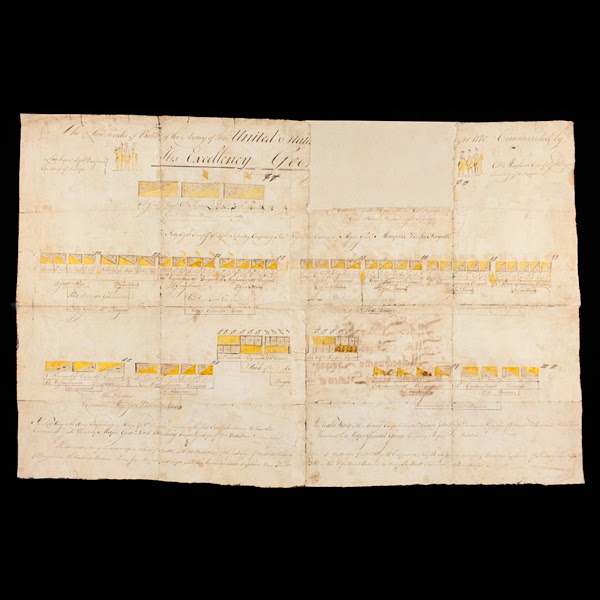
Historic Deerfield just announced that it had conserved a line of battle for Gen. George Washington’s Continental forces drawn up around 1780.

Maj. Moses Ashley (1749-1791) of Westfield was a Yale graduate who joined the fight as a lieutenant in April 1775. In May 1780 he wrote to his commander-in-chief from “the Highlands” in New York asking about a promotion from captain to major. Washington replied that he had to ask his state government.

Heitman’s Register of Officers of the Continental Army says Ashley was major of the 5th Massachusetts Regiment from January 1780 on, so he got his promotion—and got it backdated.

At some point, Maj. Ashley used his time to draw up a contingency plan for a large battle that might happen along the Hudson River. He sketched in each regiment with the name of its colonel and its accompanying cannon. He drew dragoons at the top, as shown above. On the other side he wrote in a decorative hand:
Moses Ashley Esq.
Major Brigade to the 2d
Massachusetts Brigade
in Service United States of
America
Historic Deerfield acquired the Ashley document at auction three years ago. Having been folded for many years, the paper was creased and split, and one segment was lost.

Paper Conservator Rebecca Johnston of the Williamstown Art Conservation Center reconnected the pieces, reduced the staining, and stabilized the document for the future. Her work was supported by the Massachusetts Society of Cincinnati, of which Maj. Ashley was an original member.

Historic Deerfield will display this document with care to preserve it. A full-size facsimile will be available for researchers at the Society of Cincinnati Library in Washington, D.C. There are also detailed images of the document here, though that site might need its security certificate updated.

Wednesday, March 10, 2021

Deerfield Textile Forum on “Invisible Makers,” 10 Apr.

On Saturday, 10 April, Historic Deerfield will host a virtual forum on “Invisible Makers: Textiles, Dress, and Marginalized People in 18th- and 19th-Century America.”

The event description says:
Globalized manufacturing in the 21st century has stimulated a greater need to understand where, how, by whom, and under what conditions our clothing is made. In the past, the weaving of textiles and making of everyday clothing has largely been perceived as anonymous, most especially with regard to marginalized people living in white societies. Research into the efforts of Black, Indigenous, and other people of color to design, produce, acquire, and modify textiles and dress within the Anglo-European, North American framework has historically been difficult to quantify because of a paucity of surviving evidence as well as limited attempts both past and present to record and credit those efforts.

Lectures from a dynamic roster of academic and museum professionals promises to enrich and deepen current conversations about fashion both past and present, discussing examples of the important roles and contributions of BIPOC textile and clothing producers and consumers from the past. Presented as case studies, the research includes textiles and clothing produced by forced labor within plantations; people of color working as tailors and dressmakers in Massachusetts; and marginalized people who fashioned their dressed bodies using Anglo-European garments in ways that both subverted normative styles while expressing “other” cultural identities.
Here’s a sample of the scheduled presentations:
  • “Someone Knows My Name: A Framework for Researching the Lives and Experiences of Under-represented Craftspeople in Early America,” Tiffany Momon, Assistant Professor of History, University of the South
  • “Luxury Slaves, Negro Governors, and Jim Crow: Black Dandy Beginnings,” Monica L. Miller, Professor of Africana Studies and English, Barnard College, Columbia University
  • “‘A boy’s shirt for Waghrosra’s wife’s son’: The Global History of an Early American Indigenous Trade Garment,” Laura Johnson, Linda Eaton Associate Curator of Textiles, Winterthur Museum
  • “Behind the Seams: Enslaved Labor in the 1770s Boston Tailoring Trade,” David E. Lazaro, Curator of Textiles, Historic Deerfield
This program will be presented live via Zoom webinar. The link to the webinar will be sent to registrants before the event, and recordings will be available to registrants for two weeks afterward.

The basic cost for the webinar is $60, $50 for Historic Deerfield members, and $45 for students. People newly joining Historic Deerfield can obtain a year’s membership (normally $50) and registration for this webinar for a single price of $85.

For more information and to register, go to this page.

Saturday, January 30, 2021

Online Architecture History Courses from Marblehead and Deerfield

This week I heard about two online courses on New England architecture being taught in the coming weeks.

For the Marblehead Museum, Judy Anderson will speak about “The Architectural History of Marblehead” and how the town’s buildings reflect its development over 350 years. Anderson has delivered versions of these talks at the museum and for the town, and now she’s going digital.

This course will take place over four Wednesdays, 10:00 to 11:30 A.M., with this schedule:
  • 3 February: British settlement in 1629 and boom town through the 1760s
  • 10 February: Georgian style developing across the 1700s until the economy crashed during the war
  • 17 February: Post-Revolution “Federal” style, the 1830s recovery, and Abbot Hall cornerstone laid in 1876
  • 24 February: Major fires in 1877 and 1888, the town as a resort, post-World War development
The sessions will explore topics like why Marblehead streets and houses look the way they do, the major defining elements of each architectural period and style, and how economic conditions and national events affected the town’s houses.

The cost for this course is $60, or $50 for Marblehead Museum members. Register at this webpage.

In March, Eric Gradoia, Historic Deerfield’s Director of Historic Preservation, will explore “The Vernacular Architecture of Early New England” for that museum.

These talks will trace the evolution of the dwelling house with respect to architectural trends, advances in technology, and social customs. Gradoia will focus on vernacular architecture: common buildings, purpose-built, that employ local building traditions and materials in their construction.

Each session will cover a distinct period from the seventeenth to the mid-nineteenth century. Talks will cover typical house forms, building plans, construction practices, and architectural details unique to each period, along with discussions on such broader themes as architectural treatise and print material, the transition from craft-based building practices to machine-manufactured materials, and design movements and public tastes.

This course will also take place on Wednesdays, but from 6:00 to 8:00 P.M.:
  • 3 March: First Period: English Tradition and the New World Dwelling
  • 10 March: Georgian Architecture: New England Classicism and the Rural Residence
  • 17 March: Federal Architecture: The Refined and Elegant House
  • 24 March: Greek Revival and Picturesque Architecture: Building in the Age of Technology
Gradoia will present live via Zoom webinar, with a link sent to registrants prior to the event. Recordings will be available to registrants for up to 30 days after each session.

The cost for this Historic Deerfield course is $125, $110 for members, and $80 for students. Register online at this page.

Saturday, September 05, 2020

The Power of Preserved Iconoclasm

Back in December 2015 I wrote several postings on incorporating the power of iconoclasm—the destruction of images—into historical monuments and commemorations.

Those thoughts were provoked by a talk by Wendy Bellion, author of Iconoclasm in New York: Revolution to Reenactment, who started with New Yorkers pulling down a statue of King George III after their first public reading of the Declaration of Independence.

Then, she noted, the city kept that plinth empty for decades, reenacted the destruction in ceremonies (which entailed creating new statues of George III), and collected and displayed the surviving bits of statuary. The remnants and recreations kept that destructive act and its meaning fresh in people’s eyes.

Incorporating the power of such iconoclasm is more than the one-time, permanent destruction of a statue or monument. It means finding a way to preserve the act of iconoclasm itself, thus recognizing the original object, the popular objections to it, and how society changed.

One of my favorite examples of this approach is in the Memorial Hall Museum in Deerfield, where updated cloth panels now hang over the original stone panels on a memorial to the 1704 raid on the town. Visitors can thus learn about that event, about how it was understood in the late 1800s, and about how we can view it today with added knowledge and multiple perspectives.

There are spontaneous examples of such iconoclasm, as when college students feathered a statue of Thomas Jefferson with Post-It notes registering their distaste with some aspects of his life. The result recognizes both Jefferson’s lasting importance and how he exploited other people. This year the plinth of the giant statue of Robert E. Lee in Richmond was likewise turned into an expression of community rejection of what Confederate general fought for.

Lasting iconoclasm can even be built into a monument from the start, as in the Saratoga Battle Monument, which has niches for four statues of American commanders but only three statues (of Horatio Gates, Philip Schuyler, and Daniel Morgan). Nearby is the Boot Monument, erected in 1887 in honor of an American general wounded in the Battle of Saratoga but never named on the stone. The missing man is Benedict Arnold, and the way he’s erased shows the national distaste for how he betrayed the Continental Army.

Vulture just highlighted another example of monumental iconoclasm from Australia, an outdoor exhibit that ends this weekend. This year is the Sestercentennial of Capt. James Cook’s first landfall on Australia. Statues of him have become controversial not so much for what he himself did on that continent but for the imperial conquest that his arrival launched and the idea that he “discovered” and “claimed” an already populated continent.

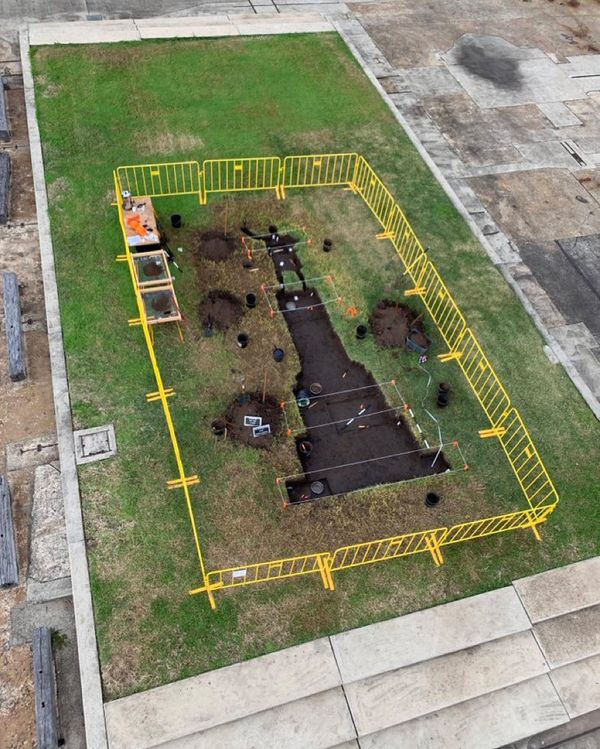
As a response to that 250th anniversary, Nicholas Galanin, an Alaskan artist, dug a hole in a field on Cockatoo Island (shown above) that matches the prominent statue of Capt. Cook elsewhere in Sydney. The work is called “Shadow on the Land.” It’s also a symbolic grave for the monument. This work certainly doesn’t celebrate Cook, of course, but it can’t help but acknowledge his historic significance. Imagine it dug permanently at the foot of the actual statue.

Closer to home, the city of Charleston removed its large statue of slavery advocate John C. Calhoun and more recently pulled down the towering pillar it rested on. Segments of the granite column buried themselves in the ground. I believe the city has already started moving those stones away, but I think for a moment the spontaneous ruin formed a more powerful monument to historical change than anything the city could build in that spot.
COMING UP: What do we do with a problem like Faneuil?

Monday, August 24, 2020

“Material Culture of Sugar” Webinar from Historic Deerfield, 26 Sept.

Way back in April, Historic Deerfield was going to host a one-day forum on sugar in early New England culture. But then people recognized the Covid-19 virus had started to spread in this country, and institutions postponed their public events for a few months.

The virus is still spreading, the national government hasn’t committed to an effective strategy to stop it, and even in parts of the country where the pandemic seems more under control we have to be careful. Responsible institutions have therefore reconciled themselves to smaller gatherings and online events.

Historic Deerfield has now announced that “The Bitter and the Sweet: The Material Culture of Sugar in Early New England” will be a digital event on Saturday, 26 September. Here’s the event announcement:
I own I am shocked at the purchase of slaves…
I pity them greatly, but I must be mum,
For how could we do without sugar and rum?
—William Cowper, Bristol Gazette, June 12, 1788
Sugar is a sweet part of our everyday lives, but one with a bitter history. The insatiable demand for sugar transformed the global economy, generated new sources of commercial wealth, and fueled an unprecedented human diaspora. Domesticated in New Guinea more than 10,000 years ago and first processed in India and the Middle East, sugar emerged as a New World commodity in the 15th century. At first a rare and expensive luxury restricted to the elite, demand for sugar as an indispensable product increased exponentially during the 17th and 18th centuries in tandem with the rising popularity of the tea, coffee, chocolate, and punch it sweetened.

Grown and processed by enslaved Africans in the Caribbean, sugar formed one of the three legs of the trans-Atlantic triangular trade that flourished from the 16th through the 19th centuries. New England merchants sent barrel staves, building materials, provisions, and livestock to the West Indies enabling plantation owners to convert every available acre to sugar cultivation. Ships carried sugar and molasses from the plantation colonies of the Caribbean to New England rum distilleries. Merchants then shipped rum to Africa in exchange for ever-larger numbers of enslaved people carried back to the Caribbean to produce more and more sugar.

This one-day forum brings together a diverse group of historians, curators, and archaeologists to focus on the material culture and history of sugar in New England, including issues of wealth, power, refinement, status, social justice, and politics.
The speakers will include:
  • Mark Peterson on how the rise of large-scale sugar production in Barbados rescued the New England colonies from economic collapse and provided dynamic growth through the colonial period.
  • Brandy S. Culp on the material world fueled and shaped by sugar, encompassing the history of the trade and its human impact to the goods generated around its use.
  • Justin DiVirgilio on the social and political context in which rum distilleries operated, using archeological evidence about a distillery in mid-18th-century Albany.
  • Amanda Lange on the varieties of cane sugar used in 18th- and 19th-century New England households and the objects associated with tea, coffee, chocolate, and punch.
  • Dan Sousa on the museum’s newly acquired group of anti-slavery ceramics, reflecting how sugar production was intimately bound up with slavery.
  • Barbara Mathews on maps and artifacts demonstrating the relationships between Brazil, the Sugar Islands, New England, and the leading European powers.
The cost for the all-day program is $60—less than for the in-person forum, but then you’re providing your own lunch and there’s no hearth-cooking demonstration to produce a snack at the end of the day.

See the event announcement for more details, including the exact schedule, biographies of the speakers, and how to register.

Tuesday, May 19, 2020

Remembering Joseph Peter Spang

Earlier this month, Joseph Peter Spang died at the age of eighty-five. I had the honor of meeting him at the Dublin Seminar for New England Folklife, which took place in the white church at Historic Deerfield.

To be frank, I was deathly afraid Peter would trip over my extension cord in his trips up and down the aisles, greeting everyone and offering words of encouragement.

At Antiques and the Arts Weekly, Donald Friary wrote about Peter’s career at Deerfield:
Soon after his return from [study at the Courtauld Institute in] London, Peter learned that Helen and Henry Flynt were seeking a fledgling curator to assist them in managing their growing collection at Deerfield.

Under the tutelage of artist and Deerfield descendant Elizabeth Fuller, Abbott Lowell Cummings of the Society for the Preservation of New England Antiquities, and the local historical researcher Amelia “Mimi” Miller, Peter learned the history of Deerfield and became acquainted with the remarkable survival of books, manuscripts and objects at the Pocumtuck Valley Memorial Association and in Deerfield families.

He worked with steady, but gentle, persuasion to direct the Flynts to focus their collecting and furnishing more closely on Deerfield. He was for more than ten years the only professional staff member at Historic Deerfield and was involved with everything – the library, educational programming and lecturing near and far on the Deerfield project.
Phil Zea and Joseph P. Gromacki of Historic Deerfield wrote:
As Historic Deerfield’s founding curator, he began work for Henry and Helen Flynt on September 19, 1959 at 3:30 p.m. His legendary attention to detail and his memory, forged as a staff member and then a long-time trustee, became both a signature and tool.

Peter was first and foremost a steward of his adopted town. He valued tradition, collectors, and collecting anything—especially ocean liner memorabilia and architectural pattern books, the latter now housed in our Joseph Peter Spang III Rare Book Room at the Memorial Libraries. His commitment to Deerfield was the central thread of our institutional history for three generations of museum visitors, supporters, trustees and staff members, and most particularly students.

Peter loved to participate in scholarship. He mentored every one of the 450+ Historic Deerfield Summer Fellows since the program’s founding in 1956, and surely none have ever forgotten him. Peter also mentored generations of staff members at both Historic Deerfield and the Pocumtuck Valley Memorial Association. He shaped the how behind the what for many of us in the arts, humanities, and antiques marketplace. Peter knew the value of storytelling and documentation, and he wedded them together “in the best documented small town in America.”
Historic Deerfield has established the Joseph Peter Spang III Memorial Fund to “support the preservation of Deerfield’s deep cultural history and the dissemination of the town’s most inspired national stories.”

Friday, January 17, 2020

Dublin Seminar to Look at “Living with Disabilities”

The Dublin Seminar for New England Folklife has announced the subject of this year’s conference: “Living with Disabilities in New England, 1630–1930.”

The conference will be held in Deerfield, Massachusetts, on the weekend of 19-21 June 2020. The Dublin Seminar strives to be a meeting place for scholars, students, and committed avocational researchers. Professional development points are available for public school teachers who participate.

The Dublin Seminar is now accepting proposals for papers and presentations at this conference that address the history of people living with disabilities in New England and adjacent areas of New York and Canada from the seventeenth to the early twentieth centuries. The principal topic examined by this conference is how children and adults with disabilities experienced disability in everyday life.

Proposals might address the following questions:
  • How was disability defined during this period?
  • How did gender, race, and class intersect with the experience and meaning of disability?
  • What was the relationship between the law and disability?
  • How did people with disabilities interact with institutions ranging from religious organizations to state-sponsored hospitals to schools?
  • What is the history of disability within the context of military or industrial settings?
  • How did people with disabilities interact with material culture and technology, including but not limited to assistive technologies such as artificial limbs and hearing aids; clothing; landscapes and buildings; and service animals?
  • What is the relationship between medical history and disability history?
The Seminar encourages papers that reflect interdisciplinary approaches and original research, especially those based on material culture, archaeological artifacts, letters and diaries, vital records, federal and state censuses, as well as newspapers, visual culture, business records, recollections, autobiographies, and public history practice or advocacy at museums, archives, and elsewhere.

The “Living with Disabilities in New England, 1630–1930” conference will consist of approximately seventeen lectures of twenty minutes each. Selected papers will appear as the 2020 Annual Proceedings of the Dublin Seminar to be published about eighteen months after the conference.

To submit a paper proposal for this conference, please submit (as a single email attachment, in Word or as a pdf) a one-page prospectus that describes the paper and its sources and a one-page vita or biography by 10 Mar 2020. Send proposals to dublinseminar@historic-deerfield.org.