J. L. BELL is a Massachusetts writer who specializes in (among other things) the start of the American Revolution in and around Boston. He is particularly interested in the experiences of children in 1765-75. He has published scholarly papers and popular articles for both children and adults. He was consultant for an episode of History Detectives, and contributed to a display at Minute Man National Historic Park.

Subscribe thru Follow.it


•••••••••••••••••


Showing posts with label Patrick Carr. Show all posts

Friday, September 05, 2025

“Lt. Hawkshaw yesterday near expiring thro. his bad wounds”

During the British army withdrawal on 19 Apr 1775, Lt. Thomas Hawkshaw of the 5th Regiment was shot in the side of his face.

As recorded by his regiment’s surgeon, blood gushed from his nose and mouth as well as his wound. Some of the affected tissue became inflamed. He had trouble swallowing.

People thought Lt. Hawkshaw was lying on his deathbed. And according to legal and popular understandings of the time, that meant he couldn’t lie in another way. After all, a person wouldn’t utter a falsehood just before meeting his maker, right?

Or, as a legal maxim quoted in 1700s reference books said: Nemo moriturus præsumitur mentiri. A dying person is not presumed to lie.

Usually that “dying declaration” doctrine allowed testimony from a dead victim that would otherwise be ruled out as hearsay. Thus, Patrick Carr’s doctors could report his remarks about the soldiers holding back before the Boston Massacre in 1770. To discredit such strong evidence, Samuel Adams had to resort to sneering that Carr “in all probability died in the faith of a roman catholick.”

The same thinking made “deathbed confessions” convincing. In the case of Lt. Hawkshaw, word went around that as his life slipped away he blamed the army for starting the war. Justice of the peace Edmund Quincy wrote to John Hancock on 22 April:
Here they say & swear to it all round, in excuse of ye Regulars, proceeding at Lexinton—that they were attack’d first & I doubt not many oaths of Officers & men are taken before J. G—ley [Justice Benjamin Gridley], to confirm it—but among others who contradict ’em—Lt. Hawkshaw yesterday near expiring thro. his bad wounds——Call’d Several Credible persons to him & told ’em as a dying man—that he was obliged in Conscience to confess—that the first Action of ye Whole at L. was done by the Kings troops—wr. they killd & wounded eight men—but doubtless you have sufficient proof of ye Fact & every Circumstance attending near at hand— . . .

Capt. [John] Erving, at his house yesterday Gave me ye Account of Hawkshaws Confesso.-proved to him at ye No: End yesterday to be real
As discussed here, Quincy gave that letter to Dr. Benjamin Church, Jr., who slipped it to Gen. Thomas Gage. Which meant Lt. Hawkshaw’s commander read that he was contradicting the official army line.

TOMORROW: A quick response.

Wednesday, March 03, 2021

The Boston Massacre’s Political Resonance

The Boston Massacre was a political event, of course.

It arose from conflicts between sources of authority—the imperial government and the town government, the British army and the local community, two groups of people feeling threatened and in the right.

In the immediate aftermath, the Whigs memorialized that event as part of that larger political campaign. Then in 1783, when independence had been won and the U.S. of A. was no longer part of internal British politics, Boston stopped commissioning orations every March.

The Massacre gained new political meaning in the mid-1800s as William Cooper Nell and other abolitionists used the figure of Crispus Attucks to argue that Americans of African descent had long been central to the nation and deserved equal rights.

As Mitch Kachun traces in First Martyr of Liberty, Attucks became an emblem of African-American patriotism in the late nineteenth and early twentieth centuries. When Boston erected a monument to the Massacre victims on the Common in 1889, black civil rights campaigners had been among its strongest proponents, and it was informally called “the Crispus Attucks monument.” (Not to be left out, Irish-Americans pointed to Patrick Carr and German-Americans to Christopher Seider as important martyrs.)

Other African-American heroes and models became prominent in the twentieth century, and Attucks’s name lost some of its resonance. In Boston, Melnea Cass revived the tradition of Crispus Attucks Day, shown in this photograph from 1970. His inspiration and her legacy will be discussed at Revolutionary Spaces’s ”Grief, Remembrance, Justice” online panel discussion on 5 March at 5:00 P.M.

Two months after that 1970 anniversary, National Guardsmen shot and killed four student protesters at Kent State University. Within days, Eric Hinderarker reports in Boston’s Massacre, someone published the poster shown above, paralleling the shooting on King Street and the shooting in Ohio. At almost the same time, Mississippi police officers killed two more students at Jackson State University.

Blacks were not the only Americans seeing their cause reflected in the Massacre of 1770. In Boston, the Bicentennial coincided with a federal court instituting busing to integrate schools. One of the more militant white groups resisting that order, R.O.A.R., attended the 1775 Massacre reenactment in force. When the muskets fired, as J. Anthony Lukas recounted here, scores of those protesters fell down, too—assuming the role of victims of an oppressive government.

The 1999 reenactment was the first I attended in a long time. It came a month after New York detectives had killed an African immigrant named Amadou Diallo, shooting 41 rounds at the unarmed man sitting on his front stoop. The current issue of the New Yorker, dated 8 March, showed a white policeman at a fairground shooting booth with a sign that read “41 Shots 10¢.” At the reenactment, I recall hearing a couple of spectators shout, “Forty-one shots for a dime!”

Last May after a peaceful Black Lives Matter protest on Boston Common, Boston police forcefully went after straggling groups of protesters, resulting in arrests, looting, and vandalism. There was slight damage to some historic sites and statuary. In subsequent days the governor called out the state militia, and Jake Sconyers caught a resonant image of a military vehicle parked in front of the Old State House on a spot where some of the crowd had stood on 5 March 1770.

As long as we have conflicting sources of authority, as long as groups feel threatened, rightly or wrongly—in other words, for the foreseeable future—the Massacre will continue to have contemporary political resonance.

Monday, January 18, 2021

Dr. Jeffries and Dr. Warren

When I started looking at Dr. John Jeffries’s records of caring for young smallpox inoculatees in June 1775, I hoped to find clues to his whereabouts during that month.

For almost two hundred years at least, a story has circulated about Jeffries and Dr. Joseph Warren meeting that June, and it’s always struck me as dubious.

To review, Dr. Jeffries (1745-1819) was son of Boston’s treasurer, David Jeffries, and protégé of Dr. James Lloyd. He thus had strong links to both the town’s Whig establishment and to friends of the royal government. Dr. Jeffries dined with the Sons of Liberty in August 1769, but in November 1770 Lloyd and Jeffries testified for the defense in the Boston Massacre trial. The two doctors described the victim Patrick Carr’s dying words, which helped to absolve the soldiers.

That testimony appears to have put Jeffries in the Loyalist camp. The next year, he accepted a sinecure appointment as a Royal Navy surgeon. He evacuated Boston with the British military in 1776, became a military surgeon, and spent the war either with the Crown forces or in London seeking higher positions.

In peacetime, Dr. Jeffries used his money to become a pioneering balloonist, or at least balloon passenger. But eventually the cost of living in the imperial capital and the lure of an inheritance in Massachusetts sent him back home. He reestablished his family and elite practice in Boston.

In 1825, six years after Dr. Jeffries died, Samuel Swett published his pioneering study of the Battle of Bunker Hill. He wrote this about the identification of Dr. Warren’s body on the morning after the battle, 18 June 1775:
Dr. Jeffries was on the field dressing the British wounded, and the wounded American prisoners, with his usual humanity and skill. [Gen. William] Howe inquired of him if he could identify Warren; he recollected that he had lost a finger nail and wore a false tooth, and informed the general that Warren had five days before ventured over to Boston in a canoe to get information, invited Jeffries to join the Americans as surgeon, and informed him that he was himself to receive a commission in the army.
Swett probably heard that story from Jeffries’s family. It’s certainly complimentary to the late physician, with its superfluous mention of “his usual humanity and skill.” And of course the idea that the heroic Warren had thought enough of Jeffries’s skills to try to recruit him was a ringing endorsement.

TOMORROW: A longer version of the story.

Tuesday, February 11, 2020

The Great 1770 Quiz Answers, Part 1

Thanks to everyone who puzzled over the Great 1770 Quiz, whether or not you entered answers in the comments!

It looks like the competition is down to John and Kathy since they answered both parts. If I try this again I hope to remember the bunch all the questions in one posting.

In this Age of Google, it’s increasingly easy to find information—as long as one knows how to ask and how to assess sources. That means it’s also increasingly difficult to come up with trivia questions that can’t be answered with a few keystrokes.

This week I’ll share the answers to the questions and point to sources where people could find those answers. So let’s go!

I. Lord North became prime minister of Britain in January 1770. On March 5, the date of the Boston Massacre, what motion did he make in Parliament?

The answer is that on 5 Mar 1770 Lord North stood up and proposed in the House of Commons that Parliament repeal the duties on glass, paper, lead, and painter’s colors instituted by the Townshend Act.

Simply Googling the phrases “Lord North,” “Parliament,” and “March 5, 1770” (each phrase within quote marks, of course) brings up that answer in this essay at History Is Fun.

But of course an online tertiary source should be confirmed, ideally with period references that would pass muster in scholarship. The Annual Register for 1770 describes North’s proposal and the debate next to the date “March 5.”

Notably, that account doesn’t use Lord North’s name. It simply refers to “the government,” which he headed. British printers in this period were still testing the water of reporting Parliamentary debate, so they often didn’t identify speakers by name.

A few years later, however, an anonymous author rewrote the Annual Register into A View of the History of Great-Britain, during the Administration of Lord North, and that book was explicit about Lord North’s action:
One of the first acts of the new minister, was the bringing in a bill [footnote: March 5, 1770] for the repeal of so much of a late act of parliament as related to the imposing of a duty on paper, painters colours, and glass, imported into America; the tax upon tea, which was laid on by the same act, was still continued.

This repeal was made in compliance with the prayer of a petition, presented by the American merchants to the house of Commons, setting forth the great losses they sustained, and the fatal effects produced by the late laws, which for the purpose of raising a revenue in the colonies, had imposed duties upon goods exported from Great-Britain thither.
Both books report that some Members of Parliament proposed repealing the tea tax as well. Again, the names of those politicians don’t appear. But in a 1908 biography Charles A. W. Pownall credited his ancestor, former Massachusetts governor Thomas Pownall, with forcing a vote on that issue. Pownall lost, and the tea tax remained.

All four people who responded to this question—kmjones234, Kathy, Justin C, and John—answered correctly!

II. According to the records of King’s Chapel, which of the following events did NOT occur in that church in early 1770?
  • the funeral of Christopher Seider, killed by Ebenezer Richardson
  • the funeral of Patrick Carr, killed in the Boston Massacre
  • the baptism of Ebenezer Richardson, on trial for killing Christopher Seider
  • the marriage of John Murray, representative to the Massachusetts General Court from Rutland
Last November I featured the Colonial Society of Massachusetts’s online publication of the records of King’s Chapel, which inspired this question. The second of those two volumes contains the records on baptisms, marriages, and funerals.

In those webpages we can find mentions of all four of the events listed above: John Murray’s wedding on 24 January, Christopher Seider’s funeral on 26 February (though his name is spelled “Sider”), Patrick Carr’s funeral on 17 March, and Ebenezer Richardson’s baptism on 14 April.

The funerals included processions through the streets, but some religious service evidently took place in King’s Chapel or else they wouldn’t be recorded here. However, the listing for Richardson’s baptism says it took place “In Prison” rather than in the church, so that’s the correct answer.

Richardson’s was an unusual “Adult” baptism in the Anglican church. The man’s birth in 1718 is listed in the records of Woburn’s meetinghouse, indicating that he’d been baptized as an infant there, but in April 1770 he apparently wanted more salvation. Since he was about to go on trial for killing a child and none of the lawyers in Boston wanted to represent him, Richardson evidently felt he could use all the help he could find.

This question may have been too tricky by half because no one got it entirely right, but John noted all four events are in the King’s Chapel records while Kathy discerned that Richardson was in jail.

TOMORROW: Weapons and the legislature.

Wednesday, October 11, 2017

“All interred in the same grave with him”

Yesterday I started to look into the question of whether Christopher Seider, memorialized on a stone in the Granary Burying-ground, was actually buried there in 1770.

Celebrate Boston’s page on grave-robbing [perhaps an odd topic to celebrate] says:
Christopher Snider, 1st Martyr to the Noble Cause, was likely buried at Central Burying Ground, and not at Granary as commemorated.
As evidence, the page points to a statement about little Seider that Gov. Thomas Hutchinson put into his history of Massachusetts:
A grand funeral was, however, judged very proper for him. Young and old, some of all ranks and orders, attended in a solemn procession from liberty tree to the town-house, and then to the common burying ground.
The Seider family lived near the south end of Boston Common on Frog Lane (now Boylston Street). So it might make sense to place his body in the cemetery nearest their house—what we now call the Central Burying Ground (shown above, courtesy of Wikipedia).

The problem with that analysis is that the phrase “common burying ground” didn’t rule out the Granary Burying Ground because that, too, had been carved from land originally assigned to Boston Common. Nathaniel B. Shurtleff’s A Topographical and Historical Description of Boston confirms that the cemetery beside the Granary was sometimes called by the Common Burying Ground. Hutchinson might also have used the word “common” to mean not the Boston Common but the tombs and graveyard space that Boston owned collectively.

Likewise, at different times Bostonians referred to both the Granary Burying Ground and the Central Burying Ground as the South Burying Ground and as the Central or Middle Burying Ground. As more cemeteries were opened to the south, the labels shifted. In 1770 the middle cemetery was the one beside the town granary.

We have clues from period newspapers about where Christopher Seider was buried. We start with the report of the funeral for the first four victims of the Boston Massacre, published on 12 Mar 1770 in both the Boston Gazette and Boston Evening-Post:
The Bodies were deposited in one Vault in the middle Burying-ground
Furthermore, the 19 March Gazette said Patrick Carr was interred in the same vault:
His Remains were attended on Saturday last from Faneuil-Hall by a numerous and respectable Train of Mourners, to the same Grave, in which those who fell by the same Hands of Violence were interred the last Week.
A year later, the 7 Mar 1771 Massachusetts Spy reported:
On Tuesday last the anniversary of the Boston Massacre, at noon, and after nine in the evening, all the bells in town tolled; and at dark was exhibited in the chamber window of Mr. [Paul] Revere in the Old-North square, a set of transparent paintings, representing, in the fourth window a monumental obelisk, bearing in front the bust of young Seider; and on the front of the pedestal, the names of the five persons murdered by the soldiery on the fifth of March, and all interred in the same grave with him:
Thus, contemporaneous newspapers stated that all the Massacre victims and little Christopher Seider were interred in the same vault in the Middle or Granary Burying Ground. Which means the 1906 stone in that cemetery today doesn’t have to move. (Phew!)

TOMORROW: The missing monument.

Monday, March 04, 2013

Charles Bahne on the Scene of the Massacre

As we approach the anniversary of the Boston Massacre on 5 March, Charles Bahne, author of The Complete Guide to Boston’s Freedom Trail, kindly shared this essay analyzing what may be our earliest visual source on the question: What did the Boston Massacre look like?

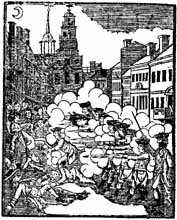
Besides the depositions and testimony given by eyewitnesses to the Boston Massacre, we have two contemporary pictorial depictions of the incident. Better known of the two is the copperplate print of “The Bloody Massacre”, “Engrav’d Printed & Sold by Paul Revere, Boston.” As discussed here, Revere’s print of the Massacre was copied—some say plagiarized—from an almost identical image by Henry Pelham.

The Revere/Pelham print is an accurate portrayal of the setting for the Massacre — the buildings, the starry night with its crescent moon, the overall streetscape. But its depiction of the events is far less accurate; issued as part of the radicals’ propaganda efforts, it contains some deliberate distortions. And to compress the entire action into one image, the perspective was foreshortened, placing the victims in much closer proximity than they really were.

For a more accurate depiction, we look to the above image, also attributed to Paul Revere, but with less certainty, since it’s unsigned. (Mellen Chamberlain, who gave this document to the Boston Public Library, said that the handwriting matched Revere’s.) Unlike the more famous print, which was fairly widely distributed, this image existed only in manuscript and wasn’t circulated publicly until over a century later.

We’re looking at a plan or map of the action that evening, drawn from an overhead perspective. North is at right, west at top. In the upper center the Town House (Old State House) is prominently marked. Rows of buildings line either side of King Street (State Street), with other streets branching off to right and left.

But while this plan is a more accurate portrayal of the Massacre events, it also has its limitations. Four bodies lie in the street, some drawn in intricate detail, along with six circles, which apparently show the injured townsfolk. That makes a total of ten victims, but eleven people were actually shot—five dead and six wounded.

At extreme upper right is a seventh circle, unlabeled by the artist and unnoticed by any earlier commentator. Could this be the eleventh victim, or is it something else entirely, being so remote from the rest of the action?

All four bodies, and five of the circles for the wounded, are labeled with letters. Two letters clearly match the names of the slain: A for Attucks and G for Gray. But the other two bodies are marked C and G, only a partial match with the other martyrs, Caldwell, Carr, and Maverick. The circles are labeled with three Ps and two Ms; the six wounded citizens were Payne, Patterson, Parker, Monk, Clark, and Green.

Some discrepancy may have been caused by the belated deaths of Patrick Carr and Samuel Maverick. Was one of them considered wounded, rather than killed, when the plan was drawn?

Still, there are just nine letters in this plan. With eleven known victims, we’re missing two Cs; while a G and an M appear to have been switched between the injured (Green) and the deceased (Maverick).

At lower right, in front of the Custom House, stands a curved line of seven soldiers—not the eight who were actually there. Some historians have theorized, partly on the basis of this plan, that one of the regulars may have stood behind the others, not in line with his colleagues.

Unfortunately, the meaning of the letters, numbers, and circles must remain a matter of speculation. If a key to the plan was created, it’s been lost. Some say that a key was written on the back of the paper, which has since been glued to a board, permanently obscuring whatever it may once have said.

In their recent books about the Massacre, Neil York and Richard Archer both attempt to match the bodies and circles with the names of the fallen citizens—and they disagree. (Neil York consulted with me on this, and cites me in his book.)

The bottom line is that we know with some certainty where Crispus Attucks and Samuel Gray fell, next to the soldiers, and where Edward Payne was hit, standing on his doorstep at lower left. James Caldwell is one of the other bodies shown on the plan, probably the prominent one in the middle of the intersection. As for the other victims, we can only guess who fell where.

TOMORROW: How the scene looks today.

Sunday, March 06, 2011

“O’er thy Pile shall Flames celestial burn”

Yesterday, a couple of my favorite local blogs observed the anniversary of the Boston Massacre with complementary poetry. [Actually, one of the blogs observed the anniversary last year, with a tweet reminder yesterday, and I didn’t notice the older date. I should probably check the dates I’m writing on checks as well.]

Rob Velella’s American Literary Blog reprinted Phillis Wheatley’s poem on the death of Christopher Seider (which she spelled “Snider”) on 22 Feb 1770. It also mentioned her poem about the Massacre, known from its title but not in her first collection—most likely because that book was printed in London, where the event had a very different political value.

William Henry Robinson’s 1984 edition of Wheatley’s writings and a 1998 article in the journal The Explicator by Antonio T. Bly suggested that the lost Wheatley poem was in fact printed anonymously in the 12 Mar 1770 issue of the Boston Evening-Post. Yesterday Caitlin G. D. Hopkins’s Vast Public Indifference blog reprinted those lines along with some thoughts about how the newspaper presented them. Here they are:

With Fire enwrapt, surcharg’d with Death,
Lo, the pois’d Tube convolves it’s fatal Breath!
The flying Ball with heav’n-directed Force,
Rids the free Spirit of it’s fallen Corse.

Well fated Shades! let no unmanly Tear
From Pity’s Eye, distain your honour’d Bier:
Lost to their view, surviving Friends may mourn,
Yet o’er thy Pile shall Flames celestial burn;
Long as in Freedom’s Cause the Wise contend,
Dear to your Country shall your Fame extend;
While to the World, the letter’d Stone shall tell,
How Caldwell, Attucks, Gray, and Mav’rick fell.
At the time, Patrick Carr was still clinging to life. He would die two days later, bringing the official number of victims to five. However, Christopher Monk, badly wounded and apparently disabled as a teenager, may have died of complications years later.

Friday, March 06, 2009

Bostonians and “Irish Teagues”

The silliest explanation for the Boston Massacre I’ve seen comes from Stuart A. P. Murray’s Smithsonian Q & A: The American Revolution, published in 2006.

Q: What made Boston such a hotbed of unrest and eventually the seat of open rebellion in the colonies?

A: The fact that Boston had a large anti-English Irish population was not the least of the factors involved in Boston’s radical temperament. . . .

That there often were brawls between soldiers and civilians should have surprised no one, since many Bostonians were Irish and the soldiers came to the city directly from serving in restive Ireland.
In fact, Boston and Massachusetts as a whole had a large anti-Irish English population. Eighty-five percent of the provincial population was English, according to Jon Butler’s Becoming America; less than ten percent was Irish, Scottish, and Welsh combined. Boston society was much less welcoming to non-English immigrants than Philadelphia, New York, Newport, and Charleston, the other four big American ports. Check out the story of young Hector McNeill’s arrival to see how Bostonians welcomed people from Ireland, even Protestants of Scottish extraction.

There were definitely some Irishmen in the crowd on King Street, including victim Patrick Carr and witness Charles Conner, as explained by the latter’s testimony. There were also a few established businessmen from Ireland, such as John Field and James Forrest. Boston’s Irish population was big enough to start a mutual-aid society—but it was excluded enough to need one.

Carr’s presence among the Massacre victims allowed John Adams to characterize the mob on King Street as “a motley rabble of saucy boys, negroes and molattoes, Irish teagues and out landish jack tarrs.” Of course, as a defense attorney he was highlighting the elements of that crowd that seemed most dangerous and expendable. Adams could make that argument because he knew the Suffolk County jury was prejudiced against all those other parts of the population.

The Smithsonian Q & A book misses the major fact that the greatest concentration of Irishmen on King Street that night were the soldiers themselves. Just look at their names:
Boston’s Whigs were happy to tie the soldiers to Ireland, and drop hints about their likely Catholicism.

There are lots of other errors in this Smithsonian Q & A book. Page 26 says that “ten comrades” joined the sentry on King Street, for example, while page 27 says that “seven soldiers” were tried for the shootings; neither figure is correct. But the assumption that the fabled Irish-American dominance of Boston began in the late 1700s is the biggest error, at least in the section about the Revolution in New England, and apparently original to this book.

Thursday, May 31, 2007

John Field: breeches-maker

Back in March, I posted about what little is known of Patrick Carr, one of the victims of the Boston Massacre. He was working for a maker of leather breeches named John Field, and I’ve found more information about that man. Like Carr, Field appears to have immigrated to Boston from Ireland, but he was wealthier.

Church records show that Field’s wife had been named Catherine (or Katherine) Ryan, and they had married at the Presbyterian Meeting-House on 15 Jan 1767. They had their children baptized in Anglican churches: Mary in 1769, Catherine in 1772, John in 1774 (all at King’s Chapel), then Margaret in 1781 and Betsy in 1786 (at Trinity). The family was close to a blacksmith named John Magner and his wife Mary; the couples sponsored the baptisms of each other’s children. In February 1772, Field joined the Charitable Irish Society of Boston; most of its members were immigrants from Ireland.

Field stayed in Boston through the siege of 1775-76 rather than joining the provincials outside. Then he stayed through the evacuation of March 1776 rather than leaving with the British military. The Provincial Congress had him arrested for questioning, but he seems to have been released quickly.

Field might then have tried farming in Chester, Massachusetts. The baptismal record of Margaret Field in 1781 names her father as “John Field of Chester.” In the 13 June 1782 Independent Chronicle, John Field advertised a farm for sale in Chester. But he still owned real estate in Boston; in late 1781 he sold a lot to John Magner.

Another source on John Field are two narratives of a poor black woman from Rhode Island named Phillis Merritt Wanton. In 1784, she testified

that the next day after her Master [John] Merritt [of Providence] died, she was sold by Mr. Overring, the executor, to one Mr. John Field of Boston, a leather breeches maker, and in that month went to live in Boston with the said Field as his servant; that some years ago the said Field told her she might go and get her own living; and that he went away out of the country; whereupon she came to Providence about four years ago
I can date John Merritt’s death to 1770, which would mean Wanton was in the Field household for about ten years, perhaps from the time he moved onto Cornhill, one of Boston’s main streets, until he left town to try farming.

However, in 1800 Wanton described her history differently. She then said that Field had bought her for £100 after Merritt’s death, but then sold her to a “Mr. Peck” of Boston, who granted her freedom “about the time of the blockade of that place by the British.” Wanton may have been trying to shape her history to prevent the Providence officials from ordering her to leave that town—in which case, she was unsuccessful. Both these accounts are transcribed in Ruth Wallis Herndon’s Unwelcome Americans.

The 9 Sept 1800 Massachusetts Mercury reported that “Mrs. Catharine Field, Aet. [i.e., aged] 46, widow of Mr. John Field,” had died. So John had died some time before—perhaps in 1787, when the town granted Catherine a stand in Market Square for selling fruit and vegetables. But what’s most interesting about this notice is that, if the age is correct, John Field had married Catharine when she was only about twelve or thirteen years old.

Thursday, March 15, 2007

Charles Conner Testifies About Patrick Carr

On 15 March 1770, the day after Patrick Carr became the fifth death from the Boston Massacre, coroner Thomas Dawes took this deposition from a man who had been with Carr on the night of the 5th:

I Charles Conner of Boston, of lawful Age being duly sworn to Testify and Say; that on the evening of the fifth of March, between the hours of nine and ten of the Clock in the evening: I was in Kingstreet with Mr. Patrick Carr, the occasion of my going, was the Cry of Fire and bells ringing:

we was their but a few minutes before several Small Arms was fired from a Detachment of Regiment soldiers drawn up near the Custom house

instantly upon the guns firg., the said Patrick Carr, who stood next to me and who had no Stick or any sort of weapon whatever about him, said to me, Conner; that was he wounded

I told him I hoped not, but asisted in carrying said Carr to a House in Fitch’s Alley and imeadiatly went for a Doctor for said Carr; seing of him badly wounded: the said wounds was received by the ball or balls that was fired by said detachment.

It was not the first gun that was fired, by which said Patrick received his wound. but a Second or Third;
The coroner then apparently asked Conner about the size of the crowd because he then wrote, “and semingly not more than 50 or 60 people there,” followed by a footnote:
Almost every one that have given Evidence agree that there was but a few persons in Kingstreet when the Guns were fired Some say about 50 Some 60—Some that there may be thereabouts &c.
This document is in the Chamberlain collection of the Boston Public Library’s manuscripts department, along with many others that seem to have been either rescued or liberated from legal files in the late 1800s.

TOMORROW: Who was this Charles Conner?

Wednesday, March 14, 2007

Patrick Carr: breeches-maker, Massacre victim

On 14 March 1770, a young Irish immigrant named Patrick Carr died in Boston. He had been shot on the 5th, and thus became the fifth (and by most counts the last) fatal casualty of the Boston Massacre.

On the H-OIEAHC email list, someone recently asked why we don’t know more about Patrick Carr. I replied that we know very little about any working-man of the time. In fact, we know more about Carr than about most men of his circumstances because of how he died.

Shortly after the Massacre, Boston’s newspapers had described Carr this way:

Mr. Patrick Carr, about 30 Years of Age, who worked with Mr. Field, Leather-Breeches-Maker, in Queen-Street, wounded; a Ball entered near his Hip, and went out at his Side.
The records of King’s Chapel, from which he was buried, also gave his age as thirty.

Dr. John Jeffries, one of the surgeons who treated Carr’s wounds, testified in the soldiers’ trial, adding a few more details about the man:
he was a native of Ireland, that he had frequently seen mobs, and soldiers called upon to quell them: whenever he mentioned that, he always called himself a fool, that he might have known better, that he had seen soldiers often fire on the people in Ireland, but had never seen them bear half so much before they fired in his life.
In addition, Jeffries said that Carr told him he had left Field’s house when the church bells rang, and was “carried home to Mr. Field’s by some of his friends” afterward.

We also have the trial testimony of Mrs. Catherine Field and John Mansfield, who preceded Dr. Jeffries on the witness stand. They both testified that Catherine’s husband had told Carr, his employee and tenant, not to go out with a sword under his coat. But only an unnamed neighbor woman was able to convince Carr to leave that weapon behind.

Inspired by success in identifying the employer of another Massacre victim, I did a little digging on “Mr. Field, Leather-Breeches-Maker.” Leather breeches were a standard garment for working-men and for boys of all classes, so there was a steady trade in them. It didn’t take long to find records of a man in that business named John Field. In February 1772 he joined the Charitable Irish Society of Boston; most of its members seem to have been immigrants from Ireland, so he might well have been one, too.

In Oct 1770 several Boston newspapers carried this advertisement:
John Field,
Breeches-marker and Glover—takes this Opportunity to Acquaint the Publick, that he as removed from the House he lately lived in, in Queen-street, opposite to the Old Brick Meeting-House, near the Town-House, where he has a large parcel of the best Buck and Doe skin Breeches, and a large Assortment of the best Gloves, which he means to sell by Wholesale or Retail; such Gentlemen as are pleased to favour him with their Custom, may depend on having their Work done in the neatest and best Manner.
George R. T. Hewes, whose memory had proven reliable in many details, recalled Carr’s employer as living “on Prison Lane,” the west end of Queen Street (modern Court Street). So in March 1770 John Field and his household were only a couple of blocks from the site of the Massacre at most. Then at the end of the year they moved around the corner onto Cornhill. (I’m digging deeper into the Fields’ life, and have found some strange holes to discuss sometime.)

Someone’s created a Wikipedia article about Patrick Carr with:
  • a middle name, which was quite rare in the 1700s for lower- and middling-class men.
  • famous descendants, though there’s no hint from Boston records that he was married or had children.
  • a botched transcription of the testimony about him at the soldiers’ trial (since improved).
But that article includes no sources for all that personal information. Obviously, the hunger for information about Patrick Carr, reliable or not, is strong.

Thursday, March 08, 2007

The First Newspaper Reports on the Massacre

In colonial Boston, some newspapers published each Monday, and some each Thursday. Because the Boston Massacre occurred on a Monday evening, the first press reports appeared on Thursday the 8th—237 years ago today. The Massachusetts Gazette and Boston News-Letter listed the casualties this way:

Mr. Samuel Gray, Ropemaker, killed on the Spot, the Ball entred his Head broke the Skull.

A Mollatto Man, named Johnson, who was born in Framingham, but lately belonging to New-Providence, and was here in order to go for North-Carolina, killed on the Spot, two Balls entering his Breast.

Mr. James Caldwell, Mate of Capt. Morton’s Vessel, killed on the Spot, two balls entering his Breast.

Mr. Samuel Maverick, a promising Youth of 17 Years of Age, Son of the Widow Maverick, and an Apprentice to Mr. Greenwood, Joiner, mortally wounded, a Ball went through his Belly, and came out at his Back: He died the next Morning.

A Lad named Christopher Monk, about 17 Years of Age, an Apprentice to Mr. Walker, Shipwright; Mortally wounded, a Ball entered his Side and came out of his Back; apprehended he will die.

A Lad named John Clark, about 17 Years of Age, whose Parents live at Medford, and an Apprentice to Capt. Samuel Howard of this Town; Mortally wounded, a Ball entered just above his Groin and came out at his Hip, on the opposite side, apprehended he will die.

Mr. Edward Payne, of this Town, Merchant, standing at his Entry Door, received a Ball in his Arm, and shattered some of the Bones.

Mr. John Green, Taylor, coming up Leverett’s Lane, received a Ball just under his Hip, and lodged in the under Part of his Thigh, which was extracted.

Mr. Robert Patterson, a Seafaring Man, who was the Person that had his Trowsers shot thro’ in [Ebenezer] Richardson’s affair, wounded; a Ball went thro’ his right Arm.

Mr. Patrick Cole, about 30 Years of Age, who work’d with Mr. Field Leather- Breeches-maker in Queen-Street, wounded, a Ball entered near his Hip and went out at his Side.

A Lad named David Parker, an Apprentice to Mr. Eddy the Wheelwright, wounded, a Ball entered his Thigh.
What seems off about this list? Well, for one thing, though people expected apprentices Christopher Monk and John Clark to die shortly, neither did. Monk remained disabled by his wound for several years before dying, so he’s not memorialized among the standard five Massacre victims.

The Boston Gazette, published the same day, ran a similar list, emphasizing the three wounded apprentices ahead the working-men. The Gazette also gave different names for two men. The first was Patrick Carr, an Irish-born laborer I’ll have more to say about soon. While the two apprentices survived, Carr turned out to have been mortally wounded.

The Gazette also reported the one name people today are most likely to connect to the Boston Massacre: Crispus Attucks. Apparently he was living in Boston under the alias “Michael Johnson,” the name on the coroner’s report on his death (now in the collections of the Old State House Museum). Both the News-Letter and the Boston Chronicle reported the mulatto sailor’s name as Johnson. But the Boston Gazette had the name that appeared on all the subsequent legal proceedings, the name that’s come down in history.

Oddly enough, however, the News-Letter and Gazette had the same description of the man’s history: born in Framingham, working as a sailor out of the Bahamas, in Boston between voyages. Both identified him as mulatto, and therefore didn’t grant him the honorific title of “Mr.” In the 1850s historians found a newspaper ad that implied Attucks had escaped from slavery in Framingham twenty years before, which would explain why he used an alias while back in his home province. But how Bostonians discovered the history of that dead man, and how details reached one newspaper before the others, is still a gnawing mystery.