J. L. BELL is a Massachusetts writer who specializes in (among other things) the start of the American Revolution in and around Boston. He is particularly interested in the experiences of children in 1765-75. He has published scholarly papers and popular articles for both children and adults. He was consultant for an episode of History Detectives, and contributed to a display at Minute Man National Historic Park.

Subscribe thru Follow.it


•••••••••••••••••


Showing posts with label Amherst. Show all posts

Monday, May 25, 2026

“The services of their father in repairing certain cannon”

Preserved Clap was born in Hadley, lived in the part of that town which became Amherst, and ultimately died at age eighty up the Connecticut River in Claremont, New Hampshire.

His headstone appears here courtesy of Find a Grave. His wife Eunice’s stone is nearby.

Clapp probably had earlier ties to that region. The Preserved Clap listed as serving in 1775 in a provincial company recruited largely from Bolton was said to come from Charlestown, New Hampshire, next to Claremont.

There’s also this curious anecdote related by Jaazaniah Crosby in his History of Charlestown in New Hampshire (1833):
On the 18th of June, 1756, while Lieut. Moses Willard was endeavoring to extinguish the fire, which had been kindled in his fence, he was attacked by the Indians, and killed behind the barn of the late Capt. John Willard, and near the academy. At the same time, his son Moses was wounded in the hip by a spear, which is said to have remained in the wound till after his retreat into the fort. It is further said that a Mr. Preserved Clap carried the same spear into the revolutionary war.
Preserved and Eunice Clap’s son Roswell was living in Claremont by 1790, per the first U.S. Census.

Dr. Clap’s children followed in his footsteps in at least one way: asking to be paid for his inventions during the Revolutionary War.

In 1837, the U.S. Senate took up “the petition of Roswell Clapp and Charlotte Reed, children and heirs of Preserved Clapp, praying compensation for the services of their father in repairing certain cannon belonging to the United States.” That referred to work sixty-one years before, just after the siege of Boston.

And the Clap family kept up that plea until 1841, thirty years after the doctor had died.

Friday, May 22, 2026

A Long Line of Preserved Claps

Dr. Preserved Clap, the man who stepped forward to render Boston’s broken cannon useful again in the spring of 1776, came from a long line of Preserved Claps.

According to The Clapp Memorial (1876), the doctor’s ancestors Roger Clapp and Joanna Ford arrived in Massachusetts in 1630, settling in Dorchester.

(This genealogy preferred the spelling “Clapp,” even changing how the name appeared in the period sources it quoted.)

Those Clapps named their first children Samuel, William, and Elizabeth, but then went full Puritan for most of the rest: Experience, Waitstill, Preserved, Hopestill, Thanks, Desire, Thomas, Unite, and Supply.

Preserved Clapp (1643–1720) moved to Northampton and had a son named Preserved Clapp (1675–1757), who likewise had a son named Preserved Clapp (1705–1758). That last man moved to Hadley. He married Sarah West in August 1730, and they had their first son the following May: Preserved Clap (1731–1811).

Histories of Northfield and Deerfield say that in the fall of 1754 our Preserved Clap was in charge of a small force—nine or ten men—guarding the settlement of Huntstown, now Ashfield.

The genealogy above didn’t have this information, but more recent researchers have found that in 1756 this Preserved Clapp married Eunice Atherton of Lancaster, and they started having children by 1760. His name appears a couple of times in the Amherst town records in the following decade.

On 1 Jan 1770 the Connecticut Courant of Hartford ran this notice:
CLOCKS and Watches made in the best Manner, by
PRESERVED CLAP
of Amherst.

Likewise all Kinds of Instruments in Surgery.
That’s the first surviving sign that the latest Preserved Clap had ambitions to be more than a country farmer.

The Colonial Society of Massachusetts published the image of a clockface above in an article about the engraver Thomas Johnston (1708–1767). At the top it says: “Preserved Clapp / New England.”

Did Clap order this plate from Johnston for a clock he planned to build, or for one he planned to own? And did he pay for it? Johnston kept that sheet of copper and used the other side to engrave a musical score for his publication of Daniel Bayley’s A New and Compleat Introduction to the Grounds and Rules of Musick (Boston, 1766).

Massachusetts Soldiers and Sailors of the Revolutionary War records that in 1775 a man named Preserved Clap served a few months as a private in the company of Capt. Benjamin Hastings of Bolton. I haven’t found anyone else named Preserved Clap of military age at the time. But it seems unusual for a forty-three-year-old man with military experience, social ambition, and some connection to medicine to serve in the ranks. In any event, Hastings’s company saw action at Bunker Hill.

The next time Preserved Clap surfaces in the records I’ve found is the Rev. Dr. Samuel Cooper’s 29 Apr 1776 letter to Samuel Adams, which refers to him as “a Country Surgeon in our Army.” By this time he was evidently using those “Instruments in Surgery,” not just making them. However, I haven’t found any record of Clap being surgeon for a Continental regiment. Perhaps he had taken that role in one of the militia regiments that Massachusetts raised in early 1776.

TOMORROW: Claiming credit.

Friday, November 14, 2025

Call for Proposals for “Rebellion, Resistance & Refuge” Symposium

Slavery North has issued a call for proposals for a scholarly conference to be held at the University of Massachusetts, Amherst, on 8-12 July 2026 on the topic “Rebellion, Resistance, and Refuge: Slavery and Border-Crossing during the American Revolution.”

The call says:
Like all conflicts, the Revolutionary War (1775–1783) brought disruption, violence, and uncertainty. However, because it unfolded at a moment when Transatlantic Slavery was yet to be abolished in the regions that were to become Canada and the USA, for the enslaved, the war also brought large-scale upheaval of forced inland and maritime migration which opened opportunities for escape and emancipation. On the 250th anniversary of the signing of the Declaration of Independence, Slavery North invites proposals for papers that rethink the cultures, events, and experiences of the war across the liminal borders (regional and proto-national) of British North America.

While scholars of early America have centered studies on the political motivations and military maneuvers that influenced the rebels, the grassroots impact of sedition, and the interpretation of constitutional debates, most scholarship on the Canadian side of the border has been regionally and thematically biased towards a celebratory focus on White Loyalists in the Maritimes.

Meanwhile, little scholarship – Canadian or American – has been devoted to recuperating and understanding the experiences of the enslaved across regions, origins, identities, climates, geographies, and circumstances. Nor has attention been paid to the turmoil that ensued when White Loyalist enslavers, those they enslaved, and newly freed Black Loyalists were all evacuated into northern (Canadian) territories which had already been shaped by Transatlantic Slavery.

Slavery North invites abstracts for 20-minute papers in Humanities and Fine Arts disciplines that engage new approaches and perspectives, interrogate un(der)studied archives, and tackle original topics and themes on the art, cultural, material, and traditional histories of the Revolutionary War on both sides of the 49th parallel. We especially encourage contributions that recuperate and center the aspirations, resistance, perspectives, and experiences of enslaved people and communities.
Slavery North therefore “invites proposals for 20-minute papers from graduate students, scholars, professors, and cultural and heritage workers.” Those proposals must include:
  • Name, title, affiliation/institution, and location (city, province/state, country)
  • Paper title
  • Abstract (200-300 words)
  • Two-page c.v. (featuring research highlights)
The submission deadline is Friday, 19 December. Proposals should be sent via email as P.D.F. files to Emily Davidson.

Scholars whose proposals are accepted in January will be expected to participate fully in the in-person symposium program in Amherst. The organizers will cover the costs of travel, accommodation, and some meals.

Saturday, September 03, 2022

Independence Pease and What Came After

Earlier this summer, I delved into the question of the child baptized with the name of Independence in central Connecticut in July 1776.

Before finding little Independence Booth, I came across another Connecticut baby given that name—but after the date of the newspaper article (highlighted by Emily Sneff) that prompted the investigation.

Emory and Mary Pease of Somers, Connecticut, had a baby girl on 27 Aug 1776 whom they named Independence. (I have yet to find a boy christened Independence that year.)

Independence Pease grew up to marry David Mack, Jr., of Middlefield, Massachusetts, in 1803. There were other Peases in Middlefield, so the couple may have met while Independence was visiting relatives. The Mack family was prominent, with David, Sr., helping to found the town and David, Jr., opening its first store.

In May 1804, Independence Mack gave birth to a son, named David after his father and grandfather. As an adult he went to Yale College, worked in the law, became a teacher and anti-slavery activist, spent time in the utopian community of the Northampton Association, and finally founded the Belmont Public Library.

David and Independence Mack’s daughter Julia, born in 1806, grew up to marry a minister. Another boy, Lyman, came in 1807, but died ten years later.

By then Independence (Pease) Mack had died, too—on 13 Apr 1809, at the age of thirty-two. At the beginning of that year another, probably related Middlefield couple, Amos and Betsey Mack, had a little girl whom they named Independence, so the name carried on.

The widower David Mack remarried in 1812 and had three more children with his second wife. He served as town clerk and in other roles, and gained the title of general from his militia rank during the War of 1812. He was elected to the Massachusetts General Court. The second Mrs. Mack died in 1842, and he married a minister’s widow in 1844.

By then David Mack had left Middlefield to live in Amherst. He became prominent there, too, owning a general store and later a hat factory, and holding political and church offices.

In 1833, as he moved to Amherst, David Mack bought a mansion with the understanding that the lawyer Edward Dickinson and his growing family would live in the eastern half.

The Dickinson family of Amherst, you say? Yes, those Dickinsons. In 1830, three years before David Mack bought the property, Emily Dickinson was born there. Her family moved out to a house of their own in 1840.

On 23 Sept 1851 Emily Dickinson wrote to her brother Austin about their previous dwelling:
I am glad we dont come home as we used, to this old castle. I could fancy that skeleton cats ever caught spectre rats in dim old nooks and corners, and when I hear the query concerning the pilgrim fathers – and imperturbable Echo merely answers where, it becomes a satisfaction to know that they are there, sitting stark and stiff in Deacon Mack’s mouldering arm chairs.
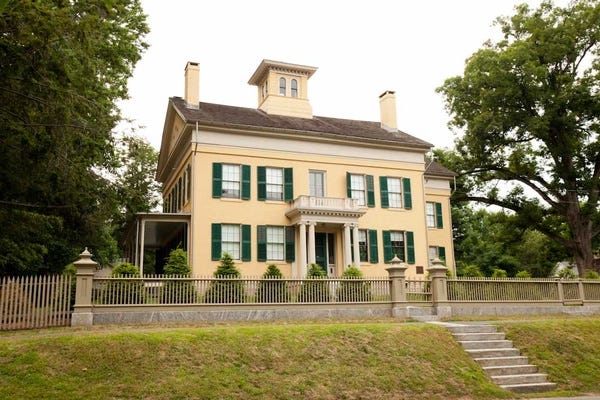
David Mack died in 1854. The Dickinsons repurchased the mansion and moved back in. That was where Emily Dickinson lived while writing most of her poetry, and today it’s the Homestead at the Emily Dickinson Museum (shown above).

Tuesday, June 18, 2019

Pvt. Simon Fobes: “fully resolved to go as far as my officers did”

Simon Fobes was a nineteen-year-old provincial soldier when he fought at the Battle of Bunker Hill. More than forty years later he moved to Ohio, and in 1835 one of his sons wrote down his recollections of the Revolution. That memoir was published in Historical Collections of the Mahoning Valley in 1876.

Fobes’s ancestors had first settled in Bridgewater, Massachusetts, under the name Forbes, but lost the R to the nascent Boston accent before his own branch moved to Canterbury, Connecticut. He was born there in 1756. Not owning much property, Simon’s parents moved the family again to Amherst when he was about fourteen.

At his father’s urging, Simon Fobes became a minuteman. But he was visiting relations back in Canterbury when the fighting started in Lexington. He got the news in Union, raced home, “made some change of clothing, took my gun and accouterments, and started, in company with some others, for Cambridge.” Once there, Fobes enlisted for the rest of the year in the company of Capt. Eliakim Smith of Hadley, Lt. Col. Jonathan Ward’s regiment.

Around midday on 17 June 1775, Fobes’s regiment was ordered onto the Charlestown peninsula. He told his son:
Soon after the firing, on that memorable day, had begun, about one-half of our regiment marched, as a re-enforcement, from Cambridge to Charlestown Neck, where the British were continually firing. There we lay awhile, waiting for orders. When the orders came we marched on behind the buildings, as well as we could, across the Neck, which was partially flooded, it being high water.

When we started from the fort, in Cambridge, marching in double files, I was near the center of the detachment, fully resolved to go as far as my officers did. In crossing the Neck I soon perceived that fully one-half of our soldiers were missing, and I was now near the front of the detachment.

As we ascended the hill the other side of the Neck, the musketballs whistled merrily. I noticed my officers dodging, first one way, then the other. For my part I knew not which way to dodge. A ball struck my gun near the lock as I was carrying it on my shoulder, and split off a piece of the stock. All this, together with the frequent meeting of our men, bringing off the wounded and the dying, made it a trying time for young soldiers. I can not tell which way or how my hair stood, for it seemed to me it stood every way.

As we were hurrying on without much order, some one called to us to come that way, and there was a good place. We advanced to a post and rail fence through a shower of musket-balls, where we made a stand.

I discharged my gun three times at the British, taking deliberate aim as if at a squirrel, and saw a number of men fall. I had become calm as a clock. When loading my gun the fourth time, I happened to cast my eyes around, and, to my astonishment, my fellow-soldiers were running at full speed down the hill. I had heard no orders to retreat. That instant my sergeant, who stood near me, started to follow them.

Then it was I saw a company of British regulars marching rapidly toward us. I finished loading my gun as quick as I could. When they had got within a few rods of us, however, I fired it off at them, and then ran for my life. At the same time the British were ordered to halt, make ready, and fire.

The balls whistled again, but did no material injury. One of my mates received a flesh wound. Firing down hill they shot over us.

A very large number of men, both old and young, had now collected. All seemed to be bustle and tumult. Charlestown, now wrapped in flames, added greatly to the interest of the scene. I saw the lofty steeple when on fire. It trembled and fell to the ground. Our officers, with evident anxiety and perplexity, were running to and fro, endeavoring to devise some plan by which we could drive the British from the hill.

A noted officer (I do not recollect his name) now stepped forward, and marched round in the crowd calling for volunteers to attempt the retaking of the hill. A large body of us volunteered, and we marched on near to the neck, where our commander came upon General [Israel] Putnam. Our soldiers were very poorly equipped, nearly one-half being armed with old rusty guns without bayonets. I was so fortunate as to have a good gun and bayonet.

The British had now paraded on the top of the hill with heavy artillery. While General Putnam and our commanding officer were talking together, a cannon-ball struck the stone wall near the former. After conversing awhile, General Putnam wheeled his horse and rode off.

Prudence seemed to direct that the attempt should be abandoned. After remaining in suspense until near dark, we were dismissed, and with our officers marched back to our tents.

In the mean time some of our soldiers had been to Cambridge, and got a pail of rum for us to drink when we returned. It being hot weather, I had become very thirsty and was much fatigued. At the door of the tent stood a pail, containing water as I supposed, with a pint tin cup in it. Some one asked me to drink. I took the cup and dipped it almost full, and drank the most of it before I was aware that it was rum. I was very much startled, fearing the consequences of what I had done. Being very weary, I lay down, and was soon asleep, and did not awake until the next morning.

When I arose I found that my fears were not realized. I had sustained no material injury, as in ordinary circumstances I doubtless should have done, and I was ready to do my duty as usual.
After Gen. George Washington arrived, Fobes’s regiment was moved to Dorchester on the southern wing of the siege. In September he volunteered to join Col. Benedict Arnold’s expedition to Québec, but that’s another story.

Tuesday, October 23, 2018

Call for Papers at 2019 Book History Conference in Amherst

The Society for the History of Authorship, Reading, and Publishing (S.H.A.R.P.) will hold its 27th annual conference in Amherst, Massachusetts, from Monday, 15 July, to Thursday, 18 July 2019.

The conference theme is “Indigeneity, Nationhood, and Migrations of the Book,” and here is the call for submissions:
What is the role of place in book history: from “native tongue” to “Native writing,” author’s homeland to author’s house, sites of reading to websites? Print capitalism has been adduced as a factor in the consolidation of vernaculars and national literatures and the rise of the national imaginary from Europe to its colonial regimes. Rather than viewing the relation between indigenous and European communication practices as a hierarchical and sequential one of center and periphery—“literacy” replacing “illiteracy” (whether dismissed as “inferior” or eulogized as “authentic”)—what could we learn by instead exploring it as one of encounter and continuing evolution?

Consider the setting for SHARP19: New England—the very name connoting old and new “worlds”—was at once native land for the original inhabitants, with their established social and communication systems, and a site in which European settlers, rather than simply replicating the homeland (making a “new” England), created out of many sources and influences a different, distinctly American culture. Successive generations of arrivals—from captive Africans and indentured Asians to voluntary, if often unwelcome, immigrants—writing in their mother tongues or in English, transformed the very notion of an “American” language and literature. Alfred Kazin, son of Yiddish-speaking immigrants from Russia, provocatively entitled his pioneering 1942 study of modern American prose, On Native Grounds. How have literacy and print functioned here and around the world on a spectrum including oppression, resistance, assimilation, and dialogue?

We invite book historians to train their eyes on indigenous cultural practices, national literatures, colonized and colonizing texts, landscapes and sites of literary life, and textual migration and exchange in a global context.
S.H.A.R.P. sessions are generally ninety minutes long, consisting of three 20-minute papers and a discussion period. Proposals must include a title, abstract (250 words maximum), and short biography of the presenter (100 words). Proposals for full panels must also include a panel title and abstract (250 words) as well as information about each paper in the panel. The organizers welcome “lightning talks, posters, and digital project demonstrations,” with the same requirements as paper proposals. The submissions window closes on 1 December. For more details, see the call page.