J. L. BELL is a Massachusetts writer who specializes in (among other things) the start of the American Revolution in and around Boston. He is particularly interested in the experiences of children in 1765-75. He has published scholarly papers and popular articles for both children and adults. He was consultant for an episode of History Detectives, and contributed to a display at Minute Man National Historic Park.

Subscribe thru Follow.it


•••••••••••••••••


Showing posts with label Barre. Show all posts

Thursday, May 02, 2024

“A brief historical sketch of the skull of a British Soldier”

At the end of yesterday’s post, the Worcester printers and antiquarians Albert Tyler and Daniel Seagrave confirmed with Nancy Felch that her late husband had lectured about phrenology.

That conversation happened in the mid-1870s, with the men asking about events about thirty-five years before. In the intervening years Walton Felch had been most active as a hydropathic physician (and amateur poet), but he had indeed been a phrenologist.

As related by Tyler in 1905, the two men pressed on to their real interest: Had Felch owned the skulls of two British soldiers killed on 19 Apr 1775?
She answered “Yes.”

“Where are they now?”

She said she had them in possession, and they were packed away among other things useless to her at her old residence in Barre.

The thought of their value to the collection of this then young [Worcester] Society [of Antiquity] instantly occurred, and the writer [Tyler] asked her if she was willing to part with them. She replied that if we wanted them, we could have them in welcome.

So in due time a box containing the whole phrenological outfit was received at our office. . . .

We found in the collection only one of the two skulls—the absence of the other the widow could not explain.
Walton Felch’s phreonological material doesn’t appear on the inventory of his estate, which might reflect its low market value in 1872.

Though Tyler’s reminiscence was silent on this point, it seems clear that the antiquarians offered Nancy Felch some payment for those goods. A local newspaper article from 1881 said, “The members made up quite a collection of money for the donor,” she being “in reduced circumstances.” A Boston article from 1895, while getting several details wrong, stated that Daniel Seagrave “assisted the widow with the funeral expenses.” I suspect Seagrave bought the material, expecting to give the skull to the society when it had a place to keep it.

The widow Felch finally died in Barre in 1896. Her maiden name was Brigham; the Worcester Society of Antiquity’s proceedings credit Dr. F. K. and F. A. Brigham with donating “Pam[phlets], Papers, Hand-Bills and Plaster Casts belonging to the late Walton Felch, phrenologist” in 1897. That suggests she may not have located all her late husband’s phrenological material in the 1870s, but eventually the society got all that survived.

The society’s published record of its meeting on 5 June 1877 says:
Mr. Charles R. Johnson gave a brief historical sketch of the skull of a British Soldier who was killed at the battle of Concord, April 19th, 1775, now in the possession of a member of this Society.
That sketch was not printed with the proceedings, and the member who possessed that relic was still anonymous.

Meanwhile, Tyler was still interested in the other skull. His story went on:
In a casual conversation with the late Dr. Joseph N. Bates [of Barre] there was another “happening.” He was a collector of antique things, and when the discovery of the skull was mentioned to him, and the loss of the other one, he smiled and said, “I have got that one; I attended Mr. Felch in his last sickness and he gave it to me!”

Dr. Bates died; his brother, Dr. George Bates, was his executor; inquiry was made of him concerning the second skull, but nothing ever came of it. It is probably lost beyond recovery.
Dr. Joseph N. Bates (1811–1883) appears above, courtesy of the Roster and Genealogies of the 15th Massachusetts Volunteer Infantry.

Back in 1840, Edmind Quincy Sewall, Jr., had described how one of the skulls ”was only the upper half of the head” displaying a “bullet hole.” He didn’t take note of the other at all. I suspect that it was intact and undistinguished, though I’ll note later statements to the contrary. If I’m right, the skull that Dr. Bates took looked like any other specimen of the cranium and was thus easily overlooked after he died.

TOMORROW: Getting to see the skull.

Wednesday, May 01, 2024

“Intensely interested in the history of the battles for independence”

Albert Tyler (1823–1913, shown here courtesy of the Cabinet Card Gallery) was born in Smithfield, Rhode Island. As a teenager he trained as a printer at the Massachusetts Spy in Worcester.

This was the newspaper that Isaiah Thomas co-founded in Boston, then moved to central Massachusetts just before the outbreak of the Revolutionary War.

After coming of age, Tyler moved to the nearby town of Barre and printed the Barre Patriot for several years. Then in 1851 he left printing to be a Universalist minister.

Over the next ten years Tyler preached to three congregations, which might indicate that profession was not for him, but he kept the honorific “Reverend” nonetheless.

Tyler returned to Worcester and went into business with another former employee of the Massachusetts Spy (and Universalist), Daniel Seagrave (1831–1902). They bought the book and job printing operation of the Spy, staying in the same building.

In 1875 Tyler, Seagrave, and a grocery magnate named Samuel E. Staples (1822–1902) took the lead in founding the Worcester Society of Antiquity. Seagrave became its first secretary.

Thirty years later, on 6 June 1905, society secretary E. B. Crane read reminiscences from the Rev. Albert Tyler about “singular happenings” related to the building of the society’s collections. At the start of one anecdote the octogenarian recalled what appear to be the course of lectures Walton Felch offered at the end of 1840:
In 1839, in the old and original Worcester Town Hall, a traveling lecturer, Walter Felch by name, gave phrenological examinations in the day-time and lectured in the evening upon phrenology, then a popular topic. He exhibited the usual array of drawings, plaster casts and skulls in the delineation of his subject.

Among the latter were two skulls, which he said the Selectmen of Concord had permitted him to take from the graves of the British soldiers who fell in that first battle of the Revolution.

The writer was a boy of fifteen years of age, who, as a Spy printer boy, had a free pass to the lecture. He was intensely interested in the history of the battles for independence . . .

Nearly forty years passed away, the boy had become a man beyond middle age, and was one of the proprietors, under the business name of Tyler & Seagrave, of the office in which he had learned the trade. In editing and printing a historical work, we came across the name of “Walton Felch,” whose brief history was necessary to its completeness. After many inquiries we learned of the residence of his widow. We communicated with her, and she called at our office.

The boy, who remembered the skulls, was not so sure he remembered the name, and though the husband’s name seemed familiar, forty years had dimmed his recollection into uncertainty, but he ventured to ask the widow if her husband ever lectured on phrenology. She said he had in his younger days. The query then followed, “Did he have two skulls of British soldiers who fell at Concord?”
TOMORROW: Yes and no.

Tuesday, April 30, 2024

“The healing power of Mesmerism and Pure Water”

At the end of the year 1840, Walton Felch, “Teacher of the Science of PHRENOLOGY, otherwise known as the author of a new theory of language,” came to Worcester.

Felch’s advertisement in the Worcester Palladium, illustrated with a man’s profile, stated that he had “been employed, within the last 2 years, to deliver nearly 40 courses of from six to eight Lectures, before not less than 11 or 12,000 persons.”

He now offered the people of Worcester his expertise on:
Phrenology, and its Application
to Government, Education, Social Intercourse, the Philosophy of Language, and of Rhetoric, and the Moral, Intellectual, and Physical Improvement of Mankind.
And the first lecture in the Town Hall was absolutely free, if that’s how you wanted to spend the evening of 25 December.

In April 1842 Felch offered eight lectures on phrenology in Boston’s North End, followed by seven in the vestry of the Fifth Universalist Church. After that, notices of his talks stop appearing in newspapers.

Felch continued to show an interest in phrenology. In November 1851, he assisted another practitioner, Dr. Noyes Wheeler, in lectures in Boston and then served as “chairman” of a meeting of Wheeler’s friends voting him a commendation.

By that time, however, Walton Felch had moved on to some other forms of healing. The first sign of this appears in a curious stretch of newspaper items in 1847 that stars with the 26 March Barre Gazette report of a robbery of James H. Desper’s store of goods and silver worth about $112.

Two weeks later, the Barre Patriot reported that “Dr W. Felch” had helped to found the Barre Falls Lyceum for the “easterly part of town.” He became its president, and Desper was steward. (I can’t help but wonder if that was the result of some dispute within the Barre Lyceum.)

On 28 May the Barre Gazette ran a notice saying:
Veto! Veto!! Veto!!!!

I, JAMES H. DESPER of Barre, having lately heard a variety of Reports apparently designed to raise a public prejudice against Dr. W. Felch, and theredy [sic] hinder him from giving proofs of the healing power of Mesmerism and Pure Water as applied by himself;—1st, that he was turned out of my house; 2d, that he injured the health of my wife and others while boarding here;—3d, that he has been suspected of breaking open our store, &c. &c. I hereby give notice, and my wife sets her signature with mine, that all these reports are most villainous falsehoods; which character, we doubt not, is common to all the reports against the same individual. . . .

And the enemies of reform ought to know that persecution is very much like a kicking gun—there is only one thing certain about it—that is, the kicking over of the fool that fires it off.
“Pure Water” was a sign that Felch, now styling himself a physician, had adopted hydrotherapy as his principal field.

In 1850 the Water-Cure Journal and Herald of Reform reported that “Dr. W. Felch” had just opened the Green Mountain Water-Cure in North Adams. That year’s U.S. Census located Felch in Adams.

In 1854 both the Water-Cure Journal and William Garrison’s Liberator told readers that Dr. Felch was the physician at the new Cape Cod Water-Cure in Harwichport. “Ellen M. Smith, (a young lady of medical education,)” was his assistant, though elsewhere listed as a hydropathic physician herself.

To be sure, the Boston Semi-Weekly Advertiser for 28 Jan 1854 said “Dr. W. FELCH, of Cambridge,” was lecturing every Sunday “on the Philosophy and Evidence of Ghost-seeing.” I can’t say for sure that was Walton Felch, but the 1855 state census and 1860 federal census found him and his second wife Nancy in Boston. His son Hiram had become a city official.

(I’m assuming Walton Felch was not the “W. Felch” quoted in advertisements for “Dr. Hill’s Cordial Balm of Syriacum” in 1855, stating he “had the misfortune to contract the veneral affection of the most aggravated character.” Mostly because this writer had nothing to say about his own medical knowledge.)

By 1870 Hiram Felch had moved out to Boxborough, and Walton and Nancy were back in the Coldbrook Springs part of Oakham.

In 1872, now over eighty years old, Felch made his will. He left his books to be divided equally among Nancy and three grown children and his real estate to be sold to support his widow.

Walton Felch died in Boxborough later that year, apparently visiting his son; his body was returned to “Coldbrook” for burial. That May, the Massachusetts Spy reported that the man’s estate included $700 in real estate and $300 in personal property.

TOMORROW: But what happened to the British soldiers’ skulls?

Monday, April 29, 2024

“The lecture room has been filled every evening”

In April 1840, Walton Felch brought his phrenological lectures to Concord.

As quoted back here, on 1 April twelve-year-old Edmund Quincy Sewall, Jr., went to the town’s Lyceum Hall expecting to hear Felch speak on phrenology. He saw a collection of skulls laid out on the lectern, including at least one skull of a British soldier killed in 1775.

But then those teaching aids were taken away, and Edmund heard another speaker instead. Two days later, he corrected what he’d written in his diary about Felch:
I said he had not come up from Boston. He had been engaged on the supposition that Mr Haskins would not come but as Mr H. did come he had to give place.
On that evening, 3 April, Edmund finally heard Felch deliver his talk on phrenology. The twelve-year-old judged it to be “pretty interesting.”

It looks like that lecture wasn’t officially part of the Concord Lyceum program, according to records kept by Edmund’s teacher Henry David Thoreau. Instead, those weekly lectures were on such topics as Roger Williams of Rhode Island and the Rev. Ralph Waldo Emerson on “The Present Age.” But Felch did apparently speak in Lyceum Hall.

On 18 April, the Yeoman’s Gazette of Concord took notice of Felch’s “course of lectures”:
The lecture room has been filled every evening, and we understand that his audience have generally expressed much gratification at the manner in which the subject has been treated. . . . We understand that the popular favor has been attested by numerous and increasing audiences.
The newspaper also praised the phrenologist for allowing anyone to attend, asking only “voluntary contribution.”

Of course, those lectures were marketing for Felch’s services. He quoted from his good reviews in a long advertisement in the 12 June Barre Gazette, closing with:
Mr. Felch will wait on individuals and families who may wish to avail themselves of his skill as an Experimental Phrenologist.
Weeks later, on 24 July, that local newspaper published a long article of “Mr. Felch’s Lectures on Phrenology.” The topic was no longer novel, it said, and, “The country has been deluged with lecturers, who…palm off the most miserable quackery and ignorance.” But Felch was different!
That his design is the collection of money, no one believes who knows him. He is imbued with a strong love of the subject, a full conviction of its truth and of its capacity to promote the welfare of mankind. He has studied well and deeply, and we doubt if even a few can be found in the country who are more intimately versed in the theory and details of the science.
However, this reviewer did have two criticisms. First, Felch went on for too long: “The shortness of the evenings at least should have cut short some of the reasonings and illustrations.” And while speaking of phrenology Felch indulged another of his hobby-horses:
Nor can we pass over what seems to us a faulty digression upon the subject of grammar. Mr. Felch is an enthusiast on this subject and is the author of a work touching it. . . . But we are unable to discover the connection which the lecturer supposes to exist between the two subjects, and could only feel a breakage when he passed on Monday evening from one to the other. Perhaps the lateness of the hour was an incentive to the feeling—but we trust yet that they will not be again chained fist and fist together.
Notably, I haven’t found any reviews from this period that criticized Felch for displaying human skulls, or for having British soldiers’ bodies dug up. Apparently people accepted those acts as necessary for science.

TOMORROW: The peregrinations of Walton Felch.

Sunday, April 28, 2024

“Mr Felch is delivering a course of Phrenological Lectures”

Walton Felch was born in Royalston, Massachusetts, in 1790, youngest in a large family. Eventually his parents and some siblings moved to Vermont, forming the village of Felchville in Reading.

Walton Felch appears to have gone to work in one of Rhode Island’s early industrial mills as a teenager. Ambitious and eager for knowledge, he rose to management ranks. He then did something even more unusual, turning his experience into poetry.

In 1816 Felch published The Manufacturer’s Pocket-Piece, or, The Cotton-Mill Moralized: A Poem, with Illustrative Notes. The notes about how mills of this time really operated appear to have had more lasting value than the poetry.

Felch continued to write poetry his whole life. He composed verses on fire, the stars, his ancestors, and other topics. When he died, a big part of his legacy to his family was hundreds of unpublished poems.

The year before The Manufacturer’s Pocket-Piece appeared, Felch married Lydia Inman of Smithfield, Rhode Island. He was then listed as living in Attleboro, and the couple may soon have moved to Medway. Walton and Lydia had at least three children: Hiram (house builder and assessor who stayed in Massachusetts), Walton Cheever (trained as a printer, moved to California in the Gold Rush), and Sarah (married a man named Dunbar).

Walton Felch was living in Hubbardston in 1831 when he married again, to Mrs. Nancy Sullivan. By 1840 he was in the area of Oakham called Coldbrook Springs, and he was living there at the end of his life—but didn’t necessarily remain there the whole time.

Felch was certainly intellectually restive. He enjoyed the lyceum movement of the time, particularly the Barre Lyceum, right over the town line. He spoke there in 1834 on the subject of geology. The next year, he participated in a debate: “Does the strength of temptation lessen the turpitude of crime?” In 1837 he spoke on the costs and benefits of government-sponsored South Sea exploration.

One of Felch’s most consuming interests was grammar. In December 1834 he lectured on his “Architectural System of the English Grammar.” He then published A Comprehensive Grammar, Presenting Some New Views of the Structure of Language (1837) and Grammatical Primer: Comprising the Outlines of the Compositive System (1841). The Norfolk Democrat credited Felch with “a very amusing and instructive Lecture” on the topic in January 1840.

The Barre Gazette of 23 Feb 1838 signaled a new interest:
Oakham Lyceum Meets on Monday evening, the 26th inst. Lecture by Mr Felch on Phrenology.
Phrenology was a relatively new scientific pursuit—diagnosing people’s personalities, strengths, and deficits from the bumps on their skulls, usually as felt through through hair and skin. By the next year, Felch felt he had mastered it enough to publish A Phrenological Chart: And Table of Combinations.

On 15 Nov 1839 the Christian Freeman and Family Visitor of Waltham published this item:
Phrenological Lectures.

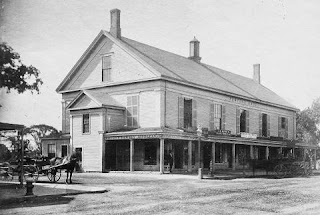
Mr Felch is delivering a course of Phrenological Lectures in Rumford Hall [shown above]. We perceive from letters in his possession, that he shares the confidence of Mr [George] Combe, and has given great satisfaction where he has lectured. He has not only read extensively on the science upon which he lectures, but is a close observer of mankind, and an original thinker. We were pleased and instructed by his lecture last Tuesday evening, which was the first of a course of six, to be delivered on Tuesday and Thursday evenings. Admission 12 1-2 cents each evening.
That expertise seems to have been enough to persuade the selectmen of Lincoln to let Felch take the skulls of two British soldiers killed on 19 Apr 1775 from the town’s old burying-ground. Indeed, according to Henry David Thoreau’s understanding, Felch actually had those skulls “dug up” particularly for his phrenological investigation.

TOMORROW: When Felch took his skulls to Concord.

Saturday, July 10, 2021

Unpaid Taxes and a Stolen Horse

As I said yesterday, I searched Massachusetts newspapers for any mention of the Quock Walker cases in July 1783 or any other month of that and preceding years—without success.

I searched not only for Walker’s name but also for the names of Nathaniel Jennison and John and Seth Caldwell, the white men involved.

I didn’t find reports of the case. But I did come across advertisements showing some of what those men were dealing with in 1783.

On 30 Dec 1782, Jotham Houghton, constable for Petersham, sent out a long, detailed notice about the taxes on tracts of land in that town and how much tax was owed on them. It was printed in the 16 Jan 1783 Independent Chronicle in Boston.

According to Houghton’s accounts, “Nathaniel Jennison, of Barre,” owed more than £30 going back to June 1780, plus “for hiring a soldier, 1s 5d.”

In apparent response, Jennison placed an advertisement in the 3 July 1783 Massachusetts Spy offering fifty acres in Petersham and “A LOT of new LAND lying in Rutland” for sale “for State securities or good private security, hard money will not be refused.”

On 2 July, Jennison was on the eastern side of the state. The 10 July Independent Chronicle ran this ad from him:
STOP THIEF!
Twenty dollars reward,
STOLEN from a pasture in Roxbury, on the 2d of July instant, a large dark bay HORSE, sixteen hands high, black mane and tail, trots and paces, high carriage, about nine years old. Any person who shall take up said horse, and give intelligence to Nathaniel Jennison, of Barry, in the county of Worcester, shall receive ten dollars, with all necessary charges; and if the thief is apprehended, and brought to justice, they shall have the above reward of twenty dollars…
It wasn’t turning out to be a great year for Nathaniel Jennison, even beyond the judgment against him in the Walker cases. 

But Jennison wasn’t the only figure having troubles. On 19 February, David Puket, the tax collector of Greenfield, issued a notice, printed in the next day’s Independent Chronicle, that he was selling “One farm belonging to John Caldwell, Esq;” for unpaid taxes. As a measure of inflation, Duket calculated the tax bill to be worth:
  • “79l. 4d. old emission.”
  • “4l. 6s. 11d. State’s money.”
  • “16s. silver.”
The sale was to take place on Monday, 17 March.

On 10 June, John and Sarah Caldwell bought a notice in Isaiah Thomas’s Massachusetts Spy (published first on 12 June), saying that they would sell “By PUBLICK AUCTION” three horses and “A NUMBER of good likely COWS” at “the house of Mrs. SARAH CALDWELL, widow, in BARRE.”

Finally, the 26 June Independent Chronicle ran a notice from Daniel Wells, new tax collector in Greenfield, stating that “John Caldwell, Esq;” now owed nearly £2.13s., and he would sell off the man’s property on 21 July if that bill was still unpaid.

Because of the number of Caldwells in Barre and nearby, I’m not sure those three notices involved the same John Caldwell involved in the Quock Walker cases. Nor can I figure out how this John Caldwell was related to the widow Sarah Caldwell; her late husband was possibly William, who died young in 1780.

Despite those genealogical uncertainties, those advertisements show how farmers in central Massachusetts, including relatively prosperous men who had been able to invest in land in different towns, were under economic pressure by 1783. That was part of the background to the Quock Walker decisions.

One bit of pleasant news: Seth Caldwell married Mary (Polly) Jones of Worcester in 1782, and they started a large family the next year. He died in 1805 at age forty-seven, styled a militia major. She died in 1828 at age sixty-four.

Friday, May 04, 2018

“With child Quaco, about nine months old”

Here’s another connection between the Worcester Art Museum’s portrait of Lucretia Murray and the institution of slavery in Massachusetts.

John Singleton Copley painted that portrait in 1763, two years after Lucretia Chandler had married John Murray of Rutland. Copley’s portrait of John, also at the Worcester Art Museum, appears here. (This Murray is often called “Col. John Murray” because he held that rank in the militia and it helps to distinguish him from the Rev. John Murray, the pioneering Universalist.)

Murray was Rutland’s leading gentleman, which meant he had a hand in a lot of legal matters. In 1754, he witnessed this bill of sale, quoted here:
Rutland District, May 4th, 1754

Sold this day to a Mr. James Caldwell of said District, the County of Worcester, & Province of the Massachusetts-Bay, a certain negro man named Mingo, about twenty Years of Age, and also one negro wench named Dinah, about nineteen years of age, with child Quaco, about nine months old—all sound and well for the Sum of One hundred & eight pounds, lawful money, recd. to my full satisfaction: which Negroes, I the subscriber to warrant and defend against all claims whatsoever as witness my hand

Zedekiah Stone.
James Caldwell thus became the owner of a young family consisting of Mingo, Dinah, and baby Quaco.

Nine years later, Caldwell died unexpectedly. How unexpectedly? According to Hurd’s History of Worcester County:
James was killed in 1763, he, with one of his slaves, having taken refuge under a tree during a heavy thunder-shower. The tree was struck by lightning, and falling, killed him and broke a thigh of the negro.
Not expecting a lightning strike, Caldwell didn’t leave a will. John Murray got involved in settling the estate by becoming guardian for Caldwell’s children, preserving their interest in their father’s property. That property included the enslaved family, assigned to Isabel Caldwell as part of her widow’s third.

A lot happened to those families over the next decade:
  • Mingo escaped from Isabel Caldwell, as shown by an advertisement she placed in the Boston News-Letter on 13 and 20 June 1765. 
  • Dinah Caldwell, the wife Mingo left behind, married a black man named Cumberland Chandler in Worcester on 29 Nov 1767. He was no doubt linked to Lucretia Murray’s relations. 
  • Lucretia Murray died in 1768, and John Murray married again at the end of the following year. 
  • On 28 Mar 1769, Isabel Caldwell married Nathaniel Jennison. They lived in the part of Rutland that had become the town of Hutchinson in 1774 and then the town of Barre in 1776. She brought Mingo and Dinah’s enslaved son, now named Quock and in his late teens, to the new household. 
  • In 1774, Isabel Jennison died, and her property went to her husband, Nathaniel.  
  • The uprising in central Massachusetts late that same summer sent John Murray, recently appointed to the Massachusetts Council, fleeing into Boston for safety. He eventually settled in New Brunswick.
According to Quock, James Caldwell had promised him freedom on his twenty-fifth birthday. And Isabel Caldwell reportedly amended that to freedom on his twenty-first birthday, a promise Nathaniel Jennison committed to when he married her. But as the late 1770s went on, Jennison refused to manumit the young man.

In April 1781 Quock, now using the surname Walker, left Jennison’s house and went to the farm of John and Seth Caldwell—sons of the man who had bought him as a baby in 1754. (John Murray had served as their guardian in the mid-1760s.) The Caldwell brothers, who had probably grown up with Quock Walker, were ready to employ him as a free, wage-earning laborer.

Days later, Jennison violently forced Walker back to his own farm, ignoring the Caldwells’ objections that he deserved to be free. Walker sued Jennison. Jennison sued the Caldwells. The dispute landed in the Superior Court in the spring of 1783, becoming one of the cases by which judges declared that Massachusetts’s new constitution provided no protection for slavery.

(Historical Digression has an excellent discussion of this case.)

Saturday, December 05, 2015

Removing Symbols of the Old Ways

On 18 July 1776, the Massachusetts Council oversaw the reading of the Declaration of Independence at the State House. Afterwards, the public pulled down the royal emblems of the lion and unicorn from that building and burned them in a big bonfire.

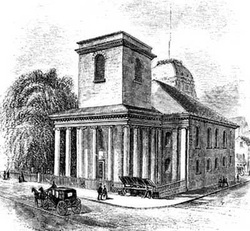
In the following years, the town of Boston renamed King Street and Queen Street to the more republican State Street and Court Street. King’s Chapel (shown here) was called the Stone Chapel for a while. The town’s main road, which had four names for different stretches in 1776, eventually became Washington Street to honor the new country’s new leader.

Hutchinson Street bore the name of the reviled Gov. Thomas Hutchinson, so it was renamed Pearl Street. In 1776 the town of Hutchinson petitioned the Massachusetts General Court to change its name as well; it became Barre, after Isaac Barré, a British Whig in Parliament who had advocated for American colonists for a decade. A few years later, the town of Foxborough was named for Charles James Fox, another sympathetic M.P.

Similar changes happened all across the new nation. New Yorkers pulled down the gilt statue of King George III on the Bowling Green. Tavern owners altered their signs, as Washington Irving’s story “Rip Van Winkle” later played on for comic effect.

This history is useful to recall when we consider current campaigns like those to change the name of the Woodrow Wilson School at Princeton, remove the statue of Thomas Jefferson at the University of Missouri, or create a new seal for Harvard Law School that doesn’t honor Isaac Royall.

Throughout history, societies have used names, public art, and other symbols to honor individuals they admire, and societies have removed or changed those symbols when they no longer reflect widespread values. That’s something societies do. It’s nothing new, so claiming that there’s an unprecedented wave of “political correctness” reveals historical blindness, not historical consciousness.

Furthermore, removing symbols of honor doesn’t erase the history behind them. The Bostonians who destroyed the lion and unicorn still knew full well that they had been part of the British Empire. They still acknowledged that Thomas Hutchinson had been the royal governor of Massachusetts from 1770 to 1774. They weren’t rewriting history. They just no longer felt those people and institutions deserved so much public respect.

Many people accuse those who now want to remove symbols they associate with slavery and racism of wishing to eradicate or hide troubling aspects of our history. That’s ridiculous. The people driving those campaigns will remain quick to highlight an institution’s historical connections to slavery and racism, and to argue that those connections remain significant. They’re really interested in preserving and broadening the memory of that history. They just disagree with previous generations about which historical figures deserve so much honor.

Accusing those campaigners of the opposite of their stated aims and usual behavior suggests their critics are parroting talking points they’ve never really examined. That seems to show a lack of knowledge and a disrespect. And I suspect there’s a significant overlap between people who say we should retain symbols despite their roots in slavery and racism and people who say they’re tired of hearing about the effects of slavery and racism.

People can respond to those symbol-changing campaigns in multiple ways, depending on circumstances and philosophy. We may support the goal but not the methods. We may differ on whether removing such symbols really helps efforts to eradicate the underlying wrongs, or might even hurt. I’m going to share some thoughts on those issues over the next couple of days. But mistaken claims that such behavior is new or that it’s an attempt to “erase history” add nothing to the discussion.