


J. L. BELL is a Massachusetts writer who specializes in (among other things) the start of the American Revolution in and around Boston. He is particularly interested in the experiences of children in 1765-75. He has published scholarly papers and popular articles for both children and adults. He was consultant for an episode of History Detectives, and contributed to a display at Minute Man National Historic Park.

Subscribe thru Follow.it


•••••••••••••••••


Showing posts with label Dr. Elisha Story. Show all posts

Saturday, March 21, 2020

Robert Patterson’s Memory of the Massacre
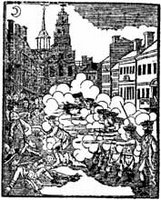
On 20 Mar 1770, 250 years ago yesterday, a sailor named Robert Patterson testified to his memory of the Boston Massacre.

Patterson was one of the men wounded in that shooting—badly wounded in one arm. Furthermore, he had also been at the Christopher Seider shooting eleven days earlier, so close that pellets from Ebenezer Richardson’s musket had cut through his baggy sailor pants.

Patterson was unable to sign his testimony, possibly because of the injury to his right hand. (He was disabled from his wound.) Dr. Elisha Story, perhaps the sailor’s physician, attested to his mark.

Here is Robert Patterson’s story, as published in Boston’s Short Narrative report:
…on Monday night, the 5th current, being at Capt. [Hector] McNeill’s at the North End, heard the bells ring and “Fire!” cried. I immediately ran till I got into Royal Exchange lane, it being about a quarter after 9 o’clock. I saw a number of people in the lane. I asked what was the matter? They told me that the soldiers were going to kill all the inhabitants.

I immediately went through the lane, and stood in the middle of King street about ten or eleven minutes (the sentinel then standing leaning against his box), when I saw an officer with seven or eight soldiers coming from the main-guard, clearing the way with their guns and bayonets, go below the sentinel box, and turn up and place themselves around it, facing the people standing opposite Royal Exchange lane; when I saw a man with a light colored surtout at the Custom-house door, the door being wide open, there standing with his shoulder against the side; then I heard the officer order the soldiers to load, which they did.

After that I heard the people say, ”Damn you, why don’t you fire?” In about a minute after I heard the word “Fire!” (but from whom I cannot say) which the soldiers did. Looking round I saw three men lay dead on the snow; the snow being at that time near a foot deep. Immediately they loaded again.

The people then gave three cheers, and cried out, “Let’s go in upon them, and prevent their firing again;” upon which they put on their hats and advanced towards them. My hand being raised to put on my hat, still advancing towards the soldiers, the sentinel up with his gun and fired, the balls going through my lower right arm, my hand immediately falling; and finding myself wounded, made the best of my way home with help.
Patterson’s oath was certified by Justice John Hill and Justice John Ruddock, one of the more confrontational Whigs and Dr. Story’s father-in-law.

The Whigs assembling the Short Narrative inserted Patterson’s testimony in the midst of the three witnesses I quoted back here, all supporting the idea of people shooting down from the Customs House. That might have been because of the figure Patterson described in the Customs House door, who might even have given the order to “Fire!”

What really stands out in Patterson’s testimony, however, is his description of the final shot coming after significant activity: three men falling dead, the soldiers all reloading, the crowd cheering and moving toward the soldiers, and the sentinel—Pvt. Hugh White—shooting Patterson in the arm. (It’s not clear what the crowd did after that point, but Patterson wisely left to find help.)

Patterson thus described the shooting as more than a panicked chain reaction—all the soldiers got ready to shoot again, and one did. He also described the crowd as more determined in that same moment, moving toward the troops instead of panicking. However, no one else on King Street described that sequence of events.

Other witnesses mentioned Patterson in their testimony. Josiah Simpson, joiner, said:
The deponent then standing by Warden and Vernon’s shop on the south side of King street, with his back to the soldiers; immediately after heard the word present, at which word he stooped down. A little space of time ensued, and then he heard the words, “Damn you, fire;” the sound of which words seemed to proceed from the left of all the soldiers, and very near to the sentry box; upon this order, he judged two guns were discharged, and immediately three more, and then two more—one of the two last guns went about five or six inches over the deponent’s back—after which he stood up, and another gun was discharged which wounded one Robert Patterson in the arm, and the blood was sprinkled upon the deponent’s hand and waistcoat. After the firing the deponent saw four persons drop; then looking towards the soldiers, the deponent saw them making towards the inhabitants with their fixed bayonets; upon which he retired down Quaker lane…
John Wilson stated:
Some small boys coming up made a noise to the soldiers, on which the officer said to them, “Why don’t you fire? Damn you, fire!” They hereupon fired, and two men fell dead in my sight. I then left the place, and went over the street and assisted Patterson the wounded man in getting home.
It’s notable that neither of those witnesses describe the same series of events as Patterson. Simpson did agree that there were several shots, a pause, and then a final shot that hit the sailor’s arm. But no reloading, no three cheers. If in fact the crowd gave three cheers, if all the soldiers reloaded, other people must have participated in, heard, and seen those actions—but no one else testified to them.

One witness mentioned seeing a soldier working with his gun before firing the last shot. That was William Wyatt, captain of a coasting vessel based in Salem, whom Donna Seger just profiled at the Streets of Salem. Wyatt told the magistrates:
…the second man on the left wing fired off his gun, then, after a very short pause, they fired one after another as quick as possible, beginning on the right wing; the last man’s gun on the left wing flashed in the pan, then he primed again, and the people being withdrawn from before the soldiers, most of them further down the street, he turned his gun toward them and fired upon them.
So here’s how I reconcile Patterson’s testimony with the rest of the witnesses. There was a burst of shots, starting with Pvt. Edward Montgomery. Then a couple of seconds with no firing. Patterson, Simpson, and others stood up, thinking the danger was over. Patterson may have even thought about moving forward to disarm the troops.

But then one soldier primed his firelock again and fired the ball that hit Patterson’s arm. In his anger and confusion, Patterson enlarged people straightening up into the whole crowd giving three cheers and advancing, and that one soldier fixing his musket into the whole line reloading.

Of course, the Massacre was a sudden, chaotic, confusing event involving scores of people in a heightened emotional state. There are a lot of discrepancies between different witnesses’ testimony, and at times even between the records of a single witness’s testimony. (Patterson, unlike Simpson and Wyatt, wasn’t called to testify at the trials, so we have only one account from him.) This is how I piece together the overall evidence about the shot that hit Robert Patterson.

Tuesday, May 06, 2008

Robert Patterson: riotous sailor

Robert Patterson was a sailor. Since Boston was the third largest port in North America, there were many sailors in town over the winter of 1769-1770. But Patterson stood out by standing on the front line of riotous crowds.

On 22 Feb 1770, a mob of boys attacked Customs official Ebenezer Richardson’s house after he tried to break up their anti-importer demonstration. Richardson fired a musket-full of birdshot down at the crowd. Some of those pellets cut Patterson’s pants. (As a sailor, he wore baggy shin-length trousers rather than closely fitted leather or cloth breeches.) Patterson must therefore have been standing close to Christopher Seider and Samuel Gore, the two boys wounded (one fatally) by Richardson’s shot.

Judicial authorities made Patterson agree to a £50 bond to ensure he’d be available to testify against Richardson. They may have thought that necessary because the sailor wasn’t a legal inhabitant of the town and might have gone to sea at any time. We don’t have complete records for that trial, but notes kept by special prosecutor Robert Treat Paine summarize Patterson’s testimony this way:

I went up to R[ichardson], and I saw R fire the Gun, from within the House. The Boy fell. The Shot went thro’ my Trowsers.
One might think that such a close call would have prompted Patterson to stay home quietly the next time there was trouble. But no. Here’s what he did on the night of 5 March, in his own words:
I, Robert Patterson, of lawful age, testify and say, that on Monday night, the 5th current, being at Capt. [Hector] McNeill’s at the North End, heard the bells ring and “Fire!” cried.

I immediately ran till I got into Royal Exchange lane, it being about a quarter after 9 o’clock. I saw a number of people in the lane. I asked what was the matter? They told me that the soldiers were going to kill all the inhabitants.

I immediately went through the lane, and stood in the middle of King street about ten or eleven minutes (the sentinel [Pvt. Hugh White] then standing leaning against his box), when I saw an officer [Capt. Thomas Preston] with seven or eight soldiers coming from the main-guard, clearing the way with their guns and bayonets, go below the sentinel box, and turn up and place themselves around it, facing the people standing opposite Royal Exchange lane; when I saw a man with a light colored surtout at the Custom-house door, the door being wide open, there standing with his shoulder against the side; then I heard the officer order the soldiers to load, which they did. After that I heard the people say, “Damn you, why don’t you fire?”

In about a minute after I heard the word “Fire!” (but from whom I cannot say) which the soldiers did. Looking round I saw three men lay dead on the snow; the snow being at that time near a foot deep.

Immediately they loaded again. The people then gave three cheers, and cried out, “Let’s go in upon them, and prevent their firing again;” upon which they put on their hats and advanced towards them. My hand being raised to put on my hat, still advancing towards the soldiers, the sentinel up with his gun and fired, the balls going through my lower right arm, my hand immediately falling; and finding myself wounded, made the best of my way home with help.
Patterson signed this deposition with his mark; perhaps his right arm was disabled, or perhaps he never could sign his name. Dr. Elisha Story attested to that mark, so he might have been caring for the sailor. Then again, Story might have been on the scene to help his father-in-law, Justice of the Peace John Ruddock, take the deposition.

The historical consensus is that there were not two volleys of shots from the soldiers as Patterson described; instead, the Boston Massacre resulted from an irregular series of shots. Though the soldiers reloaded, they didn’t fire a second time. There’s also no corroboration for Patterson’s recollection of a civilian in the Customs house doorway at the time of the shooting—a detail that would have implicated royal revenue officials in the incident. Paine didn’t call Patterson to testify at the soldiers’ trial, and Pvt. White was ultimately acquitted.

TOMORROW: What the future held for Robert Patterson.

Friday, April 25, 2008

The Attack on Patrick McMaster

I’ve been meaning to mention Colin Nicolson’s article “A Plan to ‘banish all the Scotchmen’: Victimization and Political Mobilization in Pre-Revolutionary Boston” since I got the 2007 issue of the Massachusetts Historical Review last fall. (Some older articles from this periodical are available online, but not the latest.)

This article focuses on the suffering of Patrick McMaster, a merchant born in Galloway in 1741 who came to Boston in 1767 and lived to regret it. Here’s a capsule history of the man, in notes about his claim to the British government’s Loyalists Commission on 26 Dec 1785:

He is a Partner in the House of James & Patrick McMaster & Co., which consisted of the three Brothers... [the third being John].

They are all natives of Scotland & went to America before 1768, and at the commencement of the troubles they carried on Trade at Boston & Portsmouth. John left America in 1772, & has remained in London ever since.

In 1770 the Witness was seized by the Mob and carted through the streets of Boston, at that time the mob forced him to take an oath that he should not return to Boston—the cause of his treatment was that the House imported British Goods.

He took shelter with the 14th Regt. at Castle William.

In 1775 the Witness was settled at Boston, John was settled at Portsmouth, New Hampshire. They were both uniformly attached to Great Britain & Patrick was enrolled in the North British Association at Boston.

He quitted Boston at the Evacuation—he has been carrying on trade within the British lines & at home ever since—he is now settled in Halifax as a Mercht.
The assault on McMaster in 1770 was a unique event in that turbulent period: he ended up nearly being tarred and feathered.

On 1 June, Dr. Thomas Young led a crowd of “hundreds of Men and Boys” to the McMasters’ shop and ordered them out of town by six o’clock on the 4th. Ever since the previous fall, the brothers had been defying the Boston Whigs’ “nonimportation” (or boycott) of British goods. They were relatively recent arrivals to town, and they were Scottish. Since March, after the Boston Massacre, there were no soldiers patrolling the town, and in May a mob led by a New London ship’s captain had tarred and feathered a Customs officer named Owen Richards.

The McMasters apparently communicated to Whig leaders that they were willing to compromise, and stayed in town. But on 19 June, a mob appeared at their shop (apparently without Dr. Young) and tore down their sign. Patrick was the only one home, so the people dragged him out and put him into a cart with a barrel of pine tar. As he was rolled around Boston, McMaster fainted, prompting a stop at an apothecary shop. According to Customs Commissioner Henry Hulton:
[McMaster] fainting away from apprehension of what was to befall him, they spared him this ignimony, and contented themselves with leading him thro’ the town in the Cart to Roxbury, where they turned him out, spiting upon him, & otherwise contemptuously & rudely treating him.
The merchant promised not to return to Boston. (That evening, a mob attacked Hulton’s home in Brookline.)

The fact that McMaster had fainted was clearly one factor in the mob’s leniency. He probably also benefited from deference to his class as a gentleman (most victims of such attacks were working-class). Furthermore, he may not have seemed like quite the right target for tar and feathers. Almost all the other victims of such attacks in Massachusetts were low- and mid-level employees of the Customs service. The McMasters had no connection to that branch of the Treasury.

McMaster wrote an account of his ordeal, dated 27 June 1770, which Nicolson reprints with his article. The merchant named three men among his attackers. One was John Ballard, who administered the oath in which the Scotsman swore not to come back to Boston. Ballard also ran a wharf that the McMaster brothers used for unloading their goods from Britain; his motivation for treating a customer this way is unclear.

Another assailant McMaster named was “Eliga Story.” Could that have been Dr. Elisha Story? It seems unusual for a genteel doctor to have been part a tar-and-feathers mob. Then again, McMaster might not have named Story as one of the mob’s leaders, merely as one of the few faces he’d recognized.

Dr. Story was born in 1743 to William Story, a local Customs official whose own house was mildly mobbed during the Stamp Act protests of 1765; after William’s career in the royal bureaucracy stalled, he retired to Ipswich and became a firm Whig. Dr. Story was also a son-in-law of John Ruddock, the “big man” of the North End. The doctor participated in the North End Caucus and helped to patrol the docks to ensure the East India Company tea would not be landed. I’ve seen his appointments book at the Massachusetts Historical Society, and he cleared his schedule in the week leading up to the Boston Tea Party. A few months after that event, Dr. Story moved to Marblehead, where he remained until his death in 1805.

As for Patrick McMaster’s fate after the war, Beamish Murdoch’s A History of Nova Scotia states:
About christmas, 1797, a small schooner was lost on the bay of Fundy shores, near Wilmot. Three mutilated dead bodies were found on the bank, and three others who had been frozen to death in the woods after escaping from the water. Mr. Patrick McMaster, a merchant of Halifax, was one of the three who had been drowned...
(I put that last bit in partly so I could include the name “Beamish Murdoch.”)

Thursday, March 29, 2007

Pulling Teeth in Colonial Boston

Before John Baker arrived from London and promoted the notion of specialized “surgeon dentists,” it looks like most Bostonians went to their regular doctors for dental care—which usually meant having teeth pulled rather than repaired. Indeed, losing one’s teeth seem to have been an experience that connected people.

John Cary, the biographer of Dr. Joseph Warren, wrote: “During the first years of practice, Warren charged one shilling, four pence for the extraction of teeth, one of his most common medical services.” On 27 Jan 1765, for example, Warren recorded extracting a tooth from Hannah Flucker, who was then fourteen years old. Her father was Thomas Flucker, later the last Secretary of the royal province, and her younger sister Lucy married Henry Knox.

Dr. Elisha Story extracted teeth from town watchman Benjamin Burdick’s wife and children. Indeed, Story’s office records for 12 Oct 1768 seem to be the only documentation for one of those children. Burdick and Knox were both at the Boston Massacre, trying to calm the conflict.

Ame [pronounced, I think, as “Amy”] and Elizabeth Cumings were two sisters who came to Boston from Scotland in the 1760s to set up a shop. Among the many things they sold, according to their ad in the 11 Nov 1765 Boston Gazette, were “Teeth Tincture and Powder.” In 1771 Knox rented space from the Cumingses for his first bookshop.

Merchant John Rowe wrote in his diary on 14 June 1769:

Sent for Dr. [James] Lloyd to have my Tooth drawn & had not Resolution to go thro’ the Operation.
One person who didn’t remove teeth was the painter John Singleton Copley (whose painting of Warren appears above, and who also painted Flucker). But the Rev. Dr. Mather Byles, Sr., who rarely passed by a chance for a pun, reportedly told a man to go to Copley’s house to have a tooth drawn. Drawn—get it? (With jokes like that, it’s no surprise that Dr. Byles’s congregation swiftly voted to remove him from their pulpit after the war began.)