J. L. BELL is a Massachusetts writer who specializes in (among other things) the start of the American Revolution in and around Boston. He is particularly interested in the experiences of children in 1765-75. He has published scholarly papers and popular articles for both children and adults. He was consultant for an episode of History Detectives, and contributed to a display at Minute Man National Historic Park.

Subscribe thru Follow.it


•••••••••••••••••


Showing posts with label John Pitts. Show all posts

Tuesday, September 29, 2026

“To be a liege subject of the State of Massachusetts Bay”
In May 1778, the Massachusetts General Court began a new legislative year.

On 17 September, Council member John Pitts brought the lower house “a Petition of Hopestill Capen, a Prisoner in Boston Goal, praying that he may not any longer be confined.”

This was a breakthrough. For the first time, Capen was addressing the General Court as a legitimate government. Previously he had insisted that doing so would violate his religious scruples.

Once again, the legislators formed a joint committee to consider Capen’s petition, along with a similar plea for release from the shorthand expert John Hodgson.

On 19 September, the Council approved a resolution “liberting them on certain Conditions.” This time, the House fully concurred. The official resolve stated:
that the prayer of Hopestill Capen’s petition be so far granted, that he be liberated from his confinement upon his giving bond to the Treasurer of this State for the sum of Two thousand pounds, with sufficient sureties that he will subscribe and closely adhere to the following declaration by him proposed in his petition, vizt. “I, the subscriber, acknowledge myself to be a liege subject of the State of Massachusetts Bay, and hold myself obliged to assist in supporting peace and good order in this State and when called on by lawfull authority I am ready so to do.”
Back in February 1778, the legislature had stipulated this oath of allegiance:
I, A.B., do swear (or affirm as the case may be) that I will bear faith and allegance to the state of Massachusetts Bay, and will faithfully support and maintain and defend the same against George the Third, king of Great Britain, his abettors and all other enemies and opposers whatsoever, and will discover all plots and conspiraces that shall come to knowledge, against said state or any other of the United States of America. So help me God.
Hodgson was ready to take that oath, but Capen still shied from explicitly renouncing his loyalty to George III. After all, what if the tide of war turned, and the Crown prevailed? According to his faith, he would have to be a Loyalist again. But for now, Capen would acknowledge the state of Massachusetts as his sovereign. (It’s notable he used the term “subject,” not “citizen.”)

In the fall of 1778, after twenty-five months of confinement, Hopestill Capen got out of jail.

TOMORROW: The last years.

Monday, September 14, 2026

“We have esteemed him to be an honest and peaceable citizen”

In May 1777 Boston had a series of town meetings concerned chiefly with its military defenses.

On 17 May that discussion went further to assembling a list of “Persons belonging to this Town, as have been endeavouring since the 19th. of April 1775, to counteract the united Struggles of this & the neighbouring States.”

The town meeting voted to have those twenty-nine men “apprehended & confined”—while recognizing that would require an order from the Massachusetts Council.

Boston’s official list of suspected Loyalists included the Rev. Dr. Mather Byles, Dr. James Lloyd and four other physicians, William Jackson of the Brazen Head, and others. Three of those men were already in jail: Hopestill Capen, Thomas Edwards, and Benjamin Davis, Sr.

On 22 May the town elected seven representatives to the Massachusetts General Court, with John Pitts and Ellis Gray getting the most votes—more than 500.

Some prominent people disagreed with the town’s list of Loyalists. Soon after the new legislative session started, the Council received a petition “praying the Court to give Orders for the Removal of Hopestill Capen, a Prisoner in Boston Goal.” That petition came from a group headed by Robert Pierpont, a Roxbury merchant and official with impeccable Patriot credentials.

Furthermore, it appears Patience Capen had collected ninety signatures on this statement, transcribed in American Archives:
We, the subscribers, inhabitants of Boston, do hereby certify, that Mr. Hopestill Capen is well known to us, and we have esteemed him to be an honest and peaceable citizen; some of us in particular, have experienced his kind and faithful services in securing and saving our interest and property when we were out of the town; and we all join with the petitioner that he may be released from gaol and restored to his family.
The phrase “when were were out of the town” referred to the siege of Boston. Capen had evidently looked after other shopkeepers’ goods or real estate.

Again, those signers included some men deeply involved in Boston’s Patriot movement and town government: William Dawes, Samuel Dashwood, Moses Grant, Timothy Newell, Edward Payne, John Scollay, Pool Spear, Henry Bass, and so on. Other signers were more moderate Whigs—Ezekiel Price, John Andrews, Thomas Fleet, Thomas Handysyd Peck, Duncan Ingraham. But none of those names would raise political or religious suspicions.

Ninety signatures on a petition was a very impressive number. Nonetheless, those men would have been a decided minority in a town meeting attended by up to 500 citizens worried about the town being attacked from without or undermined from within.

On 18 June, Council member Dr. Samuel Holton brought the businessmen’s petition to the House with a proposal to form a committee “to examine the Commission of the Court of Enquiry, and their Doings thereon at large, together with this Petition, and report what is best to be done thereon.” The House approved that step the next day.

And then, it appears, nothing happened for months.

COMING UP: The repetition of Patience Capen.

Friday, November 07, 2025

“The House being jealous of their Priviledges”

As recounted yesterday, on 4 Oct 1775 Gen. George Washington and his fellow generals realized that the Continental Congress’s articles of war weren’t strict enough about passing information to the enemy.

Which was a problem since they had just uncovered evidence that the head of the army’s hospitals, Dr. Benjamin Church, had been doing just that.

In reporting the situation to John Hancock as chairman of the Congress, Washington respectfully wrote that he was “suggesting to their Consideration, whether an Alteration of the 28th Article of War may not be necessary.”

Dr. Church didn’t just have a military appointment. He was also one of Boston’s four representatives in the Massachusetts General Court, elected back on 18 July. Of course, that town meeting hadn’t happened inside British-held Boston. Instead, the “dispersed” inhabitants had gathered in the meetinghouse at Concord.

Dr. Church was active in the first few days of the legislative session in Watertown’s meetinghouse. But in August he took up his new job overseeing the medical care of the army. Two of the other men chosen to represent Boston, Samuel Adams and John Hancock, were away in Philadelphia. That left John Pitts to speak for the town. But that assembly couldn’t do much to affect life in Boston then anyway.

Then in early October came the bombshell news that the army had put Church under arrest. People were soon hearing about why, but this was the house’s first formal response on 14 October:
ORDERED, That Mr. [James] Sullivan bring in a Resolve making a proper Application to General Washington, relative to the imprisonment of one of the members of this House, viz. Doctor Benjamin Church.
The resulting resolution said:
…the House being jealous of their Priviledges, and desirous to know the Cause of said Imprisonment:—— Therefore

Resolved, That the Speaker [James Warren], Mr. Sullivan and Major [John] Bliss, be a Committee to apply to is Excellency George Washington, Esq; requesting him as soon as may be to certify to this House the Cause of the Detention and Imprisonment of said Benjamin Church, Esq; that they may advise thereon.
On 17 October, Warren reported that he had received from Joseph Reed, Washington’s military secretary, “a Letter from Dr. Church to the Enemy, as decyphered by the Rev. Mr. [Samuel] West.” The house voted:
Resolved, That Dr. Church ought to be brought to the Bar of this House, to shew Cause, if any he has, why he should not be expell’d the same.
The next day, Gen. Washington sat down for a council with Benjamin Franklin, Benjamin Harrison, and Thomas Lynch from the Continental Congress and with officials from the New England governments. That meeting would run through 24 October and cover many topics. One item on the agenda was “What Steps are necessary to be pursued with Regard to Dr Church?”

The developments in Watertown offered an out: “Upon a Discussion of all Circumstances it was agreed to refer Doctor Church for Tryal & Punishment to the General Court of Massachusetts Bay.” As for what the army should do, given the articles of war, Washington would wait for the Congress’s guidance.

TOMORROW: Dr. Church makes his move.

Sunday, August 27, 2023

Jacob Bates and the Boston Selectmen

On 27 Aug 1773, 250 years ago today, Jacob Bates met with the Boston selectmen.

As I discussed back here, Bates had become celebrated on continental Europe for feats of horsemanship. There was even a German print devoted to him and his horses.

In late 1772 Bates arrived in Philadelphia. He placed notices in newspapers from 2 September to 2 November.

Then the performer moved on to New York from June through early August 1773.

Unlike some traveling performers who could roll into town, find a tavern to host them, and quickly start shows in a courtyard, Bates had to set up a large space to ride in, plus an enclosure around that space to prevent people who hadn’t paid from seeing. That’s what he wanted to talk to the selectmen about on that Friday.

In that discussion were John Scollay, Timothy Newell, Thomas Marshall, Samuel Austin, and John Pitts. (John Hancock and Oliver Wendell were absent.)

The town’s official records say:
Mr. Jacob Bates a famous Horsman, attended & craves leave of the Selectmen to erect a Fence in the Common which will inclose about 160 feet of Ground in order to show his feats in Horsmanship—
Boston was notoriously hostile to theater and suspicious of anything that smacked of it. Traveling performers did come through, such as the rope-flyer John Childs and the musician James Joan. However, they had to navigate local rules and not disrupt life for too long.

Did the selectmen find Bates’s request to fence off part of the fifty-acre Common for a show of horsemanship reasonable?
his request was not granted.
COMING UP: Getting back on his horse.

Friday, July 14, 2023

Boston’s Town Meeting on the Fourth Day of the War

As quoted yesterday, on 3 Apr 1775 the Boston town meeting voted to continue their work by adjournment on 17 April.

By that date, town clerk William Cooper had slipped out of town with the official records. Also unavailable were Samuel Adams, chosen moderator of that meeting, and selectman John Hancock.

I’ve found no record of a notice that Bostonians would not meet that day, nor indication that they tried. The following day, Gen. Thomas Gage set his plan for the Concord expedition in motion, and the day after that the province was at war.

The first indication of another town meeting appeared in Isaiah Thomas’s Massachusetts Spy, newly moved to Worcester, on 3 May. After a detailed account of the first day of fighting, that paper stated:
It is now thirteen days since Boston was entirely shut up. The Sunday after the battle there were but two or three religious assemblies that met in Boston. In the Forenoon there was a town meeting, at which a Committee, consisting of the Select-Man, were chosen to wait upon General Gage, in order to get permission for the inhabitants to remove out of town with their effects.
A more detailed and apparently more accurate account appeared in the Boston Gazette on 26 June. This report used the legal formula of Boston’s other town meetings, and it’s clear the selectmen were involved, so this appears to meet all the criteria to be an official meeting.
Boston, ff. At a Meeting of the Freeholders and other Inhabitants of the Town of Boston legally warned, on Saturday the Twenty second day of April, A. D. 1775.

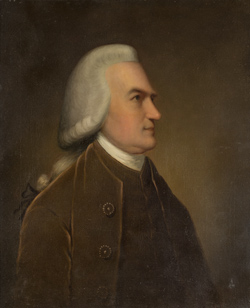
The Hon. JAMES BOWDOIN, Esq [shown above]; was chosen Moderator.

The Moderator informed the town that the present meeting was in consequence of an interview between his excellency General Gage and the Selectmen, at his desire, and mentioned the substance of the conversation that pass’d; and also that the Selectmen with the advice and assistance of a number of gentlemen had prepared several votes, which they thought it might be proper for the town to pass—And which in conjunction with the assurances that had been given to his excellency by the selectmen, they apprehended from the interview aforesaid, would be satisfactory to his excellency——

Whereupon,
The Hon. James Bowdoin, Esq; Ezekiel Goldthwait, Esq; Mr. Henderson Inches, Mr. Edward Paine, Mr. Alexander Hill, together with the selectmen, viz. John Scollay, Esq; Mr. Timothy Newell, Mr. Samuel Austin, Thomas Marshall, Esq; & Mr. John Pitts, were appointed a committee to consider of this important matter, and were desired to report as soon as may be.

The said Committee made report, and after some debate, the two following votes passed unanimously, viz.

His excellency General Gage in an interview with the selectmen, having represented that there was a large body of men in arms assembled in the neighbourhood of this town, with hostile intentions against his majesty’s troops stationed here, and that in case the troops should be attacked by them, and the attack should be aided by the inhabitants of the town, it might issue in very unhappy consequences to the town.

For prevention whereof, his excellency assured the selectmen, that whatever might be the event of the attack, he would take effectual care, that the troops should do no damage, nor commit any act of violence in the town; but that the lives and properties of the inhabitants should be protected and secured, if the inhabitants behaved peaceably; and the selectmen in behalf of the town engaged for the peaceable behaviour of the inhabitants accordingly:

In confirmation of which engagement—Voted,
That as the town have behaved peaceably towards the troops hitherto, they hereby engage to continue to do so; and the peace officers, and all other town officers, are enjoined, and the magistrates, and all persons of influence in the town, are earnestly requested to exert their utmost endeavors to preserve the peace of the town:

The Town at the same time relying on the assurances of his excellency, that no insult, violence or damage shall be done to the persons or property of the inhabitants, either by the troops or the kings Ships, whatever may be the event of the attack his excellency seems to apprehend; but of which attack we have no knowledge or information whatever, as all communication between the town and country has been interrupted by his excellency’s order, ever since the collection of the body aforesaid.

Whereas the communication between this town and the country both by land and by water is at present stop’d by order of his excellency General Gage, and the inhabitants cannot be supplied with provisions, fuel and other necessaries of life; by which means the sick and all invalids must suffer greatly, and immediately; and the inhabitants in general be distress’d, especially such (which is by much the greatest part) as have not had the means of laying in a stock of provisions, but depend for daily supplies from the country for their daily support, and may be in danger of perishing, unless the communication be opened:

Therefore, Resolved,
That a committee be appointed to wait on his excellency General Gage, to represent to him the state of the town in this regard, and to remind his excellency of his declarations in answer to addresses made to him when the works on the neck were erecting, viz. “That he had no intention of stopping up the avenue to the Town, or of obstructing the inhabitants or any of the country people coming in or going out of the town as usual;” that “he had no intention to prevent the free egress and regress, of any person to and from the town, or of reducing it to the state of a garrison; that he could not possibly intercept the intercourse between the town and country;” that “it is his duty and interest to encourage it; and it is as much inconsistent with his duty and interest to form the strange scheme of reducing the inhabitants to a state of humiliation and vassalage, by stopping their supplies,”—

Also, to represent to him, that in consequence of these repeated assurances of his excellency, the fears and apprehensions of the inhabitants, had generally subsided, and many persons who had determined to remove with their effects, have remain’d in town, whilst others largely concern’d in navigation, had introduced many valuable goods, in full confidence of the promised security:

That the Town think his Excellency incapable of acting on principles inconsistent with honor, justice and humanity, and therefore that they desire his excellency will please to give orders for opening the communication, not only for bringing provisions into the town, but also, that the inhabitants, such of them as incline, may retire from the town with their effects without molestation.

The same Committee were appointed to wait upon the General with the foregoing votes.

Then the meeting was adjourned to Sabbath morning, ten o’clock.
The town was reminding Gen. Gage of all the promises he’d made in the preceding months of keeping life as normal as possible. Of course, now there was a besieging army outside (“a large body of men in arms assembled in the neighbourhood”). How would the general respond?

TOMORROW: Sunday meeting.

Saturday, August 13, 2016

A Split in the Merchants’ Club in 1771

On Tuesday, 13 Aug 1771, John Adams went into Boston for a weekly meeting of one of his gentlemen’s clubs and discovered that most of the club wasn’t there.

He wrote in his diary:
Spent the Evening at [Hannah] Cordis’s, the British Coffee house.—In the front Room, towards the long Wharfe, where the Merchants Clubb has met this twenty Years. It seems there is a Schism in that Church—a Rent in that Garment—a Mutiny in that Regiment, and a large De­tachment has decamped, and marched over the Way, to [Joseph] Ingersols.

This Evening The Commissary and Speaker, and Speaker and Commissary, Mr. [Thomas] Cushing was present. The Clerk of the House Mr. [Samuel] Adams, Mr. [James] Otis, Mr. John Pitts, Dr. [Joseph] Warren, Mr. [William] Molineux, Mr. Josa. Quincy, and myself were present.
The men left at the British Coffee House were the most politically aggressive members of the Merchants’ Club. In fact, most of those men weren’t even merchants—they were lawyers (Otis, Quincy, John Adams himself), a doctor (Warren), and a full-time politician (Samuel Adams).

Of the remainder, Cushing was pretty busy with the two high provincial offices Adams tagged him with. (Did Adams’s repetition of “Commissary and Speaker, and Speaker and Commissary” hint at some disapproval of dual office-holding?) Molineux appears to have supported himself by managing Charles Ward Apthorp’s local property while setting up a cloth factory. That left only John Pitts concerned full-time with imperial trade. (He would become a selectman in 1773-1777.)

John Adams’s other diary entries for August 1771 show that Otis’s behavior was becoming erratic. He had acted “quite wild at the Bar Meeting” the previous week. Otis had been reelected to his old seat in the Massachusetts General Court in May, but by November the authorities were stepping in. So some members of the Merchants Club might have decamped to get away from Otis.

In general, there was not much support for radical, confrontational politics in late 1771 simply because there was less to confront. The tariff on tea was the only remaining Townshend duty. There were no troops stationed in the center of town. The issues of judicial salaries hadn’t surfaced.

My big question is whether John Hancock was at Ingersoll’s Bunch of Grapes tavern with the “large Detachment” of merchants or had skipped both meetings. In this period Gov. Thomas Hutchinson perceived enough daylight between Hancock and Adams to believe he could win the young merchant over to his side. That didn’t happen, but maybe evenings like this suggested it might.