


J. L. BELL is a Massachusetts writer who specializes in (among other things) the start of the American Revolution in and around Boston. He is particularly interested in the experiences of children in 1765-75. He has published scholarly papers and popular articles for both children and adults. He was consultant for an episode of History Detectives, and contributed to a display at Minute Man National Historic Park.

Subscribe thru Follow.it


•••••••••••••••••


Showing posts with label Charles Chambers. Show all posts

Thursday, April 07, 2022

The Deep Roots of New England’s Pope Night
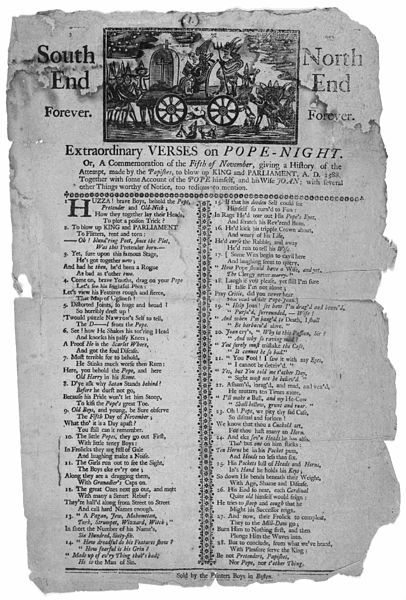
The Journal of Religious History recently made Luke Ritter’s article “Pope's Day and the Language of Popery in Eighteenth-Century New England” open for all here in the Wiley Online Library.

While eventually focusing on New England, this article begins with the reason eighteenth-century Britain celebrated the 5th of November. Unfortunately, that explanation mixes up dynasties:
The paradox of papist ambition and secrecy became powerfully instantiated in the commemoration of Guy Fawkes Day, celebrated in England annually after 1605 on 5 November. A Catholic by the name of Guy Fawkes and several other Jacobite conspirators desired to usurp the Hanoverian, Protestant monarch, James I, to restore a contending Stuart, Catholic family line. Englishmen who supported James I called the Stuart claimant a “pretender.”
James I was a Stuart—indeed, founder of the Stuart dynasty. His grandson, James II, was also a Stuart but not also a Protestant, causing Parliament to replace him with Protestant Stuarts. When that supply ran out in the early 1700s, Parliament invited in the line of Georges from Hanover. That’s when Stuart pretenders started to pose a continental, Catholic, and “Jacobite” threat to the Hanoverians.

The error, though unfortunate, is actually an apt reflection of the shifty nature of England’s established religion over two busy centuries. While the celebration of the 5th of November was rooted in the early 1600s, it took off as a holiday in New England more than a century later. Until then, the region was too often at odds with the British monarchy and Parliament to get behind celebrating their deliverance. But once the causes of anti-Catholicism, imperial pride, and respect for the king were firmly united, New Englanders were all in.

Ritter’s article digs up lots of evidence about the intellectual environment in which the holiday flourished. One of the values that united most Britons in the 1700s was that Roman Catholicism was a Bad Thing. (British Catholics didn’t hold that view, of course, but British law literally excluded them from full participation in British society.) New Englanders, with their culture’s Puritan roots, held that idea even more strongly.

As a result, during theological and political disputes New Englanders on both sides tended to accuse the other of acting too like the Catholics. Ritter quotes a New Light pioneer, the Rev. Elisha Williams, complaining in 1742 that traditionalists displayed the “true Spirit of Popery” by imposing their “Determinations on all within their Power by any Methods which may appear most effectual…in Matters of Religion.” Meanwhile, the Rev. Charles Chauncy, an Old Light leader, said even “POPERY itself han’t been the mother of more and greater blasphemies and abominations” than the New Light revivals.

As Ritter describes, Guy Fawkes was never really the focus of how New England celebrated Pope Night. Indeed, one surviving broadside about the holiday from the early 1760s misdated the Gunpowder Plot to 1588, showing how little people cared about those ancient details. Rather, the New England holiday came to lambaste contemporary enemies, starting with the Pope (not that many revelers could have told you what the current pope’s name was) and Stuart Pretender.

Eventually the “Pretender” became the name for the villain of the year being hanged in effigy. Boston’s “Pretenders” in the 1750s and 1760s included Admiral John Byng, Customs Commissioner Charles Paxton, and Governor Thomas Hutchinson. Thse effigies in turn offered meme for the Stamp Act protests of 1765 and the nonimportation pickets of 1770.

Ritter focuses a lot of attention on Massachusetts and Boston laws meant to keep Pope Night revelry from becoming too rowdy and violent, citing “tensions between elite Massachusetts-Bay legislators” and the celebrants.

While civic leaders undoubtedly worried about the violence and social disorder of Pope Night—a child was killed in 1764, after all—it’s significant that they never tried to end the celebration entirely, simply to keep it within bounds. And from the other side, I think it’s a mistake to see the holiday’s appeal for young males simply as upending authority. Rather, it was a day of misrule sanctified by also being both patriotic and pious.

As the article notes at the end, Pope Night lost its respectable rationale during the Revolutionary War. It was no longer patriotic to praise king and Parliament, and no longer politic to complain about everything Catholic when France was helping win the war. Pope Night imagery proved useful when Americans wanted to show their contempt for Benedict Arnold, but that tradition faded fast.

Mid-autumn misrule still had its appeal, though. Some Pope Night rituals hung on long enough to evolve into Halloween. But that vastly popular American holiday never regained an overt political or religious justification, despite the best efforts of UNICEF.

Friday, March 06, 2020

EXTRA: Collecting “information respecting the Massacre”

As I described earlier, the first order of business at Boston’s town meeting on 6 Mar 1770, 250 years ago today, was to collect “information respecting the Massacre of the last night.” This produced the earliest surviving eyewitness testimony related to that event.

The first man in line with such info was the painter John Singleton Copley, who reported:
that Mr. Pelham and his Wife and some Person of Mr. Samuel Wenthrops Family, heard a Soldier to say after the firing on the last Night, that the Devil might give quarters he should give them none—  
In other words, this soldier would use deadly force in any fight. [The published town records say “fixing” instead of “firing.”]

I interpret “Mr. Pelham and his Wife” to mean Copley’s half-brother Henry Pelham and his own wife Susanna (though conceivably the artist’s other half-brother Charles Pelham and his wife Mary had come in from Newton that night). Hearing this threat might explain why Pelham drew the accusatory picture of the shooting that Paul Revere later copied.

Samuel Winthrop was clerk of the Massachusetts Superior Court, where the soldiers would be tried. Copley painted him in his court robe around this time.

At the same town meeting, John Scott volunteered that “a Lad of Mr Peirpoints said at Mr. [Peter?] Cherdons, that a Soldier was heard to say that his Officer had acquainted them, that if they went abroad at Nights, they should go armed and in Companies.” This may have been the same John Scott chosen for jury duty that fall.

Robert Pierpont himself said: “before the firing on the last Night he had disarmed a Soldier who had struck down one of the Inhabitants.” Pierpont was an active Whig from the South End who had prompted his own riot the previous October. Cpl. Hugh McCann later complained that Pierpont had attacked him soon after the shooting, probably the same incident. Within days, Pierpont was overseeing inquests of the shooting victims as one of the town coroners.

The tailor Pool Spear reported: “last Week he heard one Kilson a Soldier of Pharras Company say…Inhabitants…had broke an Officers Windows [and]…that Parties of Soldiers were ordered with Pistols in their Pockets, and to fire upon those who should assault said House again, and that Ten Pounds Sterling was to be given as a Reward, for their killing one of those Persons, and fifty pounds sterling for a Prisoner.” Spear was then being sued for tarring and feathering the Customs service sailor George Gailer. Apothecary Robert Palmes reported that Spear had been near King Street the night before but went home, sensing trouble.

In such a small town, it seems, almost everyone had a link to the disputes that led to the shooting and a link to the legal system that would adjudicate it.

Another early witness was the shoemaker George Robert Twelves Hewes. His testimony wasn’t entered into the town records appended to more testimony published later, showing his determination to get this story out. Hewes said:
last night, about one o’clock, as he was returning alone from his house to the town-house, he met Sergeant Chambers of the 29th, with eight or nine soldiers, all with very large clubs and cutlasses, when Dobson, a soldier, spoke to him and ask’d him how he far’d, he told him very badly, to see his townsmen shot in such a manner, and asked him if he did not think it was a dreadful thing, said Dobson swore by God it was a fine thing, and said you shall see more of it; and on perceiving I had a cane, he informed Sergeant Chambers of it, who seized and forced it from me, saying I had no right to carry it; I told him I had as good a right to carry a cane as they had to carry clubs, but they hurried off with it into the main guard.
Was this Sgt. Chambers the same who had spent Sunday in a “house of pleasure”? I asked Don Hagist, editor of the Journal of the American Revolution. He said a Sgt. Charles Chambers is listed on the muster rolls of the 29th Regiment in October 1769 and June 1770. A Sgt. Joseph Chambers pops up on the latter roll, never having appeared in the record of the regiment before. So it’s not certain which sergeants were where.

(I was pleased Don could confirm that Matthew Chambers, who serves as an example of a redcoat with a wife and small children through much of Serena Zabin’s The Boston Massacre: A Family History, was a private and thus not the man who visited the brothel.)

It’s striking how none of this testimony that survives from that 6 March meeting directly related to the shooting on King Street, even though people like Hewes had been present. Instead, citizens were warning town officials about the ongoing threat that all the soldiers—not just those already in custody—posed to the people of Boston.

Wednesday, March 04, 2020

Looking for Trouble, Even on the Sabbath

Among the men who brawled at John Gray’s ropewalk on 2 Mar 1770 were a young ropemaker named Samuel Gray (no known relation) and Pvts. William Warren and Mathew Kilroy of the 29th Regiment.

The next day, there were more fights in Boston. Some redcoats from the 29th, including Pvt. John Carroll, went back into Gray’s ropewalk and challenged the men working there, along with sailor James Bailey. Then there was another brawl, with one private reportedly badly injured.

Town watch captain Benjamin Burdick also had a run-in with soldiers on Saturday:
A young man that boarded with me, and was at the Rope-Walks, told me several of them had a spite at him, and that he believed he was in danger. I had seen two soldiers about my house, I saw one of them hearkening at the window, I saw him again near the house, and asked him what he was after;

he said he was pumping ship:
(“Pumping ship” was slang for urinating. This may have been a reference to William Green’s rude joke the day before about cleaning an outhouse. Then again, the soldier might have been urinating.)
Was it not you, says I, that was hearkening at my window last night?

what if it was, he said, I told him to march off, and he damned me, and I beat him till he had enough of it, and he then went off.
That incident made Burdick, and even more so his wife, decide that he should carry a Highland broadsword when he went out on duty.

Sunday was a day of rest in Boston, of course. Yet more military men visited Gray’s ropewalks then, 250 years ago today. But this delegation was at a higher level, as owner John Gray testified:
At Sabbath noon I was surprised at hearing that Col. [Maurice] Carr [of the 29th] and his officers had entered my rope-walk, opened the windows, doors, &c, giving out that they were searching for a dead sergeant of their regiment; this put me upon immediately waiting upon Col. [William] Dalrymple [of the 14th, senior army officer in Boston, pictured above after retirement], to whom I related what I understood had passed at the rope-walk days before.

He replied it was much the same as he had heard from his people; but says he, “your man was the aggressor in affronting one of my people, by asking him if he wanted to work, and then telling him to clean his little-house.”

For this expression I dismissed my journeyman on the Monday morning following; and further said, I would do all in my power to prevent my people’s giving them any affront in future.

He then assured me, he had and should do everything in his power to keep his soldiers in order, and prevent their any more entering my inclosure.

Presently after, Col. Carr came in, and asked Col. Dalrymple what they should do, for they were daily losing their men; that three of his grenadiers passing quietly by the rope-walks were greatly abused, and one of them so much beat that he would die.

He then said he had been searching for a sergeant who had been murdered; upon which, I said, Yes, Colonel, I hear you have been searching for him in my rope-walks; and asked him, whether that sergeant had been in the affray there on the Friday; he replied, no: for he was seen on the Saturday. I then asked him, how he could think of looking for him in my walks; and that had he applied to me, I would have waited on him, and opened every apartment I had for his satisfaction.
These gentlemen in the military and in business were trying to keep the peace, but also sought to protect the interests of their operations.

The 12 March Boston Gazette added detail, perhaps even reliable, to the story of the missing sergeant:
Divers stories were propagated among the soldiery that served to agitate their spirits; particularly on the Sabbath that one Chambers, a sergeant, represented as a sober man, had been missing the preceding day and must therefore have been murdered by the townsmen. An officer of distinction so far credited this report that he entered Mr. Gray’s rope-walk that Sabbath; and when required of by that gentleman as soon as he could meet him, the occasion of his so doing, the officer replied that it was to look if the sergeant said to be murdered had not been hid there.

This sober sergeant was found on the Monday unhurt in a house of pleasure.
On the day of rest there were no more brawls, but rumors flew among the townspeople that soldiers were plotting revenge on Monday. Oddly enough, rumors spread among the soldiers that townspeople were plotting revenge on Monday.

COMING UP: Another glimpse of Sergeant Chambers. But first…