J. L. BELL is a Massachusetts writer who specializes in (among other things) the start of the American Revolution in and around Boston. He is particularly interested in the experiences of children in 1765-75. He has published scholarly papers and popular articles for both children and adults. He was consultant for an episode of History Detectives, and contributed to a display at Minute Man National Historic Park.

Subscribe thru Follow.it


•••••••••••••••••


Showing posts with label John Fellows. Show all posts

Tuesday, September 15, 2026

New York City Has Fallen

On 15 Sept 1776, 250 years ago today, the Continental Army withdrew from the southern end of Manhattan Island, leaving the city of New York to the British army.

That’s an orderly way to describe what happened. Here’s Gen. George Washington’s official dispatch to John Hancock and the Continental Congress the next day:
in the morning they began their Operations—Three Ships of War came up the North River as high [as] Bloomingdale which put a total stop to the removal by Water of any more of our provision &c. and about Eleven OClock those in the East River began a most severe and Heavy Cannonade to scour the Grounds and cover the landing of their Troops between Turtle-Bay and the City, where Breast Works had been thrown up to oppose them.

As soon as I heard the Firing, I road with all possible dispatch towards the place of landing when to my great surprize and Mortification I found the Troops that had been posted in the Lines retreating with the utmost precipitation and those ordered to support them, [Samuel Holden] parson’s & [John] Fellows’s Brigades, flying in every direction and in the greatest confusion, notwithstanding the exertions of their Generals to form them.

I used every means in my power to rally and get them into some order but my attempts were fruitless and ineffectual, and on the appearance of a small party of the Enemy, not more than Sixty or Seventy, their disorder increased and they ran away in the greatest confusion without firing a Single Shot—

Finding that no confidence was to be placed in these Brigades and apprehending that another part of the Enemy might pass over to Harlem plains and cut off the retreat to this place, I sent orders to secure the Heights in the best manner with the Troops that were stationed on and near them, which being done, the retreat was effected with but little or no loss of Men, tho of a considerable part of our Baggage occasioned by this disgracefull and dastardly conduct—

Most of our Heavy Cannon and a part of our Stores and provisions which we were about removing was unavoidably left in the City, tho every means after It had been determined in Council to evacuate the post, had been used to prevent It. We are now encamped with the Main body of the Army on the Heights of Harlem where I should hope the Enemy would meet with a defeat in case of an Attack
William Douglas, a Connecticut militia colonel whose troops had been guarding an area near Kip’s Bay, told his wife that “my Left wing gave way” under the initial artillery fire:
I Lay myself on the Right wing, wateing for the boats untill Capt. [Jonas] Printice Came to me and told if I ment to Save my Self to Leave the Lines for that was the orders on the Left and that they had Left the Lines. I then told my men to make the best of their way as I then found I had but about ten Left with me.
Caesar Rodney, one of Delaware’s delegates to the Congress, was in the region, and he gathered this information:
the Ships…began a verry heavy Fireing at Turtle-Bay, to Scour the Country previous to their landing the troops, but hurt no Body that I Can hear of—When the Fireing ceased their Troops began to Land and ours to Run as if the Devil was in them in Spite of all the Genel. Could do. They never fired one Gun—

General Whashington haveing discovered their intention to Land at that place, and haveing properly disposed of his troops in case of an Attempt in either or both the other places, ordered a Reinforcement and set out there himself. However before he Got to the place, met our people runing in Every direction. He Endeavoured by persuasion, Threats &c. to get them back, but all to no purpose, in Short they Run till they left the General to Shift for himself—
A story went round that Gen. Washington was so angry that he threw his hat on the ground and shouted, “Are these the men with which I am to defend America?” (per Gen. William Heath) or “Good God, have I got such troops as those?” (per George Weedon). No one who was with Washington at the time described him behaving that way. But of course those men had other things on their minds—and may have thought such behavior was perfectly understandable.

Sunday, July 06, 2025

“To submit myself to all the orders and regulations of the army”

On 21 April 1775, two days after fatal fighting began, the Massachusetts Provincial Congress’s committee of safety adopted this oath for men enlisting in the provincial army:
I, A. B. do hereby solemnly engage and enlist myself as a soldier in the Massachusetts service, from the day of my enlistment to the last day of December next, unless the service should admit of a discharge of a part or the whole sooner, which shall be at the discretion of the committee of safety; and, I hereby promise, to submit myself to all the orders and regulations of the army, and faithfully to observe and obey all such orders as I shall receive from any superior officer.
Most men were already required to serve in the militia, but the committee was now thinking about “the army.”

It took until 1 May before another committee of the Massachusetts Provincial Congress came up with language for an officer’s commission:
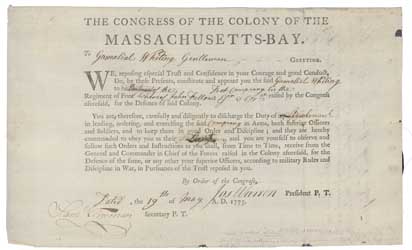
THE CONGRESS OF THE COLONY OF THE MASSACHUSETTS BAY.

To                 Greeting:

We, reposing especial trust and confidence in your courage and good conduct, do, by these presents, constitute and appoint you, the said                 to be                 of the regiment of foot                 raised by the Congress aforesaid for the defence of said colony.

You are, therefore, carefully and diligently to discharge the duty of a                 in leading, ordering and exercising the said                 in arms, both inferior officers and soldiers, and to keep them in good order and discipline; and they are hereby commanded to obey you as their                 ; and you are yourself to observe and follow such orders and instructions as you shall, from time to time, receive from the general and commander in chief of the forces raised in the colony aforesaid, for the defence of the same, or any other your superior officers, according to the military rules and discipline in war, in pursuance of the trust reposed in you.

By order of the Congress,                 the                 , of A. D. 1775.
The congress ordered a thousand copies of that form to be printed.

The Massachusetts Historical Society shares the image of one of those forms, given to Lt. Gamaliel Whiting of Great Barrington on 19 May.

The provincial congress listed Whiting as an ensign when it issued commissions for Col. John Fellows’s regiment on 7 June. It looks like “Ensign” was scraped off and the word “Lieutenant” inserted in three places, and by August the province did list Whiting as a lieutenant.

Someone added a note to this document about an “officer resigning and leaving the company at Springfield on the march to Boston,” allowing/necessitating Whiting’s promotion. Contrary to that note, there’s no evidence he achieved another promotion to captain before the end of the year. So I think family members recalled him stepping in for another man, but they mistakenly thought that happened after this commission rather than before.

(Until recently, the webpage for this document identified it as “Appointment as lieutenant in Massachusetts militia,” but now it correctly says, “Appointment as lieutenant in Massachusetts Bay Colony Regiment of Foot.” That reflects the misconception I discussed back here, that until Gen. George Washington arrived the Americans at the siege of Boston were all militia men. We’re all working on getting that transition right!)

TOMORROW: In the neighboring colonies.