J. L. BELL is a Massachusetts writer who specializes in (among other things) the start of the American Revolution in and around Boston. He is particularly interested in the experiences of children in 1765-75. He has published scholarly papers and popular articles for both children and adults. He was consultant for an episode of History Detectives, and contributed to a display at Minute Man National Historic Park.

Subscribe thru Follow.it


•••••••••••••••••


Showing posts with label Samuel Richards. Show all posts

Thursday, August 20, 2026

The Capture and Release of Capt. Samuel Richards
By 1777, both sides of the Revolutionary War held a significant number of prisoners.

Some of those people were soldiers or sailors captured in military operations while others had been detained as politically suspect.

American authorities were ready to arrange exchange prisoners as long as the British released someone of equal importance.

There were disputes about what that meant, of course. In July, a Boston crowd forcibly prevented Dr. Benjamin Church, suspected traitor and spy, from being traded for Dr. James McHenry, a young military surgeon who had already been paroled.

The Massachusetts government balked at releasing the Loyalist merchant Benjamin Davis, Sr., until a petition linked his case to Samuel Richards of Norwalk, Connecticut, as quoted yesterday.

Richards (1716–1777) lived in the village of Rowayton. He was a committee man clamping down on local Loyalism and captain of the militia company that guarded the shore.

Another Norwalk man, Stephen Hoyt (c. 1750–1809), had crossed to Long Island, New York, to work for the Crown. He cruised the coast in a sloop, picking up recruits for a Loyalist regiment called the Prince of Wales’s American Volunteers.

On the rainy night of 16 March, Capt. Hoyt led about twenty men into Rowayton to raid Richards’s farm. He captured fifteen armed men, including Capt. Richards, three Continental soldiers on leave, and eleven local guards.

Hoyt took those prisoners to New York, where they were locked up in the Provost jail. On 10 April the city’s Royal American Gazette praised the raid: “Such excursions as these will keep the Rebels in constant trepidation & give life & Spirit to our new made Soldiers & Officers.”

In May, Richards’s brother petitioned the Massachusetts General Court to exchange Benjamin Davis, Sr., for Capt. Richards. The legislature approved that plan on 2 June.

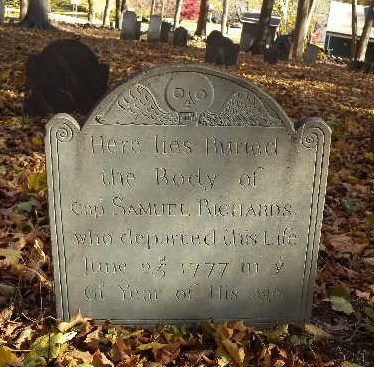
Davis traveled to New York. Samuel Richards returned to Norwalk but died very soon after, on 23 June. His gravestone appears above, courtesy of Find a Grave.

TOMORROW: Benjamin, Jr.

Wednesday, August 19, 2026

“Leave for his brother Benjamin, his son and servant, to depart this State”

As the year 1777 began, the Loyalist Benjamin Davis remained in the Boston jail along with his son and an enslaved servant.

Davis refused to petition the Massachusetts General Court for his release since he didn’t want to recognize the independent state government. But his religious scruples didn’t stop his brother Edward.

On 4 February, Massachusetts Council member Benjamin Austin came into the assembly chamber with
a petition of Edward Davis, of Boston, in behalf of his brother, Benjamin Davis, and son, prisoners in Boston Goal, praying that they may be permitted to go with a cartel to Newport
A “cartel” was the mechanism for a prisoner exchange.

The legislature named a joint committee of Austin and two House members to consider the request. The next day, that committee recommended “That the petitioner have leave to withdraw the same.” The General Court approved. That was a polite way of saying no.

On 18 February, jailer Joseph Otis listed his prisoners. Among the men noted as “being Enemical to the States” was Benjamin Davis but not his son. Benjamin, Jr., might have been paroled into the town, or at twenty years old he might still have been too young to merit his own listing.

On 6 March, the House noted
A petition of Edward Davis, praying leave for his brother Benjamin, his son and servant, to depart this State, in a cartel vessel bound for Halifax.
This time the response was “Read and dismissed.” That was a blunt way of saying no.

A newly elected legislature took their seats in May. Even as the House was getting itself in order
Nathan Cushing, Esq; brought down a Petition of James Richards, of Norwalk, praying that Mr. Benjamin Davis, a Prisoner in Boston, may be exchanged for his Brother Capt. Samuel Richards, a close Prisoner in New York Goal.
Again, the lawmakers referred this to a committee.

On 2 June, the Massachusetts House and Council reached this agreement:
Resolved that the prayer of the within petition be granted, & that Benjamin Davis now a Prisoner in the Goal in the town of Boston, be exchanged for Capt. Samuel Richards a prisoner in New York, provided that proper care be taken that sd Davis does not carry any papers with him & is cautiously sarched when deliver’d up. And it is also

Resolved that Benjamin Davis junr. Son of the aforesaid Davis, now a Prisoner in Boston Goal be exchanged for Mr John Callender a Prisoner in New York, provided due caution be taken that he does not carry any papers with him & is properly sarched when deliver’d up. But if said Callender or some person of equal rank should not be procured in Exchange for said Davis that said Davis be returned to this State.
Two days later, according to what Davis later told the British government, he was let out of the Boston jail. By the end of the year, it appears, the Davises were established in New York.

TOMORROW: The other side of those exchanges.

Thursday, March 19, 2026

“The gratifycation of being selected to carry the American flag”

Ens. Samuel Richards had a unique perspective on the Continental Army’s entrance into Boston after the British evacuation on 17 Mar 1776.

The young Connecticut officer was chosen (I don’t know how) to lead the troops in with his regiment’s flag.

He recorded his memories for his family many decades later:
By the enemies inactivity for several succeeding days we concluded they had abandoned the idea of attacking our fort. This comparative inactivity continued untill the 17th of the month when the whole of our troops were paraded and commenced our march into Boston, it being announced that the enemy were evacuating it. I had the gratifycation of being selected to carry the American flag at the head of the column which entered from the Roxbury side.

When arrived in the town numerous incidents crouded upon our view: I can particurize but few of them. The burst of joy shown in the countenances of our friends so long shut up and domineered over by an insulting enemy: the meeting and mutual salutations of parents and children and other members of families having been seperated and continued seperated by the sudden shuting up of the town after the battle of Lexington: the general delapidation of the houses: several churches emptied of all the inside work—and turned into riding schools for their cavalry [that actually happened in only one church, the Old South Meeting-House]: all the places which had been previously used for public resort torn to pieces: and at the stores around the wharves groceries—particularly salt—were in a state of destruction.

As I had no particular command I rambled at my pleasure—and being the carrier of the flag attracted some attention, was almost constantly pressed with invitations to “call in and take a glass of wine with me”

I saw the last boat of the enemy put off and proceed to the shiping.
Richards did some sightseeing, first visiting the fortifications left behind in Charlestown.
The next day I went and viewed the works on Castle island, the enemy had endeavored to blow up every usefull part of the works; in many instances they had succeeded, in others but partially, they had broken off the trunnions of all the heavy cannon, and in addition had spiked them up. In general every thing was mutilated and rendered useless.

I was invited to take lodgings at the house of a respectable widow lady Mrs. C. and treated with the utmost hospitality during the few days of my stay in the town.

On the 25th of the month the troops began their march by regiments toward New York, and by the 4th of April 21 regiments had moved on, ours being one of the number: five regiments being left to garrison the town…
Richards remained in the Continental Army through the year 1780, becoming a captain. He returned to Farmington and worked as the postmaster for two decades. In retirement he followed a daughter to Wilkes-Barre, Pennsylvania, where he died at age eighty-eight.

Wednesday, March 18, 2026

“The next morning presented to the view of the enemy a regular fort”

Samuel Richards (1753–1841) came from Farmington, Connecticut. In May 1775 he marched north with his town’s company to the Boston siege lines.

According to the memoir he wrote for his family decades later, Richards went as a gentleman volunteer, not in the ranks, and in Roxbury, Gen. Joseph Spencer offered him a post as private secretary.

However, contemporaneous records show that the young man was a sergeant in Capt. Noadiah Hooker’s company from May to December 1775. Perhaps Richards preferred his family to consider him as always of genteel class. 

Those sources agree that when the Continental Army was enlisted for a second year, Samuel Richards signed on as an ensign—the lowest rank of officer.

Ens. Richards’s regiment served on the southern side of the siege. For a while they camped on Gen. William Heath’s family farm in Roxbury, then in barracks as close to the Neck as possible.

Richards and his company were part of the reinforcement that went onto the Dorchester peninsula on the morning of 5 Mar 1776 to prepare for an expected British counterattack. He left this account of what followed in his memoir, published in 1909:
the next morning at 8 oClock a relief was sent on—of which I was one—in passing the neck the tide having overflowed it I found my boots filled with mud and water, but we had no dry clothes with us, nor any time or opportunity for changing. . . .

I found a redoubt considerably advanced in a position well calculated for defence. Outside the parapet were casks filled with sand and so placed that a slight touch would set them rolling down the hill which was very steep on every side, and thus break the ranks of the enemy on their advance.
Those barrels had prompted a lot of discussion.
On the afternoon of the 6th we very plainly saw the enemy in motion in the town: dense columns of troops moving down the main street to the wharf and embarking on board the ships which moved down the harbor and formed in a kind of crescent at considerable distance from the hill.

most of the next day [still 6 March] was spent by those ships in beating up nearer to our post—the wind being a head:

we continued our work incessantly in compleating the redoubt, being urged to exertion by a full expectation of being attacked by the enemy’s troops we had seen embark on board the ships; we had no time to spare for reflecting on and counting the cost of the issue of the expected battle, we did not work litterally with arms in our hands, but they were lying by our sides, and it is presumed that every one ardently wished for the opportunity of shewing the enemy what freemen would do when contending for their just rights. No one needed stimulating to the performance of his duty as every one possessed the inclination.

As night approached an uncommonly severe South East rain storm came on with very high wind, and in that elevated situation, surrounded by the sea, it was felt in all its force, but the severity of the storm did not stop our work, which we pushed forward with the utmost alacrity. The next morning presented to the view of the enemy a regular fort, far advanced to completion—and to our view their ships below apparently in a very disorderly condition: the day passed without any thing worthy of particular notice.
In looking back, Ens. Richards skipped over the couple of days that passed before the next action.
At evening we broke ground on Nook, or Nuke point, a small hill very near the water oposite South Boston. The enemy could plainly hear the sound of our entrenching tools, on which they opened and continued an incessant cannonade with a general direction towards this point. I counted the number of discharges up to about 1500 during half an hour and then left off counting; this firing was continued through the night, and the morning shewed a novel sight; the ground all around where the work had been carrying on appeared as if it had been plowed irregularly, and a very great number of cannon balls were picked up: but strange as it may seem there was but a surgeons mate and two privates killed during the night.
Contemporaneous sources say a doctor and three Continental privates were killed.

TOMORROW: Marching into Boston.

(Richards’s portrait, as copied for another family member around 1890, appears above. It was auctioned in 2020.)

Tuesday, March 17, 2026

“This Convinced me that they were Actually fled”

Gen. John Sullivan of New Hampshire wrote this description of how experienced the end of the siege of Boston for John Adams:

We Saw the Ships under way about 8 in the morning and the River full of Boats with Armed Soldiers. This gave an Alarm as Some Suspected they were about to Land at Dochester but having a full view of them with a Glass from Plowed Hill I found they were going on board the Ships.

I then took my Horse and Rode Down to Charlestown Neck where I had a Clear view of Bunkers Hill. I Saw the Sentrys Standing as usual with their Firelocks Shouldered but finding they never moved I Soon Suspected what Regiment they belonged to and upon taking a Clear view with my Glass found they were only Effigies Set there by the flying Enemy. This Convinced me that they were Actually fled for if they meant to Decoy us they would have taken away Every appearance of Men.

By this time I was Joined by Colo. [Thomas] Mifflin who with my Brigade Major [Alexander Scammell] agreed to go up[;] Sending two persons Round the works to Examine whether there was any of them in the Rear of the works while we went up in the front. I at the Same time Sent for a Strong party to follow us on to the Hill to assist us in Running away (if necessary).

We found no persons there and bravely Took a fortress Defended by Lifeless Sentries. I then brought on the party to Secure what we had So bravely won and went Down to the other works where we found all Abandoned but the works not Injured in any part.

We hailed the ferry Boat which came over and Informed us that they had abandoned the Town. We then gave Information to the General who ordered me with the Troops under my Command to take possession of Charlestown and General [Israel] Putnam with 2000 men to take possession of the works in Boston
Samuel Hall’s New-England Chronicle for 21 March offered the public this account of the action at the other end of Boston on the Neck:
About the same time General [Artemas] Ward, attended by about 500 troops from Roxbury, under the command of Col. Ebenezer Learned, (who unbarr’d and opened the gates) entered the town on that quarter, Ensign [Samuel] Richards carrying the standard.

The command of the whole being then given to General Putnam, he proceeded to take possession of all the important posts, and thereby became possessed, in the name of the Thirteen United Colonies of North-America, of all the fortresses in that large and once populous and flourishing metropolis, which the flower of the British army, headed by an experienced General, and supported by a formidable fleet of men of war, had, but an hour before, evacuated in the most precipitate and cowardly manner.
That’s rubbing it in, don’t you think?

TOMORROW: Ens. Richards’s perspective.