J. L. BELL is a Massachusetts writer who specializes in (among other things) the start of the American Revolution in and around Boston. He is particularly interested in the experiences of children in 1765-75. He has published scholarly papers and popular articles for both children and adults. He was consultant for an episode of History Detectives, and contributed to a display at Minute Man National Historic Park.

Subscribe thru Follow.it


•••••••••••••••••


Showing posts with label Jason Russell. Show all posts

Wednesday, September 25, 2024

Three Events on Saturday, 28 Sept.

This Saturday, 28 September, will see a number of local events linked to Revolutionary history.

10:00 to 11:00 A.M.
How We Remember
Massachusetts Avenue, Arlington

The Arlington Historical Society, Arlington 250, and Freedom’s Way National Heritage Area host a walking tour of Revolutionary sites in central Arlington, including a newly installed monument.
Historical references point to a mass grave of 40 British regulars who died on April 19, 1775 in the retreat from Lexington and Concord. A recent Ground Penetrating Radar study revealed disturbed soil in this location consistent with a mass grave. A permanent monument, dedicated September 7, 2024, now marks this historic site.

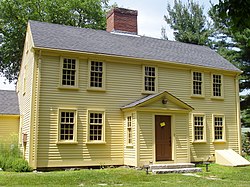
Our program will begin with a brief tour of the Jason Russell House where British bullet holes from April 19th, 1775 can still be seen. We will then walk a flat and easy 0.3 miles to the Old Burying Ground, passing Robbins Memorial Town Hall, a statue by Cyrus Dallin, the Winfield Robbins Memorial Gardens and the Whittemore-Robbins House.

Arriving at the Old Burying Ground, we will see the recently dedicated Monument to the Fallen Crown Soldiers who Died on April 19, 1775 and the 2023 Monument to Enslaved and Free Persons of Color in Menotomy who are buried in the same area. Before returning to the Jason Russell House, we will visit the 1848 Revolutionary War Monument that marks the burial site of Jason Russell and 11 of his fellow Patriots who fell on April 19th, 1775.
Space is limited to twelve people, so register in advance. 

10:00 A.M. to 4:00 P.M.
Sudbury Ancient Colonial Faire and Fife & Drum Muster
Longfellow’s Wayside Inn, Sudbury

The annual fair in Sudbury includes a colonial encampment, militia and crafts demonstrations, contradancing, and dozens of food and craft vendors. Twenty-five fife and drum corps from across the Northeast are scheduled to perform.

The Grand Parade of fifes and drums will begin at noon; this year there is a new route that starts in front of the camping area. After the groups reach the fair grounds, each performs in turn, providing music through the afternoon.

Admission is $3 cash at the gate. Nearby parking is free.

4:00 to 5:30 P.M.
Battle of Menotomy: Myth, Lore & History
Rebecca Nurse Homestead, Danvers

Prof. Donald Hayes, a longtime member of the Danvers Alarm List Company, will present his recent research on the role that the Danvers militias played in the fighting at Menotomy during the Battle of Lexington and Concord. Danvers lost seven men that day, second only to Lexington itself. He will highlight what is lore and what is documented fact. Reserve free tickets here.

Tuesday, April 23, 2024

“When forty-two countrymen Sure bid their friends adieu.”

Ezra Lunt and Henry-Walter Tinges printed the Essex Journal in Newburyport with the financial backing of Isaiah Thomas, who made a hasty move from Boston to Worcester in April 1775.

On 26 May, the Essex Journal published this verse in a section of the back page titled “The Parnassian Packet”:
A Funeral ELEGY, to the Immortal Memory of those Worthies, who were slain in the Battle of CONCORD, April 19, 1775.

AID me ye nine! my muse assist,
A sad tale to relate,
When such a number of brave men
Met their unhappy fate.
At Lexington they met their foe
Completely all equip’d,
Their guns and swords made glitt’ring show,
But their base scheme was nipp’d.
Americans, go drop a tear
Where your slain brethren lay!
O! mourn and sympathize for them!
O! weep this very day!
What shall we say to this loud call
From the Almighty sent;
It surely bids both great and small
Seek GOD’s face and repent.
Words can’t express the ghastly scene
That here presents to view,
When forty-two brave countrymen
Sure bid their friends adieu.
To think how awful it must seem,
To hear widows relent
Their husbands and their children
Who to the grave was sent.
The tender babes, nay those unborn,
O! dismal cruel death!
To snatch their fondest parents dear,
And leave them thus bereft.
O! Lexington, your loss is great!
Alas! too great to tell,
But justice bids me to relate
What to you has befell.
Ten of your hardy, bravest sons,
Some in their prime did fall;
May we no more hear noise of guns
To terrify us all.
Let’s not forget the Danvers race
So late in battle slain,
Their courage and their valor shown
Upon the crimson’d plain.
Sev’n of your youthful sprightly sons
In the fierce fight were slain,
O! may your loss be all made up,
And prove a lasting gain.
Cambridge and Medford’s loss is great,
Though not like Acton’s town,
Where three fierce military sons
Met their untimely doom.
Menotomy and Charlestown met
A sore and heavy stroke,
In losing five young brave townsmen
Who fell by tyrant’s yoke.
Unhappy Lynn and Beverly,
Your loss I do bemoan,
Five of your brave sons in dust doth lye,
Who late were in their bloom.
Bedford, Woburn, Sudbury, all,
Have suffer’d most severe,
You miss five of your choicest chore,
On them let’s drop a tear.
Concord your Captain’s fate rehearse,
His loss is felt severe,
Come, brethren, join with me in verse,
His mem’ry hence revere.
O ’Squire Gardiner’s death we feel,
And sympathizing mourn,
Let’s drop a tear when it we tell,
And view his hapless urn.
We sore regret poor Pierce’s death,
A stroke to Salem’s town,
Where tears did flow from ev’ry brow,
When the sad tidings come.
The groans of wounded, dying men,
Would melt the stoutest soul,
O! how it strikes thro’ ev’ry vein.
My flesh and blood runs cold.
May all prepare to meet their fate
At GOD’s tribunal bar,
And may war’s terrible alarm
For death us now prepare.
Your country calls you far and near,
America’s sons ’wake,
Your helmet, buckler, and your spear,
The LORD’s own arm now take
His shield will keep us from all harm,
Tho’ thousands gainst us rise,
His buckler we must sure put on,
If we would win the prize.
This tribute to the local men killed the previous month started with the town of Lexington, not just because redcoats had fired the first fatal shots there but because that town lost more men than any other.

Seven Danvers men were killed in and around Jason Russell’s house in Menotomy, so that town got the next mention—which the newspaper’s Essex County audience probably appreciated.

Eventually the poet got to individuals, naming a couple of men at the top of society—Capt. James Miles of Concord and Isaac Gardiner, Esq., of Brookline—and Benjamin Pierce of Salem, also killed at the Russell House. Other dead officers went unnamed, however.

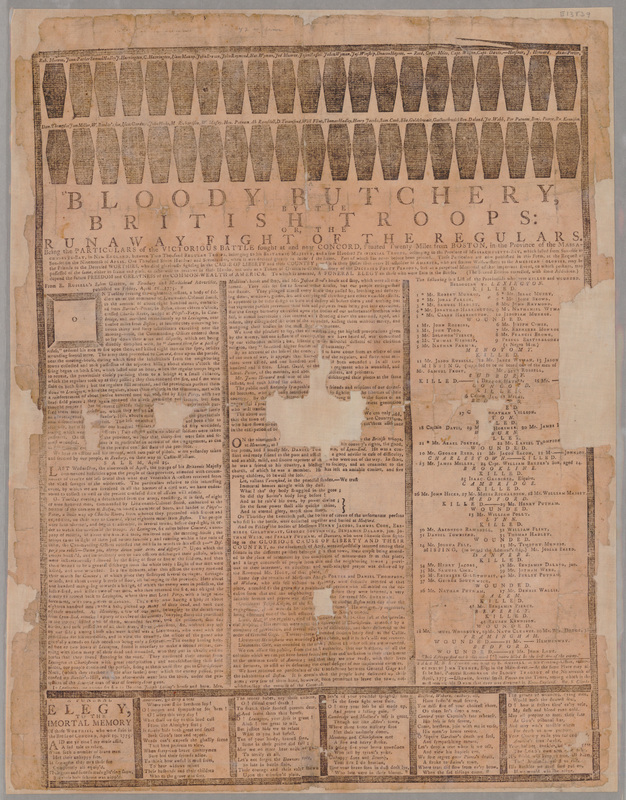
Ezekiel Russell printed this poem at the bottom of his “Bloody Butchery of the British Troops” broadside, shown above. You can peruse that page more closely through the American Antiquarian Society, founded by Thomas.

The Russell broadside contained some errors (a missing “brave,” “young” became “your,” another “your” dropped out), suggesting that shop hastily copied the text out of the newspaper. I would have expected the transmission to go the other way: from the Russell print shop, which was known for publishing a young woman’s elegiac verses, to the Essex Journal.

That in turn suggests that Russell didn’t issue the “Bloody Butchery” broadside until more than a month after the battle. Maybe he needed that time to engrave all those coffins.

Sunday, April 07, 2024

Heading into Patriot’s Day 2024

With yesterday’s posting, Boston 1775 has entered the Patriot’s Day season for 2024.

It’s hard to find a complete posting of Patriot’s Day events because so many towns and organizations have their own celebrations. But a good place to start is the calendar on the front page of Revolution 250.

Among the new commemorations this year is Tavern Week in Arlington, known as West Cambridge or Menotomy in 1775. The Massachusetts Provincial Congress’s committee on safety and supplies met in the Black Horse Tavern on what’s now Massachusetts Avenue on 18 April. Three members planned to spend the night but bolted out the back door when the redcoat column approached.

The Arlington Historical Society is also offering tours of the Jason Russell House, site of the bloodiest fighting of the day, on Saturday, 13 April, and Monday, 15 April, noon to 4 P.M.

Also on 13 April, Michael Lepage will portray Paul Revere at the Paul Revere House in Boston while the Minute Man National Historical Park hosts its annual big tactical demonstration and reenactment of events along the Battle Road.

Some of the towns planning local Patriot’s Day remembrance events include Billerica, Danvers, Somerville, Hanover, and Lynnfield. Others will send traditional contingents to the event in Minute Man Park.

All outdoor events of course depend on welcoming weather. We had snow last week, and flooding forced the cancellation of an event at James Barrett’s farm in Concord today. So let’s hope for sunshine and cool breezes for the next two weeks!

Thursday, April 13, 2023

Jason Russell House in Arlington Open for Patriots’ Day

Earlier this month it wasn’t clear if the Jason Russell House would be open during Patriots’ Day, but the Arlington Historical Society has announced its visiting hours.

There will be guided tours of the Jason Russell House on Sunday, 16 April, from 1:00 to 4:00 P.M. and on Monday, 17 April, from noon to 4:00 P.M.

Admission includes the exhibit “Menotomy—Road to Revolution.” The cost is $8 for adults, $4 for children aged six to eighteen, and free for younger children.

The house itself was studied by the Dendrochronology Laboratory at Oxford University in 2012. That examination showed that some of the timbers were cut around 1684 and probably used to build an older structure. Then Jason Russell bought the property and erected this house in the 1740s, using some older salvaged beams and some new wood.

By 1775 Russell was in his late fifties and too disabled to serve in the regular militia for this western part of Cambridge. Nonetheless, he chose not to leave his house, near the road on which the British columns marched west in the morning.

In fact, Russell welcomed militiamen from towns to the south (Dedham, Needham) and the northeast (Essex County) onto his property. Those men planned to shoot at the withdrawing redcoats, despite warnings that their ambush position was so close to the road they could be outflanked. They were.

British soldiers killed twelve men on this site. Another eight survived by holing up (down?) in the basement.

The dead, including Russell, were buried in one grave. In 1848 the people of West Cambridge, as the town was then known, erected a granite obelisk on that site. However, they knew the names of only three of the men interred there. The rest were from other towns, so they didn’t have local descendants and neighbors to remember them. The Centennial of 1875 stimulated more research, providing the names all the men who died in the battle there.

As I previously noted, the Arlington Historical Society is also sponsoring a lecture on Tuesday, 25 April, at 7:30 P.M. in the town’s Masonic Temple on “The Battle of Menotomy” by A. Michael Ruderman.

Wednesday, January 11, 2023

“She was surprised by the firing of the king’s troops”

Last month Alex Cain at Historical Nerdery rounded up four accounts from women who had all-too-close encounters with British troops during the Battle of Lexington and Concord.

Those are all stories preserved in the women’s own words, not questionable latter-day legends like Lydia Barnard.

Those accounts survive because:
  • Hannah Adams and Hannah Bradish described experiences that the Patriots could present to the world as atrocities, and therefore wrote down and spread around in 1775.
  • Mary Hartwell and Anna Munroe lived long enough to be among the few people to remember 1775, making other people more interested in hearing and recording their stories.
Here’s a taste of Hannah Bradish’s account:
about five o’clock on Wednesday last, afternoon, being in her bed-chamber, with her infant child, about eight days old, she was surprised by the firing of the king’s troops and our people, on their return from Concord. She being weak and unable to go out of her house, in order to secure herself and family, they all retired into the kitchen, in the back part of the house. She soon found the house surrounded with the king’s troops; that upon observation made, at least seventy bullets were shot into the front part of the house; several bullets lodged in the kitchen where she was, and one passed through an easy chair she had just gone from.
After the battle, Bradish reported finding many things missing, “which, she verily believes, were taken out of the house by the king's troops.”

Cain notes that the Rev. David McClure also wrote about seeing houses like Bradish’s along the battle road in Menotomy shot up with musket balls. Indeed, people can see the physical evidence of those shots in the Jason Russell House, as shown above.

But did the British muskets do all that damage? With a finite amount of ammunition, would the regulars have fired so many balls into a house with no one firing back from inside? Or might a lot of those bullets have come from provincial militiamen firing at the redcoats they saw around that house?

Wednesday, October 21, 2020

Investigating the Jason Russell House

The Arlington Historical Society just provided an interim report on various investigations into one of its historic properties, the Jason Russell House.

This building was the focus of the deadliest skirmish on 19 Apr 1775. Russell and eleven militiamen, mostly from Danvers, were killed in and around the house after being caught by a flanking guard of regulars protecting the main British column.

Joel Bohy has assembled a team to study the bullet holes preserved in the fabric of the house. They found more holes than had been previously identified, some at trajectories indicating they were ”fired through the [upper] windows from the street below, either as a preventative measure or to target a person shooting out of them.”

The dispatch describes how those bullet holes are being studied:
The team examined every hole and strike and measured with calipers to determine the caliber, which can often determine whether the projectile was discharged by a British soldier or provincial. They used metal detectors and a video scope to investigate within the walls. Scott swabbed each hole to detect for lead residue, and the team used ballistics rods and laser lights to determine the trajectory of each musket ball.
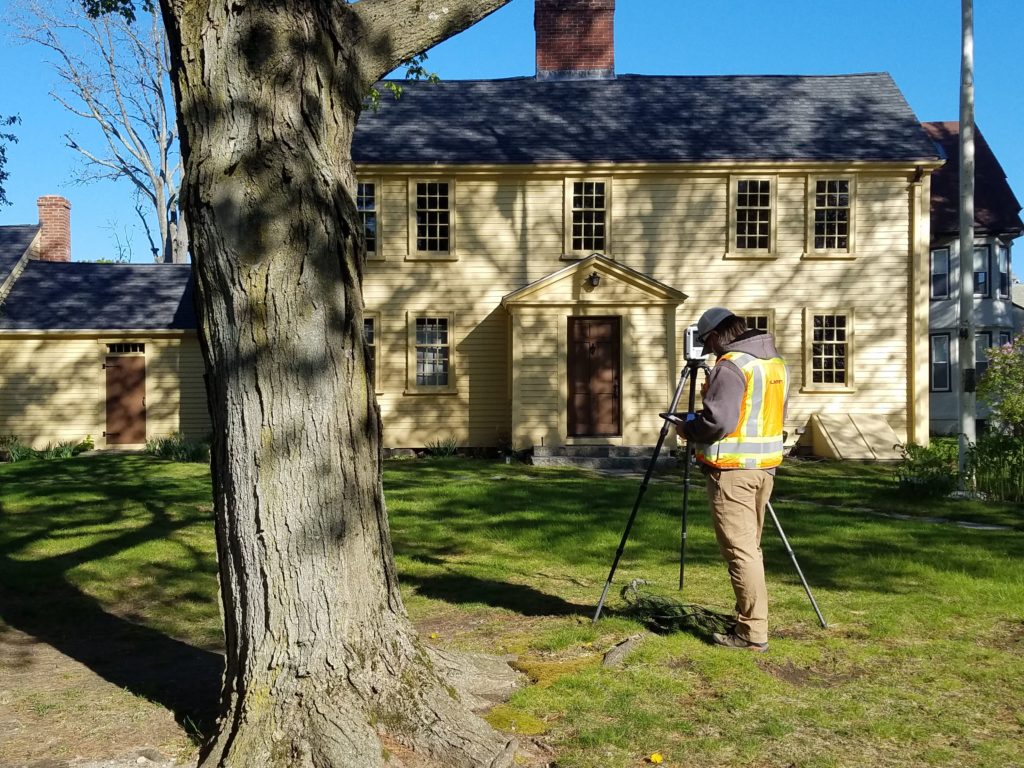
Other ongoing investigations include 3-D laser mapping of the building and grounds, a scan of the grounds by ground-penetrating radar, and even experiments firing flintlock muskets at targets built to mimic the house’s walls.

In addition, the society is still hunting for the house’s bullet-riddled door, which the Russell family sold to a collector in the late 1800s.

Sunday, April 08, 2018

A Few More Local Patriots’ Day Events

Yesterday I listed the events surrounding Patriots’ Day that are scheduled to take place in Minute Man National Historical Park. I also linked to Battleroad.org, a website listing other events in the area.

But there are yet more local commemorations, some of which may not appear on either list. I’ve come to see that pattern as emblematic of deep New England culture. Even though the militia mobilizations of 1774-1777 were by definition mass evens, our communities often like to maintain our own traditions independent from coordinating authorities.

This afternoon, for example, the town of Tewksbury commemorates its response to the 1775 alarm with the “Tewksbury Line of March” starting at 1:30 P.M. The Tewksbury Militia and Minutemen, Billerica Colonial Minutemen, and Second Massachusetts Regiment will participate. Former Tewksbury Historical Society president David Marcus will narrate the event.

Attendees are invited to walk behind the reenactors along the militia companies’ original route along East Street, Lee Street, and Chandler Street to the town library, where there will be a musket salute. At around 2:45 P.M. guest speaker will then provide a Loyalist perspective on events.

On Sunday, 15 April, Arlington will be the scene of “The Fight at the Jason Russell House,” reenacting the skirmish that cost more than a dozen lives in 1775. Participating reenacting groups include the Menotomy Minutemen, the Danvers Alarum Company, Gardner’s Regiment, and the Acton Minutemen. The Jason Russell House is at 7 Jason Street (just off Massachusetts Avenue), and this event is due to start at noon.

That fight is scheduled to finish by 2:00 P.M. when the Arlington Patriots’ Day Parade will begin, starting at Massachusetts Avenue and Brattle Street and proceeding east along Mass. Ave. to the Walgreen’s in East Arlington. Expect bands, fire engines, reenacting units, and community groups to march by.

Finally, that Sunday evening in Lexington, History At Play will present “The House of Hancock,” a “fun-filled, Hamilton-style musical” about the rise of the Hancock family. John Hancock’s grandfather was the minister in Lexington for decades, and he spent some years of his youth there before returning for his fateful visit in 1775.

“Join John and Dolly Hancock, Sam Adams, and more as they plan a revolution,” says the show notice. This chamber musical will be performed in the Lexington Depot starting at 7:00 P.M. Tickets are $20 for Lexington Historical Society members, $25 for non-members, and $15 for children.

Monday, January 02, 2017

The First Step in Preserving the Jason Russell House

The Massachusetts Historical Commission and the town of Arlington just granted the Arlington Historical Society a $15,000 grant to study what is necessary to preserve the Jason Russell House.

The society explains:
The Jason Russell House is listed both on the State Register of Historic Places and the National Register, and has both local and national significance as the site of the most intense fighting between retreating British soldiers and local civilians on April 19, 1775. It is currently interpreted as a historic house museum, owned and operated by the Arlington Historical Society. This captivating story is interpreted for the public through docent-led tours and a robust education program for area schools.

Not only does the Jason Russell House present the story of an important event in American history, but is also a tangible connection to the past. Successive owners did little to alter the original house. As a result, the house retains much of the original historic features, including musket ball holes from 1775.

The Society purchased the home in 1923, and has been able to maintain the home for intervening decades, however some urgent preservation needs have arisen and a considerable amount of restoration work is needed. This Study will become the core planning document, guiding and prioritizing projects, and ensuring that all conservation and rehabilitation projects are within standards for historic preservation.
More specifically, Russell built a two-room house in 1740, then added two more. “Decorative changes around the windows and front door and an ell were added in the 19th Century,” the house’s webpage says. The Russell family lived in the house until 1896, and many of its current furnishings come from them.

Monday, June 07, 2010

Ammi Cutter and the Old Men of Menotomy

Yesterday I quoted the part of “The White Horseman,” the earliest known story about Hezekiah Wyman on 19 Apr 1775, which makes it also the earliest known story about Ammi Cutter on that same day.

We know that there really was a man named Ammi Cutter in the western part of Cambridge, now called Arlington. The Independent Chronicle newspaper for 1-8 Feb 1776 has an advertisement from “Ammi Cutter of Menotomy” about a two-year-old red steer he’d found.

Ammi Cutter (1733-1795) was a miller and farmer on his third wife, the former Hannah Holden. Like Asahel and Abigail Porter, the Cutters got married in Samuel Perley’s church in Seabrook, New Hampshire; Massachusetts couples went to that neighboring colony if they wanted to marry quickly with no questions asked. In Ammi’s case, the questions would have been:

  • Isn’t Hannah the younger sister of your second wife, who died sixteen months ago?
  • Are you sure you’ll be able to get home before the baby comes?
The marriage took place on 27 Oct 1774. Hannah gave birth to Joshua Cutter on 1 December.

There was, in fact, another Ammi Cutter in Menotomy at the time: the first one’s son (1755-1830). He was “a large man, broad in chest,” who at nineteen almost certainly marched with the town’s regular militia company on 19 Apr 1775. According to the family history, he “is said to have disabled three British foemen on the retreat from Concord.”

And that leads us from the written vital records into unverifiable oral traditions. In his early forties (and with an infant at home), the older Ammi Cutter was reportedly exempted, along with other older men, from marching off to confront the redcoats. Instead, he and a bunch of “exempts,” some of them war veterans, stayed in Menotomy and ambushed a British supply convoy.

How did that story come down to us? The first hint comes in “The White Horseman,” which credits “Ammi Cutter” with masterminding the attack. That 1835 story says, “Ammi had planted about fifty old rusty muskets under a stone wall, with their muzzles directed toward the road.”

A more detailed story appears in the Rev. Samuel Abbot Smith’s history of west Cambridge on 19 Apr 1775, published in 1864. Based on interviews with local residents about what they’d heard growing up, Smith said that the “old men…in all about twelve” chose David Lamson to lead that attack, but he credited Cutter with being part of it. For different parts of that story Smith cited Dr. Benjamin Cutter (1803-1864), the older Ammi’s grandson; Mrs. Lydia Peirce, actually alive in 1775; a Miss Bradshaw, granddaughter of the parish minister in 1775; and Col. Thomas Russell, grandson of Jason Russell.

Smith told two other stories involving Ammi Cutter, citing Dr. Cutter. The same stories appear in two books the doctor drafted and his son William R. Cutter finished: A History of the Cutter Family in New England (1871) and History of the Town of Arlington (1880). According to those books: That makes Ammi Cutter appear crucial to much of what happened in Menotomy on 19 Apr 1775. It may be safer to say that his family was crucial in preserving and publishing the town’s stories.

Because of the contemporaneous reports and the number of people in Arlington who recalled hearing about the event, it’s clear that a group of Menotomy men did ambush British supply wagon. (The “Old Men of Menotomy” historical marker appears above, courtesy of the Historical Marker Database.) Ammi Cutter was most likely in that group, and his family definitely passed down the tale.

One descendant, also named Ammi Cutter and born in 1777, became a prominent merchant in Boston and a captain in the town militia. If he told the story about his grandfather on lots of occasions in Boston, it could have become a well-known anecdote of 19 Apr 1775, attached to the name Ammi Cutter, even before it was printed. And that’s just as “The White Horseman” presents it.

COMING UP: What about “Mother Barberick”?