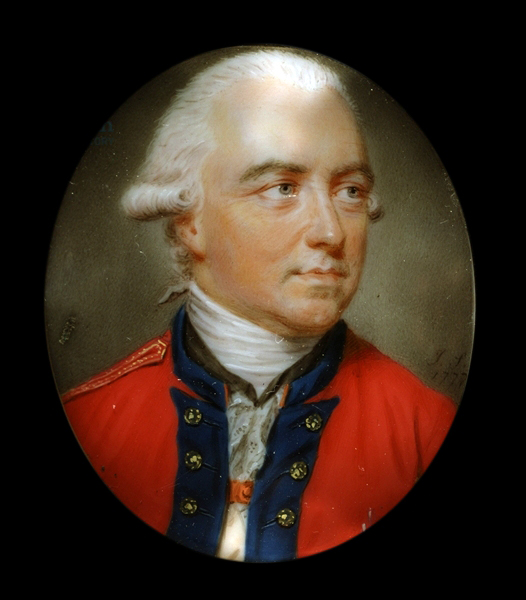
J. L. BELL is a Massachusetts writer who specializes in (among other things) the start of the American Revolution in and around Boston. He is particularly interested in the experiences of children in 1765-75. He has published scholarly papers and popular articles for both children and adults. He was consultant for an episode of History Detectives, and contributed to a display at Minute Man National Historic Park.

Subscribe thru Follow.it


•••••••••••••••••


Showing posts with label Earl Percy. Show all posts

Saturday, March 07, 2026

“A more interesting and bloody scene is apprehended”

The Rev. William Gordon’s account of the end of the siege of Boston continues, picking up (in the present historical tense) just after Gen. William Howe has spotted the Continental Army positions on the hills of the Dorchester peninsula:
The admiral [Molyneux Shuldam] informs him, that if the Americans possess those heights he cannot keep one of his majesty’s ships in the harbour. A council of war determines to attempt dislodging them.

General [George] Washington has settled his plan of defence and offence. Boston is so surrounded on every land side by neighbouring hills, that nothing can take place on the wharves or next to the water, but it may be noted by the help of glasses. Proper signals having been agreed on, by means of the hills, which are in view one of another, intelligence can be conveyed instantly from Dorchester heights to Roxbury, and from Roxbury to Cambridge and so the reverse. This mode of communicating information is the speediest and safest.

General Washington’s plan is, in case any number of the enemy leave Boston to attack the heights and are defeated, to communicate such defeat by the proper signal, when 4000 provincials are to cross over from Cambridge side, and attempt the town in the confusion that the regulars will be under. The boats are prepared, and the men paraded ready to embark. General [John] Sullivan commands the first division, and general [Nathanael] Green the second. Gen. [William] Heath objected to the command when offered, and remains in perfect safety with the troops left in Cambridge. The whole force which the commander in chief now has, including all the militia, is not much short of 20,000.

All is hurry and bustle in Boston. General Howe orders the ladders in town to be cut to ten feet lengths, that they may be fit for scaling. A large body of troops are to embark on board the transports, and to proceed down the harbour, with a view of landing in the hollow between the furtherest of the two fortified hills and the castle.

The men are observed by one, at whose door they are drawn up before embarking, to look in general, pale and dejected; and are heard to say, “It will be another Bunker’s Hill affair, or worse”—they have adopted the prevailing mistake of Bunker’s for Breed’s Hill. Some show great resolution and boast of what they will do with the rebels. When these troops, amounting to about 2,000, and designed to be under the command of lord Percy, are upon the wharves, and passing in the boats to the transports, the Americans expect they are intended for an immediate attack, clap their hands for joy, and wish them to come on.

General Washington happens at that instant to be on one of the heights; thinks with his men; and says to those who are at hand, “Remember it is the fifth of March, and avenge the death of your brethren.” It is instantly asked by such as are not near enough to hear, “What says the general?” His words are given in answer. They fly from man to man through all the troops upon the spot, and add fuel to the martial fire already kindled, and burning with uncommon intenseness.

The surrounding hills and elevations about Boston, affording a secure view of the ground on which the contending parties are expected to engage, are alive with the numerous spectators that throng them. A more interesting and bloody scene is apprehended to be just upon commencing, than what presented at Charlestown. They wait, as do the troops, officers and privates, the morning through; and till far into the afternoon, when they are convinced of the tide’s being so far ebbed, that no attack can be made by general Howe on the Tuesday, which indeed is not his intention, for he is preparing to do it on the Wednesday.

The transports go down in the evening toward the castle, a floating battery is also towed down, but the wind is unfavorable, and before they reach their destination blows up fresh, and forces three of the vessels ashore on Governor’s Island. A storm succeeds at night, such as few remember ever to have heard; and toward morning it rains excessively hard.

[March 6.] The design of general Howe was hereby frustrated, and a deal of bloodshed providentially prevented. A council of war, was called in the morning, and agreed to evacuate the town as soon as possible. The time that had been gained by the Americans for strengthening their works, before any attempt could be now made upon them, took away all hope of success…
And with that return to the past tense, Gordon signaled that the height of suspense was past. The siege would not end with a second mighty battle.

TOMORROW: When is an exchange of messages not an exchange of messages?

Tuesday, February 24, 2026

“As ever the two Armies met”

Yesterday we left schoolteacher Jonathan Hastings, Jr., and the rest of Col. Thomas Gardner’s Cambridge militia contingent caught near the Lexington meetinghouse on 19 Apr 1775.

Lt. Col. Francis Smith’s expedition to Concord (which Hastings called “the Detachment”) was headed back their way from the west, harried by other militia companies.

Col. Hugh Percy’s reinforcement column (“the Brigade”) was approaching from the east. Percy had more soldiers. And he had cannon.

We return to Hastings’s 11 June letter, now in the Thomas Gage Papers:
We were commanded to retreat into a thick Grove of Oaks over a Meadow, up to our Knees in water, wch. saved us. The Brigade turned their Artillery immediately upon us.—Their Cannon Balls cut down the Branches of the Trees merrily but none of us were killed.

As ever the two Armies met, it being about 3 Quarters after one OClock, they begun a precepitate Retreat for Bunkers Hill in Charlestown under the Protection of the navy. There were not above 400 that attacked them, being 1850 at once that day. Lord Peircy put the Cannon in Front, himself in the Centre, & the Marines were formed in the Rear. The Grenadiers & Marines were nobly peppered. Peircy had a Ball shot thro’ the Bosom of his shirt.

Two Officers were treppaned in the Red House leading to Charlestown. Quarters were offered them, they refused, replying their Orders were neither to give nor take any Favour. They met Death bravely.—

It is easier for you to imagine, than for me to describe the Horrid Barbarity & savage Cruelty of the British Troops in their Retreat. Houses plundered & burnt, wounded Men begging for mercy, had Bayonets struck into their Heads, & the Piece discharged, Women in Child Bed commanded into the Streets with a Gun at their Breasts, Old Men unarmed thrust thro’ their Bodies. Harmless young Fellows shot dead, such was the horrid Scene.

But on our side no such Vestiges of Cruelty were seen or exercised on any who chose to live: the wounded taken the utmost Care of, & when exchanged for our Men who were taken Prisoners, & have been treated most inhumanly: they cryed like Children to tarry among us.—
Of course, the redcoats had their own tales of atrocities by the enemy, starting with the “scalping” at Concord’s North Bridge.

I can think of one example of a woman who had recently given birth ordered out of her house (Hannah Adams of Menotomy) and one of a young teenager shot when he peeked out a window (Edward Barber of Charlestown). But Hastings’s letter rendered those examples as plural. And I’m not sure what he referred to with the bayonets.

Likewise, Hastings’s numbers of the troops engaged—400 militiamen chasing off 1,850 regulars—are skewed to make his side look good. Many groups of 400 provincials attacked the British column in turn. The Massachusetts force had a clear advantage in numbers.

Hastings wrote of emergency surgeries in “the Red House leading to Charlestown” as if his correspondent knew that location. Indeed, there appears to have been a brick house fitting that description. I haven’t been able to identify who owned or lived there, but sources do refer to its appearance and location.

On 12 May the Massachusetts committee of safety mentioned “the red house at the head of the creek near the road from Cambridge to Charlestown.” Soon provincials built the “Red House Fort,” more commonly called Fort No. 3, to guard a nearby crossroads, as shown in the detail of Henry Pelham’s map above. Today the site is just south of Union Square in Somerville.

TOMORROW: Finishing the letter.

Wednesday, December 17, 2025

Eight Runaway Men in a Boat from Boston

Capt. Richard Dodge was a Continental Army officer stationed in Chelsea during the second half of 1775. Like his regimental commander, Lt. Col. Loammi Baldwin, he sent periodic reports to Gen. George Washington’s headquarters about what he saw in Boston harbor.

On 16 December, Dodge reported some exciting news: “Last Eveing Eight men Runaway in a bote from Boston to our guard at the farry.”

Following recently enacted protocol, Dodge sent those men to a local health committee who “Clensed them by Smooking them” against the smallpox.

Six (or seven, according to the 25 December Boston Gazette) of those eight men were “masters of Vassels” captured by the Royal Navy and brought into Boston over the preceding months.

One, Capt. James Warden, had sailed for the Philadelphia merchant Thomas Mifflin and was anxious to renew their acquaintance now that Mifflin was the army’s quartermaster general. Naval Documents of the American Revolution reports that Warden was commanding the schooner Tryal on 22 August when it surrendered to H.M.S. Nautilus under Capt. John Collins.

The Essex Journal of Newburyport identified another of those ship’s captains as named Nowell, possibly Silas Nowell (who wouldn’t have been held that long). He came out with a copy of the Boston News-Letter, the only newspaper still being published in the town, and the news that Gen. John Burgoyne had sailed for England.

On 17 December, 250 years ago today, Dodge wrote out a prĂ©cis of what those men told him about life inside Boston. The prices for food were high. One escapee reported that “he Dined with a man that Dined with Lord parsey a feu Day ago upon horse beaff.”

Firewood was even scarcer with winter coming on. Gen. William Howe had ordered the Old North Meeting-House and empty houses torn down for fuel. We also know Howe told London that he might have to order wharves torn up next.

Citing Capt. Nowell, the newspapers added that “all the drugs and medicines in the town have been seized for the use of the army.”

TOMORROW: Tales of the searcher.

Thursday, October 16, 2025

From Hugh Smithson to the Duke of Northumberland

In 1742 a baby was born in England and baptized with the name Hugh Smithson.

His father was Sir Hugh Smithson, baronet (1714–1786), which made the little boy heir to that hereditary knighthood. Sir Hugh had served in House of Commons and filled several royal offices before inheriting that title from his grandfather.

The baby’s mother had been born in 1716 as Elizabeth Seymour, only daughter of Lord Algernon Seymour, son and heir of the Duke of Somerset. Lord Algernon also served in Parliament and as an army officer and colonial governor. In 1722 a clerical error had made him Baron Percy, granting him a title from his mother.

In October 1749 the Crown made Sir Hugh Smithson the first Baron Warkworth. The family barely had time to adjust to that before more significant changes happened. First, in January 1750, young Hugh got a baby brother named Algernon, after their maternal grandfather.

In February, that grandfather died. He had recently acquired more noble titles—Duke of Somerset, Earl of Hertford, Earl of Northumberland, Earl of Egremont, Baron Cockermouth (really), and so on. However, he had no direct male heirs. Therefore, by special arrangements his titles were doled out to his nephews, cousin, and son-in-law.

Baron Warkworth became Earl of Northumberland. In exchange, he petitioned Parliament to change his family’s surname to Percy; that law was passed in April.

Seven-year-old Hugh Smithson thus became Hugh Percy, but because he was now the oldest son of an earl, as a courtesy he was addressed by his father’s lesser title as Lord Warkworth.

Under that title, Hugh joined the British army. Within a year, still aged only seventeen, he was captain of a company. He saw action at the battles of Bergen and Minden. After a short time at Cambridge University, in 1763 Lord Warkworth was elected to the House of Commons as a member for Westminster. The next year, he married a daughter of the Earl of Bute, the former prime minister. By then he was a colonel.

In 1766 the colonel’s father, the Earl of Northumberland, was granted higher titles: Duke of Northumberland and Earl Percy. The latter rank became the courtesy title for his son Hugh.

That’s why the army colonel who served as Gen. Thomas Gage’s second-in-command at the start of the Revolutionary War was referred to as Hugh, Earl Percy. When his mother died in 1776, he inherited the barony of Percy in his own right, but fortunately that didn’t require people to call him by a new name.

In 1786 Lord Percy’s father died, and he became the second Duke of Northumberland. By special arrangement, his younger brother Algernon (then sitting in the House of Commons) inherited a new title, Baron Lovaine; four years later he was made the Earl of Beverley. (They also had an illegitimate half-brother named Jacques-Louis Macie and then James Smithson, who endowed the Smithsonian Institution.)

Monday, August 25, 2025

“No Carriage from L. & if there was—no permiso. to pass”

On 22 Apr 1775, three days after the Battle of Lexington and Concord, the Boston merchant and magistrate Edmund Quincy sat down to write a letter to John Hancock.

Quincy wasn’t just a colleague of Hancock in the Boston Patriot movement. He was also the father of Dorothy Quincy, Hancock’s fiancĂ©e (shown here).

Earlier that month, Dorothy had taken the family carriage out to Lexington and then used it to flee with Lydia Hancock from the regulars on 19 April. That left her father stuck inside Boston as the siege began.

Justice Quincy wrote to Hancock:

Dear Sir,

Referring you to a Ltr. wrote the 8th. currt: [i.e., of this month] I’m now to enclose you one I had this day out of [ship captain John] Callihan’s bag:—32 days fro. Lond: into Salem pr young Doct. [John] Sprague—who tells me [captain Nathaniel Byfield] Lyde sail’d 14 days before them wth. Jo. Quincy Esq & other passengers—that some of ye Men of War & transports sail’d also before Callihan. As to ye times [?] at home—ye Doctr. is little able to inform us—youl probably have Some papers via Salem.—————

As to my Scituation here ye unexpected extraordy. event of ye 19th: of wch. Ive wrote my thots—) now & for days past impedes my leaving town[.] No Carriage from L[exington]. & if there was—no permiso. to pass ye lines—The people will be distress’d for fresh provisions—in a Short time—

The Govr: & Genl.—is very much concern’d about ye Provl. troops without—wch. probably will be very numerous ’ere long if desired—Dorchester hill—I’m just now told, is possess’d by our provls—& I hope its true, for Ive reason to believe, ye Genl. had ye same thing in Contemplation——

Here they say & swear to it all round, in excuse of ye Regulars, proceeding at Lexinton—that they were attack’d first & I doubt not many oaths of Officers & men are taken before J. G—ley [Justice Benjamin Gridley], to confirm it—but among others who contradict ’em—Lt. [Thomas] Hawkshaw yesterday near expiring thro. his bad wounds——Call’d Several Credible persons to him & told ’em as a dying man—that he was obliged in Conscience to confess—that the first Action of ye Whole at L. was done by the Kings troops—wr. they killd & wounded eight men—but doubtless you have sufficient proof of ye Fact & every Circumstance attending near at hand—

my advice is that the Whole Matter—be forwarded at ye province expence or otherwise wth. the Greatest dispatch—that so your Advices may be in London as early as GG’s——

If the people of G:B: are not under a political Lethargy—The Account of ye late Memorable Event, will excite them to consider of their own Close Connexion wth. America; and to Suppose at length, that ye Americans especially N. Englanders will act as they’ve wrote, & engag’d—A Blessed Mistake our prudent G[ag]e has indeed made, & ye Sensible part of his Officers & Soldiers own it—& are vastly uneasie—

I had been at L— days to pay my real regards to yr. good Aunt & Dolly—but wn. we shall have ye passage clear I dont [know] we are in hopes of effecting soon. But ye Gl. is really intimidated & no wonder wn. he hears of 50.000 men &c.—Much is Confess’d of ye intripedity of ye provinls. Im much Surpriz’d to hear that the Regulars abt. 1700—were drove off & defeated by near an Equal Corps only.—

Capt. [John] Erving, at his house yesterday Gave me ye Account of Hawkshaws Confesso.-proved to him at ye No: End yesterday to be real, he also says that from all he can gather from ye Circumstances of the people of Gt. Bn. they are by this day in a State of fermentation—if we could be so happy, as to get speedily home, the necessary advices—I doubt not a Flame would soon appear—& ere its quench’d, may it burn up ye heads of the Accursed Faction fro. whence ye present British Evils spring

Genl. Gage is thrown himself into great perplexity—Ld. Percy is a thorn in his side & its said has menaced him Several times, for his late imprudence—a Good Omen

I cant nor ought I to add, but my best regards—& Love respectively & that I am
Dr. Sir Your most affecto: Friend
& H. Servt.
Ed. Quincy

youl excuse erro. for Ive not time to correct em
There are a lot of interesting bits of intelligence in this letter—Gen. Thomas Gage hoping to seize the heights of Dorchester, Col. Percy criticizing his Concord mission, Lt. Hawkshaw saying the British soldiers had fired first. Quincy urged Hancock and his colleagues to send the Patriot side of events to London as quickly as possible.

How did John Hancock respond to seeing this letter? In fact, he never saw it.

TOMORROW: Diverted mail.

Sunday, August 17, 2025

Opposing “authoritarian control over the national narrative”

The Organization of American Historians has issued a statement on the White House attempt, discussed yesterday, to dictate the operation of the Smithsonian Institution:
No president has the legitimate authority to impose such a review. Established by Congress in 1846 as a unique and independent agency, the Smithsonian Institution is not, and has never been, under the authority of the Executive Branch. It is an independent statutory agency, led by the Secretary and governed by a bipartisan Board of Regents as established by law. This legal structure is ignored by the letter, as the stated goals of the review are to “ensure alignment with the President’s directive to celebrate American exceptionalism, remove divisive or partisan narratives, and restore confidence in our shared cultural institutions.”

The White House’s effort to assert control over the Smithsonian’s staff, archives, donors, public-facing content, curatorial processes, exhibition planning, and collection use constitutes an alarming infringement on the autonomy and integrity of this 179-year old distinguished institution. Moreover, it asks the hundreds of professionals who work at the Smithsonian to violate their ethics and their dedication to free and open historical inquiry.

The effort as outlined is divorced from the realities of an evidence-based, comprehensive telling of the U.S. past, and is part of an aggressive push to flatten American history into a narrowly conceived, unrepresentative, and simplified story. Historians, scholars, or subject-area experts will not be conducting this mandated review—and certainly not those whose exhaustive research, reviews, and consultations preceded the public staging of exhibits—but rather it will be undertaken by presidential appointees aligned with a specific political agenda. This is exactly what the architects of Smithsonian independence sought to avoid.

The end result of this process will be the opposite of a fulsome presentation of the history of the United States that reflects the Smithsonian’s mission for “the increase and diffusion of knowledge.” Instead, the review and the method used to compel it, will undoubtedly be in service of authoritarian control over the national narrative, collective memory, and national collections.

It is particularly distressing to see this effort of historical censorship and sanitizing tied to the 250th anniversary of the nation’s founding—what should be a moment for thoughtful reflection about and celebration of the American experiment with all its tragedies and triumphs. Together, these moves threaten to weaponize our shared past to serve political imperatives of the present and an imagined future. They politicize the artifacts, recorded stories, and historical experiences that belong to the American people and that help to bring a full, unvarnished picture of our democracy into public view not for indoctrination, but for education.
Full statement here.

(James Smithson, founding donor of the Smithsonian Institution, was a younger half-brother, born out of wedlock, of Col. Earl Percy.)

Sunday, April 27, 2025

Earl Percy’s Map of the Route to Safety

American Heritage just shared a scoop in Edwin S. Grosvenor‘s article “Discovered: First Maps of the American Revolution.”

It’s based on a return visit to the seat of the Dukes of Northumberland, a title bestowed on Earl Percy’s father and inherited by him after his return from the American war.

Grosvenor writes about one document:

On the newly found map, Percy had drawn his route from Lexington to Menotomy and back to Boston. “He's sketching the line of march,” observed local historian Michael Ruderman, studying the new Percy map. “It's the theatre of battle, the hostile territory he had to travel during the afternoon. And he's sketching the landmarks that were significant to him like the Old Powder House tower that he passed on his left."

The Percy map provides many details about the landscape, roads, taverns, and houses that existed in 1775.

Percy averted an even greater disaster by marching his 1,700 men by an unexpected route. Rather than continuing straight to Cambridge, he took a left turn to head to the Charlestown neck, where the ships of the Royal Navy could protect his force with their guns and ferry him across the Charles River, back to Boston.

For nearly 250 years, the maps lay forgotten in a box with dozens of other maps of Revolutionary war battles and encampments brought back by Gen. Percy.
The caption explains: “When rotated with north facing up, the town of Medford is in the upper left, with the home of ‘Col. [Isaac] Royal’ marked outside the town.” At the center, looking like rude high-school graffiti, is the Charlestown powderhouse.

In the lower right corner is Cambridge. Along the bottom is the road from Menotomy village into central Cambridge with several landmarks labeled: “Menotomy mill:g House,” “Adams’s Tavern,” “Brook,” “Grove of Locust Trees,” and “Tavern.”

The last stands at the crucial corner where Col. Percy turned his column onto “Kent’s Lane through which the Troops return’d from Concord” to Charlestown.”

Saturday, April 19, 2025

Counterfactual 4: If No One Had Died at Lexington or Concord

Building on my counterfactual of what might have happened if Paul Revere and William Dawes had never brought their warning to Lexington, I reached the moment when the militiamen of Concord saw smoke rising above their town.

Under the scenario so far, the lack of urgent alerts out of Boston had no effect on the safety of John Hancock and Samuel Adams (who were never in great danger, despite their worries) or the quantity of military supplies the redcoats found (since James Barrett and his crew had already moved most of that stuff).

But that counterfactual situation would have delayed the response from towns around Concord, meaning fewer militia companies would have joined the local men on the hill overlooking the North Bridge.

We know those men were of two minds about confronting the regulars. They stayed on that hill for about two hours, marching down only after thinking other soldiers had set fire to the center of town. Then, after a fatal exchange of fire had chased the company from the bridge, they pulled back for another couple of hours.

Given those real-life details, I posited yesterday that the militia men would have been more wary about marching down on the bridge if there had been fewer of them. And eventually the smoke from town would have stopped, lessening the urgency.

In real life, after the shooting the militia companies moved around the north side of Concord and then massed east of the town. At Meriam’s Corner, once the regulars had left the most populated area, the provincials started to shoot at the column. Would that have happened the same way in this what-if scenario?

The very big difference in this counterfactual is that no one has yet been killed. There was no shooting in Lexington or at the North Bridge. Neither side had seen deaths to avenge. As long as the two groups of armed men remained at a distance, neither would have felt themselves to be under imminent threat.

In that case, the afternoon might have proceeded like the end of Lt. Col. Alexander Leslie’s raid on Salem in February: with the regulars marching in order back to where they came from while the local militia regiments watched sullenly to be sure they left. Lt. Col. Francis Smith’s men would have met Col. Percy’s reinforcement column somewhere in west Cambridge, and they would all have returned to Boston.

As it happened in April 1775, the bloodshed along the Battle Road motivated a militia siege of Boston. The committee of safety and its generals didn’t have to choose that policy; it came about naturally as militia companies massed off the peninsulas of Boston and Charlestown. Without deaths, the provincials wouldn’t have felt so much fervency, so the situation might have remained as it was: no military siege, but the countryside beyond Boston outside of royal control.

In the ensuing days, the Patriot press would have made the most of the army incursion into people’s homes while also trumpeting how the raid had found so little. The newspapers would have celebrated the escape of Hancock and Adams. They would have lauded the strong unified response of the Massachusetts militia.

As for Gen. Thomas Gage, he would have been pleased not to lose any men but frustrated at not capturing all the artillery pieces and other weapons he wanted to destroy. And how would he explain the mission to his superiors in London after they’d advised him to do something else?

Of course, that scenario doesn’t include any of the near-random events that can ignite violence, like the first shot at Lexington. What if British troops and Massachusetts militia did bump into each other somewhere? What if military patrols stopping Revere or Dawes before they got to Lexington meant that one of those popular Bostonians had wound up dead?

And even if the 18–19 April expedition did end without bloodshed, the conflict and tensions in Massachusetts would have remained unresolved. Gen. Gage’s next mission could have started the war instead, just a few weeks later.

Tuesday, February 18, 2025

“The fire then commenced and fell heavy on our Troops”

The rest of Lt. John Bourmaster’s April 1775 account of the Battle of Lexington and Concord, which I started to quote yesterday, didn’t relate his personal experiences as a Royal Navy officer.

He didn’t, for example, write anything about the operation to evacuate regulars from Charlestown back to Boston on the night of 19–20 April. He didn’t mention Maj. John Pitcairn of the marines.

Instead, Bourmaster’s letter passed on what he‘d heard from British army officers. And of course the big message that those officers, up to Gen. Thomas Gage, wanted to put out was that the rebels had started it.

Bourmaster’s very first statement about the fighting was that locals shot first.
A firelock was snapt over a Wall by one of the Country people but did not go off, the next who pulld his triger wounded one of the light Infantry company of General [Studholme] Hodgsons or the Kings own.
Other sources, including Pitcairn, Ens. Jeremy Lister of the 10th, and Capt. John Barker of the 4th (King’s Own), said that a soldier in the 10th Regiment was wounded in the morning at Lexington. In this case, Bourmaster had false information.

The lieutenant never actually got around to describing the search in Concord or the shooting there. Instead, his letter continued:
the fire then commenced and fell heavy on our Troops, the Militia having posted them selves behind Walls, in houses, and Woods and had possession of almost every eminence or rising ground which Commanded the long Vale through which the King’s Troops were under the disagreeable necessity of passing in their return.

Colonel [Francis] Smith was wounded early in the Action and must have been cut Off with all those he commanded had not Earl Percy come to his relief with the first Brigade; on the Appearance of it our Almost conquer’d Granadiers and light Infantry gave three cheers and renew’d the defence with more spirits.

Lord Percys courage and good conduct on this occasion must do him immortal honour, upon taking the Command he Ordered the King’s own to flank on the right, and the 27th [actually the 47th] on the left, the R Welsh Fuseliers to defend the Rear and in this manner retreated for at least 11 Miles before he reached Charlestown—for they could not cross at Cambridge where the Bridge is, they haveing tore it Up, and fill’d the Town and houses with Arm’d Men to prevent his passage;

our loss in this small essay ammounts to 250 Kill’d wounded and Missing. and we are at present cept up in Boston they being in possession of Roxbury a little Village just befor our lines with the Royal and Rebel centinels within Musquet shot of each other. The fatigue which our people pass’d through the Day which I have described can hardly be belived, having march’d at least 45 Miles and the Light Companys perhaps 60,
In fact, even the regulars who went all the way out to James Barrett’s farm in Concord and back traveled less than forty miles that day.

Bourmaster also wrote:
A most amiable young man of General Hodgson’s fell that Day his name Knight brother to Knight of the 43 who was with us at Jamiaca.
This was Lt. Joseph Knight, killed and buried in Menotomy. Ezekiel Russell’s Salem Gazette agreed that Knight was “esteemed one of the best officers among the Kings troops.”

TOMORROW: Those crazy provincials.

Saturday, April 20, 2024

“A ball came thru the Meeting house near my head”

Yesterday we left Maj. Loammi Baldwin and his Woburn militiamen skedaddling east from Brooks Hill in Concord with the withdrawing British column on their tail.

Baldwin’s account in his diary, as transcribed in this copy with line breaks for easier reading, continues:
we came to Tanner Brooks at Lincoln Bridge & then we concluded to scatter & make use of the trees & walls for to defend us & attack them—We did so & pursued on flanking them—(Mr Daniel Thompson was killed & others[)]. till we came to Lexington. I had several good shots—
“Tanner Brooks” referred to the tannery owned by the Brooks family. Analysts of the battle say the Woburn companies engaged the British troops somewhere around the Hartwell Tavern within the borders of Lincoln.
The Enemy marched very fast & left many dead & wounded and a few tired I proceeded on till coming between the meeting house and Mr Buckmans Tavern with a Prisoner before me when the Cannon begun to play the Balls flew near me I judged not more than 2 yards off.

I immediately retreated back behind the Meeting house and had not been there 10 seconds before a ball came thru the Meeting house near my head.

I retreated back towards the meadow North of the Meeting house & lay & heard the ball in the air & saw them strike the ground I judged about 15 or 20 was fired but not one man killed with them. They were fired from the crook in the road by Easterbrooks—
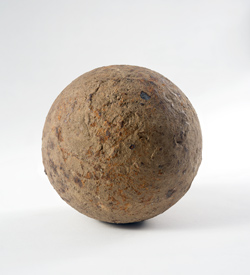
The picture above, courtesy of the Massachusetts Historical Society, shows a “small cannon ball, said to have been found on the side of the road near Lexington” at some point. The webpage for this artifact says: “It is made of lead and was the type of projectile fired from a smooth-bored cannon.”

In The Road to Concord I argue that the presence of cannon in Concord, and particularly the brass cannon of the Boston militia train, was crucial to Gen. Thomas Gage’s decision to order an expedition there.

But the provincials moved most of those cannon further west in the days before that march. They probably weren’t all equipped for use, anyway. On the British side, the expedition under Lt. Col. Francis Smith marched with no artillery for maximum speed.

But Col. Percy’s reinforcement column did come out with field-pieces, and those were the cannon that Loammi Baldwin and his Woburnites ran into. By deploying heavy weapons for the first time that day, Percy was able to make time for the combined British forces to regroup in Lexington, tend their wounded, and set off for Boston.

As for Maj. Baldwin, his diary stops as quoted above. The transcripts don’t resume until May, when he was an officer in the provincial army. Baldwin probably decided that having marched into Concord and back, fired “several good shots,” and taken a prisoner, his unit had done their dangerous duty for the day. He and his men may have followed the British column east for some more miles, but they stayed out of cannon range.

Friday, April 12, 2024

Thomas Machin on the Firing at Lexington

On 9 August 1775, Jedediah Preble (1707–1784, shown here) was visiting Cambridge.

A veteran of the wars against the French, he had been the Massachusetts Provincial Congress’s first choice to command its forces back in October 1774, but turned down the job on account of his age and health.

During that visit Preble wrote in his diary: “This morning met with a man that deserted from the regulars this day fortnight, as sensible and intelligent a fellow as I ever met with.”

A fortnight, or fourteen days, before was 27 July. There was one man who deserted from Boston around that date, remained with the Continentals, and was praised for his intelligence by men on both sides: Thomas Machin, captain in the American artillery from 1776. So I believe Preble recorded the former private Machin’s observations on the start of the war.

Preble wrote:
He was at Lexington fight. He says he came out with Lord Percy, and that he asked a young fellow of his acquaintance who fired first.

The soldiers when they first came where the Provincials were, one of them flasht his piece, on which a regular officer fired and swung his gun over his head, and then there was a general fire. They had 75 killed and missing, 233 wounded.
Alas, the antecedent for “one of them” is ambiguous: “soldiers” or “Provincials”?

Machin’s informant certainly blamed some “regular officer” for aggravating the situation. On the other hand, this version of events doesn’t have Maj. John Pitcairn or other officers ordering the redcoats to fire, which became the official provincial line soon after the battle.

There are further considerations. Machin’s information was secondhand, and he may have felt pressure to tell Americans what he thought they wanted to hear. Nonetheless, these comments ring true as a British enlisted man’s perspective: What did officers expect their soldiers to do when one of them was firing his gun and waving it around?

Preble went on:
He was also at Bunker’s Hill, where there was killed and died of their wounds 700, and 357 wounded that recovered. He took the account from Gen’l Robinson [actually James Robertson]. He says before he came out there died eight men of a-day, one day with another, and that they could not muster more than 6000 men.
Again, we know from Gen. George Washington’s files that Machin had brought out those casualty figures, as well as drawings of the British fortifications. He must have planned his desertion carefully.

Friday, April 05, 2024

After Historical Collections and Remarks

As discussed yesterday, Lt. Col. Robert Donkin distributed Historical Collections and Remarks to most of his subscribers in the spring of 1778, even though Hugh Gaine printed it in 1777.

The book carried a dedication to Earl Percy (shown here), best known for leading the British relief column during the Battle of Lexington and Concord in April 1775. The next year, he was promoted to general.

Percy participated in the Crown’s recapture of New York City and Newport, Rhode Island, in 1776. Gen. Henry Clinton left him in charge in the latter port.

Gen. Percy didn’t get along with Gen. Sir William Howe, his commander-in-chief. He sailed home to Britain in May 1777, ostensibly for noble family reasons but really because he didn’t want to take orders from Howe anymore. (Percy was heir to an English dukedom while Howe was merely younger brother of a viscount in the Irish peerage.)

Thus, by dedicating Historical Collections and Remarks to Percy, and then commissioning a frontispiece featuring him, Donkin took sides in a feud within the British command. However, in late 1777 Howe sent his own resignation to London, and he left America in May 1778, so Donkin’s career didn’t suffer.

The artist who engraved Percy’s portrait, James Smither, evidently accompanied the British army from Philadelphia to New York in the summer of 1778. The following 22 May, he advertised in James Rivington’s Royal Gazette:
JAMES SMITHER,
Engraver and Seal Cutter,
LATE of Philadelphia, at the Golden-Head No. 923, in Water-Street, near the Coffee-House, and next door but one to Mr. Nutter’s, where he engraves in the most elegant manner Coats of Arms, Seals, Maps, Copper Plates, and all other kind of engraving.
Meanwhile, the government of Pennsylvania declared that Smither was a Loyalist collaborating with the enemy and confiscated his property.

After the war was over a few years, however, Smither was able to quietly return to Philadelphia. In 1790 he started advertising an “Evening Drawing School,” much as he had back in 1769. He died around 1797, and his son, also named James Smither, carried on engraving until the 1820s.

As for Lt. Col. Robert Donkin himself, he continued to serve in the British army. He didn’t have the money that let Percy, Howe, and some other officers resign on principle.

In 1779 Clinton made Donkin the lieutenant colonel of the Royal Garrison Battalion. This unit was made up of “the worn out & wounded Soldiers of the British Regular Regiments in America,” Donkin later wrote. The officers were chosen for “Zeal & Experience and Constitutions broken by a long & arduous Service.” The unit was thought unfit for duty on the march or in battles but capable of serving in New York City, the Caribbean, or other secure garrisons. By 1780, Lt. Col. Donkin was commanding the bulk of those troops on Bermuda.

In 1783 the Royal Garrison Battalion was reduced. Donkin returned to Britain as a retired officer with a pension. Out of courtesy he was gradually promoted every few years, and since he lived until 1821, when he was ninety-three years old, Donkin made it all the way up to full general.

TOMORROW: More holes in Historical Collections.

Thursday, April 04, 2024

“An elegant frontispiece is now engraving”

We left Maj. Robert Donkin in 1777 with probably hundreds of copies of his Military Collections and Remarks needing to be shorn of a footnote that intemperately suggested his fellow British soldiers could fire smallpox-tipped arrows at the Americans.

That fall Donkin was busy with other things. In September the War Office announced his promotion to lieutenant colonel, news that made the American newspapers in December. By that time, Donkin was part of the British military force occupying Philadelphia.

We left the Philadelphia engraver James Smither as he switched to work for the Crown forces instead of Pennsylvania’s rebel government. Smither had been in North America for less than ten years, and, with the redcoats taking the American capital, he probably thought the king’s forces were winning.

On 14 April 1778, James Robertson’s Royal Pennsylvania Gazette ran this notice:

To the corps at New-York and Rhode-Island, that subscribed to the military remarks, &c.

LIEUT. Col. Donkin, gives notice that he has distributed to the orphans and widows of of [sic] the army here - - British £204.15.0

And that Mr. Thompson, Town-Adjutant of New-York, will proceed to distribute forthwith - - - £85.13.7

Being the balance arising from the publication, after defraying the expences of printing, &c. £290.8.7

N.B. An elegant frontispiece is now engraving at Mr. Smither’s, one of which will be sent to every subscriber.

Philadelphia, 13 April, 1778.
Thompson ran a similar announcement and accounting in Hugh Gaine’s New-York Gazette on 27 April. Donkin had deputized him to collect subscriptions the year before. (I haven’t found this man’s given name. The Scots Magazine and North-British Intelligencer reported that he was sergeant-major of the 37th Regiment.)

Thus, in 1778 Donkin commissioned Smither to create an illustration for his Military Collections, perhaps to make up for the delay and deletion of the footnote. So far as I can tell, none of the three copies with the footnote intact have the frontispiece shown here, and all of the copies with the frontispiece have a hole in page 190–1.


Donkin had dedicated his book to “the Right Honourable Hugh, Earl Percy, Colonel to his Majesty’s Vth regiment of foot,…commander in chief of the forces in Rhode Island.” He wrote:
HAVING had frequent occasions in the subsequent treatise to quote the grand actions of the most renowned captains of antiquity, it was natural for me to look at home for a Modern equally brilliant. Britannia holds forth PERCY! Fame sounds,
“Great in the war, and great in the arts of state!” ILIAD.
That was the scene Smither illustrated: Donkin at work on his book, interrupted by Fame trumpeting and Britannia (notably without a Liberty Cap) holding out a picture of the earl with the label “Ille noster heros (He is our hero).”

I quoted the £290.8.7 in charitable donations from inside this copy of the book. It’s possible that those pages were added to what Gaine had printed in 1777 at the same time that the frontispiece was inserted. To know for sure, we’d need to examine the copy owned by Gen. Valentine Jones (now at the Clements Library).

TOMORROW: Separate ways.

Sunday, April 17, 2022

Beck’s Blow-by-Blow Analysis

A century after Frank Warren Coburn shared his conclusions about which town militia companies fought the British troops at the Battle of Lexington and Concord, Derek W. Beck produced a new analysis.

Coburn sorted out the action by the towns where fighting occurred. In Igniting the American Revolution, 1773–1775, Beck focused more closely on individual skirmishes. Here’s his analysis about which towns’ companies joined the fighting and where.
Coburn listed the Watertown company as entering the fray in Arlington. Beck described those men following an order from Gen. William Heath and sticking near the bridge over the Charles River in Cambridge. In his memoir, Heath wrote (speaking of himself in the third person):
From the committee, he took a cross road to Watertown, the British being in possession of the Lexington road. At Watertown, finding some militia who had not marched, but applied for orders, he sent them down to Cambridge, with directions to take up the planks, barricade the south end of the bridge, and there to take post; that, in case the British should, on their return, take that road to Boston, their retreat might be impeded.
Watertown had an unusually large number of men under Capt. Samuel Barnard, so it’s possible some of them went into the fight on the north side of the Charles while others held the bridge. But Col. Percy avoided any confrontation at the river by turning east from Cambridge toward Charlestown. (Beck suggests the Watertown men might have then come up from the bridge to fight.)

Another town Coburn listed as taking part in the battle but Beck found no place for is Newton. Coburn wrote that three Newton companies joined the fight at Lexington, citing mainly Samuel F. Smith’s town history.

Smith gave a lot of space to a narrative passed down in the Jackson family, which actually says the Newton men started fighting in Concord and carried on all the way to when the redcoats got into their boats at Lechmere’s Point in Cambridge—which never happened.

However, Smith and another local historian, Francis Jackson, also printed a story about Capt. Jeremiah Wiswall’s company, how his seventy-five-year-old father insisted on marching along, and how the old man was shot in the hand. I quoted those passages back here.

It strikes me as potentially significant that two of the Newton companies said they “Marched from Newton to head quarters at Cambridge” while the third, Capt. Wiswall’s, went “upon the Alarm in Newton to Lexington.” That third muster roll includes “Mr. Noah Wiswall,” the captain’s father. Contemporaneous accounts do list Noah Wiswall among the wounded provincials.

All told, I therefore lean toward including Capt. Wiswall’s Newton company among the units that actually engaged the British troops in either east Lexington or west Cambridge. I’m not sure about the other two seeing combat, and the muster rolls contradict the Jackson family tradition.

[Full disclosure: I’m from Newton.]

Tuesday, February 08, 2022

“The infamous Capt. Beeman”

The Rev. Jeremy Belknap’s account of how Gen. Thomas Gage’s plan for the march to Concord leaked out to the Patriots, quoted yesterday, mentions four men by name.

Three of those people were well known Patriot leaders: Dr. Joseph Warren, Samuel Adams, and John Hancock.

The fourth was a Loyalist scout for the British troops identified as “the infamous Capt. Beeman.” Is there any more evidence about such a figure, especially evidence not publicized by October 1775? If so, that would suggest that Belknap truly heard some inside information.

And indeed we can identify “Capt. Beeman.” That must be Thomas Beaman (1729–1780), a Loyalist refugee from Petersham, Massachusetts.

Beaman was born in Lancaster. He joined Gov. William Shirley’s 1755 expedition against Acadia as a sergeant under Capt. Abijah Willard, and before the end of that war he was a captain under Col. Willard at the capture of MontrĂ©al. From then on people called him “Captain Beaman” even in peacetime.

In the 1760s Beaman was married and settled in Petersham. The first and so far only minister of that town was the Rev. Aaron Whitney (1714–1779). Unlike most of his Congregationalist colleagues in New England, Whitney strongly supported the royal government in the political disputes of the 1760s and 1770s.

So did Beaman. There was an argument and lawsuit over a schoolhouse around 1770 that I’ll save for later. Instead, let’s skip ahead to late 1774 after royal authority outside Boston broke down. According to Petersham town records, Beaman was among fourteen local men who banded together and agreed:
That we will not acknowledge or submit to the pretended Authority of any Congresses, Committees of Correspondence or other unconstitutional Assemblies of Men, but will at the Risque of our Lives, and if need be, oppose the forceable Exercise of all such Authority.
A 2 January Petersham town meeting summoned those men by name to explain themselves or repent. Only two showed up, defiantly maintaining their position. The meeting then determined:
Therefore as it appears that those persons still remain the incorrigable enemies of America and have a disposition to fling their influences into the scale against us in order to enslave their brethren and posterity forever, and after all the friendly expostulations and entreaties which we have been able to make use of, we are with great reluctance constrained to pronounce those, some of which have heretofore been our agreeable neighbors, traitorous paricides to the cause of freedom in general and the United Provinces of North America in particular…
The meeting urged townspeople not to have any commercial dealings with those men, even planning to print up 300 handbills at town expense. The Boston newspapers reported on that resolution.

Customs Commissioner Henry Hulton left this version of what happened next, starting in February 1775:
A number of Inhabitants in the town of Petersham, who had entered into an association for their mutual defence, finding the spirit of persecution very strong against them, assembled together in an house, resolving to defend themselves to the utmost.

The house was soon surrounded by many hundreds of the people, and they were obliged after some days to capitulate and submit. The people, after disarming them, ordered them to remain each at his own house, not to depart from thence, or any two of them to be seen together upon pain of death.
Petersham’s local historian says that siege concluded on 2 March.

Beaman then probably moved his family into Boston, as many other prominent Loyalists did. [ADDENDUM: Further research cited in the comments below shows that Beaman’s wife and children remained in Petersham until early 1779, when the Massachusetts legislature permitted them to travel through Newport to join him in New York City.] But according to the account his heirs later gave the Loyalists Commission, paraphrased in E. Alfred Jones’s The Loyalists of Massachusetts, “he, at the request of General Gage, frequently traveled the country to discover the real designs of the leaders of the rebellion.”

The Beaman family’s claim also stated that “he was a volunteer (as a guide to Lord Percy) with the military detachment to Concord.” Percy got only as far as Lexington, however. According to Belknap’s informant, Beaman was actually a scout for the first British column under Lt. Col. Francis Smith; those soldiers “landed on Phips’s Farm, where they were met by the infamous Capt. Beeman, and conducted to Concord.”

Furthermore, the New-England Chronicle newspaper of 12 Sept 1776 referred to “Capt Beeman, of Petersham (who piloted the ministerial butchers to Lexington).” And Lemuel Shattuck’s 1835 history of Concord, published before many Loyalist sources became available, stated: “It is also intimated that tories were active in guiding the regulars. Captain Beeman of Petersham was one.” Those sources suggest that locals recognized Beaman among the redcoats, as Belknap’s information implies.

Back in Boston, Gen. Gage rewarded Thomas Beaman in May by appointing him wagon-master to the army. Later in 1775 Beaman became a first lieutenant in the Loyal American Association, a militia company led by his old commander Abijah Willard, which never saw combat.

Beaman kept the position of wagon-master under Gen. William Howe. He traveled with the king's army, working in and around British-occupied New York until he died in November 1780. By then the state of Massachusetts had banished him and confiscated his property. Beaman's widow and children settled in Digby, Nova Scotia.

We thus have our first indication that Belknap’s October 1775 account of the march to Concord came from someone who had at least some reliable, little-known information.

Wednesday, February 02, 2022

Why Must Margaret Gage Be the “One Person Only”?

As I wrote a couple of days back, since 1881 authors have discussed whether Margaret Gage might have divulged her husband’s plan for the April 1775 march to Concord to the Patriots, allowing them to send alerts into the countryside.

And the strongest piece of evidence for that hypothesis has remained an anecdote published in 1794, about Gen. Thomas Gage saying he’d revealed his plan to “one person only” before Col. Percy.

Why did it take a century for authors to interpret that story as pointing to Mrs. Gage? Why did it take another century before a major author argued that the story was more than jealous army officers sniping unfairly at the general’s wife?

One factor in the rise of this hypothesis might be Henry W. Longfellow’s publication of “Paul Revere’s Ride” in 1860. That poem was an enormous success, turning Paul Revere into a household name and making a fictionalized version of his activity on 18-19 Apr 1775 into a national myth. Details of that ride, including who alerted the Patriots to Gage’s plan, came to appear more significant.

Another factor was a shift from celebrating collective action to spotlighting individuals. Earlier histories of the Revolution took groups as their heroes: the Tea Party (at first a set of men, not an event), the Minutemen on Lexington common and at the North Bridge, and so on. Thinking of dozens of anonymous Bostonians observing clues about the British troops and combining that information fit the picture of collective action. But when our stories focus on crucial individuals, people want to know the identity of those individuals.

Most important, I now think, was the effect of feminism. The model of the companionate marriage promoted the assumption that a husband and wife would discuss important matters, even if those fell within the traditional male or female sphere of action. As the push for women’s rights and suffrage gained steam over the 1800s, it became clear that women were interested in politics. Even people who opposed granting women the vote described them as able to express themselves through discussion with their husbands, whose vote represented the whole family.

That environment meant there seemed to be a clear answer to the question of who the “one person only” Gen. Gage had discussed his secret plan with. Who else would that be but his wife Margaret? Who else could Percy and Charles Stedman, the former army officer who recorded that story, have been implying it was? The general’s closest confidante in all things, even military and political, must have been Margaret Gage.

In fact, we know people can have close, loving marriages and yet avoid sharing professional secrets. Today hundreds of thousands of people are preserving the confidentiality of their clients and patients when they tell their spouses about their workday. Lots of people toil deep in national security and other sensitive fields and don’t discuss details of their work at home, their loved ones understanding that that’s part of the job. Why must the Gages have been different?

Indeed, given what we know about expectations of male and female roles in the eighteenth-century British society, it was probably quicker for Thomas Gage to assume he wouldn’t discuss military strategy with his wife, and easier for Margaret Gage to accept that, than it was for authors of the late nineteenth century and later to picture such a relationship.

Furthermore, assuming that Margaret Gage was the only person Thomas discussed his expedition with requires believing he developed that plan and made all the arrangements for it without any staff help. The march to Concord involved 800 soldiers from eleven different regiments, supplemented by over a dozen scouts on horseback, equipped and supplied for a full day’s march, moved out of Boston in coordination with the navy. Did Gen. Gage write all those orders by himself?

We know that Gage didn’t tell his second-in-command, Gen. Frederick Haldimand, about the upcoming march; Haldimand learned about it the next day while being shaved. We know Gage didn’t tell his third-in-command, Col. Percy, until the evening of 18 April. But what about his adjutant, or chief administrative officer, Maj. Stephen Kemble (shown above)? That man’s job was to help the general carry out his military plans. What about Gage’s personal secretary, Samuel Kemble?

If that surname looks familiar, that’s because the Kembles were Margaret Gage’s brothers. The fact that the general gave his brothers-in-law high positions was one thing junior army officers complained about. But for Gen. Gage, keeping those arrangements within the family probably felt more secure. Stephen Kemble had worked closely with Gage since 1772, even traveling with him to Britain the following year. It looks like Samuel Kemble was a more recent addition to the staff, having been a merchant in New York.

In Spies, Patriots, and Traitors, Kenneth Daigler argues that the Kemble brothers’ positions actually support the idea that Margaret Gage was the most likely leaker. Even if the general’s “one person only” was one of those aides, Daigler writes, that Kemble could have told his sister, who could have told the Patriots. I think that skips over the more obvious suspects.

Let’s line up the usual points that people use to accuse Margaret Gage and consider all the Kemble siblings in Boston at the time.
  • Born and raised in America—Margaret, Stephen, Samuel
  • Expressed regret at the strife in North America—Margaret
  • Said to exercise too much influence over Gen. Gage—Margaret, Stephen, Samuel
  • Involved in making military plans—Stephen, maybe Samuel
  • Estranged from Gage after the war began—no one (Margaret had two children and a long married life with the retired general; Stephen remained on duty in America but maintained a very friendly correspondence with his former boss)
  • Settled in the U.S. of A. after the war—Stephen
That’s four items pointing to Stephen versus three to Margaret.

To be clear, I think it’s likely that Gen. Gage worked with Lt. Col. Stephen Kemble to prepare the march to Concord, but I don’t think Kemble informed the Patriots about that planning. I doubt the Boston Patriots needed a high-level source in the general’s household. They had been on edge about army raids for weapons since September 1774, and that April they were also already worried about arrests. It was impossible for the army to hide all its preparations for an expedition inside the crowded town. And out in the countryside Gage’s advance scouts, army officers dispatched to prevent alarm riders from getting through, ended up actually alerting locals along the march route that something was up.

Nonetheless, I am going to identify someone described as a crucial intelligence source in 1775.

COMING UP: The earliest source.

Tuesday, February 01, 2022

“Betrayed on this occasion and upon many other later ones”

So far as I can tell, no new evidence about Margaret Gage and her husband Gen. Thomas Gage’s secret plans came to light in the twentieth century, from either British or American sources.

In the 1940s John R. Alden examined the papers of Gen. Henry Clinton (shown here) for General Gage in America. Though he concluded that the theory of Margaret Gage’s betrayal was dead wrong, Alden acknowledged, “Henry Clinton positively asserts that Gage was betrayed on this occasion and upon many other later ones.”

Had Clinton named his commander’s wife or offered specific details about this first betrayer, Alden would surely have included that fact. But a broad complaint of betrayal is a far cry from evidence against any specific person.

In Paul Revere’s Ride, David Hackett Fischer listed Clinton among witnesses in favor of Margaret Gage being a crucial leaker. Fischer wrote:
Many British officers, including Lord Percy and General Henry Clinton, believed that General Gage was “betrayed on this occasion” by someone very dear to him. Some strongly suspected his wife.
The citation for those sentences is “Henry Clinton, note, n.d., Clinton Papers, WCL [Clements Library]; quoted in Alden, Gage, 244.”

That suggests the phase “betrayed on this occasion” came directly from an undated note in Clinton’s papers. In fact, despite the phrase “quoted in Alden,” those were actually Alden’s own words. Neither Percy, nor Clinton, nor any other army officer is on record as voicing suspicion that Margaret Gage or “someone very dear” to the commander leaked his plans.

There have been a couple of books about Clinton since Alden wrote, and the Clements Library is digitizing his papers. So it’s possible someone has found or will find more definite evidence in that source. Since Clinton didn’t arrive in Boston until May 1775, however, it wouldn’t be first-hand information.

Other material could come to light, of course. But for now, the strongest evidence pointing to Margaret Gage as the Patriots’ source is still that anecdote published by Charles Stedman back in 1794, Gen. Gage telling Percy he’d discussed the Concord expedition with “one person only.”

But why would that person be Margaret Gage?

TOMORROW: How assumptions changed.

Monday, January 31, 2022

“One of the flings of the time upon Mrs. Gage”

I went looking for the first author to argue that Margaret Gage betrayed her husband, Gen. Thomas Gage, by revealing his plan for the march to Concord in April 1775.

Instead, I found a series of authors, mostly American, denying the likelihood of that event and blaming the very idea on carping British army officers.

The earliest example I’ve seen so far is the Rev. Edward Everett Hale in The Memorial History of Boston (1881):

The General said that his confidence had been betrayed, for that he had communicated his design to only one person beside Lord Percy. This is one of the flings of the time upon Mrs. Gage, who was American born. The English officers who disliked Gage were fond of saying that she betrayed his secrets. But in this case, after eight hundred men were embarked for Cambridge, ten Boston men on the Common might well have known it; and the cannon at Concord were a very natural aim.
The Rev. Henry Belcher came closest to accepting the idea in The First American Civil War (1911):
Entertainments at Province House, where Madam Gage presided with the social adroitness and tact of a lady of high New Jersey family, were crowded with uniformed men from both fleet and camp. Yet suspicion attended this lady as being not too loyal to her husband’s party and to the King. It was hinted that the Governor was uxorious, and had no secrets from his wife, who passed word to the spies swarming outside.
After quoting local merchant John Andrews on officers complaining Gage was “partial to the inhabitants,” Belcher wrote, “The Governor’s partiality is alleged to have been largely due to his wife.” Belcher didn’t make any effort to refute those allegations, but he didn’t explicitly adopt them, either.

In the same year, Allen French’s The Siege of Boston echoed Hale while adding another motive for the officers to spread the rumor—to deny “Yankee shrewdness”:
The student of the time sees in this story a side-thrust at Mrs. Gage, on whom, as an American, the officers were ready to blame the knowledge of secrets which were gained by Yankee shrewdness alone. In this case we have seen that it was Gage that betrayed himself to the eyes of [Paul] Revere’s volunteer watch.
Fourteen years later, French wrote in his sesquicentennial The Day of Lexington and Concord:
It has been frequently said that the “one person only” was the general’s wife who told his plans to the Americans. A basis for this conjecture has been seen in the statement in Reverend William Gordon’s “History”, that “a daughter of liberty, unequally yoked in point of politics”, had previously sent warning to Adams in Lexington. But this was not necessarily Mrs. Gage, nor was Stedman’s “one person only” necessarily a woman. No other hint has come down that Mrs. Gage was untrue to her husband’s fortunes. It is wiser to leave such a speculation to those who like romance, and find the true explanation of the discovery of Gage’s plans in more natural causes.
Nonetheless, when Esther Forbes wrote Paul Revere and the World He Lived In in 1942, she uncritically repeated a basic premise of the theory, that Thomas Gage had shared his top-secret military plan with Margaret: “Only two people were told the destination of the regulars—Lord Percy and Gage’s own wife.”

In a note, Forbes explained: “The story is that Gage believed it was his American wife who had betrayed him, she being, as an early historian has it, ‘unequally yoked in point of politics’ to her famous husband. This version seems to be gossip started by Gage’s own officers, who did not like him and wanted to throw suspicion upon him and his wife.” She did not, however, cite specific examples.

The story was thus still in the air in 1948 when John R. Alden published General Gage in America. He wrote:
One question which has been posed again and again and which some writers have attempted to answer must be treated here, for it involves the loyalty of Margaret Gage to Britain and to her own husband. It has often been stated that Margaret Gage may have furnished information of the general’s plans for April 19 to the American leaders.
Alden provided the strongest counterargument yet, while also acknowledging that Gen. Henry Clinton, whose papers were yet unpublished, had written that Gage was betrayed in some way.

Unless another argument comes to light, the first historian to really point the finger at Mrs. Gage, not just to say that British army officers did so, was David H. Fischer in Paul Revere‘s Ride (1994). Even before that book, however, the idea of Margaret Gage as the Patriots’ source had endured for decades despite no one prominently speaking up for it.

TOMORROW: The curious appeal of a spurious idea.