J. L. BELL is a Massachusetts writer who specializes in (among other things) the start of the American Revolution in and around Boston. He is particularly interested in the experiences of children in 1765-75. He has published scholarly papers and popular articles for both children and adults. He was consultant for an episode of History Detectives, and contributed to a display at Minute Man National Historic Park.

Subscribe thru Follow.it


•••••••••••••••••


Showing posts with label Jeremiah Low. Show all posts

Sunday, November 26, 2023

Summing Up the Evidence on the Marshfield Tea Burning

Last week, inspired by today’s reenactment of the tea burning in Marshfield, I traced all the sources I could find about that event.

I found no contemporaneous or first-person account. The earliest description appeared in an 1854, and more details dribbled out over the next century and beyond, based on either family lore or no stated authority at all.

Hazy as that local tradition is, I nonetheless believe that people in Marshfield did burn tea in the wake of the Boston Tea Party.

The 1854 story echoes what happened in other Massachusetts communities, such as Salem, Lexington, and Newburyport.

First, the community agreed unofficially not to drink or sell tea to show their opposition to the Tea Act (not because the retail price of tea was too high). Local Whig leaders confiscated that form of property from shops and locked it up. Then something spurred younger, more radical Whigs to take the tea and make a show of burning it.

The 1854 report said Nehemiah Thomas confiscated the tea, and contemporaneous documents show he was indeed the town’s senior Whig, clerk, treasurer, and deacon. But that report also said he wasn’t in town for the burning.

Instead, late in the nineteenth century authors attached two brothers-in-law to the story: Jeremiah Low, who would have descendants in Marshfield, and Benjamin White, also documented as a Whig activist in this period. Plus other, unnamed citizens.

In the twentieth century local historians pointed to a very old building as one of the places the tea was stored. That’s plausible; in the 1770s the building was an ordinary, or tavern, and towns did use public houses for public business. That said, there might have been appeal in linking this rare surviving building to a historic event, providing a focus for commemoration. So I’m a little less convinced about that claim.

I’m still left puzzling about some details of this event, however. Here are my unanswered questions.

A. Starting with a history of the White family in 1895, authors describe Marshfield’s Tea Rock as “flat on ye top,” “flatt on ye top,” and “upon a stone quite flat on top”—all of those phrases within quotation marks. That implies they were quoting from a source. But none of those authors explains where those words come from, and a Google Books search turns up nothing. Is there a missing source?

B. In 1929 the Boston Herald said that after setting fire to the tea Jeremiah Low “was later forced to flee to New York with his family.” While not making an explicit connection, that article and local authors who repeated the information implied that the Lows had to leave town because of their Whig activity.

Whoever wrote that article certainly got some information from Low’s descendants. The reporter also wrote that “a fourth generation descendant of Jeremiah” was Seth Low [1850–1916], president of Columbia University and a reform mayor of New York.

However, L. E. Fredman’s article on Mayor Low in the Journal of American Studies in 1972 and online genealogies say the man was descended from a Low family in Ipswich and Salem, not Marshfield.

Furthermore, for most of the decade after 1773 Marshfield was a safe place for Whigs while New York was where Loyalists found refuge. So what was the real basis of this family lore? What had been lost or added?

C. What was the source for Cynthia Hagar Krusell’s statement in Of Tea and Tories (1976) that the Marshfield tea-burning occurred on the night of 19 Dec 1773? Was that just the first Sunday after the Boston Tea Party? If the event occurred when Nehemiah Thomas was out of town on some legislative business, as late-1800s sources suggest, that would have been late 1774 or afterward.

Friday, November 24, 2023

“Three days after the Boston Tea Party”

In 1966, Congress and President Lyndon B. Johnson established the American Revolution Bicentennial Commission.

That body would accomplish little, but it shows that some Americans were looking ahead to the anniversaries of the Revolution.

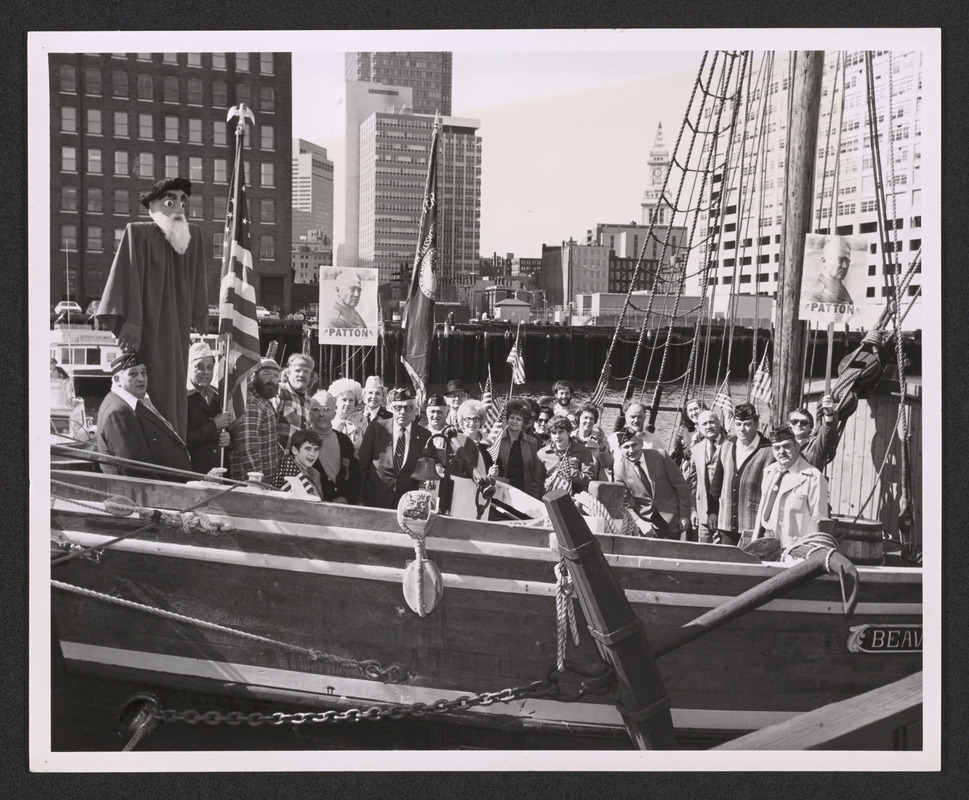
On 16 December of that year, the Disabled American Veterans of Massachusetts performed a reenactment of the Boston Tea Party. The first replica ship wouldn’t open for another seven years, so they used another sailing vessel moored along the waterfront.

The next day, people in Marshfield reenacted the burning of tea in their town. According to the Quincy Patriot-Ledger, this commemoration took place “at the foot of Tea Rock Hill.” The tea was paraded from “the old Proctor Bourne Store (now LaForest’s),” and a Bourne descendant set it alight. There was a handbell choir.

The Patriot-Ledger’s stories on the event, both before and after, quoted liberally from Joseph C. Hagar’s tercentenary history of Marshfield, as I did yesterday.

The newspaper said the tea-burning in Marshfield happened “a few nights after the famous Boston Harbor event in December, 1773,” but was no more specific than that.

Ten years later, a Bicentennial publication pinned the event to a specific date. Of Tea and Tories was written by Cynthia Hagar Krusell, a granddaughter of Joseph C. Hagar and also a descendant of someone named Thomas involved in the original burning. (Two families named Thomas were among the first English settlers in the town, so by 1773 this could mean any number of people.)

Krusell was vice-chairman of the Marshfield Bicentennial Committee, which published her booklet in 1976. A trained artist, she drew a map and genealogies for it. About the tea-burning she wrote:
The first rebel action occurred at midnight December 19, 1773, three days after the Boston Tea Party. A band of local Patriots, emboldened by fellow rebels in Boston, crept by night into the John Bourne ordinary by the town training green. They seized boxes of British tea stored there and in Nehemiah Thomas’s cellar, piled them on an ox-drawn wagon and silently bore them to “a stone quite flat on top” which stood on the crest of a nearby hill, thereafter immortalized as Tea Rock Hill.

Sensing the impact of the moment, they knelt in humble prayer while Jeremiah Lowe touched the tea with his torch, igniting simultaneously the spark of Revolutionary fervor in Marshfield.
So far as I can tell, Krusell’s publication was the first to specify a date for the burning, 19 December. But she didn’t cite evidence for that detail or others. Nothing in her list of sources leaps out to suggest the date came from a diary or other document that previous historians hadn’t seen.

In 1773, the 19th of December was a Sunday. People gathered in their congregations, and they probably did discuss the destruction of the tea in Boston. However, New Englanders tended not to carry out political actions from Saturday night through Sunday night, viewing that stretch as the Sabbath.

COMING UP: After a Thanksgiving break, lingering questions.

(I couldn’t find good photographs of the 1966 reenactments. The photo above, courtesy of Digital Commonwealth, shows a different Disabled American Veterans demonstration aboard the recreated tea ship Beaver, probably in 1979 or 1980, since the group was protesting Ayatollah Ruhollah Khomeini.)

Thursday, November 23, 2023

The Tercentenary Telling of the Marshfield Tea Burning

In 1940, the town of Marshfield celebrated the 300th anniversary of its founding.

Among the projects of the Tercentenary Committee was the publication of a new town history assembled by Joseph C. Hagar, who had succeeded Lysander S. Richards as head of the local historical society.

That book’s title page says: Marshfield 70°–40´W : 42°–5´N: The Autobiography of a Puritan Town. Book cataloguers have been divided on whether the title includes that longitude and latitude, or whether they’re just too much trouble.

On the burning of tea in the town, Hagar wrote:
The British had brought a large quantity of tea to the town, which they were unable to sell on account of the high price. They stored it in various places in the village.

On the southwest side of the old Marshfield Training Green is a hill on which now stands quite a modern residence. This hill is known as Tea Rock Hill, although the rock itself has been blasted and pieces used in the foundations of two nearby homes. The ledge, however, is still visible.

Not far away toward the South river, but northeast from the hill, stands the former old John Bourne store, now a fairly modern Post Office. The store was built in 1709. Toward the east are two houses of interest, both being old Thomas homes. . . . [One was] the residence of Nehemiah Thomas; and in his cellar was stored some of the tea which had been brought into the town. More tea was stored in the old Bourne store.

A few days after the Boston Tea Party, the enthusiastic patriots of Marshfield (one of whom, Jonathan Bourne, fought in the battle of Bunker Hill) marched quietly and earnestly to these places and secured the tea there stored. This act required courage and conviction as Marshfield had such a strong Tory element. The tea was loaded onto an ox-cart and hauled to Tea Rock Hill.

Among the patriots were women and children as well as men. Mr. Charles Peterson remembers that his grandmother told him she was one of the group.

On the top of the hill they placed the tea “upon a stone quite flat on top” and as it was evening, they knelt in the dim light of the primitive lanterns and offered prayer. A torch carried by Jeremiah Lowe was applied to the tea and it was burned. Jeremiah Lowe was later forced to flee to New York with his family.
Hagar’s book doesn’t cite evidence for specific statements. It echoes passages from sources like the D.A.R. description of the event, sometimes word for word, without acknowledgment. It contains errors. (There was no Jonathan Bourne, for instance.) All that makes it a frustrating source to work with, but it was the towns’s official tercentenary history.

This book adds a couple of details to the story of the tea burning, such as the pause for prayer before the bonfire—apparently based on what Charles Petersen’s grandmother told him.

Most important, Hagar’s recounting specified a new location for the stash of confiscated tea: “the former old John Bourne store.” In terms of commemoration, that had a couple of advantages over Deacon Nehemiah Thomas’s house, the only place previously named:
  • First, it was closer to Tea Rock Hill, making for a more compact commemoration.
  • Second, it still existed, albeit as a part of a larger building.
That building still stands today, as shown above in a photograph from Patrick Browne’s article at Historical Digressions.

TOMORROW: Two generations on, and the first reenactment.

Monday, November 20, 2023

“We have a rock that is a relic of the Revolution”

The wonderfully named Lysander Salmon Richards (1835–1926, shown here) published a two-volume History of Marshfield in 1901 and 1905.

In the first volume he summed up what authors of the previous century had written about how locals had burned tea during the fraught last weeks of 1773:
We do not have in Marshfield an historic rock, like Plymouth Rock, a relic of the Pilgrims, but we have a rock that is a relic of the Revolution. When the Boston Tea Party threw overboard in the Boston Harbor all the tea on the ships in the harbor, the patriots of Marshfield learned there was a large quantity of tea secreted by some authorities in the cellar of a house on the site now occupied by Mr. Seaverns, two or three hundred feet from the street leading from the First Congregational church to the Marshfield station.

The Marshfield patriots, not to be outdone by the Boston tea sinkers, marched to the said house and demanded the tea. Resistance being useless, it was given up and carried to a rock on a hill directly opposite Dr. Stephen Henry’s residence, not far from the First Congregational church, and there heaped upon this huge rock, it was set afire and burned to ashes. This rock (what there is remaining of it) has since been called “Tea Rock.”
In the second volume Richards included a close rewrite of what members of the White family had written about their ancestor ten years before:
Mr. [Benjamin] White was commissioned to collect the tea after it was voted not to drink it. They stored it in the house of Nehemiah Thomas. Saving the tea at that time did not satisfy those earnest, honest whigs, so they took this confiscated article and carried it into a nearby field, where there was a large rock, “flatt on ye top,” pouring it thereon, and then Mr. White and his brother-in-law, Jeremiah Low, (two staunch old whigs,) applied the torch amid rejoicings.
To compare those paragraphs with the passages I quoted yesterday, it looks like Richards didn’t add any facts to the story besides who lived in the houses in his time.

By that point, the landscape of Revolutionary Marshfield had changed—literally. To the dismay of the town’s first chronicler, Marcia A. Thomas, Tea Rock had been blasted into pieces, some of them used for the foundations of nearby houses. That’s why Richards wrote, “what there is remaining of it.” Nehemiah Thomas’s house was also gone.

Some Marshfield residents were determined to keep that story alive, though. In 1916 the town some local women established the Tea Rock Chapter of the Daughters of the American Revolution. On 5 Aug 1929 they unveiled a historic marker on Tea Rock Hill.

The next day’s Boston Herald laid out that generation’s understanding of the historic event:
…the men of Marshfield…in December, 1773, burned tea brought here by the British after the latter had failed to sell it to the public at a high price.

So much of the tea remained unsold that the British stored it in various parts of the village. Then, one night, patriots raided these places, loaded the tea onto an ox cart, hauled it to the top of the elevation known as Tea Rock hill, on which the residence of Elijah Ames now stands, and burned it.

The torch was applied by Jeremiah Lowe, who was later forced to flee to New York with his family. . . . John and Mary Ford, children of Edward Ford of Marshfield, direct descendants of Jeremiah Lowe, assisted in unveiling the tablet, which is affixed to a large granite boulder.

The memorial is inscribed as follows:
“On this hill, in December, 1773, the staunch Whig, Jeremiah Lowe, applied the torch which burned the tea confiscated by the patriots from the public and private stores of the town of Marshfield. Erected by Tea Rock Chapter, D.A.R. of Marshfield, 1929.” . . .

Miss Louise Wardsworth, regent of Tea Rock Chapter, read the history of the burning of the tea, and vocal solos were given by Miss Elsie Sennott.
The story had changed in the quarter-century since Richards’s writing. For some reason, the problem with the tea was that it was too expensive, not that it was taxed. An ox cart made its first appearance in the story, though it would have been a logical assumption before. The tea came from several unstated locations, not just Nehemiah Thomas’s house. Indeed, there was no mention of Thomas or Benjamin White, another documented political leader of the time. Only Jeremiah Low’s name was molded into the tablet.

TOMORROW: Objections and details.

Sunday, November 19, 2023

Bad Day at Tea Rock

As I recounted back in 2016, Marshfield was unusually split in the last years before the war. Some influential men supported the Crown, and some opposed it.

Control of town meetings went back and forth, and the faction that was outvoted in the official meeting would gather and grumble about the results.

One documented leader of the local resistance was Nehemiah Thomas (1712–1782), both treasurer and clerk for the town as well as a deacon at the meetinghouse.

Another was Benjamin White (1725–1783), who sometimes filled in as clerk and would also represent the town in the Massachusetts Provincial Congress.

In late 1773 Marshfield got into a tussle over tea. The official side of that dispute is documented in the record of a town meeting on 31 Jan 1774 that protested the Boston Tea Party, and then a protest against that protest, both published in the Boston newspapers.

However, there appears to have been more direct action in December, not described in writing until decades later.

The first mention of this incident I’ve found was in Marcia A. Thomas’s Memorials of Marshfield (1854):
While [Nehemiah Thomas was] absent, on one of these occasions, the whigs of the vicinity, in the ardor of their patriotism, took from his house, contrary to his intention, a quantity which had been seized by them and deposited there. This was burnt on a rock, near the meetinghouse, with much eclat. This was known afterwards as Tea Rock.
In the 13 Sept 1869 Springfield Republican I found this:
A few rods from the Marshfield post-office is “Tea-rock hill.” During the revolutionary period all the tea was secreted in the entry of one of the colonists. While he was at Boston, attending the Continental Congress [sic], a few ardent whigs, who did not believe in the soothing qualities of tea bearing a British tax, seized and burned it upon the hill’s summit.
L. Vernon Briggs’s History of Shipbuilding on North River (1889) devoted a footnote to the memories of Isaac Thomas (1765–1859), including:
He saw the burning of the obnoxious tea on the height which yet bears its name, and saw the torch touched to the fire fated pile by that devoted Whig, Jeremiah Low.
Thomas and Samuel White’s family history published in 1895 stated:
Benjamin White was one of the committee to collect the tea after it was voted not to use it, and it was stored in Nehemiah Thomas’s house. He did not feel satisfied with this, it looked as if saved for future use. When the Whigs of the vicinity, in the ardor of their patriotism, seized this tea, carrying it into a field near by, where there was a large rock which was “flat on ye top,” poured the tea thereon, when Benjamin White and his brother-in-law, Jeremiah Low, two staunch old Whigs, God bless them! applied the torch with much rejoicing. This was known ever afterwards as “Tea Rock.”
The following year, Caleb A. Wall borrowed much of that language for The Historic Boston Tea Party of December 16, 1773.

TOMORROW: Traditions in the twentieth century.

[The photograph of the marker on Marshfield’s Tea Rock Hill comes from Patrick Browne, who in his Historical Digression blog synthesized the accounts of the town’s tea-burning.]