J. L. BELL is a Massachusetts writer who specializes in (among other things) the start of the American Revolution in and around Boston. He is particularly interested in the experiences of children in 1765-75. He has published scholarly papers and popular articles for both children and adults. He was consultant for an episode of History Detectives, and contributed to a display at Minute Man National Historic Park.

Subscribe thru Follow.it


•••••••••••••••••


Showing posts with label Loyall Nine. Show all posts

Thursday, June 12, 2025

“The Continental Barracks on Noddle’s Island”

As soon as the siege of Boston ended, the Massachusetts government moved to fortify Noddle’s Island and other spots in Boston harbor.

On 6 Apr 1776, the lower house of the General Court formed a “Committee for fortifying the Harbour of Boston” and told those members
immediately to take a View of Noddle’s-Island, and report to this Court what Time it will probably take a Regiment, consisting of Seven Hundred and Twenty-eight Men, to perform the Business of Fortifying said Harbour.
Twelve days later the house empowered that committee
To purchase on the best Terms they may be had, eight Hundred Feet of the Continental Barracks (provided their Cost, with the Expence of removing and rebuilding them, shall in the Opinion of the Committee, be less than the Value of new ones) and cause them to be removed to, and re-built on Noddle’s-Island
The Council approved that plan the next day. Until John Hancock took office as an elected governor in 1780, the Council would serve as both the upper house of the legislature and the executive branch of the state government, carrying out legislative policies.

The barracks were assembled on Jeffries’s Point, the southwestern corner of the island. It looks like that building housed provincial soldiers while they built the harbor fortifications, but not year-round.

Those barracks were put to another use in 1780, after French warships started arriving in Boston harbor. That summer Thomas Chase, the state’s deputy quartermaster general, wrote to the Council:
The Commanding Officer of the French Troops has applyed to me for a Hospital for the sick, and as there is Continental Barrack on Noddles Island, suitable for that purpose, and as Mr. [Henry Howell] Williams owns the Soil, and I suppose he will make Objection to their going into Barracks, I pray your Honors would be pleased to give Orders that they shall not be molested in said Barracks.
Chase’s colleague from the “Loyall Nine” fifteen years earlier, John Avery (shown above), had become the state secretary. He reported this action by the Council on 15 July:
Read & Ordered — that Col. Thomas Chace, D.Q.M.G., be, and hereby is directed to take Possession of the Continental Barracks on Noddle’s Island for the Use of the sick Soldiers on Board the Ship Le isle de France, arrived this morning from France, belonging to his most Christian Majesty.
The local historian William H. Sumner, having accepted family lore that Gen. George Washington had given Henry H. Williams barracks from Cambridge before leaving New England in April 1776, concluded that these barracks converted into a hospital must have been a second building. But, as I wrote yesterday, there’s no evidence for such a grant. Nor any mention of multiple barracks on Noddle’s Island.

Furthermore, Chase didn’t write about Williams as having a home on the island, only as protective of his “Soil” there. Chase clearly expected Williams to interfere with turning the barracks into a hospital for the French, so the state explicitly approved his plan. That action suggests the Patriot government still didn’t trust Williams to cooperate with the war effort.

TOMORROW: Where was Henry Howell Williams during the war?

Thursday, April 10, 2025

“That the leaning of the writer of the above might not be mistaken…”

Yesterday I quoted most of the Boston News-Letter’s 22 Aug 1765 report on the first anti-Stamp Act protest the week before.

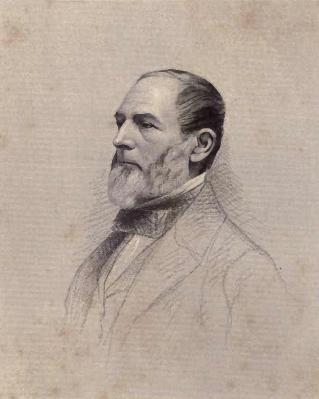
In 1856 Samuel Gardner Drake (shown here) quoted the same article at length in his History and Antiquities of Boston. He appears to have missed printer Richard Draper’s sarcastic jibes at the crowd, however. Drake wrote:
That the leaning of the writer of the above might not be mistaken, he closed by a memorable saying of Lord Burleigh, much in use in those days, “England can never be undone but by a Parliament.” Thus the mob was encouraged, and, as by the sequel it will appear, a very partial account was given of what had taken place. The course taken by the papers under the control of the Government had some effect in producing the above, for the News-Letter had been jeered by them because it had not come out with early denunciations of the proceedings of the mob.
The criticism of the News-Letter appeared in an Whiggish newspaper, not in one “under the control of the Government.” The Boston Whigs faulted Draper for not reporting on the demonstration at all; if he’d “come out with early denunciations of the proceedings of the mob,” they’d have faulted him even more vigorously.

Drake’s extract included these lines from the News-Letter (with modernized capitalization and punctuation):
The populace after this went to work on the barn, fence, garden, and dwelling-house, of the gentleman against whom their resentment was chiefly levelled [Andrew Oliver], and which were contiguous to said hill. And here, entering the house, they bravely showed their loyalty, courage, and zeal, to defend the rights and liberties of Englishmen. Here, it is said by some good men that were present, they established their Society by the name of the Union Club.
In context, coming right after describing rioters breaking into Oliver’s house “to defend the rights and liberties of Englishmen,” the reference to the “Union Club” looks like another bit of Draper’s sarcasm.

Whigs in Bristol, England, had formed a Union Club by 1750, pushing for political reform and the protection of liberties. In the 1760s a ship of that name was visiting Boston. New Englanders would have known what the “Union Club” stood for—and should have seen the irony of forming one in somebody else’s house.

In 1865 William V. Wells quoted that line about the “Union Club” without its context in his Life and Public Services of Samuel Adams. He went on to say those men were doubtless the same group as the “Sons of Liberty” who had organized the protest.

Later authors repeated that equation: the Sons of Liberty, the Union Club, and the “Loyall Nine” (a term from yet another source, published later) were all names for the same protest organizers identified by the Rev. William Gordon.

In fact, I haven’t found a single source besides the Boston News-Letter using the name “Union Club” that way. It doesn’t reappear in the newspapers. It doesn’t show up in John Adams’s or Samuel Adams’s writings. It doesn’t show up in John Rowe’s or John Tudor’s diaries. Given the sarcasm in the initial report, I doubt the “Loyall Nine” ever really adopted the term.

(By December 1774 a Union Club was established in Salem. It contributed something for the poor after the Boston Port Bill, and on 16 December Samuel Adams sent a thank-you letter to Samuel King. I can’t find any other period mention of that organization.)

Wednesday, April 09, 2025

Richard Draper’s “Report of these Images”

As long as I’m discussing nomenclature for Boston’s political groups in the 1760s, I’ll tackle “the Union Club.”

America’s first public, outdoor demonstration against the Stamp Act took place along Boston’s main road on Wednesday, 14 Aug 1765. The big elm where the protesters hung effigies hadn’t yet been named Liberty Tree.

The next day, Richard Draper published his Boston News-Letter newspaper with a two-page supplement. It didn’t report on the protest, however—that sheet was entirely devoted to foreign news.

The News-Letter did print Gov. Francis Bernard’s 15 August proclamation of a reward for the rioters who had torn down stamp agent Andrew Oliver’s building the night before. That was the paper’s only description of the event.

Boston’s Whigs complained that Draper was tilting his coverage to please the royal government. In his 22 August issue the printer objected to the News-Letter being called “a Court-Paper…under the Controul of higher Powers.” He insisted:
IN regard to the Occurrences of last Week, we would observe, that it was out of our Power to give a perfect Account thereof, as the Transactions were not finished, and a partial one would perhaps have drawn down the Resentment of many of the true Sons of Liberty, and caused us to be more in Fear, than it is said were of publishing any Thing relating thereto:—

Had the Gentleman who furnished one of the Papers with a decent Account of the Affair, been so kind as to have sent us something of the same Nature, he would have saved himself the Trouble (if he really took the Trouble) to inform the Public that we filled an extraordinary Half Sheet with immaterial Foreign Articles.
The News-Letter’s account of the anti-Stamp Act protest, “as concise and true…as it is in our Power,” followed. In the details it agreed with the Monday newspapers, but it also included several sarcastic zings at the protest.
VERY early on Wednesday Morning, the 14th Instant, were discovered hanging on a Limb of the Great Trees, so called, at the South Part of this Town, two Effigies, one of which by the Labels appeared to be designed to represent a Stamp-Officer, the other a Jack-boot, with a Head and Horns peeping out of the Top. said by some of the Printers, to be the Devil or his Imp; but, as we are not acquainted with that Species of Gentlemen, we cannot so well determine whether it was an exact Resemblance or not:

The Report of these Images soon spread thro’ the Town, brought a vast Number of Spectators, and had such an Effect on them that they were immediately inspired with a Spirit of Patriotism, which diffus’d itself through the whole Concourse: So much were they affected with a Sense of Liberty, that scarce any could attend to the Task of Day-Labour; but all seemed on the Wing for Freedom.

About Dusk the Images were taken down, placed on a Bier, (not covered with a Sheet, except the Sheet of Paper which bore the Inscription) supported in Procession by six Men, followed by a great Concourse of People, some of the highest Reputation, and in the greatest Order, ecchoing forth, Liberty and Property! No Stamp! &c—

Having passed through the Town-House, they proceeded with their Pageantry down Kingstreet, and it is said intended for the North Part of the Town; but Orders being given, they turned their Course thro’ Kilbystreet, where an Edifice had been lately erected, which was suppos’d to be designed for a Stamp-Office.

Here they halted, and went to work to demolish that Building, which they soon effected, without receiving any Hurt, except one of the Spectators, who happened to be rather too nigh the Brick Wall when it fell: This being finished many of them loaded themselves with the wooden Trophies, and proceeded (bearing the two Effigies) to the Top of Fort-Hill; where a Fire was soon kindled, in which one of them was burnt; we can’t learn whether they committed the other to the Flames, or if they did whether it did not survive the Conflagration, being its said like the Salamander conversant in that Element.—

The Populace after this went to work on the Barn, Fence, Garden, and Dwelling-House, of the Gentleman against whom their Resentment was chiefly levelled, and which were contiguous to said Hill; and here entering the House they bravely showed their Loyalty, Courage, and Zeal, to defend the Rights and Liberties of Englishmen:——

Here, it is said, by some good Men that were present, they established their Society by the name of The Union Club.—

Their Business being finished, they retired, and proceeded to the Province-House, which was at about 11 o’Clock, gave three Huzzas, and all went quietly home.
The report went on to events of 15 August: Oliver’s resignation and an aborted action against Lt. Gov. Thomas Hutchinson’s house.

The 19 August Boston Gazette offered a detailed and favorable description of the protest in its own two-page supplement. The same day’s Boston Evening-Post printed a positive report from “A.Z.,” who also got in the dig at Draper’s paper. The Boston Post-Boy, friendly to the royal government, ran nothing. None of the three Monday papers reprinted Gov. Bernard’s proclamation.

TOMORROW: The long and short of “The Union Club.”

Sunday, April 06, 2025

From “Loyall Nine” to “Sons of Liberty”

We have a reasonably good idea of who eight of Boston’s “Loyall Nine” were:
In addition, the ship masters Henry Wells and Joseph Field were also lumped in with this group by different contemporaries.

Within months after they started organizing anti–Stamp Act protests, the group appears to have adopted another name. Back during Parliament’s debate over that law, opponent Isaac BarrĂ© called American colonists “Sons of Liberty,” as reported to this side of the Atlantic by Jared Ingersoll. By the fall the “Loyall Nine” started using that phrase.

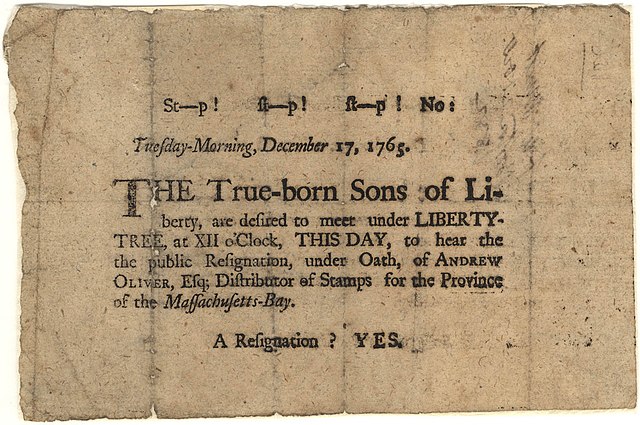
The handbills that Bass described the group printing in his December 1765 letter said: ”The True-born Sons of Liberty, are desired to meet under LIBERTY-TREE, at XII o’Clock, THIS DAY…” Evidently any man could merit that label by coming out to resist the new tax from London. In early 1766 the phrase also started to appear in newspapers in other ports.

But the group also used that term for themselves. In January 1766 John Adams called them “the Sons of Liberty.” On 15 February, Crafts wrote to Adams that “the Sons of Liberty Desired your Company at Boston Next Wensday.” Those are clearly references to a specific group, not to everyone taking a certain political stand.

It looks like the more general use won out. By August 1769, “An Alphabetical List of the Sons of Liberty who din’d at Liberty Tree [Tavern], Dorchester” included 300 names. Clearly those Sons of Liberty weren’t just the “Loyall Nine”—though all eight men listed above were there.

Nonetheless, because of some unsubstantiated claims and portrayals in popular culture, the belief persists that the Sons of Liberty was an identifiable group of activists, not a mass movement, as I’ve written before. Because of that squishiness, I tend not to use the term. But of course it’s strongly associated with the Revolution.

TOMORROW: Back to the bowl.

Saturday, April 05, 2025

Counting the “Loyall Nine”

In a 19 Dec 1765 letter divulging details about Boston’s latest Stamp Act protest, and earlier ones, Henry Bass wrote of the organizers as “the Loyall Nine.” He added:
And upon the Occasion we that Evg. had a very Genteel Supper provided to which we invited your very good friends Mr. S[amuel] A[dams] and E[des] & G[ill] and three or four others and spent the Evening in a very agreable manner Drinkg Healths etc.
On 15 Jan 1766 John Adams wrote in his diary:
Spent the Evening with the Sons of Liberty, at their own Apartment in Hanover Square, near the Tree of Liberty. It is a Compting Room in Chase & Speakmans Distillery. A very small Room it is.

John Avery Distiller or Merchant, of a liberal Education, John Smith the Brazier, Thomas Crafts the Painter, Edes the Printer, Stephen Cleverly the Brazier, [Thomas] Chase the Distiller, Joseph Field Master of a Vessell, Henry Bass, George Trott Jeweller, were present.

I was invited by Crafts and Trott, to go and spend an Evening with them and some others, Avery was mentioned to me as one.
Finally, in 1788 the Rev. William Gordon wrote in his history of the Revolution about the first anti-Stamp protest, back in August 1765:
Messrs. John Avery, jun. Thomas Crafts, John Smith, Henry Welles, Thomas Chace, Stephen Cleverly, Henry Bass, and Benjamin Edes…provide and hang out early in the morning of August the fourteenth, upon the limb of a large old elm, toward the entrance of Boston, over the most public street, two effigies,…
Those sources, which were published in reverse chronological order, all seem to refer to the same group of men. The lists of names overlap—but not exactly.

Bass said there were nine men, and seemed to treat Samuel Adams, Edes, and Gill all as guests. Gordon named eight men, including Edes among them. John Adams also listed Edes in the group, and he treated George Trott, not on Gordon’s list, as in the group.

John Adams didn’t list Henry Wells from Gordon’s list (though Tea Leaves and some subsequent books misquote him as doing so). Instead, Adams named Joseph Field, saying he was a ship captain. According to mentions in the Boston press before he died in 1768, Henry Wells was also a ship captain. Would either of them have been in town long enough to help plan protests? 

It’s therefore difficult to say exactly who the “Loyall Nine” were, but there was definitely a political club supping at the Chase distillery near Liberty Tree and organizing the protests under that tree.

TOMORROW: A change of names?

Monday, December 26, 2022

How John Adams “Dined at Mr. Nick Boylstones”

John Adams finally got his invitation to dinner at Nicholas Boylston’s mansion in January 1766.

Adams’s mother was a Boylston, first cousin to this Boston merchant. However, Adams visited Boylston’s home only after becoming a rising young lawyer from Braintree, in Boston for court business and a whirl of political conversations.

On 14 January, for instance, Adams dined at town clerk William Cooper’s house with Thomas Cushing, speaker of the house; William Story, an Admiralty Court official; and John Boylston, yet another cousin on his mother’s side.

Adams recorded in his diary:
Boylstone, affecting a Phylosophical Indifference about Dress, Furniture, Entertainments &c., laughed at the affectation of nicely distinguishing Tastes, such as the several Degrees of Sweet till you come up to the first degree of bitter, laughed at the great Expences for Furniture, as Nick Boylstones Carpetts, Tables, Chairs, Glasses, Beds &c. which Cooper said were the richest in N. America.—The highest Taste and newest Fashion, would soon flatten and grow old.
The next evening, Adams met with “the Sons of Liberty, at their own Apartment in Hanover Square, near the Tree of Liberty.” This was the group also called the “Loyall Nine,” principal organizers of the protests that had negated the Stamp Act the year before. They were preparing to celebrate the law’s expected repeal.

Finally came this diary entry:
Thurdsday. Jany. 16th. 1766.

Dined at Mr. Nick Boylstones, with the two Mr. Boylstones [Nicholas and his brother Thomas, probably], two Mr. [James and Isaac?] Smiths, Mr. [Benjamin] Hallowell and the Ladies [the Boylstons’ sister Mary Hallowell and possibly James Smith’s wife, Elizabeth]. An elegant Dinner indeed!

Went over the House to view the Furniture, which alone cost a thousand Pounds sterling. A Seat it is for a noble Man, a Prince. The Turkey Carpets, the painted Hangings, the Marble Tables, the rich Beds with crimson Damask Curtains and Counterpins, the beautiful Chimny Clock, the Spacious Garden, are the most magnificent of any Thing I have ever seen.
Even though those luxurious furnishings might “soon flatten and grow old,” they awed the young country lawyer.

TOMORROW: Dinner conversation.

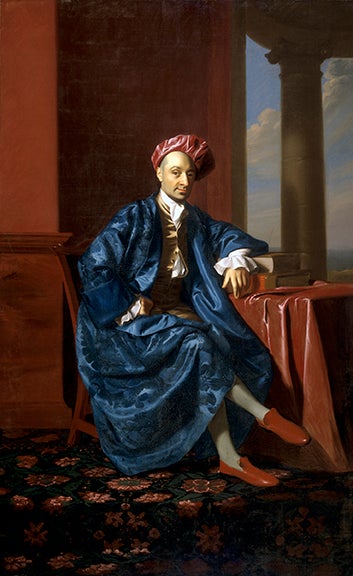
[The image above shows how John Singleton Copley remade his portrait of Nicholas Boylston, shown yesterday. Harvard College commissioned this copy in 1773, after the merchant had died and left money for a professorship. To match other paintings Copley had made for the college, he turned his original composition into a taller, full-figure portrait. As a result, Boylston was immortalized in honking big red slippers.]

Saturday, August 15, 2020

The Landlord of Liberty Tree

This is how the merchant John Rowe described Boston’s first public protest against the Stamp Act in his diary:
A Great Number of people assembled at Deacon Elliots Corner this morning to see the Stamp Officer hung in Effigy with a Libel on the Breast, on Deacon Elliot’s tree…
The great elm that held the effigy and provided shade for that protest hadn’t yet been dubbed Liberty Tree. In the coming months, the Sons of Liberty would come up with that name, hammer a plaque into the side of the tree, and make it a political gathering-point. As of mid-August 1765, however, that elm was still “Deacon Elliot’s tree.” And who was he?

As far back as May 1733, when the Boston town meeting debated setting up official marketplaces, one of the proposed sites was “near the great Tree, at the South-End, near Mr. Eliot’s House.” When the 31 May Boston News-Letter reported on that hotly contested vote (364 yeas to 339 nays), it referred to “the great Trees at the South End.” That phrase suggests that there were multiple large trees near Eliot’s house, but one particularly big one. It had probably been growing there for over a century, since before Englishmen came to the Shawmut peninsula.

As for clues about “Deacon Elliot,” this advertisement appeared in the 17 June 1734 New-England Weekly Journal:
TO BE LETT,
A Good convenient House, adjoyning the South Market place, with a large Garden in good Order; Inquire of Mr. John Eliot Stationer, living near the great Trees.
When proposals for publishing an American Magazine went around in 1743, “Mr. John Eliot, at the great Trees at the South-End,” was one of the men collecting subscriptions (along with “Mr. Benja. Franklin, Post Master in Philadelphia”).

John Eliot was born in 1692, a descendant of some of Boston’s earliest British settlers. He was a great-nephew of the famous Rev. John Eliot, “Apostle to the Indians.” The young man appears to have followed his uncle Benjamin Eliot (1665-1741) into the business of bookbinding and stationery sales. He also commissioned small books from printers, almost all sermons and other religious literature. As early as 1716 Eliot was issuing these publications “at his shop at the south-end.”

It appears Eliot inherited that land in the South End, as well as property out in Brookline. In 1708, when the Boston selectmen laid out the southernmost stretch of the main road through town, they defined Orange Street as from the old Neck fortifications to the Eliot house. With, presumably, the great elms nearby.

As he neared the age of thirty, Eliot married Sarah Holyoke. Her brother, the Rev. Edward Holyoke, was a Marblehead minister who became president of Harvard College. The Eliots had eight children between 1721 and 1735.

In the early decades of the eighteenth century, the south end of Boston was still sparsely populated. Then the Hollis Street Meetinghouse was built for the Rev. Mather Byles in 1732. The town opened its south market, and soon the area had more houses and streets. We can see that growth in how Eliot’s title pages described his business:
  • “at his shop, the south end of the town,” 1724
  • “in Orange Street at the south end of the town,” 1734
  • “near the South Market,” 1741
Even after the consolidation of Boston’s marketplaces at Faneuil Hall in 1743, the neighborhood grew.

Deacon Eliot’s big trees remained a handy landmark for people entering or navigating town. Newspaper advertisements tell us Josiah Quincy, Sr., lived “opposite to the great Trees, at the South End,” until he struck it rich in privateering and moved to a country estate in Braintree. Other sites in the neighborhood included the house of auctioneer and deacon Benjamin Church, Sr.; the leather workshop of Adam Colson; and a building once called “the Half-Moon, or Land-Bank House.”

Isaiah Thomas later wrote of Eliot:
He published a few books, and was, many years, a bookseller and binder, but his concerns were not extensive. However, he acquired some property; and being a respectable man, was made deacon of the church in Hollis street.
Thomas simply missed the period when Eliot was most active in publishing. After his uncle’s death in 1741, the deacon appears to have cut back on new ventures and lived off his real estate and shop.

Sarah Eliot died in 1755 at the age of sixty. Deacon John Eliot was then sixty-three years old. He married again to a woman named Mary, then in her forties, but she died in 1761. The deacon’s daughters Sarah and Silence remained unmarried, so one or both might have kept house for him after that.

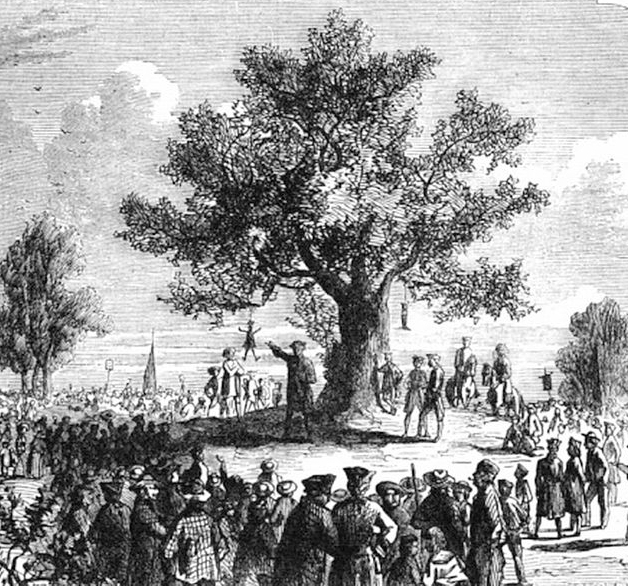
In August 1765, as described yesterday, the Loyall Nine used the boughs of Deacon Eliot’s tree to hang Andrew Oliver in effigy. The figures of several other royal appointees and political enemies followed in the subsequent years. The Sons of Liberty put up a flagpole beside the tree and raised a banner—the Union Jack on a red field—to call public gatherings. Christopher Seider’s funeral train stopped at the tree. So did the processions of men being tarred and feathered.

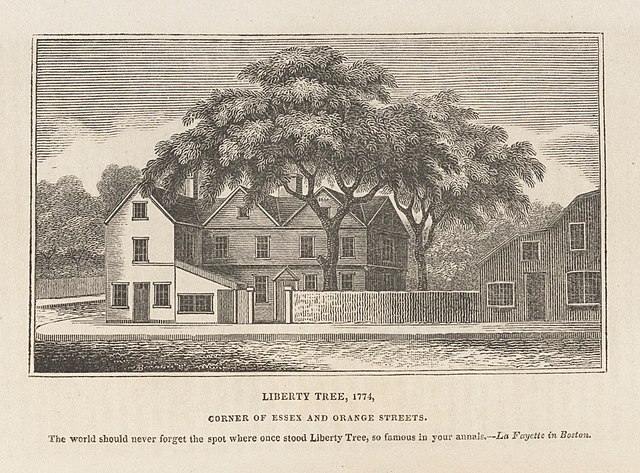
The way people referred to the tree as belonging to Deacon Eliot suggests it stood on his property with the branches extending over the street. It’s not clear how near Eliot’s house was to the tree, or whether he had a fence around his land. (The picture above was created decades after the tree was cut down in 1775, and there’s no way to know how accurate it was.) How did Eliot feel about the large political gatherings right outside his house? About his property being identified with rebellion?

Though Eliot doesn’t show up on the records as an active Whig, he does seem to have supported that cause and accepted the new identity for the elm outside his house. The 10 Apr 1769 Boston Gazette included an advertisement saying that land and “a large Building thereon, commonly known by the Name of the South Market,” was to be sold by court order. Prospective buyers were invited to “inquire of John Eliot at Liberty-Tree.”

On 14 August that year, the elderly deacon was among the many local dignitaries who dined with Boston’s Sons of Liberty at Lemuel Robinson’s tavern in Dorchester. In 1770, when William Billings advertised his New-England Psalm-Singer, one of the of the four places where people could buy it was “Deacon Elliot’s under Liberty-Tree.”

By that time, Deacon Eliot was in his late seventies. He didn’t live to see all that his elm tree inspired. On 22 Nov 1771, the Boston News-Letter ran this death notice:
Last Thursday died here, Mr. John Eliot, Deacon of the Church under the Pastoral Care of the the Rev’d Dr. Byles—He justly sustain’d the Character of an Honest Man, and a good Christian—His Remains were decently interr’d on Saturday last.
Three days later an ad in the Boston Gazette called on people with debts to settle with Eliot’s estate to meet with the administrators, Joseph Eliot and Thomas Crafts, Jr. The former was probably his son (1727-1782), who moved to Natick, as did his unmarried sisters. The latter was a member of the Loyall Nine who watched over Liberty Tree from his nearby workshop.

The gravestone for Deacon John Eliot and his two wives still stands in the Granary Burying Ground.

Thursday, July 09, 2020

“Become a violent advocate in the Cause of Liberty”

As recounted yesterday, Capt. Thomas Speakman was killed in the French and Indian War in January 1757.

Though I haven’t seen his probate records, Speakman appears to have left a considerable estate to his wife Mary and their children, including properties in Marlborough and Boston. But perhaps not as much as they needed to maintain their lifestyle. Then a house on Milk Street belonging to Thomas Speakman’s estate was among the buildings destroyed in the Great Fire of 1760.

Thomas and Mary Speakman’s oldest child, William, was then twenty years old, looking ahead to his career. The other surviving siblings included:
  • Gilbert Warner, born 7 Nov 1747
  • Hannah, born 1 Nov 1749
  • Sarah, born 27 Oct 1751
  • Mary, born 26 Sept 1754
One important asset for young William Speakman were the men who had married his late father’s sisters—the merchants John Rowe and Ralph Inman. Rowe in particular became a mentor for William and his younger brother. It’s possible William spent time in Rowe’s counting-house, learning business skills; Gilbert certainly did.

By 1765, at the age of twenty-five, William Speakman was partners with a slightly older man named Thomas Chase at a rum distillery in the South End of Boston. Speakman may have inherited that building from one of his grandfathers while Chase handled day-to-day management, but it’s hard to tell. Chase and Speakman also appear together on the records of King’s Chapel, sponsoring babies in their circle at baptism.

Then came the Stamp Act. Thomas Chase was one of a small group of young businessmen who organized public protests against that law, calling themselves the Loyall Nine and later the Sons of Liberty. On 15 Jan 1766 John Adams described dining with the group in “their own Apartment in Hanover Square, near the Tree of Liberty. It is a Compting Room in Chase & Speakmans Distillery. A very small Room it is.”

Speakman never appeared on the list of Whig activists, but he was activist-adjacent. I’ve found only one instance of him participating in politics. On 18 Mar 1768, the anniversary of the repeal of the Stamp Act, his uncle Rowe reported that Speakman, Thomas Crafts, and John Avery took down “two effigies on Liberty Tree this morning marked C[harles]. P[axton]. and J[ohn]. W[illiams].” That action looks like supporting those Customs officials, but in fact Crafts and Avery were members of the Loyall Nine. They wanted to control such protests, and they were among the few men in town with the clout to take down someone else’s effigies when they thought the timing was bad.

A few months later, on 29 August, Rowe wrote in his diary: “Poor Wm. Speakman was taken in a fit & had doubtful Struggles for Life.” Speakman survived this health scare, but it probably prompted him to leave Boston and move out to Marlborough, where his mother was living. William and his brother Gilbert Warner Speakman (listed erroneously as “G. William Speakman”) appear on the 1770 list of polls reprinted in Charles Hudson’s history of the town.

Mary Speakman was an upper-class Anglican, a relative of imperial merchants, and thus a natural supporter of the royal government. But in that same month, on 7 August 1768, her Marlborough neighbor Christian Barnes reported to her friend Elizabeth Smith:
Mrs. Speakman was become a violent advocate in the Cause of Liberty which (if I was not upon my gard) would ocation some warm disputes but I saw so much of party rage in my last excurtion that I determin’d to surpress my sentiments rather than enter into any debate upon that subject.
The following year, on 20 Nov 1769, Barnes confirmed: “my Friend Mrs. Speakman still continues a Staunch Whig tho to do her Justice not from any Self interested Motives at least that I can see.”

It was in that context that Barnes wrote in June 1770 after locals vandalized her husband’s property (including a coach apparently bought from Smith):
it is said that a Young Gentleman (who had formily Headed the Mob in Boston and now resides with us) is the perpetrator of all this Mischeife but I will not beleive it till I have further profe
On 13 July, after the threats had escalated, Barnes was ready to name names:
I mention’d in my former Letter that some people affirm’d that Billy Speakman was the Person that cut your Coach to Peices I did not beleive it nor do I now but this I am certain of that those who have taken such a cruel Mession [?] to undermine us in our Business would stick at nothing to perpetuate their Scheem and who knows what these two Young fellows may be capible off and how far they may work up the People (already distracted with party rage) to Molest and injure us.
The “two Young fellows” appear to be William and his younger brother.

Meanwhile, the gulf between Mrs. Barnes and Mrs. Speakman had widened to include not just politics but business.

COMING UP: What to do with Gibby?

Friday, June 15, 2018

“The People are to be left to use their own Discretion”

The Liberty riot of 10 June 1768 wasn’t just about the seizure of John Hancock’s sloop for alleged Customs violations. It was also about how H.M.S. Romney, which helped in that seizure, had been impressing sailors in Boston harbor.

Of course, it was a lot easier to threaten Customs officers than to threaten a 50-gun warship. By Sunday, Collector Joseph Harrison wrote, he was the only top Customs official in town, “all the rest having taken shelter either on board the Man of Warr or gone into the Country”—and he had stayed in bed for two days recovering from his injuries instead of venturing out.

Boston’s Whig politicians were trying to calm the town—or at least to make it look calm. As in late 1765, when the Stamp Act riots both served the purposes of the elite and made them nervous, gentlemen sought a way to end the unrest before it harmed Boston’s reputation.

One idea was that the Customs service would return the Liberty to Hancock in exchange for a promise that if he lost the smuggling case in court he’d surrender it to the government. That didn’t work, for two reasons. First, the Customs Commissioners didn’t like the way the offer was delivered:
a verbal Message from the People by a Person of Character to this Effect “That if the Sloop that was seized was brought back to Mr. Hancock’s Wharf, upon his giving Security to answer the Prosecution, the Town might be kept quiet”; Which Message appearing to Us as a Menace, we applied to Capt. [John] Corner to take Us on board His Majesty’s Ship
Commissioners John Robinson, Henry Hulton, William Burch, and Charles Paxton were all on the Romney by Sunday.

The second problem was that Hancock himself soured on the idea of compromise. I think he was waking to the instincts that would make him a very successful politician and an unsuccessful businessman. Getting the Liberty back would let him keep making money with it. Not getting it back would make him a political martyr, a hero of the waterfront. So the sloop remained anchored beside the warship, protected from rescue by its guns.

Gov. Francis Bernard had met with his Council on 11 June, but heard “no apprehension in the Council that there would be a repetition of these violences,” so he had gone off to his country house in Jamaica Plain. But by Sunday he was receiving alarmed reports from the Commissioners like this one:
some of the Leaders of the People had persuaded them in an Harangue to desist from further Outrages till Monday Evening, when the People are to be left to use their own Discretion, if their Requisitions are not complied with.
Bernard gave permission for the Commissioners, Harrison and his family, and other Customs men to be admitted to the safety of Castle William. He called an emergency Council meeting for Monday morning.

The governor later wrote:
Before I went to Council, the Sheriff [Stephen Greenleaf] came to inform me that there was a most violent and virulent paper stuck up upon Liberty Tree, containing an Invitation to the Sons of Liberty to rise that Night to clear the Country of the Commissioners & their Officers, to avenge themselves of the Officers of the Custom-house, one of which was by name devoted to death:

There were also some indecent Threats against the Governor, if he did not procure the release of the Sloop which was seized.
In another letter Bernard said that paper invited the Sons of Liberty “to meet at 6 o’ clock to clear the Land of the Virmin which are come to devour them &ca. &ca.”

But Bernard and the Council weren’t the only men worried about further violence. By afternoon, there was a printed handbill being distributed around town:
Boston, June 13th, 1768.
The Sons of Liberty.
Request all those, who in this time of oppression & distraction, wish well to, & would promote the peace, good order & security of the Town & Province, to assemble at Liberty Hall, under Liberty Tree, on Tuesday the 14th. instant, at Ten O’Clock forenoon precisely.
That message came from street-level political leaders like the Loyall Nine who had organized the first anti-Stamp demonstration in 1765 and tried to steer most protests since. The handbill was most likely a product of Edes and Gill’s print shop. It superseded the call for an uprising on Monday night; as the 16 June Boston News-Letter reported, “the Expectation of this Meeting kept the Town in Peace.”

On Tuesday, 14 June, “vast Numbers of the Inhabitants” gathered at Liberty Tree under the British flag. Since the weather was “wet and uncomfortable,” they moved to Faneuil Hall. Someone proposed making this gathering an official town meeting, so the selectmen sent out a summons to convene at 3:00. So many men arrived that the crowd moved on to the Old South Meeting-House.

James Otis, Jr., presided over what the official minutes called “very cool and deliberate Debates upon the distressed Circumstances of the Town.” The meeting chose large committees to express Boston’s grievances—to present a petition to Gov. Bernard; to send a letter to Dennis Deberdt, the Massachusetts House’s lobbyist in London; and to draft a resolution protesting the Customs officers’ action. And then the first committee, again led by Otis, headed out to the governor’s house.

TOMORROW: Gov. Bernard’s response.

Saturday, May 21, 2016

Lanterns on Liberty Tree

On the night of Monday, 19 May 1766, with fireworks going off all over Boston Common to celebrate the repeal of the Stamp Act, Whigs hung forty-five lanterns on Liberty Tree in the South End.

That number had plenty of political symbolism. The royal government had tried to suppress the 45th issue of John Wilkes’s magazine The North Briton in April 1763 for coming too close to criticizing King George III. That blew up into a controversy over freedom of the press, general warrants, and parliamentary privilege.

“No. 45” had thus become Whig shorthand for resisting oppressive measures by the royal government, even for people who were also proclaiming their loyalty to the king.

However, in the midst of all the other illumination in Boston that night, a mere forty-five lanterns evidently got lost in the branches of the big elm. Plus, once their obelisk burned up, the Loyall Nine needed another way to keep the party going at Liberty Tree.

It’s conceivable that other Boston politicians thought a Wilkesite number was too radical, but I’m not convinced. The town’s genteel Whigs tried to forge a long-distance alliance with Wilkes in the following years, and they continued to use “No. 45” symbolism; one famous example is the silver bowl that Paul Revere made and engraved in 1767.

I’m therefore inclined to take this Boston Gazette report at face value:
On Tuesday Evening some of the Sons of Liberty apprehending the Lanthorns hung on the Tree of Liberty, which the Night before amounted only to the ever memorable No 45, would have made a more loyal and striking Appearance if increased to the glorious Majority of 108, met and procuring that Number, disposed them on the Tree in a very agreeable picturesque Manner.
The “glorious Majority of 108” was the difference between the number of Members of Parliament who had voted to repeal the Stamp Act and the number who had wanted to retain it. As far as I can tell, American Whigs never celebrated a vote margin like that any other time. They probably chose that number because it was closest to how many lanterns they figured they could collect.

And that wasn’t all the decorating they did down in “Hanover Square”:
The Houses next adjoining and opposite were decorated with Figures characteristic of Those to whom we bear the deepest Loyalty and Gratitude: Here, an imperfect Portrait of their Majesties, our most gracious King and Queen—there, the Royal Arms;—here, the illustrious Campden, Pitt, Conway, Barre, and others of late so conspicuous in the Cause of Liberty and their Country:
Another report printed in the same newspaper said that on Tuesday Liberty Tree had been hung with lanterns “till the Boughs could hold no more,” and that the windows of nearby houses “were covered with illustrated Figures as large as the Life, the Colours all in a glow with the Lights behind them.”

In particular, the front windows of Thomas Dawes and Thomas Symmes displayed “An elegant Portrait of Mr. [William] PITT” with the inscription:
Hail, PITT! Hail, Patrons! Pride of GEORGE’s Days.
How round the Globe expand your Patriot Rays!
And the NEW WORLD is brighten’d with the Blaze.
Pitt was immensely popular in America, and he had strongly advocated repealing the Stamp Act. However, he wasn’t otherwise offering much help to the the Marquess of Rockingham’s Whig ministry. He refused to accept a cabinet post, but he would jump at the job of prime minister in July.

TOMORROW: Looking at a lantern.

[The photo above shows the Disney version of hanging lanterns on Liberty Tree from Johnny Tremain.]

Thursday, May 19, 2016

John Hancock and “the Brilliancy of the Night”

The 19 May 1765 Boston Gazette offered a brief description of the very start of that day’s town-wide observance of the end of the Stamp Act. But the issue one week later devoted almost a full page to celebrating the celebration:
The Morning was ushered in with Musick, Ringing of Bells, and the Discharge of Cannon, the Ships in the Harbour and many of the Houses in Town being adorned with Colours—

Joy smil’d in every Countenance, Benevolence, Gratitude and Content seemed the Companions of all. By the Generosity of some Gentlemen remarkable for their Humanity and Patriotism, our Goal was freed of Debtors.—
A later item in the paper credited the idea of paying off what the jailed debtors owed to “a fair Boston Nymph.” The action no doubt resonated strongly in a society that knew the Old Testament concept of a jubilee, not to mention a recent bankruptcy crisis.
At One o’clock the Castle and Batteries, and Train of Artillery fired a Royal Salute; and the Afternoon was spent in Mirth and Jollity.—In the Evening the whole Town was beautifully Illuminated:—

On the Common the Sons of Liberty erected a magnificent Pyramid, illuminated with 280 Lamps: The four upper Stories of which were ornamented with the Figures of their Majesties, and fourteen of the worthy Patriots who have distinguished themselves by their Love of Liberty.
The newspaper offered a detailed description of the obelisk shown yesterday and all the text painted on it. As I noted, its wooden frame was covered with paper rubbed with oil to become translucent so the structure could glow from within.
On the Top of the Pyramid was fix’d a round Box of Fireworks horizontally. About one hundred Yards from the Pyramid the Sons of Liberty erected a Stage for the Exhibition of their Fireworks, near the Work-House, in the lower Room of which they entertained the Gentlemen of the Town.

John Hancock, Esq; who gave a grand and elegant Entertainment to the genteel Part of the Town, and treated the Populace with a Pipe of Madeira Wine, erected at the Front of his House, which was magnificently illuminated, a Stage for the Exhibition of his Fireworks, which was to answer those of the Sons of Liberty:
The spring of 1766 marked the start of Hancock’s political career. In March the town meeting made him a selectman for the first time. In May a more exclusive town meeting elected him to the Massachusetts General Court. From then on, Hancock never lost a popular vote he really wanted to win.
at Dusk the scene opened by the Discharge of twelve Rockets from each Stage; after which the Figures on the Pyramid were uncovered, making a beautiful Appearance.—To give a Description of the great Variety of Fireworks exhibited from this Time till Eleven o’clock would be endless—the Air was filled with Rockets—the Ground with Bee-hives and Serpents—and the two Stages with Wheels of Fireworks of various sorts.

Mr. [James] Otis and some other Gentlemen who lived near the Common kept open House, the whole Evening, which was very pleasant; the Multitudes of Gentlemen and Ladies, who were continually passing from one Place to another, added much to the Brilliancy of the Night:

At Eleven o’clock the Signal being given by a Discharge of 21 Rockets, the horizontal Wheel on the Top of the Pyramid or Obelisk was play’d off, ending in the Discharge of sixteen Dozen of Serpents in the Air, which concluded the Shew.

To the Honor of the Sons of Liberty we can with Pleasure inform the World, that every Thing was conducted with the utmost Decency and good Order, not a Reflection cast on any Character, nor the least Disorder during the whole Scene.—

The Pyramid, which was designed to be placed under the Tree of Liberty, as a standing Monument of this glorious Æra, by accident took Fire about One o’clock, and was consumed:—The Lamps by which it was illuminated not being extinguished at the Close of the Scene it is supposed to have taken Fire by some of them.
That left the Sons of Liberty, or Loyall Nine, with no monument to install at Liberty Tree.

TOMORROW: While those men worked on that problem, there were celebrations in nearby towns.

Wednesday, May 18, 2016

“A View of the Obelisk”

On Monday, 19 May 1766, all of Boston was gearing up to celebrate the repeal of the Stamp Act at last.

The issue of the Boston Gazette published that day appears in the Harbottle Dorr collection at the Massachusetts Historical Society. It included a statement from the “Sons of Liberty” who had met on the evening of 16 May at “Hanover Square,” or the corner where Liberty Tree stood. They laid out their plan for a celebration with fireworks from “a Stage to be erected near the Work-House Gates.”

That item ended with a new announcement from the group:
I do therefore notify the Friends of Liberty, that an authentic Account of the Repeal of the Stamp Act is arrived, and the Gentlemen Select Men of Boston, have fix’d upon This Evening for the public Rejoicing, at whose Desire will be exhibited on the Common, an OBELISK—a Description of which is engraved by Mr. Paul Revere; and is now selling by Edes and Gill.——The signal of its Ending will be by firing a Horizontal Wheel on the Top of the Obelisk, when its desired the Assembly will retire.

By Order of the Committe,
May 19, 1766. (Signed) M. Y. Secretary.
The meeting-place and the links to Edes and Gill, printers of the Gazette, indicate that this notice came from the same group previously known as the Loyall Nine. No member of that group had the initials “M. Y.”—that was a pseudonym. Despite taking control of the town celebration, they were still keeping their names out of the papers.

Both the obelisk and the engraving are very detailed. At the top were sixteen portraits of British politicians and royals whom Americans praised as guardians of their traditional liberties, starting with George III and Queen Charlotte. Then there were many lines of poetry. At the bottom were four allegorical scenes of the king saving America from the Stamp Act monster (in our recent history comics workshops I pointed out that these pictures constitute “sequential art”).

To create the obelisk, those drawings and words were inked onto large sheets of (unstamped) paper which were affixed to a wooden frame and then soaked with oil to become translucent, so they could be illuminated from inside. I haven’t found a description of how tall the structure was, but it was meant to be impressive. The engraving also had explanatory captions at the top and bottom, every letter carved backwards into a sheet of copper.

All that work means that both the obelisk and the engraving must have been in preparation well before Boston received word of the Stamp Act repeal. Otherwise, there was only one work day between the Sons of Liberty meeting and the publication of that Gazette. That’s more evidence of how the town and its activists had been getting ready for this triumphant day since early April.

TOMORROW: The celebration at last.

Tuesday, May 17, 2016

“Unaffected Gaiety” on the Repeal of the Stamp Act

News that Parliament had repealed the Stamp Act arrived in Boston on 16 May 1766, as described yesterday. That quickly set off a public celebration.

The town’s newspaper printers collaborated on a broadside announcing the news from London (readable in more detail through the Massachusetts Historical Society).

The 19 May Boston Gazette reported:
It is impossible to express the Joy the Inhabitants in general were in, on receiving the above great and glorious News—

The Bells were immediately set a Ringing, and the Cannon fired under Liberty Tree and many other Parts of the Town. Colours were displayed from the Merchants Vessels in the Harbour, and the Tops of many Houses.

Almost every Countenance discovered an unaffected Gaiety on the Establishment of that Liberty which we were in the utmost Hazard of losing.
The “Cannon fired under Liberty Tree” must have been two small brass guns owned by the new Boston militia artillery company led by Adino Paddock. The “Colours” on display everywhere where variations on the British national flag.

The Whigs who had opposed the new tax so fervently weren’t the only ones glad that it was gone. John Temple, the Surveyor General of the Customs service in the port of Boston, must have been relieved to announce that he and his colleagues no longer had to worry about the unenforceable law.

Even Gov. Francis Bernard summoned his Council to share the news. He gave orders for the batteries in Boston, Charlestown, and Castle William to fire salutes in celebration of the news. He also invited those gentlemen to come to his official residence, the Province House, to toast the king’s health on the evening of Monday, 19 May.

That was perhaps a way to rise above the town’s official celebration, which at an afternoon meeting the selectmen scheduled for that same Monday evening. As a town meeting had already decided, there would be an illumination throughout Boston—candles in all the windows. (The governor authorized the Town House and Province House to be illuminated as well.) And there would be fireworks on the Common.

And those weren’t the last leaders heard from. On the evening of 16 May Boston’s “Sons of Liberty” had “a meeting…in Hanover Square,” near Liberty Tree, and “unanimously Voted”:
1. That their Exhibition of Joy on the Repeal of the Stamp Act be on the Common.

2. That the Fire Works be play’d off from a Stage to be erected near the Work-House Gates.

3. That there be an Advertisement published on Monday next, of the intended Exhibition, the place where, and the Time when it will end.
Thus, even as Bostonians prepared to celebrate their restored political unity with Britain, different levels of authority—the governor, the selectmen, and the Sons of Liberty or Loyall Nine—were jockeying to own the celebration.

Monday, August 24, 2015

Details of the First Stamp Act Protest

The anonymous account of Boston’s 14 Aug 1765 Stamp Act protest I quoted yesterday also includes a passage that’s prompted a lot of questions about who was behind the event:
…thus Hung the Image thro all the Day tho Three Guineas [£3.3s.] was offerd to any one that should take it down and no one dared to make the Tryall. The Paper on which A. O in Capitals was wrote blew off and at mid Day a person came with an Hanchif over his Face went up with a Ladder and fastnid it on in the Sight of Numbers who dard not obstruct him. It was observd that in making a Slip his Trousers slide up and discovered a silke Stockinge and Breeches answerable in Goodness—from whence you may infer that some of them undress’d were not of the lowest Class.
Trousers were stereotypically sailors’ dress, and this anecdote suggests that a man wealthy enough to afford silk stockings and good breeches had disguised himself as a sailor during the protest. That man was probably a member of the Loyall Nine, the political club that included both better established craftsmen and young merchants.

That evening, “Forty or fifty tradesmen, decently dressed,” led the procession with the effigy, according to Thomas Hutchinson, writing in his capacity as historian. The organizers were obviously trying to present the protest as coming from the middling class, not the gentility.

Another passage from that letter that I skipped yesterday described where that procession went:
They…proceeded to the Town House [shown above in 1751], went thro that and here the noise was Bombs bursting and cannons firing, on this the Governor and Councillors who were above stairs consulting the Dispersion of the Mob, thought it prudent to extinguish their Lights and take to their Heels as fast as they could.
Gov. Francis Bernard’s account said only:
knowing that we were sitting in the Council Chamber, they gave three huzza’s by way of defiance, & passed on.
However, Lt. Gov. Hutchinson confirmed that the crowd was actually in the building:
Just at dark an amazing mob brought the image thro the court house [Town House] the council then sitting above…
And Cyrus Baldwin wrote that the effigy “was brought by the Mob through the main street to the Townhous, carried it through…” The street level of the Town House (now the Old State House Museum) was set aside for a merchants’ exchange. Evidently in the evening it was open to pedestrians.

Baldwin’s letter contains another curious phrase about how the procession started: “after sun sett the North gave up & the South keept not back.” That appears to refer to the North End and South End Gangs, best known from their annual brawl on Pope Night. The effigies, the procession to the center of town, and the bonfire on Fort Hill were all part of the South End Gang’s regular Pope Night ritual.

The South End’s “captain” for that year, shoemaker Ebenezer Mackintosh, was soon being called the leader of the protest movement, so he was probably at the head of those “forty or fifty Tradesmen” who marched the effigy through the Town House. However, as Loyall Nine member Henry Bass wrote at the end of the year, those men were “not a little pleas’d to hear that McIntosh has the Credit of the whole Affair.”

Friday, August 14, 2015

“A Stampman hanging on a Tree”

This is the 250th anniversary of Boston’s first public demonstration against the Stamp Act, which set off a wave of similar protests in the other ports of British North America.

One of the best sources on that event is a letter from Boston merchant John Avery (1739-1806) to his brother-in-law John Collins (1717-1795) of Newport, Rhode Island. A copy of that letter survived and was published in the papers of the Rev. Dr. Ezra Stiles of Newport, suggesting that Rhode Islanders passed it around as news.
Boston Aug. 19, 1765.

Brother,

The last Week A[ndrew]. O[liver]. Stamp man was seasonably taken out of this troublesome World by an ignominious Death, he was found early in the Morning of the 14th. Instant hanging on the Trees South End with this Inscription on his Breast in Capital letters, Viz.
Fair Freedoms glorious Cause I meanly Quitted,
Betrayed my Country for the Sake of Pelf,
But ah! at length the Devil hath me outwitted,
Instead of stamping others have hanged my Self.
Upon his right Arm A O at large; on his left these lines, viz.
What greater Joy did ever New England see
Than a Stampman hanging on a Tree
Behind him was a Boot [a reference to Earl Bute] with a Devil peeping his Head out; and there they Hung to the View of the Joyous Multitude, the whole Day or to the Ridicule of all Collours proclaiming Liberty Property & No Stamp, down with all Placemen &c. you would have laughed to have seen two or three hundred little Boys with a Flagg marching in Procession on which was King, Pitt & Liberty for ever, it ought to have been Pitt, Wilks & Liberty. The Governor [Francis Bernard] & Council sent several Times in order to have it cut down by the Common Hangman, alias the Sheriff [Stephen Greenleaf]. But he could get no Body that dar’d to attempt it.
Avery did not state that he was a leading member of the Loyall Nine, the small group of young businessmen who organized that demonstration.

The 19 August Boston Gazette added this detail:
The Diversion it occasioned among a Multitude of Spectators, who continually assembled the whole Day, is surprising; not a Peasant was suffered to pass down to the Market, let him have what he would for Sale, ’till he had stop’d and got his Articles stamp’d by the Effigy.
That action drove home the message that the Stamp Act affected every transaction (even though it didn’t) and every American. Benjamin Edes, co-publisher of the Boston Gazette, was another member of the Loyall Nine.

TOMORROW: The action after nightfall.

[The picture above, engraved by Paul Revere at the end of 1765, actually shows a later effigy-hanging at Liberty Tree. But it’s the only visual depiction of this spectacle by someone who probably saw it himself.]

Tuesday, December 09, 2014

Whom Do We Mean by “Sons of Liberty”?

One for the perennial questions about America’s Revolution is how we should understand the “Sons of Liberty,” as American activists called themselves. With a television show of that name on the way, I suspect the question will come up even more.

In recent weeks Rebecca Brooks’s History of Massachusetts blog and Bob Ruppert’s article for the Journal of the American Revolution have tackled that question, rounding up the sources on the Sons of Liberty in Boston.

One one side of the spectrum of possible answers is the one implied by the “Sons of Liberty medal” I discussed yesterday: it was such a formalized group that it gave each member a medal engraved with his initials to wear on public occasions and (at least according to Johnny Tremain) flash as a sign of membership. That idea holds appeal for spy fiction writers, but the evidence for it is very thin.

On the other side is the idea that “Sons of Liberty” was a generic label for any men in the colonies who opposed the Crown’s new revenue measures and enforcement between the Stamp Act and the outbreak of war. That suggests it was no more of a formal group than, say, “all true Americans.”

Ben Carp’s article on the term for Colonial Williamsburg, which I missed when it was published on the web three years ago, offers some valuable information on how the phrase resonated in the Georgian British Empire:
The term “sons of liberty” or “sons of freedom” was a generic term of national pride in the eighteenth century, usable on both sides of the Atlantic for anyone who felt that English, and later British, liberty was his birthright. An English writer in 1753 knew that his readers, as “sons of liberty,” would recoil at tales of despotism in India and elsewhere. An Irish Protestant might rally his compatriots with the phrase. Essentially, a British son of liberty was the same thing as a patriot, or a “friend of his country.” In the 1760s, when Americans took pride in their identity as British subjects, they thought of empire and liberty as one and the same.

But in 1765, the relationship between Great Britain and the colonies changed, and so did the meaning behind the phrase “Sons of Liberty.” The phrase caught fire in America when Colonel Isaac BarrĂ© spoke against the Stamp Bill introduced in Parliament in February 1765.
A group of Whigs in Albany led by Dr. Thomas Young adopted the name “Sons of Liberty” when they wrote themselves a “constitution,” now known only through a photostat copy.

Most other groups didn’t that far, and local newspapers used the term in a more general way, as in “a great Number of Gentlemen, Sons of Liberty” (New York Mercury, 13 Jan 1766), or “some young gentlemen, Sons of Liberty” (Newport Mercury, 14 Apr 1766). There were also references to “Daughters of Liberty” and “Friends of Liberty,” all united in the same cause.

And in Boston? On 15 Jan 1766, John Adams wrote in his diary that he “Spent the Evening with the Sons of Liberty, at their own Apartment in Hanover Square, near the Tree of Liberty.” He named nine men who were there, without suggesting they were the only members of the group, and compared them to the sort of gentlemen’s club he was used to. A month later, one of those men, Thomas Crafts, Jr., told Adams that “the Sons of Liberty Desired your Company at Boston Next Wensday.”

So in early 1766 the term “Sons of Liberty” seems to have meant a particular group in Boston. Yet as of the end of the previous year that same group was calling itself “the Loyall Nine” while issuing the invitation shown above to “all True-born Sons of Liberty”—which implies they saw themselves as just part of a larger movement. And within a couple of years men not part of the Loyall Nine, such as Dr. Young from Albany, were taking the lead in organizing political actions in Boston.

By the anniversary of the first Stamp Act protests in 1769, over three hundred “Sons of Liberty” dined at Lemuel Robinson’s Liberty Tree tavern in Dorchester. Those men included some who became Loyalists as war arrived. That’s obviously too large and diverse a group to be secretly organizing radical political actions as the Loyall Nine had done back in 1765.

On the other hand, those political actions could bring out thousands of people, as at the funerals of early 1770 or the tea meetings of 1773. So there were probably many more than three hundred men in Boston who considered themselves “Sons of Liberty.” (Indeed, by making their celebration a sit-down dinner out in Dorchester, whoever organized that banquet made sure it was just for gentlemen.)

I think it’s best to think of the label “Sons of Liberty” as similar to “Tea Party,” “Women’s Lib,” or other mass movements from recent decades. There are small formal groups that use “Tea Party” in their names, but many people support the movement or attend events without joining such groups. No single organization decided everything said and done in the cause of “Women’s Liberation.” And those movements developed recognizable iconography, but they didn’t have membership badges.

Saturday, November 12, 2011

Ebenezer Mackintosh, Captain of the South Enders

Pope Night is turning out very long this year. Some Boston 1775 readers thought yesterday’s description of the Fifth of November celebration in 1765 put too much emphasis on upper-class gentlemen manipulating the crowds. But I can read the same events the other way as well: the crowds manipulating the elite. Or perhaps both groups got what they wanted together.

There are many more sources from the genteel class than from the working class, of course. Rich men of all political persuasions wrote about the “mob” with distaste. Friends of the royal government blamed riots on secret Whig instigators. Whigs blamed the same events on oppressive laws spurring entirely foreseeable anger from the lower sort. No one recorded much about what workingmen themselves thought, how they organized, and what they hoped to accomplish.

Alfred F. Young’s “Ebenezer Mackintosh: Boston’s Captain General of the Liberty Tree,” an essay published earlier this year in Revolutionary Founders, collects what we know about the most prominent working-class political figure in pre-Revolutionary Boston.

Mackintosh, a twenty-seven-year-old shoemaker, was the captain of the South End gang in 1764. It looks like the youth of that part of Boston chose him for that post, along with some unnamed lieutenants, but we have no idea how. The South Enders won that year’s Pope Night brawl, but a young boy was killed, town officials tried to seize the wagons, and North End captain Henry Swift lay in a coma for days.

In March 1765 Mackintosh, Swift, and others were indicted for rioting, with a stern lecture from Chief Justice Thomas Hutchinson. Yet the same month, Bostonians elected Mackintosh as a Sealer of Leather, one of the town’s many inspectors. So clearly he was still popular, and commanded some respect from the men who could vote in town meeting.

The next month brought news of the Stamp Act, scheduled to take effect at the start of November. Boston was the site of America’s first public protest against that law, carried out by a large crowd in the South End on 14 Aug 1765. With Ebenezer Mackintosh as a very visible leader, that protest used the same sort of effigies as on Pope Night. The elm hanging over the proceedings was later dubbed “Liberty Tree,” and Mackintosh became its “Captain General,” a term borrowed from the militia.

Behind the scenes, it looks like the Loyall Nine, a group of young merchants and luxury craftsmen, did much of the preparation for that protest. Records also show that two days before it Samuel Adams had sworn out a warrant for unpaid taxes against Mackintosh and his partner; later, Adams apparently dropped that matter. Was that because Mackintosh had kept the violence under control and directed against the property of Stamp Act agent Andrew Oliver?

On 26 August, a more spontaneous crowd sacked Hutchinson’s house in the North End. That’s a very murky affair, made murkier by Hutchinson’s conspiracy theories. Mackintosh was arrested for the riot, then let go on the grounds that there would be worse trouble if he were locked up. No one preserved evidence that Mackintosh was actually involved, but by then many officials perceived him as controlling the Boston crowd.

That fall, protests against the Stamp Act spread up and down the Atlantic coast. In Massachusetts it became clear that Oliver wouldn’t be able to collect the new tax, and that judges and other officials would proceed without requiring stamped paper. With that struggle going his way, and legal threats still hanging over him, Mackintosh had an incentive to help keep Boston peaceful. At the same time, his South End gang constituency was probably looking forward to their Pope Night celebrations.

Yesterday’s posting said that town leaders convinced the South End and North End gangs to forgo their traditional brawl on 5 Nov 1765 by supplying a festive banquet instead. In fact, gentlemen paid for large quantities of food and drink three times that fall:

  • In late October, the two “richest men in town”—perhaps John Hancock and John Rowe—hosted two hundred workingmen at a tavern, with Mackintosh and Swift at the head table.
  • On Pope Night, there were refreshments for all under Liberty Tree as the gangs rolled their wagons around peacefully.
  • There was another formal dinner a week after the holiday, filling five rooms.

Furthermore, merchants gave the Pope Night officers new blue and red uniforms, hats, and canes. The young men first wore those in a public march on 1 November, the day the Stamp Act was to take effect. Mackintosh walked alongside William Brattle, general of the Massachusetts militia and Council member. A gentleman and a shoemaker, South Enders and North Enders, Pope Night officers and militia units—Bostonians thus showed their unified opposition to the Stamps. If Pope Night was all about having fun while showing off one’s patriotism, those parades and banquets accomplished the same thing without anyone getting bashed on the head.

Mackintosh wasn’t just getting a few meals and a fancy coat, furthermore. He was also getting a seat at the political table, a show of respect from gentlemen. There’s some evidence Mackintosh did have a wider political consciousness; he named his first son after a famous Corsican rebel. But we don’t have any sense of his platform, or how he might have differed on issues with the town’s rich merchants and employers. Was he a puppet, or a puppeteer, or just another actor in a complex process?

Supporters of the royal government and officials in London continued to worry about Mackintosh until the start of the war. Back in Boston, he was never prominent after 1766. Debt, the death of his wife, and possibly drink caught up with him. Mackintosh took his children to Haverhill, New Hampshire, in 1774.

More genteel men such as Dr. Thomas Young and merchant William Molineux became the Whigs’ street leaders. Members of the Loyall Nine, such as Thomas Crafts, rose to more high political offices. As for the crowds, they continued to act on their own, sometimes supporting Whig positions and sometimes defying pleas from Whig leaders. Even Mackintosh couldn’t really control everyone.