J. L. BELL is a Massachusetts writer who specializes in (among other things) the start of the American Revolution in and around Boston. He is particularly interested in the experiences of children in 1765-75. He has published scholarly papers and popular articles for both children and adults. He was consultant for an episode of History Detectives, and contributed to a display at Minute Man National Historic Park.

Subscribe thru Follow.it


•••••••••••••••••


Showing posts with label Stoughton. Show all posts

Friday, August 30, 2024

Commemorating the Suffolk Resolves in Milton, 31 Aug.
On 6 July 1774, sixty men from towns in Berkshire County met in Stockbridge as a county convention.

On the colony’s western end, that gathering was far from the royal governor’s troops, and also beyond the powerful Loyalists of the Connecticut River valley.

I don’t think those men had been elected by their towns, so this might have been a self-appointed group of activists. They endorsed the Solemn League and Covenant boycott, and they provided a model for a new form of resistance.

County conventions thus became another way to protest Parliament’s Coercive Acts. Like court closings, they moved from west to east, moving closer to Boston and the redcoats.

The Massachusetts Government Act arrived during that time, putting new restrictions on town meetings. But that law said nothing about county meetings because there hadn’t been any before.

On 16 August 1774, men from “Every Town & District in the County of Suffolk, Except Weymouth, Cohasset, Needham & Chelsea” met at Thomas Doty’s tavern in Stoughton. (That part of town later became Canton.) At that time Suffolk County included not only Boston but also all of modern Norfolk County extending to the Rhode Island border.

However, those men decided not to proceed formally “as Several Towns Had not Appointed Delegates for the Special Purpose of a County Meeting.” Instead, they issued a call for all towns to send such delegates to a meeting “at the House of Mr. Woodward Innholder in Dedham on Tuesday the Sixth day of September.”

The owner and likely manager of that inn was actually Richard Woodward’s wife, formerly Mrs. Deborah Ames. She had run the place as a widow from 1764 to 1772, and would run it again after she and Woodward divorced in 1784.

On 6 September, the Suffolk County delegates convened and named a large committee headed by Dr. Joseph Warren, one of the several Boston delegates, to write its resolutions. Warren was a practiced newspaper essayist, and he could also build on the resolutions adopted by Berkshire, Worcester, and Middlesex Counties.

On 9 September, the Suffolk County Convention met in Milton “at the house of Mr. Daniel Vose”—another tavern. The delegates unanimously approved the resolutions Dr. Warren had drafted.

Warren then had Paul Revere carry Suffolk County Resolutions to Samuel Adams and his other colleagues in Philadelphia. There the Continental Congress had been startled by the “Powder Alarm” scare, and its members no doubt welcomed Revere’s confirmation that Boston wasn’t in ashes and was still resisting. They endorsed the resolutions, elevating that document above the other Massachusetts county declarations.

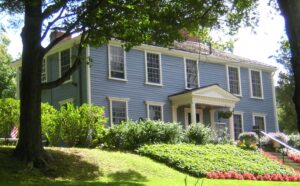
Of the three taverns associated with the Suffolk County Convention, only the Vose house survives, albeit in a different place. It’s now headquarters of the Milton Historical Society and is called the Suffolk Resolves House. 

On Sunday, 31 August, the Milton Historical Society, the Massachusetts Freemasons, and the Dr. Joseph Warren Foundation will commemorate the 250th anniversary of the Suffolk Resolves with guided tours of the Vose house, speakers, and reenactors. This event is scheduled to run from 9:00 A.M. to 4:00 P.M. Tickets are $10 per adult, $20 for a family of two adults and children under eighteen. Proceeds will benefit the Milton Historical Society.

Tuesday, January 16, 2024

Sorting Out Details about William Hendley

On 23 Feb 1830, the Rhode-Island American reported this death:
In Waldoborough, (Me) Mr William Hendley, formerly of Roxbury, Mass. aged 82. He was a revolutionary pensioner, and present at the destruction of the Tea in Boston Harbour.
That report may have come from another newspaper closer to Maine. The same sentence appeared in several other American newspapers afterwards.

According to the 11 Nov 1814 Dedham Gazette, Mary Hendley, wife of William, had died in Roxbury at age 63. The veteran was then in his seventies. He might have moved north to Maine to live with children or relatives.

The U.S. Revolutionary War Pension database turns up only one William Hendley from Massachusetts. His application stated that he had enlisted as a private soldier on 24 Mar 1777 at Stoughton in the 7th Massachusetts Regiment and served for three years under Col. Ichabod Alden and Col. John Brooks. His first company commander was Capt. William Patrick, killed at Cobleskill, New York. In 1780 Hendley was discharged at West Point as a corporal.

Hendley’s file offers almost no other information except that in 1820 he identified himself as a “Mariner,” and that he made his application at the court in Boston.

Massachusetts Soldiers and Sailors, based on state records, lists a William Hendley/Hendly with the same service details. It also lists other soldiers with the same or similar names from Boston and Scituate.

When William Hendley of Waldoborough died, American newspapers were starting to lift the curtain on who had destroyed the East India Company tea in December 1773. Editors had kept the secret until the 1820s, especially inside Boston itself. But as time passed, and veterans passed on, the old custom faded. Unfortunately, Hendley died too early for anyone to interview him in depth about the Tea Party and what role he’d played.

The 1835 book Traits of the Tea Party even included an appendix of men who had participated in the event, the first such list published. William Hendley was on it, possibly because of the newspaper death notice.

Decades later, Francis Drake sought to profile all the men and boys at the Boston Tea Party in his book Tea Leaves (1884). About Hendley he wrote:
A Revolutionary pensioner, formerly of Roxbury, died at Waldoborough, Me., in February, 1830; aged eighty-two. He was a mason, on Newbury Street, Boston, in 1796.
The first sentence was based on the obituary, the second on the 1796 Boston directory, which listed:
Henly, William, mason, Sweetser’s buildings, Newbury Street.
However, it’s quite possible that William Henly, Boston mason, wasn’t William Hendley, Roxbury mariner who would die in Maine. The 14 June 1804 Boston Gazette reported that “Mr. William Henly, aged 44,” had died in town “after a lingering illness.” The mason might have been one of the other veterans listed in Massachusetts Soldiers and Sailors; if so, he didn’t live long enough to apply for a pension.

Furthermore, at some point Drake’s entry about Hendley was misread. He was changed from a mason to a Freemason.

Thus, on looking at the earliest sources of information about this man, I sort out:
  • William Hendley, “present” at the Tea Party, soldier in the Continental Army for three years, lived in Roxbury, applied for a U.S. pension, moved to Maine, and died in 1830.
  • William Henly, possibly in the army, mason in Boston in 1796, possibly died in 1804.
  • “William Hendley, mason,” an amalgam of these two men and later fictitiously a Freemason.

Monday, July 19, 2021

Dr. Samuel Curtis Goes to War

When, last September, I left Dr. Samuel Curtis of Marlborough, his wife Lydia and their two babies had all died in December 1774.

Lydia Curtis had been married before, to Dr. Ebenezer Dexter. Three teen-aged sons from that first marriage were still alive. The oldest, William Dexter, married in Shrewsbury in early 1775, so he was probably already in that town, training under another medical doctor.

I suspect the younger two boys were living with Lydia’s parents, who were wealthy and influential in Marlborough.

Dr. Curtis had served on Marlborough’s committee of correspondence since 1772 and represented the town at the 1774 Middlesex County convention. After his wife’s death, he may have thrown himself even more into the Patriot movement. In March 1775, as I recounted here, Curtis took the lead in hunting for British army spies seeking refuge at Henry Barnes’s house.

There are no records of how Curtis responded to the outbreak of war the next month. His name doesn’t appear in militia records. He continued to serve on town committees, and in the fall of 1775 the Massachusetts legislature appointed him a justice of the peace.

(Dr. Curtis was a son of the Rev. Philip Curtis of the second precinct of Stoughton, which in 1775 became the new town of Sharon. Late the following year, Samuel’s younger sister Susanna Curtis married his former trainee, Dr. Daniel Cony [1752-1842, shown above later in life], whose family had moved out to Shutesbury. Dr. Cony spent chunks of the next few years in military service. Eventually the Conys moved up to Maine, where one of his medical colleagues was the midwife Martha Ballard. But I digress.)

William Dexter turned twenty-one in 1776. I believe that meant he came into his mother’s Marlborough property, where Dr. Curtis had been living as a widower. That gave the doctor three reasons to make a life change:
  • psychological, after his wife and children’s deaths.
  • domestic, as his stepson was taking over the family home.
  • political, to help fight the war.
And impulse control might not have been Curtis’s strength.

In March 1777, Dr. Samuel Curtis signed on to be surgeon aboard the Hancock, the first frigate built for the Continental Navy. He would serve under Capt. John Manley, who in the fall of 1775 had proved to be the most stealthy and successful naval officer in the Continental military, winning several important prizes. Manley had been granted the authority of a commodore, meaning that in company with other Continental vessels he could boss their captains.

The Hancock was an excellent product of Newburyport shipwrights. Some British officers would even deem it “the finest and fastest frigate in the world.” It carried 24 twelve-pounder cannon and 10 six-pounders, plus a crew of 290 men. Dr. Curtis spent his first two months in the navy collecting medical supplies for that vessel.

On 21 May the Hancock slipped out of Boston harbor, past the Royal Navy patrols lurking in the ocean. Along with it came the Continental frigate Boston, 30 guns, commanded by Hector McNeill; the privateer American Tartar, 24 guns, under John Grimes; and eight other, smaller privateers. Manley’s target was British fishing vessels and unaccompanied merchant ships.

TOMORROW: Dr. Curtis’s first fights at sea.

Friday, November 27, 2020

Finding Jurors for the Boston Massacre Trial

On 27 Nov 1770, 250 years ago today, the second trial for the Boston Massacre got under way.

It was supposed to start a week earlier, but the court had trouble finding twelve jurors who were ready to sit on what promised to be an unusually long, unusually charged trial.

The defense team was giving the jurors extra scrutiny. Acting governor Thomas Hutchinson wrote to Gen. Thomas Gage in New York:
My great concern is to obtain an unbiased Jury and for that purpose, principally, I advised Captain [Thomas] Preston to engage one of the Bar, over and above the Council to conduct the Cause in Court, in the character of an Attorney who should make a very diligent inquiry into the characters and principles of all who are returned which he has done and it may be to good purpose, but after all it will be extremely difficult to keep a Jury to the Rules of Law.
That appears to be the reason that the young solicitor Sampson Salter Blowers joined John Adams and Josiah Quincy, Jr., on the defense team. (Blowers appears above later in life, when he was a judge in Nova Scotia.) Robert Auchmuty, senior counsel for the defense in Preston’s trial, saw his job as done.

The defense lawyers challenged every potential juror from Boston as too close to the case. After all, the town was paying Robert Treat Paine to be a special prosecutor. And the judges accepted those challenges. As a result, the jurors all had to come from other towns in Suffolk County (which at that time included all of present-day Norfolk County as well as Hingham). 

The trial record, which is unusually thick for the eighteenth century and published in volume 3 of The Legal Papers of John Adams and thus on Founders Online, shows the difficulty in seating a jury of twelve. The men called were: 
  • Samuel Williams, Roxbury, challenged for cause.
  • Joseph Curtis, Roxbury, challenged for cause.
  • Nathaniel Davis, Roxbury, sworn.
  • Joseph Mayo, Roxbury, sworn.
  • Abraham Wheeler, Dorchester, sworn.
  • Edward Pierce, Dorchester, sworn.
  • William Glover, Dorchester, challenged peremptorily.
  • Isaiah Thayer, Braintree, sworn.
  • Samuel Bass, Jr., Braintree, challenged peremptorily.
  • James Faxen, Braintree, challenged peremptorily.
  • Benjamin Fisher, Dedham, sworn.
  • John Morse, Dedham, challenged peremptorily.
  • James White, Medway, challenged peremptorily.
  • Nehemiah Davis, Brookline, challenged peremptorily.
  • Samuel Davenport, Milton, sworn.
  • Joseph Houghton, Milton, sworn.
  • James Richardson, Medfield, challenged peremptorily.
  • John Billings, Stoughton, challenged peremptorily.
  • Joseph Richards, Stoughton, challenged for cause.
  • Consider Atherton, Stoughton, sworn.
  • Abner Turner, Walpole, challenged peremptorily.
The clerk then called the Boston men whose names were at the bottom of that list, and the defendants challenged them all.
  • John Brown, Boston, challenged for cause.
  • Joseph Barrell, Boston, challenged for cause.
  • Silas Aitkins, Boston, challenged for cause.
  • Harbottle Dorr, Boston, challenged for cause.
The judges had Sheriff Stephen Greenleaf bring in more men, and the process resumed.
  • Samuel Sheppard, Boston, challenged peremptorily.
  • John Goldsbury, Boston, challenged for cause.
  • Samuel Peck, Boston, challenged for cause.
  • William Gouge, challenged for cause.
  • Joseph Turrell, Boston, challenged for cause.
  • Jacob Cushing, Jr., Hingham, sworn.
  • Josiah Lane, Hingham, sworn.
  • Jonathan Burr, Hingham, sworn.
Finally, the court officers did a little legal maneuvering to ensure the last three men from Hingham were indeed eligible, and the opening arguments began.

Joseph Mayo (1721-1776) of Roxbury was named foreman of the jury. He owned a large farm a little past the intersection of modern Washington Street and South Street in Roslindale. A veteran of the Louisbourg expedition of 1745, he was a captain of his town’s militia company. Mayo had also served on town committees to promote non-importation and to instruct the Massachusetts General Court representatives to stand up for the province’s charter rights. But the defense team felt, based on their inquiry, that he could assess the case fairly.

Saturday, September 26, 2020

“No such order as Mr Gridley alludes to”

Scarborough Gridley didn’t just write to Elbridge Gerry seeking back pay in February 1784, as I quoted yesterday.

Gridley first went to the president of the Massachusetts Senate to ask for his help. That man was Samuel Adams (shown here). This is why Gridley’s letter to Gerry is in the Samuel Adams Papers at the New York Public Library, of all places.

Adams’s political estrangement from John Hancock was at its height, so he was probably quite open to Gridley’s complaint that the governor had failed to carry out his duty to send an inquiry to Gen. George Washington about Gridley’s military role. (In 1789 Hancock and Adams reconciled and ran as a ticket, so Adams was Hancock’s lieutenant governor and successor.)

Adams had been in Philadelphia in 1775, when Gridley was cashiered out of his father’s artillery regiment, and 1776, when Gridley claimed his father brought him back on as an assistant while fortifying Boston harbor. So the senate president wasn’t up on the details of the younger man’s career.

On 25 February, Adams wrote from Boston to Gerry, then representing Massachusetts in the Congress, which was convened at Annapolis.
Inclosd is a Letter to your Self from Colo. Scar Gridley. It seems he applied to this G[eneral] C[ourt] some time ago for Depretion of his pay while in the Service, upon which the Govr. was requested to write to G W to make known to him the Rank held by Mr. Gridley & [missing text] but the Letter has never been written.

I advisd him to write you on the Subject, & hope you will excuse my giving you the Trouble. As you are now near the Place of Residence of General Washington, perhaps it may not be inconvenient to you to write to him, in doing which you will gratify & oblige Mr. Gridley.
On 18 March, Gerry wrote to Washington, then retired:
By the last Post I received from the president of the Senate of Massachusetts a Letter, inclosing the papers herewith transmitted, & requesting me to write to your Excellency on the Subject. As I have no other Knowledge of the Matter, than what is derived from Colo Gridley’s Letter & the Resolve accompanying it, I can only say, that when your Excellency is at Leisure, if You think it expedient to make any Observations on the Subject or Answer to the Resolve, & should inclose them to me, I will direct them to Colo Gridley.

I flatter myself with the Hopes, that since your Retirement from publick Life, You have not only enjoyed, Health, peace & Competence, but likewise the pleasure of seeing all your Friends in the same happy Circumstances.
On 31 March, Washington wrote back from Mount Vernon:
I have examined my Letter and orderly Books but find no such order as Mr Gridley alludes to, in his letter of the 21st of Feby, to you.

If his Father, or himself ever received such orders they are no doubt to be produced, and will speak for themselves. Mr Gridley never reported himself to the Chief Engineer (Genl [Louis Lebègue] Duportail) nor has he ever been returned to me by him, or any Senior Officer in that department that I remember as one of the Corps—in the Service of the United States—It is not in my power therefore, from any recollection I have of the circumstance he speaks of—or of his Services—to certifie anything on which his claim can be founded.
According to Gridley, his father had told Washington about his appointment in 1776 and the commander-in-chief had approved it. But there’s no mention of that in the published correspondence of the two men.

The nearest hint of a new army job for Scar Gridley was his court-martial panel’s statement that “they do not consider him incapable of a Continental Commission, should the General Officers recommend him to his Excellency”—which the general officers never did.

Gerry returned Gridley’s letter with Washington’s response in a note to Adams dated 2 April. Adams replied simply: “Your Letter of the 2d relating to Colo. Gridleys Affair came to hand. I am obligd to you for the Care you have taken.” And that was the end of that.

One detail that stood out to me in this exchange is that Adams, and then Gerry, referred to Scarborough Gridley with the title “Colonel.” Gridley was a major when he was removed from the Continental Army in 1775. Some paperwork hints that in the summer of 1775 he and his father tried to get him the rank of lieutenant colonel, but that didn’t go through.

So when and how did Scar Gridley start introducing himself to people as a colonel? Then again, if he really had managed to collect a few years of pay and rations as an assistant engineer in the Continental Army without any commander knowing it, he had a lot of audacity to call on.

Scarborough Gridley died in 1787 at the age of forty-eight at his parents’ home in Stoughton.

Thursday, September 17, 2020

Young Doctors in Marlborough

Yesterday I introduced the figure of Dr. Ebenezer Dexter, Marlborough’s leading doctor in the 1760s.

On 3 May 1769, however, the Rev. Ebenezer Parkman of nearby Westborough wrote in his diary: “Dr. [Edward] Flynt came from Dr. Dexter, and says the latter will hardly live through the Night.”

Indeed, Dr. Dexter died the next day. On 6 May Parkman reported: “Dr. Dexter was buryed at Marlborough.”

The doctor’s gravestone, shown here courtesy of Find a Grave, says, “He was an Eminent Physician but was Subject unto Death even as other men.”

The doctor’s death left an opening in his town. Two young physicians soon moved into Marlborough, hoping to establish their own practices.

One was Amos Cotting, born in Waltham in 1749 (under the name Cutting, which would have been apt for a surgeon). He graduated from Harvard College in 1767 and then earned his M.A., presumably while studying medicine. Charles Hudson’s history of Marlborough said Cotting came to that town “On the death of Dr. Ebenezer Dexter, 1769,” but he wasn’t on the list of men paying the poll tax in 1770, so he may have arrived later.

The other young doctor was Samuel Curtis, eldest son of the Rev. Philip Curtis of Stoughton. He graduated from Harvard a year before Cotting and also gained an M.A. Curtis was apparently starting to practice medicine in Roxbury when he learned about the sudden opportunity in Marlborough. Hudson quoted from the town’s warning-out records to reveal what happened next:
Dr. Samuel Curtis came to town, June, 1769; came last from Roxbury. Taken in by widow Dexter.
The following month, the Rev. Mr. Parkman rode to Marlborough to see a sick relative, and he also recorded: “Visit Mrs. Dexter and Dr. Curtis who lodges there.”

Curtis had advantages over Cotting in any competition to become the town’s favorite physician. He was slightly older, and as son of a minister instead of a farmer he was probably more genteel. But the big edge appears to have been that he was now living in Dr. Dexter’s house, thus endorsed by Dr. Dexter’s wife, all ready to see Dr. Dexter’s patients.

The widow Dexter was still only in her early thirties, with four young sons to care for and an estate to maintain. Then, in early 1771, Lydia Dexter became pregnant.

TOMORROW: Can this marriage be saved?

Monday, September 14, 2020

“Remissness and backwardness” at Bunker Hill

On 13 Aug 1775, Gen. George Washington issued orders for a court-martial to take place the following day with Gen. Nathanael Greene presiding.

The defendant was Col. John Mansfield (1721-1809) of Lynn. Three junior officers in his regiment had accused him “of high Crimes and Misdemeanors”—namely “remissness and backwardness in the execution of his duty, at the late engagement on Bunkers-hill.”

But there was a delay. On 17 August, Washington told Greene and the other officers to try Col. Samuel Gerrish instead. There were also hearings on officers of lesser rank in that month. As I discussed last month, Gen. Washington was happy to remove a bunch of officers from the Continental ranks.

On 20 August the commander-in-chief told his cousin and overseer Lund Washington, “there is two more Colos. now under arrest, & to be tried for the same Offences.” One was Mansfield.

Why the delay? The charge against Mansfield also involved Maj. Scarborough Gridley of the artillery regiment, who was a protégé of his father, Col. Richard Gridley. The colonel was highly respected in Massachusetts because of his service in the last two wars, particularly the 1745 siege of Louisbourg. With a half-pay pension from the Crown, he was seen as the equivalent of a British army artillerist. The Massachusetts government had even moved to promote Col. Gridley to major general on 23 June.

Gen. Washington and particularly Gen. Charles Lee were not at all impressed with Col. Gridley’s fortifications and other work when they arrived in Cambridge in July. Washington informed the Continental Congress of Gridley’s new Massachusetts rank but pointedly didn’t endorse it. The Congress commissioned him as a Continental colonel instead. But people still didn’t want to totally alienate Col. Gridley.

What’s more, for a significant time that summer the colonel was home in Stoughton recovering a wound he’d suffered at Bunker Hill. His son Scar was the only liaison between him and the army. So both politically and practically, Maj. Scar Gridley was almost untouchable for a while.

That’s where the incident with Col. Mansfield came in. Mansfield’s failing at the Battle of Bunker Hill was to listen to Maj. Scar Gridley. As Richard Frothingham explained the situation in his History of the Siege of Boston, both officers had been ordered onto the battlefield on the Charlestown peninsula but stopped before crossing the neck:
Major Gridley, of the artillery, inadequate to his position, with part of the battalion, marched a short distance on Cambridge road, then halted, and resolved to cover the retreat, which he thought to be inevitable. Col. [Joseph] Frye, fresh from the battle, urged him forward; but Gridley, appalled by the horrors of the scene, ordered his men to fire at the [Royal Navy ship] Glasgow, and batteries from Cobble Hill. He also ordered Colonel Mansfield to support him with his regiment, who, violating his orders, obeyed.
To convict Mansfield of disobeying higher orders, cowardice, or incompetence would imply that Scar Gridley was guilty of the same charges. And how would his father respond? That might have been why Mansfield’s court martial took so long to get started.

In early September 1775, however, the court-martial proceedings started again. The logjam might have been broken from below as officers in the artillery regiment fired accusations at each other.

TOMORROW: Two trials in two weeks.

Monday, July 16, 2018

The Confiscation of John McWhorter’s Gun

On 16 July 1775, the Taunton Patriot leader David Cobb (shown here, courtesy of the Massachusetts Historical Society) wrote to his brother-in-law, Robert Treat Paine, about the Battle of Bunker Hill, smaller skirmishes, and a local conflict:
John McWhorter from a trifling incident that happen’d in the Weymouth Alarm, in which I was oblig’d to take his Gun by force, has wag’d an eternal war with the Neighbourhood and now lives in a surly, morose, malicious, damn’d Scotch looking manner without conversing with his Family or Friends.
John McWhorter was a big man in Taunton. He owned a tavern where John Rowe visited (calling him “McQuarters”), the local Sons of Liberty reportedly met, and attorney and near neighbor Daniel Leonard supped after his wife died. It contained upscale tea tables and was still referred to as “McWhorter’s Inn” years after his death—probably because his wife kept it running most of the time. McWhorter also owned at least one slave, and he had interests in shipping.

Most important for the war effort, McWhorter was part-owner of an ironworks in Stoughton. (David Cobb’s father had also been in the iron business.) Responding to a resolution of the Massachusetts Provincial Congress in February 1775, Stoughton’s committee of inspection
stopped upwards of a Ton of Iron, the Property of John McWhorter of Taunton, by seizing and storing the same in the Town of Stoughton, which Iron they had every probable Reason to suspect was designed for the Use of the British Army.
Whether or not that suspicion was accurate, as war approached people clearly regarded McWhorter as a potential Loyalist. And he no doubt perceived Patriot officials as infringing on his property.

That was the situation when there was an alarm about the Royal Navy threatening Weymouth in the summer of 1775. With many of the region’s fighting men off at the siege of Boston, the task of defending the coast fell to militia companies, including the men of Taunton. A “trifling incident” during that tense time prompted Cobb to confiscate McWhorter’s musket.

In December 1776 Taunton’s militia commander noted that McWhorter was one of twenty men on the town’s “alarm list” who hadn’t turned out to protect Rhode Island from the return of the British military. Of course, McWhorter couldn’t have turned out for militia service if Cobb still had his gun.

McWhorter’s feuds continued. On 5 May 1777 the town’s committee of correspondence considered “the verbal complaint of Mr. [John?] Porter [a committee member] respecting the abuse he received from Mr. McWhorter[;] after hearing both parties, the Chairman was desired to give Mr. McWhorter a reprimand which was accordingly done.”

Back in 1776 the Stoughton committee had sold the confiscated iron, offering McWhorter “24s. per Hundred for said Iron, and Interest from the Time it was seized and stored.” But he refused and sued the committee members for “£486, Lawful Money.”

Just before the case was to be tried in June 1779, the committee brought the Massachusetts General Court into the dispute. In September the legislature ordered the Stoughton committee to pay £30.7s.4p. for the iron—basically the initial offer, nowhere close to what McWhorter had demanded.

John McWhorter stayed in Taunton through the war and died in 1800. By then he had probably reconciled himself to his neighbors and they to him, but people might still have been surly and morose.

Friday, July 13, 2018

Watching the Native Northeast Portal Grow

The Native Northeast Portal is still in early development but offers great promise. It addresses the challenge of how many primary-source documents about New England Native communities are unpublished, scattered, and difficult to access. As the website explains:
The Portal represents a scholarly critical edition of New England Native American primary source materials gathered presently from the partner institutions into one robust virtual collection, where the items are digitized, transcribed, annotated, and edited to the highest academic standards and then made freely available over the Internet, using open-source software. By providing annotated transcriptions, the Project’s editors provide the Series users with useful information within a well-researched and balanced context necessary to understand the complexities of the historical record.
As an example of this portal's resources, here's a petition from Jonathan Capen seeking the release of Isaac Williams from the Suffolk County jail in December 1776. Crisp images of the document with the Council's response written on it are accompanied by a transcription and a map showing the pertinent location.

Other sources fill out the story. Williams was "a Molatto" from Dedham who enlisted in Capt. Joseph Guild's company in May 1775 and served until the end of the year. Early that November Williams married Elizabeth Will, a member of the Punkapoag community in Stoughton.

Williams must have reenlisted in the Continental Army or was drafted for it in some way because on 14 Aug 1776 he was listed as a deserter from Guild's company. He was then said to be twenty-three years old and 5'10" tall. The army still listed him as coming from Dedham.

Apparently Williams had gone to his wife in Stoughton because the selectmen of that town had him arrested as a deserter and put in the Suffolk County jail. (That didn't mean the jail in Boston since Suffolk County then included all of modern Norfolk County.)

Capen was the agent for the Punkapoag community in its dealings with the government, so he petitioned on behalf of Elizabeth Williams. Capen wrote that her young husband was "in a very poor State of Health," which might well be why he had left the army. The Massachusetts Council approved that petition and ordered the selectmen to release Williams.

As for the end of Williams's story, I'm pleased to report that he recovered. According to genealogists David Allen Lambert and Jennifer Pustz, he lived until 1831. The Stoughton Historical Society owns the pieces of his gravestone. Elizabeth Williams lived until 1848, long enough to apply for a pension as a Continental Army widow. (Her application doesn't mention any service or arrest in 1776.) Among the people supporting the Williams pension claim with a shaky signature was Jonathan Capen, evidently the elderly son of the man who filed the 1776 petition.

Wednesday, July 12, 2017

The First Continental Death Under Gen. Washington

Back in February, the Journal of the American Revolution ran Patrick H. Hannum’s article “America’s First Continental Army Combat Casualty.” Hannum confined his search to the riflemen from Pennsylvania, Virginia, and Maryland, categorizing the New England troops already at the siege of Boston as militia. He named Pvt. William Simpson as the first man from those rifle companies to die.

I was among the commenters responding that by the end of May 1775 the New Englanders were legally enlisted as full-time soldiers for the rest of the year. And the Continental Congress adopted the colony armies around Boston at the same time it recruited men from the south and appointed George Washington, Philip Schuyler, Charles Lee, and other generals. Thus, all the troops around Boston were Continentals.

Another such commenter was Jim Gallagher, who went on to explore the question of who was the first soldier from
any unit of the Continental Army to die under Washington’s command. I’m running his findings as a guest blogger on this anniversary.

We can identify the first fatal casualty of the Continental Army according to Gen. George Washington’s reports to Congress. In his first report of 10 July 1775, addressed to John Hancock, the new commander reported a successful action with no American casualties (driving British troops from an outpost at Brown’s house/store).

In his second report, written 14 July, Washington reported the action of 12 July; the first engagement under his command which resulted in casualties. Casualties consisted of one soldier wounded and another killed on Moon Island in Boston Harbor. This soldier was killed while covering the withdrawal of a party burning hay to prevent its use by British troops.

According to a letter from Richard Cranch to John Adams the valiant soldier killed in this expedition was a “Mr. Clarke, of Stoughton.”

Massachusetts Soldiers and Sailors of the Revolutionary War verifies the death (pg 562), listing this soldier as Nehemiah Clark, of Stoughtonham, who marched on the alarm of April 19 and then enlisted on 8 May 1775 in Col. Joseph Reed’s 20th Reg’t, Capt. Samuel Payson’s Co., killed at Squantom 12 July 1775. Squantom is the town nearest to, and incorporates, Moon Island, and this engagement is known colloquially as “the Battle of Squantom”.

Nehemiah Clark’s story is equally compelling and offers glimpses into the relationships between the soldiers, their cause, and their families. Nehemiah was born 23 Feb 1741, son of Ichabod and Sarah Clark of Stoughton.

He married Judith Payson, sister of the man who became his company commander, on 9 Aug 1764, in Sharon, where the couple lived. At that time Sharon was an unincorporated area of Stoughton; an area from which today one can see the lights and hear crowd noise from Gillette Stadium, home field of the New England Patriots. The couple had six children, four of whom survived to adulthood. One of the twins born ten months after their marriage died shortly after birth, and another child died in 1774 at seven months of age.

Nehemiah left his wife and four children behind. Following his death, records show that his pay and the value of the “bounty coat” he never received were collected by his lieutenant on behalf of the family. Judith Clark never remarried, and died in 1786 of jaundice and scurvy. (“Clarks of Sharon”, 1999, Dr. Frank O. Clark.)

Thanks to Jim Gallagher, and to Patrick H. Hannum, for bringing to light the names and details of those unfortunate men, making them more than casualty figures again.

The photograph above shows Moon Island today, connected to the mainland by a causeway. It now belongs to Quincy, and is used by the Boston Police and Fire Departments for training.

Saturday, January 28, 2017

“In daily expectation of Colonel Knox’s arrivall”

Yesterday I quoted the Boston businessman and court official Ezekiel Price about Col. Henry Knox and the artillery he brought from Lake Champlain in January 1776.

At that time Price was a war refugee living at Thomas Doty’s tavern in what was then Stoughton (shown here). That was also the home town of Col. Richard Gridley, Chief Engineer of the Continental Army and, until the previous fall, the commander of its artillery regiment. Price socialized with the Gridley family. He also gathered up rumors from other sources.

Price’s diary entries make clear that people like him knew about Knox’s mission to retrieve cannon and were eagerly awaiting the result.
Thursday, Jan. 11. — Went down to Milton. Could hear nothing remarkable from the American Army. It is reported that Colonel Henry Knox is on his return from Crown Point; got back as far as Worcester, and has with him a number of brass cannon and other ordnance-stores, and was expected at Cambridge last night with his artillery. Mr. William Bant [a business associate of John Hancock] called here on his way to the army, &c. Son Zek spent the day with us. Mrs. Price, Polly, &c, went home with Zek in the chaise. The weather threatens snow or rain soon.

Friday, Jan. 12.— A light snow fell in the night. The weather is moderate, and the morning agreeable for the season. Towards noon, it began to grow cold. Mrs. Gridley and daughter Beckey stopt here, in their way to Cambridge to visit Scar Gridley, who, they hear, is dangerously ill. A soldier from the army below says that nothing material has happened there within a day or two past, except that he heard Colonel Knox was on his return to Cambridge, and that a number of cannon had reached there, which Colonel Knox sent before him. It is cloudy, and has the appearance of more foul weather soon.
I’m skeptical about that “number of cannon” reaching Cambridge; no other sources confirm that secondhand information, and it looks to me like Knox went ahead of the guns instead of the other way around.

On 13 January, Gen. George Washington was still awaiting his artillery commander. He told Col. Alexander McDougall of New York, “I am in daily expectation of Colonel Knox’s arrivall.”

That same day, Price wrote, “By advices from Canada, I think Governor [Guy] Carlton’s head is pretty near the noose: so that we may hope to see him soon at headquarters.” He was expecting news of American triumph at Québec City.

In the evening Thomas Crane, representative from Stoughton to the Massachusetts General Court, told Price “that Knox, with the cannon, was at Springfield.” Which of course contradicted the earlier reports that the colonel was much closer. But Price was still optimistic.

Meanwhile, Washington kept waiting. On 16 January, he received a progress report from Gen. Philip Schuyler in Albany and wrote back: “I am much pleased, that the artillery was like to be got over the River, and am in Hopes, that Colonel Knox will arrive with it in a few Days—It is much wanted.”

Late the next day, Gen. Washington received bad news: Gen. Richard Montgomery had died in an unsuccessful assault on Québec. Washington called his generals together for a council of war the next morning to decide how many soldiers they could spare to bolster that effort against Canada. Knox, according to Gen. William Heath, finally arrived later on the 18th.

Sometime that same day, Ezekiel Price also heard about Montgomery’s death. He held out hope that that “melancholy and unfortunate” report was false. But on the 19th everyone connected with the army told Price the same bad news, and he had more detail by the 20th. For the next two days he described troops preparing to head north. Despite all his anticipation of Knox’s arrival, Price never actually recorded that event or mentioned the new artillery until late February. The disastrous news from Québec completely overshadowed it.

Sunday, December 20, 2015

The Stamp Act as a Marriage Tax

Genealogists, historians of marriage, and other experts might correct me on this, but in provincial Massachusetts a new couple didn’t obtain a certificate of marriage.

Rather, they got a certificate of their intention to marry from their town clerk, who certified that the engagement had been announced from the pulpit for the requisite fifteen days (three Sundays) beforehand.

Then they could take that paper to the minister or justice of the peace (ministers seem to have become the default choice by the eighteenth century) for the actual marriage.

I looked for examples of certificates of intent to marry from eighteenth-century Massachusetts, and the closest I got, courtesy of Access Genealogy, was the example above from 1806. But hey, it’s signed by William Cooper, who was Boston’s town clerk from 1761 to 1809. So he would have signed the equivalent document in the 1760s.

[To folks at the Massachusetts Historical Society: If my notes are correct, the Willard (Knox) Papers contain the certificate that Cooper filled out for Henry Knox and Lucy Flucker on June 23, 1774. That might make a nice Object of the Month.]

I did find a number of transcriptions from town clerks’ records, showing they didn’t all follow the same linguistic formula in noting down who planned to marry in their towns. Here’s an example from Stoughton:
The Intention of Marriage Betwen Mr. Ezra Morse of Stoughton & Mrs. Susanna Guild of Walpole Entred April ye 13th 1765
From Dover:
October 1st 1786. The intention of marriage between Mr David Fuller Jr of the District of Dover and Miss Sally Gay of Dedham is this day entered with me and a certificate given that the said intention of marriage hath been made public agreeable to law

Joseph Haven District Clerk
The text of a certificate from Westfield:
This may certify that the Intention of Marriage between Mr. Zenas Noble, of Washington, and Mrs. Margaret Granger, of Westfield, hath been published in the manner the Law directs; and their names entered with me fourteen Days previous to the Date.

Westfield, Oct. 24th, 1791
Attt. P. WHITNEY, Town-Clerk.
Some clerks noted when couples registered their intention but never came to pick up their certificates, and were therefore not supposed to have gotten married.

The text of the Stamp Act makes no explicit mention of marriage, but it includes this clause:
For every skin or piece of vellum or parchment, or sheet or piece of paper, on which shall be ingrossed, written, or printed, any appeal, writ of error, writ of dower, Ad quod damnum, certiorari, statute merchant, statute staple, attestation, or certificate, by any officer, or exemplification of any record or proceeding in any court whatsoever within the said colonies and plantations (except appeals, writs of error, certiorari, attestations, certificates, and exemplifications, for or relating to the removal of any proceedings from before a single justice of the peace) a stamp duty of ten shillings.
Evidently the term “certificate, by any officer,” covered certificates of intent to marry. As a result, the Stamp Act put a ten-shilling tax on the legal act of marrying.

TOMORROW: Tax avoidance in 1765.

Sunday, September 28, 2014

A Short Look at the Vita Brevis Blog

Recently I came across the Vita Brevis blog from the New England Historic Genealogical Society, “designed to offer the reader short essays by the Society’s expert staff on their own research as well as news of the greater genealogical community.”

Entries include Alice Kane on “Mapping Vermont”:
Regardless of the jurisdictional dispute between New York and New Hampshire, much of the vital and land records remained with the Vermont towns recording them, while probate records are held by the probate district within the county – Strafford [a town moved from one county to another, based on different colonial grants] is covered by the Bradford Probate District, for which digital images may be viewed at https://familysearch.org/search/collection/1807377.
David Allen Lambert on the families of color in eighteenth-century Stoughton:
By the early eighteenth century, the population of the Punkapoag Indians was diminishing. Marriages between Punkapoag Indians and former slaves were not uncommon. One particular Punkapoag Indian–Elizabeth Will (the daughter of Nuff Will and Sarah Moho)–married former slave Isaac Williams, a Revolutionary War soldier from Roxbury, Massachusetts. This African-American/Native American family would live in the northern part of Stoughton for over half a century. Williams collected a federal pension for his service during the war. His widow Elizabeth lived to be more than 100 years of age, dying in 1848.
And Lindsay Fulton took a look at family customs in the previous century when illegitimate births were rarer: What surname did such a child inherit?

Tuesday, March 13, 2012

Richard Gridley: “become very obnoxious to that corps”

A lot of the research we rely on about Col. Richard Gridley, first commander of the Massachusetts and then Continental artillery regiment, comes from Daniel T. V. Huntoon, a writer in the late 1800s.

Huntoon was from Canton, Massachusetts, the town where Gridley settled a few years before the war when it was still part of Stoughton. Huntoon was, like Gridley, a Freemason.

Huntoon wrote and rewrote several articles about Gridley and included a long section on the colonel in his history of Canton. He argued that Gridley—whom he called a major general—deserved a bigger monument, and eventually the town installed the impressive grave marker shown here.

One document that I don’t see quoted in any of Huntoon’s writings about Gridley is the minutes of the conference at Gen. George Washington’s headquarters on 23 Oct 1775. Along with the general and his aides were Benjamin Franklin, Thomas Lynch, and Benjamin Harrison, delegates to the Continental Congress. Those men had all been meeting with representatives from Massachusetts and other New England governments, but they saved some topics for a smaller group.

Item 14 on their agenda said:
Very unhappy disputes prevailed in the Regiment of Artillery. Colonel Gridley is become very obnoxious to that corps, and the General is informed that he will prove the destruction of the Regiment, if continued therein. What is to be done in this case?

That as all Officers must be approved by the General, if it shall appear, in forming a new Army, that the difference is irreconcileable, Colonel Gridley be dismissed in some honourable way; and that the half pay [pension from the Crown] which he renounced, by entering into the American Army, ought to be compensated to him.
The notes of that meeting were published in the mid-1800s and available to Huntoon. He quoted other documents that appeared in Washington’s papers and American Archives that complimented Gridley. But if you read Huntoon’s several articles, you’d never know that Washington thought removing Gridley from command was the only way to avoid “the destruction of the Regiment.”

I’ll be discussing Washington’s management challenge this Thursday at Longfellow House–Washington’s Headquarters National Historic Site at 6:00 P.M.

(Photo above from the Canton Citizen, whose 2011 article about Gridley relies too much on Huntoon’s writing.)

Tuesday, April 05, 2011

A Mourning Ring for the Rev. Samuel Dunbar

Eldred’s Auction Gallery in East Dennis is about to offer this gold mourning ring for sale. It’s inscribed “Rev’d Saml. Dunbar ob [i.e., died] June 15, 1783 ae [i.e., aged] 78” and stamped with the initials “PR.”

In the Canton Citizen, local historian George T. Comeau laid out the evidence connecting that ring to the Boston silversmith Paul Revere. (The same article appears on the Postcards from Canton blog.)

Dunbar, born in 1704, was the minister of the first parish in Stoughton (which later became Canton) from at least 1727. A handwritten account of his funeral sold three years ago by Thomaston Place Auction Galleries states that he died “in the 79th year of his age, and 59th of his ministry,” which means he might have started preaching in Stoughton in 1725. Or maybe that should have been transcribed “57th of his ministry.”

As town minister Dunbar is credited with having influenced Roger Sherman, who grew up in Stoughton, and with lending his authority to the Suffolk Convention of September 1774. In 1755 he was chaplain for a Massachusetts military expedition to Crown Point on Lake Champlain, where he probably preached to young Revere.

Daniel T. V. Huntoon wrote of Dunbar in Potter’s American Miscellany in 1876:

judging from some specimens that tradition has handed down to us, his prayers were to the point; for example, during the Revolutionary war, Mr. Dunbar was informed that the British fleet, under Lord [Richard] Howe, was off the coast meditating a descent on Boston. He then prayed “That the Lord would put a bit in their mouth and jirk them about, and dash them to pieces on Cohasset Rock;” and again, in a season of great anxiety, that “God would let them speedily return from whence they came, for Thou knowest, O God, that their room is better than their company.”
Nearly every historical tradition in Stoughton and Canton seems to flow through Huntoon. I’ve found him to be not fully reliable on the career of local hero Richard Gridley, so take those traditions accordingly. (Some of the statements about Dunbar associated with this auction aren’t even in Huntoon, and are arguable or simply mistaken.)

It’s definite that Dunbar died on 15 June 1783, and his death was a big deal for the town. In mid-1783 Revere’s workshop made eight mourning rings matching this one for a “Capt. James Indicot.” That was, Comeau surmises, James Endicott, an important figure in Stoughton.

The auctioneer states, “Paul Revere mourning rings are extremely rare, and signed examples are nonexistent to the best of our knowledge.” In 1783 the silversmith was moving toward proto-industrial manufactures, and several years later Revere set up his copper-rolling factory in what had become Canton.

Sunday, April 12, 2009

Massachusetts Manuscript Maps

Back in January I bumped into the Massachusetts Historical Society’s “Massachusetts Maps” online exhibit. A lot of these images are manuscript maps—i.e., drawn by hand, not made for mass reproduction, and thus not to be seen anywhere else. Until now.

Among the choice selections:

The exhibit also offers a look at other locations in Massachusetts: And I’ve barely started to explore the graphic representation of the comprehensive Boston property survey of 1798.