J. L. BELL is a Massachusetts writer who specializes in (among other things) the start of the American Revolution in and around Boston. He is particularly interested in the experiences of children in 1765-75. He has published scholarly papers and popular articles for both children and adults. He was consultant for an episode of History Detectives, and contributed to a display at Minute Man National Historic Park.

Subscribe thru Follow.it


•••••••••••••••••


Showing posts with label Oliver Wendell. Show all posts

Sunday, May 18, 2025

“What Stock you had upon the Island”

Most islands in Boston harbor weren’t convenient for living on, but some were good for keeping livestock.

Cattle and sheep could graze on the natural grasses, taking in adequate water and salt, and they couldn’t run away.

That meant that as the Revolutionary War began, several islands had a lot of animals on them, as well as pasturage that could feed horses.

As the same time, the British military found itself penned up inside Boston, cut off from the town’s usual supply of food from the countryside.

It would take about six weeks before the government and merchants of London would hear of the outbreak of war, another six weeks before any supply ships they sent in response would arrive at Boston. The royal authorities therefore had to secure their own provisions for the next three months. Of course, that was a concern for Boston’s civilian authorities as well.

Leaders of the Massachusetts Provincial Congress saw the same situation. Recognizing that it was to their advantage to starve out the enemy, the committee of safety told farmers around the harbor not to sell provisions to anyone in the British military. Of course, that was easier said than done.

Boston selectman Oliver Wendell owned animals on Hog Island. “Greatly shocked by the Nervous Disorder,” he had left Boston for Newbury before the fighting broke out. His former apprentice Henry Prentiss therefore was trying to manage Wendell’s assets for him from Charlestown.

Of course, neither of those merchants actually handled the animals; that was the job of an employee named William Harris. On 9 May, Prentiss told Oliver Wendell, “Harris continues [on the] Island and sells to every one that comes.”

That wasn’t entirely voluntary. The next day, a man named Elijah Shaw told the committee of safety that British soldiers had “robbed him of 11 cows, 3 calves, a yearling heifer, 48 sheep, 61 lambs, 4 hogs, and poultry, hay 5 tons, and almost all his furniture.” The military was confiscating valuable provisions from people who wouldn’t sell.

On 12 May, Prentiss sent more details, starting with an inquiry from one of Wendell’s fellow selectmen, Thomas Marshall:
Coll. Marshall sent over here to know what Stock you had upon the Island, upon which I sent Mingo to the Island to bring an account to me.

He tells me Mr. Harris is very uneasy, the people from the Men of War frequently go to the Island to Buy fresh Provision, his own safety obliges him to sell to them, on the other Hand the Committee of Safety have thretned if he sells anything to the Army or Navy, that they will take all the Cattle from the Island, & our folks tell him they shall handle him very rufly.
Mingo was enslaved to Wendell, it appears, and trusted by him. At the start of the month another mercantile partner, Nathaniel Appleton, reported that Mingo had just gotten out of besieged Boston and “will give you more particulars of the Town.” Then the man returned from Newbury to Charlestown, doing this job for Prentiss.

Tuesday, July 23, 2024

“So they painted the little maid”

The Discover Quincy website now says in its description of the Dorothy Quincy Homestead in Quincy:
The childhood home of Dorothy Quincy, who became Mrs. John Hancock; the second President of the Continental Congress, first signer of the Declaration of Independence and the first Governor of Massachusetts.
There’s no mention of any other Dorothy Quincy.

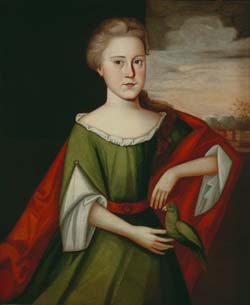
But there was (at least) one, and records are clear that that house was named after an earlier woman named Dorothy Quincy (1709–1762, shown here courtesy of the Massachusetts Historical Society). She was an aunt of the woman who married Hancock.

The earlier Dorothy Quincy married the merchant and mill-owner Edward Jackson. One of their children was the merchant and politician Jonathan Jackson. The other child, a daughter named Mary Jackson, married the Boston merchant and politician Oliver Wendell.

A portrait of young Dorothy (Quincy) Jackson descended in the Wendell family to Dr. Oliver Wendell Holmes, Sr., who became a very popular author. He wrote about the painting and its subject in “Dorothy Q.: A Family Portrait” in 1871. That poem begins:
Grandmother’s mother: her age, I guess,
Thirteen summers, or something less;
Girlish bust, but womanly air;
Smooth, square forehead with uprolled hair;
Lips that lover has never kissed;
Taper fingers and slender wrist;
Hanging sleeves of stiff brocade;
So they painted the little maid.

On her hand a parrot green
Sits unmoving and broods serene.
Hold up the canvas full in view,—
Look! there's a rent the light shines through,
Dark with a century’s fringe of dust,—
That was a Red-Coat’s rapier-thrust!
Such is the tale the lady old,
Dorothy’s daughter’s daughter, told. . . .
This was one of several poems Holmes wrote about the memory of the Revolution and its shadow on his time, such as “The Last Leaf” and “Under the Washington Elm.” He was so good at creating images and phrases that people overlook how he often simultaneously raised questions about those icons.

But Holmes wasn’t correct on the painting’s subject, either. His footnote for this poem said:
Dorothy was the daughter of Judge Edmund Quincy, and the niece of Josiah Quincy, junior, the young patriot and orator who died just before the American Revolution, of which he was one of the most eloquent and effective promoters. . . . The canvas of the painting was so much decayed that it had to be replaced by a new one, in doing which the rapier thrust was of course filled up.
Dorothy (Quincy) Jackson’s father was an Edmund Quincy, but a later Edmund Quincy was the father of the later Dorothy Quincy. That Dorothy Quincy did have an uncle named Josiah Quincy, but a later Josiah Quincy was the Patriot who died in 1775. So the confusion is understandable.

Nonetheless, it’s worth maintaining the knowledge of how the Dorothy Quincy Homestead got its name. It represents a confluence of the Colonial Revival and the Fireside Poets, and it stood for decades of family history. Discover Quincy’s current write-up is all about big names from the Revolutionary years only.

Saturday, July 15, 2023

“Upon the inhabitants in general lodging their arms in Faneuil-hall”

On 22 Apr 1775, with the Massachusetts militia besieging the king’s soldiers inside Boston, many townspeople wanted to get out of the way.

Gen. Thomas Gage, army commander and royal governor, had his own priorities: forestalling any citizen uprising against those soldiers.

Gage had approached Boston’s selectmen to start discussions on avoiding discontent and unrest. Those officials seized the opening to talk about letting people leave town.

In addition to five of the seven selectmen (John Hancock and Oliver Wendell had left Boston earlier in the month before fighting broke out), the town appointed four men to communicate with the governor. They were all established businessmen with political experience:
  • James Bowdoin, a member of the Council, firm Whig, and, therefore, longtime headache for Govs. Francis Bernard and Thomas Hutchinson. He was, however, wealthy and learned, thus undeniably respectable. Also, though Bowdoin might excuse violence after the fact, he didn’t encourage it beforehand.
  • Ezekiel Goldthwait (shown above), insurance broker, registrar of deeds, and veteran of other political offices, including Boston town clerk. While calling himself a Whig, Goldthwait was more centrist than most in that party and maintained friendly relations with the royal governors. Some people even called him a Tory.
  • Henderson Inches, a Boston selectman voted out earlier in the decade for not pushing as hard on the Massacre orations as the voting public wanted, but still in the Whig party.
  • Edward Payne, wounded in the Boston Massacre while standing peacefully on his front steps—but he chose not to sue about it. 
  • Alexander Hill, a warden and fireward often chosen to audit the town’s accounts. Though he had been put on the town’s committee of correspondence, Hill was rarely involved in protests and debates over imperial issues.
In sum, these were gentlemen whom the governor couldn’t dismiss or treat with suspicion.

It’s a sign of the emergency situation that the town met on Sunday, 23 April. Indeed, Hill’s job as warden had been to ensure that people didn’t conduct business on the Sabbath. But these were desperate times.

The record published in the 26 June Boston Gazette continued:
Sabbath morning ten o’clock, April 23, 1775.

The town met according to adjournment.

The said committee made a verbal report. Whereupon it was desired that the committee would withdraw and reduce their report to writing, which was accordingly done, and is as follows, viz.

The committee appointed by the town to wait upon his excellency General Gage, with a copy of the two votes passed by the town yesterday in the afternoon; report, that they being read to him by the committee, and a long conference had with him upon the subject matter contained in the said votes, his excellency finally gave for answer, that upon the inhabitants in general lodging their arms in Faneuil-hall, or any other convenient place, under the care of the Selectmen, marked with the names of the respective owners, that all such inhabitants as are inclined may depart from the town, with their family’s and effects; and those who remain may depend upon his protection. And that the arms aforesaid at a suitable time would be return’d to the owners.
Most men in Boston, as in other towns, were required by law to drill with the militia and therefore owned firelocks. Gen. Gage didn’t want those guns used against his soldiers. He also didn’t want people to take their weapons out of town, join the besieging force, or arm fighters in that force.

On the other hand, the province had just gone through several months of Patriots complaining that they had the right—indeed, the obligation—to amass weapons, gunpowder, and other military supplies. Bostonians couldn’t participate much in that arming of the countryside, being under army occupation, but they supported it. Would they give up their means of self-defense?

TOMORROW: The townspeople’s expectations?

Sunday, March 08, 2020

“They all four were buried in one grave”

On the afternoon of Thursday, 8 Mar 1770—250 years ago today—Boston had a huge public funeral for the first four people to die after the Boston Massacre.

This was only eleven days after the funeral for Christopher Seider, reportedly attended by 1,300 to 2,000 people. The March procession had, in the estimate of merchant John Rowe, at least five times as many mourners:
I attended the Funeral of the four Unhappy People that were killed on Monday last. Such a Concourse of People I never saw before — I believe Ten or Twelve thousand. One Corps with their Relations followed the other & then the Select Men & Inhabitants.
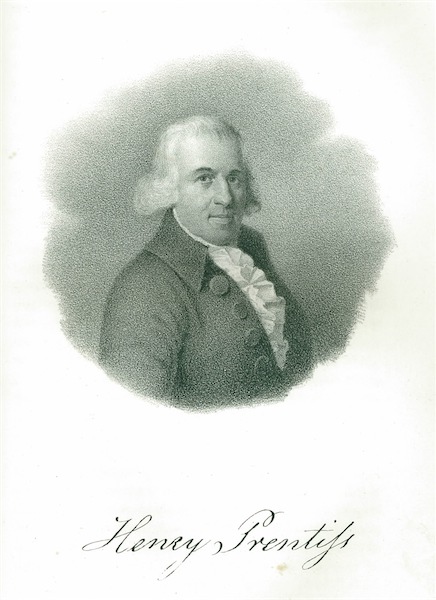
Christopher Davis alerted me through Facebook to a letter about this funeral from Henry Prentiss (1749-1821, shown here in middle age) to his father, a minister in Holliston. Prentiss had just finished an apprenticeship with the merchant Oliver Wendell and asked his father to check “what he [Wendell] was to give me when my time was up”—meaning he didn’t have a copy of his own indenture.

Prentiss sent his father an eyewitness account of the shooting on King Street and the government deliberations that followed. In a postscript, he added what information he’d gathered about the Massacre victims:
The Names of those persons that were killed and their occupation. Jackson a Molatto fellow. Sailor. Gray a Rope maker. Covil mate of a vessell. Munk a Boat Builder. Maverick a Lad about fifteen years of age. Wounded viz., Edwd Payne Mercht in this town shot thro his arm. Green a Taylor shot through his thigh. Patterson shot thro his arm. The Names of the Rest have slip’d my memory.
Even what Prentiss recalled had errors. The “Molatto fellow” was then being identified as “Michael Johnson,” though within days he’d been named as Crispus Attucks. “Covil” was James Caldwell.

It doesn’t appear that Prentiss was close to any of the victims. Indeed, he gave only one man’s full name—Edward Payne, a fellow merchant. 

The next morning, Prentiss appended his description of the funeral:
Yestaday Afternoon four of those unhappy persons that were shot last Monday Evening were inter’d, the procession was much the grandest of any ever seen in America. Gray’s Corps went first then his Relations, then Covil and his Relations, then Maverick and his Relations & then Jackson & after Jackson the Inhabitants walk’d four a brest. I imagine to the number of three or four Thousand, & then a vast number of Carriges, they all four were buried in one grave & young Snider dug up & put with them.

severall company’s of Soldiers are gone to the Castle and the Remainder embarking as fast as possible, to-morrow Night the town will be Clear of them.
Prentiss’s estimate of the crowd at “three or four Thousand” might have been more accurate than Rowe’s, but that was still the largest procession Boston had seen in decades. And speaking of estimates, it took a lot longer than two days to move all the soldiers out of Boston.

(My thanks to Christopher Davis, and to Holliston chronicler George F. Walker, for bringing this source to light.)

Monday, July 01, 2019

Schoolmasters with the Initials “J.L.”

As quoted yesterday, in the summer of 1775 London newspapers reported that letters found on the body of Dr. Joseph Warren after the Battle of Bunker Hill implicated some people in Boston as “spies.”

The newspapers disagreed on how many letters the royal authorities had found on Warren’s body—three or six. I don’t believe the text of any letter survives. But those documents prompted the arrest of schoolteachers James Lovell and John Leach on 29 June, twelve days after the battle.

This article from the Essex Institute Historical Collections shows James Lovell writing to friends outside the siege lines throughout May and June. In a 10 May letter, Lovell even told Oliver Wendell about the dangers of sharing sensitive information:
You must however give us no State Matters; for ’tis but “you are the General’s Prisoner,” and whip! away to the Man of War; as is the Case of poor John Peck. I carry’d him Breakfast to the main Guard yesterday, and again this Morning but he was carry’d off last Evening and put on Board Ship. Inquisitorial this!
The royal authorities released John Peck in a prisoner exchange on 6 June. However, the heavy losses at Bunker Hill made the royal authorities far less forgiving.

Lovell was a strong Patriot, known for orating on the memory of the Boston Massacre back in 1771. On 3 May he told Wendell that he was trying to get his wife and children out of Boston, but
I shall tarry if 10 Sieges take place. I have determined it to be a Duty which I owe the Cause & the Friends of it, and am perfectly fearless of the Consequences. An ill Turn, a most violent Diarhea, from being too long in a damp place, has confirm’d Doctr. [Joseph? Silvester?] Gardners advice to me not to go into the Trenches, where my whole Soul lodges nightly. How then can I be more actively serviceable to the Friends who think with me, than by keeping disagreeable post among a Set of Villains who would willingly destroy what those Friends leave behind them.
Lovell was probably writing in a similar vein to Dr. Warren and perhaps indeed sending out information useful to the provincial military. He took elementary precautions. As Sam Forman notes and the E.I.H.C. article shows, Lovell already often signed his letters with just his initials. In addition, he asked Wendell to be sure to seal all their correspondence. But there was no protection for the documents that Dr. Warren chose to carry onto the battlefield.

As for John Leach, he appears to have been dragged into this situation simply because he had the same initials as Lovell. It’s also possible that the letters mentioned teaching school. Boston had three schoolteachers with the initials “J.L.” One, John Lovell of the South Latin School, was a staunch Loyalist. The other two got hauled off to jail.

Then Leach’s specialty as a teacher of navigation became a liability. Lovell taught Latin and Greek—hardly sensitive subjects. But royal officers found “Drawings” in Leach’s home when they arrested him. Those probably included detailed nautical maps and sketches of the harbor.

On 19 July, after three weeks in jail, the schoolteachers and other prisoners were taken into a military court presided over by Maj. Thomas Moncrieffe. According to Leach, the proceeding confirmed how little evidence the authorities had on them:
Till this Time we did not know our Crimes, on what account we were committed, but now we found Mr. Lovell was charged with “being a Spy, and giving intelligence to the Rebels.” And my charge, “being a spy, and suspected of taking plans.” When Capt. [Richard] Symmes appeared, he knew so little of us, that he called me Mr. Lovell; he knew so little of us, that instead of being a just Evidence [i.e., witness], he appeared ashamed and confounded, and went off.
Nevertheless, Leach wasn’t released until 3 October.

In late August, Lovell told a friend “that he expects to be out soon, tryumphant over his Enemies,” and was ready to give up “idlely schooling the children of a pack of Villains” in Boston. Instead, the royal authorities kept him locked up through the end of the siege and then carried him off to Halifax. Eventually he was exchanged.

Lovell never did go back to teaching school. Instead, he became a delegate to the Continental Congress, where he managed the correspondence with America’s diplomats—this time using a code.