J. L. BELL is a Massachusetts writer who specializes in (among other things) the start of the American Revolution in and around Boston. He is particularly interested in the experiences of children in 1765-75. He has published scholarly papers and popular articles for both children and adults. He was consultant for an episode of History Detectives, and contributed to a display at Minute Man National Historic Park.

Subscribe thru Follow.it


•••••••••••••••••


Showing posts with label Trenton. Show all posts

Tuesday, September 08, 2026

“The British Empire Strikes Back” in New Jersey, 6–8 Nov.
The next Pursuit of History Weekend session is called “The British Empire Strikes Back,” and it will cover the New York and New Jersey campaigns from August 1776 to January 1777.

Here’s how we’re describing the developments of 250 years ago:
Even as the United States declared their independence, the British military returned to New York. Starting in August 1776, Gen. William Howe pushed Gen. George Washington off Long Island, off Manhattan Island, and down into New Jersey. The Continental Army struggled through battles at Brooklyn, Harlem Heights, White Plains, and Fort Washington.

By late December, the Congress was evacuating Philadelphia, Washington was estranged from top aides, and Continental soldiers’ enlistments were about to run out. Only by counterattacking Gen. Cornwallis and his Hessian vanguard at Trenton and Princeton did Washington reenergize the American cause.
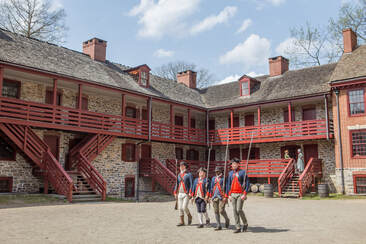
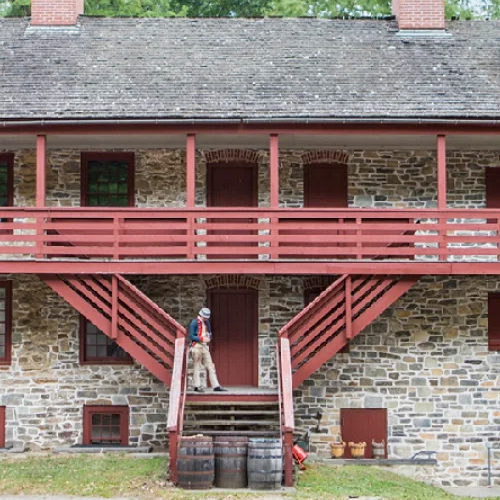
Our main meeting space for this weekend will be the Old Barracks Museum in Trenton, New Jersey, built to house troops in the French and Indian War. On 6–8 November, we’ll visit sites of fighting in that city; Washington Crossing, Pennsylvania; and Princeton, New Jersey. 

Here are some of the experts I’m eager to hear from:
  • Ricardo Herrera, Ph.D., joins the Pursuit of History Weekends as a program director and faculty member. He is Senior Historian at the George Washington Leadership Institute at George Washington’s Mount Vernon, having previously served as Professor of Military History at the U.S. Army War College and as an Armor and Cavalry officer. For the U.S. Army Center of Military History Rick wrote The New York Campaign 1776 (2026).
  • Friederike Baer, Ph.D. (friederikebaer.com), is the author of Hessians: German Soldiers in the American Revolutionary War (2022), honored with the American Revolution Round Table of Philadelphia’s Annual Book Award and the Society of the Cincinnati Prize. She is a Professor of History at Penn State University Abington College.
  • Benjamin L. Carp, Ph.D. (benjamincarp.com), wrote The Great New York Fire of 1776 (2023) and Rebels Rising: Cities and the American Revolution (2007), and other award-winning studies of the American Revolution. He holds the Daniel M. Lyons Chair in American History at Brooklyn College within the City University of New York.
  • William L. “Larry” Kidder, M.A. (wlkidderhistorian.com), has written several books about the Revolutionary War, including Ten Crucial Days: Washington’s Vision for Victory Unfolds, Crossroads of the Revolution: Trenton 1774–1783, and Revolutionary Princeton 1774–1783. He is a veteran of both the U.S. Navy and forty years of teaching high school.
  • Phillip Papas, Ph.D., explored the life of the Continental Army’s most confounding commander in Renegade Revolutionary: The Life of General Charles Lee (2014). Also author of That Ever Loyal Island: Staten Island and the American Revolution (2007), Papas is Senior Professor of History in the Economics, Government, and History Department at Union County College.
We’re still finalizing the schedule with the venues, but I expect to give some brief presentations as well.

Pursuit of History Weekends are limited to about forty people to facilitate discussion with speakers and among attendees. As of this holiday weekend, only ten slots are left.

For more information and to register, please visit this webpage.

Sunday, November 10, 2024

Helping to Shape Two Gifts for Revolutionary History Fans

I autograph copies of my book The Road to Concord for people who order through The History List. Sometimes I also help out polishing the details of its products for fans of the American Revolution.

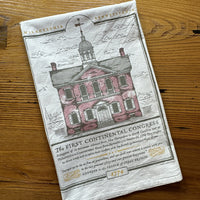
One of the recent items I advised on is this handsome portrait of the handsome Carpenters’ Hall in Philadelphia by artist and calligrapher Larry Stuart. It’s available as a print, a tea towel, and a magnet.

Two hundred fifty years ago this year, Carpenters’ Hall hosted the Continental Congress. That body was later renamed the First Continental Congress since a follow-up gathering at the nearby Pennsylvania State House ended up lasting for years and overshadowing its namesake. (So much so that that building is now Independence Hall.)

That created a challenge for how to explain the historic significance of what happened in Carpenters’ Hall in 1774. Conveying the mindset of that year meant not reading the First Continental Congress through the lens of the Second. Thus, we usually think the first Congress had delegates from twelve of the “thirteen colonies,” but there were open invitations to more than thirteen, and thirteen didn’t become a meaningful number for another few years.

Likewise, it seemed important to describe the First Continental Congress not as laying the groundwork for independence but as trying to resolve the dispute with Britain while avoiding independence and/or war. I found a quotation from the Congress’s address to the people of Great Britain which summed up the message of 1774:
Permit us to be as free as yourselves, and we shall ever esteem a union with you to be our greatest glory and our greatest happiness
(Of course, in the original eighteenth-century prose, that’s only a fragment of a much longer sentence.)

In addition, The History List just announced its advent calendar, conceived by proprietor Lee Wright.

This calendar counts down the days to 25 December because that was the night Gen. George Washington launched the attack on the Crown forces at Trenton, crossing the Delaware as depicted in the main image. Each window in that picture opens to a new image of some object associated with that event.

For this item, I drafted a brief description of how December 1776 was going for Washington. (Not well.) 

I don’t see any money from my little contributions to History List products, but every so often I do get ice cream.

Sunday, September 22, 2024

“Winning Independence” with General Washington

Here’s yet another video that’s interesting as a representation of the Revolution for modern Americans.

The modern Americans of 1932, that is.

That year, the U.S. of A. celebrated the 200th anniversary of George Washington’s birth, a division of Kodak called Eastman Classroom produced four fifteen-minute movies about him with the blanket title George Washington: His Life and Times.

The screenshots in this posting are from the installment “Winning Independence,” as put on YouTube by Periscope Films.
Though talking pictures had become standard entertainment by that time, schools still weren’t wired for sound, so these films were made as silent movies, with an emphasis on visuals.

Judging by the number of men shown, the battlefield scenes must have had high budgets. The image above shows grenadiers marching up Bunker Hill, looking very much like Howard Pyle’s painting of that scene. There are also animated maps.

The narrative is standard: Washington provides discipline for the army, loses New York, wins at Trenton and Princeton, loses Philadelphia the next year, learns enough at Valley Forge to win at Monmouth, and then there’s a jump over several years with just a quick mention of Charleston and Gen. Nathanael Greene before we arrive at Yorktown.
The credits thank William Randolph Hearst for the impressive scenes of Washington and his troops crossing the Delaware River on the night of 25–26 Dec 1776. Some of those shots match the 1924 feature Janice Meredith, starring Hearst’s inamorata Marion Davies.

The other movies in the series are “Conquering the Wilderness,” “United the Colonies,” and “Building the Nation.” 

Wednesday, March 09, 2022

American Revolution Conference in Williamsburg, 19-20 Mar.

I’d missed this good news, but America’s History L.L.C. is hosting its Ninth Annual Conference of the American Revolution in Williamsburg, Virginia, on 19-20 March 2022.

The presenters will be:
  • Edward G. Lengel, head of faculty: “Some Desperate Glory: The Battles of Connecticut Farms and Springfield, June 1780”
  • Michael Gabriel, “‘To Induce the Officers & Soldiery to Exert Themselves’: Plunder and Trophies in the Revolutionary War” 
  • Michael Harris, “Germantown: The Battle for Philadelphia, October 1777” 
  • T. Cole Jones, “Captives of Liberty: British, German and Loyalist Prisoners of War and the Politics of Vengeance”
  • Larry Kidder, “Ten Crucial Days: Washington’s Campaign against Trenton and Princeton”
  • Mark Edward Lender, “Cabal!: The Plot against George Washington” 
  • James Kirby Martin, “Reconciliation or Independence: Understanding the Rebel Insurgents of 1775-1776”
  • David Preston, “General George Washington: Echoes of the Seven Years’ War in the Revolutionary War”
  • Eric Schnitzer, “Make Way for New Interpretations: Don Troiani’s Campaign to Saratoga – 1777”
  • Gary Sellick, the Dr. Robert J. Christen Emerging Scholar: “Black Men, Red Coats: The Creation of the Carolina Corps in Revolutionary South Carolina”
Bruce Venter and his America’s History team had to cancel the last two years of conferences because of the pandemic, with all the anxiety and frayed relations that produces. I’m pleased to see this event back on the calendar for Revolutionary War buffs even though I can’t attend.

In future, I hope the topics will once again broaden to include more than the military side of the Revolution, and the presenters will be similarly diverse. But after all the organizational angst of the last two years, it’s good to see this conference in any form.

Wednesday, December 22, 2021

Music to Enjoy over the Holidays

Here are some links to music with colonial connections to enjoy at home over the upcoming holidays.

During last year’s stay-at-home holiday, the Middlesex County Volunteers Fifes and Drums recorded a version of “We Wish You a Merry Christmas” on a multitude of fifes to a multitude of cameras, expertly arranged together.

Also from last year, the original cast of Hamilton reunited on video to perform some modern Christmas songs together. Top-notch singing. 

In an older vein, the Sons of Liberty (shown above) are three Smith brothers from Virginia who, at least until they went off to separate colleges, played period music at historic sites and reenactments. They, too, recorded a video at the end of last year; the eighteenth-century music starts at about 4:30. Here’s a half-hour concert commemorating the Battle of Cowpens.

Finally, the Museum of the American Revolution is hosting a live concert of period music that people can enjoy in their homes.

Tuesday, 28 December, 6:00 to 7:30 P.M.
A Hessian Holiday Concert
Museum of the American Revolution

The museum says:
Join us for this live concert and discussion exploring the surprising German influence on early American music performed by ensemble members of Philadelphia Baroque Orchestra Tempesta di Mare, hosted by Museum Curator of Exhibitions Matthew Skic with illustrated comments from Ulrike Shapiro, Executive Director at Tempesta di Mare. . . .

At the Battle of Trenton on Dec. 26, 1776, Washington’s army defeated a force of Hessian troops, German soldiers who fought alongside the British in America. Included among the 900 captured Hessians was a group of oboists (or “hautboists”), the favorite entertainment of Colonel Johann Rall, who was mortally wounded at Trenton. Accompanied by regimental drummers, these 10 oboists marched into Philadelphia as prisoners of war following the battle.

Less than a year later, the Continental Congress hired these musicians to provide entertainment for the first anniversary of the Declaration of Independence on July 4, 1777. John Adams wrote that the festivities included “fine music from the band of Hessians taken at Trenton.”

Some of these Hessian musicians returned to Hesse-Cassel following the end of the Revolutionary War, but some of them stayed. One of them, Philipp Pfeil, moved to Philadelphia and became “Philip Phile, music master,” later composing the march we know today as the ceremonial march of the Vice President of the United States.
The concert will include both German music and early American patriotic songs, performed by five members of Philadelphia Baroque Orchestra Tempesta di Mare.

Online access to this concert costs $15, $10 for museum members. Purchase tickets here.

Sunday, January 03, 2021

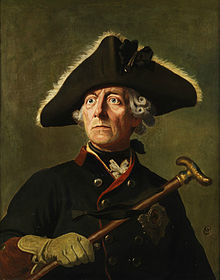
What Frederick the Great Thought of Washington

The Bicentennial dubbed the time between the Continental Army’s expedition against Trenton on 25 Dec 1776 and the Battle of Princeton on 3 Jan 1777 the “ten crucial days” of the New Jersey campaign. More recently, William L. Kidder wrote a book of that name.

One widely repeated statement about that period appeared in a footnote of Recollections and Private Memoirs of Washington, by His Adopted Son, George Washington Parke Custis in 1859. The “illustrative and explanatory notes” of that volume were written by Benson J. Lossing.

One of those notes concluded:
It is said Frederick the Great of Prussia declared, that the achievements of Washington and his little band of compatriots, between the twenty-fifth of December, 1776, and the fourth of January, 1777, a space of ten days, were the most brilliant of any in the annals of military achievements.
Lossing provided no source for this statement. Indeed, by prefacing it with the phrase “It is said…” he acknowledged that he didn’t have an identifiable source and was relying on hearsay at best. Lossing also didn’t use quotation marks, signaling that he wasn’t claiming to reproduce Frederick’s words, even in translation.

In the following decades Lossing wrote more books about the Revolution, including school textbooks, in which he repeated this statement with no “It is said” beginning. Other authors quoted the phrases about “Washington and his little band of compatriots” and “the most brilliant of any in the annals” from Lossing, using quote marks. That made it appear that those words came from a reliable translation of Frederick’s own words.

Authors continue to repeat that so-called quotation from Frederick in this century. The words appear in Ron Chernow’s biography of Washington and Michael E. Newton’s book on Alexander Hamilton’s rise. My curiosity about the words was piqued by a tweet from Mount Vernon last month. But all the citations lead back to Lossing’s footnote, with its lack of a direct quotation and highly fudged attribution. (I didn’t find any mention of Frederick the Great in Larry Kidder’s book, nor in David H. Fischer’s Washington’s Crossing.)

In 1874, the American historian and diplomat George Bancroft published the tenth volume of his History of the United States, covering some of the war years. In the preface he described studying many archives in Europe, and especially in Berlin, where he was posted. But he wrote: “I sought for some expression, on the part of Frederic, of a personal interest in Washington; but I found none.” Bancroft really wanted to find such evidence, and he came up empty.

In 1904 Paul Leland Haworth published an article in the American Historical Review titled “Frederick the Great and the American Revolution.” By then the Prussian king’s papers had been archived, transcribed, and published. That let Haworth demonstrate how Frederick’s interest in the distant war in North America arose entirely from his pleasure at seeing the British Empire diminished. In his conclusion Haworth echoed Bancroft’s statement: “there is nowhere in Frederick's correspondence any trace of a personal interest in Washington.“

Whatever we might think of the Continental Army’s maneuvers at the end of 1776 and the start of 1777, we can’t ascribe that opinion to Frederick the Great.

TOMORROW: The letter, the portrait, and the sword.

Saturday, December 26, 2020

Virtual Visits to Trenton on the Battle Anniversary

Today is the anniversary of the first and more famous Battle of Trenton. This year, in lieu of a reenactment and other in-person events, the Old Barracks Museum is hosting a series of online presentations.

This means that those of us from outside the area can make a virtual visit to Trenton while still enjoying our holiday weekend at home. And we don’t have to brave the cold, either.

The museum schedule includes these afternoon events:
  • 12:00 noon: “The Trouble with Trenton Virtual Puppet Show!” Register here.
  • 1:00 P.M.: “Hogmanay,” a traditional Scottish celebration of the New Year, presented by the Trent House Museum with the Practitioners of Musick. Suggested donation $10. Register here.
  • 2:00: “The Real Story of the Battle of Trenton” followed by live questions and answers with Asher Lurie, Chief of Historical Interpretation. Register here.
  • 3:00: “Blacks at the Battles of Trenton,” a talk by Algernon Ward, Jr., of Trenton. Register online.
  • 4:00: “The Gentler Conflict: Dancing in 18th-Century America” with Sue Dupre and Early Music Princeton. Register here.
At 5:00, William (Larry) Kidder will speak online about Revolutionary Princeton, 1774-1783: The Biography of an American Town in the Heart of a Civil War. His new book details the lives of Princetonians who lived through the Revolutionary War, building on his previous work in Crossroads of the Revolution: Trenton 1774-1783 and Ten Crucial Days: Washington’s Vision for Victory Unfolds. Register for the talk here.

Finally, at 7:00, Don Hagist will discuss his new book Noble Volunteers: The British Soldiers Who Fought the American Revolution, which brings life to the redcoats, describing their training, experiences, and outcomes. Drawing on military records and other primary sources in British, American, and Canadian archives, and the writings of dozens of officers and soldiers, Noble Volunteers shows how a peacetime army responded to the onset of war, how professional soldiers adapted quickly to become tactically dominant, and what became of the thousands of career soldiers once the war was over. Register for that talk here.

All of these events are free, but in signing up there’s an opportunity to donate to the museum to keep its programs going. You can also order books by Kidder and Hagist through the museum’s online store.

Thursday, January 24, 2019

Fort Plain Washington’s Birthday Symposium, 16 Feb.

On Saturday, 16 February, the Fort Plain Museum will host its first annual George Washington’s Birthday Symposium.

The scheduled speakers are:
  • Edward G. Lengel, “Setting the Example: George Washington’s Military Leadership”
  • Bruce Chadwick, “George & Martha”
  • William Larry Kidder, “George Washington’s Ten Crucial Days: Trenton and Princeton”
  • Norman J. Bollen, “George Washington and the Mohawk Frontier”
This event will be held at the Fulton-Montgomery Community College, located at 2805 NY-67, Johnstown, New York. It will start at 8:15 A.M. and end at 3:30 P.M. Registration costs $35 in advance, $40 at the door, and $20 for students. Admission includes a sandwich lunch buffet and refreshment breaks. The authors’ books will be available for purchase and signing.

To register, email fortplainmuseum@yahoo.com with your name, phone number, email address, and street address. Send a check to the Fort Plain Museum, Attn: GW BDAY, P. O. Box 324, Fort Plain, NY 13339, or call 518-774-5669 with credit-card information. (If you get connected to voicemail, leave a phone number for a volunteer to call you back.)

Saturday, December 01, 2018

A Busy Month in Princeton

If you’re anywhere around Princeton, New Jersey, tomorrow, consider checking out the Princeton Battlefield Society Education Forum. This year’s theme is “Soldiers and Civilians in Princeton Winter 1776 to 1777,” focusing on the “Ten Crucial Days” bridging the Battle of Trenton and the Battle of Princeton.

The speakers at this year’s forum are:
  • Larry Kidder on the disruptive experiences of the people living in and near Princeton during those busy months. Kidder is the author of A People Harassed and Exhausted: The Story of a New Jersey Militia Regiment in the American Revolution, Crossroads of the American Revolution: Trenton 1774 to 1783, and Ten Crucial Days: Washington’s Vision for Victory Unfolds.
  • Don N. Hagist on His Majesty’s 17th Regiment of Foot, which fought at Princeton, analyzing the nationalities, ages, background, and experience of the common British soldiers. Don is managing editor of Journal of the American Revolution and maintains the British Soldiers, American Revolution blog. His most recent books are The Revolution’s Last Men: The Soldiers behind the Photographs and British Soldiers, American War.
  • Joseph Seymour on the Philadelphia Associators, a Pennsylvania militia “association” formed to defend the neighboring state. Seymour is a historian at the U.S. Army Center of Military History. He is the author of Pennsylvania Associators, 1747-1777 and several articles on the subject.
  • Glenn F. Williams is the afternoon’s moderator. A Senior Historian at the U.S. Army Center of Military History, Dr. Williams is a retired Army officer who wrote the award-winning Year of the Hangman: George Washington’s Campaign against the Iroquois and Dunmore’s War: The Last Conflict of America’s Colonial Era.
This forum will take place from 1:30 to 5:00 P.M. in the Stockton Education Center of Morven, the estate that once belonged to Richard Stockton. The registration cost is $20.

The Princeton Battlefield Society has other events coming up this month.

On Saturday, 8 December, it will host a gathering of children’s-book creators at the Princeton Friends School:
  • Trinka Hakes Noble, author of The Scarlet Stockings Spy, The New Jersey Reader, and many other books.
  • William P. “Wil” Mara, author of If You Were a Kid During the American Revolution, If You Were a Kid in the Thirteen Colonies, and dozens of the biographies for young readers.
  • Rob Skead, coauthor of Patriots, Redcoats, and Spies and Submarines, Secrets, and a Daring Rescue.
Find more information and registration for that event here.

Finally, on the morning of Sunday, 30 December, the society will host its “Battle of Princeton in Real Time Tour” featuring local reenactors and Gen. George Washington on horseback. For more information, go here.

Monday, December 26, 2016

The Crucial Days After Trenton

The Battle of Trenton on 26 Dec 1776 was just the beginning of the Continental Army’s strike back against the British in central New Jersey after a very rough campaign season.

Revolutionary New Jersey, the Crossroads of the American Revolution, explains:
After ferrying their Hessian prisoners across the Delaware to Pennsylvania on December 26, Washington’s troops returned to New Jersey to engage the British at Trenton once again on January 2, 1777. Fighting along the Assunpink Creek ended at dusk. During the night, Washington led his troops along a back route to Princeton, where he attacked General Cornwallis’ rear guard on the morning of January 3, 1777.

While the second Battle of Trenton (also known as the Battle of the Assunpink) had no military outcome, it enabled another American victory, at Princeton. In the ten days succeeding Christmas, Washington had engaged the enemy in three battles and by winning two had restored belief in the possibility of ultimate victory.
The Ten Crucial Days organization offers videos, maps, and other information about those events. Its tours cover the Washington’s Crossing sites on both sides of the Delaware, the Old Barracks Museum in Trenton, and the Princeton Battlefield.

The small local publisher Knox Press, linked to Ten Crucial Days, offers David Price’s book Rescuing the Revolution: Unsung Patriot Heroes and the Ten Crucial Days of America’s War for Independence.

(Above is Boston’s own slice of Washington’s crossing, “The Passage of the Delaware” by Thomas Sully at the Museum of Fine Arts.)

Sunday, December 25, 2016

“Washington’s Christmas Party” by Ada Simpson Sherwood

Ada Simpson Sherwood (1861-1959) was a teacher, education professor, and prolific author of the sorts of poems that schoolchildren learned to recite or sing around the last turn of the century. She was especially diligent in writing about Revolutionary history.

The 25 Jan 1894 Journal of Education published six poems under the headline “Washington’s Birthday Selections,” for teachers to use in the coming month. Three were by Sherwood. This one is to the turn of “Yankee Doodle.”
Washington’s Christmas Party

Come, all who love a merry tale,
With joke both true and hearty,
We’ll tell you how George Washington
Once made a Christmas party.
Across the Delaware quite plain,
The British flag was vaunted,
His troops ill-clad, the weather bad,
And yet he was undaunted.

“Come, boys,” he said, “we’ll go to-night
Across the raging river;
The troops will be at Christmas sports,
And will suspect it, never.
The Hessians all will keep this night,
With games and feasting hearty,
We’ll spoil their fun with sword and gun,
And take their Christmas party.”

And as they row across the stream,
Tho storms and ice pursue them,
The fishermen from Marblehead
Knew just how to go thru them.
Upon the farther shore they form
And then surround the city,
The Hessians all, after their ball
Were sleeping. What a pity!

And when at last, at call to arms,
They tried to make a stand, sir,
They soon took fright and grounded arms.
To Washington’s small band, sir.
Across the stream they took that day,
One thousand Hessians hearty.
Their fun was spoiled, their tempers roiled,
By this famed Christmas party.
The picture above comes from the same era: “Washington Inspecting the Captured Colors after the Battle of Trenton” by Edward Percy Moran (1862-1935), courtesy of Wikipedia.

Thursday, December 26, 2013

The Importance of “Being George”

On 26 Dec 1776, Gen. George Washington led a successful attack on Crown forces at Trenton, his first battlefield triumph of the Revolutionary War. That move began with his fabled Crossing of the Delaware River, which local volunteers reenact yearly in Pennsylvania and New Jersey.

Or try to reenact. When the weather is too harsh or the current too strong, local governments call off the row for the sake of safety—for both participants and spectators. (Already the crossing is scheduled for daytime when people can see it easily rather than night-time when people couldn’t.) I recall many news stories over the years about reenactors glumly walking across the bridge instead of getting to travel in the boats.

I also recall reports of some resentments about who got the plum role of Gen. Washington. For a long time that was a matter of seniority within the local reenacting group. Then the director of Washington’s Crossing Historic Park asserted more control. The current process is more formal, with auditions before a panel of judges from local historical organizations, but that doesn’t mean it’s free of controversy.

The Star-Ledger newspaper produced a documentary titled “Being George”, about the choice of Washington in 2012. Directed by Nyier Abdou and Adya Beasley, the video is about forty-five minutes long and focuses on four of the ten men who vied for the post:
  • the incumbent, breaking with a recent precedent of not seeking the role again after a three-year term.
  • a past Washington who never got to cross by water in his years.
  • a devoted Washington impersonator from outside the local community.
  • a long-time reenactor in his forties, about the same age Washington was in 1776. (The other candidates, and our image of Washington, are older.)
Who has the strongest claim? Who would do the best job? Unfortunately for the sake of the documentary, the auditions and the judges’ discussions of them were off-limits to the camera. And unfortunately for the sake of “reality” television, the candidates are too polite for fireworks to erupt on screen. But the emotions are clear, both in the video and in the comments section below it. And there’s always next year.

Saturday, August 24, 2013

Princeton Battle Lecture in Arlington, Va., 4 Sept.

On Wednesday, 4 September, the the American Revolution Round Table of the District of Columbia will host an illustrated lecture by Wade P. Catts titled “As great a piece of Generalship as ever was performed: Reinterpretation of the Battle of Princeton, 3 January 1777.”

The group’s announcement says:
This illustrated lecture will present new information and in some cases, reinterpretation, of the battle of Princeton. The culminating battle of the “Ten Crucial Days,” Princeton was a remarkable military maneuver that had far-reaching results for the American cause, and a major setback for the Crown. Undertaken by the Princeton Battlefield Society and funded by a grant from the American Battlefield Protection Program, the recently completed study utilizes historical records, maps, topography, GIS, and archeology to examine the battlefield.
Catts is historic preservation consultant based in Pennsylvania who served the Princeton project as a historical archeologist. He’s worked on many other Revolutionary War sites as well.

“Piece of generalship” was a popular eighteenth-century expression for what we’d now call a clever strategy. On 7 Jan 1777, Stephen Moylan, volunteering as one of Gen. George Washington’s aides after a short, terrible tenure as quartermaster general, wrote to Robert Morris describing the battle:
By Heavens, it was the best piece of generalship I ever read or heard of. An enemy, within musket shot of us [at Trenton], determined, and only waiting for daylight, to make a vigourous attack. We stole a march, got to Princeton, defeated, and almost totally ruined, three of the best regiments in the British service; made all their schemes upon Philadelphia, for this season, abortive; put them into such a consternation, that if we only had five hundred fresh men, there is very little doubt but we should have destroyed all their stores and baggage, at Brunswick, of course, oblige them to leave the Jerseys, (this they must do)…
The British didn’t leave New Jersey, but they withdrew to the north of the state for the rest of the winter. The Trenton and Princeton victories cheered American Patriots, especially after the bigger British victories around New York, and helped the new republic last into the new year.

The ARRT of DC meets at the Fort Myer Officers Club in Arlington, Virginia, four times a year. See the website for more information on attending or joining. In November, the group will welcome Don N. Hagist, author of British Soldiers, American War: Voices of the American Revolution, 1775-1781.

Saturday, March 16, 2013

How Do You Solve a Problem like George Baylor?

Yesterday I quoted a letter from Gen. George Washington noting that George Baylor (shown here) held a unique position among his aides de camp. Baylor was the equivalent of a bike messenger among paralegals. While the rest of the staff were good at composing and copying letters, orders, and other paperwork, Baylor was not a “ready Pen-man” and good only for riding.

(Which is not to say that Baylor wasn’t from the same genteel class as the other aides de camp. He was a Virginia planter not unlike Washington himself. But he didn’t have professional training as an attorney, businessman, or doctor, as Washington came to prefer in his aides.)

Of course, the commander-in-chief couldn’t just fire Baylor and fill the slot with another penman. Not when Baylor was the son of a companion from the French & Indian War. Not when he was the senior aide and perfectly agreeable about doing all the riding tasks Washington asked of him.

But there was a tradition in the eighteenth-century British army that after a major victory the commander would choose one aide to carry his official report back to the capital. That was a big honor for the junior officer, not least because another tradition held that the bearer of such good news usually got a promotion.

In 1762, for example, Gen. Robert Monckton sent Capt. Horatio Gates to London with word that the British forces had taken Martinique. The general recommended Gates “to His Majesty’s Favour, as a very deserving Officer.” Within five weeks of landing in England, Gates was promoted to major and given £1,000 toward purchasing a lieutenant colonelcy.

(The only problem is that victories like Martinique meant the war was soon over, the army downsized, and Gates never got the chance to rise further. That soured him on the whole British patronage system, turned him into a “red hot Republican,” and led him to move to America in 1773. But I digress.)

Washington didn’t have any battlefield victories to report to the Continental Congress until late December 1776, when he surprised the British and Hessian troops at Trenton. And whom did he choose to carry that news to Baltimore (the Congress having left Philadelphia because the royal forces were getting closer and closer)?

Washington chose George Baylor, of course! The general even added:
Colo. Baylor, my first Aid de Camp, will have the honor of delivering this to you, and from him you may be made acquainted with many other particulars; his spirited Behavior upon every Occasion, requires me to recommend him to your particular Notice.
The Congress accordingly made Baylor head of the new 3rd Continental Light Dragoon Regiment. Problem solved!

Tuesday, February 14, 2012

Elkanah Watson’s Magic Egg

This anecdote is from Men and Times of the Revolution, the posthumously assembled memoirs of Elkanah Watson (1758-1842). It starts in December 1776 just after young Watson and some friends were inoculated against smallpox:
About the time we left the hospital, Major Thomas, of the army, arrived at Plymouth, from head-quarters. He had left Washington retreating through New-Jersey. I spent the evening with him, in company with many devoted Whigs. We looked upon the contest as near its close, and considered ourselves a vanquished people. The young men present determined to emigrate, and seek some spot where liberty dwelt, and where the arm of British tyranny could not reach us. Major Thomas animated our desponding spirits by the assurance that Washington was not dismayed, but evinced the same serenity and confidence as ever. Upon him rested all our hopes.

On the ensuing Sunday morning, as the people were on their way to church, I suddenly witnessed a great commotion in the street, and a general rush to the back door of Mrs. H—’s dwelling. Supposing the house to be on fire, I darted into the crowd, and on entering the house, heard the good woman’s voice above the rest, exclaiming, with an egg in her hand—“There, there, see for yourselves.” I seized the magic egg, and to my utter astonishment read upon it, in legible characters formed by the shell itself, “Oh, America, America, Howe shall be thy conqueror!”

The agitation and despondency produced, will hardly be appreciated by those unacquainted with the deep excitability of the public mind at that period. We were soon relieved from our gloom and apprehension, by ascertaining from an ingenious painter, who happily came in, that the supernatural intimation was the effect of a simple chemical process. We were convinced it was a device of some Tory to operate on the public feeling.

In the afternoon, an express arrived from Boston; a hand-bill was sent into the pulpit, and at the close of the service our venerable Whig Parson [Chandler] Robins, read from his desk the heart-thrilling news of the capture of the Hessians at Trenton—a happy retort upon the Tories.
Watson’s memoir was published in 1856, or nearly eighty years after this reported event.

TOMORROW: An earlier version of the same anecdote.

(Click on the portrait above or here for the Princeton University Art Museum’s exploration of John Singleton Copley’s 1782 portrait of Elkanah Watson.)

Sunday, December 26, 2010

“O Silent night shows war ace danger!”

This is a semi-famous sonnet by David Shulman titled “Washington Crossing the Delaware.” Can you see what’s notable about it?

A hard, howling, tossing water scene.
Strong tide was washing hero clean.
“How cold!” Weather stings as in anger.
O Silent night shows war ace danger!
The cold waters swashing on in rage.
Redcoats warn slow his hint engage.
When star general’s action wish’d “Go!”
He saw his ragged continentals row.
Ah, he stands—sailor crew went going.
And so this general watches rowing.
He hastens—winter again grows cold.
A wet crew gain Hessian stronghold.
George can’t lose war with ’s hands in;
He’s astern—so go alight, crew, and win!
Every line—that’s every line—is an anagram of the phrase “Washington Crossing the Delaware.” Yet Shulman still managed to produce couplets and a semblance of sense, though I must admit that metre fell overboard.

Wednesday, January 13, 2010

“Shot with an Iron Gun Rammer”

CSI: Colonial Boston now takes a field trip to New Jersey, soon after the Battle of Trenton, for a case study of a British soldier’s wound. This passage comes from an anonymous manuscript titled A Brief Narrative of the Ravages of the British and Hessians at Princeton in 1776-1777, published by the Princeton University library in 1906.

The writer seems to have used the verb “lap” to mean “to fold around something.”

On the first day of January 1777 some Regular [i.e., British] Soldiers came along the main road from over Stoney brook

One of them was very Strangely Wounded for he was shot with an Iron Gun rammer in Stead of a bullet, Which entered under his chin and came out again at his nose near his eyes one end of it, and the other end lapt round his thigh (as it is said)

Whether he was a Horsman or not I Know not, but it is very likely he was, and rideing up to the Enemy before he done charging, and perce[iv]ing that he was like to be shot with the Rammer, lean’d back on his horse to avoid it, and so received his wound in that manner, as to the Other end laping round his thigh, one end being Stopt, and the other end being heavy would continue its force until it met with something to stop it, and happened to meet with his thigh

He Languished a few days and Dyed.
And now back to your breakfasts.

(Click on the thumbnail above for a video of how one is supposed to stow a rammer, uninterrupted, courtesy of Fort McHenry.)

Saturday, May 23, 2009

“The Number Was Read in the Camp”

As I described yesterday, back in January I started poking around for the source of the statement from many authors over many decades that Gen. George Washington ordered the start of Thomas Paine’s American Crisis to be read to the whole Continental Army shortly before the Battle of Trenton. The earliest description of that event that I found came from George Lippard, who was far from a reliable source. But I didn’t feel confident about labeling the whole story a myth because I don’t know the sources on Paine well.

So I called in a favor from the expert on Revolutionary America’s response to Paine’s writing, Ken Burchell. Pickering & Chatto is about to publish his six-volume series on just that topic. Ken directed me to James Cheetham’s 1809 biography of Paine, which has this to say:

When the colonists drooped, he [Paine] revived them with a Crisis. The first of these numbers he published early in December, 1776. The object of it was good, the method excellent, and the language, suited to the depressed spirits of the army, of public bodies, and of private citizens, cheering.

Washington, defeated on Long-Island, had retreated to New York, and been driven with great loss from Forts Washington and Lee. The gallant little army, overwhelmed with a rapid succession of misfortunes, was dwindling away, and all seemed to be over with the cause when scarcely a blow had been struck. “These,” said the Crisis, “are the times that try mens’ souls. The summer soldier and the sunshine patriot will, in this crisis, shrink from the service of his country; but he that stands it NOW deserves the love and thanks of man and woman. Tyranny, like hell, is not easily conquered; yet we have this consolation with us, that the harder the conflict the more glorious the triumph; what we obtain too cheap we esteem too lightly.”

The number was read in the camp, to every corporal’s guard, and in the army and out of it had more than the intended effect. The convention of New York, reduced by dispersion, occasioned by alarm, to nine members, was rallied and reanimated. Militia-men, who, already tired of the war, were straggling from the army, returned. Hope succeeded to despair, cheerfulness to gloom, and firmness to irresolution. To the confidence which it inspired may be attributed much of the brilliant little affair which in the same month followed at Trenton.
That passage seems reliable for a couple of reasons. First, it was well within the lifetime of men who had served in the Continental Army in 1776. Second, Cheetham wasn’t a fervent admirer of Paine—not anymore. He’d come to hate the man’s religious writings, and, as Appleton’s Encyclopedia said, his Paine biography was even “inspired by enmity.” So his praise for Paine’s contributions to American independence fell into the category of “reluctant testimony.”

I therefore think it’s safe to say that a lot of the Continental Army under Washington read the American Crisis in late 1776. Furthermore, Cheetham’s statement that those words were heard by “every corporal’s guard” implies that there were orders from the top. Certainly lots of later authors assumed that meaning. But I know of no documentation for such an order. And Cheetham may have written with a bit of exaggeration to paint a picture of how many soldiers read the Crisis.

The retelling of this story by later authors follows the same path as the development of a far more outlandish legend about how Paine wrote Common Sense. Starting from the testimony of Dr. Benjamin Rush (another early admirer of Paine who came to dislike his religious writings), that tale diluted evidence that Americans were already talking about independence in favor of a story of Continental Congress delegates and eventually Washington himself asking Paine to lead the people to their idea.

In the case of the Crisis, lots of soldiers probably took it upon themselves to read and discuss the essay. They were, after all, a big part of Paine’s intended audience, and some must have known him personally since he’d just traveled with the army through New Jersey. But by the mid-1800s the standard American history depicted Gen. Washington pressing Paine’s writing onto the common soldier.

Friday, May 22, 2009

“Behold the Crisis Read by Every Corporal”

Back on Inauguration Day, I noted how President Obama had invoked the story of “the father of our nation” ordering Thomas Paine’s Crisis to be read to his troops. Boston 1775 reader David Churchill Barrow wrote to me of his fondness for that historical picture, yet astutely added: “But do we have solid historical evidence for this, or is it merely a satisfying myth?”

Certainly the story of Gen. George Washington having the army read Paine’s words in December 1776 is well established. In fact, publishers have been using it to sell reprints of the Crisis for well over a century. In 1861, J. P. Mendum of The Boston Investigator was advertising “The Crisis; being a Series of Pamphlets, in sixteen numbers, by Thomas Paine, written during the American Revolution, and, by the orders of General Washington, read to each regiment of the army as they were published (clothbound, price 40 cents).” Here’s an 1877 edition of The Crisis published with that blurb right on the title page.

But where did that story come from? I couldn’t find anything earlier than George Lippard’s Washington and His Generals, published in 1847. And let’s just say that book didn’t attempt a scholarly tone:

Yes, in the dark days of ’76, when the soldiers of Washington tracked their footsteps on the soil of Trenton, in the snows of Princeton—there, first among the heroes and patriots, there, unflinching in the hour of defeat, writing his “Crisis,” by the light of the camp-fire, was the Author-Hero. THOMAS PAINE!

Yes, look yonder—behold the Crisis read by every Corporal in the army of Washington, read to the listening group of soldiers—look what joy, what hope, what energy, gleams over those veteran faces, as words like these break on their ears:

“These are the times that try men’s souls! The summer soldier and the sunshine patriot, will in this Crisis, shrink from the service of his country; but he that stands it Now, deserves the love and thanks of man and woman. Tyranny like hell, is not easily conquered; yet we have this consolation with us, that the harder the conflict, the more glorious the triumph!—”

Do not words like these stir up the blood?

Yet can you imagine their effect, when read to groups of starved and bleeding soldiers, by the dim watch-fire, in the cold air of the winter dawn?

Such words as these stirred up the starved Continentals to the attack on Trenton, and there, in the dawn of glorious morning, George Washington, standing sword in hand, over the dead body of the Hessian [Col. Johann] Ralle, confessed the magic influence of the Author-Hero, Thomas Paine!
Furthermore, George Lippard, a fan and protégé of Edgar A. Poe, is one of the great mythologizers of the Revolution. He loved to write about Washington’s experiences in and around Philadelphia—even experiences that Lippard imagined as happening after Washington had died. But some of Lippard’s fiction wasn’t recognized as such by later readers. For example, he’s mostly responsible for the Revolutionary associations of the Liberty Bell, since he wrote that it cracked in 1776 as people rang it to signal the Declaration of Independence.

I couldn’t find any mention of The Crisis in Washington’s general orders, much less instructions for it to be read to the whole Continental Army.

So, I began to wonder, had Lippard made up this scene of “the Crisis read by every Corporal in the army of Washington, read to the listening group of soldiers”? And had that scene duped one later generation after another until the story came from the mouth of Washington’s latest presidential successor?

TOMORROW: Asking an expert.

Saturday, May 09, 2009

Storms with Revolutionary Consequences

The September 1775 hurricane that got dubbed the “hurricane of independence” didn’t actually affect the course of the Revolutionary War. But other storms did.

Boston, 5 Mar 1776. Having spotted the new Continental Army artillery batteries on Dorchester Heights, Gen. William Howe ordered an amphibious assault on that peninsula. But, as Boston selectman Timothy Newell recorded, “a Hurrycane, or terrible sudden storm,” arrived, battering the boats and rendering firelocks useless. The general called off the attack. By the time the weather cleared, the American position was too strong, and Howe chose to evacuate Boston, ending the war’s oldest campaign with an American victory.

Trenton, 25 Dec 1776. Because of freezing temperatures and a mix of sleet, snow and icy rain, the Hessian troops at Trenton felt secure enough to pull back their picket sentries. Desperate for a victory, Gen. George Washington led columns of Continental Army soldiers across the icy Delaware River under cover of that same storm. Though not all the American forces managed to get across, those that did routed the Hessians and broke a long string of demoralizing battlefield losses.

Newport, 11-12 Aug 1778. A French fleet and an American army were supposed to collaborate on driving the British military out of Rhode Island. Adm. d’Estaing chose instead to engage the British fleet. Then a heavy storm hit the area, scattering and damaging the French ships. D’Estaing headed to Boston for repairs rather than try another attack, and the British drove back an American advance at the end of the month. Newport remained in British hands.

Yorktown, 16-17 Oct 1781. In a desperate move, Gen. Cornwallis started to have men ferried across the James River from Yorktown to Gloucester Point to counterattack the French and American forces. But after the first trip, the general wrote, “the weather from being moderate and calm, changed to a most violent storm of wind and rain,” and scattered the British boats. With no other options, the next day the British commander opened negotiations with Gen. Washington to surrender.

And there are probably other examples as well, especially when it came to the war at sea. Plus, long-term meteorological or environmental events, such as famine in India, the loss of good farmland in New England, and a dip in the “little Ice Age,” probably had even bigger long-term effects.

TOMORROW: The biggest storm of all.

[The portrait of D’Estaing above comes from this webpage describing how Haitian soldiers fought alongside Americans at Savannah.]