J. L. BELL is a Massachusetts writer who specializes in (among other things) the start of the American Revolution in and around Boston. He is particularly interested in the experiences of children in 1765-75. He has published scholarly papers and popular articles for both children and adults. He was consultant for an episode of History Detectives, and contributed to a display at Minute Man National Historic Park.

Subscribe thru Follow.it


•••••••••••••••••


Showing posts with label Comfort Sage. Show all posts

Sunday, March 02, 2025

Independence and Enslavement in Middletown

At the end of the Revolutionary War, lots of things changed in Middletown, Connecticut.

In 1784, Hugh White left that town to start surveying an area of upstate New York that would become Whitestown. Relatives and neighbors would follow. The central part of that area would take the name Whitesboro and for a long time have an unfortunate town seal.

Other Middletown residents also moved west to lands made available by the U.S. victory over Britain and its Native allies. Retired general Samuel Holden Parsons became a director of the Ohio Land Company. He traveled to western Pennsylvania in November 1789 and drowned while canoeing.

There were also legal changes at home. The area around the Connecticut River port, where the merchants and ship-builders lived, incorporated itself as a city in 1784. Instead of a town meeting with nearly every farmer eligible to vote, the city of Middletown had a mayor, four aldermen, and ten “common-council-men” chosen from the upper class.

The first set of aldermen included two former generals—Comfort Sage and the ill-fated Parsons—plus Col. Matthew Talcott and, for old times’ sake, former militia captain Philip Mortimer.

Among the first common-council-men was the husband of Mortimer’s favored niece, George Starr, as well as Col. Return Jonathan Meigs.

Also in 1784, the state of Connecticut passed a Gradual Emancipation Act—so gradual that it didn’t actually emancipate anybody for another twenty-five years. Children born into slavery after 1 Mar 1784 would become free on their twenty-fifth birthdays.

The 1790 U.S. Census counted 2,648 people enslaved in Connecticut, alongside 2,771 free blacks. The person who owned the most other people in the state—eleven by official count—was Philip Mortimer.

Back in Boston, as we know from newspaper advertisements, Mortimer employed at least one Irish teenager at ropemaking in 1738, and he imported young indentured servants from Ireland in 1740 and 1741. Maybe he enslaved Africans then, too, but he was doing so in a big way (by New England standards) in 1790.

That number grew to seventeen by July 1792. Mortimer then listed the people working for him for free as:
  • Bristol, married to Tamer
  • Hagar and her daughter
  • Jack, Sophy, and Sophy’s sons Lester, Dick, and John, all under age fourteen
  • Amarillas and her children
  • Silvy
  • Peg, still under the age of twenty-six
  • Peter and Prince
That first census also found that Mortimer was the only white person on his estate, the biggest in Middletown. Most of the people he claimed as property must have been his household and farm help. But Peter and Prince worked at his ropewalk as spinners.

TOMORROW: Freedom, but not yet.

Monday, August 01, 2022

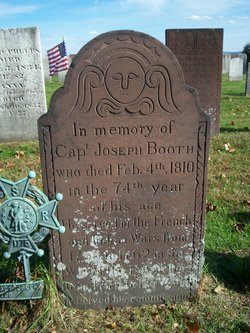
In memory of Capt. Joseph Booth

A tweet from Emily Sneff sent me on the track of an item that appeared in the Connecticut Courant of Hartford on 29 July 1776:
Last Sunday a Child was baptised by the Rev. Mr. [Joseph] Perry of East Windsor, by the Name of INDEPENDENCE.
That news item was reprinted in the New-England Chronicle.

The Courant appeared on Mondays, so “Last Sunday” probably meant not the day before but a week before then: 21 July.

That single sentence still left a lot of questions. Who was the couple who chose to name their child Independence? Was that a boy’s name or a girl’s name? What happened to that child later in life?

So I went looking for Independence. And I found two different babies baptized Independence in central Connecticut in the summer of 1776, with the possibility of still more. Here’s one story.

Joseph Booth (1736–1810) of Enfield, Connecticut, served in the colonial forces during the French and Indian War when he was in his early twenties. Booth’s diary recording that experience and a miscellany of later events, from family milestones to sermon topics to household accounts, has been digitized by the Connecticut Historical Society.

In 1762 Joseph Booth married Mary Hale (1733–1809), born in Glastonbury. They had their first child a year later, “Mary Hale junr.” as Joseph noted in his diary. Booth recorded another child every two or three years after that: David, Annis, Lydia, another Joseph, Peter, Eliphalet… All of the Booth babies survived infancy and lived into the nineteenth century.

That brings us up to the outbreak of war. Heitman’s Historical Register lists a Joseph Booth serving as an ensign in Erastus Wolcott’s Connecticut state regiment from December 1775 to February 1776 and a captain in Comfort Sage’s state regiment from June to December 1776.

One Booth family genealogy, Genealogical Records of Some of the Descendants of Robert Boothe, of Saco, Maine, 1642 by J. H. Booth (1877), quotes a commission signed by Gov. Jonathan Trumbull on 20 June 1776 naming Joseph Booth as a captain. Another, One Branch of the Booth Family Showing the Lines of Connection with One Hundred Massachusetts Bay Colonists by Charles Edwin Booth (1910), states that commission was issued on 21 Mar 1777.

I can’t sort all that out. It’s possible these commissions refer to multiple men. There might have been separate commissions in the Connecticut militia and the state’s short-term forces. And the family chroniclers did make some errors.

All sources agree, however, that Joseph Booth served in the American military early in the Revolutionary War, reaching the rank of captain. Wolcott’s regiment was on the siege lines at Boston in the first months of 1776, and Sage’s was at the Battle of White Plains. But Booth, reaching the age of forty in 1776 and being the father of several young children, was on missions that took him away from Enfield for a few months at most, not years.

TOMORROW: The child Independence was born.

Wednesday, September 07, 2011

Col. Sargent and Col. Sage

Earlier this week, I quoted from the records of the court-martial of Ens. Matthew Macumber, kicked out of the Continental Army in September 1776 despite first being cleared of plundering.

Other officers involved in that incident were also gone from the Continental Army in a few months, though not so ignominiously.

Col. Paul Dudley Sargent (shown here), who Macumber said had ordered him to empty Loyalist houses in New York, was home by spring 1777.

The head of the court-martial panel that originally convicted Macumber on a lesser charge, Col. Comfort Sage, did not reenlist at the end of the year.

I wonder if those officers departed because they sensed they had gotten on Gen. George Washington’s bad side.

Both gentlemen remained respected in their own communities: Sargent became a magistrate in Maine, and Sage a brigadier general of the Connecticut militia. Most of what we know about them came from the writings of their descendants, who of course would not have said much about Gen. Washington’s dissatisfaction.

TOMORROW: The career of Maj. Daniel Box.

Sunday, September 04, 2011

The Retrial of Matthew Macumber

On 21 September 1776, Col. Comfort Sage reconvened a court-martial to consider the case of Ens. Matthew Macumber. Just the day before, that panel had found Macumber not guilty of disobeying orders by plundering, but guilty of defying an officer who had tried to stop him. But then Gen. George Washington had ordered the court to reconsider the sentence.

It seems to me that everyone knew the generalissimo really wanted a reconsideration of the verdict. Which left little doubt about what verdict he preferred. But how could the same panel (minus two members) justify a reversal?

They called a new witness for the prosecution:
Captain [NATHANIEL?] RAMSAY being sworn, deposes. Last Tuesday, in the beginning of the afternoon, I was crossing Harlem Plains; I saw a number of men loaded with plunder. I went up to them and told them they had been acting exceeding wrong, and would have to answer for their conduct; they said they had acted in obedience of their officers’ orders. Presently Ensign Macumber came up, and I renewed the conversation with him; he told me he had gone out by orders of his officer, and that he had a right to take any thing outside of our lines.

Ensign Macumber had at this time a knapsack full on his shoulder, out of which stuck two waxen toys, which I took hold of, and jested with him on his having such a pretty sort of plunder; he made me no reply, but ordered them to proceed with what things they had; they had a large chair full, consisting of poultry and some house furniture; some were loaded with kettles and kitchen furniture.

Just upon this, Major [Daniel] Box came up, and spoke to the foremost of the party, who told him they had got the plunder at Harlem; on which the Major, with a pistol in his hand, ordered the man to lay it down; the man hesitated and looked round on his party; upon this, Major Box ordered the whole party to lay down their plunder, or he would shoot the first man that refused; immediately on this, Ensign Macumber called out to his men, “my lads, stand to your arms and form,” and said to Major Box, “we’ll see who has the strongest party,” or words to this effect; the men instantly formed; on this, Major Box asked the Ensign if he knew him; the Ensign replied, yes, that he knew him to be Major Box. The Major replied that he was so, and that he came with express orders from his Excellency to act as he did, and to prevent plundering; the Ensign told him that he had acted by orders of a superiour officer.

Major Box said, I must put you under an arrest, and ordered a man to take his arms. Macumber said he would not be disarmed, but would go with them and his plunder to his General, who might act with them as he pleased, and that he would spill his blood before he would give them up there. At this time his men were exceeding mutinous; several of them cocked their pieces and brought them nearly to a present at Major Box. The Major asked for the Ensign’s name, and went off.

The men were exceeding abusive to the Major, and Ensign Macumber ordered them to be quiet. I have no doubt but if any attempt had been made to disarm the prisoner, his party would have fired; and I was so apprehensive of this, that I stood on my guard.
Dramatic as this testimony was, it didn’t provide significant new information about Box’s confrontation with Macumber. (Well, I guess the wax dolls was a new detail.) Witnesses the day before had already described how Macumber had defied Box, claiming that his colonel’s orders justified the taking of that property, and also how Macumber had tried to restrain his men from going too far.

But the new testimony would be enough to justify a new verdict. Macumber, who may have sensed what was coming, offered no additional witnesses.

Following “the maturest consideration of the further evidence,” the panel rendered its new decision:
the prisoner is guilty of plundering and of mutiny, and the Court annul the sentence of yesterday, and are of opinion that the prisoner be cashiered for said offence; and he is accordingly cashiered.
Washington endorsed that decision, and apparently decided to make an example of the incident. His general orders for 25 September said:
Colonel [Paul Dudley] Sargent is to send to the Provost-Guard the soldiers who were with Ensign Macumber, and charged with plundering at Harlem.
Washington also passed on details of the case to the Continental Congress, which on 30 September resolved:
That General Washington be directed to call upon such of the Members of the Court-Martial as sat upon the trial and concurred, in the acquittal of Ensign Macumber, to assign their reasons for their first judgment; that those reasons, together with the names of such of the said Members who were for the acquittal, be returned to Congress:
The officers on the court-martial panel had to send a letter justifying their original decision. I haven’t seen it, but I suspect the task was a reminder that they had displeased Gen. Washington.

(The doll above comes from the collections of Colonial Williamsburg.)

Friday, September 02, 2011

The Trial of Matthew Macumber

On 19 September 1776, an officer with the delightful name of Col. Comfort Sage presided over the court-martial of Matthew Macumber, accused of “plundering and robbery, and also of mutiny.”

Macumber was an ensign (equivalent of second lieutenant) in the 16th Regiment under Col. Paul Dudley Sargent (1745-1828) from Maine. He pled not guilty.

Here’s part of the trial testimony, taken from Force’s American Archives.
Major [DANIEL] BOX. Last Tuesday, about two o’clock, I saw a number of people plundering down on Harlem Plain. I took a party and went down on the Plain, and met Ensign Macumber, with a party of upwards of twenty, all loaded with plunder, such as house furniture, table linen, and kitchen utensils, China and delf ware. I ordered him to lay it down, or carry it back to the place he took it from. He said he had his Colonel’s order for what he had done, and that he would defend the plunder as long as he had life. I asked him if he knew me, and told him who I was, and told him how express the General’s orders were about plundering. I told him if he did not deliver up the plunder, I should fire upon him, and jumped over a fence, and my little party followed. On this the prisoner and his party surrounded me, and the prisoner gave orders for the party to make ready; they did so, and told me they would die by the plunder, and Macumber, the prisoner, declared the same. When I found I could do nothing, I left them and went up and got a party, and went down. The prisoner seeing me coming, left his party and put off across the fields, loaded with something. I disarmed the party, and made them prisoners. The prisoner ordered his party to make ready, before I jumped over the fence.

Sergeant THAYER. I was one of the party with Major Box, on Tuesday, and met Ensign Macumber, as has been related. Major Box told the prisoner’s party to lay down their plunder; they all refused, and the prisoner said that he had obeyed the Colonel’s orders, and that he would carry the plunder to his Colonel. On Major Box presenting his pistol at the Ensign, he ordered the men to form themselves. The men were clamorous, and the Ensign was quieting them. He said he had orders from his Colonel, and had obeyed them, and would obey them to the spilling his blood; which I took to mean that he would defend his party and the plunder. The Major went off, and we returned soon after; but I know nothing more of the prisoner. There was women’s clothing among other articles of plunder.

WILLIAM THOMAS. Says he was one of the party, and confirmed Sergeant Thayer’s testimony.

SAMUEL BROWN. Confirmed Sergeant Thayer’s testimony, and adds that the prisoner told Major Box, after he had ordered his men to form, that he would see which had the strongest party, or that the ground should drink his blood. Several of his men said they would blow out Major Box’s brains, if he cocked his pistol again.

WILLIAM CORNISH. Confirms Brown’s testimony, and adds, that from every appearance, he doubts not the prisoner’s party would have fired upon them had they attempted to have rescued the plunder out of their hands.
Then came the witnesses for the defense.
JOHN PETTY. Just before we entered the town of Harlem, Ensign Macumber stopped the party and expressly ordered us not to plunder. I was posted as a sentry, and know nothing of the party plundering. I was one who drove the cattle off, and did not join the party who had the plunder.

GORDON SPENCER. After we got into Harlem, Ensign Macumber took some of the party and went off with them. After he was gone, some of the men broke into the house. I went and found the Ensign, and told him of it. He said it was against his orders, and bid me go and tell them to leave the house. Before we met Major Box, Ensign Macumber had told the men they should carry all the plunder to Colonel Sargent.
The court was cleared, and the officers on the court-martial panel discussed the case with “mature consideration.” Their verdict on Macumber:
the prisoner is not guilty of plundering or of robbery, nor of mutiny, but that he is guilty of offering violence to and disobeying Major Box, his superiour officer. And the Court sentence and adjudge that the prisoner ask pardon of Major Box, and receive a severe reprimand from the commanding officer at the head of the regiment he belongs to.
The records of all such proceedings were sent up to the commander-in-chief’s office.

TOMORROW: Gen. Washington is not happy.