J. L. BELL is a Massachusetts writer who specializes in (among other things) the start of the American Revolution in and around Boston. He is particularly interested in the experiences of children in 1765-75. He has published scholarly papers and popular articles for both children and adults. He was consultant for an episode of History Detectives, and contributed to a display at Minute Man National Historic Park.

Subscribe thru Follow.it


•••••••••••••••••


Showing posts with label John Jack. Show all posts

Thursday, June 25, 2026

“From which patterns of everyday life and social change would emerge”
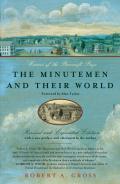
Back in April the Concord Bridge published a nice retrospective profile of Robert Gross, author of The Minutemen and Their World.

Published in 1976 and recently updated, that book has proved the most lasting of the New England community studies that came out in the middle of the twentieth century.

No doubt Minutemen gets a boost from its connection to the nation’s origin story, but it’s a really good book that offers both an early example of computer-aided data analysis and interesting new ideas about how generations interact.

Plus individual stories, as the article says:
Gross wanted to write about “men, women, free and slave, native and newcomer, patriot, neutral, and loyalist” — all of those who had been excluded from conventional accounts — recovering their voices. His approach would reflect his interest in social history, a method that was growing in popularity. It involved tapping overlooked sources such as tax lists, censuses, vital records, genealogies, and town meeting minutes, from which patterns of everyday life and social change would emerge, he says.

Among those who people “Minutemen” is John Jack, an enslaved man who worked for a cobbler, bought his freedom, built a cabin in Great Meadows, and paid his taxes, but was never allowed to vote. At the time of Jack’s death, he owned eight acres, a pair of oxen, and seven barrels of cider. “His was a marginal place in the community, but it was nonetheless a real place,” Gross writes.

And there is Lucy Barnes Hosmer, daughter of a prosperous farmer and town clerk. When Joseph Hosmer, a cabinet maker, asked for permission to marry 16-year-old Lucy, her father refused, wanting her to wed someone wealthy and important.

Though a father could not dictate his daughter’s choice of spouse, he could try to arrange unions and pressure her to agree, Gross says. Lucy rebelled, denying her father’s choice of a cousin for her, and acted on her own. When she married Hosmer at 19, she was two months pregnant.
Highlighting people like that reflects the appeal of such human detail in a study of a society, a balance that The Minutemen and Their World achieved.

Saturday, July 25, 2015

Hannigan on Slavery in Concord, 28 July

On Tuesday, 28 July, the Concord Museum will host a talk by John Hannigan titled “‘She Ought to be Set at Liberty’: Slavery and Freedom in 18th-Century Massachusetts.”

Hannigan is earning his Ph.D. in History at Brandeis University. I’ve enjoyed his eye-opening presentations on African-American soldiers in the first Continental Army, how the war affected slavery in New England and vice versa.

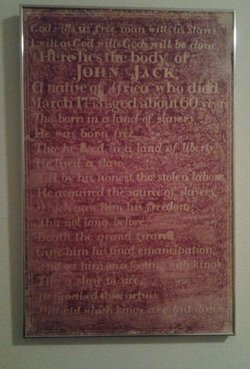
It looks like this talk will be about how slavery was woven into the fabric of life in eighteenth-century New England. As the museum’s event description acknowledges, Concord is more used to celebrating its links to abolitionism, not slavery. Town histories even praised the Loyalist lawyer Daniel Bliss because he wrote an anti-slavery tombstone for John Jack, shown here.

But the past decade has brought new attention to the wider experience of slavery in the region with such projects as Elise Lemire’s Black Walden, the Robbins House, and the exhibit this talk comes in conjunction with, “Thomas Dugan, Yeoman of Concord” (described here).

Hannigan’s talk is scheduled for 6:00-7:00 P.M. Admission is $5 for museum members, $10 for everyone else. Reservations are required; to make them, visit the museum website or call 978-369-9763, ext. 216.

Thursday, September 17, 2009

Saving Caesar Robbins’s House

Earlier this week, following stories in the local press, the Boston Globe reported on an effort in Concord to preserve the house of Caesar Robbins. The paper said:

the brown shingled house on Bedford Street, built in the 1780s by the town’s first freed slave, is the last of its kind, a crucial but long-forgotten link to the town’s early black community and abolitionist movement. With the house in danger of being demolished, its history has emerged from obscurity, and advocates have mounted a spirited campaign to stave off its demise.

The owners, who were bequeathed the property, had applied for a permit to level the one-story house in hope of selling the land, while the town wants to save the house for posterity. A six-month stay issued by the town expired Saturday, and while there are no immediate plans to level the house, advocates are scrambling to raise $30,000 for moving costs to keep it from harm.
I’m not sure what the “first freed slave” phrase refers to. John Jack of Concord bought his freedom before dying in 1773; that part of his life is told on a famous gravestone (actually a replica of the original) in the Concord cemetery, erected by Loyalist lawyer Daniel Bliss as a way to stick it to liberty-loving Patriots. Here’s an old paper about Jack and Bliss.

Robbins became free in 1780 after serving in the Revolutionary War, and built the house about that time. Three years later, the Massachusetts Superior Court ruled that the state’s new constitution outlawed slavery. Robbins and his wife Rose raised their family in the house, dying within two days of each other in 1822. His age was then recorded as seventy-six, hers as eighty-one.

Caesar Robbins passed the house to his descendants, and then to other African-American families. In the mid-1800s it was home to Peter Hutchinson, a butcher Henry David Thoreau wrote about; Hutchinson’s name is on the structure’s current historic sign. The house was moved to its present spot in 1870, according to the National Trust for Historic Preservation.

A house lot in Concord is worth a lot more than an old house today, and the people who inherited the property most recently are hoping to build something new on that land. So folks have undertaken to raise funds to move the Robbins house again and make it a museum. The Globe says:
The town hopes to relocate the house to property it owns near the Old Manse, a 1770 house on the Concord River near the Old North Bridge. The town leases the land to the Minute Man park, which has expressed strong interest in adding the house as a destination.
Donations for this effort are being collected at:
Concord-Carlisle Human Rights Council
P.O. Box 744
Concord, MA 01742
If you choose to donate, put “The Drinking Gourd Project” on the check’s memo line.

The photograph above is by Ann Ringwood for the Concord Journal.