Yesterday I wrote about
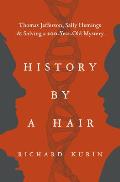
History by a Hair, Smithsonian anthropologist Richard Kurin’s new book on his effort to determine if there is a genetic match between
Thomas Jefferson and descendants of
Sally Hemings and
Martha Jefferson.
That book is due to be published this week, but it ran into some jarring bumps in the last two months. Having worked in publishing, I presume Dr. Kurin and folks at Crown Publishing (part of Penguin Random House) worked feverishly to finalize its pages.
It appears that the book is Kurin’s personal narrative of working on the investigation over fifteen years. While collecting genetic samples, he met many descendants of the Jefferson–Wayles–Hemings family.
Among those people was Mary Brady-Atkins. She is, as
described in the Chronicle of Higher Education, “a retired Michigan State University professor with a Ph.D. in psychology.” At ninety-eight, Dr. Brady-Atkins is the oldest living descendant of Madison Hemings. She gave Kurin a D.N.A. sample early in the project. He visited her in Pittsburgh over the ensuing years and asked to include her photo in the book.
The
Chronicle article also reports that on 11 August Kurin spoke about his book to John H. Works, Jr., who claims descent from Thomas and Martha Jefferson. In 2000 Works co-founded the Thomas Jefferson Heritage Society to raise questions about the growing evidence of the Jefferson-Hemings relationship. He is now that organization’s
president, treasurer, and secretary.
Back in 2002, Works spoke of the value of genetics as he worked to exclude Hemings descendants from the Monticello Association, formed by descendants of Thomas Jefferson. The
Raleigh News and Observer quoted him as saying, “For (Hemings descendants) to say, ‘I don’t need no DNA evidence,’ well, I’m sorry, but you do.” I see no sign that Works also insisted on D.N.A. evidence from people claiming descent from Martha Jefferson. (And he doesn’t appear to use the double negative normally.)
Works’s society has long argued that the President’s brother, Randolph Jefferson, or one of that man’s sons could have fathered the Hemings children—thus providing the Jefferson Y chromosome that Dr. Eugene Foster matched to a patrilineal descendant of Eston Hemings in 1998. In 2017, Works began gathering genetic samples for his own study. As of last November, he was
petitioning to exhume the body of John Randolph Jefferson, one of those sons (and thus not one of his own ancestors).
In response to people like Works pointing fingers at Randolph Jefferson, Korin’s study collected samples from that man’s descendants as well.
According to the New York Times, geneticists Richard (Ed) Green and Beth Shapiro of the University of California at Santa Cruz found that those people’s D.N.A. does not significantly match that in Thomas Jefferson’s hair, nor in samples from descendants of Martha Jefferson or Sally Hemings. In sum, the new study renders the argument that Randolph Jefferson or his sons fathered Sally Hemings‘s children not just historically unlikely but scientifically implausible.
In their 11 August conversation, Kurin told Works about his colleagues’ findings. He said their analysis had been reviewed by “Carlos D. Bustamante of the University of Oklahoma; Erich D. Jarvis of Rockefeller University; and Eric D. Green, chief medical officer of the DNA-sequencing giant Illumina and former director of the National Human Genome Research Institute.”
Works asked when that study will be published. Kurin said it was being considered by a scientific journal. As is standard, the journal has found more peer reviewers unknown to the authors, and Kurin and his colleagues are not allowed to name the journal publicly while it goes through its process.
On 19 August, the
Chronicle reports, Works “sounded the alarm” about Kurin’s book to the Monticello Association. Works took the position that it was premature for Crown to issue
History by a Hair before the underlying scientific paper is published and assessed. (The Thomas Jefferson Heritage Society chose a different route back in 2001, publishing its critique of the 1998 genetic study itself rather than submitting those arguments to a journal for outside peer review.)
Sometime before 2023, Works gave an interview to the
documentary filmmaker Sanjay Rawal, though it’s unclear what that conversation was about. On
a new Instagram reel, the filmmaker states that he became interested in the Jefferson-Hemings question only later, after meeting Mary Brady-Atkins. According to
this article in the Pittsburgh Tribune-Review, his film, now tentatively titled
We Hold These Truths, came to focus on “the long friendship that Brady-Atkins formed with the Jefferson family, despite the ancestry being connected to enslavement.” Rawal appears to have connected Brady-Atkins and Works in 2023, per the
Chronicle.
On 24 August, five days after Works’s “alarm,” Brady-Atkins withdrew her participation from Kurin’s D.N.A. study. The
Chronicle says that Rawal helped Brady-Atkins to draft her email message, alongside her daughter and her friend and executor.
Brady-Atkins’s data was then removed from the genetic database and her samples destroyed. I presume that required a revision of the paper under review, though it reportedly didn’t produce a significant change in the findings. In addition, Kurin probably had to edit his book to remove her photograph and anecdotes in the last weeks before publication.
According to the
Chronicle, Dr. Brady-Atkins withdrew because of the same objection that Works was expressing: “the book is being published…before its
science has been vetted by a scientific journal’s peer-review process.” In addition, that article stated that Brady-Atkins felt “Kurin often treated her as more of a friend than as a research participant, while not always showing her the courtesy and clarity she felt was owed to her in either role—not giving her an advance copy of the book, for instance.”
The
Chronicle also states of Brady-Atkins:
In her view, not enough attention has been paid to the possibility that another male Jefferson relative, such as his younger brother, was responsible. Based on what she knows about the founding father, she doesn’t think “a man of that integrity would get involved” with Hemings.
“What I’ve read about Jefferson and my knowledge of human behavior and my experience as a clinical psychologist, I just feel in my gut that this man did not sire these children,” she said.
As late as April 2024, Brady-Atkins
identified herself publicly as “the oldest descendant of Thomas Jefferson and Sally Hemings.” But she has come to the same position as the Thomas Jefferson Heritage Society.
We probably have more historical evidence about who fathered Sally Hemings’s children than for any other Americans born in the same circumstances. Nonetheless, for more than thirty years some authors have demanded genetic evidence to resolve the question. As science advances, that D.N.A. evidence has become more detailed and specific to Jefferson himself. Will it ever be enough to satisfy everyone?
TOMORROW: Meanwhile, in Washington.