J. L. BELL is a Massachusetts writer who specializes in (among other things) the start of the American Revolution in and around Boston. He is particularly interested in the experiences of children in 1765-75. He has published scholarly papers and popular articles for both children and adults. He was consultant for an episode of History Detectives, and contributed to a display at Minute Man National Historic Park.

Subscribe thru Follow.it


•••••••••••••••••


Showing posts with label Jonas Green. Show all posts

Friday, June 09, 2017

More Colonial Newspaper Advertising Rates

After my posting on colonial newspaper advertising rates, Caitlin G. DeAngelis alerted me to some additional data inside Charles E. Clark’s The Public Prints: The Newspaper in Anglo-American Culture, 1665-1740.

Then I found more examples quoted in Arthur M. Schlesinger, Sr.’s New England Quarterly article on “The Colonial Newspapers and the Stamp Act.” And in confirming those I came across other items in newspapers.

So here are yet more prices for colonial newspaper ads:
  • John Peter Zenger’s New-York Weekly Journal, 1733: “three Shillings the first Week, and one Shilling every Week after.”
  • Jonas Green’s Maryland Gazette, 1752: “Advertisements of a moderate Length are taken in and inserted for Five Shillings the first Week, and a Shilling per Week after for Continuance.”
  • Benjamin Franklin’s Pennsylvania Gazette, 1754: “In the Gazette, small and middling Advertisements at 3/ the first Week, and 1/ per Week after, or 5/ for 3 Weeks. Longer ones to be valued by Comparison with the foregoing; as if 20 Lines be a middling Advertisement, Price 5/ for 3 Weeks, one of 30 will be 7/6d, etc. judging as near as you can, by the Light of the Copy, how much it will make.” (It seems characteristic that Franklin’s prices would come in the form of a word problem about ratios.)
  • Newport Mercury, probably around 1765: 3s.9d. for three appearances of an ad of 12 lines or fewer, plus 1s. for each additional appearance.
In addition, Clark’s Public Prints reports that in the late 1750s Thomas Fleet billed the Massachusetts government 4s. for each notice in the Boston Evening-Post.

And in the early 1770s, Benjamin Edes and John Gill charged shopkeeper Ebenezer Hancock (John’s little brother) 4s. for advertisements in the Boston Gazette.

And there’s a political dimension to this topic—which brings us back to the Stamp Act! Among the many provisions in that law was:
For every advertisement to be contained in any gazette, news paper, or any other paper, or any pamphlet which shall be so printed, a duty of two shillings.
That basically doubled the cost of a typical ad, it appears—cutting the number of ads people would buy. For printers, that loss of business came on top of the cost of the stamped paper that they had to print the newspaper on—a penny for each full sheet. And, as Carl Robert Keyes explains in this essay, “this put printers in the position of collecting duties” for the stamp agent.

UP AHEAD: What about subscription rates?

Wednesday, October 14, 2015

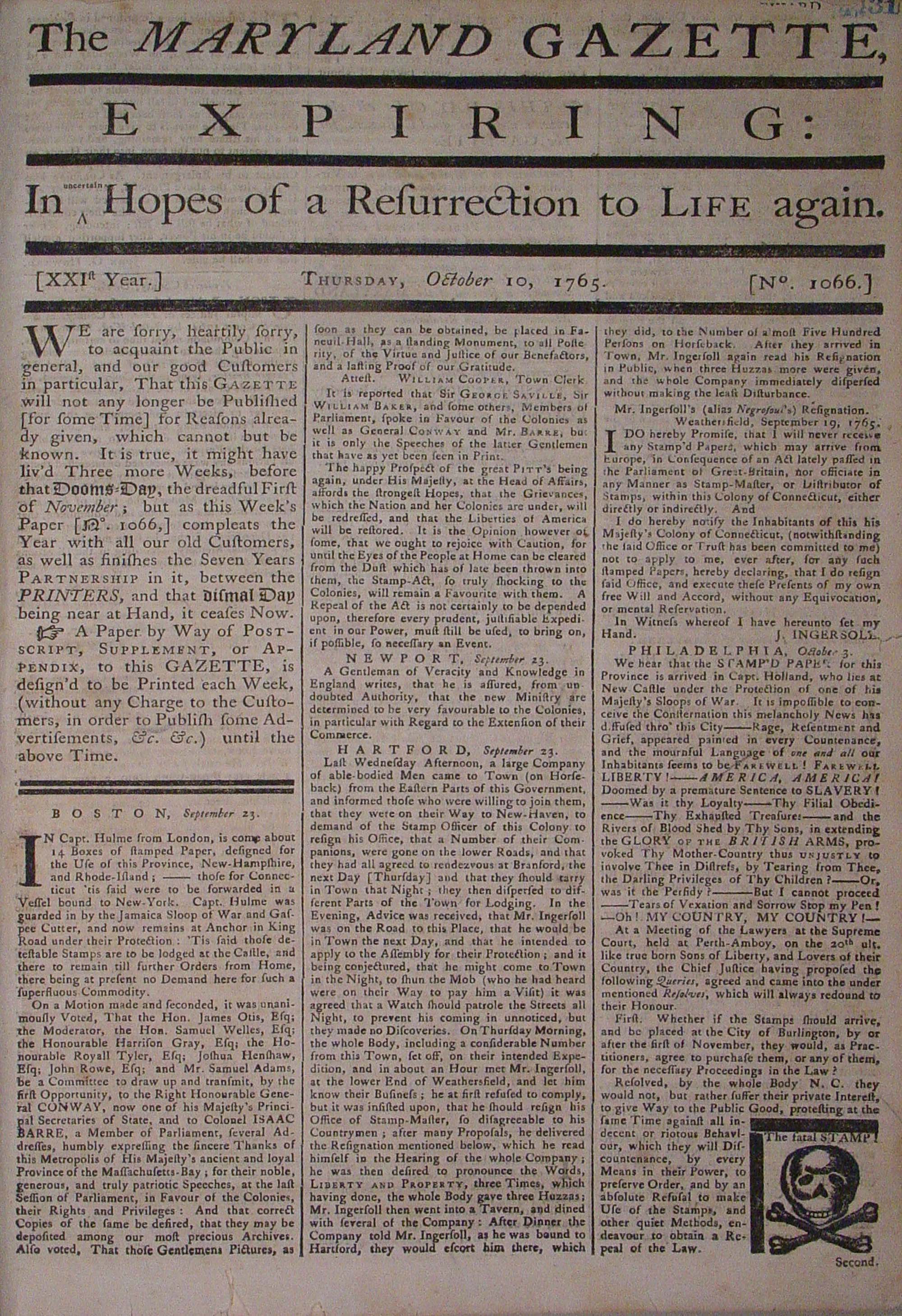
The Expiring Maryland Gazette

Yesterday I showed an image of the 5 Sept 1765 Maryland Gazette. In the lower right corner, publisher Jonas Green put an image of a skull and crossbones with the label, “Hereabouts will be the place to affix the STAMP.”

Green continued to run that image in the corner of his paper, with different captions, for another few weeks as a warning against the impending Stamp Act. Finally, on 10 October, he issued The Maryland Gazette, Expiring, blaming “The Fatal Stamp” for his decision to close the newspaper.

Green revived the Gazette in early 1766 once it was clear that the Stamp Act was a dead letter. He died the following year, and his Holland-born widow Anne Catherine Green continued the business until the eve of the war.

This University of Maryland website says the Greens had previously used that skull-and-bones woodcut to draw attention to prominent obituaries. The webpage continues, “When Archaeology in Annapolis excavated the remains of their print shop, the piece of type used to create the image on the front page was recovered.”

Tuesday, October 13, 2015

Annapolis Commemorates the Stamp Act Protests, 19-25 Oct.

On 26 Aug 1765, the same day that Bostonians tore apart Lt. Gov. Thomas Hutchinson’s home in the North End, Annapolis saw its first public protest against the Stamp Act.

Following the model of the widely reported demonstration in Boston on 14 August, Marylanders built an effigy of their colony’s stamp agent, Zachariah Hood, and then ritually destroyed it. This is the account from the Maryland Gazette, published by Boston native Jonas Green:
Monday morning last, a considerable number of people, assertors of British American privileges, met here to show their detestation of, and abhorrence to, some late tremendous attacks on liberty, and their dislike to a certain late-arrived officer, a native of this Province. They curiously dressed np the figure of a man, which they placed on a one horse cart, malefactor-like, with some sheets of his paper in his hands before his face.

In this manner they proceeded through the streets of town till noon, the bells at the same time tolling a solemn knell, when they proceeded to the hill; and after giving it the Mosaic law [i.e., thirty-nine lashes] at the whipping-post, placed it in the pillory, from whence they took it and hung it to a gibbet erected for that purpose, and then set fire to a tar-barrel underneath, till it fell into the barrel. By the many significant nods of the head while in the cart, it may be said to have gone off very penitently.
Among the people who led that event was twenty-four-year-old lawyer Samuel Chase. The next year, members of the local political establishment called him “a foul-mouthed and inflaming son of discord and faction.” Chase went on to be a signer of the Declaration of Independence, Chief Justice of Maryland, and an Associate Justice of the U.S. Supreme Court, surviving impeachment in 1805.

Zachariah Hood himself wasn’t in Annapolis to see his effigy. He arrived from London a few days later, met by an angry crowd. In September another mob burned one of his warehouses. Meanwhile, other Maryland towns—Baltimore, Elk Ridge, Fredericktown—burned him in effigy. Hood fled to New York City, then Flushing. Tracked down by local activists in a show of continental solidarity, he finally resigned as Maryland’s stamp agent on 28 November.

Historic Annapolis will commemorate those events with Sons of Liberty Week on 19-25 October. The schedule includes:
  • Lecture and panel discussion on “Freedom of the Press Then and Now,” with historian Glenn Campbell and several present-day journalists.
  • Revolutionary Annapolis Walking Tour.
  • Reenactment march up Main Street on Sons of Liberty Day, 25 October.
  • Revolutionary Festival at the William Paca House and Garden.
  • Exhibit of the Maryland Gazette at the Historic Annapolis Museum.
  • Hand-printed broadsides from the Maryland Hall for the Creative Arts.
In addition, the organizers promise “Public Outbursts” throughout the week: “costumed re-enactors will appear at random throughout the Annapolis historic district in October to exhort townspeople and visitors to join the rebellion.”