J. L. BELL is a Massachusetts writer who specializes in (among other things) the start of the American Revolution in and around Boston. He is particularly interested in the experiences of children in 1765-75. He has published scholarly papers and popular articles for both children and adults. He was consultant for an episode of History Detectives, and contributed to a display at Minute Man National Historic Park.

Subscribe thru Follow.it


•••••••••••••••••


Showing posts with label law. Show all posts

Friday, October 16, 2026

“The Right of the Governor to carry them to Houssatonick”

John Hancock and Samuel Adams split in early 1772 over a few small issues—at least according to Gov. Thomas Hutchinson.

The first involved where the Massachusetts General Court was meeting.

Under orders from London, Hutchinson had summoned the legislature to meet in Cambridge instead of in Boston. His predecessor, Gov. Francis Bernard, had done the same. The General Court had also gone to Cambridge during a smallpox outbreak.

In the eighteenth-century British Empire it was widely accepted that colonial legislatures would be elected once a year, but then the royal governors could convene those legislatures where and when they chose. This power derived from their being representatives of the monarch in Britain.

According to Hutchinson in June 1771:
Mr [James] Otis in a Speech the first day after the Election gave his opinion to the house that we had a very good Governour and he was sure the People in all parts of the Province thought so, he condemned the proceedings of the House the last year & acknowledged the Right of the Governor to carry them to Houssatonick, the Western extreme part of the Province, was sensible that it would be inconvenient and that he would not do it and hoped he would carry them back to Boston. This gave a shock to the party and the House voted to go on with their business as usual without a division or opposition.
This speech immediately made Otis’s colleagues and constituents worry about which side he was on.

Soon Adams as assembly clerk rallied the legislators to complain bitterly about being summoned to an inconvenient meeting place and refuse to do any business until they were back in Boston. Hutchinson tried to bring up issues that the representatives, especially those from western towns, couldn’t resist acting on.

As the spring of 1772 came around, Hutchinson let it be known that as long as the house petitioned him to convene the General Court in Boston for practical reasons, with no challenge to his chartered power to summon them elsewhere, he would accede to that preference. (After all, as house speaker decades earlier, he had maneuvered to keep the legislative seat in Boston.) 

Adams wanted to stick to the principled, no-compromise confrontation. Hancock, along with speaker Thomas Cushing, was willing to couch their complaint on practical grounds. Ultimately, so did the majority of legislators.

The difference between Adams’s and Hancock’s positions was not that big, and Hancock may have had a better sense of what his fellow lawmakers and voters were up for. Still, this disagreement over wording or tactics was enough to give Hutchinson hope that two of his biggest opponents were splitting.

One of the grievances in the Declaration of Independence would be:
He has called together legislative bodies at places unusual, uncomfortable, and distant from the depository of their public records, for the sole purpose of fatiguing them into compliance with his measures.
That referred to this dispute over where the General Court should gather, which became an even bigger deal in 1774 when Gen. Thomas Gage summoned the legislature to Salem.

The Revolutionary War ended up changing the norm about where and when American legislatures met. The U.S. Constitution gave Congress authority over “the Seat of the Government of the United States” and provided for regular meetings there. Only “on extraordinary Occasions” can the President convene Congress, and only “in Case of Disagreement between” the two houses can the President adjourn them.

TOMORROW: Another chronicler.

Thursday, October 15, 2026

“Told John Hancock Esqr. that he heard me say in a threatning manner”

The newly released first volume of The Papers of John Hancock, covering the years 1754–1769, doesn’t even have an index entry for Samuel Adams. Hancock was politically active in that time, as a Boston selectman and representative in the Massachusetts General Court. But he did his politicking in person, not in (preserved) letters or newspaper essays.

In contrast, the first volume of the Writings of Samuel Adams, covering 1764–1769, includes a couple of items defending Hancock from charges of fomenting riots: a 1768 letter written for the signature of House speaker Thomas Cushing and a 1769 newspaper essay signed “Candidus.” Hancock also served on several committees with Adams, but Adams gets the credit (via a descendant’s biography) for creating those committees’ documents.

In those corpuses, the first sign of a rift between Hancock and Adams appears in a 15 Dec 1771 “Memorandum” that Adams wrote for himself after a conversation with the colony’s deputy treasurer:
This day I waited on Mr. Harrison Gray junr. to acquaint him that I had been informd that he had told John Hancock Esqr. that he heard me say in a threatning manner that Mr. Hancock might think as he pleasd, Mr. [James] Otis had friends & his (Mr. Hancocks) treatment of Mr. Otis would prejudice his (Mr. Hancocks) Election.

Mr. Gray declard to me that he did not hear me mention a Word of Mr. Hancocks Election—that a conversation happend between Mr. John Cotton [deputy secretary of Massachusetts] & myself (Mr. Gray being present) relative to Mr. Otis—that Mr. Cotton said Mr. Otis’ Conduct must be the Effect of Distraction or Drunkeness—that I said I did not think so—but that it rather proceeded from Irritation—that he (Mr. Gray) said if Mr. Otis is distracted why should Mr. Hancock pursue him—& that I answerd that Mr. Hancock might be stirred up by others to do it, but I thought he had better not or it was a pity he should.

This Mr. Gray declared was all that I said relative to Mr. Hancock, in answer to his Question as is before mentiond & that it did not appear to him that I discoverd the least Unfriendliness towards Mr. Hancock. He further said he was willing to give his oath to the truth of this his declaration.

Upon which I told Mr. Gray that it was far from my Intention to make Mr. Hancock displeasd with him, that I was satisfied that Mr. Hancock understood him differently & I should let Mr. Hancock know what he now said, & asked him to repeat it which he did precisely as before—& told me he was freely willing that I should repeat it to Mr. Hancock that if Mr. Hancock & myself desired it he would thus explain it in presense of us both.
Here’s the scan of that document from the New York Public Library.

At this time, Boston had reelected James Otis, Jr., to the House after a year off, hoping he would regain his sanity and efficacy as a legislative leader. Instead, Otis became more inclined to support royal policy and then more irrational, as I discussed back here.

In November, acting in his capacity as a probate judge after a request from the Otis family, Gov. Thomas Hutchinson asked the Boston selectmen to assess whether Otis was “a Non Compos Distracted or Lunatick Person.” The selectmen, including Hancock, decided he needed a guardian. On 3 December, Otis was “carried off…in a post chaise, bound hand and foot,” for treatment.

Samuel Adams’s memorandum doesn’t say when he discussed Otis with Cotton and Gray. Adams had tried to gloss over the situation: Otis was acting from “Irritation,” he insisted, not “Distraction or Drunkeness.” As to why Hancock thought otherwise, he “might be stirred up by others.”

This episode belies the common picture, pushed by Loyalists and adopted by many authors since, that Adams was the savvy politician pulling Hancock’s strings. Not only was Hancock breaking from Adams, but the merchant had a better sense of the situation. Otis needed help, and he was losing popular support. In the spring of 1772, the North End Caucus (in my reading) and then the Boston town meeting chose never to vote for him again.

The memorandum does show Adams’s keen judgment about what could annoy Hancock, however. Adams had heard, quite possibly from Hancock himself, that Gray had described him as speaking “in a threatning manner.” And what was Adams supposedly threatening? Hancock’s popularity and prospects for reelection. Adams recorded this evidence to show Hancock that he’d said no such thing.

Without this memorandum in writing, we’d have no evidence of Adams worrying that Hancock thought he’d revealed “Unfriendliness” in the fall of 1771.

TOMORROW: Matters come to a head.

Tuesday, October 06, 2026

Speeding Up “Slow-Motion Scholarship”?

I’ve been doing test drives on the Clements Library’s machine-made transcriptions of documents from the Thomas Gage Papers, seeing how useful those texts from Transkribus are.

Archiving documents already costs money, of course. Systematic scanning of those documents and making them available online costs more.

Producing accurate transcriptions for those documents requires even more labor, with a lot of expertise and patience thrown in. That might be the most expensive stage.

The U.S. government once deemed that work important enough to fund. We can look back at precedents like the Varick Transcripts of Gen. George Washington’s letters made in the 1780s, Peter Force’s American Archives in the ante-bellum period, and the major scholarly projects of the Progressive, New Deal, and Cold War eras.

Originally based on thick printed volumes, that effort has naturally spread to computers and computer networks. Founders Online is not only hosted by the National Archives, but its constituent projects received funding through the National Historical Publications and Records Commission (N.H.P.R.C.).

But that was all before the current administration set out to slash funding for historical projects that don’t feed its leader’s ego, both within the budget process and illegally outside of it. In June the Organization of American Historians issued a report titled “The Federal Assault on History: A Record of Executive Actions,” (P.D.F. download). It says:
Despite the impressive work done with the assistance of NHPRC grant awards, the program created by Congress often finds itself eliminated in presidential budget requests. FY 2026 and 2027 were no different, with the Trump Administration attempting to zero out the funding. As in prior years, Congress recognized the value that NHPRC brings to their districts and rebuked the effort, providing $5 million in grantmaking funds, though this represents a 50 percent cut to the program from FY2025.

Funding is only one of the challenges faced by NHPRC in 2025 and now in 2026. NHPRC is convened twice a year by the Archivist of the United States, its chair, to review grant proposals, recommend awards, and approve new calls for proposals. Without an Archivist of the United States duly confirmed by the Senate, the Commission has no chair to convene it and has not been able to meet since November 2024. This little-understood effect of the firing of the Archivist of the United States in February 2025 has blocked Congress’s intention to award millions of dollars in grant funding to archives and other historical institutions throughout the country.
That’s yet another part of our national government and polity that will need repair.

To be sure, there were limitations in that approach to transcribing archives. For example, there’s always been more funding available for the papers of elite American Founders than for other sorts. (Gen. Thomas Gage came from an elite class, too, but he was on the Wrong Side.)

Those monumental projects also took decades. Back in 1997 Lingua Franca magazine published an article by Jack Hitt titled “In the Franklin Factory: Slow-Motion Scholarship in an Age of Academic Obsolescence.” It concluded with a glimpse of the Benjamin Franklin Papers editors looking ahead to the end of their work after four decades. They’re still at it.

Given that environment, it’s easy to see the appeal of artificial-intelligence software as a way to ease, speed up, and democratize the transcription of handwritten documents. If, that is, the technology actually works.

TOMORROW: Alternative approaches.

Wednesday, September 30, 2026

Hopestill Capen’s Last Decades in Boston

Before the Revolutionary War, Hopestill Capen regularly advertised British dry goods in Boston newspapers.

After his two years in jail on suspicion of being inimical to the newly independent state, Capen kept a lower profile. He ran no ads—though he may not have had many goods to sell, either.

Nonetheless, Capen’s shop sign, the Cornfields, continued to be mentioned in the newspapers as a landmark in central Boston.

On 26 July 1786, Boston’s selectmen met to draw names of citizens in good standing to serve as jurors “for a Maritime Court” the next month. The first name chosen was Paul Revere, now with “Esq.” after his name.

The second name was Hopestill Capen, showing he had been fully reintegrated into Boston society.

Interestingly, the third name was David Spear. Capen and Spear had married sisters, Patience and Sarah Stoddard.

Hopestill and Patience Capen had had eight or nine children between 1761 and 1774. Most died in their first year, and only one, Thomas, was still alive when the British left.

Sarah Spear and Patience Capen died within a few days of each other in January 1791. Patience was 57 years old.

On 21 Nov 1795, Hopestill Capen placed this advertisement in the Columbian Centinel:
A Theft.

On Tuesday Evening last, between the hours of 6 and 10 o’clock, was stolen from the Subscriber’s house, the following PLATE, marked as follows, viz

Three table Spoons, one H.C. to P.C. made by Mr. HOMES, one d[itt]o A.B. to P.S. made by A. OLIVER; one d[itt]o. T. S. S. and 1 Porringer, marked T. S. A. Engish mode. Whoever will discover the person, so that he or she may be brought to justice, and the property restored, shall receive TEN DOLLARS reward.
I rather hope Hopestill Capen got his family silver back, including the spoon with his and his late wife’s initials on it.

On 2 Mar 1807, Hopestill Capen died at the age of 76. His funeral proceeded from the house his son Thomas had inherited, 47 Hanover Street—now the Union Oyster House.

The Capens were buried in the Copp’s Hill cemetery. Patience and Hopestill’s gravestones were still readable in the late 1800s, but they no longer appear to exist.

Tuesday, September 29, 2026

“To be a liege subject of the State of Massachusetts Bay”

In May 1778, the Massachusetts General Court began a new legislative year.

On 17 September, Council member John Pitts brought the lower house “a Petition of Hopestill Capen, a Prisoner in Boston Goal, praying that he may not any longer be confined.”

This was a breakthrough. For the first time, Capen was addressing the General Court as a legitimate government. Previously he had insisted that doing so would violate his religious scruples.

Once again, the legislators formed a joint committee to consider Capen’s petition, along with a similar plea for release from the shorthand expert John Hodgson.

On 19 September, the Council approved a resolution “liberting them on certain Conditions.” This time, the House fully concurred. The official resolve stated:
that the prayer of Hopestill Capen’s petition be so far granted, that he be liberated from his confinement upon his giving bond to the Treasurer of this State for the sum of Two thousand pounds, with sufficient sureties that he will subscribe and closely adhere to the following declaration by him proposed in his petition, vizt. “I, the subscriber, acknowledge myself to be a liege subject of the State of Massachusetts Bay, and hold myself obliged to assist in supporting peace and good order in this State and when called on by lawfull authority I am ready so to do.”
Back in February 1778, the legislature had stipulated this oath of allegiance:
I, A.B., do swear (or affirm as the case may be) that I will bear faith and allegance to the state of Massachusetts Bay, and will faithfully support and maintain and defend the same against George the Third, king of Great Britain, his abettors and all other enemies and opposers whatsoever, and will discover all plots and conspiraces that shall come to knowledge, against said state or any other of the United States of America. So help me God.
Hodgson was ready to take that oath, but Capen still shied from explicitly renouncing his loyalty to George III. After all, what if the tide of war turned, and the Crown prevailed? According to his faith, he would have to be a Loyalist again. But for now, Capen would acknowledge the state of Massachusetts as his sovereign. (It’s notable he used the term “subject,” not “citizen.”)

In the fall of 1778, after twenty-five months of confinement, Hopestill Capen got out of jail.

TOMORROW: The last years.

Monday, September 28, 2026

Hopestill Capen Still in the Boston Jail

We left the Boston merchant Hopestill Capen locked up in the Boston jail in mid-1777.

As a Sandemanian, Capen had stayed loyal to the British Crown—but then he’d stayed in Boston after the British military left. He refused to pledge allegiance to the colonies declaring independence in July 1776, rendering himself suspicious.

As I previously quoted, Capen tried a public plea for his release. His wife Patience petitioned the state government. His friends in the merchant community vouched for him.

On 20 June 1777, the Massachusetts Council approved a petition from merchant Robert Pierpont and others for Capen’s release. The lower house of the General Court “concurr’d as taken into a new Draught.”

A resolution is printed in Massachusetts Acts and Resolves, stipulating that Pierpont and friends would give “Give bond to the Treasurr. of This State in the sum of five hundred Pounds” that Capen would “appear before any Court in the County of Suffolk.”

But apparently the House never agreed to that wording, or those terms. Capen remained in jail.

On 24 Feb 1778, the Council took up a new petition from Patience Capen. That board named Benjamin Austin to a committee to consider it along with whatever members the House named.

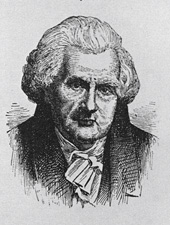
On 3 March, the Council accepted that committee’s recommendation. Moses Gill (shown above) delivered the news to the House. And the House disagreed, telling the committee instead to “enquire of the Committee of Correspondence, &c. of the Town of Boston, respecting Mr. Capen.”

A week later, there was a new report. The Council again agreed with the committee, Jabez Fisher reported. The House again disagreed, and voted to set the petition aside.

The Council, made up of richer men, was apparently inclined to be more lenient, but the House, dominated by rural delegates, was still not in a forgiving mood.

The Massachusetts government had exchanged some of its Loyalist prisoners to bring captives back from New York. That wasn’t an option for Capen since he didn’t want to go over to the enemy.

And thus the legislative term ended in the spring of 1778 with Hopestill Capen still in the Boston jail.

TOMORROW: Change of heart.

Friday, September 25, 2026

Jortner on “Jewish Patriots” in Worcester, 29 Sept.

On Tuesday, 29 September, the American Antiquarian Society will host an online presentation by Adam Jortner on “A Promised Land: Jewish Patriots, the American Revolution, and the Birth of Religious Freedom.”

It looks like this presentation will be based on Jortner’s book of the same name, published by Oxford University Press in 2024. On the Jewish Book Council website, Stuart Halpern described that book like this:
…a mag­is­te­r­i­al his­to­ry of Amer­i­ca’s first Jew­ish cit­i­zens. It weaves tales of promi­nent lead­ers like Ger­shom Seixas and Jonas Phillips with lit­tle-known accounts of rev­o­lu­tion­ary Jew­ish troops, fundrais­ing for the first syn­a­gogues (and sub­se­quent intra­com­mu­nal dis­putes), and Jews respond­ing to anti­semitism by chal­leng­ing their antag­o­nists to life-endan­ger­ing duels. Demon­strat­ed through­out the book is how the Jew­ish com­mu­ni­ty in Amer­i­ca’s ear­li­est years wres­tled with its past and mapped its future — just like the coun­try itself. . . .

Jort­ner places great empha­sis on how Jews peti­tioned against test oaths, pledges to Chris­t­ian val­ues that pre­vent­ed Jews from hold­ing polit­i­cal office. These efforts helped shape reli­gious free­dom in the Unit­ed States.
Adam Jortner is a professor of American History at Auburn University. His other books on early American history include The Gods of Prophetstown: Tippecanoe and the War for the American Frontier and Blood from the Sky: Miracles and Politics in the Early American Republic.

Jortner has explored various channels for sharing historical information with the public, from a regular column in Current magazine to being part of the writing team for Where in Time Is Carmen Sandiego? His Audible downloads include The Hidden History of the Boston Tea Party, Faith and the Founding Fathers, and a new 24-lecture Great Courses series on the year 1776.

This online event will take place from 7 to 8 P.M. Register through this page.

Also available now via the A.A.S. is Prof. Ronald Angelo Johnson’s talk on his new book, Entangled Alliances: Racialized Freedom and Atlantic Diplomacy During the American Revolution.

Johnson, the Ralph and Bessie Mae Lynn Professor of History at Baylor University, discusses “the ways in which English and French language newspapers from 1758 to 1783 informed and inspirited revolutionary Atlantic inhabitants in British North America (later the United States) and French Saint-Domingue (later Haiti) toward freedom, liberty, and equality.”

Thursday, September 17, 2026

“The Prize Papers of the American War” Workshop, 8 Oct.

On Friday, 8 October, the Prize Papers Project at Britain’s National Archives will host an international symposium on “The Prize Papers of the American War of Independence.”

Online registration to this event is available, but folks should know that it will take place in London. The discourse will start at 4:30 A.M., Boston time.

The workshop description says:
Bringing together specialists on prize law, the American War of Independence and the Prize Papers, the workshop approaches the collection as a transnational archive of wartime capture and its afterlives. The workshop creates a forum for sustained international exchange and collaboration.

The year 2026 marks the 250th anniversary of both the Declaration of Independence of the United States of America in July and the opening of the British Vice-Admiralty Court in newly-captured New York City in September 1776. Although exceptionally rich, the prize papers of this court have been largely inaccessible. The newly catalogued papers of the New York court (and its mother-court in London) provide new perspectives on the War of Independence at sea, and on lived experiences of the time, through the intercepted papers and letters found by the British on merchant and fighting ships.

Maritime warfare was central to the War of Independence. Controlling, disrupting, and capturing shipping was crucial to the war on both sides. America started privateering early, in 1775, and sought new (previously forbidden) trading partners. From 1778, French naval and privateering activity expanded the war against Britain, followed by Spain and the Netherlands. British naval forces and loyalist privateers sought to stop American and allied shipping, enforce their imperial authority, and weaken the Continental cause. The conflict eventually extended far beyond the North American seaboard.

An initial group of papers from 150 captured ships, American or supporting America, will be published online on 8 October in the Prize Papers Portal, the open-access online database of the Prize Papers Project. . . . Major bodies of captured material from American, French, Spanish, Dutch and recaptured British vessels will be published in the coming months and years…
Presentations schduled for 8 October include:
  • Amanda Bevan & Luan Cakolli: “A Voyage of Discovery and Delivery … and what we’re learning along the way”
  • Suzanne Foxley: “American Experience of British Prize Law”
  • Séverine Angers: “Write to me by different ships as the English capture many”
  • Randolph Cock: “Piecing Together Clues from the U.S.S. Lexington, 1777: A Whodunnit”
  • Rebekah Harbord: “Behind the Scenes: Preparing documents from the Prize Papers for digitisation”
  • Bethany Groff Dorau: “‘Taken by 64 Guns’: A Case Study of Dalton Marine Captain Offin Boardman”
  • Christopher Minty: “‘False & Colourable’: The Brigantine Adventure and the Paper War of the American Revolution”
  • Abby Mullen: “Mutiny or Loyalty?: Revolt from the Enemy in American Prizes”
  • Graham Moore: “Revolution 250: Exhibiting the Prize Papers at The National Archives”
  • John Beiner & Lucas Haasis: “History at the Helm: The Prize Papers and the Making of the Videogame Ahoy”
The keynote address to close out Friday will be delivered by Nathan Perl-Rosenthal, author of The Age of Revolutions and the Generations Who Made It (Basic Books, 2024).

The Prize Papers Project is run by the National Archives, U.K., and the University of Oldenburg, Germany. Other organizers of this event are the German Maritime Museum Bremerhaven and the German Historical Institute London. The workshop will be hosted by Nele Popp, Amanda Bevan, Oliver Finnegan, and Lucas Haasis.

This symposium occurs alongside an exhibit at the National Archives in Kew titled “Revolution 250: America's Independence Story 1763–1783,” which will run through 29 November.

Sunday, September 13, 2026

“Mr. Capen insults the State, by denying their jurisdiction”

At the end of 1776, Hopestill Capen was still locked away from his wife Patience.

And Capen lost patience in another way. On 30 December, he sent a letter from “Boston Prison” to Joseph Greenleaf, a justice of the peace.

As transcribed in American Archives, that letter says:
It is now one hundred and forty-seven days since you, with John Hill, Joseph Gardner, and Samuel Pemberton, Esqrs., accused and judged me unfit to go at large, for no other cause whatever than my plainly and simply pleading conscience in obeying the plain Scripture commands; and for that only, you, with the other three of my accusers, committed me to close prison in a felon’s room, there to be kept until delivered by a due course of law.

Can any one with truth say this is not unjust, and against the law of the God of Heaven, who speaketh in the Scriptures? Is there any law that forbids any man’s obeying the plain commands of the great Lawgiver, who is the Maker and Judge of all men? [Multiple citations from the Bible follow] . . .

But I shall be very glad of my just liberty; and I beg that you will not persecute me any longer for that I cannot in conscience do. Can you, on a cool reflection, take any pleasure in such tyranny, while you profess to be the supporters of liberty? What liberty is dear as the liberty of conscience? And I again beg of you to release me from such cruel oppression. . . .

P.S. Surely injustice continued will not atone for past wrongs; and I most heartily entreat you not to keep me away any longer from my just and lawful liberty.
Capen sent similar letters to Sheriff William Greenleaf (not a close relative of the justice) and jailer Joseph Otis (not a close relative of the Barnstable family).

Justice Greenleaf forwarded his copy to James Warren, speaker of the Massachusetts House (and not a close relative of the Roxbury family), with this request:
I must beg the protection of the Court from the insults of Mr. Capen, who stands committed for signing an association to join the enemies of his country whenever called upon, and other crimes. Mr. Capen insults the State, by denying their jurisdiction. He disowns me as a Magistrate, because appointed by the present Administration, while he owns the jurisdiction of the other members of the Court of Inquiry, because appointed by the King’s Governour, and (as he apprehends derive) their authority from thence.
The “association” Greenleaf referred to was a Loyalist militia formed during the siege of Boston. Capen hadn’t just signed up; he’d volunteered to be a sergeant. Greenleaf had “the Books, which contain the Names of the Associations.”

This letter might help to explain why the Massachusetts General Court took no action on Patience Capen’s petition asking for her husband’s release. He was still in jail as the spring of 1777 arrived.

TOMORROW: Yet another approach.

Friday, September 11, 2026

“I am to be confined in Prison for that I cannot in Confidence do”

A month ago, Boston 1775 followed Hopestill Capen (1731–1807) to the Boston jail, suspected of being disloyal to the new U.S. of A. And left him there.

Postings veered off onto the trail of Benjamin Davis, already in the jail after being captured while sailing from Haliax to New York.

Both Capen and Davis were Sandemanians. They grounded their attitude to the new independent state on their religion. They felt bound to remain loyal to King George III, they said, until events showed that this new republican government had God’s approval. 

When the Massachusetts Council ordered that Capen and dozens of other suspected men be detained, it named seven Suffolk County magistrates to question them: Joseph Palmer, Benjamin White, Joseph Greenleaf, Samuel Niles, Thomas Penniman, Theophilus Cushing, and Thomas Crafts.

Capen wrote an address to that “Court of Enquiry” dated 29 August. It doesn’t look like he had a chance to deliver it, at least as he had imagined, because he later wrote this preface:
The following was written with an expectation that I should have the Liberty to lay the same before the Court of Enquiry, before whom I was impeached as an Enemy to my country and cast into Prison, (in Boston 6th August 1776) but it has been said by some I was not rightly understood, and if opportunity be given to me to open my simple meaning to the Court, and I am restored to my just right of Liberty, cause of Complaint will end; and if not, this will serve to inform all whom it may concern, the Principles I acted upon, and if I am to be confined in Prison for that I cannot in Confidence do, it will be happy for me if I am indeed taught to suffer with Patience.
Several copies of that text survive because Capen had his address printed—an act that probably reinforced militant Patriots’ fear that he was a troublemaker.

On the copy of that handbill offered by Sotheby’s in 2013, Capen also wrote a note to Sheriff William Greenleaf:
You have never yet shewed me by what authority you have kept me thus in prison which you ought to have dun & now demand of you a coppey of my commitment and I likewise demand of you my just liberty as I look on you answerable for all the consequences of unjust imprisonment.
Again, perhaps not the most politic way of winning over the authorities.

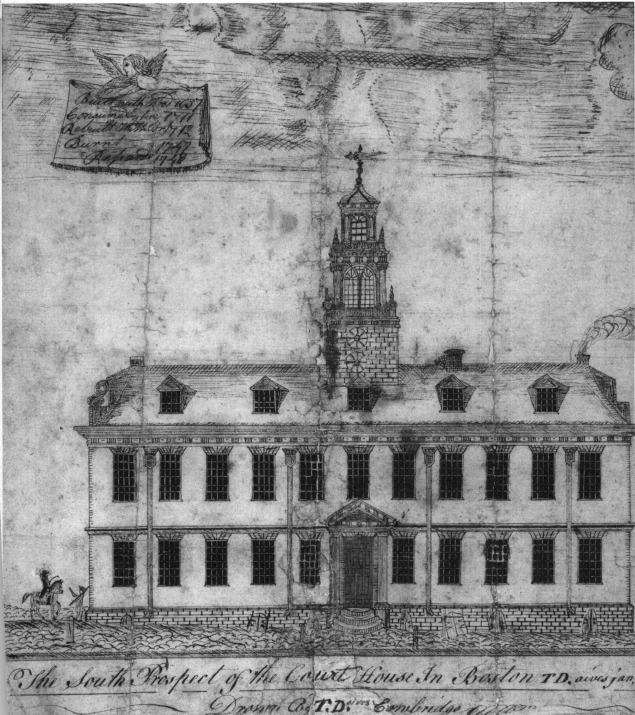
Capen kept a copy of his handbill sold by Heritage Auctions in 2006 with Biblical citations for his argument and notes about exactly how long he was in jail. That copy appears above.

While Boston 1775 may have just left Capen in the Boston jail for a month, 250 years ago the Massachusetts authorities kept him locked up for much longer.

TOMORROW: Another sort of plea.

Wednesday, September 09, 2026

Forsaken and Lost Founders at the Athenaeum

This month the Boston Athenaeum will host two presentations about Founders less known to the public than the big six. To forget one Founder may be a misfortune, but to lose memory of two would be sheer carelessness.

16 September, 6 to 7 P.M.
The Forsaken Founder
Scott S. Greenberger

When George Washington and the Continental Army faced starvation, he turned to Gouverneur Morris to help devise a plan to provision the troops. When the fledgling nation needed a financial system to sustain the Revolution, Morris again was called upon to help design its first national bank and currency.

When the compromises between North and South, large states and small, had to be stitched into a single governing document, the task of shaping the Constitution’s final language fell largely to him. At the Constitutional Convention, Morris spoke more often than any delegate save James Madison—and more forcefully against slavery. When Alexander Hamilton died in a tragic duel, his widow insisted that Hamilton’s closest friend, Gouverneur Morris, deliver the eulogy.

Morris continued to serve the republic after its founding as envoy to France during the Revolution and Reign of Terror, and as an early visionary who grasped that New York, not Philadelphia, could become the nation’s economic capital if a canal opened the interior to the sea.

In this deeply researched biography, The Forsaken Founder, Scott Greenberger restores this indispensable figure to history and asks why one of the most prescient and principled founders faded from memory. Was it his uncompromising opposition to slavery? His unapologetic aristocratic style? His belief that liberty required structure as well as passion?

Scott S. Greenberger is coauthor of the New York Times bestseller Critical: What We Can Do About the Health-Care Crisis and author of The Unexpected President: The Life and Times of Chester A. Arthur. Currently the executive editor of Stateline, he has been a newspaper reporter at the Austin American-Statesman and the Boston Globe. Greenberger has a bachelor’s degree in history from Yale University and a master’s degree in international relations from George Washington University.

Tickets are required for this event. Athenaeum members can attend with up to three guests at no cost. Visitor tickets are $20.

28 September, 6 to 7 P.M.
The Lost Founder
Jesse Wegman

As a young lawyer, James Wilson made a celebrated case for American independence in an essay that inspired the famous words “We hold these truths to be self-evident, that all men are created equal.” He wrote the first draft of the Constitution and, along with the more famous James Madison, played perhaps the essential role in its ultimate creation.

Wilson believed that the people are the ultimate source of all power. He argued successfully for a strong central government and a powerful presidency, and fought unsuccessfully for a direct vote for the President and the Senate. Appointed as a justice to the first Supreme Court, he was later brought down by reckless land speculation and died of malaria in the back room of a North Carolina tavern while hiding from his creditors.

Instead of being remembered as one of the nation’s great political thinkers, Wilson was virtually written out of history. But in The Lost Founder, Wegman brings to life the most prescient of the earliest patriots and makes a convincing argument that scandal should not diminish the life and impact of a brilliant, complicated man whose vision for his country could not be more relevant today.

Jesse Wegman is a senior fellow at the Brennan Center for Justice, where he works with the Kohlberg Center on the U.S. Supreme Court and the Future of the Constitution Advisory Committee. From 2013 through 2025, Wegman was a member of the New York Times editorial board. His work was part of a package that won the Pulitzer Prize for Public Service in 2018. Wegman is the author of Let the People Pick the President: The Case for Abolishing the Electoral College.

Tickets are required for this event. Athenaeum members can attend with up to three guests at no cost. Visitor tickets are $20.

Wednesday, September 02, 2026

“Those who have something to lose who are now ye. Zealous Patriots of the Day”

Since this is the anniversary of the 1774 “Powder Alarm” in Cambridge, I’m quoting from a letter that discusses that event and the surrounding political environment.

Stephen Mix Mitchell (1743–1835, shown here) was a lawyer in Wethersfield, Connecticut, having spent the 1760s as a student and then tutor at Yale College.

On 19 Sept 1774, Mitchell wrote to the merchant Peter Verstille in Boston. He first discussed his recent trip to the Rev. Eleazar Wheelock’s school, the challenges of collecting debts that season, and land that Gov. Francis Bernard might have been granted in Vermont.

Then Mitchell turned to the political turmoil in New England, addressing Verstille as representative of Boston and Massachusetts (which he wasn’t, but that’s another story):
We in the Country are more engaged for your Liberties (as I am told) than you are yourselves, you cannot conceive the Ardor of our people when the late Alarm happend. They flew to their Arms as readily as if they had been told their Wives & Children were captivated & carried of by a foreign foe,

I am fully convinced that the Country will never swallow these Acts of Parliament untill four fifths of the people are slain, the general say is “Tis a Country for which our fathers fought, bled & died with Savages, a Country for which we are not beholden to Great Britain, whose Liberties we will not give up but with our Lives——[”]

The Unanimity is beyond all Expectation. I have had Opportunity to enquire particularly in four or five Towns round about us which contain each about 4000 [sic] Inhabitants & not a Man whom the warmest Sons of Liberty do even suspect would not sacrifice his Life rather than submit....if this matter should come to blows, God only knows what would be the Event of it,

the Day is come when the friends of government at home can not say tis a Rabble who oppose them for tis now the land holders the freemen of our Towns those who have something to lose who are now ye. Zealous Patriots of the Day, & they will send their Sons to defend their Liberties; those who in the late warr would give 50 & 60 Dollars to hire a man to go into ye warr to get their Sons excused, are now determind. to trust the Defence of their Liberties in the hands of none but of their own families…

they say they chuse to live on their wonted good Terms with Great Britain, they chuse peace they chuse dependance on their mother Country, but if they must have warr or submit to these Duties & Marks of Slavery they have no Hesitancy in chusing the former;

they look up their old Deeds of patents from the Govt. & Company of the Colony when they read your Bill for regulating the Government of the Massachusetts Day, & then argue with themselves thus, “tis by this Deed I tho’t I held my land, this Deed is founded on our own Charter & what prevents our Charter from being taken from us, as that of our Neighbours has been? Then what security have I that I can hold my land by?”

Upon this the old Gray heads draw their old rusty Swords & order them to be cleand. & say like the brave Earl of Warren in another Case, “by this my father held & won his Land & by this I & my Children will defend it”—

This is no fiction but the cool deliberate Determination of the people, people who are friends to order & good government, & they are determind. this Time not to trust solely to the Virtue of the Merchants respecting non Importation, they will suffer no Mercht. To bring Goods.
It took some effort to track down Mitchell’s allusion to the “brave Earl of Warren.” Tobias Smollett’s Complete History of England told the story of John de Warenne, 6th Earl of Surrey (1231–1304), this way:
the earl of Warenne, who being required by the judges to produce his charter, unsheathed an old rusty sword, as the instrument by which his ancestors had acquired their lands, and with which he resolved to preserve them to the last drop of his blood. This bold answer gave [King] Edward to understand, that his inquisition would be attended with very dangerous consequences…
In the mid-1780s Mitchell represented Connecticut in the Confederation Congress. He was later appointed to the U.S. Senate to serve out Roger Sherman’s term, but his main government service was as a judge on Connecticut’s supreme court.

Mitchell’s letter is now at the American Philosophical Society and has been scanned as part of its Revolutionary City website. I haven’t found it transcribed anywhere before.

Tuesday, August 18, 2026

“‘Subject’ to an authority founded on the late Declaration of Independence”

During the siege of Boston, Benjamin Davis, Sr., signed up for the Loyal American Association, which appears to have been a pro-Crown militia.

We have these companies’ rolls but little other information on what they actually did, if anything. But membership is a useful yardstick for Loyalism.

According to Todd Braisted’s On-Line Institute for Advanced Loyalist Studies website, Davis was listed as a sergeant in the Third Company, headed by Adino Paddock. Hopestill Capen, a fellow Sandemanian, was also a fellow sergeant.

Benjamin Davis, Jr., joined the Second Company under Capt. Abijah Willard at the rank of private. He was around nineteen years old, thus of prime military age.

In 1776 both father and son evacuated Boston with the British military. Then they headed back to New York to be part of the British military’s return to the newly-declared independent U.S. of A. After their ship was captured, both were locked up in the Boston jail starting in July.

In the Massachusetts state archives, and published in Peter Force’s American Archives, is a long letter dated 10 Oct 1776 to James Bowdoin, who happened to be a senior member of the Massachusetts Council. The signature as transcribed was “Benj’a Davis, Jun.” However, the writer refers to “my son” and “the property which I left in my store in Boston, in March past, worth about a thousand pounds sterling,” so it must have come from Benjamin, Sr.

This letter lays out Benjamin Davis’s religious motivation for remaining loyal to the royal government, to the extent that he refused to recognize the authority of his captors, even to ask for his release:
There is a proverb that it will be well for me to attend to, as it is applicable to one in my present situation: “The fear of man bringeth a snare.” [Proverbs, 29:25] I consider myself now to be wholly in the power of the people, and that there is no legal authority for me to apply to for relief. The present distressed situation I am in, and the method pointed out to me in order to get relieved, are such as makes it necessary for me to be much on my guard, lest I get ensnared.

I am bound by God’s law to “be subject to the higher power;” [Romans 13:1] and I have much more to dread from the disobedience of his commands than I can have to fear from those who may be offended at me because I cannot in conscience be “subject” to an authority founded on the late Declaration of Independence. I am very sorry I am placed in such a situation, as though designed to compel me to take such a step for my enlargement as would be in me a breach of God’s law.

To compel me to act or do, contrary to the dictates of my conscience, any one thing that shall carry with it any authority founded on the Declaration of Independence, until the same be recognized and fully settled so as to become my duty to be “subject,” would be the same, and I see no odds, as if I was in Spain or Portugal and committed to the Inquisition as a heretick, and they were to inflict on me the most cruel tortures in order to compel me to deny the faith.
I’m sure Bowdoin didn’t expect that!

Davis pointed out that he wasn’t demanding his confiscated property since doing so would be another form of recognizing the local courts. He probably knew that also meant fewer locals would see him as an enemy.

The letter continued:
I profess myself a liege subject of his Majesty King George III, founded on this principle, that all who are born within his dominions or realm he has a claim upon as his rightful and lawful subjects; that the Provinces and Colonies in North America make a part of his realm.

I was born in this Province; of course allegiance is due from me to him, nor can it be dissolved but by his consent, or by a revolution taking place within the Kingdom, or the Government fixed and established, in which case it would be dissolved. I am bound by God’s law to “honour the King,” and to be subject to the legislative authority of Great Britain as “the higher power.”

I cannot, in any way, be aiding or assisting in any plan or scheme for bringing about any revolution in the Empire upon any pretence whatsoever, without breaking a positive law of God. But whenever any revolution does take place within the Kingdom, and the Government becomes fixed and established, be the cause that brings it about what it may, I shall then be bound in conscience to be “subject” to its authority, for they will then become the “higher power” in the Apostle’s sense.
That’s Sandemanian doctrine.

Davis said he didn’t desire “being abroad” in Boston, lest people think he was trying to convert them or spy on them; that “would be as unbecoming as to be an informer against my neighbour, who may be concerned in an illicit trade.” But he also said he hoped to “take lodgings in town.”

Finally, Davis suggested that “my son, together with myself and servant, could be exchanged for any prisoners in the hands of his Excellency General [William] Howe, at New-York.”

TOMORROW: Petitions.

Wednesday, August 12, 2026

Benjamin Davis, Jr., at the Boston Massacre

On 4 Apr 1756, Trinity Church in Boston recorded the baptism of “Benjamin Davis, Son of Benj. & [blank].”

Benjamin, Jr.’s mother was Elizabeth (Phillips) Davis, a convert to the Church of England. She bore a third child in 1757 but must have died in the few years following.

Presumably Benjamin, Jr., was baptized a few days after birth, meaning he was born in the spring of 1756. However, when he died on 28 Dec 1836, Boston newspapers reported that he was eighty-one, so it’s also possible his baptism was delayed a few months.

In 1762 Benjamin, Sr., married a second time, to Anstis Greenleaf, daughter of Suffolk County sheriff Stephen Greenleaf. She died in 1764, after giving birth, and Benjamin, Sr., remarried again to Alice Whipple of Rhode Island—and we all know how that turned out.

As a teenager, Benjamin, Jr., was present at the shooting on King Street in March 1770. He was called to testify at the soldiers’ trial, identified as “son to Mr. Davis a former witness.”

Here, as taken down by John Hodgson, is what Benjamin, Jr., experienced:
On the evening of the 5th March last, near the bottom of Royal exchange-lane, I saw a mob by Mr. [John] Greenleaf’s, I went right along into King street, I saw the Sentinel [Hugh White]; a barber’s boy [Edward Garrick] was there crying, and said the Sentry had struck him, and asked him what business he had to do it:

I went home and staid at the gate in Green’s lane some time,

Samuel Gray (one of the persons killed that night in King-street) came along, and asked where the fire was?

I said there was no fire, it was the soldiers fighting, he said, damn it, I am glad of it, I will knock some of them on the head; he ran off, I said to him, take heed you do not get killed in the affray yourself, he said, do not fear, damn their bloods.

Q. Had he a stick in his hand?

A. He had one under his arm.

Q. What sort of a stick was it?

A. I did not take notice.

Q. How long was this before the firing?

A. I do not suppose he could have got into King-street two minutes before the firing.
Benjamin’s father was also observing the action from a different angle, and his uncle Edward’s family had a clear view across the street at the Customs office. They were all defense witnesses at various trials.

TOMORROW: Fire!

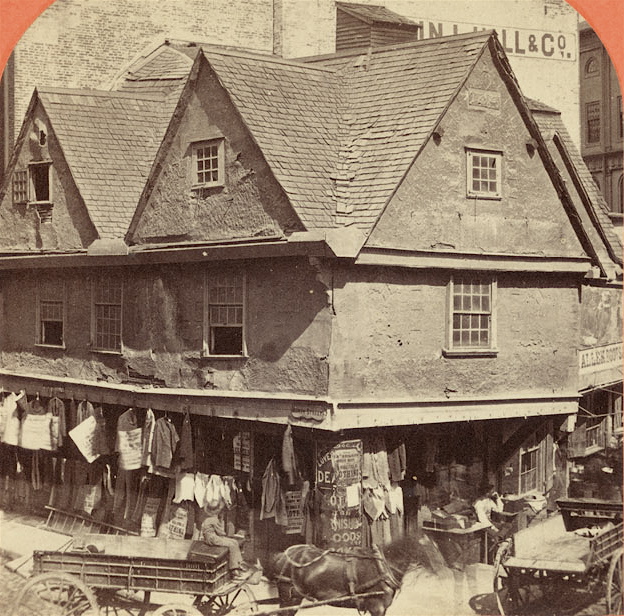
(Based on Benjamin’s quick description, I’m guessing he first spotted the crowd near John Greenleaf’s apothecary store, which survived into the late 1800s as the Old Feather Store at Dock Square, shown above.)

Sunday, August 02, 2026

“Dependant upon the Imperial Crown of Great Britain”?

In 1775, John Adams and John Dickinson held the same basic position about the best course for the British Empire and its large North American colonies:
  • There must be a new understanding of the relationship between those colonies and the central government in London.
  • But those colonies need not become independent.
The problem was that the two men defined “independent” differently.

On 15 May, Silas Deane made these notes on the Continental Congress’s debate:
Mr. Jno Ruttlidge…insists it previously some that points must be settled, such as do We aim at independancy, or do we only ask for a Restoration of Rights & putting of Us on Our old footing. speaks long & well

Mr. Robt. R Livingston Succeeds him in the same way. short

Mr. Jno. Adams lengthy, and argumentative. independance on Parliamant is absolutely to be avowd. in the Americans, but a dependance on the Crown is what We own
Adams thus declared himself in favor of “independance” only from Parliament, not the entire British system (“the Crown”). How exactly that would work he didn’t say.

Two months later, in his letter to James Warren that fell into British hands, Adams went into more detail:
We ought to have had in our Hands a Month ago, the whole Legislative, Executive and Judicial of the whole Continent, and have compleatly moddelled a Constitution, to have raised a Naval Power and opened all our Ports wide, to have arrested every Friend to Government on the Continent and held them as Hostages for the poor Victims in Boston. And then opened the Door as wide as possible for Peace and Reconcilliation
Adams still didn’t use the term “independance.” He still held out the prospect of “Reconcilliation.”

To Dickinson, however, Adams’s wish list amounted to “a total Independence, & the Establishment of a Commonwealth.” The term “commonwealth” recalled the English protectorate of the mid-1600s, which Adams’s Puritan ancestors had applauded but most British subjects remembered with distrust.

Adams never saw the material that Dickinson sent to David Barclay in Britain in August 1775. In fact, hardly anyone in the history of the world saw those documents until they were just published in the William & Mary Quarterly. With his letter Dickinson included draft legislation he hoped would calm the crisis by resetting the imperial relationship to how it had been back before Parliament started raising tariffs in 1763.

But Dickinson prefaced part of that legal repeal with this language:
Whereas it is essential to the good Government & Prosperity of every Sosciety [sic] or State, that an undisputed Supreme superintending Power & Authority should exist within it; And whereas this Power & Authority hath always been vested in & exercised by Parliament; and whereas the respective local legislatures of distinct Colonies are in many Instances incompetent; be it therefore further enacted by the Authority aforesaid, that when any of the said Colonies shall by an Act of Assembly acknowledge & recognize & declare the said Colony to be dependant upon the Imperial Crown of Great Britain, and that the Kings most excellent Majesty by & with the Advice & Consent of the Lords Spiritual & temporal & Commons in Parliament assembled had hath & of Right ought to have full Power & Authority to make Statutes to bind the People of the said Colonies, where the general Wellfare of the Whole Empire shall require the Exercise of such a Supreme superintending Power & Authority, as especially to make Statutes for regulating the Trade & Navigation of the Whole Dominion of the Imperial Crown of Great Britain…
To Adams, Dickinson’s concession would have amounted to accepting dependence on Parliament.

Ironically, both men claimed that the disclosure of Adams’s letter was useful because it showed how far he wanted to go. Dickinson felt those words should make politicians in Britain realize that some Americans sought de facto independence. Adams felt the same words emboldened more Americans to adopt his position.

In fact, none of the documents I’ve been discussing—Adams’s intercepted letter, Dickinson’s two letters to Barclay and his draft legislation—made any difference in London. On 23 August, before those papers could cross the Atlantic, King George III issued a proclamation written by Lord Dartmouth that the North American colonies were in “open and avowed rebellion” and his forces should “use their utmost endeavours to withstand and suppress such rebellion.”

Tuesday, July 28, 2026

“Praying for an Act of Assembly to hang the Memorialist”

At the end of August 1771, Richard Steele finished a very busy year.

Since the start of September 1770, the young man had been:
  • convicted of theft, whipped, cropped, and branded twice
  • locked up seven times, twice in irons
  • escaped three times
  • acquitted of theft twice
All those events were reported in Connecticut’s newspapers. And then we don’t hear about Steele’s activity for three years.

That said, on 15 October the Connecticut Courant in Hartford ran a long essay, filling most of a newspaper page and headed:
A MEMORIAL, praying for an Act of Assembly to hang the Memorialist.

To the Honorable the General Assembly of the Colony of Connecticut, to be conven’d at New-Haven, on the second Thursday of October, 1771.

The MEMORIAL of Richard Steele Burglarian, now confin’d in Fairfield Goal, in behalf of himself and the rest of the Housebreakers who now, or hereafter may, practice their calling and profession, within said colony
In this context the word “memorial” meant a memorandum, not a remembrance of the dead (yet).

The author was not Richard Steele but someone (ironically) stealing his persona to complain, for himself and fellow criminals, about the state of legal justice in the colony. The essay was dated September, and its writer was apparently unaware that in late August a court acquitted Steele of the charges that had landed him in the Fairfield jail. Not that such knowledge would have made the author happy.

The essay argued that under Connecticut’s legal system “the reformation of the punished—has…never been to any degree effected.” Yet “the confining of us to hard labour” was “utterly inconsistent with the privileges and liberties of Englishmen.”

That left only one course of action: “That your honors would order, decree and enact that the first offence be punished with death.”

It’s a weird use of sarcasm. I suspect that the real target was talk of establishing a prison to lock up convicted criminals for long terms. The essayist expressed hope
That the proposal for confining us to hard labour may (as we are confident it will) be treated with the contempt it deserves.
The Connecticut assembly didn’t approve converting the Simsbury copper mine into a prison until October 1773, but this looks like an attempt to quash that proposal early. It didn’t work.

Indeed, Richard Steele probably was the sort of criminal the New-Gate Prison was designed for. The traditional corporal punishments hadn’t deterred him, and by the end of 1770 he had no more ears to crop. Yet juries may have been reluctant to send the young man to the gallows for property crimes—hence the two acquittals in 1771.

An underground prison might have looked like the best way to keep Richard Steele off the streets.

COMING UP: Steele goes to New-Gate.

Monday, July 27, 2026

“Steel made a most vigorous Resistance”

The 7 May 1771 Connecticut Courant newspaper of Hartford repeated Sheriff Ezekiel Williams’s wanted notice for Richard Steele that I quoted yesterday.

Folks up in Hartford Country didn’t know that Steele was once again in jail.

Four days earlier, on 3 May, the Connecticut Journal of New Haven reported:
Last Monday [29 April], the notorious Burglar, Richard Steel, was taken up at Milford, and conveyed to Fairfield Goal, (charged with several Burglaries and Thefts, since his late Escape from Hartford Goal, the last of which was committed in Stratford) also one Evens, an occasional Landlord of Steel’s, and as whose House he was taken; Steel made a most vigorous Resistance, and wounded the Person in the Head, with a Cutlass who took him.
The same item was reprinted in the 18 May Providence Gazette with the landlord’s name spelled “Evans.”

As far as I can tell, this was the first time Steele was accused of a violent act, as opposed to stealing clothing, jewelry, or horses.

Steele had a record of breaking out of jails, but Fairfield County managed to hold onto him. On 30 July, the Connecticut Courant ran this item:
NEW-HAVEN, July 26.

A few Days ago a Letter from the notorious Richard Steel (now in Fairfield Goal, and who is to be tried for his Life for Burglary at the next Superior Court) directed to a Woman belonging to Milford, named Alling was intercepted, the Contents of which was to desire her to be out of the Way at the Time of his Tryal, she being the principal Witness against him;——but to prevent her escape she was last Evening committed to the Goal in this Town; not being able to procure Bail.
Steele thus stayed in custody until his case came up in August. Furthermore, Connecticut authorities had detained two possible accomplices or witnesses against him. Surely he wouldn’t get away with his crimes again!

On 27 August, the Connecticut Courant reported:
The notorious Richard Steel, so well known in this Town and County, and who was tried for his Life for Burglary last March Term, in this Place and acquitted, was again tried for his Life last Week at Fairfield for a like Offence, and again acquitted.
TOMORROW: The “Memorial of Richard Steele.”

Sunday, July 26, 2026

“The notorious Burglarian, that called himself Richard Steel”

Yesterday we left young Richard Steele back in the custody of Hartford County law enforcement in February 1771.

According to the 27 August Connecticut Courant, Steele “was tried for his Life for Burglary last March Term, in this Place and acquitted.”

Acquitted! The man was already being labeled “notorious.” But the evidence must not have been strong enough this time.

Nonetheless, the Connecticut authorities detained Steele on the grounds that he hadn’t paid the costs of his last case. That kept him off the streets for a few weeks, but the 2 April Connecticut Courant reported:
A few Days since the noted Richard Steel was dismissed from Goal in this Place, where he had been confined for Costs on his last Trial for Burglary——and on Tuesday Night last Week [26 March] he broke open the House of Mr. —— Kibbe, of Enfield, and rob’d it of sundry Articles and a small Sum in Money; from thence he went to the Barn of Mr. Terry of Enfield, and stole a Horse, and made off; but he was pursued and taken the next Day at Weston, and on Saturday returned to his former Lodgings in this Place, where it is hoped he will be confined till he shall receive a full Reward for all his past Offences.
Those hopes were soon dashed, though. This advertisement appeared in the 23 April Connecticut Courant and ran in that newspaper through early May:
Hartford, April 16, 1771

BROKE out of the county Gaol in this town, last Night and escaped, the following persons viz.

The notorious Burglarian, that called himself Richard Steel, that has been twice crop’d and branded, and was at March Court, in Hartford, again tried for the third Offence, but found not guilty, pursuing his old Trade, was again taken up and closely confined in Irons, but has found Means to get them off.

His appearance is that of a likely young Man of about 21 year of Age, about middling for Height somewha [sic] slender, has a lively, keen, dark colour’d Eye and is finely pitted with the Small Pox, wears his Hair, pretty dark Colour’d, but not unlikely he may soon get a wig to cover his Ears; he is pretty quick and lively in speaking, and has a little different Manner from persons born among us.
After descriptions of two other escapees, the same ad listed:
Also a woman called Rosanna Blanchard, who had been convicted of harbouring and entertaining the above named Steel and punished, and was held for the Cost.

Whoever shall take up either of the first mentioned notorious Criminals, and secure them that they may be brought to Justice, shall have a Reward of Forty Shillings; Lawful Money, and all necessary Charges paid;…and for the woman, Ten Shillings.

Ezekiel Williams, Sheriff.
The same newspaper carried this notice:
Ten Dollars Reward.

STOLEN from the Subscriber, out of his Stable in Hartford, on the Evening of the 17th Inst. a dark brown, or black colour’d MARE, with white on her near hind Foot, had on her Breast, the Mark or Print of a Collar, about fourteen Hands High, five years old; said Mare is well shaped, very high Liv’d, and good Carriage, both Paces and Trots. ALSO a plain Russett SADDLE, with a Saddle Cloth, and Bridle.—

Said Mare, &c. is supposed to be Stolen by that notorious Burglarian, who calls himself by the Name of Richard Steel, he hath been twice Crop’d and Branded within 12 Months past. Said Steel, broke out of Hartford Goal but two Nights before said Mare was Stolen, is about 21 Years old, of a middling Stature, somewhat slender, of a genteel Shape and Appearance, hath lively Dark coloured Eyes, and is very finely pitted with the Small Pox, Dark coloured Hair, European Born.

Whoever shall Apprehend and Secure said Thief, so that he may be brought to Justice, or shall secure said Mare, Saddle and Bridle, so that the Owner may have them again, shall have a Reward of TEN DOLLARS, Paid by me,
WILLIAM HOOKER.

Hartford, April 20th, 1771.
The description of Steele as “European Born” and the statement that “has a little different Manner from persons born among us” suggests that he had grown up somewhere in the British Isles.

By this time Steele was so infamous that people were assuming he was responsible for thefts simply because he was in the vicinity. Those accusations may well have been accurate, but the authorities would need better evidence if they wanted to convict him.

TOMORROW: A summer in jail.

Saturday, July 25, 2026

“When at liberty very sociable and familiar”

Yesterday’s posting left Richard Steele in New Haven, Connecticut, in December 1770, being branded and cropped on his ear the second time in a few months.

(I presume his right ear was cropped first, then his left, but the newspaper accounts don’t specify that.)

You might think that punishment would have taught Steele the error of his ways, or at least made it harder for him to keep committing crimes.

But no, Steele managed to get in one more theft before the end of the year, according to the Connecticut Journal of 4 Jan 1771:
----Stop the Felons!----

A Goldsmith’s Shop, belonging to the Subscriber in Waterbury, was broken up, on the Night of the 27th Instant, and sundry Pair of Stone Ear Rings, one Pair Stone Buttons, one Pair Gold ditto, and one Gold Ring, with some Shillings in Coppers, and some other Money, and likely some other Articles of Goldsmith’s Ware, was taken away, supposed by one Richard Steele, (and his Partner unknown) who was lately punished for breaking open Mr. Marks’s House in Derby.

Said Steele is of middling Stature, about 21 Years of Age, has dark brown Hair, not much curl’d, black Eyes, and beautiful Complection, but much Pockbroken, both Ears crop’d, branded twice in the Forehead, wears a brownish Coat, check’d woollen Shirt, old leather Breeches, and Hat slop’d.

Whoever will take up said Steele, or his Accomplice, and secure him or them, and notify me, shall have Three Dollars Reward, and necessary Charges paid, by
JOSEPH HOPKINS.
Dec. 31, 1770.
The 8 January Connecticut Courant, published in Steele’s usual haunt of Hartford, summarized the news about him for local readers.

Then on 5 February the Connecticut Courant had good news:
The Thief is Caught!

And was last thursday bro’t to this town and again committed to goal. He is perhaps the most notorious one that ever infested this colony, was last September before the hon. Superior Court, held in this place, convicted of Burglary by the name of Richard Steele, and in consequence thereof crop’d and branded, not long after which he broke goal, and escaped but pursuing his trade, was again taken for Burglary committed in Derby, and indicted at New-Haven before the adjourn’d Superior Court in December last, for the second offence, and again crop’d and branded, and very soon after escaped from that goal, and has since (perhaps) committed more Burglary’s than ever the notorious [Isaac] Frasier who was hanged at Fairfield ever did in so short a time.

He is now put in irons in very close confinement but least he should again escape, would that the world might know him, observe that he is a young man of about 20 years old, rather of a slender make, and about or little more than middling for stature, his facce [sic] finely pitted with the small pox, has a keen black eye, wears his own hair, of a very dark colour, pretty well down on his forehead in order no doubt to hide his scars, is a very lively active man and I believe when at liberty very sociable and familiar.

He had on him now when taken a light coloured surtout, of a cloth call’d bearskin or coating, most probably stolen from Mr. Ingersol of Westfield; a strait bodyed coat, stolen from Dr. Hooker of this town, trim’d with silver buttons, one each of which was wrote at large Sept. 2d, Daniel Hooker 1764; also 2 summer jackets stolen out of Mr. Mattock’s shop a barber in this place from whom also it is supposed, he took at the same time 2 wiggs, not yet found; had also with him, two silver watches; one of which stolen from Mr. Jonah Gillot of Wintonbury, the other with a China face, seems to answer the description of one advertized to be stolen from somebody in Stratford; also 5 pair silver shoe buckles; 2 gold necklaces; 2 pair stone jewels set in gold; 2 small Rings with 3 stones set in each; 3 watch seals set in silver; one pair gold sleeve buttons; one chain ditto, marked within side B W; one worsted purse with a mill’d dollar, marked G R and sundry other pieces of silver money; 4 very good black Barcelona handkerchiefs, with a paper pin’d on one of them marked 9s; a hatt crape; one brass inker with penknife and case, marked D, a scale for a womans finger; a bodkin, and a small gimblet; said to be owned by Jonathan Burney of Union, where he has disposed of a considerable quantity of valuable goods—

The foregoing articles are now lodged with the Sheriff of this County, and may be seen by any claimers this week at the Court House in Hartford, and any time afterwards before the setting of the superior court, in March next at his own house in Weathersfield.

If the Printers should generally insert the foregoing in their papers, it might perhaps be of public service.
This was, by my count, the fourth time Sheriff Ezekiel Williams had Steele in his custody.

And it looks like this time Steele stayed in jail for nearly two months.

TOMORROW: A busy April.