J. L. BELL is a Massachusetts writer who specializes in (among other things) the start of the American Revolution in and around Boston. He is particularly interested in the experiences of children in 1765-75. He has published scholarly papers and popular articles for both children and adults. He was consultant for an episode of History Detectives, and contributed to a display at Minute Man National Historic Park.

Subscribe thru Follow.it


•••••••••••••••••


Showing posts with label Gnaddenhutten. Show all posts

Tuesday, September 22, 2026

“Unearthing Fort Rutledge” at Clemson, 25 Sept.

On Friday, 25 September, Clemson University will host a talk by Prof. Joshua Catalano titled “Unearthing Fort Rutledge.”

The event description says:
Tucked away on the edge of Clemson University’s campus are the remains of the Cherokee town of Esseneca and Fort Rutledge. Most people passing by the old monument near the site are unaware of the history.

On August 1, 1776, a small battle occurred at Esseneca between the South Carolina militia and British/Cherokee force. Following the skirmish, the militia destroyed the town and built Fort Rutledge. The fort played an important role in the American Revolution serving as a staging area for patriot expeditions. It also served as a mechanism of settler colonialism, further displacing the Cherokee from their home.

The British "destroyed" the fort in 1780, and nature buried what was left over the centuries. This history is little remembered. In 2021, Clemson faculty and students partnered with the National Park Service and the Eastern Band of Cherokee Indians to unearth what was left of the fort. This research led to new and unexpected discoveries that are changing our understanding of the region’s history.
Dr. Joshua Catalano as an Associate Professor and Public History Coordinator in Clemson’s History department. In addition to the Fort Rutledge project, he is working on a study of the production, dissemination, and continual reinterpretation of the memory of the Gnadenhutten Massacre of 1782 and the burning of Col. William Crawford.

Clemson was founded in 1889 on a plantation once owned by John C. Calhoun, the Senator, Vice President, and advocate for chattel slavery. He had named that property Fort Hill because of memories of Fort Rutledge nearby, though for a long time the fortification’s exact location was lost.

People can attend this lecture in person or online through this link.

Tuesday, March 08, 2016

Naming a Massacre

Bostonians started to call the killings on King Street on 5 Mar 1770 a “massacre” almost immediately, according to the official record. The minutes of the emergency town meeting that started the next day begin:

At a Meeting of the Freeholders and other Inhabitants of the Town of Boston at Faneuil Hall on Tuesday the 6th. Day of March 1770 – 11 O’Clock A:M; occasioned by the Massacre made in King Street, by the Soldiery the preceeding Night . . .

Upon a Motion made it was Voted, that if any of the Inhabitants present could give information respecting the Massacre of the last Night, that they be desired to do it in Meeting, that the same might be minuted by the Town Clerk
That clerk was William Cooper, and it appears he was the person who started to apply the term “massacre” as he took notes at that meeting.

By the end of that town meeting that afternoon, Cooper was writing the phrase “horrid Massacre.” On the afternoon of the 12th, that had become “the late horred Massacre.” The latter meeting had chosen a small committee headed by James Bowdoin to write Boston’s official report on the event, which had the title A Short Narrative of the Horrid Massacre in Boston.

In choosing that word, Boston Whigs strengthened the links they perceived between them and government reformers in London. The term echoed the Massacre of St. George’s Fields, which had taken place in London in May 1768. A crowd had turned out to show support for the radical politician John Wilkes. Magistrates “read the Riot Act,” ordering the people to disperse. When they didn’t, soldiers fired at the crowd, killing six to eleven people.

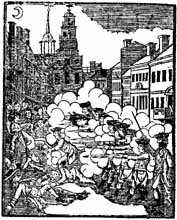
A related question is when the term “Boston Massacre” arose. At the end of 1770, Isaiah Thomas published his first Massachusetts almanac, to cover the following year. He had Paul Revere produce a new version of the image he’d taken from Henry Pelham, this time as a woodcut rather than an engraving. Harbottle Dorr pasted that picture in his newspaper collection beside the first reports of the shootings. That example is discolored by glue, but we can see the label “BOSTON MASSACRE” at the top. That phrase also appeared in advertisements for the almanac.

Another label, John Johnson of Minutemen and Their World has pointed out, was “Preston’s Massacre,” after Capt. Thomas Preston, acquitted in late 1770 of having ordered soldiers to fire into the crowd. That phrase appeared in the 5 Mar 1771 issue of Salem’s Essex Gazette, exactly one year after the event. A week later, Edes and Gill reprinted that text in their Boston Gazette, filled out with large display type, dark borders, and a description of Boston’s first-anniversary memorial events.

The war that followed a few years later brought several more events labeled as “massacres”: the Paoli Massacre, Baylor Massacre, Waxhaw Massacre, Cherry Valley Massacre, Sugarloaf Massacre, Pyle’s Massacre, and Gnaddenhutten Massacre. Most of those events were actually fights between the two armies in which one side was really successful at wiping out the other. Only a couple involved attacks on unarmed civilians, with the Gnaddenhutten attack the worst atrocity.