J. L. BELL is a Massachusetts writer who specializes in (among other things) the start of the American Revolution in and around Boston. He is particularly interested in the experiences of children in 1765-75. He has published scholarly papers and popular articles for both children and adults. He was consultant for an episode of History Detectives, and contributed to a display at Minute Man National Historic Park.

Subscribe thru Follow.it


•••••••••••••••••


Showing posts with label Daniel Vaughan. Show all posts

Wednesday, July 09, 2025

“Capt. Potter answered that he would share none”

Rhode Island actually began its military build-up back in December 1774, as detailed in a letter from former governor Samuel Ward that I quoted back here.

At that time the colony appointed its first ever major general: Simeon Potter (1720–1806).

Potter was a militia colonel, representative of the town of Bristol in the colonial assembly, and veteran privateer captain.

Indeed, Potter had already helped to lead one attack on the British military: while several fellow merchants supported the assault on H.M.S. Gaspee in 1772, he actually commanded one of the boats.

Now in fact, Potter’s most successful privateering haul came in 1744 not from attacking enemy ships but from raiding a poorly defended settlement in French Guyana that hadn’t even heard the empires were at war.

According to one of his captives, he sailed away with:
seven Indians and three negroes [none previously enslaved], twenty large spoons or ladles, nine large ladles, one gold and one silver hilted sword, one gold and one silver watch, two bags of money, quantity uncertain; chests and trunks of goods, etc., gold rings, buckles and buttons, silver candlesticks, church plate both gold and silver, swords, four cannon, sixty small arms, ammunition, provisions, etc.
Father Elzéar Fauque reported that the looting included “tearing off the locks and the hinges of the doors, particularly those which were made of brass,” before burning everything to the ground.

Potter’s lieutenant Daniel Vaughan testified in 1746 that at Suriname
Capt. Potter put a Quantity of sd. Merchandize up at Vendue on board a Vessel in the Harbour and purchased the most of them himself and ship’t them to Rhode Island on his own account; then said Sloop Sailed for Barbadoes on wch. passage the men demanded that Capt. Potter would Share the Money taken, according to the Articles, to which Capt. Potter answered that he would share none until his Return for all the Men were indebted to the Owners more than that amounted to and Swore at and Damn’d them threatning them with his drawn sword at their Breasts, which Treatment Obliged the Men to hold their Peace and when said Sloop arrived at Barbadoes Capt. Potter without consulting the Men put part of the afore mentioned Effects into the Hands of Mr. Charles Bolton and kept the other part in his own Hands and Supply’d the Men only with Rum and Sugar for their own drinking, and further this Deponent saith that Capt. Potter refusing to let the men have their Shares and his Ill Treatment of them by beating them occasioned about twenty-four to leave the Vessel whose Shares Capt. Potter retained in his Hands
Simeon Potter came home to Bristol a rich man. A few years later, in 1747, the peninsula that contained that town was shifted from Massachusetts to Rhode Island, making Potter one of the richest men in the small colony.

Potter launched various maritime businesses: a ropewalk, a distillery, a wharf, a store, and so on. He invested in slaving voyages to Africa. By the 1770s he owned more enslaved people than anyone else in Bristol. According to a nephew, Potter declared, “I would plow the ocean into pea-porridge to make money.”

In those years, Potter’s neighbors recognized his status by electing him to the legislature and to militia commands, and he was happy with the power.

TOMORROW: A fighting man.

Friday, November 08, 2019

Searching for Daniel Vaughan

The third Rhode Islander that sailor George Gailer sued for tarring and feathering him in October 1769 was “Daniel Vaun[,] Mariner.”

Unfortunately, as this webpage shows, there were a lot of men with that name (surname also spelled Vaughan and Vaughn) documented in eighteenth-century Rhode Island. I think there are a couple of top candidates.

One is the man whom the Newport Mercury and a headstone both reported dying in March 1800 at the age of 56. This Daniel Vaughan was therefore a contemporary of Eleazer and Benjamin Trevett, the brothers from Newport that Gailer also accused. He could have been another sailor on their father’s ship Success.

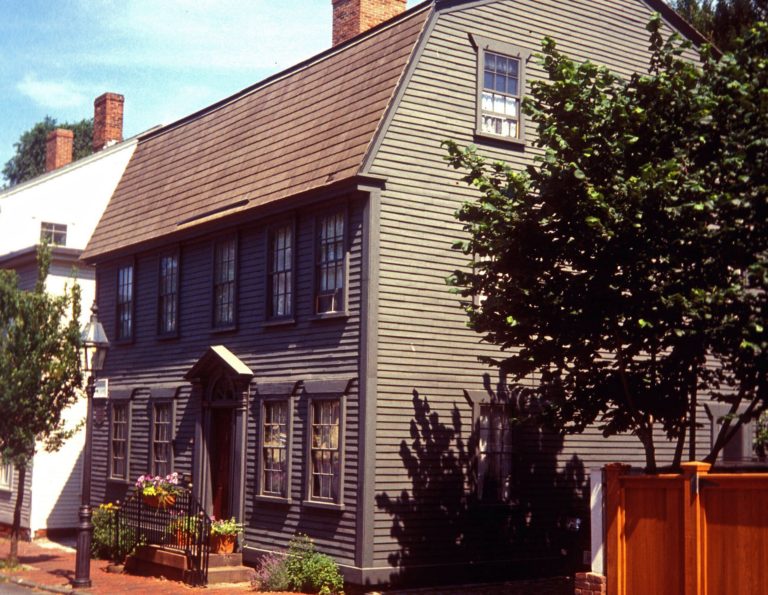
This man was also the right age to have been the Daniel Vaughan who became one of the first third lieutenants commissioned in the Continental Navy in December 1775. And he could have been the owner of the Daniel Vaughan house in Newport, built after the war and shown above.

Another possibility is an older Daniel Vaughan, born in 1716 or 1722. Such a man appears to have been the right age to have been involved in all of these incidents:
  • A Daniel Vaughan was first lieutenant under Capt. Simeon Potter on the privateer Prince Charles of Lorraine during King George’s War in 1744. Potter and his crew sacked a settlement in French Guiana. A priest’s detailed report suggests Lt. Vaughn took the lead in trying to hunt down slaves and plunder villages. Potter eventually stranded a lot of his men and took their shares of the loot, as Vaughan testified in the ensuing controversy back in Rhode Island.
  • A Daniel Vaughan was first lieutenant on the Tartar under Capt. James Holmes in 1748 when it captured a schooner carrying sugar. There was another inquiry about that capture since the schooner had been flying a flag of truce.
  • In 1764, a Daniel Vaughan was the gunner at Fort George on Goat Island off Newport. The local authorities ordered him to fire cannon at H.M.S. St. John. Ostensibly they were trying to stop the Royal Navy ship from sailing away with sailors suspected of stealing hogs, but the real reason for their animosity was that its captain had clamped down on molasses smugglers. Vaughan’s gun crew reportedly fired thirteen shots, striking the warship’s sails and rigging. This was the first of several examples of Rhode Islanders attacking royal government vessels in the years before the Revolutionary War.
In 1773, a man named Daniel Vaughan—who could have been either of these candidates—testified in the investigation of the burning of H.M.S. Gaspee, the most famous of those Rhode Island attacks. The leader of that assault was almost certainly none other than Simeon Potter, acting with the encouragement of the Browns and the Greenes. Vaughan’s testimony, however, discredited one of the Crown’s only cooperating witnesses. This Vaughan was also involved in salvaging iron out of the destroyed warship.

It’s possible those Daniel Vaughans were related. It’s also possible that another Daniel Vaughan got into the mix. But all in all, I’d say either man’s activities are consistent with helping to tar and feather an unpopular informer in Boston in 1769.

COMING UP: The tailors from Boston.

Monday, November 04, 2019

“An assault, on the Body of the said George Gailer”

George Gailer, the first victim of tarring and feathering in Boston, was an ordinary sailor. He was therefore not the type of person who typically left letters, journals, newspaper essays, or other writings.

However, we do have Gailer’s perspective on that assault through a lawsuit he filed three months later in January 1770.

The sailor’s attorney was Robert Auchmuty (c.1722-1788, shown here as a young man, courtesy of Amherst College), who also had Crown appointments. Since Auchmuty was probably beyond Gailer’s price range, I suspect the Customs office helped pay his fees.

John Adams represented one of the defendants, the Boston tailor David Bradlee. Adams also copied Auchmuty’s initial filing into his “Pleadings Book,” just in case he needed to file a similar motion for another client. We’re lucky he did so because the original court file has been lost.

Gailer’s warrant said:
Attach &c. Eleazar Trevett Junior and Benjamin Trevett, Merchants, Daniel Vaun Mariner, all of Newport in the County of Newport and Colony of Rhode Island and Providence Plantation, and David Bradley, Pool Spear, Taylors, and David Provence Infant and Edward Mathews Mariner all of Boston in our County of Suffolk.

To answer unto George Gailer of Boston aforesaid Mariner, in a Plea of Trespass, for that the said Eleazar Trevett Jnr., Benjamin Trevet, Daniel Vaun, David Bradley, Pool Spear, David Provence, and Edward Mathews, at said Boston in the Evening of the twenty Eighth Day of October last, together with diverse other Persons to the said George Gailer unknown, with Force and Arms, an assault, on the Body of the said George Gailer did make, and then and there with Force as aforesaid did strip the said George Gailer naked, tar and feather his Skin, and carry the said George Gailer naked, tarred and feathered, as aforesaid in a Cart about said Boston for the space of Three Hours, and with Clubbs, Staves, and a hand saw did then and there strike him the said George Gailer, sundry heavy and grievous Blows, upon the said George Gailers naked Body, and greatly bruise, and wound him and hit him the said George Gailer diverse grievous Blows, with Stones:

By Reason of all which the said George Gailers Life was put into great Hazard and Danger, and greatly despaired of, and many other Enormities, and Cruelties, the said Eleazer Trevett Jnr., Benja. Trevett, Daniel Vaun, David Bradley, Pool Spear, David Provence, and Edward Mathews, with others unknown to the said George Gailer did then and there commit, on the said George Galer, against the Peace of our Lord the King and to the Damage &c. £2000.
This description of the assault differed in some details from what was in the newspapers. The warrant said the crowd “did strip the said George Gailer naked.” However, the Boston Post-Boy said “his Cloaths except his Breeches [were] pulled or torn off,” and other papers agreed. So this is an example of the period usage of “naked” not being stark naked.

On the other hand, the warrant described more violence than the newspapers, saying the crowd hit Gailer “with Clubbs, Staves, and a hand saw” and “Stones.” The press, particularly the Whig press, might have suppressed those blows, or decided they were few and exceptional and didn’t deserve mention. It’s also possible Gailer and Auchmuty pumped up those details because they were fighting a perception that a tar-and-feathering wasn’t a real assault. Yet that “hand saw” doesn’t seem like the sort of detail one could make up.

According to The Adams Legal Papers, Gailer’s case was initially “decided in the defendants’ favor on demurrer,” meaning the defendants didn’t address the truth of the allegation but argued that those actions weren’t enough to justify a legal judgment. Adams received 19s.4d. from Bradlee. Auchmuty filed an appeal in March 1770. None of the parties appeared when the case came up in the August 1771 term, and the case was dropped. I’ve never come across any other mention of George Gailer.

TOMORROW: An eyewitness account from a soldier.