J. L. BELL is a Massachusetts writer who specializes in (among other things) the start of the American Revolution in and around Boston. He is particularly interested in the experiences of children in 1765-75. He has published scholarly papers and popular articles for both children and adults. He was consultant for an episode of History Detectives, and contributed to a display at Minute Man National Historic Park.

Subscribe thru Follow.it


•••••••••••••••••


Showing posts with label Daniel Morgan. Show all posts

Sunday, July 30, 2023

Memories of “A Bee Line for Boston”

Earlier this month at the Emerging Revolutionary War blog, Kevin Pawlak described the impressively fast journey of the Virginia rifle companies to the siege of Boston:
On June 14, the Continental Congress declared that “six companies of expert riflemen, be immediately raised in Pennsylvania, two in Maryland, and two in Virginia.” Once formed and equipped, “each company…shall march and join the army near Boston, to be there employed as light infantry, under the command of the chief Officer in that army.”

The Virginia companies went to Daniel Morgan, who organized his company in Winchester, and Hugh Stephenson, the leader of the company rendezvousing at Mecklenburg. Joining soldiers signed one-year enlistments. . . .

It took less than seven days to raise each company to the strength of 100 men. Only the delay in getting enough rifles to arm the entire Mecklenburg company prevented them from leaving immediately after filling the ranks.

Once mustered, Stephenson and Morgan agreed to meet in Frederick, Maryland, and march to Boston together. On July 15, Morgan’s men marched first, stealing a step on the Mecklenburg men, who left Morgan’s Grove on July 17. “Morgan having the start we used every exertion to overhaul him, in Vain, altho’ we marched (always in single file) from 30 to 36 miles a number of days,” said [company lieutenant Henry] Bedinger.

Food and cheering citizens greeted Stephenson’s men along the march and kept their marching feet moving at the blistering pace needed to catch Morgan. Only two men failed to make the entire march (one was court-martialed, and the other was accidentally wounded).

On August 11, after a march of over 500 miles in 25 days and just behind Morgan’s men, Stephenson’s company halted in front of General George Washington in Cambridge.
In 1860 Rep. Alexander Robinson Boteler of Virginia referred to the men from his state as having made “a bee-line for Boston.” He used this phrase both in a speech in the House of Representatives and in the anonymous book My Ride to the Barbecue, or Revolutionary Reminiscences of the Old Dominion. He was trying to make a case for national unity, arguing that slavery wasn’t a divisive issue in 1775 so it shouldn’t be now.

The U.S. Civil War followed. The town where the riflemen’s march started, Shepherdstown, Virginia, became Shepherdstown, West Virginia. But Boteler’s phrase survived in writings of the late 1800s and became the root of the label Pawlak used for the Virginia soldiers’ feat, “the Beeline March.”

Thursday, March 23, 2017

The Fame of the Virginia Riflemen


As I discussed at an event last week, the Continental Congress voted to raise rifle companies for the Continental Army in June 1775 even before it chose a commander-in-chief.

The first plan called for two companies from Virginia, two from Maryland, and six from Pennsylvania. The response from western Pennsylvania was so strong that by the end of the month, the Congress added two more companies from that colony.

Thus, about two-thirds of the riflemen who came to Cambridge in the summer of 1775 were Pennsylvanians. That surprised me because I’d read so much about Virginia riflemen.

So I went to Google Book’s Ngram viewer to see if my impression was off. I searched for the frequency of the phrases “Virginia riflemen,” “Pennsylvania riflemen,” and “Maryland riflemen” in literature between 1775 and 1860, stopping the search then so it wouldn’t be confused by results from the U.S. Civil War.

As you can see from the results, “Pennsylvania riflemen” showed up more often soon after those companies were formed. But then “Virginia riflemen” took over. The next century brought a printing boom, and in the 1820s and from 1840 on those Virginian troops were marching far ahead of the men from the other two colonies.

I’m not sure what to make of that. Certainly the most successful and famous rifleman of the initial regiments was Gen. Daniel Morgan of Virginia. But Lancaster County, Pennsylvania, was known for producing the actual rifles. Of course, John Adams would explain it by saying, “Virginian geese are always swan.”

In other riflemen research, at the Journal of the American Revolution Ian Saberton shared some sources about the marksmanship of those soldiers compared to British infantrymen. And here’s Hugh Harrington’s article on the work by David Rittenhouse and Charles Willson Peale to mount a telescopic sight on a rifle.

Friday, March 10, 2017

“Washington’s Riflemen” in Cambridge, 16 Mar.

On Thursday, 16 March, I’ll speak at Longfellow House–Washington’s Headquarters National Historic Site in Cambridge. This is the latest in a series of annual talks about some aspect of Gen. George Washington’s work there in 1775 and 1776.

This year my topic will be “Washington’s Riflemen: Heroes or Headaches”:
Soon after Gen. George Washington came to Cambridge in 1775, a new kind of Continental soldier started to arrive: the rifleman. Recruited in Pennsylvania, Virginia, and Maryland, the rifle companies did more than signal how those colonies were committed to New England’s war. They were touted as deadly marksmen, the key to quickly driving the British out of Boston. But those newcomers were also frontiersmen, many recent immigrants, far from home and rebellious. Soon Gen. Washington realized the riflemen were not his biggest weapon but one of his biggest problems to solve.
To show what sort of high expectations those riflemen engendered, here’s part of a letter that appeared in the Pennsylvania Gazette on 16 Aug 1775. It came from a gentleman visiting Frederick, Maryland, at the start of that month, who had watched the company commanded by Capt. Michael Cresap put on a shooting demonstration:
Yesterday the Company were supplied with a small Quantity of Powder from the Magazine, which wanted airing, and was not in good Order for Rifles; in the Evening, however, they were drawn out to show the Gentlemen of the Town their Dexterity in shooting;

a Clapboard, with a Mark the Size of a Dollar, was put up; they began to fire off hand, and the Bystanders were surprised, few Shot being made that were not close to or in the Paper; when they had shot for a Time in this Way, some lay on their Backs, some on their Breast or Side, others ran 20 or 30 Steps and firing, appeared to be equally certain of their Mark—

With this Performance the Company were more than satisfied, when a young Man took up the Board in his Hand, not by the End but the Side, and holding it up, his Brother walked to the Distance and very coolly shot into the white; laying down his Rifle, he took the Board, and holding it as it was held before, the second Brother shot as the former had done.—By this exercise I was more astonished than pleased.

But will you believe me when I tell you that one of the Men took the Board and placing it between his Legs, stood with his Back to the Tree, while another drove the Center.

What would a regular Army, of considerable Strength in the Forest of America do with 1000 of these Men…?
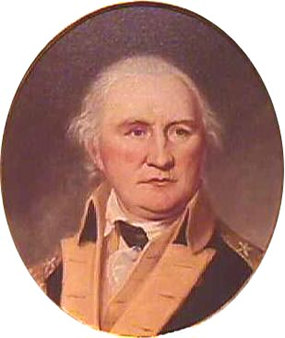
Of course, not everyone was equally impressed. A correspondent to Alexander Purdie’s Virginia Gazette on 15 November noted that report from Maryland and responded, “it is no more than what has been frequently done by the Virginia riflemen.” (As John Adams was fond of saying, “Virginian geese are always swan.”) One company of the Virginian riflemen was commanded by Capt. Daniel Morgan, shown above.

This talk is scheduled to start at 6:30 P.M., after on-street parking becomes available nearby. It is free and open to the public.

Tuesday, May 12, 2009

More Suggestions for Whom to Follow through the Revolution

On Monday, guest blogger Ray Raphael asked which eighteenth-century Americans you might follow to tell the story of the overall Revolution. I shared some of my ideas this morning.

Boston 1775 reader David Churchill Barrow braved the challenge and suggested:

  • Nathaniel Greene: Lapsed Quaker, so perhaps there was some struggle of conscience, or a rebellion against upbringing. Saw and influenced the war in both the north and the south. Washington would have wanted him as his own replacement, should he have gone down in the fight.
  • Benedict Arnold: Saw the war from both sides. Snubbed early hero. Very complex character, and again with a family background that may have inspired him for both good and bad. He and Peggy were an “it” couple, Like Brad Pitt and whoever today.
  • Daniel Morgan [shown here]: Coolest and most mysterious character of them all. Makes Davy Crockett look like a mere piker.
  • William Lee (Washington’s valet): Personal perspective from inside the inner circle. Also an African-American point of view.
  • Andrew Jackson (as a boy): How the hardships of the war had lasting effects.
Ooh—a young person’s experience! Intriguing. And good coverage of the crucial southern theater.

In addition, Bloomfield Bob commented:
I, for one, hope James Otis is a character! I'd love to learn more about this guy.
Otis is indeed a fascinating character, but his story really ends before the war begins. Though he lived to 1783, Otis was so mentally unstable after 1770 that the Boston Whigs had to worry about him more than the Crown. The best modern discussion of him appears in John J. Waters’s The Otis Family in Provincial and Revolutionary Massachusetts (1968).

More suggestions and comments welcome!