J. L. BELL is a Massachusetts writer who specializes in (among other things) the start of the American Revolution in and around Boston. He is particularly interested in the experiences of children in 1765-75. He has published scholarly papers and popular articles for both children and adults. He was consultant for an episode of History Detectives, and contributed to a display at Minute Man National Historic Park.

Subscribe thru Follow.it


•••••••••••••••••


Showing posts with label William Harris. Show all posts

Sunday, May 18, 2025

“What Stock you had upon the Island”

Most islands in Boston harbor weren’t convenient for living on, but some were good for keeping livestock.

Cattle and sheep could graze on the natural grasses, taking in adequate water and salt, and they couldn’t run away.

That meant that as the Revolutionary War began, several islands had a lot of animals on them, as well as pasturage that could feed horses.

As the same time, the British military found itself penned up inside Boston, cut off from the town’s usual supply of food from the countryside.

It would take about six weeks before the government and merchants of London would hear of the outbreak of war, another six weeks before any supply ships they sent in response would arrive at Boston. The royal authorities therefore had to secure their own provisions for the next three months. Of course, that was a concern for Boston’s civilian authorities as well.

Leaders of the Massachusetts Provincial Congress saw the same situation. Recognizing that it was to their advantage to starve out the enemy, the committee of safety told farmers around the harbor not to sell provisions to anyone in the British military. Of course, that was easier said than done.

Boston selectman Oliver Wendell owned animals on Hog Island. “Greatly shocked by the Nervous Disorder,” he had left Boston for Newbury before the fighting broke out. His former apprentice Henry Prentiss therefore was trying to manage Wendell’s assets for him from Charlestown.

Of course, neither of those merchants actually handled the animals; that was the job of an employee named William Harris. On 9 May, Prentiss told Oliver Wendell, “Harris continues [on the] Island and sells to every one that comes.”

That wasn’t entirely voluntary. The next day, a man named Elijah Shaw told the committee of safety that British soldiers had “robbed him of 11 cows, 3 calves, a yearling heifer, 48 sheep, 61 lambs, 4 hogs, and poultry, hay 5 tons, and almost all his furniture.” The military was confiscating valuable provisions from people who wouldn’t sell.

On 12 May, Prentiss sent more details, starting with an inquiry from one of Wendell’s fellow selectmen, Thomas Marshall:
Coll. Marshall sent over here to know what Stock you had upon the Island, upon which I sent Mingo to the Island to bring an account to me.

He tells me Mr. Harris is very uneasy, the people from the Men of War frequently go to the Island to Buy fresh Provision, his own safety obliges him to sell to them, on the other Hand the Committee of Safety have thretned if he sells anything to the Army or Navy, that they will take all the Cattle from the Island, & our folks tell him they shall handle him very rufly.
Mingo was enslaved to Wendell, it appears, and trusted by him. At the start of the month another mercantile partner, Nathaniel Appleton, reported that Mingo had just gotten out of besieged Boston and “will give you more particulars of the Town.” Then the man returned from Newbury to Charlestown, doing this job for Prentiss.

Sunday, August 18, 2024

The Life of “an exceeding active Man”

As I recounted this past week, in the summer of 1774 Elisha Porter of Hadley traveled to New York, Providence, and at least some way to New London seeking military supplies for the Continental Army besieging Boston.

In late September, the Patriot authorities called on Porter for another sensitive job: deciphering the letter that Dr. Benjamin Church, Jr., had given to his mistress Mary Butler, and which she unwisely asked her ex-husband, Godfrey Wenwood, to send into Boston.

Elbridge Gerry gave Porter a copy of that letter to work on. Porter’s deciphering exactly matched one by the Rev. Samuel West. Gerry then spread around news of the results.

During those months Porter was also busy on many committees of the Massachusetts General Court, and in August 1775 he became sheriff of Hampshire County.

In January 1776, Porter volunteered to raise a Massachusetts regiment to go into Canada and shore up the effort to win over that territory by force. Gen. George Washington introduced him by letter to Gen. Philip Schuyler as ”Colo. Porter, said to be an exceeding active Man.” I think that praise is a little faint for someone who had worked directly for the general.

Washington also gave Porter instructions urging him to act quickly, and the Massachusetts government supplied him with money.

Col. Porter started to keep a diary in January 1776, published in 1893. It describes how he got as close as the Plains of Abraham outside Québec City on 27 April, and how a week later the American forces started to withdraw.

Porter took a leave in August because of illness but returned in time to help with the Trenton campaign. He later served in the Saratoga campaign as a militia colonel and escorted Gen. John Burgoyne east. According to the Porter family, Burgoyne left his host a dress sword.

In 1778 Porter married a second time, to Abigail Phillips of Boston, first cousin of his first wife. That couple had no children, and I have no clue who brought up the young children of his first marriage while he was away from home.

After the war, Porter continued to serve as sheriff and militia officer and occasionally a town representative. He argued for Massachusetts to ratify the new U.S. Constitution. In 1796 he died unexpectedly at the age of fifty-four.

As for the other man involved in Gen. Washington’s plan to obtain gunpowder from Bermuda, sea captain William Harris appears to have gone back to sailing out of New London, Connecticut. He may have been the captain named Harris who spread word of a British fleet approaching New York in August 1776.

The 15 Mar 1809 Connecticut Gazette of New London reported the death of “Capt. WILLIAM HARRIS, aged 66 years.”

Friday, August 16, 2024

“The only Chance of Success is by a Sudden Stroke”

On 11 Aug 1775, Elisha Porter returned to Gen. George Washington’s headquarters with a letter from Rhode Island governor Nicholas Cooke, the second Cooke had sent within four days.

Both letters said the same thing about the general’s proposal to send an armed ship to Bermuda to collect gunpowder: Rhode Island couldn’t spare the resources to do it, and the Bermudans might deliver the gunpowder on their own.

That was not what Gen. Washington wanted to read. During the siege of Boston, he constantly sought to do something about the king’s troops in Boston. He felt the Continental Congress had sent him to drive that force out of Boston, not just to prod them until its commanders decided to leave.

The lack of gunpowder seemed like the biggest obstacle to any plan, so Washington was eager to take any action to fix that problem. Then he could get on to other schemes, like sending Col. Benedict Arnold up through Maine, launching armed schooners, or eventually proposing an attack across the frozen Charles River.

On 14 August, therefore, the general wrote back to the governor that the Bermuda plan was really good, and it depended on not quibbling and acting fast:
Having conversed with Collo. Porter and farther considered the Matter, I am of Opinion it ought to be prosecuted on the single Footing of procuring what is in the Magazine. The Voyage is short, our Necessity is great: The Expectation of being supplied by the Inhabitants of the Island under such Hazards as they must run, is slender: so that the only Chance of Success is by a Sudden Stroke. . . .

I should suppose the Captain who is to have the Direction of the Enterprize, would rather chuse to have Men whom he knew, and in whom he could confide in Preference to Strangers. From what Collo. Porter informs me, I do not see that [William] Harris’s Presence is absolutely necessary, and as his Terms would add considerably to the Expence, after obtaining from him all the Intelligence he could give, his Attendance might be dispens’d with.
Sea captain William Harris of New London, Connecticut, had come to Massachusetts proposing the voyage to Bermuda and obviously hoped to profit from it. Now Washington and Porter planned to milk him for information and cut him out of the deal.

Cooke didn’t write back until the end of the month. He hadn’t even proposed to the Rhode Island assembly that the colony undertake this mission, choosing instead to maneuver until he could work with a select committee. But he was still pessimistic: “At present the Undertaking appears to me extremely difficult. The most suitable Man we have for the Purpose is confined to his Bed by Sickness.”

Washington would not have been pleased to hear that.

TOMORROW: A mission from Rhode Island.

Thursday, August 15, 2024

“The General would be glad to confer with you”

Yesterday I started to profile Elisha Porter, as of July 1775 Hadley’s representative in the Massachusetts General Court and militia colonel.

Porter helped fellow lawyer Joseph Hawley of Northampton write this letter to the Continental Congress waxing eloquent on the need for more gunpowder:
Were you now in the Continental Army which invests Boston, it would beget unutterable vexation and torment in your hearts, to behold so large a body of so active brave men as that army consists of, insulted by the fire and blaze of the enemy’s cannon and mortars from their lines, ships, and floating batteries; and the same brave men, although possessed of divers good pieces of great ordnance, and willing, at any hazard, to improve them, yet wholly restrained from returning any fire of the kind, lest, by so doing, their little stock of gunpowder should soon be exhausted, and they reduced to the fatal necessity of laying down their arms or flying into the woods, leaving their houses to be burnt, their fields wasted; in short to give up and abandon the just claims of all America, and in effect to resign themselves and the lives of all the children of liberty in this whole Continent, to the arbitrary pleasure of a haughty Administration, instigated and influenced by enraged tories of our own breeding.
I couldn’t resist quoting that sentence, as transcribed by Peter Force.

In mid-July, Porter made a trip to New York, seeking “2 hhds Flints & 10 Tons Lead,” as the general wrote. He returned on 2 August, having succeeded in arranging for ”80,000 Flints & eight Tons of Lead.”

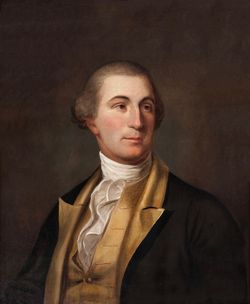
The next day, a council of war disclosed how little gunpowder the army had. Joseph Reed (shown above), Gen. George Washington’s military secretary, sent Porter a quick note:
If you could spare Time to ride down to Head Quarters this Afternoon the General would be glad to confer with you on a Matter of some Importance which you mentioned to him on your Return from New York
Porter made the short trip from Watertown to Cambridge. Later that day Washington wrote to Rhode Island governor Nicholas Cooke about the urgent need for gunpowder and the possibility of obtaining it from Bermuda, as quoted here. He concluded:
Col: Porter has undertaken to assist in the Matter or to provide some suitable Person to accompany [William] Harris to you who will communicate all Circumstances to you.
Porter personally carried that letter to Cooke. There was a brief glitch when they lost track of Harris, a sea captain who was continuing to shuttle among American ports. On 11 August, Cooke sent Porter back to Washington with a letter.

Gov. Cooke had already expressed his position: reports suggested that Bermudans were inclined to sell that powder to Continental forces, so there was no need to send a ship to the island, and besides Rhode Island didn’t have the resources for such a mission, anyway.

TOMORROW: The general’s response.

Tuesday, August 13, 2024

“They gave Information of the Powder”

As I quoted back here, on 3 Aug 1775 Gen. George Washington wrote to Gov. Nicholas Cooke of Rhode Island asking him to send all available gunpowder and lead.

Washington also urged the governor to dispatch one of the colony’s armed ships with a man named Harris to Bermuda to seize more gunpowder.

As I wrote yesterday, I think Harris was a Connecticut-based sea captain named William Harris.

Cooke wrote back promptly on 8 August. His responses were:
  • Rhode Island didn’t have that much gunpowder and lead left, and needed all it had.
  • The colony couldn’t spare either of its armed sloops.
  • There wasn’t enough money available to buy the gunpowder in Bermuda.
  • Washington’s agent, Elisha Porter, “can hear nothing of Harris…but is greatly apprehensive that he is fallen into the Hands of the Enemy.”
But aside from those details, Cooke was eager to cooperate with the general’s plans.

I believe Capt. Harris had gone on to New York. The 10 August issue of Rivington’s New-York Gazetteer reported that the Customs office had just cleared “Bittern, Harris,” to sail for “Rhode-Island.”

On 11 August, Cooke told Washington that Harris was back in Providence. And he had news to share about that powder in Bermuda:
Since my last to you Mr [Samuel] Ward One of the Delegates hath returned from the Congress. He informs me that some of the Bermudians had been at Philadelphia soliciting for Liberty to import Provisions for the Use of the Island. They gave Information of the Powder mentioned in your Letter to me, and were of Opinion it might be easily obtained. They were told by the Delegates that every Vessel they should send to the Northward with Powder should be permitted to carry Provisions to the Island. Whether their Situation will not probably prevent them from bringing the Powder I submit to your Excellency.
Gov. Cooke sent that letter back to Cambridge with Porter.

TOMORROW: The general’s operative.

Sunday, August 11, 2024

“Arrived here a Sloop from Bermuda”

As I quoted yesterday, on 4 Aug 1775 Gen. George Washington wrote to the governor of Rhode Island about what he’d heard about Bermuda from a man he called “One Harris.”

The editors of The Revolutionary Correspondence of Governor Nicholas Cooke identified Harris as “Captain Benjamin Harris,” but I don’t see what they based that on. I can’t find other mentions of Benjamin Harris in connection with Rhode Island or Bermuda.

I found clues in newspapers pointing in another direction. Rivington’s New-York Gazetteer for 15 June reported: “sloop Bittern, Harris, [cleared for] Bermuda.” And on 27 July: “Bittren, Harris, Bermuda” was among the inward entries, the only one from that island. The 31 July New-York Gazette reported that sloop as “Brittain, W. Harris.”

In addition, the 24 July New-York Gazette reported:
Friday Night last [i.e., 21 July] arrived here a Sloop from Bermuda: By Letters from thence we learn, that the Inhabitants of that Island are greatly alarmed at the present Situation of publick Affairs, being under the most dismal Apprehensions of Starving; to prevent which they have passed a Law, that no Provisions should be sent off the Island at any Rate whatsoever; and were about dispatching a Vessel to Philadelphia, to request the Honourable the Continental Congress to take their Case into their most serious Consideration.
That was reprinted in the 27 July New-York Journal and from thence in the 2 August Massachusetts Spy and the 3 August New-England Chronicle.

Thus, we have a ship’s captain named “W. Harris” arriving from Bermuda on a ship named something like the Bittern, probably bringing political news, in time to make his way to Gen. Washington’s headquarters in Cambridge with an offer.

Another clue about Harris appears in Gov. Cooke’s 8 August response to Washington saying that he didn’t know where the man was. Washington’s agent Elisha Porter was “bound as far as New-London to endeavour to meet with him,” indicating that people perceived Harris as most likely to surface in New London, Connecticut.

That took me to my favorite smuggling merchant, Nathaniel Shaw of New London. His letter book shows he employed two captains named William Harris in the early 1770s. He wrote sometimes of William Harris, sometimes William Harris, Jr., and most often simply ”Harris.”

The 10 May 1771 New-London Gazette reported among the ships cleared out of that harbor “Sloop Bittren, Harris [to] New York.” On that same say Shaw sent a letter to Peter Vandervoort in New York with a shipload of molasses overseen by “Wm. Harris Junr.” The 6 Dec 1770 Pennsylvania Journal likewise links a “W. Harris” with the “Sloop Bittern” traveling between New York, Philadelphia, and New London. Several newspapers in 1770 render Harris’s ship as the “Bittren.”

Two years later, the 23 Apr 1773 New-London Gazette shows “Capt. William Harris, late of New-London,” had died and one of the estate administrators was “William Harris”—no doubt formerly Jr.

Thus, I propose that the “One Harris” who visited Gen. Washington in August 1775 with a proposition regarding gunpowder was William Harris of New London, Connecticut, a ship captain recently returned from Bermuda on a sloop called something like the Bittern.

COMING UP: Mission to Bermuda.

Wednesday, March 11, 2009

Questions on a Silver Mug

Yet another news story with Revolutionary roots appeared in last Sunday’s Boston Globe, this time in the arts news. As Linda Matchan reported, officials in the Massachusetts Treasurer’s office found a mug made in the early eighteen century by Boston silversmith Andrew Tyler in an abandoned safe-deposit box. The Museum of Fine Arts has now acquired the item from the heir of the couple who had rented that box.

The article states:

The mug, it appears, was made by Tyler sometime in the early to mid-1700s for a highly-placed local judge named Robert Auchmuty Jr., famous for being one of the defense attorneys during the Boston Massacre, with co-counsel John Adams.

For reasons unknown, Auchmuty relinquished it. “He had to leave Boston in a hurry because he was a loyalist; he got the boot,” said Harris. “It’s possible the mug went from his family to mine when he had to leave. It might have been a fire sale situation.”

Somehow it ended up in the possession of Harris’s ancestor, Thaddeus Mason Harris, a Unitarian minister who grew up in Charlestown. During the Battle of Bunker Hill, the British burned Charlestown and the family fled from their home with only a few prized possessions, including the mug.
The source of that information appears to be the handwritten note found with the mug, which goes all the way back to...1976. And I see a number of reasons to do some more research. The details of that story don’t connect.

First, in the video that accompanies the Globe story, M.F.A. curator Gerry Ward estimates that Andrew Tyler made the mug about 1730; at the latest, he must have finished before 1741, when he died. The Robert Auchmuty described above was born about 1723, so he was still in his teens when Tyler made the mug. Perhaps the first owner was actually that man’s father, also called Judge Robert Auchmuty (but a judge on the Massachusetts Superior Court rather than the Vice Admiralty Court).

Yet another complication: Ward states on the video that the initials on the mug’s bottom are “M over T E,” and obviously expects those to be the initials of its first owner. So how is Auchmuty connected?

Then there’s the fact that the Loyalist Robert Auchmuty was living in Roxbury until 1774. The Harrises were living on the other side of Boston and the other side of the Charles River. It seems unlikely that their paths would casually cross, and I don’t see any sign of a family relationship.

The Harris family fled from Charlestown before the Battle of Bunker Hill, as did most of their neighbors; nobody wanted to be caught in the war zone. This is how the move is described in what appears to be the earliest biography of Harris, a letter written in 1849 by a clerical colleague:
After the first hostile demonstrations on the part of the mother country, at Lexington, fears were entertained for the safety of Charlestown; so that, just before the battle of Bunker Hill, Mr. [William] Harris fled, with his family, in the hope that they might somewhere find a refuge from the threatening danger.

Accordingly, with a few necessary articles of clothing, such as they could carry in their hands, they set out on foot,—Thaddeus, then not quite seven years old, leading his twin sisters next in age to himself, the father and mother each carrying a child, and an aged grandmother also making one of the company. They spent the first night at Lexington with a remote relative [another biography says at Munroe’s Tavern]; and, while there, an empty wagon was about leaving, in which they bespoke a passage to any place to which the owner was bound.

Accordingly, they were carried to Chookset, part of Sterling, where Mr. Harris took a small house, and supported his family by keeping a district school. Meanwhile, he went to Charlestown, and brought away a few articles of value which he had left behind. But soon the Battle of Bunker Hill took place, Charlestown was laid in ashes, and the house of Mr. Harris, with whatever of its contents remained, was demolished.

Shortly after this, he joined the Army as Captain and Paymaster; and, on a visit to his family, died of a fever, October 30, 1778, aged thirty-four years.
So even if William Harris did acquire the silver mug before Bunker Hill, it wasn’t there during the battle.

Furthermore, those biographies go on to describe Thaddeus Mason Harris’s poverty after his father died: living with one relative or benefactor after another, begging lunch from schoolmates after giving his own food to his mother, and making brooms, axe-handles, and cat-gut to pay his way toward Harvard. If the family had recently acquired a silver mug with no sentimental value, why didn’t they sell it?

It seems more likely to me that Harris came by the mug in middle age, when he was a minister in Dorchester. During that time he wrote many books and was a leading Freemason. He later served as Librarian of the Massachusetts Historical Society. If I’d had a bit of old silver from Roxbury to sell, the Rev. Mr. Harris might well have struck me as a likely customer.