J. L. BELL is a Massachusetts writer who specializes in (among other things) the start of the American Revolution in and around Boston. He is particularly interested in the experiences of children in 1765-75. He has published scholarly papers and popular articles for both children and adults. He was consultant for an episode of History Detectives, and contributed to a display at Minute Man National Historic Park.

Subscribe thru Follow.it


•••••••••••••••••


Showing posts with label Province House. Show all posts

Tuesday, August 05, 2025

“On the Alarm being given…”

The Massachusetts Patriots weren’t the only folks building an alarm system over the winter of 1774–75.

On 30 December, Gen. Thomas Gage set out this plan for his garrison in case they were attacked from the countryside:
The Alarm Guns Will be Posted at the Artillery Barracks, the Common & the Lines, the Alarm given at either of those places, is to be repeated at all the rest, by firing three Rounds each.

On the Alarm being given the 52d Regt. is immediately to Reinforce the Lines, leaving a Captain & 50 at the Neck, The 5th Regt. will draw up between the Neck Guard & the Liberty Tree.

The 4th or Kings own Regt. will Reinforce the Magazine Guard with a Captain & 50 and with the Remainder draw up under Bartons Point.

The 43d Regt. will join the Marines & together defend the Passage between Bartons Point & Charles Town Ferry.

The 47th Regt. will draw up in Hanover Street securing both the Bridges over Mill Creek.

The 59th Regt. will draw up in the Front of the Court House.

The 3 Companies of the 18th Regt. joined by those of the 65th Regt. the 10th 23d & 38th Regts will draw up in the Street between the Generals House & Liberty Tree.

Majors [William] Martins Company of the Royal Regt. of Artillery will move with expedition to the Lines, Reinforcing the Neck with one Commission’d Officer 2 Non Commission’d & 12 Men the Remainder of the Royal Regt. of Artillery will get their Guns in order & wait for orders.

If any Alarm happens in the Night, the Troops will March to their Post without Loading, & on no Account to Load their Firelocks, it is forbid under the Severest Penalty to fire in the Night, even if the Troops should be fired upon, but they are to Oppose & Route any body that shall dare to Attack them (with their Bayonetts) And the greatest care will be taken that the Countersign is well known to all the Corps & Small Parties, Advanced, that in case of meeting they should know their friends & not Attack each other in the Night thro’ Mistake.

The Officers Commanding Regts will Reconoiter the Streets leading from their Quarters, to their Respective Alarm Posts. & fix upon the Streets they intend passing thro’, each taking a different Route.
Bartons Point was the northwest tip of the town, sticking out into the Charles River. It’s striking that the army adopted the designation “Liberty Tree” for the big elm in the South End, despite its political origin.

Gen. Gage’s plan was never implemented, of course. On 20 Apr 1775, he stated: ”All former Orders Respecting Alarm Posts to be Cancel’d, & the Regts. to form in their Barracks.”

Friday, January 26, 2024

“In a most Deploreable and Dangerous Setuation”

Yesterday I quoted the Massachusetts Spy report on the 25 Jan 1774 mob attack on John Malcolm.

Here’s the Customs officer’s own account, as quoted by Frank W. C. Hersey from a “memorial” (memorandum) to the Massachusetts government asking for compensation:
…a Number of People assembled at the House of your memorialist in Boston and after insulting him with opprobrious Language, under a False pretence of his haveing the Same day used a Boy Ill in the Street, they Broke his windows and endeavourd forcibly to Take him out of his House, but from the Natural Opposition he made, or Some friendly Interposition they thought Proper to Desperse—

That about Eight OClock in the Evening of the same Day a vast Concourse of people again beset the House of your memorialist, Who were Armed with axes Clubs &ca and Broke open the door and Windows of the Lower appartments on which he Retired to an upper Chamber to make what Deffence he Could but One Mr Russell Declareing himself to be the friend of your memorialist, Came Into the Room with all the appearances of Friendship, shook hands and at same Time Desired he might be permitted to Look at the sword of your memorialist which was the only weapon he had for his immediate Deffence, which request being granted he siezed the sword and Calling out to the people assembled as afore said, they immediately Rushed in, and by violence forced your memorialist out of the House, and Beating him with Sticks then placed him on a sled they had Prepaird and Draged him before the Custom House where they gave three Huzza’s they afterwards Took him out of the sled and put him into a Cart, and Notwithstanding the severitty of the weather, Tore of his Clothes, and Tarrd and Featherd his Naked body, and in that setuation Carried him before the Provience House and ordered him to Curse The Governor and say he was an Enemy to his Country but your Memorialist Refused—

from thence they prosceeded with him to Liberty-Tree so Called, where they again ordered him to Curse the governor and the board of Commissioners, and say they were Enemyes to this Countrey, and Commanded him also to Resigne his Commission; all which he Refused.

that your Memorialist asked the People what he who was their friend had Done to Desplease them, they answered he was an Enemy to the Countrey and that they would soon serve all the Custom House officers in Like manner—

that from Liberty Tree they Carryed your Memorialist to the Gallows, put Round his Neck a Rope and threatned to Hang him if he would not Do as they had before ordered him, but he still Refused Desiring and praying they would put their threats in Execution Rather than Continue their Torture, they then Took the rope off his Neck and Tying his hands Fastned him to the Gallows, and beat him with Ropes and Sticks in most savage manner, which Compeled him to Declare he would do any thing they Desired, upon which they unbound him, and obliged him to Curse the governor and the Board of Commissioners, and Declaring at the same Time they would serve the governor in the Same manner, and Extorted a promise from him to assist &ca

and Returning with him to Liberty Tree then they made him Repeat several oathes, among which one was that he would not Discover [i.e., identify] any of the persons then present; and Carting him through the Town stopd before the Provience House and made him Repeat the above mentioned oathes.

Dureing these Transactions several Humane gentlemen at Divers Times offerd him gairments to Cover him but his Tormentors would not suffer that Indulgence, at Length they Carried yr memorialist to his House, in a most mizerable setuation Deprived of his senses

that your Memorialist is now Confined to his bed, in a most Deploreable and Dangerous Setuation in Consequence of the afore said Treatment,…
Malcolm’s account agrees in most respects with the newspaper report, as unsympathetic as that was to him.

Ann Hulton, sister of Customs Commissioner Henry Hulton, also described the attack in a letter, including some details Malcolm didn’t mention:
  • “his arm dislocated in tearing off his cloaths”
  • “This Spectacle of horror & sportive cruelty was exhibited for about five hours.”
  • “they demanded of him to curse his Masters The K: Govr &c which they coud not make him do, but he still cried, Curse all Traitors.”
  • “They say his flesh comes off his back in Stakes [steaks]”
Living in Brookline, Hulton was almost certainly passing on secondhand information. Some of her added details might be correct while others, such as Malcolm being encouraged to curse “The K[ing]:,” were probably exaggerated.

One detail in both Malcolm and Hulton’s accounts was that the Customs man was “naked” when he was tarred and feathered. The Spy stated he was stripped “to buff and breeches.” The latter is probably more accurate for our understanding, the term “naked” being less absolute in meaning then.

TOMORROW: Bringing tea into it.

(The picture above is an engraving published in London in October 1774. Titled “A New Method of Macarony Making as practised at Boston in North America,” it depicted the attack on Malcolm without using his name. This cartoon shows one of the attackers wearing a hat with the number “45” on it, linking this incident back to support for John Wilkes’s court cases in the early 1760s.)

Saturday, November 17, 2018

“The town was altogether under the government & controul of the military power”

One of the things that Bostonians found most irritating about the British army regiments who arrived in the fall of 1768 was how they posted armed guards around town.

There were sentries at the gate on the narrow Neck to the mainland. There were sentries in front of major government buildings like the Province House, where the royal governor lived, and at the houses that commanders rented for themselves. That meant armed soldiers were standing at some of the busiest corners of the town.

Yesterday I quoted the Whigs’ “Journal of Occurrences” huffing about rude and even violent guards on the Neck and elsewhere.

On 5 December Samuel Adams as “Vindex” complained in the Boston Gazette:
I Can very easily believe that the officers of the regiments posted in this town, have been inform’d by our good friends [i.e., royal officials] that the inhabitants are such a rude unpolish’d kind of folks, as that they are in danger, at least of being affronted during their residence here; and therefore their placing centinels at their respective dwellings seems to be a natural precaution, and under that apprehension may be a necessary step to guard their persons from injury.

Or if it be only a piece of respect or homage every where shown to the superior officers of the army, it is a matter which concerns no other persons that I know of, I am sure it is no concern of mine: In this view it is a military custom, in no way interfering with, obstructing or infringing the common rights of the community.

But when these gentlemens attendants take upon them to call upon every one, who passes by, to know Who comes there as the phrase is, I take it to be in the highest degree impertinent, unless they can shew a legal authority for so doing.

There is something in it, which looks as if the town was altogether under the government & controul of the military power: And as long as the inhabitants are fully perswaded that this is not the case at present, and moreover hope and believe that it never will, it has a natural tendency to irritate the minds of all who have a just sense of honor, and think they have the privilege of walking the streets without being controul’d.
When the regiments first arrived in Boston, the royal authorities had been worried about locals rising up and attacking those men. But there was no rebellion. Indeed, the Whigs themselves worked to channel public anger into political, not physical, resistance.

So why did the army command keep the sentries out stopping everyone coming into and leaving the town or passing major landmarks? Sure, that provided more protection, but it also exacerbated people’s anger, which could only lead to more trouble in the future.

Part of the answer is that setting up sentry posts is what armies did. It was how garrisons worked. It kept the men occupied, trained, and alert.

But another part of the answer is that the commanders weren’t really trying to stop civilians. They were trying to stop deserters from their regiments.

On 1 November the “Journal of Occurrences” reported:
The last night a soldier passed the guards, at the south part of the town, and was haled, but not answering, they followed and fired at him several times, and being impeded in running by the sea-weed on the beach, he was taken and brought back to the guards: This man was present at the execution [of Richard Eames] in the morning, but nothing is like to prevent desertion while the troops remain in this place.
The army was thus locked in a vicious cycle. The Crown had ordered those regiments to keep peace inside Boston, not out on Castle Island. But being stationed in a populous town made it easier for soldiers to escape. Which meant the army had to set up sentries, search parties, and firing squads to stop deserters. Which angered the civilian population and only made it harder to keep the peace in Boston.

Saturday, September 22, 2018

Opening Day for the Massachusetts Convention of 1768

On Thursday, 22 Sept 1768, 250 years ago today, the Massachusetts Convention met for the first time in Faneuil Hall. Participants were dubbed to be “committees” from their respective towns.

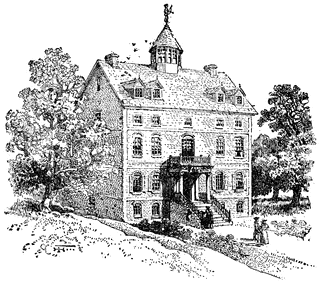
Gov. Francis Bernard sent a strongly worded message from his official home, the Province House (shown here):
As I have lately received from his Majesty [i.e., the Crown government in London] strict Orders to support his constitutional authority within this Government [i.e., in the province of Massachusetts], I cannot sit still and see so notorious a violation of it, as the calling an Assembly of the people by private persons only. For a meeting of the Deputies of the Towns is an Assembly of the Representatives of the people to all intents and purposes; and it is not the calling it a Convention what will alter the nature of the thing. . . .

It is therefore my duty to interpose at this instant, before it is too late. I do therefore earnestly admonish you that instantly and before you do any business, you break up this Assembly and separate yourselves. I speak to you now as a friend to the Province, and a well-wisher to the individuals of it.
Andrew Oliver, the royal secretary of Massachusetts, delivered that message to Thomas Cushing, the Convention chairman (usually speaker of the Massachusetts house). The Convention records noted that the letter was:
said to be by Order of the Governor, but not being signed, it was by a Vote of the Committees returned to the Secretary, with Assurance to him that they should be always ready to pay all due Respect to any Messages which they might be assured should come to them from the Governor of the Province.
The Convention then approved a petition to Gov. Bernard asking him to convene the Massachusetts General Court. Back in June, the governor had ended a legislative session because the lower house refused to rescind its Circular Letter to other colonies. Bernard had explicit orders from the ministry in London to take that action.

The governor therefore declined to receive the petition from the small committee that brought it, sending a note in reply:
Gentlemen,

You must excuse me from receiving a Message from that Assembly which is called a Committee of Convention; for that would be to admit it to be a legal Assembly; which I can by no Means allow.
The Convention responded that this letter wasn’t signed, either. But the three delegates who had been to the Province House “declared in Writing under their Hands that his Excellency delivered the same to them.”

The Convention and the governor having each refused to recognize the other, the first day of the momentous gathering came to a close.

TOMORROW: Meanwhile, in the Council Chamber…

Friday, May 25, 2018

Going through the Motions on Election Day

On 25 May 1768, 250 years ago today, Election Day finally arrived in Boston.

At 9:00 A.M. the towns’ representatives to the Massachusetts General Court gathered in the Town House and took their oaths of office. They unanimously reelected Thomas Cushing as the assembly’s speaker and Samuel Adams as the clerk.

At 11:00, Gov. Francis Bernard walked over from his official residence, the Province House, escorted by two upper-class militia units: the Horse Guards under Col. David Phips and the Cadets under Lt. Col. Joseph Scott. Bernard received Cushing and approved the assembly’s choice, and then everyone walked a block to the Old Brick Meeting-House to hear a sermon by the Rev. Daniel Shute (1722-1802) of Hingham.

Shute had chosen to speak on Ezra 10:4: “Arise: for this Matter belongeth unto thee; we also will be with thee: be of good Courage; and do it.” While hearing that exhortation to action, the gentlemen got to sit for a long time. According to merchant John Rowe, “This was a very long sermon, being one hour & forty minutes.”

Then came the midday dinner. Boston’s town meeting had barred the use of Faneuil Hall as long as the governor invited the Commissioners of Customs to dine. Many of the Cadets had said they wouldn’t participate in any such event, either. But Gov. Bernard was not about to back down on an issue of respecting the royal prerogative.

Therefore, there were two dinners on that Election Day. As the 26 May 1768 Boston News-Letter reported, Bernard and Cushing “together with the Council, and several other Gentlemen, went in Procession to the Province House, (preceded by the Militia Officers, and escorted by the Cadets,) where an elegant Dinner was provided by His Excellency…”

Meanwhile, “A public entertainment was provided at the British Coffee-House, where the militia Officers, Troop of Guards, and Company of Cadets dined, & where also many loyal Toasts were drank.” There were also traditional cannon salutes from the North and South Batteries and Castle William.

The week before, most of the Cadets were refusing to promise to participate in the Election Day pageantry. Maj. John Hancock had reportedly torn up his commission, and company members talked about replacing Lt. Col. Scott as their commander. But, most likely because of an after-hours meeting that Thomas Flucker facilitated between Hancock and Gov. Bernard, the Cadets did escort the governor after all. The separate dinners meant they didn’t have to sit down with the Customs Commissioners.

There may have been another part of the deal. On 2 June, the News-Letter reported:
His Excellency the GOVERNOR hath appointed JOHN HANCOCK, Esq; to be first Major of the Independant Company of Cadets, and WILLIAM COFFIN, jun. Esq; to be second Major of the said Company.
Hancock already held the rank of major; I don’t know if becoming “first Major” was a promotion. Nor can I tell if he participated in the Cadets’ procession on Election Day or sat that one out. But, even after his vocal protest, Bernard restored Hancock’s high rank.

Hancock may have come around to the position that the Cadets should respect the office of the governor even when they disagreed with his actions. In May 1773 there was another controversy over the presence of the Customs Commissioners at an Election Day gathering. Two Cadets, Moses Grant and James Foster Condy, clubbed their muskets and participated in the raucous protest outside. By then Hancock had become the colonel in charge of the company, and he booted Grant and Condy out.

In the end, the public dispute about the Customs Commissioners and the dinner was symbolic. But Election Day was also about allocating real political power.

TOMORROW: Electing the governor’s Council.

Friday, April 27, 2018

Sometimes a Kitchen Just Wants to Look Pretty

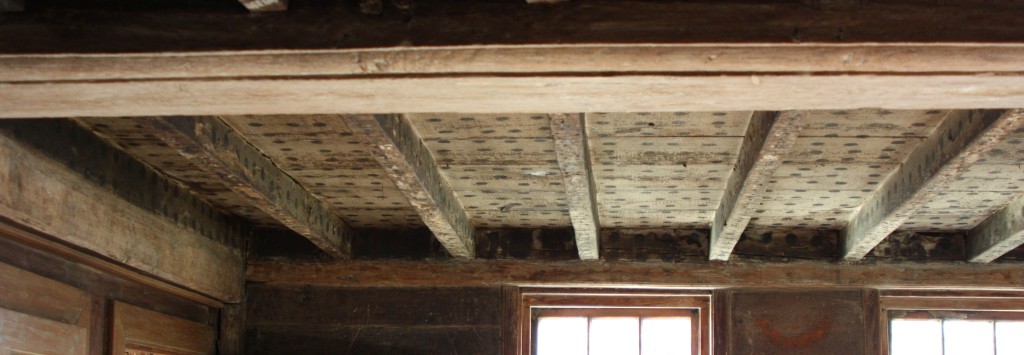
With Patriots’ Day putting the Arlington Historical Society’s Jason Russell House back in the news, I followed a path to this 2015 article from the Arlington Advocate about something else notable in that house: the dotted pattern the kitchen ceiling.
Surviving free-hand painting in Colonial interiors is rare, but it is preserved on the ceilings (and sometimes the wall sheathing) of a few other 17th and 18th century New England houses. For example, the kitchen ceiling of the Buckman Tavern in Lexington is enlivened with roughly painted chevrons; the White-Ellery House in Gloucester displays a pattern of semi-circular slashes; and a portion of a preserved ceiling from a demolished house in Dartmouth goes wild with a combination of commas, chevrons and a few splashes of color.

The decorative technique employed in the Russell kitchen is one that Colonials called “spotting,” now sometimes referred to as “sponge painting.” Only a handful of similar examples still exist. The wall sheathing of the upper hallway of the Boardman House in Saugus reveals a fairly regular pattern of black dots of about one and a quarter inches in diameter on a light background, while the kitchen ceiling of the Sherburne House in Strawbery Banke Museum in Portsmouth, New Hampshire, is boldly decorated with larger grey dots on a dark red ceiling.

Closer to home, the inside of a small, bullet-scarred door panel from the old Adams House, now in the Arlington Historical Society collection, shows an irregular distribution of starburst-like black spots on an unpainted wood ground. In none of these instances does it seem that the painters employed an actual sponge; instead, they may have applied their spots by skillfully twirling a round brush or by stamping the pattern on with a blunt, semi-absorbent object such as the broad end of a corncob.

Spotting and other decorative ceiling designs reached their popular peak around the turn of the 18th century, and the Russells’ spotted ceiling therefore would seem to support an earlier theory that the house was built the 1680s. However, later scholarship and a dendrochronology study in 2012 suggest a construction date of 1740-1750. Such a late date for the Russell polka dots is not out of the question. In 1738, for example, the painter Samuel Heath charged the Province of Boston for “colouring and spotting a Large Kitchen” in the no longer extant Province House.

The Jason Russell House’s polka-dotted ceiling probably owes its survival to the fortunate decision by a later Russell resident of the house to ‘modernize’ by plastering it over. Thus, it was safely preserved until the Historical Society’s restoration in 1924.
The Jason Russell House is open for visitors every Saturday and Sunday from 1:00 to 4:00 P.M. until Columbus Day.

Tuesday, May 17, 2016

“Unaffected Gaiety” on the Repeal of the Stamp Act

News that Parliament had repealed the Stamp Act arrived in Boston on 16 May 1766, as described yesterday. That quickly set off a public celebration.

The town’s newspaper printers collaborated on a broadside announcing the news from London (readable in more detail through the Massachusetts Historical Society).

The 19 May Boston Gazette reported:
It is impossible to express the Joy the Inhabitants in general were in, on receiving the above great and glorious News—

The Bells were immediately set a Ringing, and the Cannon fired under Liberty Tree and many other Parts of the Town. Colours were displayed from the Merchants Vessels in the Harbour, and the Tops of many Houses.

Almost every Countenance discovered an unaffected Gaiety on the Establishment of that Liberty which we were in the utmost Hazard of losing.
The “Cannon fired under Liberty Tree” must have been two small brass guns owned by the new Boston militia artillery company led by Adino Paddock. The “Colours” on display everywhere where variations on the British national flag.

The Whigs who had opposed the new tax so fervently weren’t the only ones glad that it was gone. John Temple, the Surveyor General of the Customs service in the port of Boston, must have been relieved to announce that he and his colleagues no longer had to worry about the unenforceable law.

Even Gov. Francis Bernard summoned his Council to share the news. He gave orders for the batteries in Boston, Charlestown, and Castle William to fire salutes in celebration of the news. He also invited those gentlemen to come to his official residence, the Province House, to toast the king’s health on the evening of Monday, 19 May.

That was perhaps a way to rise above the town’s official celebration, which at an afternoon meeting the selectmen scheduled for that same Monday evening. As a town meeting had already decided, there would be an illumination throughout Boston—candles in all the windows. (The governor authorized the Town House and Province House to be illuminated as well.) And there would be fireworks on the Common.

And those weren’t the last leaders heard from. On the evening of 16 May Boston’s “Sons of Liberty” had “a meeting…in Hanover Square,” near Liberty Tree, and “unanimously Voted”:
1. That their Exhibition of Joy on the Repeal of the Stamp Act be on the Common.

2. That the Fire Works be play’d off from a Stage to be erected near the Work-House Gates.

3. That there be an Advertisement published on Monday next, of the intended Exhibition, the place where, and the Time when it will end.
Thus, even as Bostonians prepared to celebrate their restored political unity with Britain, different levels of authority—the governor, the selectmen, and the Sons of Liberty or Loyall Nine—were jockeying to own the celebration.

Sunday, August 23, 2015

Another Account of the Stamp Act Protests

About a century ago, there was a trend in American publishing to issue the works of famous authors in multi-volume sets. Those were “limited and numbered editions,” but that often meant the publisher would print only a few hundred copies with the title page The Works of Alexandre Dumas, another few hundred copies as Alexandre Dumas’s Works, another few hundred as Dumas: The Complete Works, and so on.

As an added inducement to collectors, the publishers sometimes included actual manuscript pages with these sets. For example, as the Harvard Gazette recently reported, in 1906 Houghton Mifflin published a twenty-volume collection of Henry David Thoreau’s works with a page from Thoreau himself—a handwritten manuscript—bound into the first volume of each set.

Of course, this commercial transaction split that part of Throreau’s papers into 600 separate pieces. It was, Harvard curator Leslie Morris says, “a nightmare for people who want to actually work with the manuscripts.” Morris and his colleagues recently put a lot of effort into regaining one part of that trove, Thoreau’s account of looking for Margaret Fuller’s body and effects after she drowned in a shipwreck off Fire Island, New York.

Likewise, in 1876 the city of Boston published a special edition of the program for its Celebration of the Centennial Anniversary of the Evacuation of Boston by the British Army bound with “engravings, broadsides, newspapers, and manuscripts” from the Revolutionary period. Decades later that volume came to the Massachusetts Historical Society, and researchers realized one of those manuscripts was a previously unknown account of the 14 Aug 1765 Stamp Act protests. The society published that text in its Proceedings volume for 1966.

This manuscript is undated, unsigned, unaddressed, and probably unfinished. It appears to be a draft of a letter written on 15 Aug 1765. No one has identified the handwriting. The writer revealed no inside knowledge of the protest organizers. He (or she) wasn’t terribly sympathetic with those men or with the populace, but he (or she) didn’t write favorably about the royal officials, either.

Here are some extracts from that document:
Our Stamp Officer [Andrew Oliver] hung on one of the greatet Trees by Deac. [John] Eliots at the south End, resembling him as near in size Form and Dress as such a piece of Pagentry Would admit of with Diverse Libels hung on and a peic of Low Poetry descriptive of the Minds of the People. Near by was Boot with a Little Devil peeping out and thrusting the Stamp officer with a Horrid Fork. . . .

It was Observd that a Connecticut Man very attentively viewd the Image and at length took off the Lines on which some one asked him what he was about. He replied, that as he was going home he was only taking a Sample of the Fruit of that Tree, it would be seen more; for he was satisfied that some their Trees would bear the like. . . .

As Nightsun went down in an Instant a Crowd of People to the amount of a Thousand Suddenly appeard, but from whence they came none say—and with great Solemnity took down the Image put in a Coffin and carried it thro the main Street stop at the Governors [Province House, shown above] went up his Yard gave 3 Huzzas, on which all the People ran out in great surprise.
The letter described how the crowd visited the Town House and destroyed Oliver’s building, but I’ll discuss those passages later.
Some of the Mob went to the Secretarys [i.e., Oliver’s] House. The Lieut Governor [Thomas Hutchinson] who it is said followed them there with the High Sheriff [Stephen Greenleaf] drew their Swords and threatned them further that they got one or Two of them into a Room and shut the Doors in order to secure them, upon which the Mob was enragd and upon an Alarm given Crowds poured down from Fort Hill entered the House and the two great officers of State fled (the Secretary had already securd himself in Charles Paxtons house).

They took Possession went from Top to Bottom satisfied themselves with good Cheer broke all his Glass Windows &c. and Three very valuable Looking Glasses and then returned to fort Hill Where they were entertained with a good Bon Fire and Wine in flowing Bowls and at Eleven Clock dispersed.
And there the manuscript breaks off.

TOMORROW: The conspiracy theory of the Stamp Act protest.

Friday, April 15, 2011

“There will be hell to pay to-morrow”

Another story of how Boston’s Patriot leaders got early intelligence of the British march on 18 Apr 1775 credits a stable-worker in the center of town. The circumstances of this story are hazy, and it developed over time, but here’s as far back as I’ve been able to trace it.

Samuel A. Drake’s Old Landmarks and Historic Personages of Boston (1873) says:

A groom at the Province House [the royal governor’s mansion, shown here] dropped into the stables, then opposite the Old South on Milk Street, for a social chat with a stable-boy employed there. The news was asked of the British jockey, who, misconceiving the sentiments of his friend, replied, that he had overheard a conversation between [Gen. Thomas] Gage and other officers, and observed, “There will be hell to pay to-morrow.” This was immediately carried to Paul Revere, who enjoined silence on his informant, and added, “You are the third person who has brought me the same information.”
As usual, Drake didn’t provide a source for his anecdotes. He recorded this one over a decade after Henry W. Longfellow had made Revere famous as carrier of the news of that march. Revere wrote nothing about such a discussion in his 1798 letter about the day to the Rev. Jeremy Belknap.

The next year, Drake expanded on the story in Historic Fields and Mansions of Middlesex, adding a name:
John Ballard was the hostler at the stables on the corner of Milk and old Marlborough Streets, to whom the groom imparted the intelligence that “there would be hell to pay to-morrow”; but even he little thought how prophetic his language would become. Ballard was a liberty boy, but his informant did not suspect it. His hand trembled so much with excitement that he could hardly hold his curry-comb. Begging his friend to finish the horse he was cleaning, and feigning some forgotten errand, Ballard left the stable in haste. Not daring to go directly to Revere’s house, he went to that of a well known friend of liberty in Ann Street, who carried the news to Revere.
Drake’s first book had mentioned a man named John Ballard twice: once in regard to the “Paddock elms” planted along the edge of the Common beside Tremont Street, and once as proprietor of the British Coffee-House. But it hadn’t linked him to this anecdote.

In 1875, George William Curtis delivered a centennial oration at Concord that repeated Drake’s story about John Ballard and his trembling hand; that oration was reprinted many times over the following decades. Three years after that, in the privately published William Dawes and His Ride with Paul Revere, Henry Holland wrote:
On the afternoon of the day before the attack, [Dr. Joseph] Warren learned from several sources that the British were about to move. A gunsmith named Jasper got it from a British sergeant, and told Colonel [Josiah] Waters, of the Committee of Safety,—Dawes’s cousin; and he, of course, told Warren at once. John Ballard, in the Milk Street stable, heard one of the Province House grooms say that “there would be hell to pay to-morrow,” and made a pretext to run with the news to a friend of liberty on Ann Street (William Dawes, I think), who carried it to Revere, who told him he had already heard it from two other persons.
Holland’s version of events is, you might notice, quite Dawes-centric. He was a descendant of that Patriot.

Many authors have repeated variations of this story. But is it reliable? In particular, should we trust these authors’ identification of John Ballard as a source of information?

TOMORROW: Who is John Ballard? (Or, to be more accurate, who are John Ballard?)

Wednesday, June 24, 2009

Checking Out Some Specialized Blogs

Here are some interesting blogs I’ve come across, or learned about from alert Boston 1775 readers. Barbara Sarudy, author of Gardens and Gardening in the Chesapeake, 1700-1805, has a website on American Garden History, featuring lovely photographs and sources from the eighteenth century.

Sarudy has also created a blog on American Women of the Eighteenth Century. (And one on women of the nineteenth century, but that doesn’t concern us.) But be aware: something on that site—perhaps the changing portraits of women—that has caused trouble for my browser in the past. Clearly the problem isn’t Blogger’s Scribe template.

This spring the Massachusetts Historical Society’s Beehive announced an online gallery of items in the society’s collections of art, artifacts, and documents. Up above, for example, is the copper Indian figure that served as a weather vane atop the Province House, the royal governor’s residence.

Finally, one of my favorite unclassifiable blogs is Strange Maps. The entries don’t usually pertain to early America, but this one starts there; it’s a map of the geographical center of the U.S. population in the year of each census. Washington, D.C., turns out to have been extremely close to the new nation’s center of population (though not voters) in the country’s first three decades. After that, we can watch the American population move steadily westward, with a big jump in the 1850s because of the California gold rush.

Thursday, January 22, 2009

Old Boston Photographs on Flickr

After my recent postings on the now-demolished Galloupe House in the North End, Boston 1775 reader Richard De Fonce alerted me to the Boston Public Library’s Flickr set of Old Boston Photographs.

The collection includes a photograph of the Galloupe House on Hull Street, from the same perspective as its nineteenth-century engravings. I guess there was only one way to get a good look at it since it was hemmed in by other buildings.

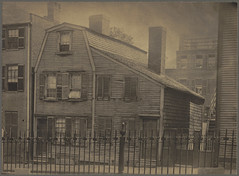
De Fonce noted that the nearby Hart House (shown here) is also identified as “Headquarters to General Thomas Gage during the Battle of Bunker Hill” in its online caption. However, this is clearly a case of “memory creep”; all the information about the Galloupe House in MacDonald’s Old Copp’s Hill and Burying Ground, including its construction date of 1724, has been assigned to the Hart House as well. Rambles in Old Boston shows and discusses what it calls the Hartt House without noting any Revolutionary significance.

The B.P.L.’s online collection includes a picture of Province House, official residence of the royal governors—where Gage definitely had his main headquarters. This is not a photograph but an engraving which was printed in many histories.

Province House remained standing until 1922, so why don’t we have good photographs of it? By the time photography was invented, the house had been hemmed in on all sides by other buildings. It no longer looked stately, as it did in the eighteenth century. In fact, it probably looked like what it had become: a dark, rundown commercial building.

I’m going to pull up and discuss other images from the B.P.L.’s collection as it strikes me, but here are some random highlights to check out:

Not all the buildings pictured in the collection go back to the Revolutionary War, and not all of them were significant in how that war turned out, but together they offer a glimpse of lost Boston.

Friday, January 16, 2009

“Military Headquarters of General Gage”?

Last month Boston 1775 reader John C. Beasley sent me a query about this picture of a house from Old Boston Days and Ways, written by Mary Caroline Crawford and published in 1909. It appears on page 86.

The caption identifies that building as Gen. Thomas Gage’s “military headquarters,” which raises two questions:

  • What’s the basis for that statement? Old Boston Days and Ways doesn’t mention this building anywhere else.
  • How does this caption square with Crawford’s statement on another page that Gage used the Province House as his Boston headquarters?
The Province House (often called simply “Province House”) was a large brick house on a spacious lot across from Old South Meeting-house, a couple of blocks from the center of town. Massachusetts maintained that house as the official residence of royal governors. Most histories agree Gage lived and worked there. Crawford’s book includes a picture of the Province House, so she clearly knew this was a different building. But what building was it?

TOMORROW: House hunting in colonial Boston.