J. L. BELL is a Massachusetts writer who specializes in (among other things) the start of the American Revolution in and around Boston. He is particularly interested in the experiences of children in 1765-75. He has published scholarly papers and popular articles for both children and adults. He was consultant for an episode of History Detectives, and contributed to a display at Minute Man National Historic Park.

Subscribe thru Follow.it


•••••••••••••••••


Showing posts with label Henry Champion. Show all posts

Friday, December 17, 2021

“An alledged libel against Julius Deming”
While researching the life of Elisha Horton, as I laid out yesterday, I came across newspaper articles about a local political controversy in the early 1800s.

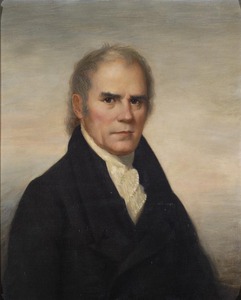
The other main figure in this story is Julius Deming (1755–1838, shown here). Born in Lyme, Connecticut, Deming became a captain of cavalry under his cousin Col. Henry Champion and then, also under cousin Henry, an army commissary at Litchfield.

As the war ended, Deming remained in Litchfield and set himself up as a merchant. He married Dorothy Champion, cousin Henry’s daughter. (Another daughter was Deborah Champion, and I wrote about her legend back in 2014.)

For business Deming traveled to London, traded with China, and formed partnerships with prominent men like Benjamin Tallmadge and Oliver Wolcott. He grew richer. He became the local magistrate and served in some state and county offices, though his family understood him not to enjoy politics. (This story suggests he had strong feelings about politics nonetheless.)

Among the businesses Deming invested in was a paper mill, where he hired Elisha Horton as his manager. One source tells me Horton started work at the Litchfield paper mill in the early 1790s, the other that he started work for Deming in the early 1800s. Maybe there were two mills, or maybe Deming bought a mill where Horton was already working for the previous owner.

The 1790s and 1800s of course saw the rise of party politics in the U.S. of A. New England Federalists like Julius Deming were shocked when Thomas Jefferson won the Presidency in 1800 and his allies made inroads in their region. Litchfield had two newspapers keeping an eye on each other: the Litchfield Monitor (Federalist) and the Witness (Republican).

By September 1805, if not before, Deming was in a feud with Selleck Osborn (1783–1826), the young publisher of the Witness. There was a dispute over coverage of a lawsuit involving Tallmadge and Wolcott. Then on 9 October the Witness published an article headlined “Reign of Terror” reporting that on the recent Election Day Deming had tried to intimidate a Republican voter.

On 11 December the Witness’s last piece of local news, festooned with a pointing hand, was:
Yesterday the Editor and Printer of the WITNESS, were indicted by the State’s attorney, for an alledged libel against Julius Deming, Esq.
That case hinged on Deming’s political methods. And when it went to court, a key witness was Elisha Horton.

TOMORROW: What Elisha Horton wanted to say.

Wednesday, January 15, 2014

A Second Look at Deborah Champion and “Uncle Aristarchus”

Yesterday I brought the story of the Deborah Champion letter into the 1970s, when the Bicentennial and the search for female heroes in American history brought her back into print. The rise of women’s history not only brought more attention to the experiences of women in the American Revolution, but also new rigor to the study of that history.

Apparently around that time—we don’t know exactly when—another version of the letter arrived at the Library of Congress. That document offered a more plausible October 1775 date and cut some of the more dubious details about the siege of Boston in the 1912/1926 text. It was also the first transcript to mention an original document, supposedly owned by descendants. And of course the Library of Congress Manuscripts Department carries a lot of authority in a footnote.

One of the major differences between the two texts of the letter is the figure of Aristarchus, the enslaved man who supposedly accompanied the young woman on her ride from Connecticut to Massachusetts. Aristarchus appears twice in the text first published in 1912:
So, dear Patience, it was finally settled that I should start in the early morning and Aristarchus should go with me. He has been devoted to me since I made a huge cake to grace his wedding with Glory and found a name for the dusky baby which we call Sophronista. For a slave he has his fair share of wits, also. . . .

Suddenly, I was ordered to halt; as I could n’t help myself I did so. I could almost hear Aristarchus’ teeth rattle in his mouth, but I knew he would obey my instructions and if I was detained, would try to find the way alone.
In the text at the Library of Congress, Aristarchus is more prominent. In fact, most of the passages that appear only in that version refer to him in some way. In addition, that text changes his wife’s name from Glory to Chloe.

The Library of Congress text also turns Aristarchus into even more of a comic character. At the outset of the journey, the letter states: “Uncle Aristarchus looked very pompous, as if he was Captain and felt the responsibility.” But when a British sentry appears out of nowhere, the narrator says, “I really believe I heard Aristarchus’ teeth chatter as he rode to my side and whispered ‘De British missus for sure.’” This version has no suggestion that Aristarchus might complete the journey on his own.

I suspect that the Library of Congress text is the later one, revised to fix some glitches in the text that Mary Rebecca Adams Squire had written out before 1912. The changing treatment of Aristarchus also suggests that the person who revised the letter thought readers would expect more comedy from the figure of a black slave. Ironically, those same parts of the letter feel most dated and discomfiting now, and since the 1970s authors have often edited them out while quoting other passages.

A final note on the man’s name: Deborah (Champion) Gilbert had a nephew named Aristarchus, born 23 Oct 1784 to her brother Henry, the Continental Army officer. Aristarchus Champion graduated from Yale in 1807, settled in Rochester, and had a long career in law, real estate, and philanthropy before dying a bachelor in 1871.

It would be quite remarkable for an upper-class family like the Champions to name one of their sons after a man they had kept as a slave. (To be sure, naming your twin sons Aristarchus and Aristobulus was remarkable to begin with.) I see the real, well documented “Uncle Aristarchus” as another reason to think that the Deborah Champion letter was concocted from a stew of half-remembered lore and details that seemed old-fashioned to someone in the early 1900s.

TOMORROW: A critical mass of Deborah Champion.

[The photograph above is Jacksonville Stumpe’s picture of the Township Hall in Chagrin Falls, Ohio. Aristarchus Champion inherited a considerable part of the land in that area, and in 1848 endowed the construction of this building as a town library. Champion never lived in Ohio, though.]

Friday, January 10, 2014

The Deborah Champion Letter as Historical Fiction

One quality of the Deborah Champion letter, in either version, that struck everyone on the team of researchers that Joseph Warren biographer Sam Forman assembled is its novelistic detail. In short, it reads like fiction. What’s more, Tamesin Eustis wrote, “Not only is it an extraordinarily well-organized ‘narrative’ that doesn’t read true for most letter-writing, it has the tone, style, and language of something written in a later era.”

Derek Beck said:
The letter is written to someone she is close to, but there seems to be language in the letter that is really meant as exposition to us the audience, as if the letter is not truly personal. One example: “John and Jerry are both good saddle horses as you and I know.” Well, if both “you and I know,” why I am explaining it? I see this in movie scripts all the time: crappy dialogue that feels unreal, and is the result of bad writing produced by a writer who is attempting to pass exposition to the audience but couldn’t find a natural way to do so.

In fact, this letter doesn’t really feel very familiar between the two at all. There’s nothing that seems to require insider knowledge between the two. I don’t feel like I’m a voyeur snooping on a personal letter, I feel like I’m reading a story, with words too polished for a mere personal letter.
In particular, I think the texts—especially the version published in 1912 and 1926—spotlight details that were quaint and historic to readers around the turn of the last century. For instance, the writer has a habit of mentioning garments and often even the cloth they’re made of: “small clothes for father,” “my linsey-woolsey dress,” “my camlet cloak,” “my close silk hood,” “her calash.” Almost all of those fabrics and garments had gone out of fashion by the early twentieth century. The letter says nothing about a straw hat or a linen gown or anything else that would still be familiar.

The letter—again, the earlier published version in particular—offers a lot of verbatim dialogue for verisimilitude, but again that conversation is made to seem antique. The Champions weren’t Quaker, but this is the way the letter has them speaking:
“Deborah, I have need of thee; hast thou the heart and the courage to go out in the dark and in the night and ride as fast as may be until thou comest to Boston town?”

“Surely, my Father, if it is thy wish, and will please thee.”

“I do not believe, Deborah, that there will be actual danger to threaten thee, else I would not ask it of thee, but the way is long and the business urgent. The horseman that was here awhile back brought dispatches which it is desperately necessary that General Washington should receive as soon as possible. I cannot go, the wants of the army call me at once to Hartford, and I have no one to send but my daughter. Dare you go?”

“Dare! father, and I your daughter,—and the chance to do my country and General Washington a service. I am glad to go.”
In short, the Deborah Champion letter reads like deliberately written historic fiction, albeit poorly researched.

TOMORROW: The Colonial Revival context.

[The appearance of The Turning of Anne Merrick above isn’t meant to suggest that Christine Blevins’s historical fiction is poorly researched. I just liked the cloak.]

Thursday, January 09, 2014

Rachel Smith on the Deborah Champion Letter

As I’ve described, a couple of months back Dr. Samuel Forman asked a bunch of Revolutionary-history contacts to assess a letter attributed to Deborah Champion of Connecticut describing a trip to Gen. George Washington’s headquarters early in the war. 

One member of that team is Rachel Smith, Assistant to the State Historian at the University of Connecticut, Hartford. I’m sharing her assessment of the Library of Congress text as a “guest blogger” posting.

Tone: If all the references to the Revolutionary War were removed and I were asked to date this letter, I would have placed it in the second quarter of the nineteenth century by its language and tone alone. The overwrought, flowery prose of the letter reeks of the popular writing sensibilities of the early-to-mid-1800s. Admittedly, the overwhelming majority of colonial documents I’ve read were written by men, but I’d still suspect this kind of over-the-top, hyper-descriptive, “sentimental” prose wasn’t commonly used by women until after the advent of female academies (last decade of the eighteenth century/early nineteenth century).

Also, the disconnect between the author’s writing style and the style of her father’s almost comically archaic speech strikes me as very odd—certainly unlike anything I’ve seen in correspondence of other young adults in that period (Quakers excepted). (I have seen slave/African dialects written out in the eighteenth century, but that was always to underscore their otherness; something one wouldn’t do with one’s respected father.)

Internal logic: There seems to be a lot of totally unnecessary description—e.g., “You know our Continental bills are so small you can pack a hundred dollars very compactly”; a contemporary wouldn’t need to be told any of that, but it sure is a wonderful (and convenient) visual for a Victorian audience totally unfamiliar with colonial paper money.

Timing: I’m not familiar with the context of this letter, but I wonder why Deborah would write such a long and explicitly detailed letter to her friend describing her “dangerous mission” when the wartime atmosphere was still an extremely volatile one in October of 1775. The liberal use of the phrase “The British” is anachronistic for late 1775 for the same reasons it would have be anachronistic for Paul Revere to yell “The British are coming” a few months earlier.

Specific language: Perhaps the most quantifiable evidence for this letter being suspect. The writer’s use of “family room” instead of “parlor” is an immediate red flag; according to the Oxford English Dictionary that term didn’t come into popular use in the United States until well into the mid-nineteenth century. Other anachronisms include “keeping-room” (O.E.D.: 1790s) and “stay-at-home” (O.E.D.: 1806). Many other phrases, like “a nice hot breakfast,” also strike me as extremely anachronistic, but those aren’t as easy to pin down chronologically.

Our thanks to Rachel Smith for her contribution to this inquiry. Things aren’t looking good for the letter’s credibility, are they?

TOMORROW: Novelistic detail.

[The photo above shows the Prudence Crandall Museum, a Canterbury, Connecticut, house that in the 1830s became one of those female academies.]

Tuesday, January 07, 2014

Deborah Champion and Samuel Gilbert in 1775

I’ve been analyzing the text(s) of the Deborah Champion letter describing that young woman’s adventurous trip from Connecticut to Cambridge in September 1775—or, according to another transcription, June 1776.

More discrepancies arise when we try to situate this letter into what we know about Deborah Champion’s life. When Mary Rebecca Adams Squire sent the letter to the ladies of Adams, New York, she wrote:
The letter seems to be a copy of one written at the age of 17, by Deborah Champion, daughter of Commissary General [Henry] Champion of the Continental Army, to her dear friend, Patience Gilbert of East Haddam [Connecticut].
The name “Gilbert” doesn’t actually appear in the letter. It’s addressed “My Dear Patience” and closes with a postscript “P. S.—Did I tell you that I saw your brother Samuel in Boston? He desired his love if I should be writing to you.” (The Library of Congress typescript says: “I saw your brother Samuel in Boston. He sent his love if I should be writing you.”)

Those details combine to produce what we might now call a little “Easter egg” for romantic readers to uncover—a glimpse of young Deborah Champion’s courtship with Patience Gilbert’s brother Samuel, the man she married, during the siege of Boston. Squire drove that home by appending a final line to the transcript she sent to New York: “Deborah Champion afterward married Samuel Gilbert.” The book Pioneer Mothers of America states: “It was only a short time afterward that Miss Deborah became Mrs. Samuel Gilbert.”

Except the dates don’t add up. Local and family records say that Deborah Champion married Samuel Gilbert of Gilead, Connecticut, on 3 Sept 1775. Even at the earliest date to appear on the Deborah Champion letter, therefore, she was no longer Deborah Champion during her trip—she was Deborah Gilbert. To be sure, no version is signed with a full name. But there’s no indication in those texts that the writer is a recently married woman beholding to and living with a husband rather than a father.

What’s more, in the autumn of 1775 Samuel Gilbert wasn’t serving with the Continental Army “in Boston.” He was in Hartford as a member of the Connecticut legislature. (Deborah’s brother Henry was part of the American army, but the letter says nothing about visiting him.)

Lastly, I couldn’t find any evidence in genealogies that Samuel Gilbert had a sister named Patience. To be very charitable, I could entertain the possibility that Mary Squire simply guessed wrong about who “Patience” was, and this letter went to another acquaintance of Deborah Champion who really did have a brother named Samuel in the army. But this document isn’t putting me in the mood to be very charitable.

TOMORROW: Deborah Champion’s view of the siege of Boston.

Monday, January 06, 2014

Sorting Out the Deborah Champion Letters

Sam Forman has posted the two distinct surviving texts of Deborah Champion’s letter about traveling to Boston during the siege to deliver dispatches to Gen. George Washington for her father.

The first major difference between those texts is when and where the letter was apparently written.
  • The text published in 1912 does not include a dateline.
  • The similar text published in 1926 gives the date of “New London, June 14, 1776.”
  • The typescript at the Library of Congress is dated “Westchester, Conn. Oct. 2nd, 1775.” That text also says Deborah Champion had been back home for ten days, meaning her ride occurred in September.
The June 1776 date is clearly impossible for a letter written soon after Deborah Champion returned from visiting Gen. Washington in Cambridge. More than two months before then, he had left Massachusetts and moved his army to New York. The October 1775 date is historically feasible, but that copy of the letter was the last to surface.

Alongside the two different dates are two different places from which the letter was apparently sent. Contemporaneous sources say that in 1775 her father, Henry Champion, lived in Westchester, Connecticut (in the house shown above), so that seems the more likely place for Deborah to sit down and write down her adventure. When Sarah E. Booth Champion, the widow of a later Henry Champion, read some version of this letter in New Haven in 1916, she stated that Deborah Champion had started her ride in Westchester. There’s no clue about whether the widow had a copy of the letter datelined “Westchester” or was applying her own knowledge of the family to the 1912 text.

It’s conceivable that Deborah Champion wrote her letter from Westchester in October 1775 and then, because it was so interesting, she or someone else wrote out a copy in New London the following June. A later copyist might have mistaken the date on the copy for the date of the original. Mary Rebecca Adams Squire sent the Deborah Champion Chapter of the D.A.R. a copy of the letter labeled “New London, June 14, 1776,” but no one seems to have doubted that date.

Someone in the Deborah Champion Chapter apparently supplied the text of its letter to the authors of Pioneer Mothers of America. If so, that person might have suppressed the dubious dateline. Alternatively, the authors could have done so, but they had an eye for discrepancies and plenty of other material to print. When the D.A.R. chapter’s local newspaper published its copy of the letter in 1926, it included the June 1776 dateline, suggesting again that no one recognized its oddity.

Meanwhile, someone working with an October 1775 original might have produced a more accurate transcript of the letter which eventually went to the Library of Congress. One that also referred to Deborah Champion’s father as “Colonel Champion,” for example, rather than “General Champion” as in the other versions. (He became a commissary general, but that wasn’t a military rank.)

Of course, another scenario is that people were quietly revising the text as time passed, realizing that it contained anachronistic details and hoping that nobody noticed.

TOMORROW: And frankly the second scenario appears more likely.

Sunday, January 05, 2014

The Second Deborah Champion Letter

As I wrote yesterday, a 1912 book and a 1926 newspaper published the text of a letter in which young Deborah Champion described carrying dispatches to Gen. George Washington during the siege of Boston. Sam Forman invited a team of us to investigate that account.

In addition to the published texts, we also discovered that a typewritten transcript of Deborah Champion’s letter is part of the manuscripts collection of the Library of Congress. Derek W. Beck recruited a couple of Washington-based friends, Kevin Peel and Will Brooks, to visit the library on the last day before this fall’s government shutdown and see what that document looks like.

As I said, it’s a typewritten transcript, not an original from the eighteenth century. It was therefore created in the late 1800s or later, in the period when Champion family descendants were spreading Deborah’s story through the Daughters of the American Revolution. We found no clue about when that transcript came to the library.

The first page begins:
Copy of letter by Deborah Champion, daughter of Commissary-General Henry Champion of the Continental Army, telling of her ride to Boston to carry despatches to General Washington—an historic fact. The original letter still in possession of the Champion family.
Neither that typescript nor the library’s catalogue offer a further clue about where the “original letter” might be.

Sam Forman has now shared both texts on his website: the letter published in 1912 and 1926 in nearly identical forms, and the transcript in the Library of Congress. Comparing the two texts reveals some interesting features:
  • Both texts tell the same story with many of the same phrases and details, indicating that they both derive from a documentary source. The overlaps and similarities are too numerous for the texts to be independent manifestations of the same family tradition.
  • At the same time, there are significant differences between the 1912/1926 text and the undated copy in the Library of Congress—differences larger than could be created by simple transcription errors.
Our conclusion is that someone edited the earliest text to produce the later version(s). Nevertheless, both available texts were presented as accurate copies of a historic original.

And next we turn to the internal evidence of the letter.

TOMORROW: Deborah Champion’s tale.

Saturday, January 04, 2014

“I at one time came across a letter”

As I described yesterday, in the early 1900s the Deborah Champion Chapter of the Daughters of the American Revolution, which had been formed in Adams, New York, was the proud owner of a copy of a letter from its namesake describing her adventurous ride during the Revolutionary War.

The text of that letter was published at least three times in the early 1900s and continues to be reprinted. Its story caught the eye of Samuel Forman, biographer of Dr. Joseph Warren, because first-person accounts of any element of the siege of Boston from women are rare. Before publishing the story on his website, however, Sam asked a handful of research colleagues to help him assess the letter and find out more about it.

The earliest text of the Deborah Champion letter that we found appeared in the book The Pioneer Mothers of America (vol. 2, 1912), by Harry Clinton Green and Mary Walcott Green. Those authors implied it had been supplied by the Deborah Champion Chapter of the D.A.R. That chapter has now been inactive for decades, and no one knows where its document might be.

I also found the 29 Dec 1926 Jefferson County Journal, which served the town of Adams. In an article titled “Deborah Champion’s Famous Ride,” it printed the same letter and indicated that it had come to the chapter from Mary Rebecca Adams Squire, a descendant of Deborah Champion living in Pennsylvania. She described her discovery this way:
Searching among some long neglected archives (I had almost said rubbish) belonging to our family, I at one time came across a letter written in the long ago time. As there seems to be an interest attached to old records just now, I have thought it might possibly interest those, who, like ourselves, had ancestors whom they are proud to acknowledge, and whose memories are held in reverence. The letter seems to be a copy of one written at the age of 17, by Deborah Champion, daughter of Commissary General [Henry] Champion of the Continental Army, to her dear friend, Patience Gilbert of East Haddam [Connecticut].

I will herewith transcribe the same.
The newspaper printed the transcription that Squire had sent. Note that she didn’t claim to have the original, only “a copy,” but we don’t know where her property might have gone.

Sam found an item in the Yale Daily News for 16 May 1916 that also mentions the letter. An article headlined “Meeting of Historical Society” says:
A meeting of the New Haven Colony Historical Society will be held this evening at 8. . . . Mrs. Henry Champion will read a letter written by Deborah Champion, describing her ride from Westchester, Connecticut, to Boston, carrying dispatches to General Washington.
The historical society’s annual report states that the letter “gave a graphic description” of Deborah Champion’s ride but offered no more details.

The person who read that letter in New Haven was Sarah Elizabeth Booth Champion, widow of Henry Champion (1838-1867), leader of the Mary Clap Wooster Chapter of the D.A.R. (member #3392), and author of Our Flag: Its History and Changes from 1607 to 1910.

The letter published in 1912—apparently in Adams by this time—doesn’t mention Westchester as the start of Deborah Champion’s ride. Sarah might have read the published letter and added that detail based on her knowledge of the Champion family. Or she might have read from another copy of the letter.

TOMORROW: Another copy of the Deborah Champion letter, of course.

Friday, January 03, 2014

The D.A.R. and Deborah Champion

In 1890, one year before The Champion Genealogy was published (as described yesterday), eighteen women and four men met in Washington, D.C., to form the National Society of Daughters of the American Revolution. That organization reflected several trends in American society: the Colonial Revival, British-Americans’ interest in tradition in the face of rising immigration from other parts of Europe and the world, and greater political activity by women, even if that didn’t go all the way to suffrage.

Among the women who joined the Daughters of the American Revolution in the group’s first decade were descendants of Henry Champion of Connecticut. He was a Continental Army commissary from 1776 to 1778 and then commissary general for the Eastern Department until 1780. He had particular responsibilities to supply cattle for the army. Any woman who could document descent from Henry Champion was therefore entitled to become a member of the D.A.R. The first two to join—Mary Deming Shipman (member #2312) and Martha Isham Mix Cone (#2838)—were from Connecticut, but the family had spread out over the eastern U.S. of A., and soon more far-flung relatives became members.

One of those descendants was Isabella Bryce Isham Thomas, born in Ohio. In 1897 the fourth volume of the D.A.R. Lineage Book listed her as member #3116 and added:
[Henry Champion’s] daughter, Deborah, at the age of seventeen bore despatches on horseback from her father to Washington, attended only by an old negro servant and at one time she carried money for the army through the lines of the enemy.
The story in the privately-published Champion Genealogy thus reached an audience outside the family.

In the same year as that volume, the 27 October Saint Paul Globe published an article about the meeting of a Minnesota chapter of the D.A.R. headlined “Honor Mrs. Squires.” (Mary Smyth Squires, member #13507, was the chapter’s newly elected president.) The newspaper quoted the group’s historian, “Miss Greene,” who described Revolutionary exploits by several ancestors of the members present, including:
Deborah Champion was sent by her father, at the age of 17, to carry despatches from New London to General Washington, at Boston. She made the journey there and back on horseback, attended only by an old slave named Aristarchus. At another time she passed through the British lines carrying funds to pay the American army—her sex enabling her to pass without suspicion.
This statement is almost identical to what appeared in the 1891 Champion Genealogy except that it makes clear that Deborah had taken two trips. Evidently there was a Champion descendant out in St. Paul with a copy of that book.

Another branch of the Champion family had settled around Philadelphia and helped to found the Declaration of Independence Chapter of the D.A.R. in January 1902. The following year, the Daughters of the American Revolution Magazine reported on the inaugural gathering at the Germantown home of Mary Adams Brooks (#31835, born in Troy, New York—her married name sometimes reported as Brooke):
The friends sang “America,” Mrs. Squire, the mother of our hostess, read a charming tale entitled “Deborah Champion’s Night Ride,” a vivid picture of an episode in the life of an ancestress of Mrs. Squire’s.
“Mrs. Squire” was Mary Rebecca Adams Squire, D.A.R. member #43315, born in Ohio, and also living in Germantown as of 1904. (Mary Rebecca Adams Squire appears to have no relationship to Mary Smyth Squires of St. Paul, mentioned above.)

Yet a third group of Champion descendants was living around Adams, New York, and in 1902 they helped to form the Deborah Champion Chapter of the D.A.R. there. Perhaps those members read about Mary Rebecca Adams Squire’s presentation in the society’s magazine the next year, or perhaps they were already in touch with their distant cousins. However it happened, by 1912 Harry Clinton Green and Mary Walcott Green wrote in the second volume of The Pioneer Mothers of America:
One of the cherished treasures of the Deborah Champion Chapter, D. A. R., of Adams, N. Y., is a copy of a letter supposedly written by Deborah Champion herself, describing this adventure to her friend Patience Gilbert of Haddam and which was presented to the Chapter by a lineal descendant.
A publication of this same letter in the 29 Dec 1926 Jefferson County Journal indicates that that document came to the ladies in New York from Mary Rebecca Adams Squire.

TOMORROW: “A letter supposedly written by Deborah Champion herself.”

Thursday, January 02, 2014

Introducing the Story of Deborah Champion

This is the story of two documents that Sam Forman, author of the recent biography Dr. Joseph Warren, just posted on his website. This story (and it’s a long story) is the product of work by a team that Sam assembled virtually late last year, including Rachel Smith, Tamesin Eustis, Derek W. Beck, and myself, along with helpful friends.

In 1891, Francis Bacon Trowbridge published The Champion Genealogy, tracing the descendants of Henry Champion of Connecticut. He was a militia colonel and commissary during the Revolutionary War. The book included this stirring story of a young woman during the Revolutionary War:
“Mrs. Deborah (Champion) Gilbert,” says a descendant, “was sent by her father at the age of seventeen to carry dispatches from New London to General Washington at Boston. She made the journey there and back on horseback, attended only by an old slave named Aristarchus. At one time she passed through the lines of the British soldiers carrying funds to pay the American army, her sex enabling her to pass without suspicion. I am proud to be able to remember her as a stately old lady of ninety-three years.”
That unnamed descendant’s account seems to describe two significant journeys: one by Deborah Champion as a seventeen-year-old from New London to Boston, and one through British lines carrying a Continental Army payroll.

The same genealogy—indeed, the same page—said that Deborah Gilbert was born in 1753 and died in 1845. Those dates appear on the Gilberts’ gravestone, shown above (courtesy of FindaGrave.com). That presents two glitches for the unnamed descendant’s story:
  • Deborah Gilbert died at the age of ninety-two and thus was never “a stately old lady of ninety-three years.”
  • When Deborah Champion was “at the age of seventeen,” the year was 1770, five years before she could have met “General Washington at Boston.” (Her sister Dorothy was seventeen in 1775, though that might just be coincidence.)
Clearly the details of this story had gotten foggy as it was passed along. Trowbridge the genealogist didn’t call attention to those discrepancies. After all, Champion descendants were the primary market for his book.

TOMORROW: Outside the family.

Friday, February 12, 2010

Lt. Champion Couldn’t Hold a Candle to Washington

Yesterday I quoted a letter from Capt. William Coit, commander of one of the armed schooners that Gen. George Washington ordered out of Beverly, Plymouth, and Newburyport to try to intercept British supply ships.

In early November Coit’s ship, the Harrison, did just that, capturing ships named the Industry and the Polly. They were headed for Boston, loaded with what the besieged British needed for the winter: vegetables, fish, cheese, butter, cattle, hogs, sheep, forage for horses, and forty cords of firewood.

On 8 Nov 1775, Coit’s lieutenant Henry Champion, Jr. (1751-1818), hurried from Plymouth to Washington’s Cambridge headquarters with news that those two captured ships were safe at Plymouth. The commander-in-chief knew that he should be pleased—other captains hadn’t been so successful, or in some cases even left port yet. But something about the lieutenant and captain’s personal style appears to have rubbed Washington the wrong way. He complained at the end of a letter to his just-departed military secretary, Joseph Reed:

I had just finished my letter when a blundering Lieutenant of the blundering Captain [William] Coit, who had just blundered upon two vessels from Nova Scotia, came in with the account of it, and before I could rescue my letter, without knowing what he did, picked up a candle and sprinkled it with grease; but these are kind of blunders which one can readily excuse. The vessels contain hay, live-stock, poultry, &c., and are now safely moored in Plymouth harbor.
Champion eventually impressed Washington enough that in 1779 he became acting major of the Light Brigade organized to attack Stony Point. The picture above, which comes courtesy of Wikipedia, shows him as a substantial landowner and militia commander in postwar Connecticut.

I’ll be talking about Washington and his splendid little naval war at Longfellow National Historic Site in Cambridge on Saturday, 20 February, at 4:00. This talk is sponsored by the site and the Friends of the Longfellow House. It’s free, but the space is limited, so the site asks folks to R.S.V.P. by calling at 617-876-4491, or through this Eventbrite page I just set up.

On that Saturday and the preceding Friday there will also be guided tours of the House focused on how Washington used it as his headquarters from July 1775 to April 1776. Again, call 617-876-4491 to make reservations. Within those walls Washington met with the men he put in charge of those schooners: Reed, Col. John Glover, muster master general Stephen Moylan, and the ships’ officers. As we can see from this letter, some of those meetings went better than others.