J. L. BELL is a Massachusetts writer who specializes in (among other things) the start of the American Revolution in and around Boston. He is particularly interested in the experiences of children in 1765-75. He has published scholarly papers and popular articles for both children and adults. He was consultant for an episode of History Detectives, and contributed to a display at Minute Man National Historic Park.

Subscribe thru Follow.it


•••••••••••••••••


Showing posts with label Thomas Cushing. Show all posts

Thursday, October 22, 2026

“I had settled it some months ago to accept Hancock”

John Hancock was elected to three important positions in the spring of 1772.

In April, fellow members of the Company of Cadets unanimously chose Hancock to lead that upper-class militia company, which served as the governor’s honor guard.

Though the top officer in ordinary companies was a captain, the Cadets commander had the rank of colonel. Because they were fancy, and rich, and well connected.

Knowing Hancock would like that status, Gov. Thomas Hutchinson approved the company’s choice. 

In May 1772, Boston held a town meeting to choose the town’s four representatives in the lower house of the Massachusetts General Court.

Back in May 1771, the four men elected had been:
(Adams was listed in the town records as “Mr. Samuel Adams” while the other three men were given the honorifics “Honorable” and “Esquire.” All four had been elected to the house before, so those designations must have been based on perceived wealth, not formal rank in government.)

In May 1772, many more voters came to Faneuil Hall for the representatives’ election. This time the results were:
Town clerk William Cooper didn’t list any other candidates, but there probably were some.

Adams won reelection with support from about 70% of the voters, but that was still a marked tumble from previous years. The March meeting highlighting his deficits as a tax collector might have hurt him. It’s also seems likely that the electorate had cooled on Adams’s militancy given that the Crown hadn’t forced any new measures for many months.

Those four representatives went out to Cambridge for the General Court session starting on 27 May. On the first day, Cushing was reelected as speaker of the assembly, Adams as its clerk. Then came the choice of the Council for the new legislative year.

The legislators produced a list of twenty-six men, including Hancock. That choice wasn’t a surprise. He had been named every year since 1768. And every year the royal governors exercised their prerogative to veto his selection.

This spring, however, Gov. Hutchinson had a new idea. He accepted all the proposed Councilors except Jerathmeel Bowers of Swansea. (Privately, Hutchinson wrote that the legislators had nearly chosen Phillips and Adams for the Council, and he would have vetoed them, too.)

As the governor told his predecessor, Sir Francis Bernard, in a letter the next day:
I had settled it some months ago to accept Hancock & have seen the good effects of it not that I can depend upon his being for any time of the same mind but it breaks the connexion & they are all jealous of him and in the greatest part of their measures he forsakes them. . . .

Han. carries Ad. in his chariot but when they come to Court they seldom vote the same way. If the former exerts himself as he promised me will do I think it not improbable that before the end of the year if not before the end of the Session they will apply to me in such a manner as that I may bring [the General Court] to Boston consistent with my Instruction. I wish to do it chiefly that I may have the Members every day at my table and provide an Antidote for the poison of that white liverd fellow that you usd so much to detest.
Convinced that Hancock wished to distance himself from Adams, and felt grateful about his colonelcy and rising onto the Council, Hutchinson was optimistic he could break up the political partnership that had roiled Boston for years.

TOMORROW: Hancock’s choice.

Tuesday, October 20, 2026

“Remaining unpaid of Mr. Adams Debt to the Town”

A couple of days ago I recounted how in March 1771 the Boston town meeting appointed the merchant William Whitwell and four other men to look into the town’s finances.

That committee finally reported on its inquiry on 9 Mar 1772. Among its conclusions was:
We also find that there still remains to be paid into the Province Treasury on Account of Mr. Samuel Adams the Sum of Fifty Pounds and from the information given us by Mr. Robert Peirpoint it appears that there is no probability of any part of the Sum of £1149 10 0 1/4 remaining unpaid of Mr. Adams Debt to the Town, will ever be received and paid into the Treasury——
Adams had been one of Boston’s tax collectors from 1756 to 1765. He turned over a lot less money than he was supposed to collect. No one believed Adams had kept funds for himself, however. Rather, he hadn’t pressed citizens for everything they legally owed. If the townspeople pressured him for more money, they knew he’d have little choice but to squeeze them back, and no one wanted that.

According to Gov. Thomas Hutchinson, John Hancock had spurred that inquiry while knowing it could harm Adams. The finding that Adams owed more than £1,000 might indeed have been embarrassing except that the town meeting had already voted to sue him for uncollected taxes back in 1767. Hutchinson had presided over an appeal of that suit. Boston had granted Pierpont, one of Adams’s bondsmen, authority to collect back taxes on his behalf. In sum, the outstanding sum was old news.

Whitwell and his committee also found that a couple of more recent tax collectors owed £148 and £432, minus their premiums. The town was in legal negotiations with another former tax collector, Jonathan Payson. Such disputes weren’t uncommon, though Adams’s deficit was much bigger than others.

In addition, the committee found that Thomas Cushing owed £155 and John Ruddock £82 from selling lottery tickets for the town. Both those men were politically active Whigs. Hutchinson suspected Cushing had been another of Hancock’s targets.

Yet later in the same afternoon, the meeting considered the even older debt of “the Linnen Manufacturing Company” that had built the Manufactory building beside the Common. Three “Surviving Members” of that company—Lt. Gov. Andrew Oliver, commissary general Thomas Hubbard, and Dr. Silvester Gardiner—asked the town to write off the remaining amount. The meeting refused. Those gentlemen were on Hutchinson’s side in the political disputes.

One more financial question remained: William Molineux petitioned the town for more money for his spinning enterprise, which provided employment for poor women and children. Or at least to forgive the £300 it had loaned him years before. Molineux was among the Boston Whigs’ most radical leaders.

That question was so involved that the discussion was adjourned to the next day. A “printed Paper” criticizing Molineux was spread around by persons unknown. “After considerable debate,” the meeting heard justice Richard Dana’s judgment that the law wouldn’t let the town forgive Molineux’s debt. So the men at the meeting voted to take no action at all beyond rejecting “unjust Reflections on Mr. Mollineuxs Character” and thanking the man for “his faithful discharge of a Contract.”

Meanwhile, Massachusetts’s royal judges took advantage of how Molineux and his supporters were busy in Faneuil Hall on that 10 March to deliver a royal pardon to convicted murderer Ebenezer Richardson so he could slip out of town unnoticed.

All in all, I see the 1772 inquiry into debts owed the town as fairly ordinary business. I’m sure Hutchinson was pleased that people had to pay attention to Samuel Adams’s “defalcation.” But I doubt the governor was accurate in believing Hancock was secretly, deliberately poking at Adams’s sensitive spot.

TOMORROW: Mr. Adams’s debt.

Monday, October 19, 2026

“An inquiry into the state of the finances of the town”

Even as he served as royal governor of Massachusetts, Thomas Hutchinson was writing the third volume of his history of the colony.

Before he died in 1780, Hutchinson cut down that manuscript. Interestingly, he removed some passages defending his own conduct, though of course what survived presented his view of events.

Hutchinson’s grandson published the edited text in 1828. In 1936 the Harvard College administrator Lawrence Shaw Mayo (shown here) republished all three volumes in a scholarly edition.

In 1947, Mayo married Catherine Barton, a “friend and companion of long standing who shared his scholarly interests,” according to Clifford K. Shipton. Six weeks later, Mayo took his own life, to his friends’ shock.

Meanwhile, Shipton was tracking down a collector who had bought Hutchinson’s earlier manuscript. He asked Catherine Barton Mayo to study it, and she published the excised passages in the American Antiquarian Society Proceedings in 1949.

One of those passages stated about the spring of 1772:
The breach between [Samuel] Adams & [John] Hancock was apparently about this time greater than ever. The latter in a town meeting, a few weeks before, had intimated his design to move for an inquiry into the state of the finances of the town, in which the former had occasioned a great deficiency, and also into the state of monies raised by lottery for the benefit of the town of which lottery Mr. [Thomas] Cushing, the speaker of the House and a kinsman and fast friend of Mr. Adams, was one of the Trustees, and reported to be deficient.
As a town selectman, Hancock had a solid reason to push for an audit of Boston’s finances. The governor hinted that this concern was actually a clever way to distance himself from Adams and Cushing.

I’m not convinced Hutchinson’s presentation of events was accurate. To start with, although Adams and Cushing were personally close, Cushing’s politics were closer to Hancock’s, especially as the 1770s went on. On the question of how much to protest the Massachusetts General Court being convened outside of Boston, the issue that reportedly first divided Adams and Hancock in the spring of 1772, Cushing was on Hancock’s side.

Then there’s a matter of timing. Boston’s town records show that the meeting created its committee to look into financial matters on 27 May 1771. (Those records don’t say who proposed that measure.) The committee chairman was the merchant William Whitwell, and the other members were Thomas Dawes, Melatiah Bourn, Alexander Hill, and Ezekiel Price, political and business insiders.

That committee offered an interim report in June but didn’t deliver its full findings until 9 Mar 1772. Even that was, as Hutchinson’s own account says, “a few weeks before” the disagreement in the General Court led to Hancock’s first noted resentment of Adams.

Now according to Hutchinson’s unnamed sources, all the way back in June 1771 Hancock “wished to be seperated from Mr Adams.” And in December Adams sensed it necessary to assure Hancock that he hadn’t said certain things about him in a conversation about James Otis. So it’s possible that Hancock was chafing under Adams’s influence, set up the financial inquiry in May 1771, and finally openly objected to something Adams said the following April.

If so, Hancock was playing a really long game.

TOMORROW: Following the money, counting the votes.

Friday, October 16, 2026

“The Right of the Governor to carry them to Houssatonick”

John Hancock and Samuel Adams split in early 1772 over a few small issues—at least according to Gov. Thomas Hutchinson.

The first involved where the Massachusetts General Court was meeting.

Under orders from London, Hutchinson had summoned the legislature to meet in Cambridge instead of in Boston. His predecessor, Gov. Francis Bernard, had done the same. The General Court had also gone to Cambridge during a smallpox outbreak.

In the eighteenth-century British Empire it was widely accepted that colonial legislatures would be elected once a year, but then the royal governors could convene those legislatures where and when they chose. This power derived from their being representatives of the monarch in Britain.

According to Hutchinson in June 1771:
Mr [James] Otis in a Speech the first day after the Election gave his opinion to the house that we had a very good Governour and he was sure the People in all parts of the Province thought so, he condemned the proceedings of the House the last year & acknowledged the Right of the Governor to carry them to Houssatonick, the Western extreme part of the Province, was sensible that it would be inconvenient and that he would not do it and hoped he would carry them back to Boston. This gave a shock to the party and the House voted to go on with their business as usual without a division or opposition.
This speech immediately made Otis’s colleagues and constituents worry about which side he was on.

Soon Adams as assembly clerk rallied the legislators to complain bitterly about being summoned to an inconvenient meeting place and refuse to do any business until they were back in Boston. Hutchinson tried to bring up issues that the representatives, especially those from western towns, couldn’t resist acting on.

As the spring of 1772 came around, Hutchinson let it be known that as long as the house petitioned him to convene the General Court in Boston for practical reasons, with no challenge to his chartered power to summon them elsewhere, he would accede to that preference. (After all, as house speaker decades earlier, he had maneuvered to keep the legislative seat in Boston.) 

Adams wanted to stick to the principled, no-compromise confrontation. Hancock, along with speaker Thomas Cushing, was willing to couch their complaint on practical grounds. Ultimately, so did the majority of legislators.

The difference between Adams’s and Hancock’s positions was not that big, and Hancock may have had a better sense of what his fellow lawmakers and voters were up for. Still, this disagreement over wording or tactics was enough to give Hutchinson hope that two of his biggest opponents were splitting.

One of the grievances in the Declaration of Independence would be:
He has called together legislative bodies at places unusual, uncomfortable, and distant from the depository of their public records, for the sole purpose of fatiguing them into compliance with his measures.
That referred to this dispute over where the General Court should gather, which became an even bigger deal in 1774 when Gen. Thomas Gage summoned the legislature to Salem.

The Revolutionary War ended up changing the norm about where and when American legislatures met. The U.S. Constitution gave Congress authority over “the Seat of the Government of the United States” and provided for regular meetings there. Only “on extraordinary Occasions” can the President convene Congress, and only “in Case of Disagreement between” the two houses can the President adjourn them.

TOMORROW: Another chronicler.

Monday, August 04, 2025

“The most profitable Business he could at present Employ himself about”

Here’s another transcribed letter from the Papers of John Hancock.

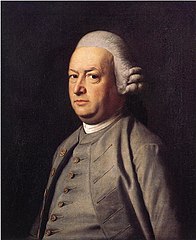
Thomas Cushing, having been replaced as a Massachusetts delegate to the Continental Congress in favor of Elbridge Gerry, was back home in Massachusetts as a member of the Council.

On 4 Apr 1776, less than a month after the British military evacuated Boston, Cushing wrote to Hancock:
Some time before you wrote to me concerning Your Brother [Ebenezer Hancock], I had not been unmindful of him, I saw him at Watertown & he told me he should like to be Employed if possible in that town in writing for the Council or House, as he should in that Care be near his family & could often Visit them, I accordingly made Enquiry after some Employ of this Sort for him & sspoke to divers Members of the Council & it appeared to me that there would soon be an opening for him –

a few days ago I saw him at Boston and told him what you hard wrote me concerning him & what prospect I thought there was of his being Employed, he told me he was oblidged to me, but it would not suit him & tarry at Watertown now as the Town of Boston was again retured to its Inhabitants, that he had found all his goods & merchandize were safe and in good Condition, that he determined to return to Boston & that he apprehended that the most profitable Business he could at present Employ himself about was in attending to the Sale of his Goods, in which I think he judged wisely. I give you joy that his Goods are Safe
John eventually got Ebenezer the job of a deputy paymaster of the Continental Army. As a result, Ebenezer sometimes had huge sums of silver money from France under guard in his Boston home.

Ebenezer Hancock’s house in downtown Boston is now on the market. It’s being promoted as John Hancock’s house because the older brother owned it, but he’d inherited a lot of property in Boston. Ebenezer, who had received a smaller bequest from their uncle, ran into business reverses and went bankrupt in 1769. According to W. T. Baxter’s article on Ebenezer’s bankruptcy, John helped him out with “rent-free premises.”

Eventually, Baxter noted, the property flowed the other way. Gov. Hancock died intestate, so Ebenezer inherited a third of his fortune, including the stone mansion on Beacon Hill.

Sunday, March 09, 2025

“Choosing a Commander” at the Longfellow–Washington Site, 13 Mar.

On Thursday, 13 March, I’ll speak at Longfellow House–Washington’s Headquarters National Historic Site on “Choosing a Commander: Myths & Realities Behind the Continental Congress’s Decision to Make George Washington the General.”

Two hundred fifty years ago this spring, the Massachusetts Provincial Congress invited the Continental Congress in Philadelphia to take over the direction (and funding) of the army besieging Boston. A big part of that direction was choosing who would command those troops.

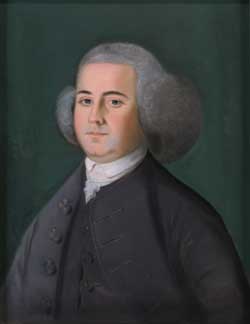
Decades later, John Adams left detailed accounts of those discussions. He described himself as the man who advocated for George Washington of Virginia when no one else would.

According to letters Adams wrote in 1815 (and possibly in 1816 but never sent), most Congress delegates preferred either leaving the army in the hands of Gen. Artemas Ward of Massachusetts or hiring former British army lieutenant colonel Charles Lee.

Adams stated:
The Nominations were made, Ward I believe by Mr [Thomas] Cushing, Lee by Mr [Thomas] Mifflin, and Washington by Mr [Thomas] Johnson of Maryland. The opposition to a change was not So warm, as it had been before, but Still each Candidate had his Advocates.

Nevertheless all agreed in the great importance of Unanimity. This point was urged from all quarters of the House with great force of Reason and Eloquence and Pathos that never has been exceeded in the Counsells of this Nation. It was unanimously agreed to postpone in Election to a future day in hopes that Gentlemen by a deliberate Consideration, laying aside all private feelings, local Attachments, and partial motives, might agree in one, and unanimously determine to Support him with all their Influence. The Choice was accordingly postponed.

By this time all the Friends of Ward, among whom there was not one more Sincere than John Adams who had known him at School within two doors of his Fathers house, and who had known him in Worcester in his riper Years, were fully convinced that Washington Should be preferred to Lee; and they had reason to fear that Delegates from the Southern and Middle States would vote for Lee rather than for any New Englandman. And all the Sober Members would have preferred Either Ward or Washington to Lee.

When the day of Election arrived, after some Observations on the necessity of Concord, Harmony and unanimity in the present portentous moment, Congress proceeded to the Choice and the Suffrages were all found to be for George Washington.
In this talk I’ll explore how much the contemporaneous record from 1775, including Adams’s own private letters, supports this recollection.

This event is scheduled to start at 6:00 P.M., and will include questions and answers afterward. It is free, but seating in the Longfellow carriage house is limited. There’s an option to watch the livestream, and a recording will be put on the site’s YouTube channel when ready.

Thursday, December 12, 2024

“You found the money and Sam Adams the brains”

For the first years of the Revolutionary War, Massachusetts continued to operate on the basis of its provincial charter.

The General Court was elected each year, starting in the summer of 1775, when it took over from the Provincial Congress. Its members chose a Council.

That Council exercised executive power, as the charter had specified for times when the royally-appointed governor and lieutenant governor were absent from the province. Which they were, for obvious reasons.

It took years, and two tries, before the towns of Massachusetts ratified a new constitution in 1780. That provided for a governor again—to be elected by the people rather than appointed.

On 19 October, the Rev. William Gordon of Roxbury wrote to John Adams, then on a diplomatic mission in Europe, about that choice:
Mr. [John] Hancock will be governour, unless Death should prevent it. I was employed by a Boston representative under the rose, to plead with Mr. [James] Bowdoin that pro bono publico [for the good of the public] he would condescend to serve as Lt. Govr.: I urged that plea, and encourage the expectation from his not declaring off, that, if the Genl. Ct. are pritty well agreed, he will not decline. He will be a good poize, and prevent undue influence and eccentric motions.

Some time back several persons dined together with the above mentioned, the conversation turned upon old matters, a country booby of a representative said, “ay I remember we used to say that you found the money and Sam Adams the brains.” A pause commenced for some minutes before the conversation was renewed. The poor mortal, upon being afterwards spoken to upon the impropriety of his remark, apologized by pleading, it was the truth and he thought there could be no hurt in speaking it.
This was during a rift between Hancock and Samuel Adams, with Gordon on Adams’s side and relishing anecdotes that made Hancock look foolish.

Hancock did indeed become governor less than a week later, but his lieutenant governor was Thomas Cushing. Bowdoin was the next elected governor, serving two difficult terms before losing to Hancock, who had decided he was healthy again. Eventually Samuel Adams became lieutenant governor under Hancock, and then succeeded him in 1793.

Thursday, November 21, 2024

“A Tragi-comic Farce, Called the present Times!”

Page 7 of the 8 May 1770 issue of Anthony Henry’s Nova Scotia Chronicle was nearly entirely taken up with what looks like an extraordinarily detailed advertisement for a play.

It began:
Just ready for the PRESS,
A Tragi-comic Farce,

Called the present Times! Some of the Characters in high Life, some in low. It is proposed to be acted by a Set of Comedians shortly expected; at a new Theatre in the enchanted Castle, at the Palace of the Sons of Liberty. Those who subscribe for Six Copies, will have the Seventh gratis; each stitched and bound, with a Variety of elegant Cuts, done by a masterly Hand! As there are already 5000 subscribed for, those who hereafter may be desirous to be out of that Number are requested to direct their Letters, (Post paid) to Don Joseph Azevedo at the Pontac Coffee House, HALIFAX, where Subscriptions are taken in.
The one mention of this newspaper item that I’ve found in books appears to treat it as authentic evidence of theater in Canada. But its real nature is revealed by the paragraphs that follow.
The Characters chiefly attempted are as follows.

William the Knave, introducing the Spinning Wheels, &c., &c. with a Bill of Taxation in his Hand (in order to support Home Manufactures) of Six Pence L[egal] M[oney] per Head on the whole P[rovince] of M[assachusetts] B[a]y; a great Procurer of Affidavits.

Thomas Trifle, Esq; Leading a drunking Man with a Glass of New-England Rum in his Hand, as a Cordial Specifick against all Disorders, lately chosen a great Officer for Indian Affairs.

Simple John, Lieut. Mandarin, demanding Audience of the Heads of the Junto, exclaiming against his Brother Commissioners of the Tribute Money to be collected—Treating the Rabble with good Chear in Hopes of reigning once more alone.
Back in October 1769 the Boston printer and bookstore owner John Mein had printed “Outlines of the characters of…the Well-Disposed” in his Boston Chronicle, lampooning leaders of the non-importation movement in highly personal terms.

That article used “William the Knave” as its label for William Molineux, an insult repeated in the 12 Feb 1770 Boston Chronicle. “Spinning Wheels” and public money “to support Home Manufactures” were allusions to Molineux’s publicly-funded scheme to employ women to make cloth in Boston. The merchant had also been busy helping to promulgate the depositions about the Boston Massacre.

The same “Outlines” article called Thomas Cushing, chairman of the merchants’ committee for non-importation and speaker of the Massachusetts House, “Tommy Trifle, Esq.”

“Simple John” must mean John Temple, the one Customs Commissioner to side with Boston’s merchants against the rest.

One of the few characters presented in a positive light was “John Plain Dealer, a Bookseller flying the Country.” A later entry mentions “Lieut. Col. Thomas Shears, his Valour is well known by his formal Attack on John Plain Dealer…”

Soon after that “Outlines” article appeared, a group of Boston merchants threatened Mein in the street. When the printer pulled out a pistol, Thomas Marshall, a tailor and militia officer not involved in the initial confrontation, swung at him with a shovel. Mein went into hiding and soon fled Boston.

“John Plain Dealer” obviously meant John Mein himself, and “Lieut. Col. Thomas Shears” meant Thomas Marshall.

This whole page in the Nova-Scotia Chronicle was a continuation of an argument that had started in Boston more than half a year before.

TOMORROW: More characters.

Wednesday, September 18, 2024

The Triumph of the Suffolk Resolves

Aside from rhetoric, the Suffolk County resolutions of 9 Sept 1774 differ from the Middlesex County resolutions of 31 August in some significant ways.

The Suffolk convention included the Quebec Act among its complaints:
the late act of parliament for establishing the Roman Catholic religion and the French laws in that extensive country, now called Canada, is dangerous in an extreme degree to the Protestant religion and to the civil rights and liberties of all America.
In Philadelphia Samuel Adams was taking steps to dispel his image as a religious zealot, but it was still quite acceptable to be anti-Catholic. Indeed, fighting “popery” was an element of British patriotism.

New grievances arose in just the few days between the two conventions. The Suffolk Resolves complained about how “it has been recommended to take away all commissions from the officers of the militia”—a suggestion from William Brattle that became public on 1 September. Also about “the fortifications begun and now carrying on upon Boston Neck”—Gen. Thomas Gage’s response to the militia mobilization on 2 September.

The Middlesex convention urged people not to cooperate with the court system under the Massachusetts Government Act. The Suffolk convention went further to endorse non-consumption of goods from Britain, as the Solemn League and Covenant promoted:
That until our rights are fully restored to us, we will, to the utmost of our power, and we recommend the same to the other counties, to withhold all commercial intercourse with Great-Britain, Ireland, and the West-Indies, and abstain from the consumption of British merchandise and manufactures, and especially of East-Indies, and piece goods, with such additions, alterations, and exceptions only, as the General Congress of the colonies may agree to.
Probably the most important difference between the Suffolk Resolves and the output of all the other Massachusetts county conventions, before and after, was the connection with that “General Congress,” or First Continental Congress.

The Massachusetts delegates to the Congress presented the Middlesex Resolves to the Congress on 14 September. The Congress’s bare-bones record says simply that they “were read.”

Dr. Joseph Warren, the man who drafted the Suffolk resolutions, had Paul Revere carry a copy to the Massachusetts delegates in Philadelphia. Revere left Boston on 11 September and arrived on the 16th, also bringing more solid news about the state of the province after the “Powder Alarm.”

On 17 September, the Congress heard the Suffolk Resolves and then unanimously voted to endorse them. Rumors of British military action had alarmed delegates the week before. They could have criticized the Massachusetts Patriots for overreacting and heightening the tension further. But instead in this resolution they praised the province’s “firm and temperate conduct.”

The Congress had the entire text of the Suffolk Resolves and the Suffolk convention’s message to Gov. Gage entered into its records, and had secretary Charles Thomson send the text to the Pennsylvania Packet to the reprinted.

John Adams called the 17th “one of the happiest Days of my Life.” Thomas Cushing wrote home to Dr. Warren:
They highly applaud the wise, temperate and spirited Conduct of our People. . . . These Resolves will, we trust, support and comfort our Friends, and confound our Enemies.
Warren in turn had that letter printed in the 26 September Boston Gazette. The message was clear: This Congress was adopting Massachusetts’s cause.

Sunday, July 14, 2024

“Universally come into a solemn league”

By the end of May 1774, Boston had held several sessions of a town meeting about how to respond to the Boston Port Bill.

On the afternoon of 13 May, the meeting had resolved, with no dissent, that some sort of continent-wide boycott was the solution to the crisis.

Over the next couple of sessions, the meeting kept asking for its committee to recommend a specific plan. Thomas Cushing kept replying that the committee didn’t yet have a report. Then the town would ask the committee to “sit again”—i.e., get to work.

On 30 May, the town meeting spelled out what it wanted by voting:
That the Committee appointed to receive Proposals & consider of Ways & Means, be desired to prepare a Paper, to be carried to each Family in the Town, the Report of which to be, not to purchase any Articles of British Manufactures, that can be obtained among Ourselves, & that they will purchase Nothing of, but totally desert those who shall Counter-work the Salutary Measures of the Town.

Voted, That the Comittee of Correspondence be & hereby are directed, to comunicate the Non Consumption Agreement aforesaid to the other Towns in the Province.
The meeting also said that the next session would be on 17 June. The committee shouldn’t expect any more guidance until then.

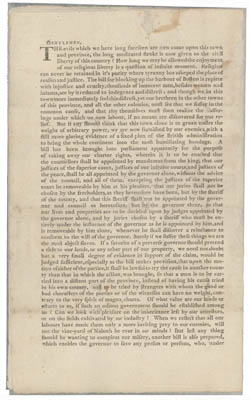
The committee of correspondence acted on 8 June. Town clerk William Cooper sent out a two-page printed letter to rural towns that began:
GENTLEMEN,

THE evils which we have long foreseen are now come upon this town and province, the long meditated stroke is now given to the civil liberty of this country? How long we may be allowed the enjoyment of our religious liberty is a question of infinite moment. . . .
How the committee got from trade restrictions to “our religious liberty” isn’t at all clear, but they definitely played on New England’s religious sentiment and tradition.

Boston’s letter said the people of Massachusetts should “universally come into a solemn league, not to import goods from Great Britain, and not to buy any goods that shall hereafter be imported from thence.” That phrase “solemn league” echoed the name of an agreement from 1643, early in the English Civil War. The actual agreement the committee sent included another word from that original, “covenant.” As a result, this boycott agreement came to be known as the Solemn League and Covenant, usurping that label from the earlier document.

On the day Cooper sent his circular letter, Cushing, Samuel Adams, and other elected politicians were in Salem for a session of the Massachusetts General Court. Perhaps Cushing’s caution and Adams’s savvy might have moderated the committee’s call for a boycott, or at least toned down the language. Or perhaps those leaders had signed off on the drafts before going to Salem.

In any event, some people thought the committee had gone too far.

TOMORROW: Complaints in and out of town.

Tuesday, July 02, 2024

“On the Conduct of the Comittee of Correspondence”

On Monday, 27 June 1774, the political argument over Boston’s committee of correspondence came to a head.

Merchants and friends of the royal government felt that the committee was wielding too much power, dragging the entire community into a costly and treasonous confrontation with the Crown.

Parliament’s Boston Port Bill was stifling every Bostonian’s livelihood, but that problem could go away at the (admittedly significant) cost of £9,660.

The committee’s Solemn League and Covenant boycott was going further than any non-importation measure so far, not only proscribing more goods from Britain and making people pledge not to do any business with people who did import goods. Was that going too far for the country folk?

The Boston Whigs, who had established the standing committee of correspondence back in November 1772, stuck to their position that for the people to make any retreat or compromise would be giving up their British constitutional rights.

The Boston town meeting resumed in Faneuil Hall at 10:00 A.M. His work with the Massachusetts General Court in Salem done (since the Massachusetts General Court in Salem was done), Samuel Adams was once again in the chair.

A motion passed that the meeting should review all the letters the committee of correspondence had written to other towns and colonies about the Port Bill.

But then came another motion: “that this Meeting be adjourned to the Old South Meeting House, the Hall not being sufficient to contain all the Inhabitants assembled.”

The committee chosen to go to Old South and ask if the town could use that space consisted of William Molineux, town clerk William Cooper, and Dr. Benjamin Church, Jr.—all radical Whigs. That alone signaled that their party had the votes to control the meeting. But what if more people came for one side or the other?

In Old South, the meeting reaffirmed its earlier vote to review the correspondence. Cooper began to read the letters aloud. After a while the crowd became bored, and they amended their earlier vote to cover only the Solemn League and Covenant, the letter sent out with that proposal, and “any other Letters that may be particularly called for.”

Eventually someone moved “that some Censure be now passed By the Town on the Conduct of the Comittee of Correspondence; and that said Committee be annihilated.” That would be a total repudiation of the committee and its work.

Adams stated that “he had the Honor of being a Member” of that committee, so someone else should moderate that discussion. By stepping away from the podium for a while, Adams not only made a point of being scrupulously fair but also allowed himself to speak, since the moderator usually didn’t express opinions on motions.

As the temporary chair, the meeting chose Thomas Cushing—merchant, speaker of the House, and another member of the Boston Whigs (though in the moderate set). Again, that showed how that group was in control of this body.

Nonetheless, the debate went on until dark, and still the opponents of the committee said “they had farther to offer.” The meeting voted to adjourn until the next morning at 10:00 A.M.

TOMORROW: The speakers and the vote.

Saturday, June 29, 2024

“Their Orders were to keep the Door fast”

On Friday, 17 June 1774, inside the Salem courthouse, the Massachusetts assembly discussed sending five men to what would become the First Continental Congress.

According to the official tally, there were 129 members present. That was only about half the number of representatives that towns had elected in May, but the royal governor’s order to move the legislator to Salem had probably cut attendance. (And truth be told, the Massachusetts House rarely saw full attendance anyway.)

Of those 129 representatives, only twelve voted against the proposal. While some of the rest may have abstained, that number suggests that the Loyalist party commanded only a tenth of the chamber. Though there were lots of political arguments in Massachusetts during these tears, there were few close votes.

Nonetheless, Gov. Thomas Gage had a power stronger than democracy. Under the charter of 1692, he could simply declare the legislative session over, halting all bills.

As soon as he learned what was happening in the House, Gage sent the provincial secretary, Thomas Flucker (shown above), to Salem with just such an order.

The 20 June Boston Gazette reported:
His Excellency the Governor having directed the Secretary to acquaint the two Houses it was his Excellency’s pleasure the General Assembly should be dissolved and to declare the same dissolved accordingly; the Secretary went to the Court House and finding the Door of the Representatives Chamber locked, directed the Messenger to go in, and acquaint the Speaker [Thomas Cushing] that the Secretary had a message from his Excellency to the Hon. House, and desired he might be admitted to deliver it;

The Messenger soon returned, and said he had acquainted the Speaker therewith, who mentioned it to the House, and their Orders were to keep the Door fast:
According to John Sanderson’s profile of Samuel Adams, published about half a century later:
The door keeper seemed uneasy at his charge, and wavering with regard to the performance of the duty assigned to him. At this critical juncture, Mr. Adams relieved him, by taking the key and keeping it himself.
Flucker proceeded with his royal duty, as the newspaper reported:
Whereupon, the following proclamation was published on the stairs leading to the Representatives Chamber, in presence of a Number of Members of the House, and immediately after in Council.
To be clear, the Rev. William Gordon wrote that the secretary “read the proclamation upon the steps leading to the representatives’ chamber.” It’s unclear whether this was before or after the assembly’s vote, but the legislators didn’t acknowledge the governor’s proclamation until Adams opened the doors.

The Massachusetts General Court was officially dissolved. Yet the assembly had officially passed the resolutions sending delegates to the congress and seeking money to pay for that trip. That packet of resolutions was quickly sent to the newspapers, which printed it before Gov. Gage’s proclamation.

TOMORROW: Meanwhile, in Faneuil Hall…

Wednesday, June 26, 2024

“Keep the committee in play, and I will go and make a caucus”

In addition to Robert Treat Paine’s recollection quoted here, the Rev. William Gordon’s early history of the American Revolution offers another peek at the delicate political maneuverings in Salem in June 1774.

Gordon wrote:
Mr. Samuel Adams observed, that some of the committee were for mild measures, which he judged no way suited to the present emergency. He conferred with Mr. [James] Warren of Plymouth upon the necessity of giving into spirited measures, and then said, “Do you keep the committee in play, and I will go and make a caucus against the evening; and do you meet me.”

Mr. Samuel Adams secured a meeting of about five principal members of the house, at the time specified; and repeated his endeavours against the next night; and so as to the third, when they were more than thirty; the friends of administration knew nothing of the matter. The popular leaders took the sense of the members in a private way, and found that they should be able to carry their scheme by a sufficient majority.
Adams and his team came up with a two-step plan.

First, the Massachusetts House would appoint delegates to a Continental Congress, an idea raised by the Providence town meeting, the Virginia House of Burgesses, and other political allies outside of the colony. The House would also alert all its counterparts of that step and urge them to participate as well.

But then there was the age-old question of how to pay for this. Sending five gentlemen to Philadelphia would cost upwards of £500. Any legislative action involving money, even if it passed the Council, could be vetoed by Gov. Thomas Gage.

The solution was to write a bill authorizing that expenditure of £500 and then adding this clause:
Wherefore this House would recommend, and they do accordingly hereby recommend to the several Towns and Districts within this Province, that each Town and District, raise, collect and pay, to the Honorable THOMAS CUSHING, Esq; of Boston, the Sum of FIVE HUNDRED POUNDS by the Fifteenth Day of August next, agreeable to a List herewith exhibited, being each Town and District’s proportion of said Sum, according to the last Province Tax, to enable them to discharge the important Trust to which they are appointed; they upon their Return to be accountable for the same.
Adams’s unofficial caucus managed to formulate that plan without official committee member Daniel Leonard or other Loyalists catching on.

The next problem was how to pass those resolutions through the House. As Paine wrote:
it was Considered that the regular Method was for the Committee on the State of the Province to make report of these doings as their Report; eight of that Committee were then present, but the ninth [Leonard] was known to be adverse to any Such measure & therefore could not be trusted, least the whole should be defeated by the Governor;…
If Gov. Gage learned about the measures that the House was discussing, he could use his constitutional authority to shut down the legislature entirely.

TOMORROW: The Bristol feint.

Saturday, June 22, 2024

The Sestercentennial of Salem as the Seat of Government

Gov. Thomas Hutchinson prorogued the Massachusetts General Court on 8 Mar 1774, stating:
I have passed over without notice the groundless, unkind, and illiberal charges and insinuations made by each of the other branches against the Governor…
So those insinuations didn’t bother him, not at all.

Two months later, Gen. Thomas Gage arrived as the new governor, and the legislature didn’t have Thomas Hutchinson to kick around anymore.

A newly elected General Court convened in Boston on 25 May. By the end of the day, the legislatures had elected twenty-eight gentlemen to sit on the new Council.

The next morning, Gov. Gage vetoed thirteen of those men. So things were off to a smooth start.

The House started to address the petitions, bills, and other business before it. On Saturday, 28 May, the governor sent a message that he was adjourning the legislature, and the term would start up again on 7 June in the courthouse at Salem (shown above).

That action was part of the British government’s policy of isolating and punishing Boston until the town repaid the cost of the tea destroyed the previous December. Gage acted on instructions from London. Deciding when and where the legislature would meet had long been a Massachusetts governor’s power.

Naturally, the House’s first business when it reconvened was to complain about having to be in Salem. Its resolution argued that since Gage had acted “unnecessarily, or merely in Obedience to an Instruction, and without exercising that Judgment and Discretion of his own,” he wasn’t properly exercising the governor’s prerogative.

A day after that, the House members responded to Gage’s speech opening the session with more complaints about being in Salem.

Late on the morning of 9 June, the House made itself “a Committee to consider the State of the Province” after the Boston Port Bill. After some private and unrecorded debate, the lawmakers appointed a committee to recommend responses to that situation. Its members were:
(Some sources say the “Col. Tyng” appointed to this committee was William Tyng of Falmouth, but he had served in the previous General Court and the House journal referred to him as “Mr. Tyng.” The only Tyng in this session was John Tyng of Dunstable, and the Rev. Dr. Samuel Cooper’s diary confirms his title of colonel.)

That committee thus included three of Boston’s four representatives to the General Court. The remaining member was John Hancock, who’s not mentioned in the record of the Salem session, suggesting he wasn’t even there.

Paine later wrote that eight of those men “were considered as firm in the Opposition to British measures.” The exception?
by the mixture of nominations from both parties in the House the Name of Daniel Leonard was so repeated, that the Speaker found himself Obliged to nominate him & he was chosen.
TOMORROW: Who was Daniel Leonard?

Monday, February 26, 2024

“This House will impeach Peter Oliver, Esq;”

John Adams’s memoir, as quoted yesterday, offers his recollection of how he informed the Massachusetts assembly about the possibility of impeaching Chief Justice Peter Oliver—a rare practice, at least in Massachusetts.

The memoir doesn’t state when that happened, only that it occurred after Adams’s exchange of newspaper essays with William Brattle in early 1773.

We can say, however, when the assembly seized on the impeachment remedy. The 1773–74 legislative year started on 26 May, and on 28 June, the second-to-last day of its first session, the house resolved:
That it is the incumbent Duty of the Judges of the Superior Court without Delay, explicitly to Declare, whether they are Determined to Receive the Grants of the General Assembly of this Province, or to Accept of their Support from the Crown;…And in such Case [of delay] it will be the indispensible Duty of the Commons of this Province, to Impeach them before the Governor and Council, as Men disqualified to hold the important Posts they now sustain.
The house thus laid out its plan for the coming months. But that game plan still took a long time to play out.

The house reconvened on 26 Jan 1774. By then the colony was anxiously waiting to see how Parliament and its ministers in London would respond to the Boston Tea Party. But there were still unfinished local business.

On 1 February, the house noted a letter from Justice Edmund Trowbridge saying he wouldn’t take any salary from the Crown. (On that same day the house dismissed John Malcolm’s petition for redress.) The next day, the body demanded answers from the other justices within six days. (It also approved a payment of £500 to Benjamin Franklin for his services, which included the infamous leak.)

In a reply dated 3 February and read to the house on Monday, 7 February, Chief Justice Oliver said he had accepted the royal salary since July 1772. And that he would continue to do so “lest I should incur a Censure from the best of Sovereigns,” which would be George III.

On 11 February, the house approved a remonstrance against Oliver, “praying that he may not be suffered any more to sit and act in his Office of Chief Justice.” There were nine votes against. Three days later, the full legislature agreed that the superior court should be adjourned for three days as this was worked out.

The next day, Gov. Thomas Hutchinson responded to the remonstrance, promising to send it to the royal government in London but refusing to interfere with that government’s choice to put Oliver on the bench and pay him.

The day after that, the house invited the Council to respond to this action. In the afternoon, it resolved that the whole house wait on Gov. Hutchinson and give him a petition seeking “the Removal of the Chief Justice.” Two days later, on 18 February, the house went into the Council chamber and speaker Thomas Cushing read this petition to the governor.

On Monday, 21 February, the house passed another resolve saying it would be “highly improper, and contrary to Usage and Precedent,” for Chief Justice Oliver to sit on the court while this dispute was ongoing.

The next day, Gov. Hutchinson summoned the house members to the Council chamber. He told them he “was obliged to decline” the request to remove Oliver, and that they had misrepresented parts of the provincial charter. In response, at the end of the session on 22 February, the house resolved “That this House will impeach Peter Oliver, Esq; Chief Justice of the Superior Court, of certain High Crimes and Misdemeanors.”

And finally on 24 February, the house did vote to impeach, with only eight nay votes. The was 250 years ago this week. The representatives chose a committee, headed by Samuel Adams, to “lay before the Governor and Council a Copy of the Articles of Impeachment.” 

Because impeachment in the lower house was only the start of the process. Based on the model of Parliament, the next step was for the upper house, the Council, to try the case. And, needless to say, Gov. Hutchinson was not ready to allow that.

TOMORROW: The governor’s move.

Friday, March 10, 2023

The Captain Who Hosted Gen. Washington in Boston

In looking for clues about the ship captain who told Gen. George Washington that the British military was preparing to leave in March 1776, I came across this line in an 18 March letter from Thomas Cushing to Robert Treat Paine:
A Detachment of our Troops have gone into Boston and this Day General Washington & his Suit dined with Captain Erving.
Was that the same captain as the Erving, Irvine, Irwin, Erwin, or Ervin who provided the general with useful information about two weeks before?

Did Washington choose to dine inside liberated Boston with the mariner who had first told him the British were preparing to leave?

It appears not.

Rather, the consensus is that Washington’s host was the Boston merchant captain and erstwhile Council member John Erving, Sr. However, as the editors of the R. T. Paine Papers commented:
John Erving (c. 1692–1786), a wealthy Boston merchant originally from the Orkneys, was an odd choice as Washington’s first dinner host. A member of the Council for some twenty years, Erving declined the offer of a seat on General [Thomas] Gage’s Mandamus Council, but his sons John and George accepted. All three of his surviving sons became Loyalists, and at least one of had just left Boston with the British troops.
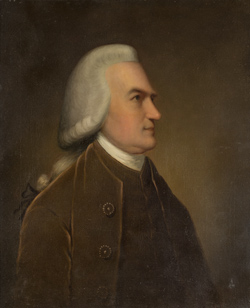
I think the answer to that minor mystery goes back to James Bowdoin (shown above), the same man whose anecdote about Gen. William Howe sent me looking for Washington’s late informants in the first place.

Bowdoin was a senior member of the Massachusetts Council who had met several times with Gen. Washington in the preceding months. On good days he was the senior figure in the Massachusetts government. And John Erving, Sr., was his father-in-law.

Bowdoin couldn’t host Washington at his own house since he didn’t know what shape it was in after British occupation. But old Capt. Erving had stayed in Boston through the siege and could still host a genteel dinner.

True, most Erving men had shown themselves to be Loyalist, but perhaps that was all the more reason to reward a well-connected patriarch who had decided to remain in town as the British left.

Sunday, June 06, 2021

“I told Cushing as Ruggles told Tyler”

Yesterday I quoted a long anecdote that John Adams wrote out in 1789 about a discussion between two Massachusetts politicians seventeen years earlier.

The specifics of Adams’s anecdotes aren’t always reliable when he was trying to make a point about politics or personalities or, in this case, both.

Adams dated that exchange to 1772. At that time one of the men he quoted, Timothy Ruggles, no longer had a seat in the Massachusetts General Court. He lived in Hardwick, in western Worcester County. The Boston merchant John Rowe recorded several encounters with Ruggles in the late 1760s but none in the early 1770s, suggesting he didn’t routinely visit the coast. So how likely was Ruggles to be socializing with Royall Tyler and other Boston Whigs in 1772?

As it turns out, however, Adams also left us solid evidence that he had heard (or heard about) that exchange between Ruggles and Tyler by the end of 1772.

On 1 Jan 1773, Adams recorded this event in his diary:
This Evening my Friend Mr. [Samuel] Pemberton invited me and I went with him, to spend the Evening with Jere. Wheelwright. Mr. Wheelwright is a Gentleman of a liberal Education about 50 Years of Age, and constantly confined to his Chamber by Lameness. A Fortune of about two hundred a Year enables him to entertain his few Friends very handsomely, and he has them regularly at his Chamber every Tuesday and Fryday Evening.
Wheelwright (1717-1784) was a wealthy heir who graduated from Harvard College in 1736. On receiving his master’s degree three years later, he delivered a speech against slavery, its effect diluted by being in Latin. After that he enjoyed a long life of wealthy obscurity, keeping out of religious and political controversies. Among Wheelwright’s properties were “the Hills at New-Boston,” which we now call the crest of the Beacon Hill neighborhood, and settlements in New Hampshire and Maine.

In Sibley’s Harvard Graduates, Clifford K. Shipton wrote:
About 1770 one of Wheelwright’s legs was so badly broken by the upsetting of his riding chair that he was confined to his chamber for the rest of his life. Having an income of about £200 a year, he moved into comfortable quarters in Newton from which, during his remaining years, he surveyed the world with intelligent curiosity.
Wheelwright kept notes on current events in his almanac diaries for more than forty-five years. Only one folder’s worth of that work survives at the Massachusetts Historical Society. He never married or had children.

Back to Adams’s diary entry, which describes a New Year’s visit to Wheelwright’s house. (Shipton identified “Mr. Swift” as John Swift, Harvard 1733; Adams doesn’t mention that man in his papers while Samuel Swift was a good friend and a link between him and Wheelwright, so I put Samuel Swift in this party.) Adams wrote:
The Speaker [Thomas Cushing], Dr. [Joseph] Warren and Mr. [Samuel] Swift were there— And We Six had a very pleasant Evening. Our Conversation turned upon the Distress of Rhode Island [during the Gaspee investigation], upon the Judges Dependency [salary grants from the tea tax], the late numerous Town Meetings, upon [William] Brattles Publication in [Richard] Drapers Paper [the Boston News-Letter] of Yesterday, and upon each others Characters. We were very free, especially upon one another.

I told Cushing as Ruggles told Tyler, that I never knew a Pendulum swing so clear.

Warren told me, that Pemberton said I was the proudest and cunningest Fellow, he ever knew.

We all rallied Pemberton, upon the late Appointment of Tommy Hutchinson [the governor’s son] to be a Judge of the common Bench, and pretended to insist upon it that he was disappointed, and had lost all his late Trimming, and Lukewarmness and Toryism.

Warren thought I was rather a cautious Man, but that he could not say I ever trimmed. When I spoke at all I always spoke my Sentiments. This was a little soothing to my proud Heart, no doubt.
Thus, by the time of this gathering Adams definitely knew that Ruggles got off a good line about Tyler and was happy to borrow it to tease Cushing. Perhaps the original conversation happened earlier than 1772, and perhaps it didn’t really start with Dr. Thomas Young, but it happened.

Now I can’t imagine anything more antsy for John Adams than waiting for his colleagues to tease him and having to chuckle about it.

Sunday, October 04, 2020

Arthur Lee “in the light of a rival”

Yesterday I quoted two letters from Samuel Adams in 1771, the first recommending William Story to a lobbyist in London and the second warning the same man that Story might be conspiring with Gov. Thomas Hutchinson.

One might think that on receiving those two letters, Arthur Lee (shown here) would have passed on that warning to his fellow agent for Massachusetts interests, Benjamin Franklin. But that’s not how Lee operated.

Back in April 1770, the London merchant Dennis DeBerdt had died, opening up the job of representing the lower house of the Massachusetts General Court to British officials and lawmakers.

(Lord Hillsborough, the Secretary of State, soon took the position that there was no such job, that the legal agent for Massachusetts in London had to be approved by the Council and governor as well. Nevertheless, the house persisted in employing its own lobbyist.)

House speaker Thomas Cushing and most of the other, more moderate Whigs wanted to make Benjamin Franklin the body’s agent. He had represented colonial governments in London for many years, amassing a long list of clients. He thus already knew everyone in London and was the most famous, respected native of Massachusetts in the British Empire. Franklin was trying to present himself as the voice of all the American colonists, and having an official mandate from one of the larger and more oppositional provinces would strengthen that claim.

However, Franklin wasn’t always in tune with the Whigs back in America. He had misjudged how angry the Stamp Act would make people. He had told Parliament that colonists objected only to “internal taxes” and not tariffs, which shaped the design of the Townshend Acts. Franklin was also growing old—in his mid-sixties—and his attention was divided among many colonies.

For those reasons, Samuel Adams, James Otis, Jr., and some other radicals in the house preferred Arthur Lee—younger, more aggressive, firmly opposed to tariffs, and more recently in America. The result in November 1770 was a compromise, with Franklin the official representative but Lee, as the house told Franklin, ”their Agent in case of your Death or Absence from Great Britain.”

Did that make Franklin and Lee colleagues? Not to the younger man. In his letter to Adams on 10 June 1771, Lee accused Franklin of betrayal and explicitly described their relationship as a rivalry:
I have read lately in your papers an assurance from Dr. Franklin that all designs against the charter of the colony are laid aside. This is just what I expected from him; and if it be true, the Dr. is not the dupe but the instrument of Lord Hillsborough’s treachery. . . .

I feel it not a little disagreeable to speak my sentiments of Dr. Franklin, as your generous confidence has placed me in the light of a rival to him. But I am so far from being influenced by selfish motives, that were the service of the colony ten times greater, I would perform it for nothing rather than you and America, at a time like this, should be betrayed by a man, who, it is hardly in the nature of things to suppose, can be faithful to his trust.
Thus, when Lee received Adams’s letter expressing doubt about William Story, he apparently said nothing about it to Franklin. He just let the older man shepherd Story around to royal officials and waited for another opportunity to undermine him.

COMING UP: William Story in London and later.

Saturday, October 03, 2020

Samuel Adams’s Two Character References for William Story

When William Story was preparing to sail to London in late 1771, Thomas Cushing wasn’t the only Massachusetts Whig he asked for a letter of reference.

Story also asked Samuel Adams, clerk of the Massachusetts house, to write on his behalf. On 27 September, Adams obliged with a postscript on his regular letter to Arthur Lee, the house’s alternate agent in Britain:
P.S.—The Bearer hereof is William Story Esqr. formerly of this town, but now of Ipswich a Town about 30 Miles East. He was Deputy Register in the Court of Vice Admiralty before & at the time of the Stamp Act & would then have given up the Place as he declared but his Friends advisd him against it—he sufferd the Resentment of the people on the 26 of August 1765, together with Lt. Govr. [Thomas] Hutchinson & others for which he was recompencd by the Genl. Assembly, as he declares in part only.

He tells me that his Design in going home is to settle an Affair of his own relating to the Admiralty Court, in which the Commissioners of the Customs as he says declare it is out of their power to do him Justice. One would think it was never in their Power or Inclination to do any many Justice. Mr. Story has always professd himself a Friend to Liberty for many years past.

I tell him that I make no doubt but you will befriend him as far as shall be in your power in obtaining Justice, in which you will very much oblige,
Samuel Adams
Five days later, however, Adams had second thoughts. That was the same day that Cushing wrote his letter about Story to Benjamin Franklin, quoted yesterday. But Adams had heard something which made him no longer trust Story.

In a second letter to Lee, dated 2 October, Adams said:
I have already written to you by this conveyance, and there mentioned to you Mr. Story, a gentleman to whose care I committed that letter. I have since heard that he has a letter to Lord Hillsborough [the Secretary of State for the colonies] from Gov. Hutchinson, which may possibly recommend him for some place by way of compensation for his joint sufferings with the governor. I do not think it possible for any man to receive his lordship’s favour, without purchasing it by having done or promising to do some kind of jobs.

If Mr. Story should form connexions with administration upon any principles inconsistent with those of a friend to liberty, he will then appear to be a different character from that which I recommended to your friendship. I mention this for your caution, and in confidence.
By this point, Adams viewed any cooperation with Gov. Hutchinson as a sign that a man couldn’t be trusted.

Story probably felt himself well positioned for his meetings in London. He had Gov. Hutchinson’s letter to the Earl of Hillsborough as well as another to Sir Francis Bernard, former governor. But he also had Cushing’s and Adams’s letters to Franklin and Lee on the Whig side. He didn’t realize that his ship carried another letter from Adams canceling out the first.

COMING UP: How’d that work out for him?